7 Best Digital Nomad Visas for Remote Workers in 2026
Discover the 7 best digital nomad visas for 2026. This guide covers eligibility, costs, and pros/cons for top destinations in Europe and the Americas.
The dream of working from anywhere is no longer a fantasy-it’s a structured, legal reality thanks to the explosion of digital nomad visas. As more countries compete to attract global talent, navigating the maze of requirements, income thresholds, and application processes can be daunting. This guide cuts through the noise. We provide a clear, actionable roundup of the best digital nomad visas available today, focusing on what truly matters: your eligibility, the costs involved, and which program best fits your specific professional profile.
Whether you're a salaried employee, a freelance creative, or a tech entrepreneur, this list will help you pinpoint the perfect destination to launch your next chapter. Forget generic advice. Each entry delivers a focused summary covering duration, income requirements, application timelines, and crucial tax implications. You'll find a clear pros and cons list and a profile of the "ideal nomad" for that visa, helping you make a decision based on your personal and professional goals.
This resource is designed for quick, practical use. We've included direct links for every visa program to get your application started. To simplify your journey even further, we'll show you how to use YayRemote’s comprehensive Digital Nomad Visa hub, a powerful tool designed to match your profile with the ideal program instantly. Consider this your definitive starting point for finding the right legal pathway to a global, remote career. We've done the research so you can focus on packing your bags.
1. Digital Nomad Visas — Complete Guide to Remote Work Visas Worldwide | YayRemote
Finding the right visa is often the most significant hurdle in planning a life of remote work abroad. Sifting through dozens of official government websites, each with its own structure and language, can be a discouraging task. The Digital Nomad Visas Guide from YayRemote addresses this problem head-on by consolidating information for over 60 remote work visa programs into a single, user-friendly hub. This makes it an essential starting point for anyone serious about finding the best digital nomad visas available today.
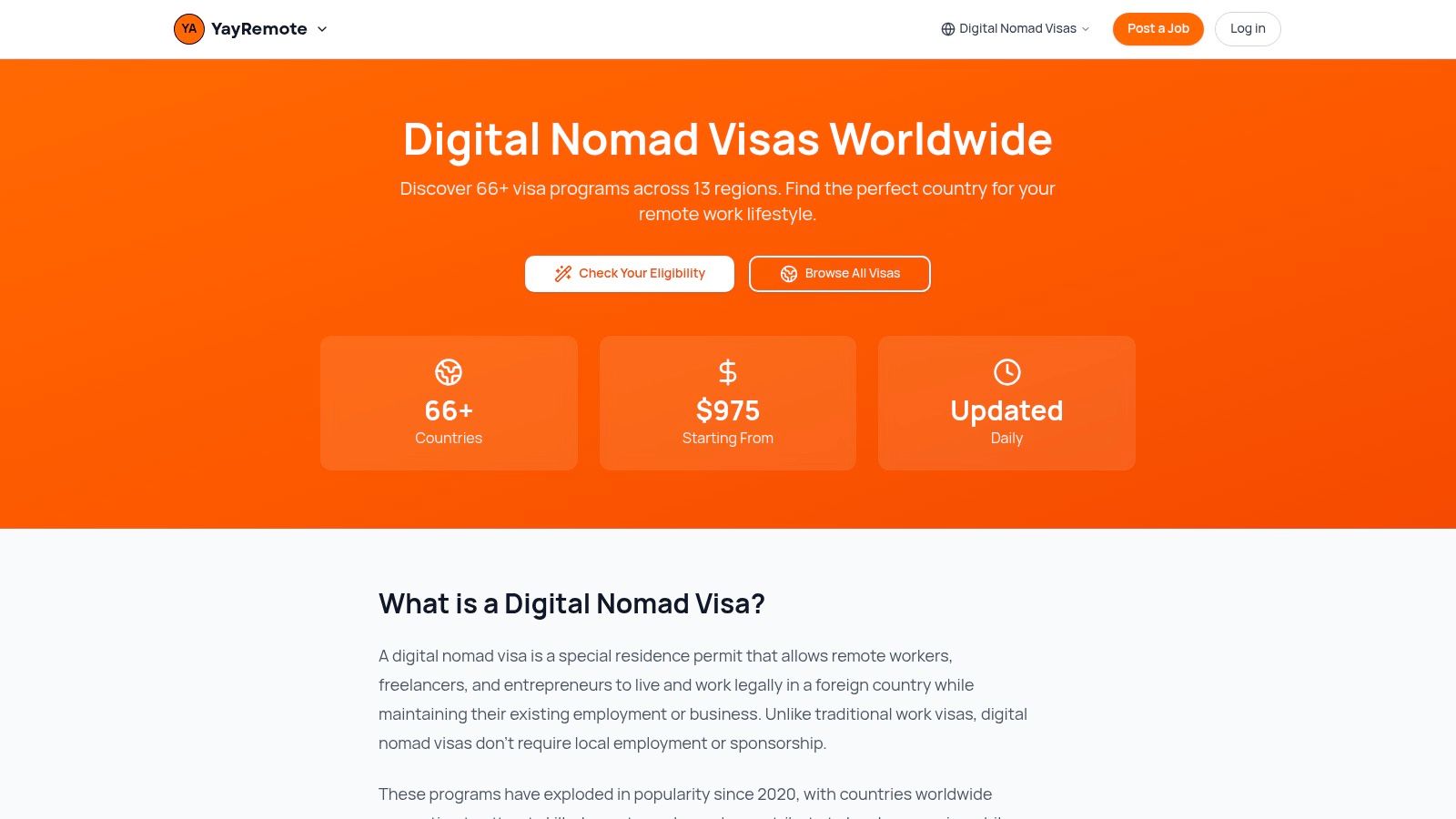
What sets this resource apart is its practical design. Instead of just linking out to other sites, YayRemote aggregates the most critical data points into a clean, comparable format. This allows you to quickly assess key requirements side-by-side, saving hours of manual research.
Core Strengths and Standout Features
The platform’s power lies in its ability to turn a complex research process into a structured, actionable plan. It moves beyond a simple list and provides tools that help you make informed decisions based on your personal circumstances.
- Centralized Information Hub: The guide aggregates 60+ visa programs from Europe, Asia, the Americas, and beyond. This wide-ranging collection ensures you can compare established options like Germany's Aufenthaltserlaubnis für Freiberufler with newer programs from countries like Colombia or Malaysia, all in one place.
- At-a-Glance Comparison Tables: Each visa is presented with standardized fields for minimum income, application fees, visa duration, and renewal options. This format is perfect for quick shortlisting, helping you identify which countries are realistically within your reach without reading pages of legal text.
- Personalized Eligibility Wizard: This is arguably the platform's most valuable feature. By inputting your nationality, monthly income, and family status, the wizard filters the entire database to show only the visas you likely qualify for. For example, a US citizen earning $4,000 per month can instantly see that they meet the thresholds for Spain and Croatia but may need a higher income for others, immediately focusing their research.
- Integrated Ecosystem: The visa guide is directly connected to the broader YayRemote platform. After identifying a promising visa, you can pivot to searching for remote jobs, use the ATS Resume Checker to optimize your application, or calculate time zone overlaps with your team. This creates a seamless workflow from research to application.
Practical Tips for Effective Use
To get the most out of the YayRemote guide, start with the Eligibility Wizard. This will give you a realistic baseline and prevent you from spending time on destinations with requirements you can't meet. Once you have a shortlist, use the comparison tables to dig deeper into the specifics of each program.
Remember that while the guide is frequently updated, visa regulations can change overnight. Always use the provided links to the official government portals to verify fees, processing times, and required documentation before starting an application.
Key Insight: The true value of the YayRemote guide isn't just the data it collects, but how it organizes that data for action. By pairing visa requirements with a personalized wizard and job-seeking tools, it bridges the gap between dreaming of a nomad lifestyle and making it a reality.
Pros and Cons
| Strengths (Pros) | Weaknesses (Cons) |
|---|---|
| Comprehensive Coverage: Gathers 60+ visa programs, saving immense research time. | Not a Legal Substitute: Information is for guidance; always consult official consular sources for final details. |
| Personalization Wizard: Filters options based on your income and nationality for a tailored shortlist. | Potential Lag on New Visas: Niche or very new programs might not appear immediately after they are announced. |
| Quick Comparisons: Standardized data fields allow for fast, easy evaluation of multiple visa options. | |
| Integrated Toolset: Connects visa research directly with remote job boards and application-enhancing tools. |
Ultimately, for anyone starting their journey, the YayRemote guide is one of the most effective resources for navigating the complex world of remote work visas. After shortlisting potential countries, you can explore our detailed analysis of the best countries for digital nomads to learn more about lifestyle, cost of living, and community.
Access the YayRemote Digital Nomad Visa Guide
2. Portugal — D8 “Digital Nomad” Visa
Portugal’s D8 visa has quickly become a favorite within the remote work community, earning its spot as one of the best digital nomad visas available. It provides a clear legal pathway for non-EU/EEA/Swiss citizens to reside in Portugal while working for foreign entities. The visa is praised for its flexibility, offering two distinct options to suit different long-term plans.
The application process starts at a Portuguese consulate or an authorized visa application center like VFS Global in your home country or country of legal residence. This is where you'll submit your initial application and documentation.
Visa Pathways and Requirements
Portugal's framework is notable for offering two tracks under the D8 umbrella:
- Temporary Stay Visa: This option is ideal for those wanting a shorter experience, permitting a stay of up to one year. It's a multiple-entry visa, allowing for travel in and out of Portugal.
- Residence Visa (for obtaining a Residence Permit): This is the more popular route. It grants a four-month, double-entry visa to enter Portugal. Once there, you must attend an appointment with the Agency for Integration, Migration and Asylum (AIMA) to convert it into a residence permit, which is typically valid for two years and renewable.
The primary eligibility requirement is proof of stable income from remote work, whether as a freelancer or a remote employee. The income threshold is set at four times the Portuguese national minimum wage. For 2024, this amounts to €3,360 per month. Applicants must show bank statements and contracts to prove this income.
Application and Key Considerations
The process requires meticulous paperwork. While VFS Global provides general checklists, the specific documents required can vary slightly between consulates. Always verify the list with the specific consulate handling your application.
Pro Tip: Secure your NIF (Portuguese tax number) and open a Portuguese bank account before your visa appointment. Many services can help with this remotely, and having these ready demonstrates a strong commitment to relocating, which can strengthen your application.
| Feature | Details |
|---|---|
| Visa Type | Temporary Stay Visa (up to 1 year) or Residence Visa (leading to a 2-year residence permit). |
| Income Requirement | ~€3,360/month (4x Portuguese minimum wage, subject to annual change). Additional funds required for dependents. |
| Primary Application | At a designated Portuguese Consulate or VFS center in your country of residence. |
| Cost | Varies by consulate, but expect visa fees around €75-€90, plus service fees for VFS and costs for document legalization and translation. |
| Ideal For | Freelancers, remote employees, and entrepreneurs seeking an EU base with a path to residency. For those exploring their career fit, check out the best digital nomad jobs. |
| Tax Note | You become a tax resident if you stay over 183 days in a year. Portugal offers a favorable Non-Habitual Resident (NHR) tax regime, though its terms have recently changed. |
Pros:
- A dedicated visa specifically for remote workers.
- The residence permit track offers a clear path to long-term EU residency and potential citizenship.
- Access to the Schengen Area for easy travel.
Cons:
- Bureaucratic delays are common, both for initial consular appointments and the in-country AIMA appointment.
- The income requirement is strictly enforced and can be a high bar for some.
Check Eligibility & Apply via VFS Global
3. Spain — International Telework (Digital Nomad) Visa/Residence (Ley 14/2013)
Spain’s International Telework visa, introduced under the Startups Act, has firmly established the country as a top destination for remote professionals. It provides a formal legal framework for non-EU/EEA/Swiss citizens to live in Spain while working for companies or clients located entirely outside of Spain, making it one of the best digital nomad visas for those dreaming of a Mediterranean lifestyle.
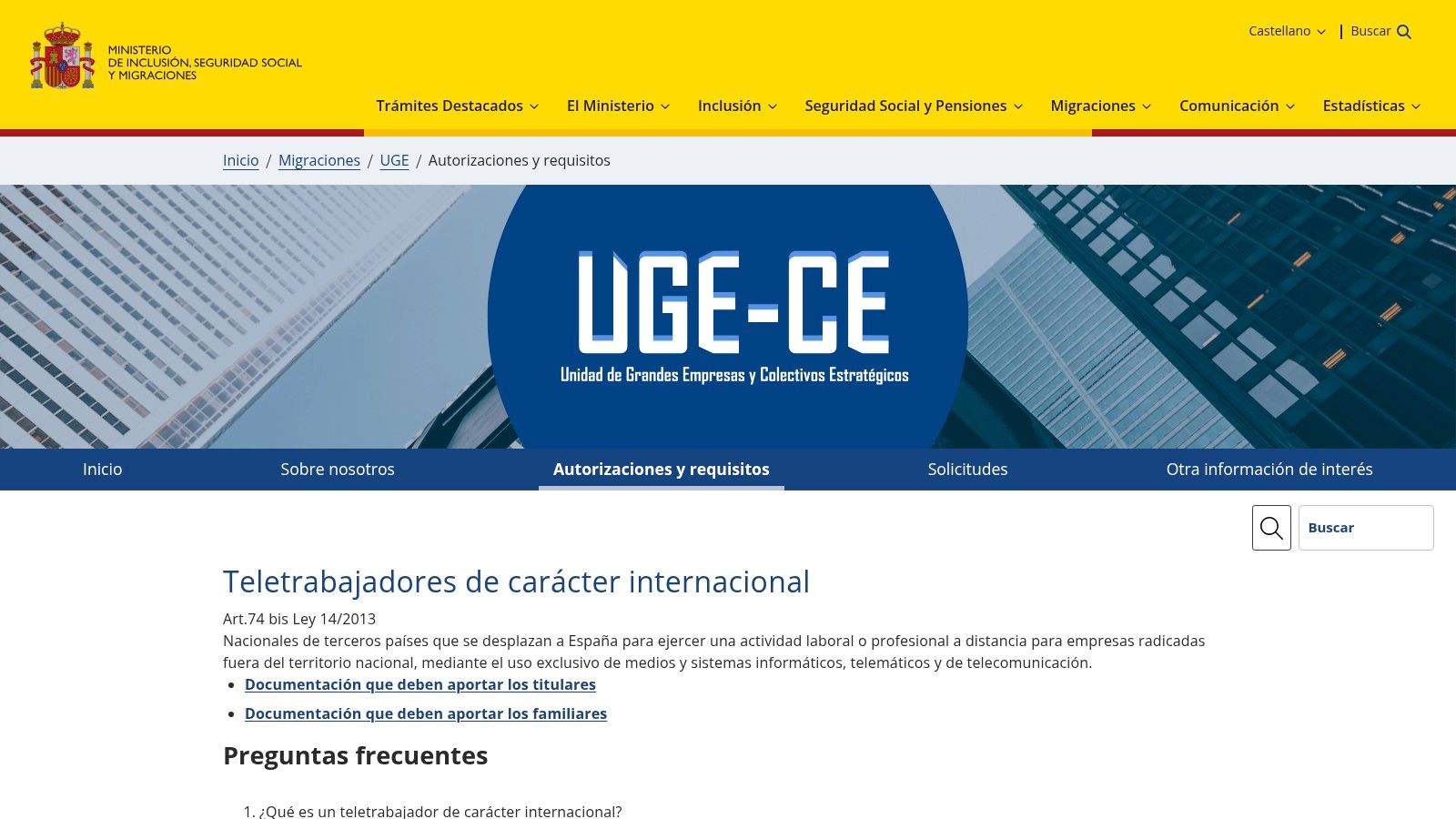
The framework is particularly appealing because it offers distinct application routes depending on an applicant's location, adding a layer of flexibility that many other programs lack. You can apply from your home country or, in a key differentiator, apply from within Spain if you are already there legally.
Visa Pathways and Requirements
Spain provides two main pathways for digital nomads, both governed by the Large Business and Strategic Groups Unit (UGE-CE):
- Visa from a Spanish Consulate: This is the standard route for those outside Spain. You apply at a Spanish consulate in your country of residence for a visa that is typically valid for up to one year. This visa also functions as your initial residence permit.
- Residence Authorization from within Spain: This option is for individuals already legally in Spain (e.g., as a tourist or student). You can apply directly through the UGE-CE portal for a residence authorization, which is granted for up to three years and is renewable.
Key eligibility criteria include proof of professional qualifications, either a university degree or at least three years of relevant professional experience. Applicants must also demonstrate a stable income from remote work for foreign entities. The income requirement is set at 200% of Spain’s national minimum wage (SMI), which is approximately €2,646 per month for 2024. This amount increases for dependent family members.
Application and Key Considerations
The application process is document-intensive, requiring apostilled and translated documents. A critical step is addressing social security coverage. Applicants must either register with Spain's social security system or provide a certificate of coverage from their home country if a bilateral agreement exists.
Pro Tip: The in-country application is a major advantage. If you plan this route, ensure you have all your apostilled and translated documents ready before you travel to Spain. This will give you a head start on the 90-day tourist visa clock and allow you to submit your application quickly and efficiently through the UGE-CE portal.
| Feature | Details |
|---|---|
| Visa Type | Consulate Visa (up to 1 year) or in-Spain Residence Authorization (up to 3 years, renewable). |
| Income Requirement | ~€2,646/month (200% of Spain’s SMI, subject to annual change). Additional funds are required for dependents. |
| Primary Application | At a designated Spanish Consulate in your country of residence or directly via the UGE-CE portal if legally in Spain. |
| Cost | Varies by consulate and nationality, but visa fees are generally around €80. The in-country authorization fee is approximately €75. Budget for translation, apostille, and legal assistance costs. |
| Ideal For | Qualified professionals and freelancers who value the flexibility of an in-country application. It's great for those looking to explore some of the best cities for digital nomads before committing to a long-term stay. |
| Tax Note | A special tax regime is available, allowing digital nomads to pay a flat 24% tax rate on Spanish-sourced income up to €600,000 for their first six years, provided certain conditions are met. |
Pros:
- Offers the ability to apply while legally in Spain, a rare and significant benefit.
- The initial residence authorization can be for up to three years, longer than many other programs.
- Family members can be included on the same application.
Cons:
- The documentation, especially for social security, can be complex and varies between consulates.
- Processing times can be inconsistent, with both consular and UGE-CE applications experiencing delays.
Check Eligibility & Apply via UGE-CE
4. Italy — Digital Nomad / Remote Worker Visa
Long awaited by remote workers dreaming of la dolce vita, Italy's digital nomad visa finally became a reality in April 2024. This new pathway allows "highly qualified" non-EU citizens to live and work in Italy for up to one year, with the possibility of renewal, while serving foreign clients or employers. It establishes a clear legal route, moving beyond the ambiguity that previously forced remote workers into other visa categories.
The application begins at an Italian consulate in your country of residence, where you'll apply for a Type D national visa. Once you arrive in Italy with this visa, you have eight days to apply for the corresponding residence permit (permesso di soggiorno per nomade digitale e lavoratore da remoto).
Visa Pathways and Requirements
The visa is structured as a single pathway for "highly qualified" professionals. The term is defined by Italian law as those who have completed a higher education qualification (like a university degree) or can prove professional qualifications from at least six months of relevant work experience.
Key eligibility criteria include:
- High Qualification: Proof of a university degree or demonstration of sufficient professional experience.
- Income: An annual income of at least three times the minimum level required for exemption from healthcare participation costs. This currently stands at approximately €28,000 per year.
- Health Insurance: Comprehensive health coverage valid in Italy for the entire duration of your stay.
- Accommodation: Proof of suitable accommodation in Italy.
- Clean Record: No criminal convictions in the past five years.
Family members can also apply as dependents, though they are subject to additional requirements.
Application and Key Considerations
The process is still very new, and consulates are actively interpreting the interministerial decree that established the rules. Required documents are substantial and will likely include employment contracts, client agreements, bank statements, educational certificates, and proof of professional standing. Document legalization (apostille) and certified translations are often necessary.
Pro Tip: Begin gathering and translating your professional and educational documents well in advance. Since the "highly qualified" standard is a key part of the application, having robust, well-organized proof can make a significant difference. Check your specific consulate's website frequently for updates to their checklist.
| Feature | Details |
|---|---|
| Visa Type | Type D National Visa (for entry), converted to a one-year residence permit (permesso di soggiorno) in Italy. The permit is renewable. |
| Income Requirement | ~€28,000/year (subject to annual updates). Additional funds required for dependents. |
| Primary Application | At a designated Italian Consulate in your country of residence. |
| Cost | The visa fee is €116. Expect additional costs for document legalization, translation services, and the in-country residence permit application. |
| Ideal For | Experienced remote employees and freelancers in skilled professions who can meet the "highly qualified" standard and want to immerse themselves in Italian culture. |
| Tax Note | You become a tax resident if you stay over 183 days a year. A partita IVA (VAT number) may be required. New tax incentives for inbound workers are available. |
Pros:
- A dedicated, official category for remote workers, ending previous legal uncertainty.
- Available to both self-employed and employed remote workers.
- Grants access to the Schengen Area for travel.
Cons:
- The "highly qualified" standard can be subjective and requires extensive documentation.
- As a new visa, processing times and specific consular requirements may be inconsistent.
- Long appointment wait times are common at busy consulates.
View the Official Decree (Italian)
5. Estonia — Digital Nomad Visa (DNV)
Estonia solidified its reputation as a pioneer in digital governance by being one of the first countries to launch an official visa for remote workers. Its Digital Nomad Visa (DNV) is a clear, well-structured program that allows non-EU/EEA/Swiss citizens to reside in Estonia for up to a year while working for a foreign employer or their own foreign-registered company. This visa is a top contender among the best digital nomad visas for its efficiency and access to one of Europe's most advanced digital societies.

The application process is known for its clarity. Applicants can apply for a short-stay (C-visa) or long-stay (D-visa) at an Estonian embassy or consulate abroad. The country’s mature digital infrastructure and widespread English proficiency make the transition smooth for incoming nomads.
Visa Pathways and Requirements
Estonia’s program is designed for a medium-term stay, with two visa types depending on the intended duration:
- Short-stay (Type C): This visa is for stays up to 90 days within a 180-day period. It's suitable for those looking for a shorter, exploratory trip.
- Long-stay (Type D): The more common choice for digital nomads, this visa grants a stay of up to 365 days. It's the primary route for those planning to settle in for a full year.
The main eligibility criterion is a high income threshold, set to ensure applicants are self-sufficient. You must prove a gross monthly income of at least €4,500, demonstrated through bank statements and work contracts from the six months preceding your application. Comprehensive health insurance valid in Estonia is also mandatory.
Application and Key Considerations
The process is managed through Estonian foreign missions, and you'll typically need to book an in-person appointment to submit biometrics and documents. The required paperwork is standard but must be organized meticulously.
Pro Tip: Estonia’s e-Residency program is separate from the Digital Nomad Visa, but they can be complementary. While e-Residency doesn't grant physical residency, it allows you to establish and manage an EU-based company online, which can be a great way to structure your freelance or business income for the DNV application.
| Feature | Details |
|---|---|
| Visa Type | Short-stay C-visa (up to 90 days) or Long-stay D-visa (up to 365 days). |
| Income Requirement | €4,500/month (gross). This is one of the highest in the EU and is strictly verified. |
| Primary Application | At a designated Estonian Embassy or Consulate in your country of residence. |
| Cost | €100 for a D-visa, plus potential costs for document preparation. |
| Ideal For | Tech professionals, entrepreneurs, and high-earning freelancers who value digital efficiency, a strong startup scene, and a modern, English-friendly environment. |
| Tax Note | Becoming a tax resident after staying 183 days is likely. Estonia has a unique corporate tax system where undistributed profits are not taxed, which could be beneficial for business owners. |
Pros:
- A very clear and one of the first established programs specifically for nomads.
- Excellent digital public services (e-Estonia) and a thriving tech ecosystem.
- High level of English proficiency across the country.
Cons:
- The €4,500 monthly income requirement is a significant barrier for many.
- The visa is limited to one year and does not offer a direct path to permanent residency.
Check Eligibility & Apply via Estonian Ministry of Foreign Affairs
6. Croatia — Temporary Stay for Digital Nomads
Croatia’s temporary stay for digital nomads offers a purpose-built permit for third-country nationals wanting to live on the stunning Adriatic coast while working remotely. This status is specifically designed for individuals employed by or owning a business registered outside of Croatia, making it a clear and direct option for remote professionals. The streamlined application, which can be initiated online, positions it as one of the best digital nomad visas for those prioritizing convenience.
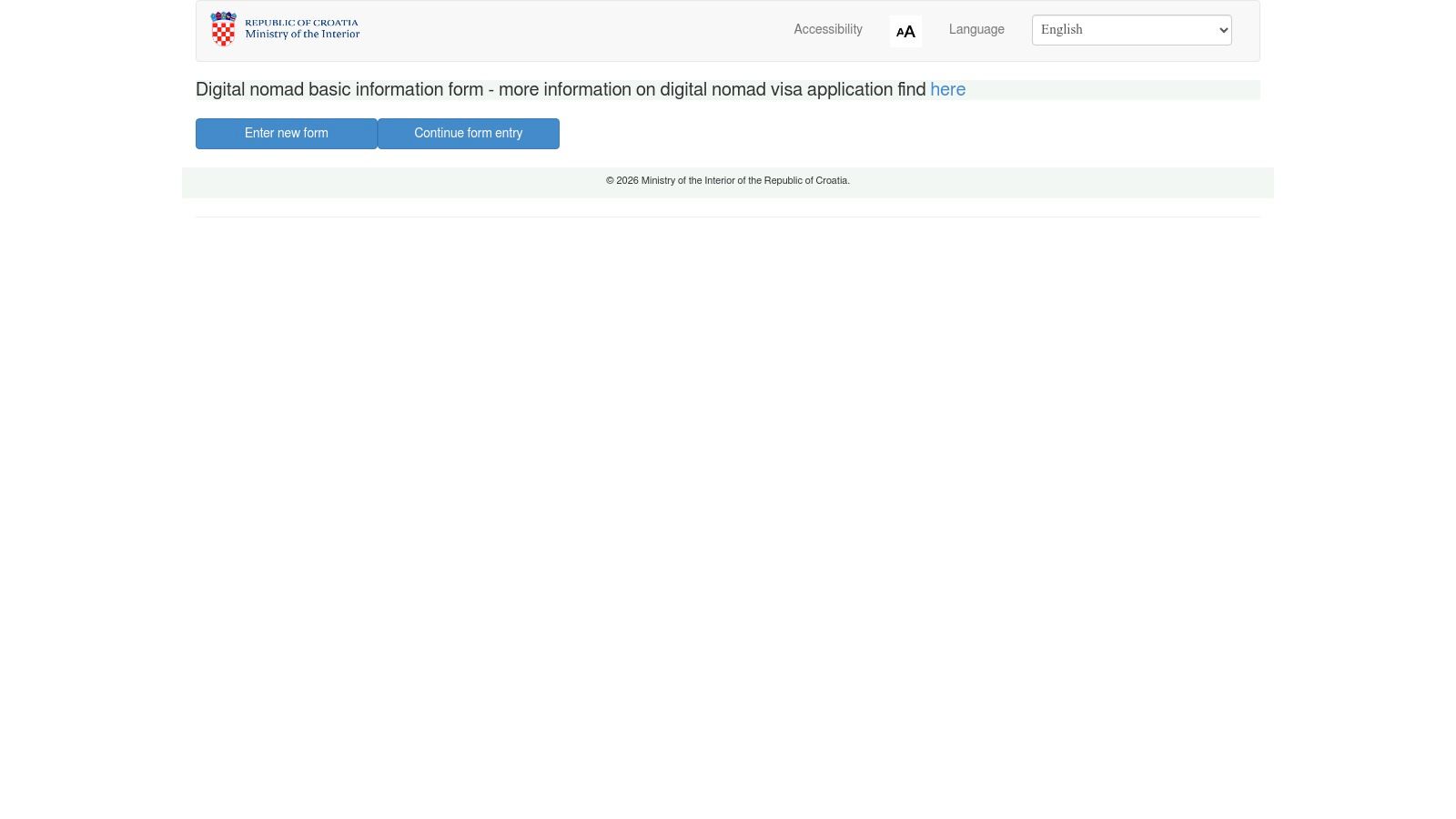
The primary application can be submitted through the official Ministry of the Interior (MUP) online portal, a Croatian consulate abroad, or, if you are already in Croatia legally, at a local police administration office.
Visa Pathways and Requirements
Unlike visas that lead to residency, Croatia's permit is a temporary stay status valid for up to one year. It cannot be immediately renewed; you must leave Croatia for at least six months before you can reapply. This makes it ideal for a "sabbatical" year or a shorter-term European base rather than a long-term relocation strategy.
Key eligibility criteria include:
- Proof of Remote Work: You must provide contracts or other documents showing you work for a foreign company or own your own non-Croatian business. You are explicitly prohibited from working for or providing services to Croatian entities.
- Sufficient Means: Applicants need to prove they have sufficient funds. The requirement is at least 2.5 times the national average net salary. For 2024, this is approximately €2,870 per month or a lump sum of €34,440 for a 12-month stay.
Application and Key Considerations
The official online portal simplifies the initial steps, but be prepared for regional variations. The specific documents and processing times can differ depending on the local police administration you deal with upon arrival. Essential documents typically include a background check, health insurance that covers you in Croatia, and proof of accommodation.
Pro Tip: While the online application is a great first step, the process is finalized in person at a local police station in Croatia. Research the specific requirements for the city you plan to live in, as some offices may have slightly different expectations for document translations or proof of funds.
| Feature | Details |
|---|---|
| Visa Type | Temporary Stay Permit for up to one year. It is not renewable and does not lead to permanent residency. |
| Income Requirement | ~€2,870/month or a lump sum of €34,440 for the year. This is based on 2.5x the average net salary and is subject to change. |
| Primary Application | Online via the MUP digital nomad portal, at a Croatian consulate, or at a local police administration in Croatia if you can enter visa-free. |
| Cost | Varies. Expect fees for the application, the biometric residence card (~€45), and administrative stamps, plus costs for document translation and notarization. |
| Ideal For | Freelancers and remote employees seeking a year-long stay in an EU country without long-term commitment. For those building a remote career, see our guide on how to become a digital nomad. |
| Tax Note | A key advantage: digital nomads with this status are generally exempt from paying personal income tax in Croatia on their foreign-sourced income for the duration of their stay. |
Pros:
- A dedicated and straightforward online application portal.
- No Croatian income tax on foreign earnings under this specific permit.
- Family members can join the main applicant.
Cons:
- Strictly a temporary stay; it is not a pathway to permanent residency or citizenship.
- Inconsistencies in processing and requirements between different local police stations can cause confusion.
Apply Online via the Official MUP Portal
7. Costa Rica — Estancia para Trabajador/Prestador Remoto de Servicios (Digital Nomad Subcategory)
Costa Rica’s "Pura Vida" lifestyle is now more accessible than ever for remote professionals, thanks to its dedicated digital nomad subcategory. This visa offers a straightforward legal path for foreigners to live and work remotely from one of the world's most biodiverse countries. It’s an excellent option for those looking for a mix of adventure, nature, and a reliable work environment, making it a strong contender for one of the best digital nomad visas in the Americas.
The program is designed for individuals earning foreign-sourced income and is celebrated for its clear requirements and benefits tailored to remote work. The application can be initiated online through the government's Trámite Ya platform, a major convenience that simplifies the initial steps.
Visa Pathways and Requirements
The Costa Rican visa provides a special stay permit (Estancia) specifically for remote workers and their dependents. Unlike many other visas, it’s not a path to permanent residency but a long-term stay permit designed for the nomadic lifestyle.
- Initial Stay Permit: Grants a one-year stay in the country. It is intended for individuals who can prove they work remotely for a foreign company or as a freelancer for clients outside Costa Rica.
- Renewal: The permit can be renewed for an additional year. To qualify for renewal, applicants must demonstrate they have resided in Costa Rica for at least 180 days during their first year and have maintained the required income.
The key eligibility factor is a stable monthly income. The threshold is set in U.S. dollars, which helps avoid confusion with currency fluctuations. An individual must prove an income of at least $3,000 per month. If applying with dependents (spouse, children), the combined income must be at least $4,000 per month.
Application and Key Considerations
The process is managed through the Dirección General de Migración y Extranjería (DGME). Applicants can submit documents via the Trámite Ya online portal, though an in-person appointment will eventually be required. All foreign documents must be properly apostilled or legalized and translated into Spanish.
Pro Tip: Secure your private medical insurance well in advance. Costa Rica requires proof of a policy covering the full duration of your stay with a minimum coverage of $50,000. Having this document ready is critical, as it is one of the main requirements checked during the application.
| Feature | Details |
|---|---|
| Visa Type | Special Stay Permit (Estancia) valid for one year, renewable for a second year. |
| Income Requirement | $3,000/month for a single applicant or $4,000/month for a family. Proof of stable, foreign-sourced income is required. |
| Primary Application | Online via the Trámite Ya platform or in-person at DGME offices in Costa Rica. |
| Cost | Government fees are around $250-$300, but costs increase with document legalization, translations, and insurance. |
| Ideal For | U.S.-based remote workers seeking time-zone alignment, nature lovers, and anyone wanting to join established expat communities in San José or Guanacaste. |
| Tax Note | Visa holders are fully exempt from local income tax on their foreign earnings. They also benefit from a one-time exemption on customs duties for work equipment. |
Pros:
- A clear, online application process with income requirements stated in USD.
- Complete exemption from local income tax on remote work earnings.
- Time-zone proximity to the U.S. and a welcoming expat community.
Cons:
- The visa does not grant the right to work for Costa Rican companies.
- Requires private medical insurance for the entire stay, which can be a significant upfront cost.
Check Official Requirements & Apply
7-Country Digital Nomad Visa Comparison
| Item | Implementation Complexity 🔄 | Resource Requirements 💡 | Expected Outcomes 📊 ⭐ | Ideal Use Cases ⚡ | Key Advantages |
|---|---|---|---|---|---|
| Digital Nomad Visas — YayRemote (Guide) | Low 🔄 — web hub with eligibility wizard | Minimal 💡 — internet access, profile info | Quick shortlist & comparisons — 📊 ⭐⭐⭐ | Initial research and destination shortlisting ⚡ | Aggregates 60+ programs; integrated tools and job listings |
| Portugal — D8 “Digital Nomad” Visa | Moderate 🔄 — consulate process, possible in‑country follow‑up | Income ≈ €3,480–€3,680/mo, health insurance, background check 💡 | Temporary stay or route to residence — 📊 ⭐⭐⭐ | Schengen access and longer stays; family considerations ⚡ | Clear remote‑work category; path to residence permit |
| Spain — International Telework Visa/Residence | Moderate‑high 🔄 — formal docs, social‑security paperwork | Degree or 3+ yrs experience, income tied to minimum wage, insurance 💡 | Up to 1 yr visa or multi‑year residence via in‑country switch — 📊 ⭐⭐⭐ | Families or applicants already legally in Spain ⚡ | Family reunification; in‑country switch option |
| Italy — Digital Nomad / Remote Worker Visa | High 🔄 — “highly qualified” proof, document legalization | Proof of high qualification, sufficient income, insurance, clean record 💡 | Up to 1 yr (renewable) + apply for permesso di soggiorno — 📊 ⭐⭐ | Highly skilled remote workers seeking Italy base ⚡ | Dedicated category across consulates; clear legal framework |
| Estonia — Digital Nomad Visa (DNV) | Low‑moderate 🔄 — straightforward consular/online process | €4,500/mo gross, health insurance 💡 | 12‑month stay; strong e‑services but limited long‑term track — 📊 ⭐⭐ | Tech/startup workers valuing digital public services ⚡ | Mature program, excellent e‑services and English‑friendly |
| Croatia — Temporary Stay for Digital Nomads | Low‑moderate 🔄 — online MUP portal or consulate route | Proof of means, accommodation, insurance, background check 💡 | Temporary stay only; no direct path to permanent residence — 📊 ⭐⭐ | Short‑term remote work and family accompaniment ⚡ | Purpose‑built category with official online application |
| Costa Rica — Digital Nomad Subcategory | Moderate 🔄 — Trámite Ya / DGME process, renewal checks | $3,000/mo individual ($4,000 with dependents), private medical insurance 💡 | 1‑yr renewable stay; US‑friendly timezone and connectivity — 📊 ⭐⭐⭐ | US‑based remote workers seeking Latin America base ⚡ | Clear USD thresholds, equipment duty exemption, established nomad communities |
From Shortlist to Takeoff: Your Next Steps to Becoming a Global Remote Professional
You've explored the leading destinations for remote professionals, from Portugal's sunny coasts to Estonia's vibrant tech scene. This list of the best digital nomad visas isn't just a collection of places; it's a launchpad for your next chapter. Each visa we've detailed offers a legal framework for a life of freedom and professional growth, but the real work starts now: turning your dream destination into a tangible reality.
The path from reading this article to receiving your visa stamp involves careful, strategic planning. The details matter immensely, from income thresholds and tax implications to application timelines and required documentation. A misstep in your paperwork can lead to costly delays or outright rejection, making preparation your most valuable asset.
Distilling Your Options: From Broad List to Personal Shortlist
Your first task is to narrow down the possibilities. Revisit the pros and cons of each visa, but this time, view them through the lens of your personal and professional circumstances. A high-income software engineer might prioritize Spain's favorable tax regime, while a freelance writer starting out may find Croatia's lower income requirement more accessible.
Consider these key questions to filter your choices:
- Financial Reality: Does your current income consistently meet the visa's minimum requirement? Remember to account for currency fluctuations.
- Long-Term Goals: Are you seeking a one-year adventure or a potential path to long-term residency and even citizenship? Visas in Portugal and Spain are structured for longer stays, while others are designed for temporary relocation.
- Professional Profile: Is your work status straightforward (e.g., a single remote employer) or more complex (e.g., multiple freelance clients, a self-owned business)? Some countries, like Estonia, are particularly welcoming to entrepreneurs.
- Lifestyle & Pace: Do you thrive in a bustling city, or do you prefer the quiet rhythm of a coastal town? Your personal well-being is a critical factor for a sustainable nomadic life.
Answering these honestly will help you eliminate options that aren't a practical fit, leaving you with a manageable shortlist of one to three top contenders.
Executing Your Plan: The Practical Path Forward
Once you have a target destination, your focus must shift to execution. This is where meticulous organization becomes non-negotiable. Don't underestimate the administrative lift required; gathering documents, securing translations, and scheduling appointments can take weeks or even months.
Here are your actionable next steps:
- Create a Master Checklist: Build a detailed checklist for your chosen visa. Go directly to the official government consulate or embassy website for the most accurate and up-to-date requirements. List every single document, from your passport and proof of income to health insurance and a clean criminal record check.
- Build Your Document Dossier: Start gathering your paperwork immediately. Some documents, like federal background checks, have long processing times. Begin with the items that will take the longest to acquire.
- Consult a Professional (If Needed): For complex situations, such as navigating the tax implications in Italy or structuring your business for the Spanish visa, investing in a consultation with an immigration lawyer or tax specialist can save you significant time and prevent critical errors.
Key Insight: The success of your digital nomad visa application often hinges on the quality and completeness of your documentation. Assume every detail will be scrutinized, and prepare your application with the precision of a project manager launching a major product. Your goal is to present an undeniable case that you meet every single requirement.
Choosing from the best digital nomad visas is an exciting first step, but the journey requires diligence. By moving from broad interest to focused action, you transform a vague aspiration into a concrete, achievable goal. The world is ready for your talent; now it's time to prepare your ticket.
Ready to find the perfect visa for your unique profile? The YayRemote Digital Nomad Visa Eligibility Wizard analyzes over 60 visa programs to give you a personalized shortlist in minutes, cutting through the noise. Take the free quiz at YayRemote to match your career and financial situation with your ideal destination.