Hiring Remote Developers: A Proven Playbook for Global Talent
Discover proven strategies for hiring remote developers, from sourcing to onboarding, leveraging a global talent pool.
Hiring remote developers isn't some niche strategy anymore; it's a core business advantage. The approach blows the doors off your local talent pool, giving you a direct line to world-class engineers no matter where they live—often at a more competitive cost. This is how modern tech companies build teams that are more skilled, diverse, and resilient.
Why Your Next Developer Hire Should Be Remote
Let's be honest, the old model of hiring developers is broken. Sticking to a 30-mile radius around your office means you're fighting tooth and nail with competitors for a tiny slice of the talent pie. The reality is, the perfect engineer for your team probably doesn't live down the street. By clinging to in-office-only roles, you're shutting yourself off from a global network of incredible professionals.

This isn't a passing fad. It's a permanent shift in the tech world, and it's being driven by what candidates want and what delivers real business results. The data couldn't be clearer: distributed teams are here to stay.
The Irreversible Shift to Remote Engineering Teams
The remote work revolution has completely reshaped how we hire developers. Think about it: back in 2020, remote jobs were just 4% of all openings in the U.S. Fast forward to 2026, and that number has exploded to over 15% of all job opportunities. In 2024 alone, new IT hiring bounced back to 963,000 positions, with roles for full-stack, back-end, and front-end developers accounting for more than half of all developer jobs.
This isn't a bubble; it's the new normal. For hiring managers, the message is urgent. If you're not building a remote-first culture, you're already falling behind in the battle for top talent.
The question is no longer if you should hire remote developers, but how quickly you can build the infrastructure to attract, hire, and retain them effectively. It's about fundamentally rethinking how you access world-class engineering talent.
Gaining a True Competitive Advantage
Hiring remotely is about more than just expanding your search. It’s a strategic decision that creates a ripple effect of positive changes throughout your organization. Companies that get this right consistently see major benefits.
- Improved Diversity and Inclusion: When you remove geography from the equation, you naturally build a team with a richer mix of backgrounds, perspectives, and problem-solving skills.
- Increased Employee Retention: Top developers crave flexibility. Offering it isn't just a perk; it's a powerful retention tool that shows you trust your team and respect their work-life balance.
- Enhanced Productivity: Give developers the right tools and an async-friendly culture, and they can find the deep focus needed for complex work, free from the constant interruptions of a traditional office.
Thankfully, the ecosystem for remote hiring has matured. Platforms like YayRemote are designed to make this transition feel effortless, from sourcing candidates across the globe to providing tools for managing time zones. By using these resources, you can turn your hiring process from a local search into a global talent strategy. To see this trend in action, it’s worth checking out which top companies are hiring remote workers.
Crafting a Job Post That Attracts Global Talent
If your job description reads like a generic corporate template, you're losing top candidates before they even hit "apply." When you're hiring remote developers, that job post isn't just a list of requirements; it's your first and most critical piece of marketing. It’s your chance to prove you actually get the remote-first mindset.

This means you have to go way beyond a dry list of tech skills. You need to sell your company culture, clearly define what "asynchronous work" means to you, and specify timezone needs without accidentally shutting out brilliant engineers from half the globe. A few simple shifts in your language can signal that you're a thoughtful remote organization, not just a company that stumbled into it.
Moving Beyond the Standard Skills List
Let’s be honest: the best remote developers aren't just looking for a paycheck. They want a company that respects their autonomy and expertise, and your job description has to reflect that trust from the very first sentence.
Instead of leading with a laundry list of demands, start with your mission. What problem is your team trying to solve? Why should a top-tier engineer get excited about dedicating their time and brainpower to your cause? Frame the role as a chance to make a real impact, not just fill a seat.
A job description is a conversation starter. The goal isn't just to filter people out; it's to draw the right people in. Focus on what a developer will get to build, learn, and achieve, not just on what you expect them to already know.
This approach immediately sets you apart from the countless companies using stale, office-centric language. It shows you value the person behind the code.
Communicating Your Remote Culture and Expectations
For a global audience, clarity is kindness. Any ambiguity about your remote setup will cause the best candidates to simply move on. You have to be explicit about how your team actually operates day-to-day.
- Asynchronous Communication: Mention the tools you rely on (like Slack or Notion) and your philosophy. Do you protect deep work and hate constant interruptions? Say so.
- Timezone Overlap: Be specific but flexible. Instead of a rigid "must be available during EST business hours," state the goal: "We aim for a 4-hour overlap with the core team for collaborative sessions." This small change respects different lifestyles and locations.
- Documentation Culture: Highlight that you actually write things down. Phrases like "we believe in a strong documentation culture" or "our wiki is our single source of truth" are huge green flags for experienced remote pros.
These details prove you’ve intentionally designed your remote environment for success. It shows you aren't just tolerating remote work—you're built for it. For companies ready to put these ideas into practice, you can easily post a remote job on platforms that attract this exact type of talent.
The difference between a job post that attracts local talent and one that excites global experts is stark. It's about shifting your entire focus from control and physical presence to trust and tangible outcomes.
Job Description Focus: Traditional vs. Remote-First
The table below breaks down the subtle but crucial differences in how you should frame your job description. It's a small change in words with a massive impact on who applies.
| Attribute | Traditional In-Office Focus | Effective Remote-First Focus |
|---|---|---|
| Culture | "Fast-paced, in-office environment," mentions of office perks like free snacks. | "A culture of trust and autonomy," "focus on deep work and asynchronous communication." |
| Responsibilities | A long list of tasks to be performed under direct supervision. | A description of problems to solve and outcomes to achieve. |
| Location | "Must be located in [City, State] or willing to relocate." | "Fully remote within +/- 3 hours of UTC" or "Global, with a 4-hour overlap with CET." |
| Requirements | Heavy emphasis on years of experience and specific tool certifications. | Balanced focus on core skills, communication abilities, and self-management. |
| Benefits | Highlights commuter benefits, gym memberships, and catered lunches. | Emphasizes flexible hours, home office stipend, and professional development budget. |
When you start using the language in that "Remote-First" column, you’re not just writing a better job description. You’re laying the foundation for a stronger, more capable global team from the very first hello.
Finding and Engaging World-Class Developers
Let's be honest: the best remote developers aren't scrolling through massive, generic job boards. If you want to connect with top-tier engineering talent, you have to meet them where they already are—in the communities they trust and on the platforms they respect.
Casting a wide, indiscriminate net is just a waste of time and energy. The real key is fishing in the right ponds with the right bait. This means building a smart, multi-channel sourcing strategy. A well-crafted job post is a great start, but it’s just that—a start. True success comes from a proactive approach that blends niche platforms, professional networks, and genuine community engagement.
Go Where the Talent Lives
Mainstream job sites can feel like shouting into the void. To find truly exceptional remote engineers, you need to focus your energy on platforms and communities built specifically for them.
Niche Remote Job Boards: Platforms like YayRemote are a goldmine. They curate roles from companies that are genuinely committed to remote work. The candidates you find here are already sold on the distributed model, which saves you from filtering through applicants who are just "remote-curious."
Developer Communities: Spend time where developers live and breathe code—places like GitHub, Stack Overflow, and Dev.to. Look for thoughtful contributors to open-source projects or engineers who provide incredibly helpful answers. This isn't about spamming them with job offers; it's about identifying real talent through their work and passion.
Professional Networks: You can still use platforms like LinkedIn, but you have to do it with a highly personalized approach. A generic "I have a job for you" message is a one-way ticket to being ignored. Reference a specific project they worked on or a skill they highlighted. Show you’ve actually done your homework.
This targeted strategy ensures you’re talking to developers who not only have the right technical chops but also the self-discipline and communication skills to thrive in a remote setting.
Build an Authentic Remote-First Employer Brand
Top remote engineers are evaluating you just as much as you're evaluating them. They can spot a company that’s merely tolerating remote work from a mile away. Your employer brand has to scream 'remote-first' in every single interaction.
Start by being radically transparent. Clearly document your remote policies and make them public. Do you offer a home office stipend? Are your working hours truly flexible? Do you have clear guidelines for asynchronous communication?
Showcasing these details proves you've put real thought into building a supportive distributed environment. For a deeper dive, use tools that help you figure out the logistics of a global team, like this guide to managing timezone overlap.
The best remote employer branding isn't about flashy perks. It’s about demonstrating a deep, foundational commitment to trust, autonomy, and asynchronous work. Your policies, your job descriptions, and your outreach all need to tell the same story.
This approach doesn't just fill one role; it builds a pipeline of incredible, diverse talent who are actively looking for a mature remote culture like yours.
Craft Outreach That Actually Gets a Response
When you find a promising candidate, that first message is everything. Developers are absolutely inundated with generic, copy-pasted recruiting messages every single day. To stand out, your outreach needs to be personal, concise, and respectful of their time.
Here’s a simple framework for a message that actually works:
- The Hook: Start with a genuine, specific compliment about their work. "I was really impressed with your contributions to the [Project Name] repository on GitHub, especially how you handled [specific feature]."
- The Pitch: Briefly introduce your company's mission and the problem this role is solving. "At [Company Name], we're building a tool to help [solve X problem], and we’re looking for a senior engineer to own our core API."
- The Ask: Make it incredibly easy for them to say yes. "If you're open to a brief, informal chat to learn more, I'd love to connect. No pressure at all."
This personalized method shows you value their individual contributions and aren’t just trying to hit a hiring quota. It respects them as a skilled professional and dramatically increases your chances of getting a positive reply.
The data backs this up. When organizations post fully remote jobs, they attract 2.6 times more applications on average than in-person roles. This opens the door to a much broader talent pool, with remote listings resulting in 15% more female applicants and 33% more underrepresented minority candidates.
What's more, with 79% of professionals saying they would be more loyal to employers offering flexible remote options, this strategy is a direct investment in reducing hiring and turnover costs. You can find more insights about the impact of remote work on hiring to see just how powerful this shift can be.
Designing a Vetting Process That Reveals True Skill
Forget the classic whiteboard puzzles and brain teasers. When you're hiring remote developers, the only vetting process that truly works is one that mirrors the actual job they'll be doing day in and day out. A predictive interview process has to move beyond theory and focus on practical application, clear communication, and how a candidate solves problems in a distributed environment.
This is your blueprint for building an interview process that pinpoints the candidates who will genuinely thrive, not just survive, in a remote role. The goal isn't to stump them; it's to see how they think, communicate, and build when faced with a realistic challenge. This is how you uncover the skills that are actually required for asynchronous success.
The modern way to acquire talent, especially for remote roles, is a much more focused journey. This flow gives you a high-level look at the steps, from finding talent to getting them onboarded.
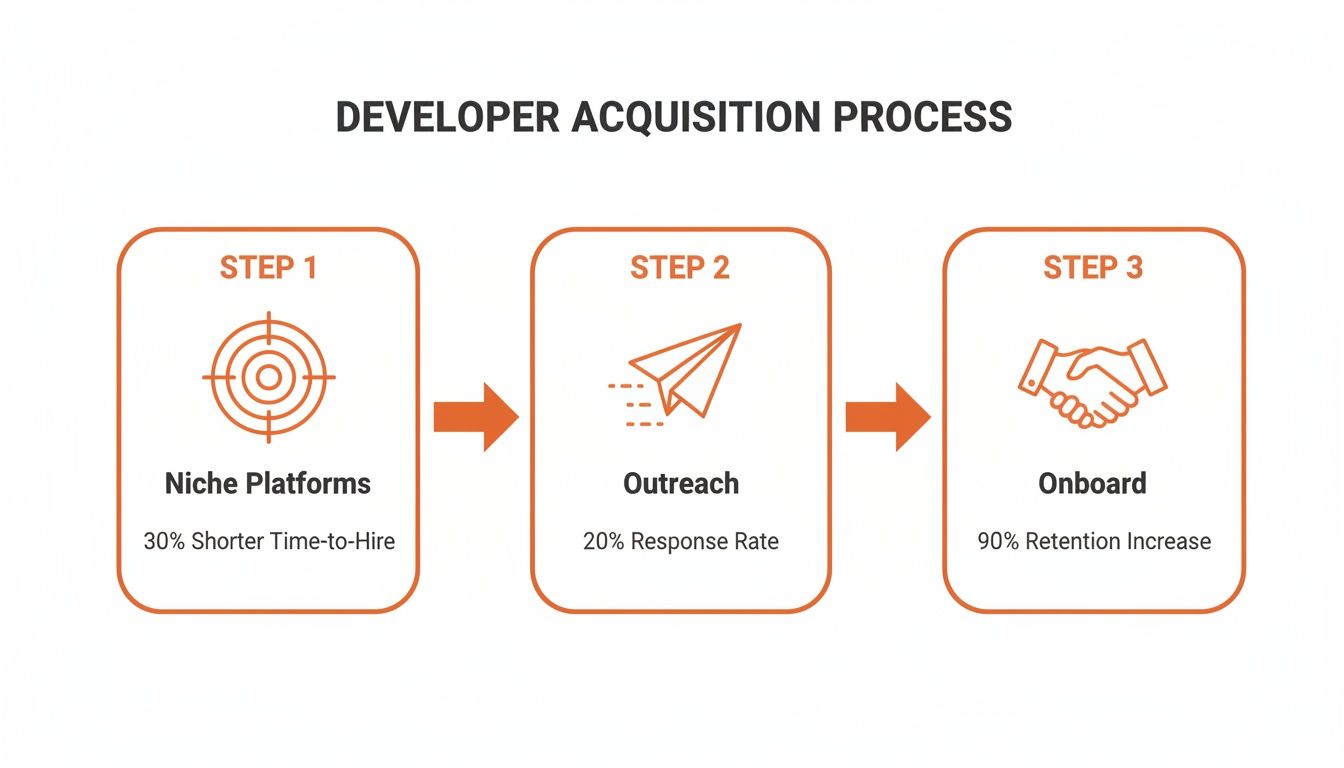
As you can see, a winning strategy hinges on targeted sourcing from niche platforms, personalized outreach that stands out, and a well-structured onboarding process to fully integrate new hires into your team.
The Power of the Paid Trial Project
The cornerstone of any great remote vetting process is the paid trial project. This isn't just another coding challenge; it's a small, self-contained task designed to feel like a real work assignment. It's the single best way to assess not just raw technical ability, but also the critical soft skills that make or break remote work.
By paying candidates for their time, you immediately signal that you respect their expertise. This simple act of goodwill dramatically increases how engaged a candidate will be and sets a positive, professional tone. Plus, it gives you the ethical grounds to ask for a more substantial piece of work than you could with a free assignment.
A well-designed trial project is a two-way street. It gives you a clear window into a candidate’s work style, and it gives the candidate a genuine taste of what it’s like to work with your team and on your codebase.
Designing a Meaningful Project
A great trial project is so much more than a coding exercise. You need to structure it to evaluate a whole range of skills beyond just shipping functional code.
- Scope and Clarity: Keep the project small enough to be completed in a reasonable timeframe, usually 4-8 hours. The instructions have to be crystal clear, providing all the context and assets someone would need. Ambiguity at this stage just tests the wrong things and creates frustration.
- Real-World Relevance: Base the project on an actual problem your team has tackled. For instance, ask a front-end candidate to build a small component from a Figma design, or have a back-end developer create a simple API endpoint with specific validation rules.
- Communication Checkpoints: Build in prompts for communication. Ask them to provide a brief progress report halfway through or encourage them to ask clarifying questions in a dedicated Slack channel. This is how you test for proactive communication.
This structure lets you evaluate the entire process, not just the final output. You get to see how they approach a problem, manage their time, and communicate when they hit a roadblock—all crucial indicators of remote success.
What to Look For in a Submission
Evaluating a trial project goes far beyond a simple "Does it work?" The final submission is a goldmine of information about the candidate’s professionalism and attention to detail.
When you’re reviewing their work, dig deeper:
- Code Quality and Clarity: Is the code clean, well-commented, and easy for another developer to understand? Did they follow established best practices?
- Problem-Solving Approach: Was their approach to the problem sensible? Did they make any smart architectural decisions or trade-offs you wouldn't have thought of?
- Communication and Professionalism: How did they communicate throughout? Were their updates clear and timely? Did they ask thoughtful questions?
- Attention to Detail: Did they follow all the instructions, right down to naming conventions and submission guidelines? A polished README file is a huge green flag.
Someone might submit perfectly functional code but communicate poorly and leave behind sloppy documentation. In a remote team, that person can cause more friction than a less experienced but highly communicative developer. The trial project helps you spot these critical differences early on.
To give you a clearer picture, here’s a sample workflow that brings these elements together. This isn't a rigid template, but a solid foundation you can adapt for your specific needs.
Sample Remote Developer Interview Workflow
| Stage | Objective | Key Activities | Evaluates |
|---|---|---|---|
| 1. Application Review | Initial screening for baseline qualifications | Review resume, portfolio, GitHub, and screener question answers | Relevant experience, communication skills, attention to detail |
| 2. Recruiter/HR Screen | Assess culture fit, motivation, and logistics | 30-minute video call to discuss role, experience, and salary expectations | Professionalism, communication, alignment with company values |
| 3. Paid Trial Project | Evaluate practical skills and remote work habits | Assign a 4-8 hour, real-world coding task with clear instructions | Technical proficiency, problem-solving, code quality, asynchronous communication |
| 4. Technical Deep Dive | Review the project and probe deeper technical knowledge | 60-minute video call with hiring manager/senior dev to discuss their submission | Technical depth, architectural reasoning, ability to explain their work |
| 5. Final Behavioral Interview | Assess self-management and team collaboration skills | 45-minute video call with cross-functional team members | Autonomy, problem-solving under pressure, collaborative mindset |
| 6. Offer | Extend a formal offer | Discuss compensation, benefits, and onboarding plan | Final negotiations and alignment |
This multi-stage process ensures you're evaluating candidates holistically, giving you confidence that you're not just hiring a good coder, but a great remote teammate.
Supplementing with Behavioral Interviews
While the trial project is your main event, behavioral interview questions are essential for uncovering the mindset required for autonomy and self-discipline. These questions aren’t hypotheticals; they ask for past experiences to predict future behavior.
Steer clear of generic questions and tailor them to the unique challenges of remote work:
- "Tell me about a time you had to solve a complex problem with minimal guidance. What was your process?"
- "Describe a situation where you disagreed with a team decision made in a different time zone. How did you handle it?"
- "How do you structure your day to stay focused and productive when working from home?"
Their answers reveal their level of self-management, their approach to asynchronous collaboration, and their ability to take ownership. Combining this behavioral deep-dive with the practical skills assessment gives you the complete picture, ensuring your next hire is truly set up to excel in a distributed team.
Navigating Offers and International Compliance
You’ve made it through the sourcing, vetting, and interviews. You've found the perfect developer. But this is often where the hiring process for a remote employee hits a wall. Suddenly, you’re faced with the complexities of international compensation, legal compliance, and onboarding, and it can feel pretty overwhelming.
Getting over these final hurdles is all about having a smart approach. It’s more than just emailing an offer letter. You need to build a legal and logistical foundation that protects your company while giving your new hire a seamless, welcoming experience. Nail this part, and what could have been a major headache becomes a serious competitive edge.
Choosing the Right Employment Model
Before you even think about drafting an offer, you have to decide on the legal structure of your relationship. This is hands-down the most critical decision when hiring internationally. It dictates everything from taxes and benefits to your company's legal risk.
You've really got three main options:
- Independent Contractor: This is usually the quickest and easiest path. You pay invoices, and the developer handles their own taxes and benefits. The big catch? You run the risk of worker misclassification. If a government agency decides that person should have been an employee, you could face some serious fines and penalties.
- Direct Hire (via a Local Entity): If you're planning a significant presence in a specific country, setting up your own legal entity there can make sense. You get total control, but it's an expensive, time-consuming process that demands a deep understanding of local labor laws.
- Employer of Record (EOR): An EOR service becomes the legal employer in the developer's country on your behalf. They manage everything—payroll, taxes, benefits, compliance—while the developer works as a full-fledged member of your team. For most companies, this is the safest and most scalable way to hire globally.
For companies hiring just one or two developers in different countries, an EOR is almost always the most efficient and compliant choice. It takes the legal burden off your plate so you can focus on what really matters: integrating your new team member.
Structuring a Competitive Global Offer
A compelling offer for a global candidate is about more than just a salary figure. You have to think about local market rates, the cost of living, and what benefits are legally required to put together a package that’s both fair and attractive.
A classic mistake is trying to apply one salary band across the entire globe. You’re much better off aiming for geo-neutral compensation if you can, or at least using a location-adjusted model that guarantees fair pay relative to the local market.
Here’s what to build into your offer:
- Base Salary: Do your homework on local salary benchmarks for the role and experience level. A strong offer should be in the top tier of the local market to land the best people.
- Benefits: In many countries, things like health insurance and pension contributions aren't just perks—they're required by law. An EOR is invaluable here, helping you navigate these rules and offer a locally competitive benefits package.
- Home Office Stipend: A one-time or recurring stipend for setting up a great home office is a fantastic perk. It shows you're truly committed to making remote work a success.
- Equity: If your company offers it, stock options are a powerful way to make someone feel like a true owner, no matter where they are in the world.
Creating a World-Class Remote Onboarding Experience
The final piece of the puzzle is making sure your new hire feels like part of the team from day one. You can't rely on casual office chats to build connections, so a structured, welcoming onboarding process is absolutely essential for remote teams.
Get all their equipment—laptop, monitors, whatever they need—shipped out well before their start date so they're ready to hit the ground running. On their first day, have a clear schedule of introductory meetings with the key people they'll be working with.
And here’s the most important tip: assign them an onboarding buddy. This should be a peer, not their manager, who can answer all the informal questions about company culture, tools, and how things really get done. That personal connection makes all the difference in helping someone feel like they belong.
The demand for developer talent isn't slowing down, and the infrastructure to support remote hiring is growing right alongside it. The remote workplace services market is expected to jump from $20.1 billion in 2022 to $58.5 billion by 2027. As more companies embrace skills-first hiring for remote roles, the global talent pool is only going to become more accessible. You can learn more about the tech job market outlook and see how these trends are changing how we build teams.
Still Have Questions About Hiring Remote Developers?
Even with a solid game plan, you're bound to run into some practical questions when you start hiring developers globally. It’s completely normal. Most managers I talk to have the same concerns about the day-to-day realities of a distributed team.
Here are some of the most common questions that come up, along with some straightforward, practical answers.
How Do We Actually Manage All These Different Time Zones?
This is probably the biggest question people have, and the answer isn't about forcing everyone to work a 9-to-5 in your local time. That’s a recipe for burnout. The key is to manage expectations and create a system that respects everyone’s time.
The best way I've seen this work is by establishing a core overlap of about 3-4 hours each day. This is your protected window for the stuff that absolutely has to happen live—team meetings, brainstorming, quick sync-ups, maybe some pair programming.
Outside of that window, it's all about embracing asynchronous communication.
A team culture built on trust and excellent documentation will always outperform one built on micromanaging people's online status. Give your developers the autonomy to structure their day, and they'll focus on delivering results, not just being available.
This approach gives your team the freedom to do deep, focused work when they’re most productive, no matter what time it is where they live.
What's the Best Way to Handle International Payroll and Compliance?
Look, unless you have an in-house team of international labor lawyers, trying to manage this yourself is a massive headache waiting to happen. Tax codes, employment laws, and standard benefits vary wildly from one country to another. Getting it wrong can lead to some serious legal and financial trouble.
The go-to solution here is to partner with an Employer of Record (EOR) service. Think of them as your local HR and legal team on the ground in your developer's country. They handle all the tricky administrative stuff for you.
- Payroll and Taxes: They manage all the local withholdings and payments correctly.
- Benefits: They'll help you offer a competitive benefits package that's fully compliant with local standards.
- Legal Compliance: They keep up with constantly changing labor laws, protecting you from things like worker misclassification.
Using an EOR lets you tap into a global talent pool without the enormous cost and complexity of setting up a legal entity in every country you hire from. It’s how companies scale their global teams quickly and safely.
How Can We Build a Strong Team Culture When We're Not in the Same Room?
You can't just expect a great culture to magically appear in a remote setting. It takes real effort. Without the casual coffee breaks and hallway chats of an office, you have to be deliberate about creating opportunities for people to connect.
Start by writing down your team's values and communication ground rules. This gives everyone a shared understanding of how you operate. Then, you need to actively foster human connection that isn't just about work tasks.
- Make space for social time: Set up virtual coffee chats, online game sessions, or even just fun Slack channels for things like #pets or #cooking.
- Celebrate wins out loud: When someone does great work, shout it out in a public team channel. Making people feel seen and appreciated is huge.
- Invest in their careers: Show you care about their long-term growth by offering a professional development budget and outlining clear career paths.
And probably the most important thing of all: consistent one-on-one meetings between managers and their direct reports are absolutely essential. These are the conversations where real trust is built, where meaningful feedback is shared, and where each person feels connected to the bigger picture.
Ready to build your world-class engineering team without geographical limits? YayRemote is the global remote job platform designed to connect you with top talent from around the world. Find your next great developer today.