How to Create an Effective Resume: Quick Guide to Get Noticed
Learn how to create an effective resume that passes automated screening and grabs a recruiter's attention with practical, proven tips.
Let's be honest: your resume isn't a timeline of your work history. It’s a marketing document, and the product you’re selling is you. A truly effective resume is built on three core ideas: it’s optimized for the resume-reading robots (ATS), it’s filled with powerful, accomplishment-focused language, and it’s clean and easy to scan. Your only goal is to show a company that you are the solution to their problem.
The Blueprint for a Modern Resume That Wins

You can pretty much forget the old-school rules. Simply listing your job duties is the fastest way to get your resume tossed in the "no" pile. A recruiter spends just a few seconds on each resume, so every single word and design choice has to count.
A great resume today has two critical jobs. First, it has to get past the digital gatekeepers—the Applicant Tracking Systems, or ATS. With over 99% of Fortune 500 companies using these systems to filter candidates, your resume's format and keywords are what get you in the door. No pass, no interview.
Second, once a real person sees it, your resume must immediately grab their attention and prove your value. This is where you need to shift from talking about what you were responsible for to showing what you actually achieved.
From Passive Job Duties to Powerful Results
The single biggest mistake I see on resumes is a laundry list of job duties. A hiring manager already has a good idea of what a "Sales Manager" or "Software Engineer" does. What they don't know is how well you did it compared to everyone else.
This is where numbers become your secret weapon. Metrics provide cold, hard proof of your impact and turn a bland statement into a compelling success story.
The golden rule is simple: Don't just list your tasks; showcase your triumphs. Frame every bullet point around a problem you solved, a process you improved, or a goal you absolutely crushed.
Think about the difference. "Managed social media accounts" is vague and forgettable. But what about, "Grew organic social media engagement by 45% in six months by launching a new content strategy"? Now that tells a recruiter you get results.
Transforming Your Resume From Passive to Powerful
Let's look at how to reframe those dull job duties into accomplishment-driven statements that make a hiring manager stop and take notice.
| Weak Statement (Before) | Effective Statement (After) | Why It Works |
|---|---|---|
| Responsible for customer support tickets and managing the team. | Reduced customer ticket resolution time by 30% and improved team satisfaction scores from 75% to 92% by implementing a new tiered support system. | It quantifies success with specific percentages and directly links an action (new system) to a positive outcome. |
| Worked on developing new features for the company app. | Spearheaded the development of a new in-app checkout feature, which contributed to a 15% increase in mobile conversion rates in Q3. | "Spearheaded" shows leadership, while the 15% increase provides a clear business impact that resonates with hiring managers. |
| Created marketing content and wrote blog posts. | Authored and published 20+ SEO-optimized blog posts, driving a 250% increase in organic search traffic and generating over 500 marketing-qualified leads. | This statement uses specific numbers (20+ posts, 250% increase, 500 leads) to paint a vivid picture of contribution and success. |
See the pattern? The "After" column isn't just about what you did, but the impact of what you did. This is the kind of detail that makes a hiring manager pick up the phone.
Turn Your Responsibilities into Compelling Accomplishments
Does your experience section just rehash the job description? It's a common trap. Recruiters already know what a "Marketing Manager" or "Software Engineer" does in general. What they really want to see is the impact you made.
The secret is to stop listing duties and start showcasing your achievements. Think of each bullet point not as a task you performed, but as a mini-story of your success. This small shift in perspective is what separates a good resume from a great one.
The "Result-Metric-Action" Formula for Impactful Bullets
I've seen countless resumes over the years, and the ones that always get a second look use a simple, powerful structure. I like to call it the "Result-Metric-Action" formula. It's an easy way to make sure you're always leading with what matters most.
- Result (X): Start with the powerful outcome you delivered. Use a strong action verb.
- Metric (Y): Back it up with a number. How did you measure your success? Think percentages, dollar amounts, or time saved.
- Action (Z): Briefly explain how you did it. What skill or process did you use to achieve that result?
This approach forces you to connect your daily work to tangible business outcomes. Instead of just saying you "managed a team," you can show how your leadership improved performance.
Every bullet point on your resume should answer the hiring manager's silent, all-important question: "So what?"
Real-World Examples That Grab Attention
Let's look at how to transform a dull responsibility into a metric-driven accomplishment that truly stands out.
Marketing Example
- Before: Wrote email newsletters for marketing campaigns.
- After (Result-Metric-Action): Grew email open rates (Metric) by 25% and click-through rates by 40% (Result) by implementing A/B testing and segmenting the subscriber list (Action).
Software Engineering Example
- Before: Responsible for fixing bugs in the application.
- After (Result-Metric-Action): Slashed critical production bugs (Result) by 60% over two quarters (Metric) by developing and deploying a new automated testing suite (Action).
Sales Example
- Before: Handled new client accounts and sales outreach.
- After (Result-Metric-Action): Exceeded quarterly sales targets (Result) by $50,000 (Metric) by creating a new outreach sequence for high-value leads (Action).
See the difference? The "after" versions don't just list a task; they prove competence, initiative, and a focus on driving real value.
Why Numbers Are Your Secret Weapon
Hiring managers are trained to hunt for proof. Numbers cut through the fluff and provide concrete evidence that you can deliver. The data backs this up: resumes with specific, quantifiable results have up to a 40% higher chance of landing an interview.
What's really surprising is that only about 8% of resumes actually include this kind of data. This gives you a massive opportunity to make your resume leap to the top of the pile.
Not every accomplishment has a clear dollar sign attached, but there's almost always a metric you can find. Think about:
- Time: Did you cut the time it takes to do something?
- Volume: Did you handle more projects, support tickets, or clients than your peers?
- Scale: Did you manage a bigger budget, a larger team, or a project with a wider scope?
- Frequency: Did you increase how often reports were generated or features were shipped?
Finding the right verbs and metrics is key. If you need some inspiration, checking out powerful resume bullet point examples can help you find the right language for your field.
Finally, make sure you're weaving in the right keywords from the job description. A great way to check this is with our Resume Skills Analyzer. By combining specific achievements with targeted keywords, your resume will catch the eye of both the ATS and the hiring manager, showing them you’re not just qualified—you’re the person they’ve been looking for.
Getting Your Resume Past the Gatekeepers
Ever get the feeling you’re sending your resume into a black hole? You’re not just imagining it. The likely culprit is an Applicant Tracking System, or ATS—the software that acts as a digital gatekeeper for most companies. A staggering 99% of Fortune 500 companies use an ATS to screen candidates, meaning your resume has to impress a robot before it ever reaches a human.
If your resume isn’t optimized for these systems, it gets filtered out before a hiring manager even knows you exist. It’s a tough pill to swallow, but the first audience for your resume isn't a person. Learning how to navigate this is the first real hurdle in your job search.
How to Speak the ATS’s Language
At its core, an ATS is a search engine for recruiters. It scans your resume for specific keywords and phrases that match what’s in the job description. If a company is looking for a "Product Marketing Manager" with "Go-to-Market" and "SaaS" experience, the system will hunt for and prioritize resumes that include those exact terms.
Your job is to become a keyword detective. Scour the job description for clues.
- Hard Skills: Pull out every specific tool (like Salesforce or Adobe Creative Suite), programming language (like Python or Java), or methodology (like SEO or Kanban) they mention.
- Soft Skills: Don't forget phrases related to collaboration and leadership. Look for terms like "stakeholder management," "cross-functional teamwork," or "strategic planning."
- Job Titles: Pay close attention to the exact job title. If the posting says "Content Strategist," make sure your resume reflects that, rather than a more generic "Marketing Specialist."
Once you've gathered these keywords, you need to weave them naturally throughout your resume. They should appear in your summary, your work experience bullet points, and your skills section. For a deeper dive on this, you can find some great advice on how to pass ATS filters with AI.
Formatting That Won't Get You Filtered
Keywords are just one piece of the puzzle. The way your resume is structured is equally critical. An ATS reads your document from top to bottom, left to right, and it gets easily confused by complex layouts.
A visually stunning resume might look great to you, but it can be completely unreadable to an ATS. Simplicity and clarity are your best friends here.
Here are the most common formatting mistakes I see that trip up these systems:
- Tables and Columns: This is the #1 resume killer. Most ATS parsers can’t interpret information in columns, so they either scramble it or ignore it completely.
- Headers and Footers: Avoid putting essential information like your email or phone number in the header or footer, as many systems are programmed to skip these sections.
- Graphics and Icons: As tempting as it is to use icons for your skills or a fancy chart to show your proficiency, stick to plain text. The ATS can't see images.
- Funky Fonts: It’s best to use standard, web-safe fonts like Calibri, Cambria, or Garamond. Anything too decorative or script-like can cause parsing errors.
Making sure your accomplishments are clearly stated in a format that both bots and humans can understand is key. This simple three-step process is a great way to think about crafting each bullet point.
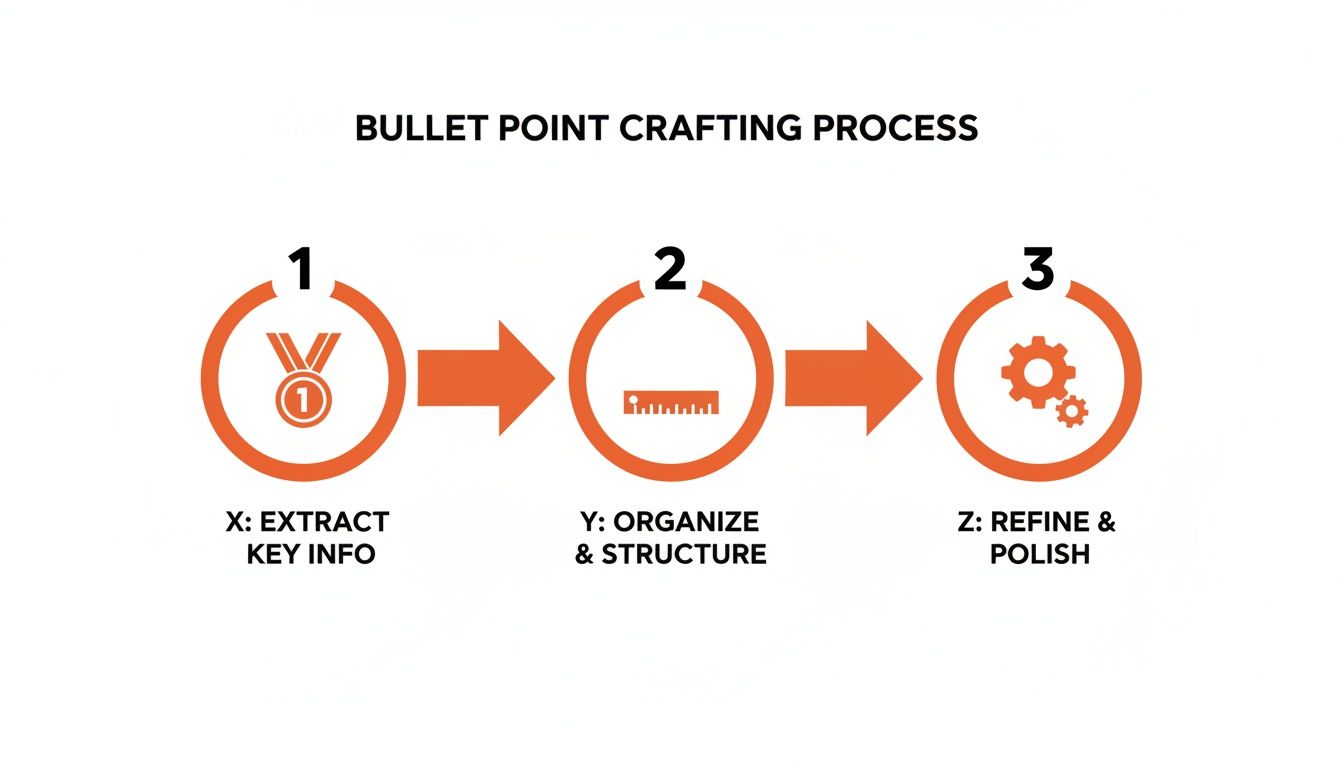
This method helps ensure every achievement you list is clear, compelling, and easy to scan. For more in-depth guidance on structuring your entire document, take a look at our guide for building an ATS-friendly resume that gets results.
By getting both the keywords and the formatting right, you give your application the best possible chance of landing where it belongs: in the hands of a hiring manager.
Choosing the Right Resume Format and Length for Your Career
Before a recruiter reads a single word, the layout and length of your resume have already made a first impression. Think of it as the visual handshake that sets the tone. The right structure immediately tells them you're a professional who understands how to present information clearly.
Your goal is to make it incredibly easy for a hiring manager to spot your value. The best format guides their eye straight to your most impressive qualifications, making their job—and your path to an interview—that much smoother.
Matching Your Format to Your Career Path
There are really only three resume formats you need to know, and each one tells a different story. Picking the right one is all about framing your unique experience in the most compelling way possible.
Reverse-Chronological: This is the industry standard for a reason. It lists your jobs from newest to oldest, clearly mapping out your career progression. If you have a solid, consistent work history, this is almost always your best bet. Recruiters know it and trust it.
Functional: This format flips the script, focusing on your skills (like "Team Leadership" or "Digital Marketing") rather than a timeline of jobs. I'll be honest, though: use this one with caution. It's sometimes used by people with big employment gaps, and recruiters can get suspicious that you're hiding something.
Hybrid (or Combination): This is my personal favorite for many professionals because it gives you the best of both worlds. You lead with a powerful summary of your skills and qualifications, then follow it up with a streamlined reverse-chronological work history. It's a fantastic option for career changers or anyone whose most relevant experience isn't from their most recent role.
For the vast majority of job seekers, the reverse-chronological or hybrid format is the way to go. They are overwhelmingly preferred by recruiters and play nicely with the Applicant Tracking Systems (ATS) that scan your resume first.
The Great Debate on Resume Length
Let's finally put the old "one-page rule" to rest. For many experienced professionals, it's not just outdated—it’s bad advice. Forcing a decade of accomplishments onto a single page just doesn't work. The real rule is to use the space you need to make a powerful argument for yourself.
The data backs this up. In 2026, 49% of job seekers are using resumes longer than one page, with 30% extending to two pages or more. This isn't just a trend; it's a response to what recruiters want. In fact, a staggering 90% of recruiters now say they prefer a two-page resume for candidates with significant experience.
Interestingly, research shows that resumes between 475-600 words tend to get the most interviews. This tells us that well-written, detailed content matters more than an arbitrary page count. You can dive deeper into these resume trends to see just how much expectations have shifted.
Your resume should be as long as it needs to be to tell your story effectively, but not a word longer. Prioritize impact over brevity.
So, when is it okay to go for two pages?
- You have 10+ years of relevant experience. If you're a seasoned pro, two pages are practically expected.
- You're in a technical or academic field. Scientists, engineers, and academics need space for projects, publications, and technical skill lists.
- You have a long list of impressive, relevant accomplishments. If every bullet point you've written adds clear, quantifiable value, don't delete it just to save space.
On the other hand, you should definitely stick to one page if you're a recent grad, have under 10 years of experience, or are making a big career change where your older jobs aren't very relevant.
Simple Design Principles for Maximum Readability
Your resume's design needs to be clean, professional, and dead simple to scan. A recruiter might only give it a six-second glance initially, so clarity is everything.
Stick with a classic, ATS-friendly font like Calibri, Cambria, or Garamond. For font sizes, here’s a reliable guide:
- Your Name: 18-24 pt
- Section Headings: 12-14 pt
- Body Text: 10-12 pt
Most importantly, don't be afraid of white space. Generous margins and spacing between sections are your best friends. They prevent that dreaded cluttered look and make your resume feel organized and easy to digest.
The Smart Way to Tailor Your Resume (Without Losing Your Mind)

We've all heard the advice: you have to tailor your resume for every job. But let's be realistic—rewriting a resume from scratch for every single application is a recipe for burnout. It’s just not practical.
The truth is, there's a much smarter way to do this. It's a system I've seen the most successful job seekers use. Instead of starting over each time, you work from a comprehensive "master resume" and make quick, targeted edits. This way, you stay efficient while still giving every recruiter exactly what they're looking for.
Create Your Career "Everything" Document
The secret weapon here is your master resume. This document is for your eyes only. It's not the one- or two-page version you send out; it's your personal archive of every single thing you've accomplished in your career.
Think of it as your professional brain dump. It should be long—maybe even four or five pages—and that's a good thing. The goal is to get every detail down on paper so you never have to dig through old files or wrack your brain trying to remember the specifics of a project from three years ago.
Your master resume should include:
- Every role you’ve ever had. For each one, write down every possible accomplishment-based bullet point you can think of, complete with any metrics or data you have.
- A complete list of your skills. This means all your technical tools, software, certifications, languages, and even the soft skills you’ve honed over the years.
- All your wins. Document every major project, award, publication, or important presentation. No win is too small for this document.
With this foundation in place, applying for a job stops being a stressful writing exercise. It becomes more of an assembly project, where you just pick and choose the best pieces from your pre-built collection.
Your master resume is the single most valuable asset in your job search. It turns the time-consuming task of tailoring your application into a quick, 15-minute process.
Investing an hour or two upfront to build this document will save you dozens of hours down the road. It gives you the ability to jump on a great opportunity the moment you see it, which is a massive advantage in today's market.
Become an Expert at Reading the Job Description
Once your master resume is ready, your next move for any application is to put on your analyst hat and dissect the job description. Your goal is to figure out what problems the company is trying to solve and what they see as the ideal solution.
Don't just skim it. I recommend printing it out or pasting it into a document so you can highlight keywords and phrases. Pay close attention to words that show up repeatedly—those are your biggest clues.
As you read, try to answer these questions:
- What are the top 3-5 must-have skills or qualifications? They're often at the top of the list or bolded.
- What business pain is this role meant to fix? Are they looking to boost sales, cut costs, or launch a new product line?
- What specific language are they using? Notice if they say "customer success" instead of "client relations," or "program oversight" instead of "project management."
When you truly understand what the hiring manager is looking for, you can position your resume as the perfect answer to their needs.
Make Quick, High-Impact Customizations
Now for the final step. Create a new document for this specific application. Start by copying and pasting the most relevant sections from your master resume.
From here, your edits should be fast and precise:
- Rewrite your summary. Your opening statement should directly reflect the top priorities from the job description. If they’re obsessed with finding someone with "B2B SaaS growth" experience, that exact phrase should be in your first couple of sentences.
- Cherry-pick your bullet points. Go through your experience sections and only keep the accomplishment bullets that speak directly to the role's requirements. If an achievement, however impressive, isn't relevant here, it just creates noise. Leave it out for this version.
- Mirror their language. Tweak your wording to match what you found in the job description. If they use the term "stakeholder engagement," so should you. This is crucial for getting your resume past the Applicant Tracking Systems (ATS) and into human hands.
This method isn’t about making things up; it’s about strategically highlighting the parts of your experience that matter most for this job. Knowing how to frame your skills is a skill in itself, and our guide on how to list skills on a resume offers more great advice on that front. By using the master resume system, you can create a unique and powerful resume for every application without draining all your time and energy.
Common Resume Questions Answered
Writing a resume can feel like you're trying to solve a puzzle with no clear answer. You get one part looking perfect, and then another question pops up that makes you second-guess everything. Let's clear up some of the most common dilemmas I see job seekers wrestle with.
This isn't about following a rigid set of rules. It’s about making smart, confident decisions that show you in the best possible light. Sometimes, that means tackling those tricky situations head-on.
Do I Need a Professional Summary?
Absolutely, but I want you to stop thinking of it as a "summary." It’s your resume’s headline. A recruiter might only give your resume a six-second glance, and this short, three-to-four-line section at the very top is your only shot to make them pause and actually read it. It's your elevator pitch, distilled.
A powerful headline immediately answers the question: "Why are you the perfect fit for this specific job?" It has to be sharp, concise, and loaded with the most important keywords you found in the job description.
Don't ever waste this prime real estate with fluff like "results-oriented professional." Instead, state your title, your most relevant years of experience, and one or two core specializations that mirror what the company is looking for.
Here’s what an effective headline looks like: "Senior Product Manager with 8+ years of experience scaling B2B SaaS products from launch to profitability. Expert in go-to-market strategy, user-centric design, and cross-functional team leadership, with a proven record of increasing user adoption by over 300%."
How Do I Handle Employment Gaps?
First, take a breath. Employment gaps happen, and they're far more common today than you might think. The real mistake isn't having a gap—it's trying to hide it. A clumsy attempt to cover up time off almost always looks more suspicious than the gap itself.
You have a couple of straightforward, honest ways to handle this on your resume:
- Use years instead of months. For gaps that are on the longer side, simply listing the years of employment (e.g., 2021-2023) is a completely standard practice. It visually smooths out the timeline without being dishonest.
- Frame the gap as productive time. If you were upskilling, you can add that directly to your resume. Create a small section called "Professional Development" and list any relevant certifications, courses, or even significant freelance projects you took on.
- Prepare your story for the interview. This is the most important part. Have a short, positive explanation ready. Whether you were traveling, caring for family, or learning a new skill, frame it around what you gained from the experience.
Your goal is to show that you were being proactive with your time, not just sitting idle.
What If I Don’t Have Many Quantifiable Achievements?
This is a huge source of anxiety, especially if you’re not in sales or a role where every task is tied to a hard number. But trust me, nearly every role has achievements you can quantify if you get a little creative. When you can't find a percentage or dollar amount, focus on scope, scale, and impact.
Ask yourself these questions to uncover hidden metrics:
- Scale: How many people were on the team you trained? What was the size of the budget you helped manage? How many client accounts did you handle?
- Efficiency: Did you introduce a process that saved your team time? Did you build a template that reduced errors? Even a statement like "Reduced report generation time from 2 hours to 30 minutes by automating data pulls" is incredibly powerful.
- Initiative: Did you volunteer to lead a new project? Did you notice a problem and propose a solution that the team adopted? Showing that you go beyond your basic duties is a huge indicator of your value.
Ultimately, a great resume is all about communicating your impact clearly. By getting these common questions sorted, you're not just listing your job history—you're building a compelling case for why you're the right person for the job.
Ready to make sure your resume stands out for all the right reasons? YayRemote offers a suite of free tools, including an ATS Resume Checker and a Skills Analyzer, to help you craft a job-winning resume. Find your next opportunity and apply with confidence at https://www.yayremote.com.