How to Find Remote Jobs and Land Your Next Great Role
Learn how to find remote jobs with this expert guide. We cover advanced search tactics, resume optimization, and interview strategies that actually work.
Finding your next remote job comes down to a simple, three-part strategy: Prepare a tailored application, Find roles on the right platforms, and Apply with a resume built for both people and software. This approach—Prepare, Find, Apply—is the most effective way to cut through the noise and focus on what actually works.
The Reality of Today's Remote Job Market
Let’s get one thing straight: remote work isn't a passing trend. It's a fundamental shift in how companies are built, and the numbers back it up. Businesses aren't just tacking on remote options as a perk anymore; they're strategically creating distributed teams for long-term growth. To land a great remote job, you first have to understand this new reality.
The Data Tells the Story
The global workforce has changed for good. An estimated 330 million people are now in full-time remote or hybrid roles, with about 73 million digital jobs being a perfect fit for working from anywhere.
This wasn't a slow trickle—it was a seismic shift. In the United States alone, the percentage of people working from home shot up from 5.7% in 2019 to 17.9% by 2021. And it’s not slowing down. With remote-capable jobs expected to increase by another 25% by 2030, the pool of opportunities is only getting deeper. You can explore the latest remote work statistics to see just how deep it goes.
This isn't just about more job listings. It's a structural change that gives you, the job seeker, a lot more leverage.
The big takeaway? Remote work is here to stay. By 2026, projections show that 27% of full-time professionals will work fully remotely, and another 52% will be in hybrid roles. That’s nearly half the global professional workforce.
Your Search Starts with a Simple Framework
A successful remote job hunt doesn’t need to be overwhelming. It really just boils down to a clear, repeatable process that you can follow every time.
Before we dive into the nitty-gritty details of each step, here’s a high-level look at the framework we’ll be following.
Your Remote Job Search Quick-Start Framework
This table breaks down the three core stages of your search, outlining the key action for each and a recommended YayRemote tool to help you get it done efficiently.
| Stage | Key Action | Recommended YayRemote Tool |
|---|---|---|
| Prepare | Optimize your resume for ATS and tailor your professional profiles. | AI Resume Checker |
| Find | Search strategically on specialized remote job boards and company career pages. | Remote Job Finder |
| Apply | Craft a compelling cover letter and submit a targeted, high-quality application. | AI Cover Letter Generator |
Think of this as your roadmap. Each stage builds on the last, ensuring you’re not just sending applications into the void but making a real, memorable impression.
This simple flowchart brings the entire process to life, showing how each stage flows into the next.
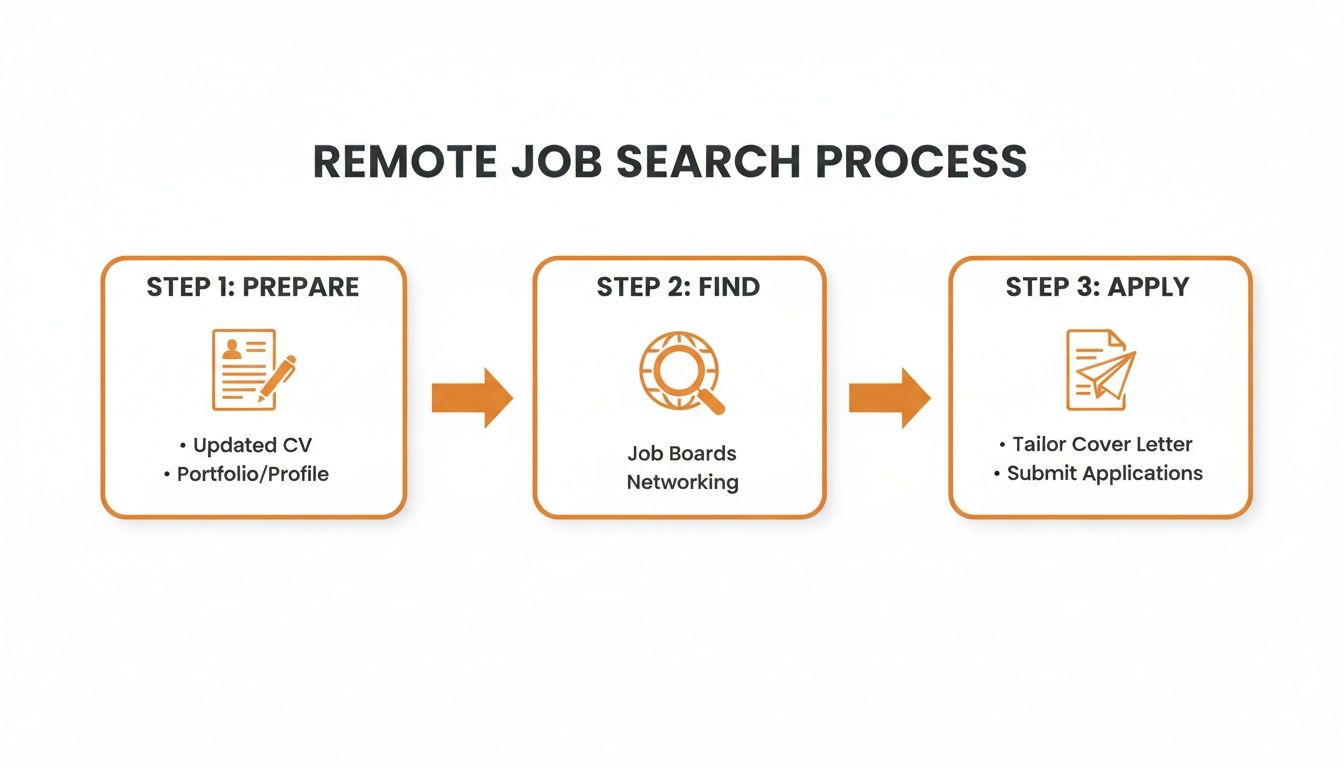
As you can see, finding the job is just the middle step. The real work happens before you even start searching and right before you hit "submit." To stand out from the hundreds of other applicants, you need to move beyond simple browsing and adopt a more strategic mindset.
This guide will walk you through exactly how to do that, giving you the tools and insights you need to land your next great remote role.
Finding High-Quality Remote Jobs Beyond the Obvious
If you've ever felt the burnout from endlessly scrolling through massive job boards, you know the feeling. It's a numbers game you can't win. A truly successful remote job search isn't about applying everywhere; it's about finding the hidden gems that most people completely miss. It’s time to stop the doom-scrolling and start getting strategic.
The best way to do this is by focusing on platforms built from the ground up for remote work. This is where a curated job board becomes your secret weapon. Instead of wading through a sea of "remote optional" roles on giant sites, you can zone in on companies that are all-in on distributed teams from day one.
Go Beyond the Standard Job Search
The real game-changer is using filters that let you search for what really matters in a remote role. I'm not just talking about job titles. I mean the stuff that actually impacts your life.
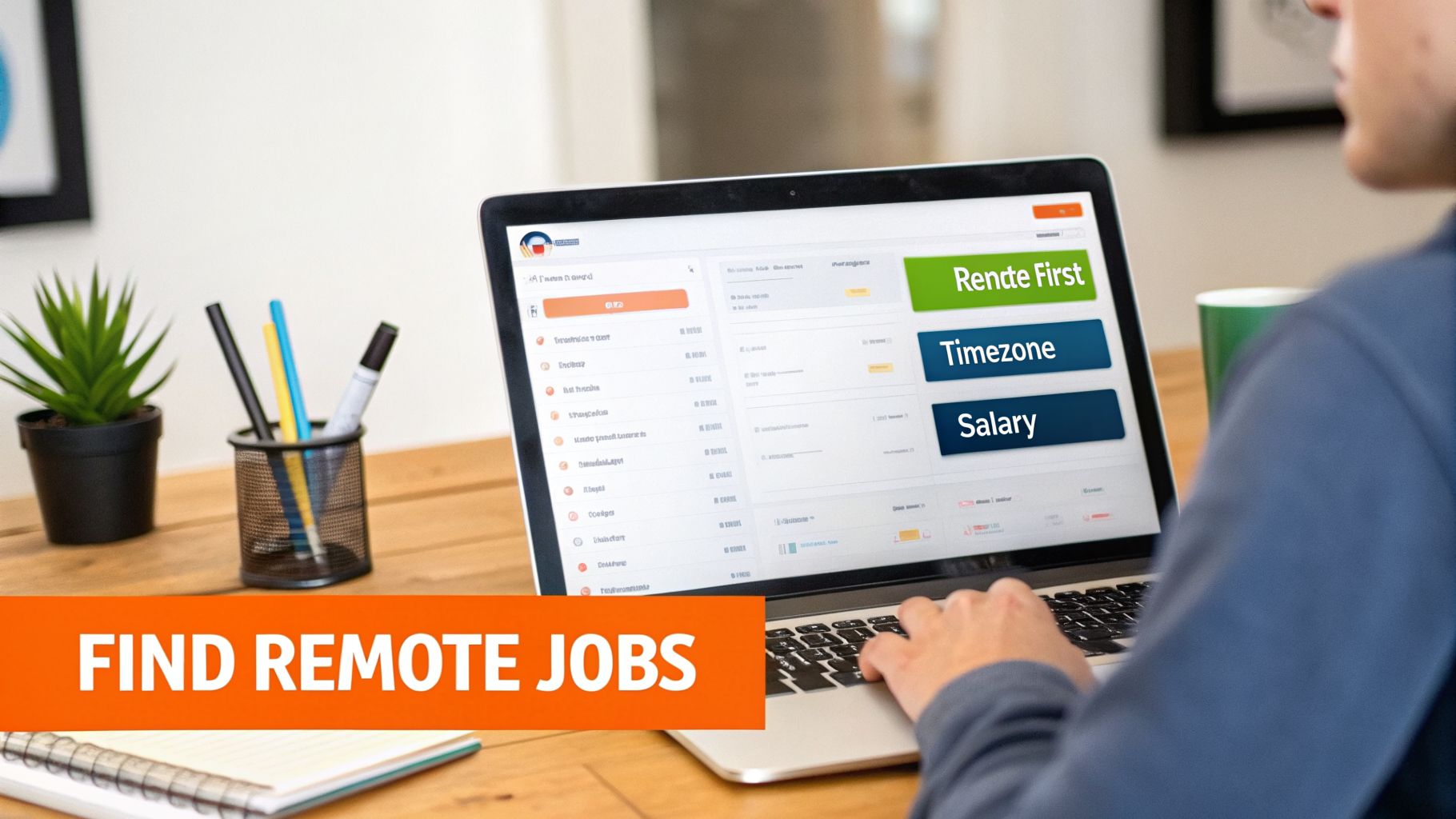
This is exactly what a targeted search looks like on a platform like YayRemote, where you can use specific filters to find exactly what you're after.
You can see how a few clicks—filtering for salary, benefits, or experience level—can turn a vague search into a highly targeted one. This simple step lets you instantly screen for jobs that meet your non-negotiables, saving you hours of wasted time and energy.
Distinguish Between Remote-First and Remote-Friendly
Here's one of the most important lessons I've learned: you have to understand the difference between remote-first and remote-friendly companies. It seems subtle, but it will have a massive impact on your day-to-day work life.
- Remote-First: These businesses are built for remote work. Every process, every meeting, and all of the company culture is designed with a distributed team in mind. Everyone is on a level playing field.
- Remote-Friendly: These companies allow remote work, but their heart is still in the office. This can lead to remote employees feeling left out of important conversations and passed over for opportunities that happen "at the water cooler."
My advice? Always prioritize remote-first companies. They get it. They understand things like asynchronous communication, invest in the right tools, and build a culture where your location has zero bearing on your career growth.
You can usually spot a remote-first company by how they talk about themselves. Their career pages will be full of details about their remote culture, global benefits, and a team spread across the world.
Tap into Niche Communities and Company Career Pages
Some of the best and most competitive remote jobs are filled before they ever make it to the big job boards. To find them, you have to go straight to the source.
Find Your Niche Online:
- Slack Channels: Join industry-specific or remote-focused Slack groups. I've seen countless hiring managers post openings here first, looking for trusted people.
- LinkedIn Groups: Look for groups tied to your profession, like "Remote Product Managers" or "Global Marketing Professionals." It’s a great way to network and spot opportunities.
- Subreddits: Don't sleep on Reddit. Communities like r/remotework often have weekly job threads with roles you won't see anywhere else.
Go Directly to the Companies: Make a list of 20-30 remote-first companies you'd be thrilled to work for. Bookmark their career pages and make it a habit to check them once a week. This shows incredible initiative and gets your name in front of them before anyone else. Many companies prefer hiring this way to avoid recruiter fees, which gives you a serious advantage.
To build out your list, spend some time exploring the best remote job boards, which are fantastic for discovering these top-tier companies in the first place.
When you combine smart searches on specialized platforms with direct outreach and community networking, you create a powerful, multi-channel strategy. This is how you take back control and shift from being a passive scroller to an active, strategic job seeker.
Crafting an Application That Actually Gets Noticed
When you're chasing a remote job, your application package is everything. It’s your handshake, your first impression, and your entire sales pitch, all before you ever speak to a real person. And before a hiring manager even gets a chance to see it, your application has to get past the gatekeeper: the Applicant Tracking System (ATS).
Let's get this out of the way first. Your resume is the first and biggest hurdle. Most companies rely on ATS software to scan applications, and it’s brutal—filtering out up to 75% of resumes before they ever land in front of human eyes. Your job isn't just to pass this robot bouncer but to make sure your resume still shines for the manager who reads it on the other side.
The good news is you don’t have to fly blind. I always recommend running your resume through a dedicated AI Resume Checker before you hit "submit." These tools give you a sneak peek into how an ATS will "read" your document, flagging everything from missing keywords to formatting glitches so you can fix them.
Optimizing Your Resume for Both Bots and Humans
Think of your resume as having two audiences, because it does. First, you have to please the ATS. Second, you have to impress the hiring manager. The key is to serve both without compromising.
It all starts with tailoring your resume for every single job you apply for. A generic, one-size-fits-all resume is a one-way ticket to the rejection pile. You need to pull keywords straight from the job description—think specific skills, software, and responsibilities—and weave them naturally into your experience and skills sections.
For instance, if a remote project manager role calls for "asynchronous communication" and "managing distributed teams," those exact phrases need to show up on your resume. That direct match is what the software is programmed to look for.
Beyond the words you use, the structure matters immensely. Stick to simple, clean formatting.
This simple table is a great pre-flight check before you send your resume out into the world.
ATS Optimization Checklist
Before you hit 'apply,' run through this checklist to make sure your resume can get past the bots.
| Check | Why It Matters | How to Do It |
|---|---|---|
| Keyword Match | ATS scans for keywords from the job description to determine your relevance. | Use a tool to compare your resume against the job post and sprinkle in missing hard and soft skills. |
| Standard Fonts | Complex or custom fonts can be unreadable to the software, causing an error. | Stick to universal fonts like Arial, Helvetica, or Calibri. |
| Simple Formatting | Columns, tables, and text boxes can confuse the ATS, jumbling your information. | Use a single-column layout. Avoid headers, footers, and any complex design elements. |
| Standard Headers | The software needs to know where to find your experience, skills, and education. | Use common section titles like "Professional Experience," "Skills," and "Education." |
| File Type | Some systems only accept specific file types, like .docx or .pdf. | Check the application instructions. When in doubt, a .docx file is often the safest bet for parsability. |
Getting these details right can be the difference between getting seen and getting tossed. For a deeper dive, our complete guide on creating an ATS-friendly resume breaks it all down.
Writing a Cover Letter That Tells Your Remote Story
Once your resume has cleared the initial hurdle, your cover letter is your chance to make a human connection. This is where you can truly show you’re cut out for remote work, something a resume can only hint at.
Don't just rehash your resume. Use your cover letter to explicitly address the unique demands of remote work. Show them you understand what it takes to succeed outside of a traditional office.
Instead of just saying, "I'm a self-starter," paint a picture. Try something like this: "In my last role, I took our Q3 marketing campaign from concept to launch, coordinating with team members across three different time zones. Using tools like Asana and Slack, I ensured we hit every deadline without ever needing daily check-ins."
This kind of statement proves you've got the core remote competencies down:
- Autonomy: You can own your work from start to finish.
- Asynchronous Communication: You know how to keep people in the loop without constant meetings.
- Proactiveness: You take initiative instead of waiting for instructions.
Demonstrating Your Value in a Booming Market
Competition for remote roles is fierce, but the opportunity is massive. The market for remote workplace services is expected to explode from $20.1 billion in 2022 to $58.5 billion by 2027. That tells you companies are investing heavily in making remote work a success.
With nearly 22.8% of U.S. professionals already working remotely, according to remote work statistics from Robert Half, being able to clearly articulate your remote-readiness gives you a serious edge.
This is where a Skills Analyzer can help you focus. By spotting the gaps between your resume and the job description, you can use your cover letter to build a bridge and highlight your most relevant skills. When you combine a perfectly tuned resume with a powerful story, your application stops being just a document—it becomes a compelling argument for why you’re the perfect person for the job.
How to Master the Remote Interview

Think of a remote interview as more than just a video call—it’s a live audition. You’re not just proving you can do the job; you're proving you can do it well without someone looking over your shoulder. This is your chance to show you have the self-discipline and communication chops to succeed in a distributed team.
Honestly, acing the remote interview boils down to two things: your technical setup and how you communicate. A sharp camera and clear mic are the bare minimum. The real test is showing you’re an autonomous, proactive professional who can thrive from anywhere.
Prepare Your Remote-Ready Setup
First impressions are made in seconds. In a video interview, your background and tech setup speak volumes before you even say a word. A messy room or a glitchy connection can send the wrong signal, suggesting you’re unprepared. Getting this right is an easy win.
Here’s a quick pre-flight checklist to run through:
- Solid Internet Connection: Run a speed test. For most remote roles, a stable connection is non-negotiable.
- Good Lighting: Face a window or a lamp. Never sit with a bright light behind you, or you’ll become a faceless silhouette.
- Clear Audio: A simple headset or an external microphone is a game-changer. Your laptop’s built-in mic will pick up every echo and background noise.
- Neutral Background: A clean, uncluttered space is key. A simple wall or a tidy bookshelf works perfectly.
Once your tech is dialed in, it's time to focus on what you'll say. You need to be ready for questions that specifically test your aptitude for remote work.
Answer Like a Remote Pro
When hiring for remote roles, managers are listening for specific evidence. They want proof that you're a self-starter who can manage your own time, communicate clearly across distances, and stay motivated without daily in-person check-ins.
A great remote employee doesn't just do the work; they actively communicate about their work. Your interview answers need to show this, not just tell it.
Instead of saying, "I'm a good communicator," share a real story. Talk about the time you used a project management tool to keep everyone in the loop, or how you created a shared document to summarize a complex discussion and get the whole team on the same page.
Be ready for direct questions designed to gauge these skills, like:
- "How do you stay motivated and manage your time without direct supervision?"
- "Describe a project where you collaborated with a team across different time zones."
- "What tools do you use to stay organized and communicate with your colleagues?"
Frame your answers through the lens of remote-first principles. For instance, highlighting your experience with asynchronous communication and solid documentation shows you already get it. If you want to dig deeper into what hiring managers are looking for, our guide on how to find remote jobs online has some great insights.
Show You Understand Global Collaboration
If the company has a global team, showing you can handle time zone differences is a massive advantage. This is where a little homework can really make you shine.
Before the interview, use a tool like a Time Zone Overlap calculator to check the working hours between you and the rest of the team. Then, you can bring it up during the conversation. For example, you might say, "I saw there's a four-hour overlap with the team in Berlin. I'm happy to adjust my schedule to make sure we have dedicated time for real-time collaboration."
This small detail shows you’re not just thinking about yourself—you're thinking about the team's workflow and success. It’s a powerful signal that you're ready to contribute from day one.
Negotiating a Modern Remote Job Offer
Getting the job offer is a fantastic moment. But before you pop the champagne, take a breath. The real work—and your biggest opportunity—is just getting started. Negotiating a remote role is about much more than just the salary. It’s your chance to shape a total compensation package that genuinely supports the way you want to live and work.
Think about it this way: a company that’s willing to invest in your remote setup is a company that’s truly committed to making its distributed culture succeed. A great offer isn't just a number; it's a collection of benefits that gives you the freedom and tools to do your best work, wherever you happen to be.
Look Beyond the Base Salary
Salary is obviously important, but it’s only one piece of the puzzle. A truly modern remote offer has a lot more to it, and your goal should be to negotiate the entire package. When the hiring manager brings up your expectations, be ready to talk about the full picture.
Start by thinking about the non-cash benefits that still have a real financial impact. These are the practical things that make working remotely sustainable and productive for the long haul.
Consider bringing these up in your conversation:
- Home Office Stipend: Will they help you pay for a good desk, an ergonomic chair, or a second monitor? This could be a one-time setup bonus or an annual allowance.
- Monthly Tech or Internet Allowance: It's a common and fair request for companies to chip in for your internet or phone bill since they're essential for your job.
- Professional Development Budget: A budget for courses, conferences, or certifications is a clear signal that the company is invested in your long-term growth.
- Co-working Space Membership: Don't love working from home all the time? Ask if they'll cover a membership at a local co-working spot.
When you bring these up, frame them as tools for success, not just personal perks. For instance, you could say: "A home office stipend would be a huge help in creating a more ergonomic and productive workspace. That's a top priority for me so I can deliver my best work."
This little shift changes the conversation from what you're asking for to how you can provide more value.
Navigating Salary in a Location-Independent World
Talking about salary for a remote job can feel a little weird. Is it based on the company's HQ in San Francisco? Your cost of living in a smaller town? Something else entirely? The good news is that more and more remote-first companies are adopting location-agnostic pay. This means they pay the same salary for a role, no matter where the employee lives.
This trend is your friend. As you search for remote jobs, research salary benchmarks for the role itself, not for a specific city. That way, when you get to the negotiation table, you can anchor your desired salary to industry standards based on your skills and experience level.
What if a company insists on location-based pay? Don't panic. This is where you double down on the value you bring. Talk about your unique skills, the concrete results you’ve delivered in the past, and your proven ability to thrive in a remote environment.
Planning for a Digital Nomad Lifestyle
If you're dreaming of working while you travel, you need to bring some logistics into the negotiation. This shows you’re a serious professional who plans ahead, not just someone with a vague sense of wanderlust.
- Days in Country Calculator: If you plan on country-hopping, mention that you're using a Days in Country calculator to manage your physical presence and stay compliant with tax and legal rules. It shows you’re on top of the details.
- Digital Nomad Visas: Do your homework. A resource like a Digital Nomad Visa hub can help you find countries with programs specifically for remote workers. Discussing your plans and showing you’ve thought through the legal side builds a ton of confidence.
By bringing these practical points to the table, you're not just trying to get a job. You're building a partnership. You’re showing them that you’re ready to co-create a working arrangement that sets everyone up for success in the long run.
Your Top Questions About Finding a Remote Job, Answered

As you start your search, you're bound to run into a few common questions. I've seen these pop up time and time again from people just like you. Let's get them cleared up so you can move forward with confidence.
What Are the Biggest Application Mistakes People Make?
The single biggest slip-up I see is sending a generic resume. If it’s not tailored for the specific role and optimized for an Applicant Tracking System (ATS), it’s probably heading straight for the digital trash can. That’s an instant red flag for any hiring manager.
Another common pitfall is failing to show how you can work remotely. Don't just list "self-starter" as a skill. Instead, talk about specific instances where you used tools like Slack or Asana for asynchronous collaboration or managed a project from start to finish with minimal hand-holding. And remember, for a remote role, your digital footprint is part of your resume—they will look at your LinkedIn profile. Make sure it tells a consistent, professional story.
How Can I Stand Out If I've Never Worked Remotely?
Lean into your transferable skills. You've probably worked with more autonomy than you think. Pinpoint any times you had to manage your own schedule, solve problems independently, or collaborate with colleagues over email and chat, even if they were just in another part of the building.
Your cover letter is where you can really connect the dots for the hiring manager.
Frame your lack of official "remote" experience as a strength. You can explain that you're a blank slate, ready to fully embrace their company's unique remote culture without any preconceived habits.
This shows you've thought deeply about the dynamics of a distributed team and can turn a potential negative into a huge positive.
Are Remote Jobs as Secure as Traditional Office Roles?
Honestly, job security has far more to do with the company's financial health and your own performance than where your desk is located. In many cases, remote-first companies can be even more stable. They often have lower overhead costs, which can make them more resilient during tough economic times.
The trick is to do your homework and vet the company thoroughly.
- Look for businesses with a well-defined, public remote work policy.
- Stick to resources that curate jobs from reputable, well-funded companies.
- Dig into employee reviews about their remote culture and satisfaction.
When a company clearly invests in its distributed team with great tools and support, it's a strong signal they’re committed for the long haul. This kind of research is what separates a good remote job search from a great one.
Ready to stop guessing and start finding the right remote role? YayRemote curates the best remote jobs from companies you can trust. Begin a smarter search today at https://www.yayremote.com.