How to Get a Job in Programming in 2026
Learn how to get a job in programming with practical advice. Discover how to pick a specialty, build a portfolio, and ace the technical interview.
Landing your first programming job in 2026 comes down to a simple, powerful formula: specialize in a sought-after field, build a portfolio that proves you can solve real problems, and apply with intention. It's no longer just about what you know; it's about what you can do.
Your Realistic Roadmap to a Programming Career
Let's cut through the noise. The path to becoming a professional developer isn't what it used to be. It’s less about a specific degree and more about a focused, hands-on effort to build and showcase skills that companies are desperate for. Think of it as a marathon, not a sprint, and you absolutely need a map.
Your mission isn't just to get good at a language like Python or JavaScript. It's to become the person who can step into a team and start solving problems. This means graduating from tutorial-based "to-do list" apps and building something that shows you think like an engineer.
The Modern Programming Job Market
The good news? The demand for good developers has never been higher. We're looking at a global community of 28.7 million developers, and that number is climbing fast. In fact, the US Bureau of Labor Statistics projects a 17% jump in developer jobs between 2023 and 2033, which translates to about 327,900 new roles.
What's really interesting is that only 41% of developers currently have a Bachelor’s degree. This is solid proof that self-taught and bootcamp routes are not just viable—they're incredibly common. You can dive deeper into these numbers with this 2026 software development report.
This whole process can be visualized pretty clearly.
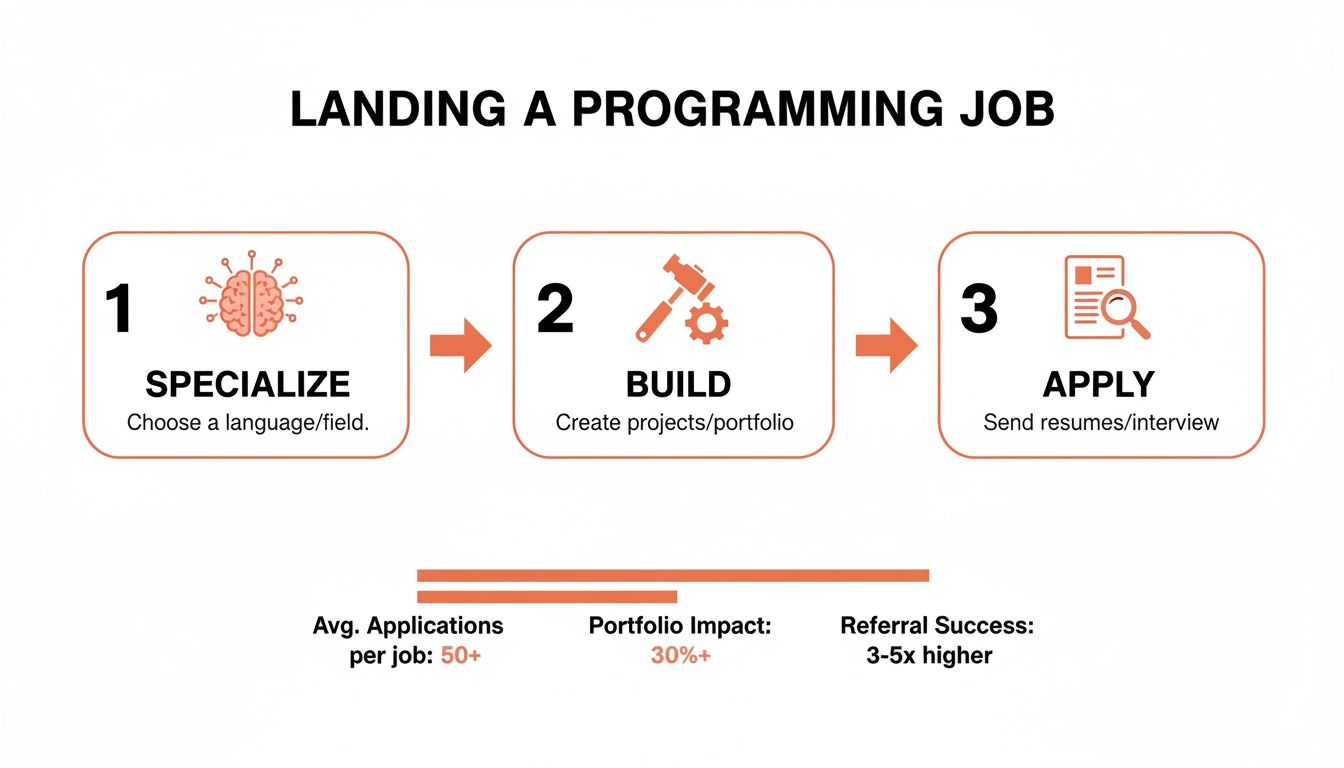
As the graphic shows, it’s a three-beat rhythm: find your niche, show your work, and then chase the right opportunities.
To give you a clearer picture, here’s a breakdown of the entire journey. This table breaks down the job-seeking process into actionable phases, giving you a clear roadmap from learning to earning.
Key Stages to Landing Your First Programming Job
| Stage | Primary Goal | Key Actions |
|---|---|---|
| 1. Learning & Specialization | Gain foundational knowledge and choose a high-demand niche. | Choose a path (e.g., front-end, back-end), master core technologies (HTML/CSS/JS, Python, etc.), and understand key concepts like version control with Git. |
| 2. Building & Showcasing | Create tangible proof of your skills and build a professional brand. | Develop 3-5 unique portfolio projects. Optimize your GitHub profile with clean code and detailed READMEs. Build out your LinkedIn profile. |
| 3. Applying & Interviewing | Secure interviews and demonstrate your value to employers. | Tailor your resume for each application. Practice data structures, algorithms, and system design questions. Prepare for behavioral interviews. |
| 4. Offer & Negotiation | Receive and negotiate a competitive job offer. | Evaluate offers based on more than just salary (benefits, culture, growth). Learn to negotiate compensation and terms confidently. |
Each stage builds on the last, turning your hard-earned skills into a career.
Building a Practical Strategy
A winning job search is a mix of solid technical skills and smart personal marketing. Forget about firing off hundreds of generic applications—that's a recipe for burnout. Your time is far better invested in polishing your professional brand and targeting roles where you can genuinely shine.
This really boils down to three core activities:
- Choose a Niche: Don't be a generalist. Master a specific domain like front-end with React, back-end with Node.js, mobile with Swift, or even data engineering. Specialists are always in higher demand.
- Build Your Portfolio: Aim for 3-5 impressive projects. One complex application that solves a unique problem is worth more than a dozen simple tutorial clones.
- Optimize Your Online Presence: A clean GitHub profile, a keyword-optimized LinkedIn page, and an ATS-friendly resume are your entry tickets. They are non-negotiable.
Remember, your online presence is your new resume. A hiring manager will almost certainly look at your GitHub before they even glance at your cover letter. Make sure it tells a compelling story about your passion and your ability to ship code.
Tools like YayRemote can give you a huge advantage by helping you filter for remote programming jobs that align perfectly with your skill set. It's all about applying smarter, not just harder, to find those top-tier opportunities without getting lost in the noise.
Choosing Your Specialty and Mastering In-Demand Skills

Saying you want a job as a "programmer" is like a musician saying they want a job in "music"—it’s just too vague. To get hired, you need a focus. Companies aren’t looking for generalists; they're hiring specialists who can solve very specific problems, whether that’s building a pixel-perfect user interface or engineering a massive data pipeline.
So, your first big decision is picking a path. This choice guides everything that comes next: the tech you learn, the projects you build, and the jobs you hunt for. Don't stress about making the "perfect" choice for the rest of your life. Careers are long, skills overlap, and you can always pivot later. The goal right now is to pick one and go deep.
Core Programming Specializations
Let's walk through the most common fields in the industry. Each one uses a different toolkit to solve a different kind of problem.
- Frontend Development: This is everything the user sees and touches. You’ll be responsible for building the visual side of websites and apps, with a heavy focus on user experience and snappy design. Your bread and butter will be HTML, CSS, and JavaScript, plus a modern framework like React, Vue, or Svelte.
- Backend Development: Think of this as the engine room. You’ll be managing the servers, databases, and application logic that make the frontend work. Common languages here are Python, Java, Go, and Node.js (JavaScript), which you’ll pair with databases like PostgreSQL (SQL) or MongoDB (NoSQL).
- Mobile Development: If building apps for phones and tablets is your goal, this is your world. You can go native with iOS development using Swift or Android development with Kotlin. Or, you can use a cross-platform framework like React Native or Flutter to write code once and ship it to both Apple and Google's app stores.
- Data Science & AI/ML: This field is absolutely booming. Here, you'll sift through huge datasets to find trends, make predictions, and build smart systems. Python is the undisputed champion, armed with libraries like Pandas, NumPy, and TensorFlow. A rock-solid grasp of SQL is also non-negotiable for pulling the data you need.
Picking a path isn’t just about the tech—it's about the kinds of problems that get you excited. Do you obsess over making things beautiful and intuitive? Frontend might be a great fit. Are you fascinated by logic, efficiency, and complex systems? You’ll probably feel right at home on the backend or in data science.
From Learning to Mastery
Once you've settled on a specialty, the real work begins. The trick is to move beyond just watching tutorials. Hiring managers want to see proof that you can actually apply your knowledge to build something, not just copy and paste someone else’s code.
Instead of building yet another to-do list app, try tackling a project that really flexes your skills in your chosen area.
- Frontend: Build a slick, responsive dashboard that pulls in and visualizes data from a public API.
- Backend: Create a full REST API for a mock e-commerce site, complete with user authentication and order processing logic.
- Data Science: Grab an interesting dataset from a site like Kaggle and build a predictive model, documenting your entire process and findings.
This kind of practical application is what truly separates an aspiring developer from a hirable one. For a deeper dive on this, check out our guide on the top technical skills for your resume to see what recruiters are really looking for right now.
The Emerging Essentials: AI and Cloud
No matter which path you take, two skills are quickly becoming essential across the board: Artificial Intelligence (AI) and cloud computing. I'd bet that by 2026, a basic understanding of both will be a practical requirement for nearly every developer role.
You don't need to be an AI researcher, but you should know how to use AI-powered coding assistants and understand how APIs can plug AI features into an application you're building.
Similarly, getting comfortable with a major cloud provider like Amazon Web Services (AWS), Google Cloud Platform (GCP), or Microsoft Azure is critical. Knowing how to deploy an app, spin up a cloud database, or use serverless functions shows you get how modern software is built and shipped. It’s a huge signal to employers that you’re ready to contribute from day one.
Show, Don’t Just Tell: Building Your Developer Portfolio and Presence
Once you’ve picked a lane for your career, it’s time to prove you can actually do the work. In the world of software development, talk is cheap. What really matters is tangible proof—your projects, your code, and the professional presence you build online.
Think of it this way: a hiring manager is drowning in applications and spends mere seconds on an initial look. Your job is to make those seconds count. This isn't about becoming some kind of tech influencer; it's about building professional assets that do the talking for you, opening doors before you even have to knock.
Turn Your GitHub into a Professional Showcase
Make no mistake, your GitHub profile will be scrutinized. It's often the first stop for a technical recruiter or hiring manager. A messy, dormant profile is a huge red flag, but a well-curated one can be your single greatest asset.
Here's how to make it work for you:
- Pin Your Best Work: Feature your 3-5 most impressive projects right at the top. These should be the ones you’re proudest of, not a graveyard of half-finished tutorials. Think quality, not quantity.
- Write Incredible READMEs: Every single project needs a
README.mdfile that sells it. What is it? Why did you build it? What tech stack did you use? How can someone run it? Go the extra mile and include screenshots or even GIFs of your application in action. - Show Your Work Ethic: That contribution graph—the grid of green squares—tells a powerful story. Consistent commits show you’re not just a weekend coder; you’re dedicated and genuinely passionate about building things.
Your GitHub is far more than a code backup; it's an interactive portfolio. A sharp README with a link to a live demo can be more convincing than any bullet point on a resume because it lets people see your skills in real time.
Get Found on LinkedIn
Recruiters practically live on LinkedIn. If your profile isn’t set up to catch their eye, you're essentially invisible. The goal is to make it incredibly easy for them to find you and instantly understand the value you bring.
Start with your headline—it's prime real estate. "Aspiring Software Developer" is a dead end. Be specific and load it with keywords. A powerful headline looks something like this: "Software Engineer | Python, AWS, React | Building Scalable Web Applications." It immediately signals your role, your key skills, and your focus.
Next, use your summary to tell a quick, compelling story. Connect the dots between your background, your chosen specialty, and the types of problems you want to solve. Sprinkle in the technologies you know to pop up in more recruiter searches.
Craft a Resume That Beats the Bots
Here's a hard truth: before a person ever lays eyes on your resume, it will almost certainly be scanned by an Applicant Tracking System (ATS). These bots are programmed to look for specific keywords and formatting. A single misstep can get your application tossed in the digital trash can.
This is what the bot sees—a report card on how well you match the job.
The report above scores a resume against a specific job description, pointing out exactly which skills are a match and which are missing. This is invaluable feedback. Seeing what's missing gives you a clear, data-driven way to tailor your resume and dramatically increase your odds of getting past that first hurdle.
Learning to work with these systems is a non-negotiable skill. You can dive deeper with our guide to creating an ATS-friendly resume that gets results and gives you a serious advantage. Using a tool like our own YayRemote ATS Resume Checker scores your resume against a live job posting, showing you exactly how to align your application for the best possible outcome.
Mastering the Technical and Behavioral Interviews

The interview is where everything comes together—your skills, your portfolio, and all that work you did on your personal brand. This is your moment to prove you're more than just a resume. You're a problem-solver who can think on their feet and work well with a team. It's not about what you've memorized; it's about how you tackle a challenge.
Getting through this stage is a huge part of learning how to get a job in programming. You'll likely face a mix of live coding challenges, big-picture system design discussions, and behavioral questions that are really just trying to figure out who you are as a person and a colleague.
Cracking the Algorithmic Challenge
Most companies start with a technical screen, often on a platform like CoderPad or HackerRank. You’ll be given an algorithm problem and an interviewer will watch you code a solution in real time. Here's a secret: they don't expect you to instantly know the perfect answer.
What they really want to see is your thought process.
- Clarify, Clarify, Clarify: Before you write a single line of code, ask questions. What kind of inputs should I expect? How should I handle edge cases, like an empty array or a null value? This shows you're thorough.
- Talk It Out: Explain your plan out loud. Start with the simple, brute-force solution, and then talk through how you could make it more efficient. This communication is golden.
- Code and Verify: Write clean, readable code. When you think you're done, run through a quick example by hand. Tracing your logic shows you can spot your own bugs.
This deliberate approach proves you’re a thoughtful and communicative engineer, which is way more valuable than just silently hammering out a flawless solution in two minutes flat.
Demystifying System Design Interviews
As you move into later rounds, you might hit a system design interview. These can feel pretty daunting. The questions are intentionally broad—"Design a URL shortener" or "How would you build a social media feed?" There's no single correct answer here.
The entire point is to see how you handle ambiguity, make smart trade-offs, and think about software at scale.
Your interviewer isn't looking for a perfect architectural diagram. They're testing your ability to gather requirements, sketch out the main components, discuss trade-offs (like speed vs. data consistency), and plan for growth. Think of it as a collaborative design session, not a pop quiz.
A good way to structure these conversations is to work through a few key areas:
- Scope and Constraints: Figure out what's a "must-have" feature versus a "nice-to-have." Ask about the expected number of users to get a sense of scale.
- High-Level Design: Draw out the big pieces. You'll probably need web servers, application servers, a database, and maybe a cache.
- Drill Down: Choose one component and go deeper. For that URL shortener, you could discuss how you'd generate unique short codes without collisions.
- Scale and Bottlenecks: Where might things break under heavy load? How would you handle a sudden spike in traffic?
This shows you have a mature engineering mindset and can think beyond a single function or class.
Telling Your Story with the STAR Method
Finally, never underestimate the behavioral interview. When you hear questions like, "Tell me about a time you had a conflict with a coworker" or "Describe a challenging project," they're trying to gauge your fit for the team's culture.
The absolute best way to handle these is with the STAR method:
- S (Situation): Set the scene quickly. “On a recent project, we were up against a tight deadline for a new feature.”
- T (Task): State your specific role. “I was responsible for integrating a third-party payment API, but the official documentation was completely out of date.”
- A (Action): Describe what you actually did. “I decided to contact their support team directly, experimented with a few undocumented endpoints, and built a small prototype to confirm it worked before writing the full integration.”
- R (Result): Share the outcome, using numbers if you can. *“That unblocked our team, we hit our deadline, and the new feature ultimately boosted user conversions by 10%.”*
This simple framework transforms a generic answer into a powerful story that highlights your initiative and impact. This is the final piece of the puzzle. The job market shows that mastering languages like Python (a 42% recruiter preference), JavaScript, and Java is a great start, but showing how you apply those skills is what truly lands the offer. For more on what employers are looking for right now, check out this February 2026 tech job trends report.
Finding and Applying for Remote Programming Jobs
Alright, your portfolio is polished and your online presence is sharp. Now for the main event: the job hunt. If your strategy is to just blast your resume across every generic job board out there, I have some bad news for you. That’s a losing game. The real key to landing a great remote programming role is to apply smarter, not harder, by focusing on platforms built for this kind of work.
The market is no joke. By 2025, tech job postings in the US were hitting nearly 1.1 million. Fast forward to early 2026, and a LinkedIn data snapshot revealed over 72,000 software engineer openings in the US. The catch? Only about 10,000 of those were for entry-level talent. This is the reality you’re up against, and it’s why a targeted approach isn’t just a good idea—it’s essential. You can dig deeper into the current tech job market statistics and outlook to see just how competitive it is.
This is exactly where a specialized platform becomes your secret weapon. Instead of swimming in an ocean of irrelevant listings, you can go straight to the source of high-quality, genuinely remote roles.
Target Your Search With Precision Filters
Your first move? Stop the endless scrolling and start filtering. The true power of a remote-first job board like YayRemote is its ability to slice through the noise and show you only the jobs that are a genuine match. This is what turns a frustrating job hunt into a successful one.
This screenshot from the YayRemote job board shows you just how quickly you can zero in on roles that fit your life and your skills.
Look closely. You can filter not just by a broad category like "Engineering," but also by specific salary expectations, required experience, and even company benefits. This simple action instantly clears away the clutter.
When you use filters this effectively, you ensure every minute you spend is on an application for a job you're actually qualified for and truly want. It’s a fundamental shift from quantity to quality.
Adopt a Quality-Over-Quantity Mindset
Once you have a solid shortlist of promising roles, fight the impulse to send out a generic application. Think of every application as a tailored pitch. You’re not just trying to get a job in programming; you’re trying to land the right one.
Here’s a practical workflow I recommend for every single application:
- Dissect the Job Description: Before you write a single word, use a tool like YayRemote’s Skills Analyzer to see how your resume stacks up against the job post. It will instantly show you which of your skills align and, crucially, where the gaps are. This gives you a clear, actionable plan for tailoring your application.
- Do Your Company Recon: Don't stop at the job description. Dig into the company itself. Check out their mission, what tech they’re using, and what their culture is like. Dropping a specific, genuine compliment about their work in your cover letter shows you’ve done your homework.
- Customize Your Resume and Cover Letter: Now you have the intel. Use it. If the Skills Analyzer pointed out a missing skill, address how you plan to learn it or how a related skill translates. If the company values teamwork, make sure your resume highlights a project where you were a key collaborator.
A thoughtfully tailored application sends a powerful signal to a hiring manager: you’re not just mass-applying. You’re specifically interested in their company and this role. That simple act of personalization can put you ahead of 90% of the other applicants.
Prove You're a Global Team Player
For remote jobs, one of the biggest unspoken fears a hiring manager has is whether you can actually work well with a team scattered across different time zones. Just saying you're a "good communicator" is meaningless. You have to prove it.
This is where a feature like YayRemote’s Time Zone Overlap tool is so powerful. Before you even apply, you can calculate the exact number of working hours you’ll share with the team. Mentioning this directly in your cover letter—"I see we’ll have a 5-hour work-day overlap, which is perfect for seamless collaboration"—is a small but incredibly effective move. It proactively answers a major hiring question before they even have to ask.
If you're still getting the hang of this work style, checking out a guide on how to find fulfilling remote work can give you more strategies. Showing you understand the logistics of distributed teams proves you're not just a coder; you're a professional ready to contribute from day one.
Common Questions About Getting a Programming Job

As you start down the path to becoming a developer, you're going to have questions. A lot of them. Getting straight answers can save you a ton of time and help you focus on what actually gets you hired.
Let's cut through the noise and tackle the big questions I hear all the time from aspiring programmers.
Do I Need a Computer Science Degree?
The short answer? Absolutely not. While a CS degree can give you a solid theoretical foundation, it's far from the only way into the industry. Honestly, most hiring managers today care more about what you can do than where you learned to do it.
Plenty of brilliant developers are self-taught or came out of coding bootcamps. They don't prove their value with a diploma; they prove it with a portfolio full of projects that solve real problems. A clean, active GitHub profile often says more than a university transcript ever could.
How Many Projects Should I Have in My Portfolio?
This is all about quality over quantity. Don't just throw a dozen small tutorial projects on your GitHub and call it a day. Your real goal is to showcase your depth and range.
Aim for 3-5 impressive projects. Seriously, one complex, full-stack application is worth ten simple to-do list apps. Think of something that solves a real problem, like an e-commerce storefront with user authentication, a live database, and a payment gateway integration. That’s what gets a hiring manager’s attention.
And for every single project, you need a killer README file. It’s non-negotiable. Your README should clearly explain:
- The "Why": What problem did you set out to solve?
- The Tech Stack: What languages, frameworks, and tools did you use to build it?
- The Features: What can someone actually do with your application?
- The Demo: Include a link to a live version or at least a GIF showing it in action.
What Is the Best Programming Language to Learn First?
If you want to land a job as quickly as possible, the most strategic choices are Python and JavaScript. Learning one of these two languages will open the door to the vast majority of entry-level developer roles out there right now.
Python is famous for its clean, readable syntax, which makes it a great first language. It’s also a powerhouse in huge fields like data science, machine learning, and backend development.
JavaScript, meanwhile, is the language of the web. You simply can't do front-end development without it, especially when combined with a framework like React. Plus, with Node.js, it’s become a major player on the backend, too. Master one of these, and you're in a great position.
How Do I Get Experience with No Experience?
This is the classic catch-22 of a job search, but the answer is simpler than you think: create your own experience. You don't need a formal "job" to build an impressive track record. You just have to be proactive and document everything you build.
One of the best ways to get real-world experience is to contribute to open-source projects on GitHub. This proves you can work on a large, existing codebase, collaborate with other developers, and follow team standards—all skills you need on day one of any job.
Here are a few other ways you can build experience from scratch:
- Find small freelance gigs on platforms like Upwork or Fiverr.
- Build a personal project that solves a problem you actually have.
- Volunteer to build a simple website or app for a local charity or non-profit.
This kind of self-directed work is incredibly valuable. It shows initiative, passion, and the exact problem-solving mindset that every single hiring manager is desperate to find. Make sure you feature these projects prominently on your resume and LinkedIn.
Ready to stop scrolling and start applying with confidence? YayRemote gives you the tools you need to succeed. Use our advanced filters to find your perfect remote programming job, optimize your resume with our ATS Resume Checker, and analyze job descriptions to tailor your application. Start your smart job search at https://www.yayremote.com today.