Remote Jobs OK: Pros, Cons & Smart Career Moves
Discover if remote jobs OK for your career. Explore pros, cons, salary impacts, and find roles tailored to your goals. Start your smarter job search.
You search “remote jobs ok,” open a listing, and immediately start translating what it really means. Is it remote, or remote-until-training-ends? Is it flexible, or does “global team” mean late-night meetings every day? Is it a career move, or just a way to get out of a commute for a few months?
That hesitation is healthy.
By 2026, remote work isn't a novelty. It's a normal part of the labor market, but it's also more complex than the label suggests. Some roles are built for asynchronous execution. Others depend on real-time calls, regional licensing, or time-zone overlap. Some companies know how to run distributed teams. Others just moved office habits onto Zoom.
The useful question isn't whether remote jobs are good or bad. It's whether a specific remote job is ok for your career stage, your industry, and the way you work.
Beyond the Hype What Remote Jobs OK Really Means
A lot of people use “remote jobs ok” as shorthand for a bigger concern. They're not just asking where to find listings. They're asking whether remote work is stable enough, legitimate enough, and practical enough to build a career around.
On that point, the answer is yes. Remote work has become a durable part of the U.S. labor market. The U.S. Bureau of Labor Statistics reported that in the first quarter of 2024, 35.5 million people teleworked or worked at home for pay, accounting for 22.9% of people at work, which shows remote work has settled into a persistent structural pattern rather than fading out (U.S. Bureau of Labor Statistics telework trends).
That matters because it changes how you should think about risk. The risk is no longer “Will remote work disappear?” The risk is choosing the wrong remote setup for the kind of career you want.
The better question to ask
When clients ask me whether remote jobs are ok, I usually bring them back to three filters:
- Career fit means asking whether your work can be measured by output instead of visibility.
- Learning fit means asking whether you can still get feedback, mentorship, and stretch assignments without being physically present.
- Life fit means asking whether flexibility will help you, or whether it will blur boundaries you already struggle to keep.
A remote role can look excellent on paper and still be a poor match if the team has weak documentation, unclear expectations, or a culture built around constant pings. The companies that handle distributed work well usually make their norms visible. If you want a grounded benchmark, these effective remote work culture practices are a good reference for what mature remote operations tend to look like.
Practical rule: Don't evaluate remote work as a perk. Evaluate it as an operating system.
What remote jobs ok should mean to you
The phrase should signal a screening process, not blind optimism. Ask:
| Question | Why it matters |
|---|---|
| Is this role truly location-flexible? | “Remote” can still mean regional or time-zone constrained. |
| How will performance be measured? | Strong remote teams define outcomes clearly. |
| How does the team communicate? | Async-heavy teams reward written clarity and autonomy. |
| What kind of support exists? | Entry-level and career-switch candidates need more structure. |
Remote work is real. That part is settled. Your decision still needs to be personal, specific, and a little skeptical.
The Two Sides of the Remote Work Coin
Remote work solves some problems cleanly and creates others subtly. The mistake job seekers make is assuming the upside comes automatically.
Remote Work Reality Check Pros vs. Cons
| Benefit | Drawback |
|---|---|
| More control over schedule | Harder to separate work from home |
| Access to jobs beyond your city | More competition from wider talent pools |
| Fewer office interruptions | Less casual visibility with managers |
| Better autonomy for focused work | Communication friction shows up faster |
Worker preference still leans strongly toward flexibility. Gallup found that six in 10 employees with remote-capable jobs want a hybrid arrangement, about one-third prefer fully remote work, and fewer than 10% prefer on-site work. The same source set notes that FlexJobs reported a 20% quarter-over-quarter increase in fully remote job postings in Q1 2026, with in-demand salaries reaching $136,763 for senior product managers and $135,328 for senior data engineers (Gallup hybrid work indicator).
What works well
For experienced professionals, the biggest upside is often deep work. Fewer drop-ins and fewer performative meetings can make analysis, writing, coding, design, and strategy work noticeably easier to finish well.
Remote work also widens the map. You're no longer restricted to employers within driving distance. That can help in two ways:
- Specialized talent can find specialized roles that barely exist in local markets.
- Workers in smaller metro areas can compete for stronger roles without relocating first.
The best remote professionals use this setup intentionally. They build routines, document decisions, and make their work visible without waiting to be asked.
What breaks down
The downside usually isn't laziness. It's ambiguity.
If the company hasn't defined communication norms, people default to over-messaging. If promotion criteria are fuzzy, office-based employees often become more visible. If the team expects instant replies, flexibility disappears even though the role still says remote.
Remote work rewards people who can create clarity when nobody is standing next to them.
Three common failure points show up again and again:
Visibility problems
Good work can stay invisible if you don't summarize progress, raise blockers early, and document outcomes.Always-on pressure
Some teams replace physical presence with digital presence. Green-dot culture burns people out fast.Self-management gaps
Remote work exposes weak planning. If you need external structure every hour, a fully remote setup may feel harder than expected.
A remote role can absolutely improve your work life. It can also magnify weak management, weak boundaries, and weak habits. Both sides are real.
Is Remote Work Right for Your Career Stage
The same remote setup can be excellent for one person and limiting for another. Career stage changes the equation more than many realize.
Entry-level professionals
Early-career candidates need repetition, feedback, and context. That's where remote work gets tricky. In an office, people overhear how senior teammates solve problems, escalate issues, and explain trade-offs. Remote environments reduce that passive learning.
That doesn't mean beginners are shut out. A significant entry-level segment does exist. JOB TODAY reports over 1,000 no-experience remote jobs in the U.S., with new openings added daily, which suggests a meaningful market for people entering customer success, operations, and AI data tasks (JOB TODAY no-experience remote jobs).
The question isn't “Can I get hired remotely?” It's “Will this employer train me remotely?”
Look for signs of structure:
- Documented onboarding instead of “you'll figure it out”
- Regular manager check-ins
- Clear task ownership for the first weeks
- Examples of previous junior hires succeeding remotely
A remote beginner can do well in support, operations, coordination, moderation, QA, or AI data work if the team is set up to teach.
A short explainer can help if you're deciding how much independence your current stage supports:
Mid-career professionals
This is the group that often benefits most. By mid-career, you usually know how to deliver work without constant oversight, and you've seen enough team dynamics to spot weak processes quickly.
Remote work is often a smart move here if you want to:
- shift into a more specialized function
- improve work-life integration
- reduce commute strain without sacrificing career momentum
- widen your search beyond your local market
People at this stage should assess whether their experience transfers cleanly into output-based work. If you're considering a pivot, a skills-mapping tool can help surface which of your current strengths fit remote-friendly paths without guessing.
Senior leaders
Senior people face a different challenge. Their work depends less on individual output and more on influence, alignment, and decision quality across teams.
That can work very well remotely, but only if they know how to lead in writing, run effective distributed meetings, and avoid building an inner circle around whoever is easiest to reach. A remote senior leader who communicates vaguely creates confusion at scale.
The more senior you become, the less remote work is about convenience and the more it's about operational discipline.
Remote work is most “ok” when your stage and your support needs match the environment you're entering.
Navigating the Remote Job Landscape by Industry
Industry changes the meaning of remote more than the job title does. A remote software engineer, a remote account executive, and a remote therapist may all have “remote” on the listing, but the day-to-day reality is entirely different.

Async-heavy roles
Tech, product, design, data, and content functions often adapt well to remote work because the work leaves a trail. Code commits, tickets, mockups, dashboards, specs, and written decisions give teams something concrete to review.
These roles still require collaboration, but they usually tolerate asynchronous work better. If your field values documentation and version history, remote work tends to feel more natural. For a broader look at how different functions translate into distributed work, this guide to remote working careers across industries is useful.
Sync-heavy roles
Sales, customer success, recruiting, and some operations roles can still be remote, but they rely more on live conversation, quick coordination, and response speed. That usually means stricter calendar expectations and tighter time-zone overlap.
Job seekers often get disappointed. The role is remote, but the flexibility is narrower than they expected because the work itself is synchronous.
Credentialed and regional remote roles
Healthcare shows the shift clearly. The meaning of remote is getting more nuanced. Listings for remote medical jobs can include IT support roles, therapists, and analysts, while some healthcare systems specify proximity or travel requirements, which points toward regional remote work rather than full location independence (RemoteOK remote medical jobs).
That creates a simple industry rule of thumb:
| Industry pattern | What to expect |
|---|---|
| Documentation-heavy digital work | More async potential |
| Client-facing live work | More fixed-hour expectations |
| Licensed or regulated work | More location constraints |
| Operational support roles | Remote possible, but process quality matters a lot |
If you're evaluating remote jobs ok in your field, don't stop at “Can this be done from home?” Ask how the work is coordinated, how quickly people must respond, and whether regulations limit where you can legally perform it.
Decoding Remote Job Listings and Employers
A remote listing is an ad, not a guarantee. You need to read it like a contract preview.
The quickest way to waste time is to search “remote jobs ok,” click fast, and assume every result means the same thing. They don't. A search for remote jobs can surface everything from highly specialized analytical work to low-complexity admin jobs, and some “remote” pages still include roles with on-site elements. In Oklahoma City alone, search results showed hundreds of remote roles, including a “Statistician - AI Trainer” paying from $40/hour that required expert statistical reasoning, while other listings tied to remote keywords were much less aligned or included in-person expectations (Indeed remote technology jobs in Oklahoma City).
Read the location line carefully
Treat location language as the first filter.
- Fully remote anywhere usually means the company can legally hire across multiple jurisdictions and has systems for it.
- Remote in specific countries or states means payroll, compliance, or tax boundaries matter.
- Remote with travel or proximity usually means hybrid in practice.
- Time-zone overlap required can be fine, but you need to know whether that means two shared hours or most of your day.
If the listing is vague, assume the constraint is real and just not written clearly yet.
Look for operational clues
Good remote listings tend to reveal how the team works. Scan for tools and habits, not just perks.
A stronger listing often mentions things like:
- Slack or Teams for structured communication
- Zoom or Meet for scheduled collaboration
- Jira, Asana, or Linear for project tracking
- GitHub or documented workflows for visible execution
- Written updates or async norms that reduce meeting load
When those details are absent, ask directly in interviews how decisions are documented and how people escalate blockers.
If a company can't explain how remote work functions, it probably doesn't function well.
Don't let the application fail at the gate
Even strong candidates get filtered out before a human review if their resume doesn't align with the employer's system and language. Before applying, it helps to review practical guidance like Europass's ATS optimization tips, especially if you're targeting larger employers or applying across multiple platforms.
Also check feasibility before you apply to cross-border roles. Time-zone overlap sounds minor until it turns every workday into split shifts or late-night calls.
Winning the Role Applications and Global Practicalities
Remote applications need proof of autonomy. Hiring teams can't watch you work, so they look for signals that you can move work forward without heavy supervision.
That changes how you write your resume and how you present your experience. Don't just list responsibilities. Show how you managed handoffs, documented work, communicated progress, and delivered outcomes across tools or teams. If you're reworking your materials for this market, this practical guide on how to get a remote job covers the basics candidates often miss.
What to emphasize in your application
A remote-ready resume usually highlights different evidence than a traditional one.
- Ownership: Show where you ran a project, process, client relationship, or workflow with limited oversight.
- Communication: Mention written updates, stakeholder coordination, documentation, or cross-functional collaboration.
- Tool fluency: Include the systems you used. Project tools, collaboration platforms, CRM systems, data tools, and version control all help employers imagine you in their environment.
- Reliability: If you worked across teams, time zones, or handoffs, say so plainly.
Portfolio material matters too. For data, product, design, engineering, and content roles, visible work samples reduce uncertainty much faster than broad claims.
The global details many candidates ignore
At this point, remote work stops being aspirational and becomes administrative.
If the employer is in another country, clarify:
Employment status
Are you being hired as an employee or an independent contractor? Those are not interchangeable.Tax responsibility
Cross-border work can create obligations in your home country, the employer's country, or both, depending on structure.Work authorization
A role may be remote and still require legal work eligibility in a specific jurisdiction.Location policy
Some companies allow remote work only from approved countries, even if the job sounds global.
For people exploring international mobility, tools matter. This is one place where YayRemote is practical rather than theoretical. Its platform combines remote job listings with tools such as an ATS Resume Checker, a Digital Nomad Visa hub, and a Days in Country calculator, which helps candidates think through application quality and location logistics in one workflow.
The Final Check Red Flags Before You Accept an Offer
A remote offer can look polished and still hide a bad operating culture. By the offer stage, your job is to stop selling yourself and start vetting them.
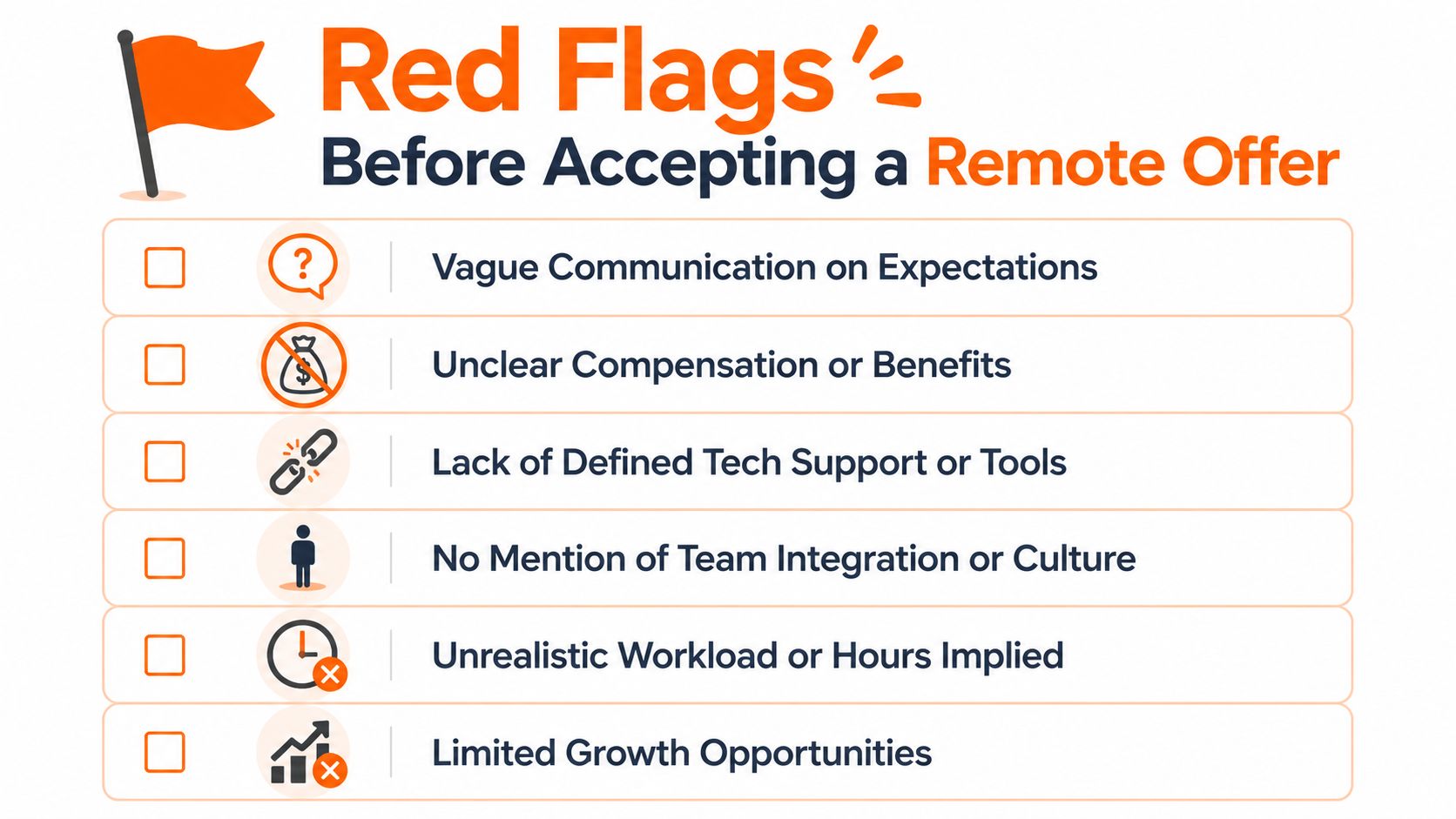
The red flags that matter most
Vague remote policy
If nobody can explain work hours, meeting norms, equipment support, or travel expectations clearly, expect confusion after you join.Promotion language that sounds office-first
Listen for hints that important decisions happen informally among people who are physically present.No onboarding process
“We move fast” is not a substitute for documented onboarding, access setup, and manager support.Personal tools for company work
Be cautious if the company expects you to use personal accounts, personal software, or unclear systems to handle company data.Unclear performance metrics
You should know how success is measured before day one.Pressure to decide immediately
Rushed offers often signal weak process or weak respect for candidate judgment.
A final safety check also matters. If anything about the company, recruiter behavior, or payment request feels off, review common warning signs in this guide to fraud work-from-home jobs.
A good remote company can answer basic operating questions without getting defensive.
Remote jobs are ok when the role is real, the systems are real, and the expectations are real. That's a higher bar than a “remote” tag. It's also the standard worth holding.
If you're sorting through remote jobs ok and want one place to compare roles, career resources, and practical tools for global work, take a look at YayRemote. It's useful for browsing distributed roles by function, checking application readiness, and thinking through time-zone, visa, and location planning before you make your next move.