Remote Python Developer Jobs: The Ultimate 2026 Career Guide
Discover high-paying remote Python developer jobs in 2026. Learn about top salaries, essential skills, and interview tips to stand out in today's market.
You've probably done this already. You open a job board, type “remote python developer,” and get a flood of results that look promising for about ten seconds. Then the filters start to matter. “Remote” really means U.S. only. Or Europe only. Or overlap with Pacific time. Or the role is technically Python, but the stack is mostly AWS, Terraform, and Go. Or it asks for senior-level ownership when you've been operating more like a solid mid-level backend developer.
That gap between what job boards show and what companies want is where most developers waste time.
The good news is that remote python developer jobs are still a real market, not a fading pandemic leftover. According to OneHour Digital's summary of Stack Overflow survey data, 32.4% of developers worked fully remote in 2025, down from 38% in 2024. That decline matters, but the more important point is that fully remote work still represents a substantial part of software hiring.
Python also keeps showing up where companies are willing to hire remotely: backend systems, APIs, data platforms, AI, analytics, security tooling, fintech, healthcare software, and eCommerce. That combination is why remote python developer jobs remain attractive. They sit where a durable language meets a durable working model.
Your Guide to the Remote Python Job Market
A lot of developers approach this market as a volume game. Apply everywhere. Rewrite the resume a little. Hope something lands. That approach works badly in remote hiring because the label “remote” hides several different markets.
One listing is global and async-friendly. Another needs you in one legal jurisdiction. A third says remote but expects close time-zone overlap and a lot of synchronous collaboration. If you treat all three as the same opportunity, your applications get noisy fast.
The practical way to look at remote python developer jobs is this: you're not only trying to prove you can write Python. You're trying to match your experience, location, communication style, and technical depth to the right remote setup.
Practical rule: Don't ask only “Can I get a remote Python job?” Ask “Which remote Python market am I actually qualified for right now?”
That single shift changes how you search. A mid-level backend engineer with Django, PostgreSQL, Git, and Docker experience may be very competitive for one class of remote role and almost invisible for another. The issue usually isn't raw ability. It's mismatch.
When I mentor developers through this process, I push them to stop reading job boards like catalogs and start reading them like signals. Seniority wording, timezone constraints, tool requirements, and deployment expectations tell you more than the title does.
If you do that well, the market gets less overwhelming. You stop chasing every opening and start building a shortlist that fits your profile.
The Remote Python Market Landscape in 2026
Salary is where expectations often break first. A lot of candidates assume remote work flattened compensation. It didn't. Remote widened access, but geography still affects pay.
According to Mismo's guide to remote Python jobs, the average annual salary for a remote Python developer in the U.S. is around $121,932, with most roles ranging from $100,500 to $138,500 and senior developers earning $160,000 or more. That's strong compensation, but it doesn't automatically translate one-to-one across global hiring.
The same source notes a global benchmark from Arc.dev of $72,489 per year, based on self-reported data from more than 300,000 Arc developers, with salaries starting from $59,300 to $86,521+. The gap tells you something important. Remote work expanded access, but it didn't erase salary stratification by market.
What remote usually means in practice
Most remote python developer jobs fall into a few buckets:
| Remote setup | What it usually means | Who it fits best |
|---|---|---|
| Remote in-country | You can work from home, but only inside one country | Developers who already live in the hiring market |
| Remote in-region | The company hires across a group of countries or a broad region | Candidates with timezone overlap and legal eligibility |
| Global remote | Hiring is open across borders, often with async workflows | Developers with strong written communication and self-management |
| Remote with overlap | Location is flexible, but working hours aren't | Engineers comfortable shaping their day around another timezone |
This distinction matters because the same title can produce very different outcomes. One company's “remote backend Python developer” role may function like a standard domestic job with home-office flexibility. Another may be built for distributed teams by design.
A clearer salary frame
Here's a practical way to think about compensation targets without assuming every market behaves the same way.
| Experience Level | Typical US Salary Range (Annual) | Typical Global Salary Range (Annual) |
|---|---|---|
| Mid-level | $100,500 to $138,500 | $59,300 to $86,521+ |
| Senior | $160,000 or more | Often below U.S. benchmarks, but can exceed local norms |
| Contract senior Python roles | $140,000 to $150,000 | Varies widely by specialization and client market |
The takeaway isn't “global remote pays poorly.” It's that you need to know which compensation logic the employer is using. Some companies peg pay to headquarters. Some use location bands. Some price by role criticality. Some optimize for lower-cost talent markets.
The strongest candidates don't just ask about salary. They ask how the company defines remote compensation.
If you're still calibrating what a strong remote engineering profile looks like, this guide on how to become a remote software engineer is worth reading alongside active job searches.
Why this market still attracts serious candidates
Even with the spread between U.S. and global pay, remote python developer jobs remain compelling for one reason. Python is attached to work that companies consider core: APIs, data systems, automation, platform tooling, analytics, and AI-adjacent products.
That makes the market more durable than trend-driven hiring categories. But durability doesn't mean simplicity. It means you need better filters. Compensation, geography, overlap expectations, and seniority are the first four.
Mastering the In-Demand Python Skillset
A remote team opens your résumé, likes the Python title, then starts looking for proof that you can own work without a lot of back-and-forth. That is the standard. Remote hiring managers are trying to answer a simple question: can this developer take a ticket, clarify the missing details, ship clean code, and communicate trade-offs before problems spread?
That is why the skillset for remote python developer jobs is narrower than many candidates expect. DailyRemote's Python developer hiring guide points to a consistent baseline: strong Python fundamentals, one major web framework such as Django, FastAPI, or Flask, plus Git, database design, SQL and ORM usage, Docker, and familiarity with cloud platforms like AWS, GCP, and Azure.
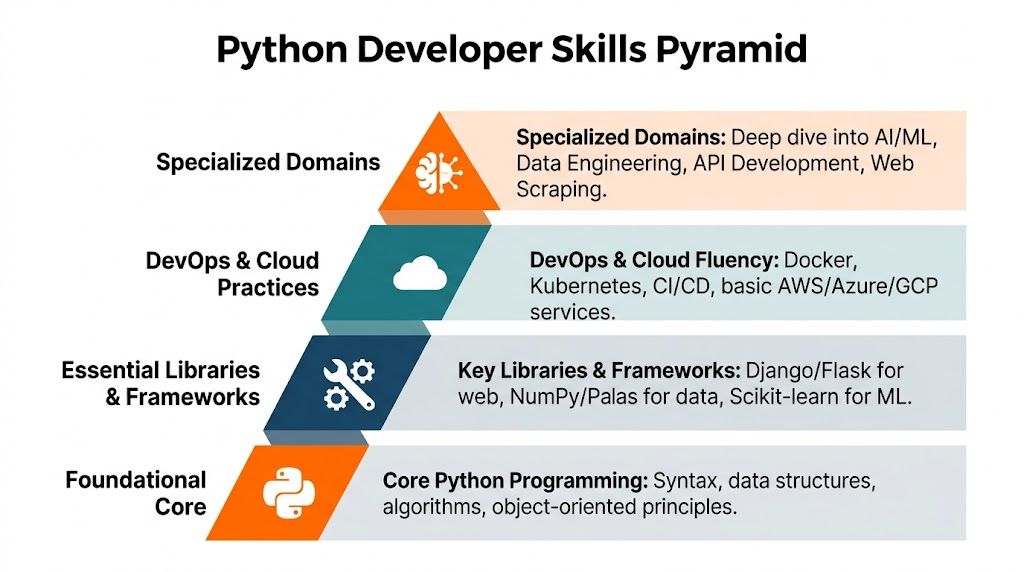
The base layer you can't fake
Mid-level developers often lose ground here because they chase visible tools before tightening the habits remote teams depend on.
You need to be comfortable with:
- Core Python fluency beyond syntax. That includes data structures, object-oriented design, error handling, testing, and writing code another engineer can review quickly.
- Git as part of collaboration. Clear commits, sensible branching, and readable pull requests matter more in remote teams because written artifacts carry more weight than office conversation.
- SQL and data modeling at a practical level. Backend interviews expose weak query design fast, and take-home projects do the same.
If that foundation is weak, another framework tutorial will not fix it.
Choose one framework and know it deeply
Breadth looks good on a skills list. Depth gets interviews converted into offers.
Django fits teams that want established patterns, admin tooling, authentication out of the box, and fast delivery for database-heavy products.
FastAPI shows up often in API-first systems, service-oriented architectures, and teams that care about type hints and performance.
Flask still has a place in internal tools, lightweight services, and codebases where the team wants more control over structure.
The trade-off is straightforward. Django gives speed through convention, but you accept its opinions. FastAPI gives a modern API experience, but you still need to make more architectural choices around the edges. Flask gives flexibility, but it also asks for stronger engineering discipline because fewer decisions are made for you.
Hiring teams usually prefer one framework you have used in production, or at least built seriously with tests and deployment notes, over three that only appear in demo repos.
Hiring signal: A single polished FastAPI or Django project with tests, clear README documentation, environment setup, and deployment instructions is more persuasive than a GitHub profile full of unfinished experiments.
Delivery skills are where remote hiring gets stricter
Remote companies do not just hire coders. They hire engineers who can deliver safely.
That usually means you can explain:
- Docker well enough to package and run your app consistently
- Cloud basics in AWS, GCP, or Azure, including deployment, secrets, logging, and environment configuration
- CI/CD workflows so you understand how code gets tested and released
- ORM usage and schema changes without creating avoidable production issues
This is often where the market's senior bias becomes obvious. A junior or early mid-level candidate may know Python and a framework. A stronger remote candidate can also explain how the app is deployed, how failures are detected, and what trade-offs were made in the design.
That difference matters more in remote roles than in office-heavy teams because managers have less appetite for constant implementation supervision.
Specialization raises your ceiling, but only if it matches the role type
Specialization changes what kinds of remote roles you should pursue.
If you are targeting globally distributed companies, backend and API work often travels well because the expectations are easier to standardize across regions and time zones. If you are targeting geo-restricted roles tied to a specific market, deeper specialization in data, machine learning, or platform work can command stronger compensation because the employer is filling a narrower, harder-to-replace need.
The skill stacks usually split like this:
| Specialization | Tools and concepts that usually matter |
|---|---|
| Machine learning engineering | TensorFlow, PyTorch, model serving, evaluation discipline |
| Data science | Pandas, NumPy, Matplotlib, analysis workflows |
| API and backend systems | FastAPI or Django, authentication, database performance, service design |
| Data platform work | Pipeline reliability, transformations, storage patterns, orchestration awareness |
The premium comes from operating in a harder domain with clearer consequences. Model quality, data quality, uptime, and system behavior affect product decisions, customer trust, or revenue.
Adding “AI” to a résumé without that depth does not help.
What to learn next if you're mid-level
If your goal is a better remote Python role, build your stack in an order that matches how remote teams evaluate risk:
- Tighten Python fundamentals until coding screens feel predictable.
- Go deep on one framework that appears in the jobs you want.
- Ship one real project with tests, Docker, and deployment notes.
- Add cloud and CI/CD basics so you can talk about delivery, not just implementation.
- Pick one specialization that fits your target market, not three disconnected ones.
- Practice explaining trade-offs out loud. Why Django here? Why FastAPI here? Why this schema, cache, or queue?
That last point is underrated.
Remote hiring is full of candidates who can write code. Fewer can explain decisions clearly, document assumptions, and make other engineers comfortable trusting their judgment. That is the skill layer that moves you from “can code in Python” to “safe remote hire.”
Your Strategic Job Search Blueprint
Most developers search for remote python developer jobs the same way they search for local jobs. That's the wrong model. Remote hiring has more hidden constraints, so your search needs to be more selective from day one.
The first filter isn't stack. It's the actual meaning of remote. As Turing's remote senior Python developer page makes clear, listings vary widely. Some are fully remote and worldwide. Others are limited by geography or time zone. That difference materially changes whether a role is worth your time.

Match the platform to your level
Different platforms surface different slices of the market.
| Platform type | What you'll usually find | Main trade-off |
|---|---|---|
| Large aggregators | High listing volume, broad seniority spread, mixed quality | More noise and more duplicate roles |
| Senior-focused talent platforms | Better pay potential, stricter vetting, more advanced expectations | Tougher entry for mid-level candidates |
| Curated remote-first boards | Cleaner filtering by remote setup, role type, and company style | Lower volume, but usually better relevance |
If you're mid-level, don't spend all your time on senior-only ecosystems and then conclude the market is impossible. It may just mean you're fishing in the wrong pond.
Build two separate searches
One search should target geo-restricted roles where your location is a direct advantage. The other should target global or flexible remote roles where your communication style, autonomy, and portfolio matter more than where you live.
That separation makes your applications better. For geo-restricted roles, emphasize legal eligibility, timezone alignment, and familiarity with local working norms. For global roles, emphasize documentation, async communication, and independent execution.
Specialized remote platforms become more useful than giant boards in these situations. Filters like salary range, benefits, experience level, and time zone narrow the field in ways generic search often doesn't. Tools that help you estimate schedule compatibility also matter more than people realize when a team is distributed across regions.
If a job board can't help you evaluate location limits and overlap expectations, you'll end up doing that work manually on every listing.
Read listings for hidden signals
Good candidates don't just skim bullet points. They infer team shape from wording.
Here's what I watch for:
- “Works across time zones” often means stronger written updates and less hand-holding are required.
- “Collaborates closely with product and design” can signal more meetings and more context-switching.
- “Owns services end to end” usually means the company expects deployment and operational maturity, not just coding.
- “Senior” with vague scope sometimes means the company wants autonomy but doesn't yet know how to define it.
Stop applying to jobs you can't actually win
A strategic search removes false positives early.
Don't apply just because the title says Python and remote. Apply when these things line up:
- Your timezone reality matches their collaboration model
- Your strongest framework matches the team's actual stack
- Your experience depth matches the ownership level in the description
- Your compensation target is plausible for that market
- Your work style fits the role's communication demands
This isn't about being overly cautious. It's about using your attention where it has the most impact. A smaller set of high-fit applications usually beats a larger set of vague ones in remote hiring.
Crafting Your Remote-Ready Application
A generic résumé is easy to spot. In remote hiring, it fails even faster because companies are screening for a narrower thing than “good developer.” They want someone who can deliver without heavy supervision, communicate clearly in writing, and ramp up without sitting next to the team.
That means your application package has to answer remote-specific concerns before anyone asks.
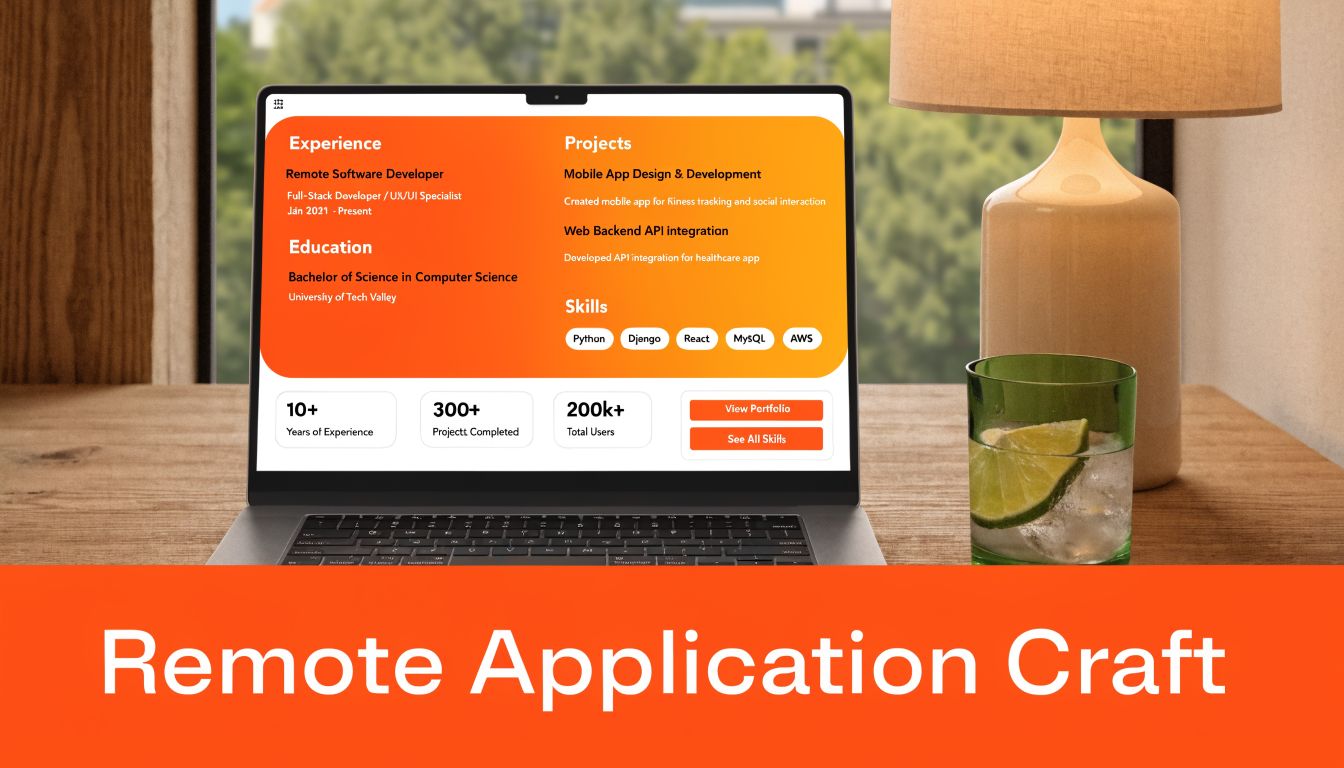
Write for both ATS and technical humans
The ATS pass still matters. If a role asks for Django, PostgreSQL, Docker, AWS, and Git, those exact skills should appear naturally in your résumé if you've worked with them. Don't bury them in a long paragraph under a job title that says almost nothing.
A practical resource on optimizing your resume for ATS can help if you've never audited your résumé from that angle.
But ATS isn't the final audience. A hiring manager will still look for signs that you work like a remote engineer. That usually means bullets that show ownership, written communication, and delivery quality.
Show remote readiness in your evidence
Your GitHub and portfolio should make remote collaboration feel low-risk.
Include projects that show:
- Readable setup instructions so someone can run the project without guessing
- Clear commit history that reflects incremental thinking instead of one huge dump
- Tests and validation because remote teams trust engineers who reduce ambiguity
- Concise documentation explaining architecture, trade-offs, and known limitations
A lot of developers upload code and stop there. That misses the point. In remote hiring, documentation is part of the product.
Your portfolio shouldn't just prove that you can build. It should prove that someone else can understand what you built without needing a call.
Frame mid-level experience the right way
If the market feels senior-heavy, don't try to cosplay as a staff engineer. That backfires. Instead, frame your experience in terms companies care about.
Talk about owning a service, improving reliability, handling production bugs, working with product requirements, writing tests, or shipping under deadline. Those are autonomy signals. Remote teams value them because they reduce management load.
A strong mid-level application says, in effect, “I don't need constant steering.” That's much more persuasive than inflating titles or stuffing your résumé with every Python keyword you've seen online.
Nailing Remote Interviews and Take-Home Tests
You join a remote interview five minutes early. Camera on, notes open, repo links ready. Within ten minutes, the team is already judging something more important than whether you can write Python from memory. They are judging whether handing you real work across time zones will feel low-risk.
That matters even more in remote Python hiring because the stronger roles often skew senior and specialized. Global-first teams usually expect autonomy fast. Geo-restricted teams may offer more structure, but they still screen hard for communication quality because managers cannot rely on hallway fixes. If you are interviewing for a well-paid backend, platform, data, or ML role, expect the process to test judgment, writing, and scope control, not just syntax.

Treat the first call like a communication screen
The recruiter screen and hiring manager intro are usually filtering for clarity. Remote teams need engineers who can explain a messy production issue in plain language, summarize trade-offs in Slack, and ask sharp follow-up questions without creating churn.
Give answers with structure. Start with the problem, then your scope, then the trade-off, then the result.
Good answer: “I owned the API layer for a Django service handling billing events. The main issue was retries causing duplicate writes. I added idempotency keys, wrote tests around failure cases, and documented the constraints because support and product needed to understand the edge cases too.”
That answer gives the interviewer something concrete to trust.
If you want to sharpen for early-stage screens, review these remote job interview questions hiring teams actually ask. Pay attention to the communication prompts, not just the technical ones.
Live coding rewards visible thinking
A lot of mid-level developers lose points here because they treat live coding like a private contest. In a remote process, silence reads badly. The interviewer cannot infer your judgment if you never externalize it.
State your assumptions early. Say what you are optimizing for. If the problem has multiple valid paths, pick one and explain why. Readability usually beats cleverness unless the prompt clearly asks for performance tuning.
A strong live-coding round usually includes:
- clarifying the input and edge cases before writing code
- breaking the problem into small steps you can verify
- testing with a quick example as you go
- naming trade-offs in plain English
- recovering calmly when you hit a bug
I have seen candidates write a technically correct solution and still lose because they created too much uncertainty around how they think. Remote teams are sensitive to that. They are hiring for signal quality under constraints.
Take-home tests are really collaboration tests
The code matters. The packaging matters almost as much.
Companies use take-homes to answer a practical question: if this person ships something on Tuesday, will another engineer understand it on Wednesday without a rescue call? That is why thin documentation, weak setup instructions, and missing tests hurt more in remote hiring than many candidates expect.
A take-home submission gets stronger when it includes:
- A short README with setup, assumptions, and how to run tests
- A sensible project structure that reflects how you would ship real work
- Tests for the main flows and one or two failure cases
- A brief trade-off note explaining what you chose not to build and why
- A time box that matches the assignment instead of a weekend-long overbuild
That last point is underrated. Overbuilding can backfire. Some teams read it as poor scope control. Others worry you will turn every task into a science project. Good remote engineers finish the asked-for work, document what remains, and leave the handoff clean.
Interview heuristic: A take-home should show that your code can be read, run, and extended without a meeting.
For ML, analytics, and AI-heavy Python roles, domain reasoning often matters as much as implementation. This guide can help you ace your data & AI interviews because those loops often probe experiment judgment, data quality assumptions, and model trade-offs.
A short visual refresher can also help before your next process:
Final rounds test trust under ambiguity
By the final stage, the technical bar is usually clear enough. The open question is whether you can operate without constant steering.
Expect discussion around production incidents, cross-functional disagreement, changing requirements, and times you made a call with incomplete information. Strong answers do not try to sound flawless. They show how you handled uncertainty, what you communicated, what you documented, and how you reduced risk for other people.
This is also where role type matters. A globally distributed startup may care more about async decision-making and independent execution. A geo-restricted company with a larger engineering org may probe how you work across product, QA, and compliance inside more formal processes. Tailor your examples to the operating model of the company, not just the job title.
If you are mid-level, do not try to imitate a staff engineer in the room. Show reliable ownership at your current altitude. Clear thinking, scoped judgment, and calm communication carry more weight than inflated claims.
Negotiating Your Offer and Thriving Remotely
Negotiation starts before the offer call. If you understand the compensation logic behind the role, you won't get caught arguing from the wrong frame. Some companies benchmark to one market. Others use location-adjusted bands. You need to know which one you're discussing.
That's where salary research becomes useful as context, not as a script. If you need a broader frame for remote compensation across technical roles, this overview of technology job salaries helps you calibrate expectations.
When you negotiate, keep the conversation tied to scope, seniority, and the value you'll own. If the role is remote but location-adjusted, ask directly how the company handles compensation bands, progression, and future increases. A lower headline number can still be a strong offer if the role has better scope, stability, and growth.
For the behavioral side of late-stage conversations, this CloudDevs behavioral interview question list is a good prep aid because many negotiation-stage interviews are really trust-stage interviews.
Once you accept, the actual work begins. The developers who do well remotely usually get a few habits right early:
- Set communication norms fast. Agree on update cadence, escalation paths, and how blockers are surfaced.
- Write things down. Decisions that live only in calls create drag for distributed teams.
- Protect your boundaries. Remote access can turn into constant availability if you let it.
- Stay visible through output. Clear updates, shipped work, and thoughtful questions matter more than performative busyness.
Remote python developer jobs reward autonomy. They also expose weak habits quickly. If you can search strategically, present yourself clearly, and work in a way that lowers friction for the team, you won't just land a role. You'll grow inside it.
YayRemote is a useful place to put this strategy into practice. You can browse hand-picked remote roles, filter by salary, benefits, experience, and timezone fit, and use tools that make cross-border job searching less messy. If you want remote work without spending hours sorting low-fit listings, it's worth exploring.