Your Guide to Virtual Assistant Remote Success
Launch your virtual assistant remote career with our guide. Master skills, tools, & strategies to land high-paying clients and thrive in a remote role.
You’re probably reading this with a messy tab bar open. One tab has remote jobs. Another has a half-finished resume. A third has someone on social media saying they became a VA in a week, which sounds suspiciously neat compared with your real life.
That’s normal.
Many who pursue virtual assistant remote work aren’t starting from a blank slate. They already know how to organize calendars, reply to customers, manage spreadsheets, chase follow-ups, fix formatting, or keep projects moving. The hard part isn’t whether they can do useful work. The hard part is turning scattered experience into a role that employers or clients will hire for.
That’s the shift to make. Stop thinking of remote VA work as “doing random admin from home.” Start treating it like a professional service built around reliability, communication, systems, and a clear specialty.
The Booming World of Remote Virtual Assistants
Remote VA work isn’t a fringe option anymore. It’s a real labor market with room for beginners, specialists, and career switchers who are willing to get specific about what they offer.

What the role actually looks like now
A modern virtual assistant remote role can include:
- Administrative support like inbox management, scheduling, travel coordination, and document prep
- Operations support such as task tracking in Asana or Trello, SOP cleanup, CRM updates, and follow-ups
- Customer-facing work including support tickets, client onboarding, and meeting coordination
- Specialized execution like social media scheduling, bookkeeping support, reporting, research, or bilingual communication
That last category matters most.
The fastest way to get ignored is to market yourself as someone who can “help with anything.” Clients rarely want anything. They want something specific handled well, on time, and without hand-holding.
Why this field keeps growing
Demand is growing because companies want flexible support without forcing every role into a traditional office structure. According to Future Market Insights on the virtual assistant services market, the global virtual assistant market is projected to expand from USD 19,506.2 million in 2025 to USD 55,406.3 million by 2035, a 184% increase, and that growth is tied to a 35% rise in demand for VAs in 2024 as companies embraced remote work.
That tells you two things.
First, this isn’t a stopgap category. Second, businesses are hiring VAs because they solve an operating problem. Founders need to achieve more. Teams need support. Managers need someone who can own recurring tasks without creating more work upstream.
Practical rule: A VA becomes valuable when the client stops checking every small detail.
What beginners get wrong
New VAs often assume they need a perfect business setup before applying. They don’t.
They need a workable offer, a believable resume, a simple portfolio, and proof they understand remote collaboration. That’s enough to start. Your first goal is not to look impressive to everyone. It’s to look useful to the right employer or client.
Here’s the better frame:
| Weak framing | Strong framing |
|---|---|
| “I’m available for any VA tasks.” | “I support busy teams with calendar coordination, inbox triage, and project follow-up.” |
| “I’m a fast learner.” | “I’ve already used Slack, Google Workspace, and task boards to keep work moving.” |
| “I need someone to give me a chance.” | “I can remove recurring admin bottlenecks so you can focus on higher-value work.” |
If you’re serious about virtual assistant remote work, treat it like a service profession. Reliable communication matters. Documentation matters. Judgment matters. The people who last in this field aren’t always the most naturally talented. They’re the ones clients trust with moving parts.
Defining Your Niche and Building Your Skillset
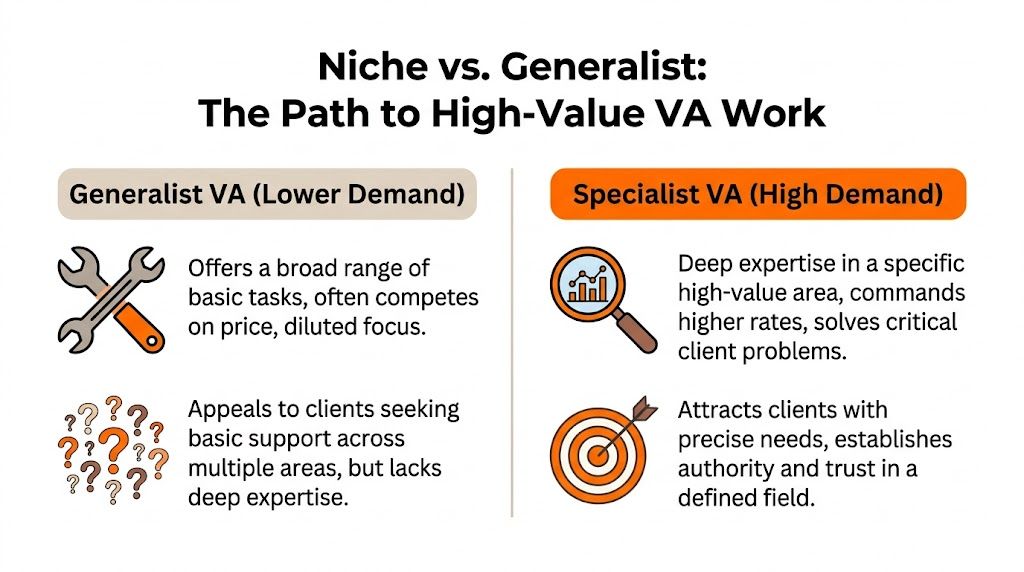
Generalists can get work. Specialists usually get better work.
That doesn’t mean you need a narrow identity on day one. It means you should stop presenting yourself like a miscellaneous task bucket. Clients pay more attention when they can quickly understand what problem you solve.
Pick a niche by matching past work to current demand
A niche is usually hiding inside work you’ve already done.
If you’ve supported managers, handled meetings, and kept calendars sane, you may fit executive assistance. If you’ve answered customer questions and tracked issues, customer support operations may be stronger. If you’ve maintained listings, checked order issues, or updated product info, e-commerce support is a natural lane.
A few common paths:
| Niche | Core tasks | Common tools |
|---|---|---|
| Executive assistance | Calendar management, travel, meeting prep, inbox triage | Google Calendar, Slack, Zoom, Notion |
| Marketing VA | Content scheduling, asset coordination, reporting, light design | Canva, Buffer, Asana, Google Drive |
| E-commerce support | Order tracking, product updates, customer queries, refunds | Shopify, Gorgias, spreadsheets |
| Technical VA | CRM cleanup, automation support, database maintenance, SOPs | HubSpot, Airtable, Zapier, ClickUp |
| Bookkeeping support | Expense tracking, invoice support, reconciliation prep | QuickBooks, Xero, spreadsheets |
The best niche is the one that fits both your background and your tolerance. Some people hate inbox work but love structured reporting. Others enjoy client communication and hate backend systems. Pay attention to that early.
Use a simple skills audit
Before you buy a course or rewrite your whole profile, audit yourself.
Write down three columns:
- Tasks you can already do without help
- Tools you’ve used in real work
- Problems people already trust you to solve
That third column is the most revealing. Plenty of people can use software. Fewer people can calm a disorganized workflow, keep a founder on schedule, or spot missing details before they become client-facing mistakes.
If you need help translating messy experience into marketable skills, this guide on remote work skills for a resume is useful because it helps you phrase what you already know in language remote employers recognize.
Clients hire confidence in outcomes, not admiration for effort.
Learn the tools that support the niche
Tool chasing wastes time. You don’t need to learn every platform. You do need to become fluent in a small tool stack that maps to your target role.
A practical starting stack for most VAs includes:
- Google Workspace for docs, sheets, calendars, and shared files
- Slack for async communication
- Asana, Trello, or ClickUp for task tracking
- Zoom or Google Meet for calls
- Canva if your role touches content or visual assets
Then add niche tools based on the work you want.
A technical VA should learn how CRMs are organized. An e-commerce VA should understand product catalogs and support workflows. An executive assistant should get excellent at calendar logic, meeting prep, and note capture.
What works and what doesn’t when upskilling
What works:
- Practice in the actual tool, not just by watching tutorials
- Recreate realistic tasks, such as building a content calendar or cleaning a fake CRM
- Document your process so you can later turn it into portfolio material
What doesn’t:
- Collecting certificates without proof of execution
- Listing software you’ve only opened once
- Trying to specialize in four directions at the same time
The cleanest path is to choose one primary lane and one supporting skill. For example, executive assistance plus project coordination. Or customer support plus reporting. Or admin support plus bilingual communication.
That combination gives you focus without boxing you in too early.
Building a Portfolio That Attracts High-Value Clients
Most beginners think they need paid client work before they can build a portfolio. They don’t. They need proof.
Proof can come from mock projects, volunteer work, internal company work, freelance samples, or well-documented process examples. A strong portfolio doesn’t just show what you made. It shows how you think, how you organize work, and how you reduce friction.
Start with a resume that can survive screening
Your resume should be written for the role you want, not the role you used to have.
If you’re applying for virtual assistant remote jobs, pull your experience toward these themes:
- Coordination
- Communication
- Documentation
- Task ownership
- Tool fluency
- Remote readiness
Bad resume line: “Responsible for administrative duties.”
Better resume line: “Managed calendars, tracked follow-ups, prepared documents, and coordinated deadlines across multiple stakeholders.”
If a job description mentions scheduling, client communication, CRM updates, reporting, or task management, mirror that language accurately where it fits. That makes your resume easier for both ATS software and human reviewers to understand.
Build portfolio pieces even if no one has hired you yet
You can create strong sample work from scratch.
Try building these:
- A mock inbox triage system with labels, response categories, and escalation rules
- A sample weekly operations dashboard in Google Sheets
- A content planning board in Trello or Asana
- A client onboarding checklist with forms, task assignments, and deadlines
- A short SOP showing how you complete a recurring task
These projects work because they mirror real support work. They also let you show judgment, not just aesthetics.
Here’s a useful structure for each portfolio item:
| Include | Why it matters |
|---|---|
| Problem | Shows you understand business context |
| Tool used | Demonstrates software familiarity |
| Process | Reveals how you think |
| Result | Shows the intended business value |
| Screenshot or sample | Makes the work tangible |
Turn old jobs into VA proof
A lot of people already have portfolio material hidden inside previous jobs.
Retail experience can become customer communication and issue resolution. Office work can become calendar management and document handling. School administration can become stakeholder coordination. Hospitality can become scheduling, client support, and fast problem-solving under pressure.
Don’t undersell “normal” work. Reframe it with precision.
If you’ve ever kept other people organized, protected deadlines, or handled repeat processes without supervision, you already have VA evidence.
Keep the presentation clean
You don’t need a fancy site. A well-organized Google Drive folder, Notion page, or simple portfolio site works fine if it’s easy to review.
A good layout includes:
- Short intro
- Your niche or support areas
- Tools you use
- Selected samples
- Brief contact information
If you need a practical model for how to build a strong freelancer portfolio, Plutio’s guide is worth reviewing because it keeps the focus on clarity and proof instead of overdesign.
The biggest mistake is stuffing your portfolio with everything you’ve ever touched. Curate it. Three relevant examples beat twelve vague ones.
How to Find and Secure Virtual Assistant Remote Work
A lot of beginners search for “virtual assistant remote” and then apply to everything with a pulse. That usually leads to silence.
A better approach is narrower. Search by function, read the posting carefully, and qualify yourself before you apply. You’re not trying to win a numbers game with random applications. You’re trying to show fit.

Search with filters, not hope
Good remote job boards become much more useful once you stop typing only one keyword.
Search combinations like:
- virtual assistant
- executive assistant remote
- operations assistant
- customer support coordinator
- marketing assistant remote
- project assistant remote
Then filter by job type, experience level, and compensation details where available. If you’re still figuring out where to search consistently, this roundup of best remote job boards is a solid starting point.
What I’d do in practice is this:
First, I’d open a role that feels slightly above my level, not wildly above it. Then I’d read for repeated needs. If the posting keeps mentioning inbox management, scheduling, and follow-up, I know the employer values reliability more than flashy branding. That changes how I write my application.
Address time zones before they become an objection
Global remote work sounds flexible until two people are trying to coordinate across continents without saying when they’re available.
According to Freelancer’s virtual assistant job market page, over 70% of remote workers report time zone mismatches as a top productivity barrier. In applications, ignoring this can signal that you haven’t thought through remote collaboration.
If a role serves clients in another region, mention your overlap clearly. Don’t make the employer guess.
For example:
- Weak: “I’m flexible with hours.”
- Better: “I can provide consistent overlap with your working day for meetings, inbox coverage, and urgent follow-ups.”
Tools like a time zone overlap calculator become practical, not decorative. Before you apply, check whether your schedule realistically fits the employer’s core hours. If it doesn’t, decide whether async work will be enough for that role.
Many applications fail before the interview because the candidate never answers the employer’s hidden question: “Will working with this person be easy?”
A short explainer can help if you’re still getting your head around remote communication expectations:
Write applications that solve a problem
Skip the template-heavy cover letter that says you’re passionate, hardworking, and excited for the opportunity. Everyone says that.
Do this instead:
- Open with role fit by naming the exact support functions you handle
- Mirror the employer’s workflow language from the posting
- Mention tools only where relevant
- Show remote awareness by addressing communication, availability, and time zone fit
- Close with usefulness, not enthusiasm alone
A strong opening might sound like this:
I support busy teams with calendar coordination, inbox triage, and follow-up systems that keep deadlines from slipping. Your posting stood out because the role centers on recurring operational support, not just one-off tasks, and that’s where I do my best work.
That works better than a generic introduction because it starts with their need.
Navigating Interviews and Structuring Your First Contract
Interviews for remote VA roles usually test one thing more than anything else. Can this person make work easier without creating extra management overhead?
You don’t need polished corporate theater to answer that well. You need examples, boundaries, and a clear way of working.
Answer interview questions like an operator
When you get asked how you handle competing priorities, don’t say you’re “good under pressure.” Explain your method.
A better answer sounds like this: you confirm deadlines, identify what blocks other people first, organize work in a visible system, and communicate early if trade-offs are needed.
Common questions often revolve around:
- How you manage deadlines
- How you communicate remotely
- How you handle unclear instructions
- What tools you’ve used
- How you protect accuracy
If you want a useful prep list, these remote job interview questions are good prompts to rehearse against. Use them to prepare short stories from your own experience, not memorized scripts.
Push for SMART deliverables early
A vague role is expensive. It creates confusion, rework, resentment, and scope creep.
According to Virtual Coworker’s guide on setting clear expectations for virtual assistants, using SMART goals increases remote project success rates from 50% to over 80%, and vague briefs are a leading cause of outsourcing failure and client dissatisfaction.
That matters even more when you’re new. If the employer or client says, “Just help us stay organized,” your job is to turn that into something concrete.
For example:
| Vague request | Better SMART version |
|---|---|
| Help with inbox | Review inbox twice daily, flag urgent items, draft replies, and maintain response tracking |
| Keep projects moving | Update task board daily, follow up on overdue items, and send a weekly status summary |
| Support the founder | Manage calendar, prep meeting notes, confirm appointments, and track action items |
SMART doesn’t make you rigid. It makes expectations visible.
Clear scope protects both sides. Clients know what they’re buying. You know what you’re responsible for.
Choose a pricing model that matches the work
If you freelance, pricing structure matters almost as much as pricing itself.
Three common models:
- Hourly works well when scope changes often or the client is still figuring out what they need
- Project-based works when the deliverable is clear, such as CRM cleanup or inbox setup
- Monthly retainer works best for ongoing support with recurring responsibilities
For beginners, hourly can be safer because it protects you from underestimating messy work. Retainers become better once you understand the client’s rhythm and can define the recurring tasks clearly.
If you need help thinking through the trade-offs, Solo AI Website Creator has a practical guide on how to price your services that’s useful for framing value and choosing a structure.
Put these clauses in your first contract
A simple contract is better than a friendly agreement lost in chat history.
Include:
- Scope of work with clear tasks and limits
- Communication norms such as response windows and channels
- Payment terms including due dates and invoicing method
- Confidentiality expectations
- Revision or change policy
- Termination terms
- Access and account handling rules
If a client resists clarity, pay attention. Confusion at the start usually gets worse, not better.
From First Client to Thriving Remote Business
Your first client proves you can get hired. It doesn’t yet prove you have a durable business.
That shift happens when you stop treating each task as isolated work and start building a reputation for stable outcomes. Clients stay with VAs who reduce stress, communicate clearly, and improve systems over time.
Retainers come from trust, not charm
Long-term work usually grows from small, boring wins done consistently.
That means you:
- Meet deadlines without drama
- Ask useful questions early
- Track recurring tasks
- Document processes as you go
- Spot issues before they become emergencies
A VA who notices that meeting notes aren’t being converted into action items is already more valuable than one who only completes assigned tasks.
This is also where many people raise their rates the right way. Not because they want more money, but because they now own more responsibility, more judgment, and more business-critical work.
Upskill into higher-value support
General admin can open the door. Specialization usually grows income.
According to Indeed’s listings for remote virtual assistant no-degree roles, VAs who move into specialized niches can access roles offering $85k to $105k, especially where the work involves data analysis or bilingual skills for project management.
That doesn’t mean everyone should rush into analytics or bilingual support. It means you should pay attention to which tasks carry more decision-making weight.
A few examples of natural growth paths:
| Starting point | Next step |
|---|---|
| Calendar and inbox support | Executive operations support |
| Customer support admin | Customer success coordination |
| Spreadsheet updates | Reporting and data analysis support |
| General communication tasks | Bilingual client or project support |
What works best is stacking adjacent skills. If you already work in spreadsheets, learn reporting logic. If you already support customers, learn onboarding workflows. If you already write clearly, bilingual support or documentation work may become a strong lane.
Build a business that is easier to run
A thriving remote VA business isn’t built on squeezing more hours out of yourself. It’s built on cleaner systems.
That means standardizing onboarding, keeping reusable templates, saving SOPs, clarifying boundaries, and reviewing which services you want to keep offering. Some VAs eventually expand into a small agency model. Others stay solo and narrow their niche until they become hard to replace.
Both routes work.
The stronger move is the one that gives you sustainable work, better client fit, and enough room to keep getting sharper.
Frequently Asked Questions About Remote VA Work
Do I need to register a business before I start
Usually, no. Many people begin by working as a sole proprietor, then formalize later if the work becomes steady or their local laws make registration worthwhile. What matters at the start is keeping records clean, separating business expenses where possible, and understanding how you’ll invoice and report income.
Check the rules in your country or state early. Don’t rely on advice from random social posts for tax or legal setup.
How should I handle taxes
Track income from the first payment. Track expenses from the first business purchase. Save invoices, software receipts, and payment records in one place.
If taxes confuse you, that’s normal. A good accountant is often cheaper than fixing mistakes later. Even if you’re just testing remote VA work part-time, treat your bookkeeping seriously.
What if I have no direct VA experience
You can still apply if you have adjacent experience. Focus on the actual work you’ve done: scheduling, customer support, research, reporting, coordination, follow-ups, documentation, and tool use.
Then prove it with samples. A small, well-built portfolio can do more for you than a vague claim that you’re motivated.
How do I deal with scope creep politely
Use calm, specific language.
Try this:
I’m happy to help with that. Since it falls outside the current scope, I can either add it to next week’s priorities or send over an updated rate and timeline for the extra work.
That response does three things well. It stays professional, it acknowledges the request, and it protects your time.
Where can I find community and support
Look for communities built around freelancers, remote workers, operations support, or the specific niche you want to enter. Good communities help with referrals, tools, pricing questions, and difficult client situations.
A weak community is just people posting “any leads?” all day. A useful one helps members solve real workflow problems and improve how they work.
What matters most in virtual assistant remote work
Reliability.
Not perfection. Not fancy branding. Not saying yes to everything. Reliable communication, clear boundaries, good judgment, and visible organization matter more than most beginners think.
If you build those habits early, you’ll stand out faster than you expect.
If you’re ready to turn scattered experience into a real remote opportunity, YayRemote is a practical place to start. You can browse hand-picked remote roles, refine your applications with the Skills Analyzer and ATS Resume Checker, and use tools like Time Zone Overlap to show employers you’re prepared for global remote work from day one.