High-Paying Work from Home Telecommunication Jobs 2026
Discover & secure high-paying work from home telecommunication jobs in 2026. Our guide covers top roles, essential skills, resume tips, & best remote openings.
You're probably seeing the same thing most telecom job seekers see. One search pulls up remote support jobs with headset requirements, script adherence, and commission language. The next shows network, VoIP, or systems roles that expect deeper technical skill and offer a very different day-to-day.
That mix confuses people. It also causes bad applications. Candidates apply broadly, use generic resumes, and end up mismatched for both tracks.
Remote work is not a fringe option anymore. In the first quarter of 2024, 35.5 million people in the U.S. worked from home for pay, representing 22.9% of the workforce, and telework accounted for 16.3% of all hours worked according to the Bureau of Labor Statistics telework data. If you're targeting work from home telecommunication jobs, the pertinent question isn't whether the market exists. It does. The smarter question is which telecom market you're trying to enter.
The Growing Landscape of Remote Telecom Work
Remote telecom hiring makes sense for the kind of work many teams already do by phone, chat, ticketing systems, cloud dashboards, and collaboration tools. A support rep can handle account issues from a home office. A VoIP specialist can troubleshoot call flow problems remotely. A network engineer can monitor systems, document incidents, and work through maintenance windows without being onsite every day.
That broader shift toward telework also changes what employers expect. They're no longer hiring for “someone who can probably work from home.” They're hiring for people who can communicate clearly, manage tasks without hand-holding, and stay productive in distributed teams. If you're trying to estimate where telecom roles fit in the wider remote market, it helps to compare them with adjacent tech categories using remote technology job salary benchmarks.
For telecom-heavy customer operations, your setup matters too. Teams handling calls, transfers, voicemail, routing, and softphones need stable systems, not improvised ones. If you want a practical look at how businesses support home-based phone work, this guide to a cost-effective work from home phone system is useful because it shows the kind of infrastructure remote employers often build around.
Work from home telecommunication jobs reward clarity. The clearer you are about the role type, the faster your search improves.
A lot of frustration disappears once you stop treating telecom as one category. It isn't. There are really two separate lanes, and they lead to different hiring standards, tools, pay structures, and career paths.
Decoding the Two Worlds of Telecom Jobs
The phrase work from home telecommunication jobs sounds neat. The actual market isn't. Current job listings commonly blend customer-facing sales and support roles with technical salaried professional roles, even though they require different skills and often come with different compensation structures and benefits, as reflected in current telecom job search results on Indeed.
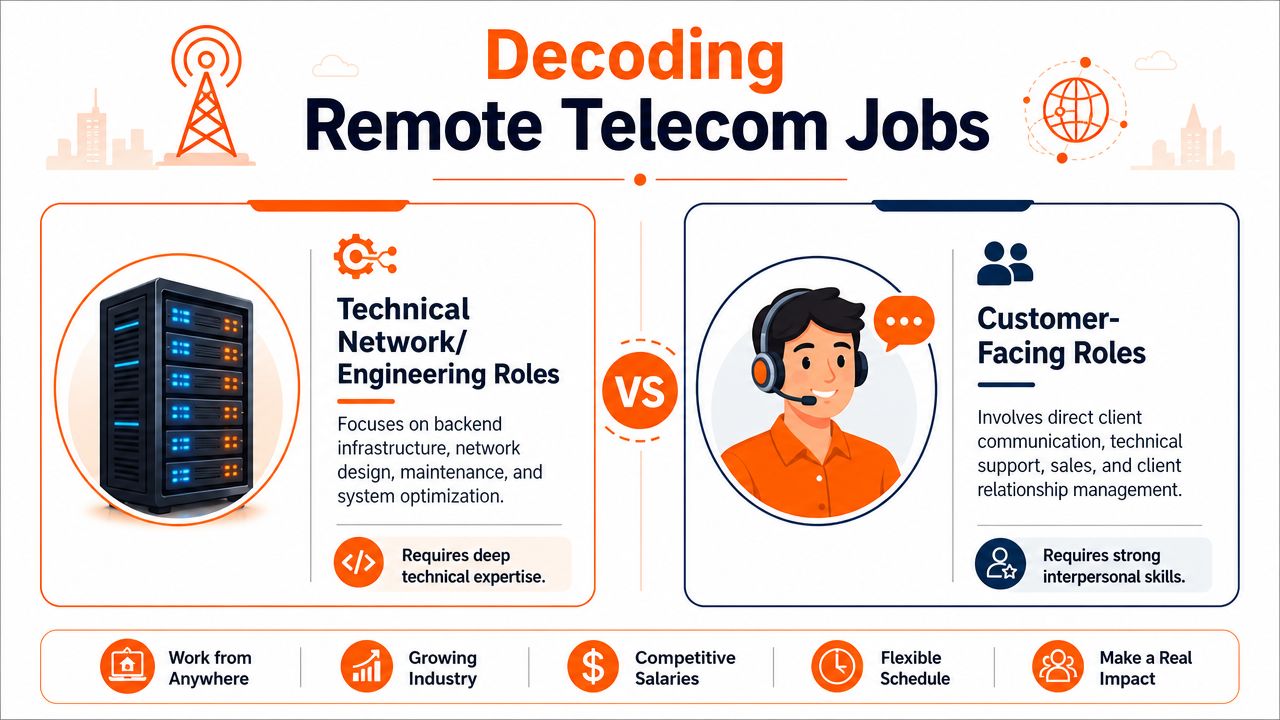
The technical path
This is the side of telecom that deals with infrastructure, systems, performance, and reliability. Typical roles include network engineer, telecom engineer, unified communications specialist, VoIP administrator, systems engineer, and telecom project specialist.
A technical telecom professional usually spends the day in tools, tickets, logs, dashboards, documentation, and meetings tied to implementation or troubleshooting. The work often favors people who like root-cause analysis, structured problem-solving, and long stretches of independent focus.
Good candidates for this path usually think in systems. They don't just answer “what broke?” They ask what changed, what dependency failed, what users were affected, and how to prevent the same outage from recurring.
The customer-facing path
This lane includes telecom sales, retention, support, account coordination, and contact center work. Some jobs focus on inbound customer service. Others revolve around outbound sales, renewals, upgrades, or account rescue.
The daily work is more visible and more measured. Hiring managers often care about call handling, written communication, objection handling, empathy, resilience, and your ability to stay composed with frustrated customers or monthly targets. If you enjoy direct interaction, persuasion, service recovery, and fast-moving queues, this path can fit well.
But it's not the same as technical telecom work. A remote support or sales agent might know the product thoroughly while still not doing infrastructure work. That distinction matters when you write your resume and choose what jobs to pursue.
Which one fits you better
| Attribute | Technical Roles (e.g., Network Engineer) | Customer-Facing Roles (e.g., Telecom Sales) |
|---|---|---|
| Core focus | Systems, infrastructure, reliability | Customers, revenue, service, retention |
| Typical work style | Independent analysis and documentation | High interaction across calls, chat, email, CRM |
| Best-fit strengths | Troubleshooting, logic, detail, change control | Communication, persuasion, patience, responsiveness |
| Common tools | Monitoring platforms, ticketing systems, admin consoles, collaboration tools | CRM platforms, dialers, knowledge bases, ticketing, chat tools |
| Hiring signals | Technical projects, certifications, problem-solving depth | Metrics awareness, call quality, conflict handling, sales or support examples |
| Compensation pattern | Often salaried with benefits | Often base pay plus commission or KPI-linked expectations |
| Promotion route | Senior engineer, architect, systems lead, operations lead | Team lead, account manager, sales manager, customer operations lead |
Practical rule: Don't apply to both tracks with the same resume. Recruiters can tell when a candidate hasn't chosen a lane.
Two fast self-checks
Ask yourself these questions before you apply:
- What kind of work gives you energy: Solving technical issues in the background, or talking customers through decisions and problems in real time?
- How do you want to be measured: By system stability, successful implementations, and technical competence, or by customer outcomes, retention, and revenue activity?
- What would you rather build first: A home lab and documentation portfolio, or a set of call handling stories, sales examples, and CRM fluency?
- What kind of stress can you handle well: Incident pressure and technical ambiguity, or customer pressure and performance targets?
If you answer those truthfully, your search gets much easier.
Building the Right Skills and Certifications
A lot of “no experience” telecom postings are only entry-level on paper. In many remote telecom listings, employers still emphasize performance expectations or prior experience, which suggests that “no experience” often means lower formal credential requirements, not a beginner-friendly role, based on Indeed listings for remote telecommunications no-experience jobs.
That's why skill-building needs to be intentional. Hiring managers don't need perfection. They need evidence that you can do the work.
Skills every remote telecom candidate needs
Regardless of track, a few capabilities show up over and over:
- Written communication: Remote teams rely on Slack, Teams, email, tickets, and internal notes. If your updates are vague, you create friction.
- Async discipline: You need to move work forward without waiting for a live meeting every time.
- Tool comfort: Screen sharing, ticket updates, headsets, CRMs, knowledge bases, and cloud collaboration tools are basic expectations.
- Problem ownership: Good remote hires don't disappear when something gets messy. They escalate clearly, document what happened, and keep others informed.
If you want the technical track
Start with fundamentals, not fancy titles. Learn networking basics, telecom concepts, VoIP terminology, ticket handling, and structured troubleshooting. Build familiarity with tools used in systems and infrastructure environments.
A practical learning route often looks like this:
- Learn core concepts such as routing, switching, SIP, VoIP, DNS awareness, endpoint behavior, and basic network troubleshooting.
- Create proof of skill through a home lab, sample network diagrams, written troubleshooting walkthroughs, or mock implementation notes.
- Study role-adjacent jobs so you understand crossover skills. Reviewing remote infrastructure paths like remote systems administration roles helps because telecom technical jobs often overlap with systems, support, and cloud administration work.
- Document your process. Employers trust candidates who can explain how they think.
If you have certifications, use them to support real examples. A certification alone doesn't carry an interview. A certification plus a specific lab, project, or troubleshooting story does.
If you want the customer-facing track
You don't need to sound like a generic “people person.” Employers want signs that you can handle volume, friction, targets, and follow-through.
Build evidence in these areas:
- CRM fluency: Get comfortable with systems like Salesforce or other customer record tools if you can access practice environments.
- Phone and chat professionalism: Record mock support calls or sales pitches and improve your pacing, tone, and structure.
- Objection handling: Practice clear responses to billing confusion, service concerns, upgrade hesitation, and cancellation risk.
- Metric awareness: If you've worked in retail, hospitality, service, or call-based environments, translate that experience into response time, conversion, retention, escalation, or resolution language.
If a posting says “no experience” but asks for target ownership, retention ability, or prior call-center discipline, treat it like a role where proof matters more than labels.
What actually helps beginners
The strongest move for newcomers is simple. Stop trying to “look experienced” and start showing usable evidence.
For technical roles, that could mean a small home lab, incident write-ups, and a GitHub repo with documentation. For customer-facing roles, it could mean a mock sales deck, sample email responses, support scripts, or a short portfolio that shows how you de-escalate and close.
That's how you narrow the gap between “interested applicant” and “hireable candidate.”
Crafting a Remote-Ready Application Package
Most telecom applications fail before an interview because they're too broad. The resume says “customer service and communication skills” or “experienced IT professional,” but the target role is asking for something narrower. Remote hiring managers want to see role fit fast.

Build two versions if needed
If you're still exploring both telecom tracks, keep separate application packages. One should lean technical. The other should lean customer-facing. Trying to merge them into one “do everything” resume weakens both.
For a technical telecom resume, prioritize:
- Role-specific keywords: VoIP, SIP, ticketing, incident response, network troubleshooting, unified communications, remote support, documentation, escalation, systems monitoring.
- Project evidence: Home lab work, migrations, troubleshooting examples, documentation, setup support, maintenance work.
- Remote signals: Async communication, distributed team collaboration, written handoff notes, remote troubleshooting.
For a customer-facing telecom resume, prioritize:
- Role-specific keywords: Customer support, retention, account management, inside sales, CRM, call handling, escalation management, upselling, service resolution, KPI awareness.
- Outcome framing: Closed issues, retained customers, handled objections, managed queues, coordinated follow-up.
- Remote signals: Video communication, chat support, self-management, schedule adherence, quality standards.
Your cover letter should do one job
A useful cover letter doesn't restate the resume. It explains why you fit this remote telecom role specifically.
Keep the structure simple:
- Opening fit: Name the role category and why it matches your background.
- Work style proof: Show that you can work independently, communicate clearly, and stay organized without close supervision.
- Relevant example: Briefly describe one challenge you handled that mirrors the role.
- Close with alignment: Confirm interest in the company's environment, customers, or technical domain.
A strong line sounds like this in practice: you've supported customers in high-volume environments and know how to stay calm, document accurately, and move issues forward across phone, chat, and ticketing. Or, you've handled technical troubleshooting remotely and are comfortable isolating issues, documenting changes, and communicating status to users and internal teams.
Translate non-remote experience the right way
You don't need prior remote job titles to look remote-ready. You need remote-friendly evidence.
Turn this:
- Helped customers in a store
- Supported office phones
- Assisted managers with reports
Into this:
- Customer issue resolution: Handled real-time service questions and de-escalation under pressure
- Telecom support exposure: Assisted with phone-related workflows, user setup, or issue triage
- Independent coordination: Managed follow-ups, maintained records, and communicated updates across teams
Hiring managers don't need a perfect background match. They need enough evidence to believe you can work without constant supervision.
If you use an ATS checker, make sure it's helping you align language to the actual posting, not stuffing your resume with empty buzzwords. Clean formatting, accurate keywords, and role-specific examples outperform “professional summary” fluff every time.
How to Find and Secure Your Remote Telecom Job
The search itself needs structure. If you just type work from home telecommunication jobs into a job board and apply to everything, you'll waste weeks. A better process looks narrower and more deliberate.
Long-term telecommuting growth gives this search real weight. Analysis cited by Global Workplace Analytics notes that regular telecommuting expanded 216% between 2005 and 2019, while total employment grew 20% over the same period, and it also reports that 75% of employees who work from home earned over $65,000 annually. That's one reason many candidates pursue remote telecom work as a path to higher-value roles rather than just convenience, as summarized by Global Workplace Analytics telecommuting statistics.
Search like a specialist
Use narrow search terms based on the lane you chose.
Technical examples:
- Remote VoIP specialist
- Remote telecom engineer
- Remote unified communications
- Remote network support
- Remote systems and telecom
Customer-facing examples:
- Remote telecom sales
- Remote telecom support
- Remote customer retention telecom
- Remote call center telecom
- Remote internet or wireless support
Use platforms that let you filter by job type, experience level, and salary transparency. If you want a broader process for evaluating distributed roles and search filters, this guide on how to find remote work is useful.
Don't just apply
The strongest candidates usually do more than click apply.
Try this approach:
- Shortlist tightly: Pick a smaller number of roles that clearly match your chosen track.
- Mirror the language: Adjust your resume to the posting's vocabulary if it reflects your experience.
- Find a human contact: Look for a recruiter, team lead, or hiring manager on LinkedIn.
- Send a clean note: Briefly state your fit. Mention one relevant skill area or project. Don't write a life story.
- Track applications: Keep a spreadsheet with role type, company, date, follow-up date, and interview stage.
That process sounds basic, but it beats random volume.
Prepare for the actual interview
Remote telecom interviews usually test three things. Can you do the job, can you communicate clearly, and can you be trusted to work independently.
Expect questions like:
- How do you troubleshoot a service issue when the user is remote and frustrated?
- Tell me about a time you handled multiple priorities at once.
- How do you document updates so the next person can pick up the issue?
- For sales roles, how do you build trust without meeting in person?
- For technical roles, how do you handle an outage or escalation when you're not onsite?
Here's a simple way to answer. State the situation, describe your actions, and end with the result or lesson. Keep the story tight. Remote interviewers pay attention to structure because structure predicts how you'll communicate on the job.
A short resource can help you get in the right mindset before interviews:
One more thing matters a lot. In remote hiring, responsiveness is part of the evaluation. Reply on time. Confirm details. Join prepared. Test your audio. Candidates lose offers over preventable sloppiness more often than they realize.
Thriving and Advancing in Your New Role
Getting hired is only the first checkpoint. Remote telecom careers reward people who make themselves easy to work with, safe to trust, and hard to ignore.
For contact-center and telecom-heavy remote operations, practical benchmarks matter. Teams tend to perform better when they establish one primary messaging channel, monitor engagement with performance data, and put strong cybersecurity measures in place because remote staff may handle sensitive customer details such as addresses and payment information, according to this overview of how inbound contact centers are adapting to remote work trends.
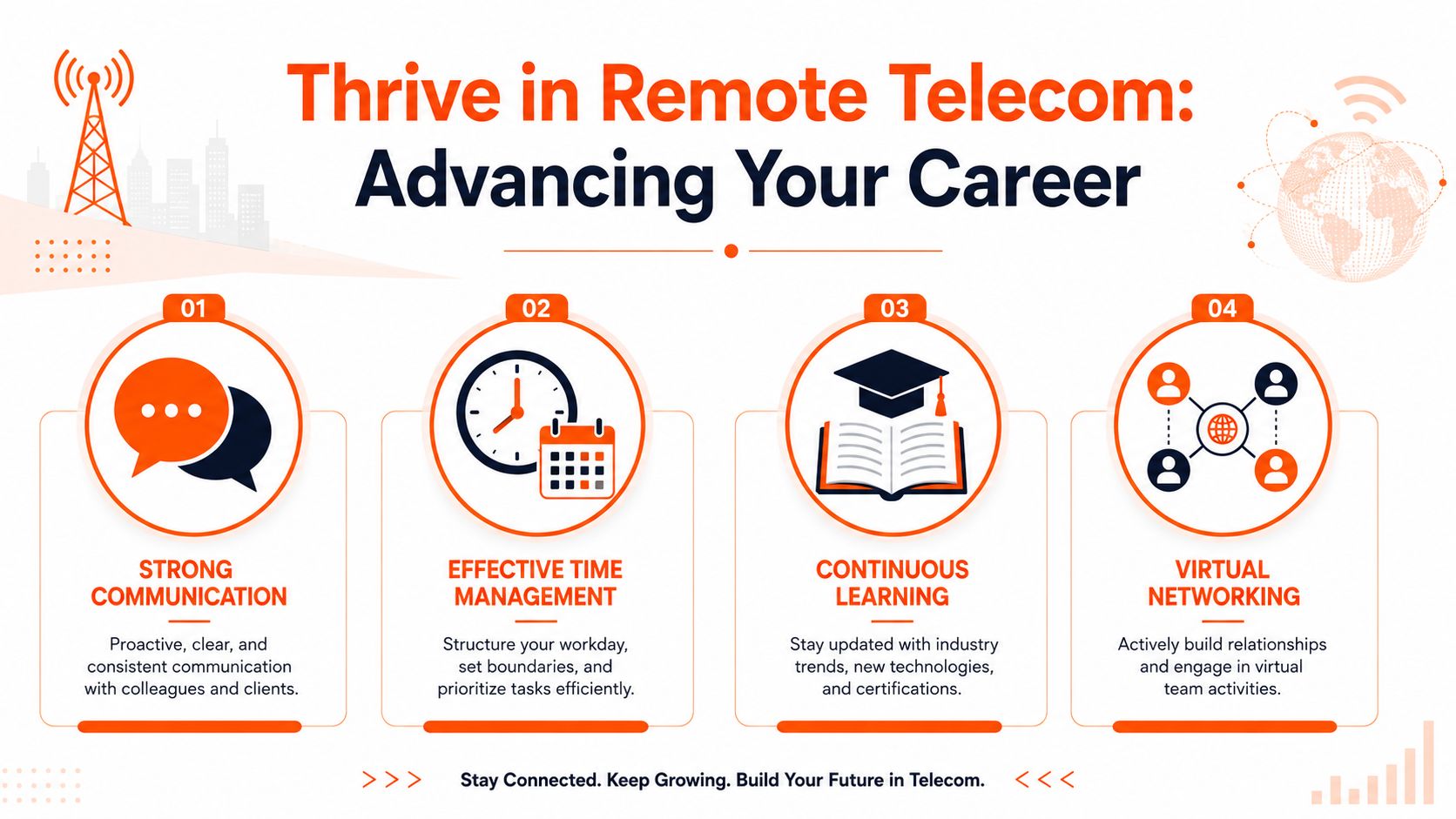
Make communication boring in the best way
Strong remote employees don't create mystery. They send clear updates, flag blockers early, and keep notes where others can find them. In telecom work, that matters because issues often move across teams, shifts, and systems.
Use one primary channel for fast operational communication if your team has one. Don't scatter updates across email, chat, side texts, and undocumented calls unless the company requires it for specific workflows. The easier your updates are to trace, the more reliable you look.
Protect data like your job depends on it
In many telecom roles, it does.
If you handle customer accounts, service details, addresses, or payment-related information, security discipline is part of performance. Lock your screen. Use approved tools. Don't improvise with personal apps. Follow access rules even when they feel inconvenient.
The remote employees who earn trust fastest are usually the ones who combine speed with caution.
Show your value visibly
Working from home can hide good work if you don't document it. Your manager can't see you helping three teammates, cleaning up a messy handoff, or spotting a pattern in recurring issues unless you capture it.
A few habits help a lot:
- Send useful updates: Summarize what changed, what's blocked, and what happens next.
- Track your wins: Save examples of solved issues, customer praise, process improvements, or clean documentation.
- Volunteer carefully: Take on work that increases your visibility, not random busywork.
- Keep learning: Add new tools, workflows, and domain knowledge over time.
Advance without becoming noisy
The best remote career moves aren't built on constant self-promotion. They're built on repeatable reliability.
If you want promotions or better roles, become known for a specific kind of value. Maybe you're the person who writes excellent handoff notes. Maybe you calm down upset customers. Maybe you clean up deployment documentation. Maybe you spot recurring service problems before others do.
That kind of reputation travels.
A remote telecom career grows well when you combine technical confidence or customer skill with habits that managers trust: clear communication, good judgment, secure work practices, and consistent follow-through. That's what turns a work-from-home role into a durable career path.
If you're ready to move from searching to applying, YayRemote lets you browse fully remote roles, filter by category and job preferences, and use tools like an ATS Resume Checker to tighten your application before you send it.