How to Land Business Analyst Healthcare Jobs (Remote Guide)
Your step-by-step guide to finding remote business analyst healthcare jobs. Learn key skills, resume tips, interview prep, and salary insights for 2026.
You're probably doing one of two things right now. You're either staring at healthcare BA job listings that all look oddly similar, or you're wondering why “entry-level” roles keep rejecting you after interviews that seemed to go well.
That happens a lot in business analyst healthcare jobs because the public description of the role is much simpler than the actual work. On paper, employers ask for SQL, stakeholder communication, and healthcare knowledge. In practice, they want someone who can walk into a messy workflow, understand clinical reality, protect sensitive data, and turn vague complaints into requirements that teams can build from.
Remote roles add another layer. Many postings barely mention home-office security, HIPAA handling outside company walls, or what kind of healthcare experience counts. Hiring managers still care about those things. They just don't always spell them out.
I've seen strong candidates lose out because they applied with a generic analyst resume, treated healthcare like any other industry, or assumed “remote” meant the same standards with more flexibility. It doesn't. Remote healthcare BA work often raises the bar because managers need proof that you can operate independently without creating compliance risk.
The Booming Demand for Healthcare Business Analysts
Healthcare organizations don't hire business analysts just to make reports cleaner. They hire them because operations break in expensive, frustrating ways. A patient intake flow creates delays. A claims process produces rework. An EHR change confuses staff. Finance sees one problem, clinical teams see another, and IT sees a third. The healthcare BA sits in the middle and turns that chaos into an implementable plan.
That role matters more now because analytics is no longer a side function in healthcare. The healthcare analytics market was valued at USD 35.3 billion in 2022 and is projected to expand at a 21.4% annual growth rate until 2030, according to Procom's healthcare analytics overview. When analytics spending grows at that pace, hospitals, payers, and digital health teams all need people who can connect the numbers to actual operating decisions.
What hiring teams really need from this role
A good healthcare BA does three jobs at once:
- Translate clinical reality: Understand what physicians, nurses, care coordinators, billers, and administrators are doing.
- Translate data reality: Know where the data lives, how reliable it is, and what it can and can't support.
- Translate business reality: Recommend changes that leadership can fund, approve, and measure.
That's why this role often outperforms a purely technical analyst in operational settings. SQL matters. Dashboards matter. But a dashboard that ignores patient flow, coding rules, or care delivery constraints won't fix much.
Practical rule: In healthcare, the best analysts don't just ask, “What does the data say?” They also ask, “Who entered it, under what workflow, and what decision will this drive?”
Why the role keeps expanding
Healthcare has become more interconnected. Clinical records, scheduling systems, prior authorization workflows, revenue cycle systems, and insurer reporting all feed each other. When one process changes, downstream teams feel it fast.
The rise of tools tied to AI adoption in healthcare adds another reason employers need strong BAs. These tools create new requirements, new workflow questions, and new governance concerns. Someone has to define what success looks like before technical teams build anything. In many organizations, that person is the business analyst.
Here's the part job seekers miss. Demand alone doesn't make hiring easier. It changes what employers screen for. They don't just want “an analyst.” They want someone who can handle healthcare's mix of regulation, stakeholder politics, and system complexity without slowing the team down.
Decoding Must-Have Skills and Certifications
The fastest way to get screened out is to present yourself as a generic analyst who happens to like healthcare. Hiring managers usually sort candidates into three buckets within minutes: technically capable, healthcare-capable, and operationally safe to trust with cross-functional work.
If you're weak in one bucket, the other two have to be unusually strong.
The technical skills that actually move you forward
Across more than 14,000 recent job postings, the most demanded skills include Data Analysis at 44.66%, SQL at 43.94%, and Healthcare Industry Knowledge at 32.57%, while 74.8% of roles require a bachelor's degree, according to NC State's healthcare analyst career data. Those numbers line up with what most hiring teams prioritize in early screening.
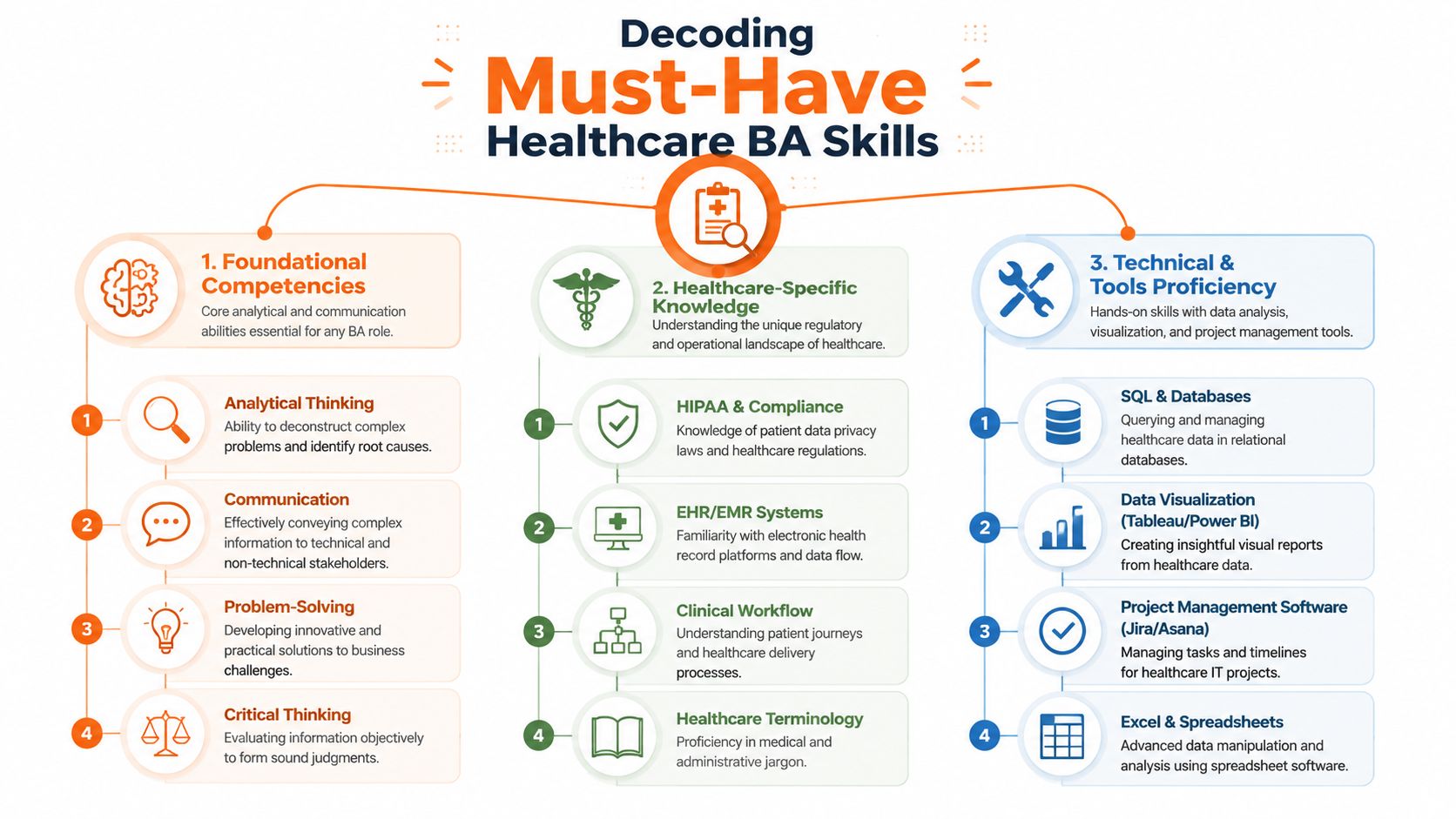
The practical hierarchy usually looks like this:
| Skill area | What gets attention first | What's often secondary |
|---|---|---|
| Technical | SQL, Excel, requirements analysis, data validation | Visualization tools, automation tools |
| Healthcare | EHR familiarity, workflow understanding, terminology, HIPAA awareness | Deep specialization in one platform |
| Delivery | Stakeholder management, meeting facilitation, documentation clarity | Formal PM ownership |
If you're earlier in your career, don't try to compete on every tool. Compete on reliability. Show that you can extract data, validate it, document requirements clearly, and communicate trade-offs without confusion.
The healthcare knowledge that separates serious candidates
Many applicants misread the market. They list “healthcare experience” because they worked near a healthcare process, but they can't discuss the consequences of changing one.
What employers usually want is practical familiarity with:
- EHR and EMR environments: You don't have to be a system architect, but you should understand how data enters the record and where workflow friction usually appears.
- Clinical and administrative workflows: Intake, documentation, ordering, referral handling, claims, eligibility, utilization review, and discharge processes all create BA work.
- Compliance basics: HIPAA isn't just a buzzword. It affects access, sharing, storage, and meeting practices.
A candidate who says, “I worked with patient data,” sounds broad. A candidate who says, “I mapped handoffs between scheduling, front-desk intake, and the EHR, then resolved conflicting field requirements before rollout,” sounds employable.
Strong healthcare BA candidates explain process consequences, not just software exposure.
Which certifications help and which don't
Certifications matter when they support a gap or confirm depth. They don't matter much when they're clearly being used as decoration.
The most useful ones tend to be tied to actual delivery work:
- CBAP: Helps when you need to signal mature BA practice, especially if your title history is mixed.
- Six Sigma: Useful if the role leans toward process improvement and operational redesign.
- Platform-specific learning: Helpful when the employer works in a known ecosystem and wants less ramp time.
What doesn't work is piling up unrelated badges without evidence you've used the methods. Hiring managers can tell.
There's also a broader hiring shift toward proving capability through work samples and applied experience rather than credentials alone. If you want a good perspective on that, Talent Pronto's guide to fairer hiring practices is worth reading. It reflects a reality many candidates benefit from. Employers increasingly care whether you can do the work, not just whether you can name the framework.
The soft skills that aren't soft in healthcare
Healthcare BAs don't get paid to be agreeable. They get paid to reduce ambiguity without alienating the people who own the process.
The most valuable behaviors are usually these:
Running stakeholder conversations with precision
You need to know how to pull requirements out of people who are busy, skeptical, or saying different things.Writing clearly enough to prevent rework
Ambiguous requirements burn time fast in regulated environments.Managing tension without becoming passive
Clinical leaders, IT teams, and operations managers rarely want the exact same outcome.
If your resume and interview examples show those traits, you'll stand out more than someone who merely lists every analytics tool they've touched.
Crafting a Standout Resume and LinkedIn Profile
A generic analyst resume gets rejected because it asks the recruiter to guess your fit. In healthcare, nobody wants to guess. The hiring manager wants to see proof that you understand systems, workflows, compliance, and business impact.
Most weak resumes make the same mistake. They describe duties instead of outcomes.
“Gathered requirements” is a task. “Led requirements sessions across operations and IT to define intake workflow changes for an EHR-related project” is evidence. The second version tells me where you worked, who you dealt with, and what kind of problem you touched.
Stop writing a job history and start writing case evidence
Treat each role on your resume like a short business case. You need to show the problem, your contribution, and the business context.
A stronger bullet usually includes some mix of:
- The setting: provider, payer, health tech, revenue cycle, care operations
- The workflow or system: intake, claims, scheduling, EHR, reporting, vendor integrations
- Your action: mapped process, validated requirements, reconciled stakeholder input, supported testing
- The result: qualitative if you don't have approved metrics
If you need a good refresher on presentation basics, structure, and phrasing, these resume writing tips are useful. Then apply them with a healthcare lens instead of stopping at generic advice.
Resume test: If someone removed the company names from your resume, would a hiring manager still know you're qualified for healthcare BA work?
LinkedIn should match the job you want, not the one you had
Your headline matters more than many candidates think. If your profile says “Analyst” or “Business Professional,” you're making recruiters do extra work. Use terms that align with business analyst healthcare jobs, especially your industry context.
Your About section should make three things obvious:
- Your healthcare exposure
- Your BA strengths
- Your target role type, including remote if that's relevant
Keep it plain. Recruiters skim.
Keyword matching still matters
Applicant Tracking Systems aren't the enemy. They're filters. If the role asks for SQL, requirements gathering, EHR experience, user acceptance testing, process mapping, HIPAA awareness, or stakeholder management, those ideas need to appear clearly in your materials.
Before applying, run your resume through an ATS optimization guide and compare your wording with the posting. Don't stuff keywords. Mirror the language of the role where it's true.
A healthcare BA resume should sound like this candidate can be trusted in a regulated environment, not like they copied a master template from another industry.
Finding and Targeting the Right Healthcare BA Jobs
You find a posting labeled “Junior Healthcare Business Analyst, Remote.” It asks for SQL, UAT leadership, EHR workflow knowledge, payer or provider experience, and comfort handling PHI from a home office. That is the pattern many applicants miss. The title sounds accessible. The job description describes someone who can contribute fast in a regulated environment.
That gap is where strong candidates save time.
Read job descriptions like a hiring manager
I tell analysts to stop sorting jobs by title first. Sort by operating context. A hiring manager usually cares less about whether your last title was “Business Analyst II” and more about whether you have worked in the same kind of environment, with similar systems, constraints, and stakeholders.
The title “Healthcare Business Analyst” can cover very different work. One role may focus on process maps, stakeholder interviews, reporting support, and user stories. Another may expect payer operations knowledge, clinical data definitions, vendor integrations, defect triage, and change control. Same title. Different risk level for the team.

Use a filter like this before you apply:
| If the posting says | It often means |
|---|---|
| “Support business processes” | Broad analyst support work, sometimes closer to junior level |
| “Clinical workflows” or “digital health” | Domain knowledge matters early |
| “Cross-functional stakeholder alignment” | Heavy meeting load, competing priorities, frequent ambiguity |
| “EHR, API, interoperability, payer data” | The team expects a faster ramp |
| “Own requirements from discovery through UAT” | Full BA ownership, usually not truly entry-level |
One line matters more than candidates think: who owns the outcome. If the role asks you to “support” a senior BA, that is different from being the person accountable for requirements quality, test readiness, and stakeholder signoff.
Remote healthcare BA jobs have extra screens that postings often hide
Remote healthcare work is not just standard BA work done from home. Teams are also screening for judgment around privacy, documentation discipline, and whether you can handle sensitive workflows without hallway support.
A remote posting that mentions HIPAA, PHI, secure file handling, audit trails, access controls, or approved workspace requirements is telling you how they think about risk. Treat that as a selection signal. If you have worked with masked data, role-based access, secure VPN use, or home-office privacy rules, make that visible in your application and screening calls.
Hiring managers also read “remote” differently depending on the work. A reporting-heavy role may be easier to staff remotely than a workflow redesign role that needs daily access to clinicians, revenue cycle leaders, or implementation teams across time zones. Some “remote” jobs are really remote-first. Others are remote on paper but expect constant availability and occasional onsite travel during go-lives or workshops.
Ask early:
- Is the role remote-first or manager-approved remote?
- How does the team handle PHI access from home?
- Are analysts working in production, test, or de-identified environments?
- What parts of discovery, validation, and UAT are done live with end users?
- Is travel expected for implementations, training, or workflow observation?
Those questions do two things. They protect you from bad-fit roles, and they signal that you understand healthcare work has compliance and operational consequences.
Be skeptical of “entry-level” labels
A lot of remote healthcare BA jobs are labeled entry-level because the employer wants a wider applicant pool. The work itself is often closer to early-mid career.
In practice, teams may accept a lower title. They still expect sound judgment, clean documentation, and enough healthcare context to avoid avoidable mistakes. If a posting asks for independent stakeholder management, current-state and future-state mapping, defect triage, data validation, and UAT coordination, the role is not beginner work, even if the experience line looks soft.
The safest read is this. Remote specialized roles usually favor candidates who need less supervision. If the job does not mention training structure, shadowing, limited scope, or close support from a senior BA, assume the team wants someone who can produce quickly.
Build a narrower target list
Strong applicants usually pick a lane before they apply at volume. That makes tailoring easier and networking more believable.
A practical breakdown looks like this:
- Provider-side roles: hospitals, ambulatory groups, population health, EHR-centered workflows
- Payer-side roles: claims, prior auth, utilization management, enrollment, reporting
- Digital health roles: product teams, integrations, telehealth, remote monitoring, member or patient experience platforms
This also helps with search terms. Don't stop at “healthcare business analyst.” Add terms tied to the actual environment, such as Epic, Cerner, payer operations, interoperability, claims, care management, UAT, or clinical workflow.
If you are targeting remote work, use a smaller set of high-intent sources instead of spraying applications across every aggregator. A curated list of remote job boards for healthcare and analyst job searches helps cut down on reposts, staffing-firm duplicates, and low-detail listings.
The goal is simple. Apply where your background already matches the team's risk, pace, and domain. That is how healthcare BA candidates get interviews without sending hundreds of applications.
Acing the Healthcare Business Analyst Interview
Interviews for healthcare BA roles usually break down into three tests. Can you think clearly? Can you work with messy people and processes? Can you be trusted around sensitive data and regulated workflows?
If you answer only the technical part well, you won't close the offer.
Early in the process, many teams are trying to see whether you understand the difference between healthcare analysis and general business analysis. They want someone who knows that changing one field, one workflow step, or one handoff can create downstream impact for compliance, operations, and patient experience.
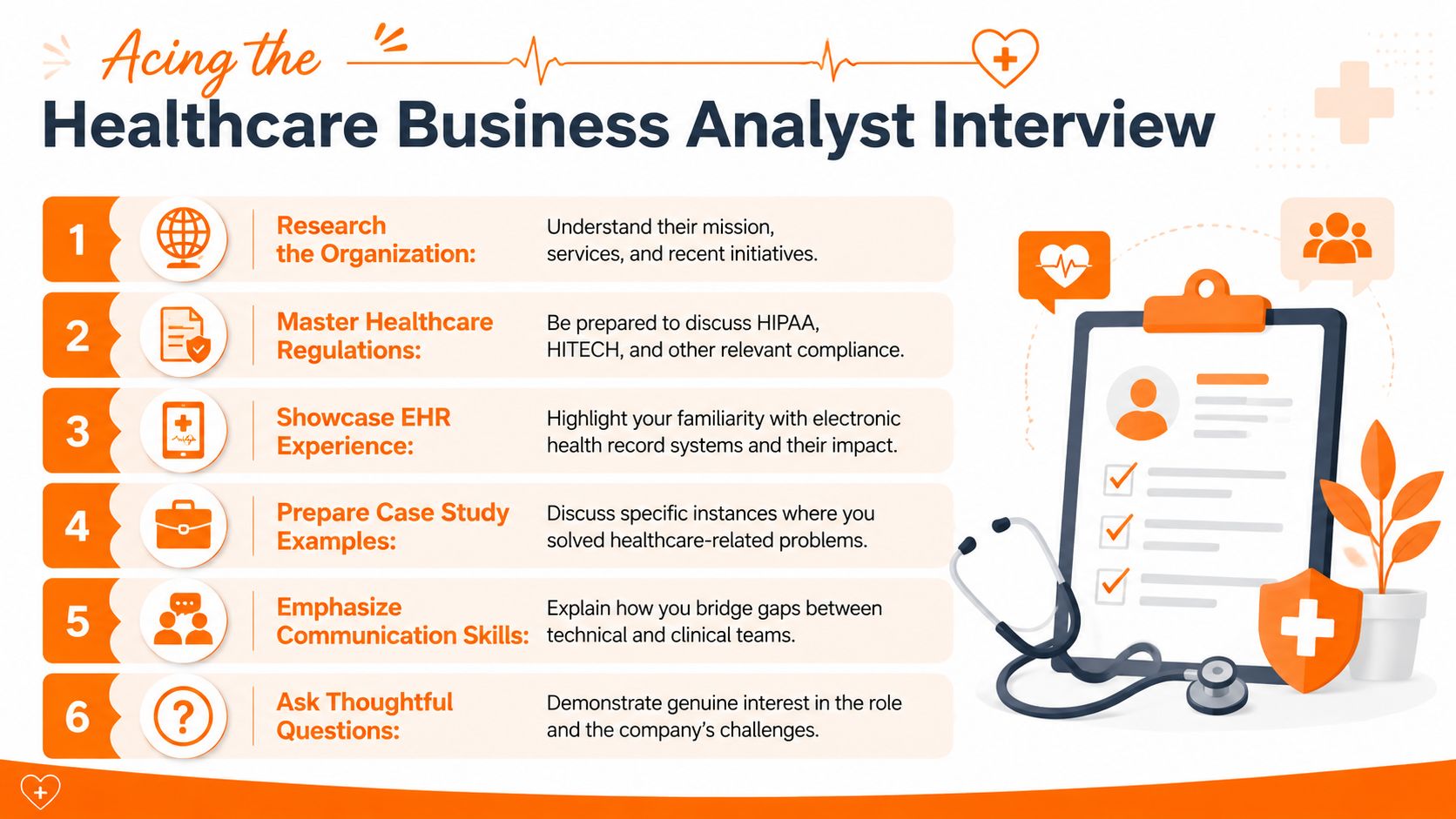
What strong answers usually include
Technical questions aren't always about the perfect answer. They're often about your method.
If you're asked how you'd analyze a workflow issue, a strong structure is:
- Clarify the business problem.
- Identify stakeholders and systems involved.
- Confirm the current-state workflow.
- Review available data and known data quality limits.
- Define the decision needed.
- Recommend a change with implementation considerations.
That's a BA answer. It shows sequence, not just intelligence.
For behavioral questions, avoid generic teamwork stories. Use healthcare-specific examples when possible. Good stories often involve conflicting stakeholder priorities, ambiguous requirements, rollout friction, or defects found during testing.
When clinicians say a process is broken, don't jump straight to a fix in your answer. Explain how you'd validate whether the issue is workflow design, training, system configuration, or data entry behavior.
The remote security question many candidates miss
Remote candidates often underperform in specific contexts related to security. A 2025 HIMSS study found that 42% of remote healthcare data breaches originated from non-enterprise devices, while over 70% of remote healthcare BA job postings don't mention remote security protocols. That hidden gap matters because interviewers may test your judgment even if the posting didn't warn you.
Don't answer remote security questions with “I take HIPAA seriously.” That tells them nothing.
A stronger answer touches on practical habits such as:
- Using approved devices and access methods
- Avoiding local storage of protected information
- Working only through authorized secure environments
- Being deliberate about screens, calls, and printed material at home
- Escalating access or security concerns early instead of improvising
You don't need to sound like a security engineer. You do need to sound like someone who won't create preventable risk.
For more prep, it helps to review common remote interview questions and answer strategies, then adapt them to a healthcare context.
A video walkthrough can also help you sharpen your delivery before live interviews.
Questions you should ask them
Your questions matter because they reveal maturity. Ask things that expose role scope and operating conditions.
Try questions like these:
- How does this team define success for the BA in the first six months?
- What systems and workflows create the most cross-functional friction today?
- How are requirements approved when clinical, operational, and technical stakeholders disagree?
- For remote work, what security and access expectations are in place for handling sensitive information?
Those questions tell the hiring manager you understand where healthcare BA work succeeds or fails.
Salary Expectations and Career Path Outlook for 2026
A remote healthcare BA gets two offers. One pays materially more, even though the job title looks almost identical. The difference usually comes down to scope, stakeholder exposure, and how much risk the employer believes that analyst can handle without constant oversight.
Salary benchmarks are useful, but hiring managers do not price these roles by title alone. They price them by business impact. The U.S. Bureau of Labor Statistics reports median pay for management analysts, the broader category that often includes business analyst roles, at the latest published national level on its Occupational Outlook page. That number is only a starting point for healthcare candidates. In practice, offers move up or down based on payer versus provider experience, EHR depth, implementation history, and whether the team needs someone who can work independently in a remote environment with secure workflows from day one.
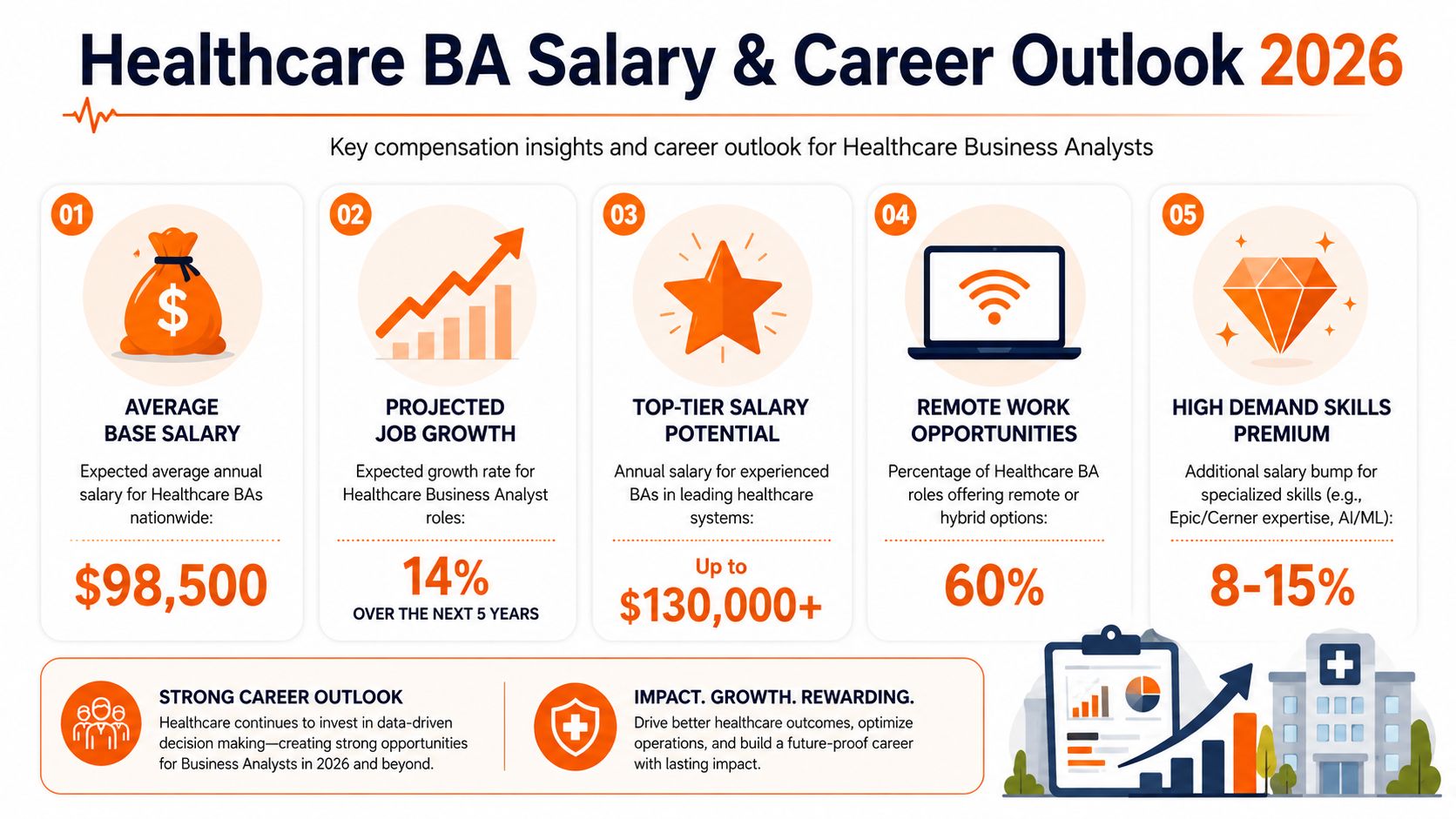
What tends to increase earning power
Higher-paying healthcare BA roles usually share a few traits.
- Specialized domain exposure: Analysts with hands-on experience in claims, prior authorization, care management, revenue cycle, interoperability, or EHR optimization often get stronger offers than generalist candidates.
- Delivery history: Employers pay more for analysts who have already run discovery, written usable requirements, supported UAT, and stayed involved through rollout.
- Remote readiness: For work-from-home roles, teams value analysts who can handle access controls, approved systems, and documentation discipline without creating compliance risk.
- Stakeholder credibility: Analysts who can work directly with clinical leaders, operations managers, and technical teams usually earn more because they reduce rework and speed up decisions.
- Certifications tied to actual work: A CBAP, PMP, or Lean credential helps more when the resume shows where that training improved delivery.
One practical warning. “Entry-level” healthcare BA roles are often mislabeled. Some are junior only in title, but still expect experience with regulated data, cross-functional meetings, and production systems. If the posting asks for one to three years plus Epic, payer, or implementation exposure, the pay should reflect that reality.
Where the career path usually goes
Healthcare BA work opens more doors than many candidates expect because it sits close to operations, systems, compliance, and leadership priorities. Analysts who perform well often move in one of four directions:
| Starting point | Likely next step | Longer-term path |
|---|---|---|
| General healthcare BA | Senior BA | Lead BA or principal analyst |
| Systems-focused BA | Application analyst or product analyst | Product, informatics, or platform leadership |
| Process-focused BA | Process improvement or operations manager | Operational leadership or program management |
| Data-oriented BA | Analytics translator or reporting lead | Analytics management or health informatics |
The strongest long-term careers usually come from choosing a lane, not collecting random projects. I have seen analysts raise their market value much faster once they became known for one hard area, such as payer operations, clinical workflow redesign, or EHR implementation support.
For remote roles, that path has an extra filter. Employers promote analysts they trust to work independently, protect sensitive information at home, and keep projects moving without hallway follow-up. That unwritten rule matters more in healthcare than many job descriptions admit.
If you are weighing offers, ask where the role can lead in two years. A slightly lower salary can still be the better move if it gives you direct exposure to enterprise systems, stronger stakeholder access, or clearer progression into senior BA, informatics, or product work.
If you want a cleaner way to find remote roles without digging through endless low-signal listings, browse YayRemote. It's useful for narrowing your search, spotting distributed companies, and applying with more focus instead of more volume.