Digital Nomad Health Insurance: Your Ultimate 2026 Guide
Confused about digital nomad health insurance? Our 2026 guide covers plans, costs, visa needs, and a step-by-step checklist to find the right coverage.
You're probably taking a common approach at this stage. You've sorted the exciting stuff first. Flights. A short-term apartment. A better backpack. Maybe a coworking pass. Then insurance shows up as the tab you keep open for three days because every policy sounds similar until you read the exclusions.
That hesitation is normal.
Digital nomad health insurance feels confusing because it sits at the intersection of travel, healthcare, immigration, and personal risk. It's not just “buy a plan and move on.” The right choice depends on how you travel, where you'll be, what care you might need, and how much uncertainty you can comfortably carry.
Most guides jump straight to provider lists. I think that's backwards. A list only helps after you know what kind of coverage fits your life. Otherwise you end up comparing slick landing pages instead of comparing the parts that matter when something goes wrong.
The Hidden Risks of a Laptop Lifestyle
You land in Lisbon, pick up groceries, answer a few Slack messages, and rent a scooter because it seems easier than figuring out the tram. On day four, you take a slow turn on a slick cobblestone street, slide out, and walk away thinking you're fine. Two hours later, your wrist is swollen, your knee is torn up, and you're trying to explain your symptoms at an urgent care desk.
That's the actual version of this lifestyle. Not constant disaster. Just ordinary, annoying, expensive disruptions in places where you don't know the system.

A lot of new nomads plan for Wi-Fi problems and visa paperwork, but they don't plan for food poisoning in Mexico City, a dental infection in Tbilisi, or a sprained ankle before a border run. If you're working while traveling, those events aren't side stories. They affect your income, your mobility, and your ability to stay where you are.
That's why digital nomad health insurance matters. It's not about being dramatic. It's about keeping a manageable problem from turning into a financial mess.
The risk isn't theoretical either. 68% of uninsured nomads experienced a costly health event abroad in 2025, and the global digital nomad health insurance market is projected to grow from $3.8 billion in 2025 to $9.6 billion by 2034 according to DataIntelo's digital nomad health insurance market report.
Practical rule: If you can't comfortably pay for treatment upfront, plus extra accommodation, plus lost work time, you're already in insurance territory.
There's also a mindset shift here. Insurance isn't the opposite of freedom. It's what lets you enjoy freedom without constantly calculating the cost of every ache, accident, or clinic visit. If you're building a location-independent life, the safety net needs to travel too.
If you're still figuring out whether this lifestyle is really for you, this guide to remote work for travelers is a useful companion because it covers the practical side people often miss early on.
Nomad Insurance vs Travel Insurance Explained
The biggest confusion for first-time nomads is simple. They think travel insurance and digital nomad health insurance are basically the same thing.
They aren't.
Travel insurance is closer to a short-trip safety product. Digital nomad health insurance is closer to a portable health plan built for life abroad. They can overlap, but they solve different problems.
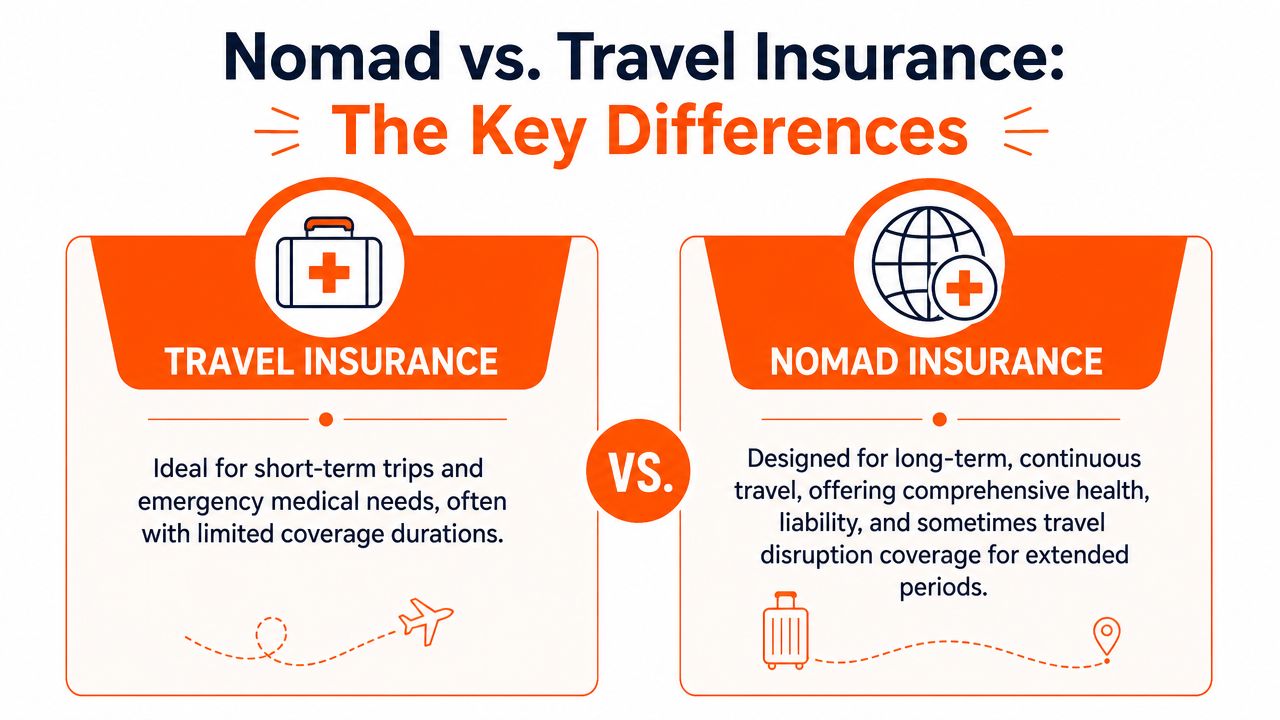
Think in terms of trip problems versus life problems
If you take a two-week holiday in Spain, travel insurance usually makes sense. You're mainly protecting yourself against trip interruptions, lost luggage, and emergency medical surprises.
If you're spending months moving between countries while working, your needs change. You might need prescriptions refilled. You might want outpatient care. You might need follow-up visits after an injury. You might need documentation that satisfies a visa office, not just a border agent.
That's where many people get caught. Their credit card includes “travel coverage,” so they assume they're protected. Then they discover it only applies to a short trip, only covers emergencies, or only works if the trip was booked in a specific way.
A side-by-side comparison
| Coverage type | Best suited to | Usually helps with | Usually weak on |
|---|---|---|---|
| Travel insurance | Short vacations and fixed itineraries | Emergency treatment, delays, cancellations, baggage issues | Long-term care, routine treatment, ongoing medical needs |
| Digital nomad insurance | People living and working abroad for extended periods | Ongoing international medical coverage, some travel-related protection, longer-term flexibility | Can cost more and may still have important exclusions |
| International private medical insurance | Long-term movers, expats, slow travelers, families | Broad medical care, specialist treatment, stronger continuity | Less focused on travel disruption perks |
Here's the simplest analogy I know. Travel insurance is like renting a car for a weekend. Nomad insurance is like owning the car you use every day. One is temporary and task-specific. The other is built around regular life.
This video gives a useful visual overview before you start comparing plans:
Where new nomads make the wrong assumption
People often ask, “If travel insurance covers emergencies, why pay more?”
Because emergencies aren't the whole story.
If you live abroad for any meaningful stretch, your healthcare needs start to look less like vacation mishaps and more like ordinary life. Skin issues. Follow-up appointments. Mental health support. Lab work. A doctor visit that isn't dramatic enough to count as an emergency but still needs attention.
Travel insurance is for the trip you planned. Nomad coverage is for the life that happens while you're away.
There's also the gray area around activities. If you house sit, pet sit, ride scooters, rent cars, or stay in homes with other people's animals and property, standard assumptions about “what's covered” can get shaky fast. If that's part of your travel style, this house sitting insurance guide helps you think beyond medical cover and into liability and practical risk.
The key takeaway is this. Don't ask only, “What provider is popular?” Ask, “Am I insuring a trip, or am I insuring my day-to-day life abroad?” That single question clears up a lot of confusion.
Decoding Your Three Main Coverage Options
Once you separate “coverage for a trip” from “coverage for a life abroad,” the choices get clearer.
For digital nomads, three insurance models show up again and again. These are not official industry labels. They are decision buckets that help you match a policy to the way you travel, work, and use healthcare.
A simple way to frame them is this: one option is built for movement, one for stability across countries, and one for putting down roots in a single place.
Flexible nomad policies
This is the entry point for a lot of people.
Flexible nomad plans are built for mobility first. They usually work best for freelancers, first-time nomads, and anyone whose next six months still look fuzzy. If you are hopping between countries, booking one-way flights, and figuring things out as you go, this category often feels easiest to live with.
Coverage usually centers on sudden illness, accidents, and hospital care. Some plans also include limited outpatient benefits, telemedicine, or optional extras.
Why people choose this model:
- Fast setup: Useful if your departure date is close.
- Good fit for frequent moves: You are less tied to one healthcare system.
- Lower commitment: You can start without buying the insurance version of a full expat life.
The trade-off is scope. These plans can work well for the “I broke my wrist in Portugal” problem, but less well for the “I need follow-up visits, blood work, and a prescription refill over the next four months” problem.
That distinction matters more than many new nomads expect.
International private medical insurance
This option fits people whose travel life has started to look more like ordinary life abroad.
International private medical insurance is usually broader than flexible nomad coverage. It often includes inpatient treatment, outpatient care, specialist visits, and better continuity if you move from one country to another. If you need regular prescriptions, therapy, ongoing treatment, or the ability to choose from a wider network of doctors, this category deserves careful attention.
It also asks more from you. The application can be more detailed. The policy wording is often denser. The monthly cost is usually higher, and age and plan design are major drivers of price.
This model tends to suit:
- Slow travelers: People spending months, not weeks, in each location.
- Remote workers with predictable income: Especially those planning around long-term living abroad.
- People with regular medical needs: Anyone who expects routine care, monitoring, or specialist support.
The easiest way to understand it is to compare it to renting an apartment instead of booking hotels. A hotel is flexible and simple. An apartment gives you more day-to-day stability, but you take on more responsibility and a longer commitment. International medical insurance works in a similar way.
Local national plans
This option gets ignored in nomad roundups because it sounds less exciting. Sometimes it is the smartest choice anyway.
If you are staying in one country long enough to build a real base, a local private plan or access to the national system may fit better than carrying global coverage forever. This is common among nomads who stop changing countries every month and start living more like residents.
The advantage is practical. Your insurance is tied to the healthcare system you use, so clinic access, referrals, and follow-up care can feel more straightforward. If you already know where you want to spend most of the year, this route can make a lot of sense. That is especially true if you are comparing destinations and leaning toward places where longer stays are realistic, like the countries in this guide to the best countries for digital nomads.
The weakness is portability. A local plan often stops being useful the moment you leave the country for any meaningful stretch. Weekend trips, regional moves, and visits home can expose the gap.
Insurance models at a glance
| Coverage model | Best for | Typical coverage | Pros | Cons |
|---|---|---|---|---|
| Flexible nomad policies | New nomads, frequent movers, uncertain itineraries | Emergencies, hospital care, some travel-related features | Easy to start, mobile-friendly, less commitment | May be limited for routine or ongoing care |
| International private medical insurance | Long-term nomads, slow travelers, people with regular healthcare needs | Inpatient treatment, outpatient visits, stronger continuity across countries | Better for ongoing care and stability | Higher cost, more complexity |
| Local national plans | People based mainly in one country | Country-specific care within one system | Good local integration, practical for residents | Poor portability across borders |
A useful test: If you cross borders often, start by checking portability. If you are building a base, start by checking continuity of care.
Another useful signal is how customized your needs are becoming. Early on, many nomads can get by with a simpler policy. Over time, the gaps become easier to spot. Maybe you want routine checkups, better mental health coverage, sports coverage, or protection that satisfies a specific visa. That is why the right question is not “Which type is best?” It is “Which type fails least often for the life I live?”
How to Choose Your Ideal Health Coverage
You are in a coworking space in Chiang Mai, your visa renewal is coming up, and you realize your insurance PDF does not clearly show the coverage amount immigration asked for. At the same time, you have been meaning to refill a prescription and book a physio visit for an old knee injury. That is the moment many nomads discover they did not choose insurance. They chose a vague feeling of being covered.
A better approach is to make the decision the same way you would choose a base city or a work setup. Start with your real life, then work outward to the policy. The goal is not to find the "best" provider in the abstract. The goal is to find the type of coverage that fails least often for your travel pattern, health needs, budget, and paperwork.
1. Match the policy to your travel pattern
Your route shapes your insurance more than glossy marketing pages do.
If you move every few weeks, portability and admin simplicity matter. You need cover that still works when your itinerary changes, claims that can be handled online, and wording that does not get awkward every time you cross a border. If you stay put for months at a time, the center of gravity shifts. Routine care, follow-up visits, and access to local clinics start to matter more.
A simple way to frame it is this: airport life and apartment life create different insurance problems.
Ask yourself:
- How often do I cross borders?
- How fixed is my itinerary?
- Am I still experimenting, or do I already have a clear base pattern?
If you are still deciding where to spend longer stretches, this guide to the best countries for digital nomads can help you connect lifestyle choices with insurance needs.
2. Buy for the version of you that is inconvenient
Many first-time nomads shop as if insurance is only for dramatic emergencies. Real life is messier.
Maybe you need a prescription renewed abroad. Maybe anxiety gets worse during constant movement and you want therapy covered. Maybe a surfing fall turns into three follow-up appointments, not one heroic ambulance story. Those are the situations that expose whether a plan fits your life.
Write down your real needs before you compare plans. Include the things you already know about yourself:
- prescription medication
- mental health support
- outpatient visits
- blood work or routine monitoring
- dental
- sports or adventure activities
- care in your home country
- maternity, if relevant now or soon
That list becomes your filter. Without it, you are just reacting to pricing tables and sales copy.
3. Let destination and visa rules narrow the field
Your destination is a key factor in this calculation.
Healthcare costs vary a lot by country, but cost is only half the story. Entry rules matter too. Many visas set specific thresholds for insurance amounts, covered services, or the wording shown on your certificate. A plan can fit your health needs and still fail the paperwork test.
As noted earlier in the article, pricing across nomad-friendly insurance options ranges from relatively low-cost emergency-only cover to much more expensive plans that include broader routine care and stronger continuity. The practical lesson is simple. The farther you move from "just cover disasters" toward "cover the care I use," the more you should expect to pay.
Before you buy, check three things against your destination list:
- Minimum coverage amount required for visas
- Whether inpatient only is enough, or outpatient care is expected too
- Whether the insurer can issue proof of coverage in the format immigration asks for
If you want another perspective on comparing these trade-offs, this guide to health insurance for global nomads is a useful companion read.
4. Check how the policy treats your home country
This catches people off guard all the time.
“Worldwide” often sounds broader than it is. Some plans give limited cover in your passport country. Some exclude it except for short visits. Some cover emergencies there but not routine care. If you expect to go home for holidays, family visits, or scheduled appointments, read that section slowly.
A policy is like a power adapter with the wrong plug. It looks fine until you try to use it in the place that matters.
5. Choose your financial pain point on purpose
Every plan shifts cost around. Lower premiums often mean higher deductibles, more exclusions, weaker outpatient cover, or stricter claim conditions. Higher premiums usually buy more predictability, not magic.
That distinction matters.
Some nomads would rather pay less each month and accept a bigger bill if something goes wrong. Others want fewer surprises, even if that means a heavier recurring cost. Neither choice is wrong. Trouble starts when the policy reflects one risk tolerance and your bank account reflects another.
Make yourself a short decision note before you buy:
- My travel pattern: frequent moves, mixed, or long stays
- My likely care: emergency-only, occasional routine care, or regular ongoing care
- My must-cover countries: places where I will spend real time
- My visa proof needs: what I may need to show on paper
- My home-country use: none, occasional, or important
- My budget style: lower monthly cost or lower surprise cost
That note does something most provider roundups do not. It gives you a decision framework. Once you have that, insurance gets less confusing because you are no longer asking, "Which plan looks good?" You are asking, "Which plan fits the way I live?"
Your Step-by-Step Insurance Buying Checklist
Once you know what you need, buying gets simpler. Not easy, but simpler. The trick is to treat it like a process, not a guess.
Step 1: Build a shortlist that matches your profile
Don't compare every provider you find. Compare providers within the model that fits you.
If you need flexible, mobile-first protection, shortlist nomad-focused products. If you need stronger routine care and long-term stability, shortlist international private medical plans. If you're mostly settling in one country, investigate local options too.
Aim for a small, serious shortlist. Too many tabs usually means you stop reading the policy wording and start judging branding.
Step 2: Read the policy wording like you expect to use it
This is the boring part that saves you later.
Look closely at deductible, co-payment, exclusions, coverage area, and claim rules. If you don't understand those terms, pause and clarify them before buying.
- Deductible: What you pay before insurance starts paying.
- Co-payment: Your share of a covered bill.
- Exclusions: What the insurer explicitly won't cover.
- Coverage area: The countries or regions included.
- Claim procedure: The exact steps you must follow for reimbursement or approval.
Here's a practical comparison image to keep nearby while reviewing options:
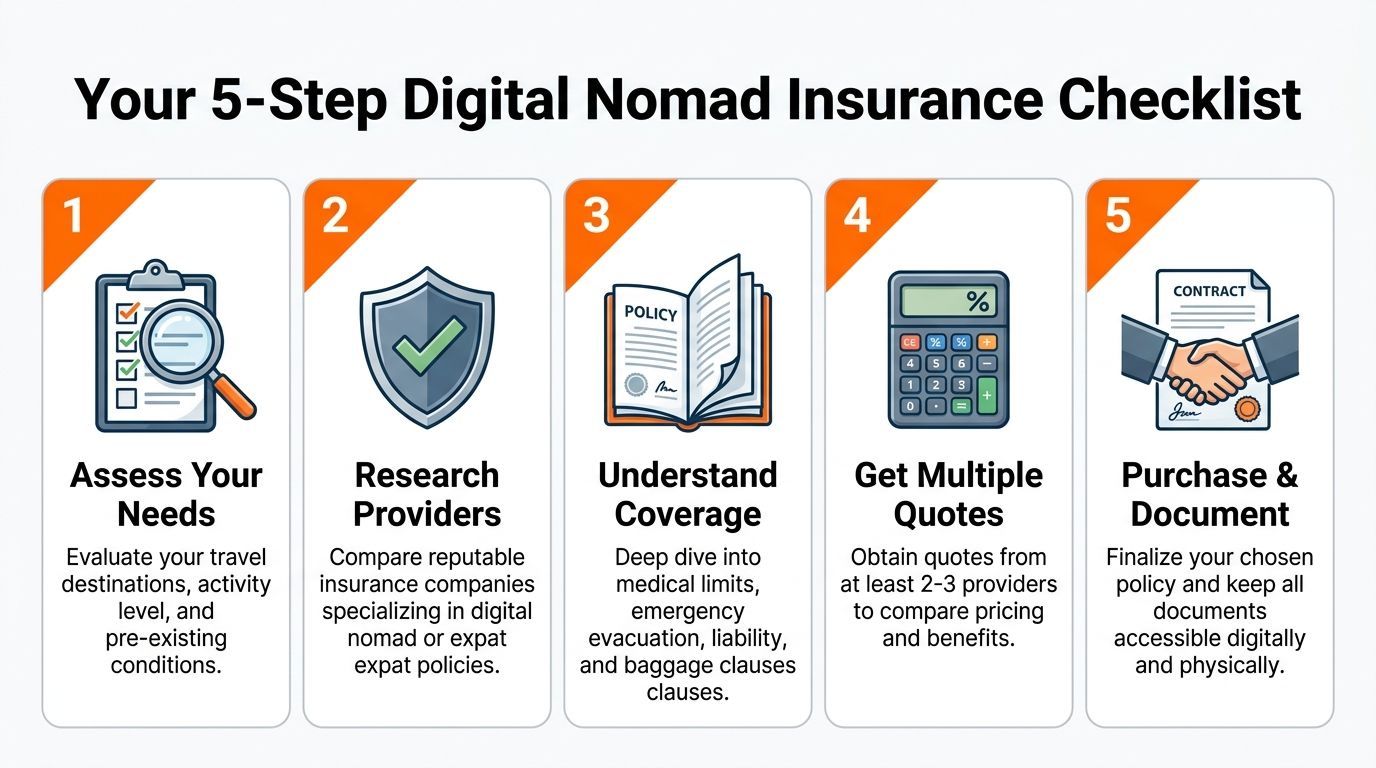
Step 3: Stress-test the claim process before you pay
Comparing benefits and ignoring usability is a frequent approach. That's backwards.
Open the claims section and ask practical questions. Do they want pre-approval for hospital treatment? Can you submit through an app? What documents do they require? Do they mention timelines? If a clinic asks for payment now, will you be reimbursed later or can the insurer pay directly?
Before buying, pretend you've just left a clinic with a diagnosis, a receipt, and weak mobile data. If the claim process still looks manageable, that's a good sign.
Step 4: Get a second source of clarity
If you want another plain-English perspective while you compare wording, this guide to health insurance for global nomads is useful because it frames the decision in practical terms rather than just listing plans.
The important part isn't to find one “perfect” article. It's to cross-check your assumptions. If two policies look similar, the details around exclusions, renewals, and how treatment gets approved are usually where the difference lives.
Step 5: Organize your documents for real-world use
After purchase, don't leave everything buried in your inbox.
Keep:
- Your policy certificate: Save it offline on your phone and laptop.
- Emergency contact instructions: Screenshot them.
- Claims portal login details: Store them in a password manager.
- A simple medical note: Allergies, medications, and emergency contacts.
- Proof for visas or border checks: Easy to access, easy to download.
That last part matters more than people think. Insurance only feels “done” when you can produce the right document quickly, whether that's at a hospital front desk or during a visa application.
Navigating Claims, Visas, and Legal Fine Print
Buying the policy is only half the job. Using it well is the other half.
The details that matter most usually don't show up in marketing headlines. They show up when you need treatment, file paperwork, or prove your coverage to an immigration office.
Understand direct billing versus reimbursement
This distinction trips people up all the time.
Direct billing means the provider or hospital bills the insurer directly, assuming the treatment and facility fit the policy rules. Reimbursement means you pay first, gather the documents, and claim the money back later.
Neither model is automatically better. Direct billing feels easier in a stressful moment, but it often depends on network rules, approvals, and whether the facility recognizes the insurer's process. Reimbursement gives you wider flexibility in some cases, but it can create cash-flow pain if treatment is expensive.
Before you buy, find the answer to these:
- Do I need pre-authorization for hospital care?
- What documents must I keep after a clinic visit?
- How are prescriptions handled?
- What happens if I go to an out-of-network provider?
Make claims boring on purpose
A smooth claim usually starts before the medical visit ends.
Get an itemized invoice. Ask for the diagnosis in writing if possible. Keep receipts for tests, medication, and consultations. Take photos of paperwork before it gets crumpled in your bag. If the insurer has an app, use it while the details are still fresh.
The best time to organize claim documents is ten minutes after treatment, not three weeks later when you can't remember which clinic gave you which receipt.
If the situation is serious, contact the insurer as early as possible. Not because call centers are magical, but because many policies have procedural requirements. Missing one administrative step can create a frustrating back-and-forth later.
Visa compliance is part of the insurance decision
A lot of nomads still think of insurance as a personal finance choice. It's also an immigration requirement in many cases.
Some digital nomad visa programs require proof of private health insurance, and some set minimum thresholds or other policy conditions. If your insurer, certificate, territory list, or coverage wording doesn't match what the immigration authority wants, your application can stall even if the policy seems reasonable to you.
This is why you should research the visa and the insurance together, not separately.
For country-by-country checking, this visual reference point is helpful:
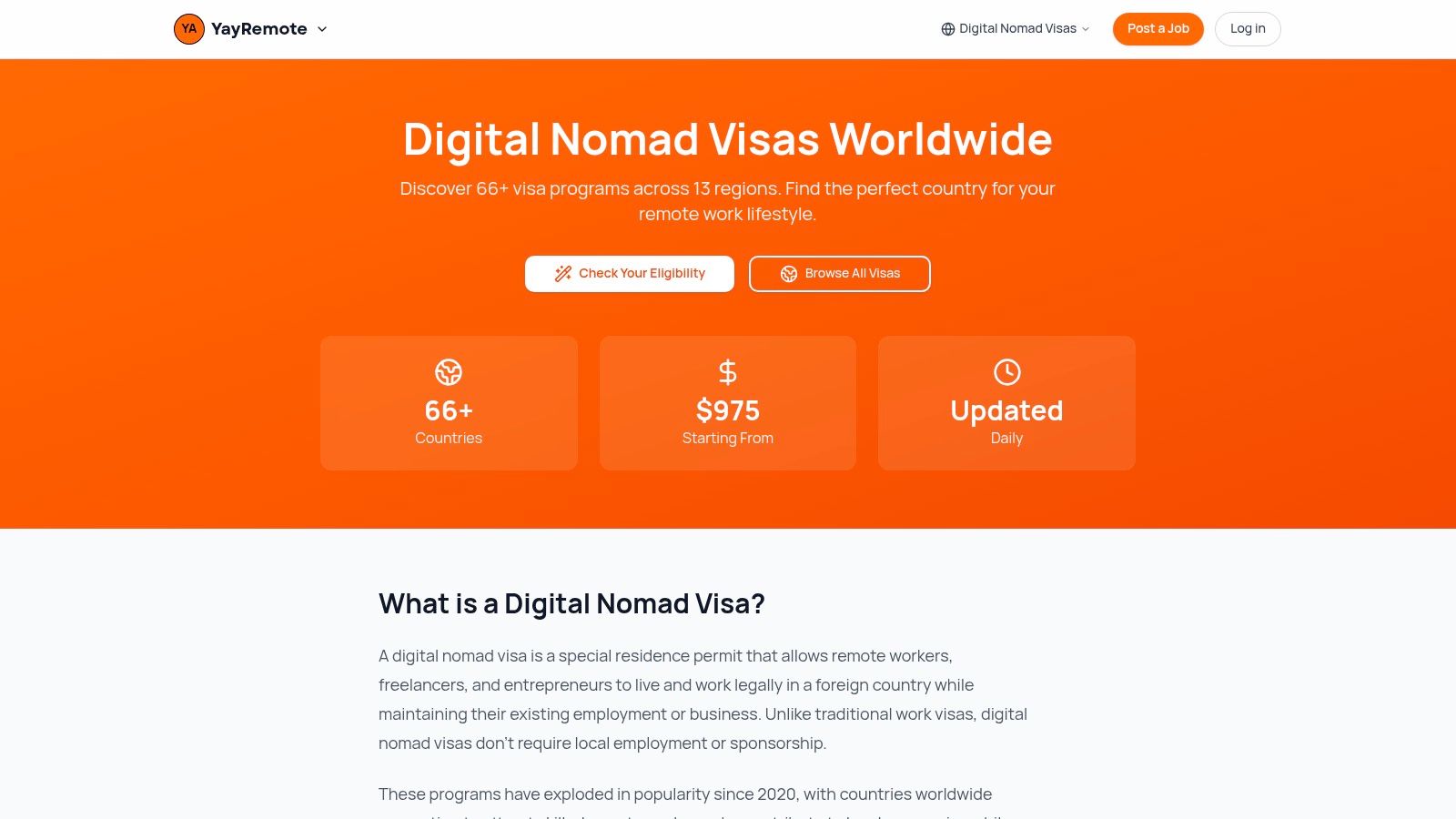
One practical habit helps a lot here. Keep a separate folder for visa-ready insurance documents. Don't assume your full policy wording is what immigration wants. Often they want a certificate, proof dates, coverage territory, and sometimes evidence of minimum medical coverage.
Read the legal fine print with the right priorities
You do not need to become an insurance lawyer. You do need to read for friction points.
Focus on:
- Territorial limits: Where are you covered, and where are you not?
- Home-country clauses: Are return visits covered?
- Waiting periods: Does some coverage start later?
- Exclusions for activities: Scooters, trekking, diving, and similar activities may have conditions.
- Renewal terms: Can you keep the policy if your trip becomes a lifestyle?
A practical reading method is to search the document for the words “excluded,” “pre-existing,” “eligible,” “emergency,” and “repatriation.” That usually surfaces the clauses with the biggest real-world impact.
The goal isn't to find a perfect policy. It's to avoid buying one that conflicts with how you travel and live.
Your Nomad Health and Safety Toolkit
The best way to think about digital nomad health insurance is this. You're not buying paperwork. You're buying margin. Margin for mistakes, illness, delays, bureaucracy, and all the messy parts of life on the road.
That's why the smartest choice isn't always the broadest plan or the cheapest one. It's the plan that matches your route, your health needs, your visa reality, and your tolerance for uncertainty.
Keep these resources in your toolkit
Use a small set of resources, not a giant pile.
- Your policy documents folder: Certificate, wording, receipts, insurer contact details, and emergency instructions.
- A claims routine: Save every receipt, ask for itemized invoices, and upload documents quickly.
- A visa research workflow: Check insurance requirements before you choose a country, not after.
- A transport backup plan: If you're concerned about worst-case movement between hospitals or getting home after a serious event, it's worth understanding how emergency medical transport insurance works as a separate layer from standard health coverage.
A simple final framework
When you compare any plan, run it through four questions:
- Will this work where I'm going?
- Will it cover the care I'm realistically likely to need?
- Will it satisfy visa or residency requirements?
- Will I still understand how to use it when I'm tired, stressed, and in a clinic waiting room?
If a plan fails any one of those tests, keep looking.
You don't need to optimize this forever. You need to get to a good, informed decision and move on with your life. If you want a broader support stack for living and working remotely, this collection of remote work resources is worth bookmarking alongside your insurance notes.
Good insurance won't make you fearless. It will make you calmer. That's enough. Calm people make better decisions when travel gets complicated.
If you're planning your next move, YayRemote can help you do more than find a job. It's a strong place to explore remote roles, practical tools, and digital nomad visa research so you can build a work setup that supports life on the road.