Mastering Digital Nomad Visa Requirements Your Global Guide
Unlock the world of remote work. Our guide decodes all digital nomad visa requirements, from income to insurance, to help you launch your global journey.
At its core, a digital nomad visa application boils down to a few key things: proving you have a steady remote income, holding valid health insurance, and passing a background check.
Think of these visas as a country's official welcome mat for professionals who work online. They're a world away from a standard tourist visa, which almost always forbids any kind of work. This special permit formalizes your stay, giving you the green light to live and work legally for an extended time, typically for a year or even longer.
What Are Digital Nomad Visas Really About?
Picture this: you try to build a small cabin on a beautiful piece of land you don't actually own. You could probably get away with it for a while, hoping nobody notices (which is a lot like working on a tourist visa). But you'd live with the constant risk of being discovered and told to pack up and leave immediately.
A digital nomad visa is the official paperwork that says, "You're welcome to build your cabin here for a year." It's a specific permit granting you the legal right to live in a country while you earn money from clients or an employer back home or anywhere else in the world.
This isn't your traditional work visa, which tethers you to a local company. Instead, it's custom-built for the modern remote workforce—the freelancers, entrepreneurs, and employees whose economic ties are outside the country they want to live in. The logic is simple: you bring in foreign currency and spend it on rent, coffee, and weekend trips, giving the local economy a nice boost without taking a job from a local resident.
The Rise of a Global Movement
This whole concept has absolutely exploded. As of 2024, over 60 countries worldwide have rolled out some form of digital nomad visa, turning what was once a niche lifestyle into a globally recognized and legally sound way to live. This massive jump from just a handful of options a few years ago shows that governments are now actively competing to attract skilled, location-independent talent. For more on this trend, Immigrant Invest offers some great analysis.
This global shift is a classic win-win situation:
- For Nomads: You get legal security, the ability to stay longer without stressful visa runs, and sometimes even a better tax situation.
- For Countries: They attract high-earning professionals who spend money locally without putting a strain on public resources like schools or social security.
A digital nomad visa essentially builds a bridge between the incredible freedom of remote work and the rigid legal structures of international travel. It replaces the murky gray area of "pretending you're a tourist" with a stable, legitimate foundation for your life abroad.
Before we get into the nitty-gritty of the specific requirements you'll encounter, let's start with a high-level view.
Common Digital Nomad Visa Requirements at a Glance
The table below breaks down the most common pillars of a successful application. Think of it as a cheat sheet for what most countries will want to see from you.
| Requirement Category | Common Expectation | Why It's Required |
|---|---|---|
| Proof of Income | Bank statements, client contracts, or pay stubs showing a minimum monthly income (often $2,000 - $4,000). | To ensure you can support yourself without needing local employment or public assistance. |
| Remote Work | An employment contract or business registration proving your work is not tied to the host country. | To confirm you won't be taking a job from a local citizen. |
| Health Insurance | A private policy with a minimum coverage amount that is valid in the destination country. | To make sure you won't become a burden on the local healthcare system if you get sick or injured. |
| Criminal Record | A clean background check from your home country or country of recent residence. | A standard security measure to ensure public safety. |
This table gives you a quick snapshot, but every country has its own unique spin on these rules. For a detailed breakdown of programs around the world, our guide to digital nomad visas is the perfect place to start.
Meeting the Financial and Employment Hurdles
When you start digging into digital nomad visa applications, you’ll quickly realize two things matter more than anything else: proving you have enough money and proving your work is truly remote. Think of them as the two main pillars holding up your entire application. If either one is shaky, the whole thing comes crashing down, no matter how perfect the rest of your paperwork is.
Countries aren't just being difficult; they need absolute certainty that you can support yourself without ever needing to dip into their local job market or rely on their social services. This is where they put your application under a microscope, and a quick screenshot of your bank balance just won't fly. They're looking for an official paper trail that tells a clear, consistent story of a self-sufficient professional who won’t be an economic burden.
Proving Your Income: The Magic Number
Every country offering a digital nomad visa has a minimum income threshold. This isn't just a random number; it's carefully calculated to ensure you can live comfortably and even spend a little money in their local economy. Often, it's tied to their national minimum or average wage. Spain, for example, requires you to earn at least 200% of its minimum wage.
To hit this target, you'll need to pull together a portfolio of financial documents. Your goal is to show a stable pattern of earnings over time, not just a single lucky month.
Here’s what they usually want to see:
- Bank Statements: Plan on providing the last 3 to 6 months of statements. Consulates are looking for regular, predictable deposits that consistently meet or beat the monthly requirement.
- Tax Returns: Your last one or two tax returns are gold. They're an official, government-stamped record of your annual income.
- Pay Stubs: If you’re a remote employee, have the last three months of pay stubs ready to go.
- Client Invoices and Contracts: For the freelancers out there, signed client contracts and a history of paid invoices are your best friends. They prove you have ongoing work lined up.
The key here is consistency. A huge one-time payment followed by two months of very little income looks risky. Three straight months of steady, reliable earnings—even if the total is the same—looks far more stable to an immigration officer. Always aim to show an average monthly income that's comfortably above their minimum.
This flowchart gives you a good visual of the first questions you need to answer. As you can see, sorting out your work and income status is the first gate you have to pass through.
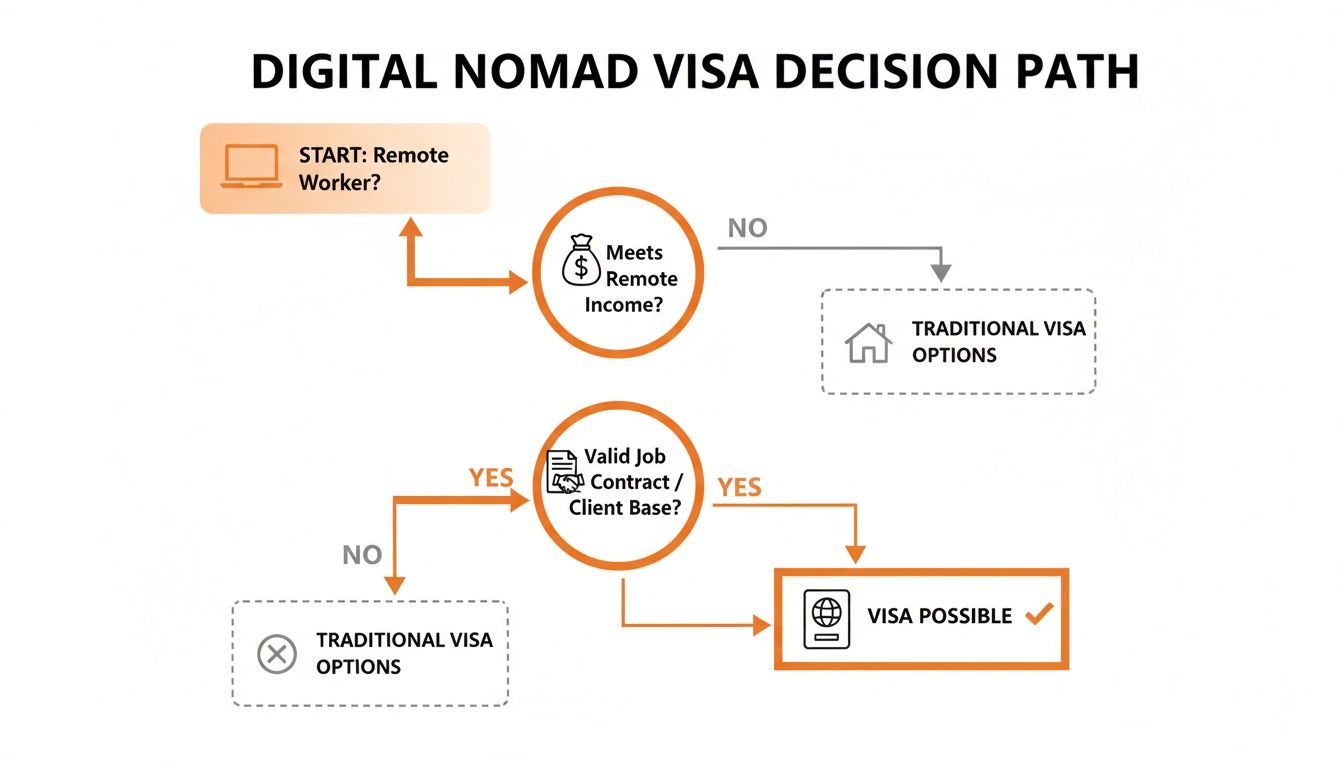
If you can't check these first two boxes, none of the other requirements will even matter.
Demonstrating Your Remote Work Status
Just as crucial is proving how you earn your living. The entire concept of a digital nomad visa hinges on one non-negotiable rule: you make your money from sources outside the country you're moving to. This is how they protect their local job market. The exact documents you'll need will depend on whether you're an employee or run your own show.
For the Remote Employee
If you work for a single company, your path is pretty clear. The star of your application will be an official letter from your employer.
This letter absolutely must:
- Confirm your job title and that you are a full-time employee.
- Clearly state your monthly or annual salary.
- Explicitly say you have permission to do your job remotely from that specific country.
- Be on official company letterhead, signed by an HR rep or your manager.
Trust me, a casual email from your boss won't cut it. This has to be a formal, verifiable document.
For the Freelancer or Business Owner
If you're self-employed, the burden of proof is a bit higher. Since you don't have a single company vouching for you, you need to show that you run a legitimate, stable business with a client base located outside your destination country.
Get ready to provide evidence like:
- Business Registration Documents: Show that your business is legally established in your home country.
- Client Contracts: Pull together a set of active contracts detailing the work, timelines, and payment terms. It looks much better to have 2-3 solid, long-term clients than a bunch of small, one-off projects.
- Invoices: A clear history of invoices that you can match up to the deposits in your bank statements.
Of course, all of this starts with landing the right gig. If you're on the hunt for your next position, our guide on how to find remote jobs online is packed with top platforms and proven strategies.
Don't underestimate how long it takes to gather all these documents. Start early, be organized, and double-check everything. A rock-solid financial and employment package is the single most important part of getting your digital nomad visa approved.
Health Insurance and Background Checks: Proving You're a Good Guest
Once you've sorted out your income and work documents, you'll hit the next major hurdle: proving you're a responsible and safe person to welcome into the country. This boils down to two key areas: health insurance and a clean criminal record.
Think of it this way: your financial paperwork shows you can support yourself. Your health and background checks show you won't be a drain on the local healthcare system or a risk to public safety. Getting these right is a sign of respect for your host country and adds a ton of credibility to your application.

Finding the Right Health Insurance
Don't assume your standard travel insurance will cut it. It almost certainly won't. Countries offering digital nomad visas need to know that if you get sick or injured, you can pay for it yourself. Their public system is for their citizens, not visitors.
So, when an application asks for "comprehensive coverage," they're usually looking for a policy with some very specific features:
- A Minimum Coverage Amount: Many European countries, especially those in the Schengen Area, mandate at least €30,000 (roughly $32,000) in coverage. Some destinations might ask for even more.
- Emergency Medical Evacuation: This one is non-negotiable. Your policy has to cover the cost of getting you to a proper medical facility or, in a true emergency, flying you back home.
- Repatriation of Remains: It's a grim topic, but this is a standard clause. It ensures that in a worst-case scenario, the costs to return your remains to your home country are fully covered.
- Coverage for Your Entire Stay: Your insurance must be valid for the full length of the visa you're applying for, which is usually one year.
Your best bet is to find a policy built for expats or long-term digital nomads. A cheap plan you'd buy for a week-long beach trip is a guaranteed rejection. Look for providers who understand visa requirements and can give you an official confirmation letter to include with your application.
Passing the Background Check
Next up is the police clearance certificate, or criminal background check. This is purely a security measure. The host country just wants to make sure they aren't granting a visa to someone with a serious criminal history. It's a standard part of the process for most long-term visas.
Getting this document isn't complicated, but it can be slow, so you need to plan ahead.
How to Get Your Police Clearance
- Find the Right Agency: The source of your background check depends on your home country. For Americans, it’s the FBI Identity History Summary Check. For others, it's typically the national police or a designated government ministry.
- Apply and Get Fingerprinted: You'll almost always have to provide fingerprints. This might mean a trip to a local police station or an authorized fingerprinting service.
- Watch the Clock: This isn't a quick turnaround. An FBI check can take weeks, sometimes months, to process. If you also need an apostille (a special certification that makes the document valid internationally), that adds even more time.
My advice? Start your background check first. It's often the single most time-consuming part of the entire application. A simple delay or a lost document can push your timeline back by weeks, so getting an early start is absolutely critical.
Navigating the Visa Application Maze: Timelines and Logistics
Once you’ve gathered your financial, employment, and health insurance documents, you’re ready for the final boss: the application itself. This is where all your hard work comes together, and where tiny, avoidable mistakes can send you right back to square one.
Think of it like packing for a long, important trip. You have all the right gear, but if you forget your passport or pack a prohibited item, you're not getting on the plane. Successfully navigating the bureaucracy of a visa application requires a good dose of patience and an almost obsessive attention to detail.
First Things First: The Paperwork Essentials
Before you even start worrying about timelines, let's nail down the basics. These are the foundational documents that every single consulate will scrutinize before they even glance at your income proof. Get these wrong, and your application is dead on arrival.
- Passport Validity: This is a big one. Your passport needs to be valid not just for your planned stay, but usually for at least six months beyond your visa's expiration date. If your passport is even close to expiring, just get it renewed now. Don't risk it.
- Photo Specifications: You wouldn't believe how many applications get initially rejected because of a bad photo. Countries are incredibly specific about this—from the exact dimensions to the background color (almost always white) and even your facial expression. Don't just use a selfie; get it done professionally and check the country's rules.
- Application Fees: The cost can be anything from under $100 to over $500, and the payment methods can feel straight out of the 90s. Some consulates only take a cashier's check or a money order. Double-check the exact amount and how you're supposed to pay.
These might feel like small details, but they are the gatekeepers of your application.
So, How Long Is This Going to Take?
The number one question I get is, "How long will it take to get my visa?" And the honest answer is... it depends. While every country moves at its own pace, you can usually bank on a certain window.
The best advice I can give you is to manage your expectations. Visa processing is a marathon, not a sprint. The "official" timelines are really just educated guesses, and delays are the rule, not the exception. Build a serious buffer into your travel plans—your sanity will thank you.
Most digital nomad visa applications are processed somewhere between 30 and 90 days. But be warned: a few popular spots, like Spain, have seen wait times stretch to four or even five months because they're swamped with applications. Your best bet is to always find the official government website for the latest estimates.
Where and How Do I Actually Apply?
The "how" and "where" of submitting your application can be just as confusing as the paperwork itself. Generally, you'll run into one of two scenarios.
- The Old-School Way: Consulate or Embassy: This is the classic process. You book an appointment at the destination country's consulate in your home country (or wherever you're a legal resident), show up in person, and hand over a stack of physical documents. Sometimes, there's a short interview.
- The Modern Way: Online Portals: Thankfully, more and more countries are getting with the times. Places like Estonia and Croatia have slick online systems where you can upload everything digitally. It's usually faster and way more convenient, though you'll often still need to visit a consulate later to get the actual visa sticker put in your passport.
It is absolutely critical to know which method to use. If you apply online when they require an in-person appointment, your application will simply be tossed out. Always, always start by finding the official government page to get the correct instructions straight from the source.
Common Application Mistakes to Avoid
Navigating a digital nomad visa application can sometimes feel like walking through a minefield. You can have all your big documents in order, but one tiny misstep can derail the whole process. I've seen it happen time and again—qualified applicants getting rejected over small, preventable errors.
Think of your application as a conversation with a busy government official. You need to present your case so clearly and perfectly that they have no reason to second-guess you. Let's walk through some of the most common tripwires so you can avoid them completely.
The Devil Is in the Details
So many applications get bogged down by simple oversights. These aren't issues with your eligibility, but with how you've presented your proof. They’re frustrating because they often lead to delays that could have been easily avoided.
Here are a few classic examples I see all the time:
- Currency Conversion Flubs: It’s easy to look at your salary in USD and think you’re in the clear. But the consulate only cares about their local currency. You have to prove you meet the threshold in Euros, Baht, or whatever they use, and you need to account for exchange rate fluctuations when you submit.
- "Good Enough" Document Translations: Sending your documents in English to a consulate in, say, Spain or Colombia just won't fly. You need an official, certified translation—what they often call a traducción jurada. Anything less will get your application bounced right back to you.
- Skimping on Health Insurance: This is a huge one. A basic travel insurance plan isn't going to cut it. Most digital nomad visas require a policy with specific minimums (often €30,000), plus explicit coverage for emergency evacuation and repatriation. The official reviewing your file will be looking for those exact words on your insurance certificate.
A visa officer is trained to spot inconsistencies. Your job is to give them a file so airtight there are no questions left to ask. Every stamp, signature, and photo must be perfect.
The Application Killers
While small mistakes can cause delays, some errors are absolute deal-breakers. These are the kinds of blunders that signal you don't understand the fundamental rules of the visa, almost always resulting in a flat-out rejection.
Steer clear of these three critical pitfalls:
- Getting Your Work Status Wrong: Never, ever give the impression that you're looking for a job locally. The entire premise of a digital nomad visa is that your income comes from outside the country. Your client contracts or employment letter must spell out, without ambiguity, that your work is 100% remote for foreign companies.
- Applying from the Wrong Place: The rules are usually very strict on this. You almost always have to apply from your country of citizenship or legal residence. Showing up in your dream country on a tourist visa and trying to switch it over is a classic mistake, unless the rules specifically permit it. This can get your application denied and even lead to a temporary ban.
- Hiding a Criminal Record: Background checks are standard procedure. Lying about a past conviction is infinitely worse than disclosing it. A minor issue from your past might be explainable, but getting caught in a lie is a surefire way to earn a rejection and a permanent black mark on your immigration record. Honesty is non-negotiable here.
Your Ultimate Digital Nomad Visa Checklist
We’ve talked through the income requirements, health insurance rules, and all the other bureaucratic hoops. Now, let’s get practical and put it all together into a game plan. Think of this checklist as your pre-flight inspection before taking off on your nomad adventure—skipping a step just isn't an option.
Breaking it all down into smaller, manageable chunks makes the whole process feel less overwhelming and helps ensure you don't miss a single crucial document. Here’s a detailed checklist I’ve put together to guide you.
Financial and Employment Documents
This part is the heart of your application. It’s where you prove you’re a self-sufficient professional who can support yourself without taking a local job.
- Proof of Income: You’ll need to pull together your most recent bank statements, typically for the last 3-6 months. These need to clearly show regular income that lands well above the country's minimum requirement.
- Proof of Remote Work: If you’re employed, you’ll need an official letter from your company. Make sure it’s on company letterhead, signed, and clearly states your remote status and salary.
- For Freelancers: Get your ducks in a row. This means signed client contracts, business registration papers, and a collection of recent invoices to show your work is legitimate and ongoing.
- Tax Returns: It’s always a good idea to have your last one or two annual tax returns on hand. They act as a solid backup to your income claims.
Legal and Personal Documents
These documents are all about verifying who you are and showing the host country that you’re a responsible person they’d be happy to welcome.
- Valid Passport: This is a big one. Your passport can't just be valid for your trip; it needs to be valid for at least six months after your visa is set to expire.
- Criminal Background Check: Start this early! Getting a police clearance certificate from your home country (like an FBI check for U.S. citizens) can take a while, so don’t leave it to the last minute.
- Passport Photos: Don't just use any old photo. Go get professional ones taken that meet the exact size and background rules of the country you're applying to. They are notoriously picky about this.
A bit of hard-won advice: organization will be your best friend. I always create a dedicated folder on my computer for high-quality scans of every single document and keep all the physical originals together in a waterproof folder. It’s a simple system, but it has saved me from a full-blown panic more than once.
Health and Logistics
Finally, this last batch of paperwork shows you’re prepared for your stay and won't put a strain on their local healthcare system.
- Health Insurance Policy: You'll need to buy a comprehensive plan that’s valid for the entire length of your visa. Make sure it includes emergency evacuation coverage.
- Application Form and Fee: Fill out the official visa application form with painstaking accuracy. One small mistake can cause major delays. And, of course, have the application fee ready to go in whatever payment method they require.
Feeling a bit lost trying to figure out which countries you even qualify for? You can take all the guesswork out of it by using a tool designed specifically for this.
A good eligibility wizard can instantly filter your options based on your income, nationality, and whether you’re traveling solo or with family, saving you countless hours of mind-numbing research. You can see which countries align with your specific situation with our Digital Nomad Visa Eligibility Wizard and start turning that dream into a concrete plan.
Got Questions? We've Got Answers
Even with the clearest instructions, the path to becoming a digital nomad is full of "what if" moments. It's completely normal. This is where we tackle the tricky questions that pop up time and time again—the nuances around taxes, family, and what to do when things don't go exactly as planned.
Let's get those last few uncertainties ironed out.
Do I Have to Pay Taxes in Two Countries?
Ah, the million-dollar question. The honest answer? It's complicated. Your tax situation hinges on a delicate balance between your home country's laws, your host country's regulations, and whether a Double Taxation Agreement (DTA) is in place between the two.
For instance, American citizens are taxed on their worldwide income, no matter where they call home. If you set up shop in Spain or Portugal for more than 183 days, you'll likely be considered a tax resident there, too.
The real key is figuring out your tax residency status in both countries. A DTA is designed to prevent you from paying tax twice on the same dollar, but this is murky water. My best advice is to talk to a tax professional who lives and breathes expat tax law.
Can I Bring My Family With Me?
Good news—many countries welcome families. But you'll need to prove you can comfortably support them without straining local resources. This almost always means a higher income requirement.
Expect the financial bar to be raised significantly. A common formula is a 50% income bump for a spouse and another 25% for each child.
You’ll also have to gather more paperwork, including:
- Official marriage and birth certificates, which often need to be professionally translated and apostilled.
- Proof of comprehensive health insurance for every single member of your family.
- Strong evidence that you have the funds to support everyone without anyone needing to find local work.
The rules for dependents can vary wildly from one country to the next, so always dig into the fine print.
What Happens if My Income Dips Below the Threshold?
This is a huge source of anxiety, especially for freelancers whose income can be a bit of a rollercoaster. Most digital nomad visas are granted for one year at a time. When you go to renew, you'll have to prove you still meet all the original requirements, including the financial one.
If your income has dropped below the minimum, your renewal application will almost certainly be denied. It’s not common for officials to do spot-checks on your bank account mid-visa, but it's not unheard of. The smartest move is to build a solid savings buffer before you go. Always aim to earn well above the minimum—it gives you breathing room and makes renewal a much less stressful experience.
Can I Use This Visa to Get a Local Job?
This is a hard and fast no. The entire point of a digital nomad visa is to bring in foreign money without taking jobs away from locals. It's the legal foundation of the whole program.
Trying to work for a local company is a serious breach of your visa conditions. Getting caught could mean immediate deportation, a ban from re-entering the country, and a world of legal headaches. If you want to work for a company in your new country, you need a standard work permit, which is a completely different (and usually more difficult) process.
Ready to stop wondering and start packing? The YayRemote Digital Nomad Visa Eligibility Wizard takes the guesswork out of the equation. Just plug in your details, and you'll get a tailored list of countries where you already qualify. Find your visa match now!