Find Remote Jobs Online: Quick Strategies to Land Your Next Role
Struggling to find remote jobs online? Get actionable steps to build a standout profile, network, and ace the virtual interview.
Finding your next remote job isn't just about scrolling through job boards; it’s about having a smart strategy. The trick is to pair a sharp, remote-ready professional profile with a targeted search on platforms that actually specialize in remote work. Using the right keywords like "fully remote" or "distributed team" is your first filter to cut through the noise and find companies that are genuinely all-in on remote culture.
Navigating the New World of Remote Work
The hunt for a remote job has completely transformed. It’s no longer a niche pursuit but a mainstream career move for professionals everywhere. What used to be a rare perk is now the standard operating model for countless companies, blowing the doors open on opportunities that were once locked down by location. This isn't just a trend—it's a fundamental rewiring of the global economy, and getting a handle on its sheer scale gives you a real edge.
The growth has been nothing short of explosive. Before 2019, only about 4% of jobs in the US were remote. Fast forward to today, and that number has leaped to over 15% of all job postings. That's a mind-boggling increase of more than 275% in just a few years. And it's not slowing down; projections show the number of digital jobs that can be done remotely is on track to hit 92 million by 2030. If you're curious, you can dig into more remote work statistics to see the full picture.
This infographic really captures the evolution of remote work, from the old-school office setup to the globally distributed teams we see today.
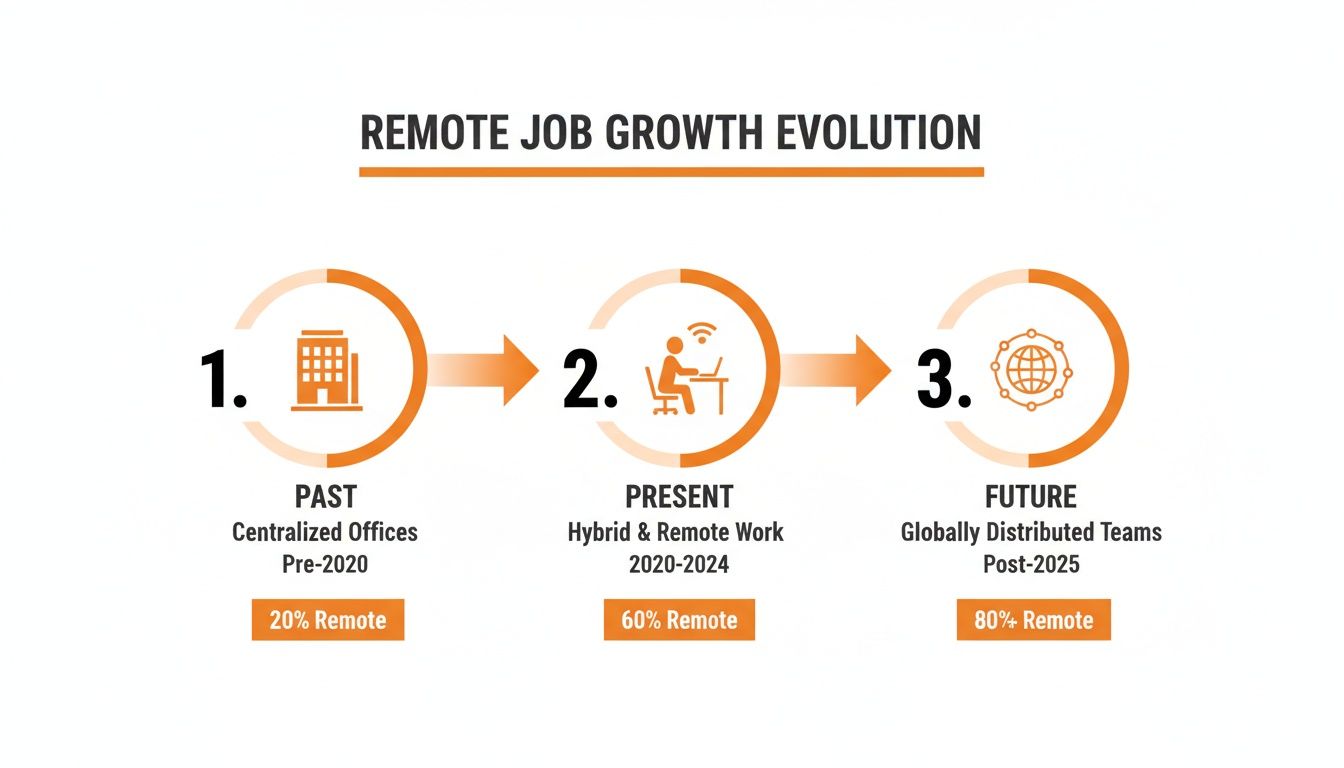
It’s clear this isn't a passing phase. Remote work is here to stay, and that means job seekers need a whole new playbook.
Adopting a Proactive Mindset
It’s time to ditch the old habit of mindlessly scrolling through massive, generic job sites. To succeed in landing a great remote role, you need to run a proactive, focused campaign. Think of it as building a personal brand that speaks directly to what remote-first companies are looking for, then using smart tools to pinpoint the best openings. This guide is that playbook, designed to walk you through every step.
Here’s a look at what we’ll cover:
- Profile & Resume Prep: Learn how to fine-tune your resume and online profiles to sail past the automated Applicant Tracking Systems (ATS) and grab the attention of a real human.
- Targeted Search Strategies: We'll dive into the specific keywords, filters, and platforms that uncover high-quality roles suited to your skills and lifestyle.
- Application & Interview Mastery: Get practical advice on writing applications that actually get read and learn how to crush virtual interviews by proving you’re ready to thrive in a remote setting.
- Negotiation & Logistics: Unpack the nuances of talking salary, benefits, and the logistics of working from a different city or even country.
Your goal is to shift from being a passive scroller to an active hunter. Treat your job search like a project with clear goals, the right tools, and a solid strategy. That’s how you drastically improve your odds of landing a role you genuinely love.
This change in mindset is what really separates the candidates who get offers from those who don't. It’s not just about your skills; it’s about how you frame them for a remote world. Let's start by building a foundation that will make your applications impossible to ignore.
Building a Profile That Recruiters Can't Ignore
Before you even think about hitting "apply," you need to get your house in order. Your resume, cover letter, and online profiles are your digital storefront, and for remote roles, they need more than just a quick dusting off. You have to actively prove you're built for this style of work, and that starts with how you present yourself on paper (and on screen).
The competition out there is no joke. With a global remote workforce of around 330 million people, your application is just one in a massive digital pile. According to some data on remote workforce trends, nearly 80% of employees who can work remotely are now doing so. To get noticed, your materials need to be sharp, targeted, and built to beat the system.
Mastering the Applicant Tracking System
Let's be real: the first gatekeeper you need to impress isn't a person. It's a bot. Most companies rely on an Applicant Tracking System (ATS) to do the initial screening, and these systems are ruthless. If your resume isn't formatted in a way the ATS can understand, it'll get tossed out before a hiring manager ever knows you exist.
The key to beating the bots is simplicity and customization. Ditch the fancy columns, graphics, and funky fonts—they just confuse the software. Stick to a clean, standard layout that's easy for a machine to parse.
More importantly, you absolutely have to tailor your resume for every single job. Pull keywords directly from the job description. If a post for a "Remote Content Strategist" mentions "SEO content briefs" and "A/B testing," you better believe those exact phrases need to appear in your skills or experience sections. This is how the ATS scores your resume, and a low score means an automatic rejection.
Using a tool like an ATS Resume Checker can give you a huge leg up. It shows you exactly how the software sees your resume and where the gaps are.
As you can see, getting an instant analysis helps you spot keyword mismatches or formatting errors that could sink your application. Aim for a high match score before you submit.
Showcasing Your Remote-Ready Skills
Hiring managers for remote teams are looking for more than just technical skills. They're looking for proof that you can actually thrive without someone watching over your shoulder. It’s on you to provide that proof.
This means shifting your resume from a list of duties to a portfolio of achievements. Quantify everything you can, and frame it through the lens of remote work.
Instead of: "Responsible for project communication."
Try: "Managed a project across three time zones using Asana and Slack, reducing email back-and-forth by 40% and ensuring all deadlines were met."
Instead of: "Managed marketing campaigns."
Try: "Independently led the Q3 marketing campaign from conception to launch, exceeding lead generation targets by 25% with minimal oversight."
These examples provide hard evidence that you're a self-starter who can communicate effectively from anywhere. For more inspiration, check out our guide on essential remote work skills for your resume.
Highlighting outcomes over duties is the core principle of a successful remote-ready resume. A hiring manager doesn't just want to know what you did; they want to know the result of your work and how it proves you're a reliable, independent contributor.
This simple change in perspective is what separates a resume that gets ignored from one that gets a call back.
Turning Your LinkedIn Profile Into a Magnet for Opportunities
Think of your LinkedIn profile as your professional headquarters. It's often the first place a recruiter will go to vet you, so it needs to be more than just a digital copy of your resume. It should be actively working for you.
Start with your headline. Don't just put your job title. Pack it with keywords. "Senior Software Engineer" is okay, but "Senior Software Engineer | Python, AWS | Seeking Fully Remote Opportunities" is a beacon for the right recruiters.
Your "About" section is your chance to tell your story. Don't just list skills. Explain your professional journey, what drives you, and specifically why you excel in a remote setting. Weave in those important keywords naturally here and throughout your experience descriptions.
Give your profile a quick audit with this checklist:
- Professional Headshot: Is it clear, recent, and approachable?
- Keyword-Rich Headline: Does it scream your expertise and remote preference?
- Compelling Summary: Does your "About" section tell a story and highlight your remote-work strengths?
- Quantified Achievements: Are your experience entries focused on measurable results?
- Skills & Endorsements: Are your most relevant skills listed and validated by others?
- Recommendations: Do you have a few recent, glowing reviews from past colleagues or managers?
A well-optimized profile is like having a secret agent out there, constantly looking for jobs on your behalf. It signals to recruiters that you're a serious professional ready to make an impact on their distributed team.
Searching Smarter, Not Harder, for Remote Roles

Okay, your resume and online profiles are looking sharp. Now comes the fun part: the hunt. But before you dive into the biggest job boards and type "remote," let's pause. That approach is a fast track to burnout, drowning you in a sea of irrelevant listings.
We're going to move away from the "spray and pray" method. The real goal is to search with intention. It's about building a system that cuts through the noise—weeding out the "remote-friendly" jobs that still want you in an office twice a week, the roles that don't meet your salary needs, and the opportunities in completely unrealistic time zones. You need to take control and find remote jobs online that genuinely fit your life.
Mastering Search Filters and Boolean Logic
Think of advanced search filters as your first line of defense. Nearly every modern job platform has them, but most people barely scratch the surface. It's time to get comfortable using these tools to your advantage.
Here are a few non-negotiable filters I always recommend using:
- Salary Range: Don't waste a single click on a role that won't pay the bills. Set your minimum and stick to it.
- Job Type: Be specific. Are you looking for a full-time W-2 position, a short-term contract, or freelance gigs?
- Time Zone Requirements: This is a big one for remote work. Many "work from anywhere" jobs still need you online during specific hours. Filter for roles that align with your location.
- Benefits: Some platforms even let you filter for key perks like a home office stipend or health insurance. Why not use it?
Once you've got the filters down, learning Boolean search operators is like unlocking a cheat code for job hunting. These simple commands let you craft super-specific queries on any job board or search engine.
Think of Boolean search as giving a search engine a precise set of instructions. Instead of vaguely asking for "remote marketing jobs," you're telling it exactly what to include and what to leave out. The quality of your results will skyrocket.
To get the best results, you need to know how to use precise keywords and modifiers.
Effective Remote Job Search Keywords
| Keyword/Modifier | What It Does | Example Usage |
|---|---|---|
| "Quotation Marks" | Searches for the exact phrase, eliminating irrelevant variations. | "customer success manager" |
| AND | Narrows the search, ensuring all specified terms appear in the listing. | "Product Manager" AND "SaaS" |
| OR | Broadens the search to include either term, great for similar job titles. | "Content Writer" OR "Copywriter" |
| NOT or - | Excludes a specific keyword, helping you filter out unwanted roles. | "Software Engineer" -Junior |
| (Parentheses) | Groups terms together to create more complex, layered search commands. | ("UX Designer" OR "Product Designer") AND "FinTech" |
Learning to combine these operators is the secret sauce. A single search string like ("Social Media Manager" OR "Community Manager") AND "B2B" NOT "Intern" can do the work of 30 minutes of manual sifting. It's a game-changer.
Identifying Truly Remote-First Companies
Here’s a hard truth: not all remote jobs are created equal. You have companies that are truly remote-first and those that are merely "remote-friendly." The difference is massive.
Remote-first companies design their entire culture, communication, and workflow around a distributed team. Everyone is on a level playing field. In many remote-friendly companies, an office-centric culture still dominates, and remote employees can easily feel like outsiders.
So, how do you spot the good ones?
- Read the Job Description Carefully: Look for positive keywords like "distributed team," "asynchronous work," and "work from anywhere." Be wary of red flags like mentions of a "local office" or city-specific requirements for a supposedly remote role.
- Consult Company Directories: Don't go it alone. Use platforms that vet and list companies with proven remote cultures. Browsing a curated list of the best remote companies to work for is a great starting point for finding employers who are genuinely all-in on remote work.
- Check the Benefits: The perks tell a story. True remote-first companies offer benefits that make sense for a distributed workforce, like home office stipends, co-working memberships, and genuinely flexible hours.
By focusing your search on these kinds of organizations, you’re setting yourself up for a much better experience. You’ll be joining a team where you have the same opportunities for growth and connection as anyone else, no matter where your desk happens to be.
Crafting Applications That Actually Get Read
Your resume might get you past the initial computer screening, but it's your application—your cover letter, your introductory email—that actually gets a human's attention. Think of it as your first real handshake. This is your chance to go from just another name on a spreadsheet to a candidate they absolutely have to talk to.
And let's be honest, a generic, copy-paste cover letter is the fastest way to the trash folder. This is especially true when you find remote jobs online, where you're competing with a global talent pool.
Instead of just rehashing your resume, your application needs to tell a compelling story. It should zero in on the company's problems and frame you as the person who can solve them. To do that, you have to read the job description like a detective. What are their biggest headaches? Are they struggling to scale their content? Do they need someone to bring order to a chaotic project? Pinpoint their pain, then connect your experience directly to that need.
This tailored approach does more than just show off your skills; it proves you've done your homework and are genuinely interested in this role, not just any role.
Moving Beyond the Generic Template
The gap between a bland template and a persuasive, customized cover letter is massive. One gets ignored within seconds; the other lands you an interview. Let's break down the difference with a real-world example.
Before: The Bland Template
"Dear Hiring Manager, I am writing to express my interest in the Remote Project Manager position I saw advertised. I have five years of experience in project management and believe my skills are a good fit for this role. My resume is attached for your review. I look forward to hearing from you."
Forgettable, right? It's completely devoid of personality and could have been sent to a hundred different companies.
After: The Persuasive Narrative
"Hi [Hiring Manager's Name], I’ve been following [Company Name]'s work in the sustainable tech space for a while and was genuinely excited to see the opening for a Remote Project Manager. The job description mentioned needing someone who can streamline cross-functional workflows for a fully distributed team, which caught my eye. In my last role at [Previous Company], I spearheaded a project coordinating engineers in Berlin with a marketing team in San Francisco. By setting up a new asynchronous communication system in Asana, we managed to cut project delays by 25% in a single quarter. I’m confident I can bring that same problem-solving approach to the challenges you're facing. My resume has more details, and I'd love to talk about how I can deliver similar results for your team."
See what happened there? The second version is a direct pitch. It proves you understand their specific challenges and gives them concrete evidence that you've solved similar problems before. It immediately puts you in a different league from other applicants.
Addressing Logistics Professionally
When you're trying to find remote jobs online, practical details like salary and time zone are non-negotiable. A lot of candidates get nervous about bringing these up, but tackling them professionally right from the start can save everyone a ton of time.
Don’t think of discussing salary or time zone as an awkward conversation. It’s about ensuring a great long-term fit for both you and the company—a clear sign of professional maturity.
If an application asks for your salary expectations, always provide a range, not a single figure. This keeps the door open for negotiation down the line. Do a little digging to find out the typical salary for that kind of role, either in your area or for remote positions at similar companies.
Here’s a simple way to phrase it:
- "Based on my experience and current market rates for similar remote roles, my salary expectation is in the $85,000-$95,000 range."
When it comes to time zones, be upfront about your location and your flexibility.
- "I am based in the EST time zone but have extensive experience collaborating with teams across European and Pacific time zones. I maintain a flexible schedule to ensure there's always enough overlap for key meetings."
Handling these points with confidence shows you’re a pro who gets the realities of remote work. It also helps you weed out opportunities that aren't a good logistical match from the get-go. And if you're ever worried about how your resume will fare against automated systems, you can always run it through a good ATS resume checker before you hit send.
Acing the Virtual Interview and Negotiation

Getting that email for a virtual interview is a huge step forward, but this is where the real work begins. A video interview isn't just a regular interview over a webcam—it’s an audition. They're watching to see how you’ll operate as a remote colleague, and your ability to build rapport through a screen is being judged just as much as your experience.
This part of the process requires a different kind of prep. You’re not just answering questions; you're actively proving you have the self-discipline, communication chops, and tech-savviness to excel without someone looking over your shoulder. This is your chance to show you're not just qualified for the job, but built for remote work.
Setting the Stage for Success
Your interview environment says a lot about you before you even unmute. A cluttered background, shadowy lighting, or bad audio can come across as unprofessional or, worse, unprepared. You absolutely have to get your tech setup right to make a strong first impression.
Lighting is everything. Face a window or a lamp. Whatever you do, don't sit with a window behind you, or you’ll turn into a silhouette. A cheap ring light can be a total game-changer here.
Test your audio. Your laptop’s built-in mic probably isn’t cutting it. Use a headset or a simple USB microphone to make sure your voice is crystal clear, without any echo or background noise from your dog barking.
Curate your background. Keep it clean and simple. A tidy bookshelf, a plant, or a plain wall works perfectly. I’d advise against virtual backgrounds—they can be glitchy and distracting. A real, organized space is always better.
Your virtual interview setup is more than just logistics—it’s a direct reflection of your ability to create a functional and professional home office environment. A clean setup shows you are serious, organized, and ready to work effectively from day one.
Answering Remote-Specific Questions
When you find remote jobs online, you can bet the interview questions will be different. The hiring manager's goal is to figure out if you can really handle working autonomously. They need to trust that you can manage your time, stay motivated, and communicate clearly without the built-in structure of a physical office.
Get ready for questions like these:
- "How do you structure your day to stay productive when working from home?"
- "Tell me about a time you worked with a team across different time zones. What were the challenges?"
- "How do you keep yourself motivated and avoid distractions without direct supervision?"
The only way to answer these effectively is with real, specific examples. Talk about the project management tools you've used (like Asana or Trello), the communication habits you've built (like posting daily updates on Slack), and the personal systems you rely on to stay focused. This gives them concrete proof that you know what you’re doing.
Negotiating Your Remote Offer
When the offer finally lands in your inbox, the conversation pivots to negotiation. With remote jobs, this is about much more than just the base salary. You need to understand the company's entire compensation philosophy for a distributed team and clarify the benefits that actually matter when you don't go into an office.
On the topic of salary, be ready for location-based pay models. Some companies adjust your pay based on your local cost of living, while others have a single pay scale for everyone. Do your homework—research market rates for your role both where you live and for remote positions nationally so you can anchor your ask in solid data.
Beyond the paycheck, think about pushing for other key perks:
- Home Office Stipend: A one-time or recurring allowance to cover your desk, a good chair, and other essentials.
- Flexible Hours: Get clarity on their expectations. Are there core hours, or is it a truly asynchronous, results-driven culture?
- Professional Development Budget: Ask for funding for online courses, certifications, or conferences to keep your skills sharp.
The data is on your side. Studies have shown remote workers are 9% more productive than their in-office counterparts, and an overwhelming 91% of remote workers feel they perform at the same level or even higher from home. These productivity boosts often save companies money—a point you can subtly weave into your negotiation. You can learn more about how remote work boosts productivity and satisfaction.
Exploring Relocation and Digital Nomad Visas
One of the best parts of landing a remote job is the freedom that comes with it. If your role is truly location-independent, you might start thinking about moving to a new city or even another country. This opens up incredible possibilities, but it also means you have to be smart about legal work authorization.
Many countries are now rolling out Digital Nomad Visas, which are designed specifically for remote workers like us. These visas create a legal pathway for you to live and work abroad for a year or more. It can feel like a lot to navigate, but some great resources out there can make it much simpler.
For example, this screenshot from YayRemote's Digital Nomad Visa hub shows a clean, organized directory for exploring different country requirements.
Tools like this let you filter visas by continent and quickly see the key details, which makes researching your dream destination way less of a headache. By handling the interview and negotiation like a pro, you can unlock a career that gives you not just a great job, but a whole new way of living.
Got Questions About Finding a Remote Job? We've Got Answers.
Jumping into the remote job market can feel like navigating a whole new world. You’ve probably got a ton of questions floating around, from how to prove you’re the right fit without prior remote experience to telling the difference between a great opportunity and a scam. Let's clear up some of the most common uncertainties people face.
"But I've Never Worked Remotely Before. How Do I Compete?"
This is probably the number one question I hear. Don't worry, it's not a deal-breaker. The trick is to stop thinking about where you worked and start focusing on how you worked. You need to show that you thrive in an environment that requires autonomy and self-motivation.
Think back to any project you owned from start to finish or a time you hit a major goal with little to no hand-holding. That’s your gold. Weave those stories into your resume and cover letter to showcase your self-discipline, proactive communication style, and killer time management skills.
A few practical tips:
- Talk About Your Tools: Are you comfortable using Slack, Asana, Microsoft Teams, or Jira? Mention them. This signals to recruiters that you already speak the language of remote collaboration.
- Reframe Your Wins: Don't just say you "completed tasks." Instead, try something like, "Independently managed the Q3 product launch from conception to completion, using asynchronous updates to keep all global stakeholders aligned and informed."
Proving you can work effectively without someone looking over your shoulder is your most powerful move. It shows you’ve got the right mindset to excel from day one.
"Do I Have to Take a Pay Cut to Work Remotely?"
Not at all. This is a common myth, but the reality is a lot more nuanced. Your potential salary really comes down to the company's compensation philosophy.
Some companies adjust pay based on your location and its cost of living. Others have a single, location-agnostic salary for each role, meaning you’d earn the same whether you’re in New York City or a small town in Nebraska.
Many in-demand roles, particularly in the tech world, offer pay packages that are just as competitive—if not more so—than their office-based counterparts. Plus, when you factor in what you’ll save on commuting, lunches out, and a work wardrobe, your take-home pay can feel significantly higher. The key is to use salary filters on job boards right from the start to find roles that match your financial expectations.
The idea that "remote" automatically means "less pay" is outdated. A well-negotiated remote offer can be incredibly rewarding. It all comes down to your skills and your strategy at the negotiation table.
What Are the Biggest Red Flags in a Remote Job Posting?
You absolutely have to keep your guard up when you’re searching for jobs online. The internet is a fantastic tool, but it also provides a layer of anonymity that can attract scammers. If an offer feels too good to be true, it almost always is.
Here are some major red flags to watch out for:
- Vague Job Descriptions: A legitimate company knows exactly what it's hiring for. The responsibilities and qualifications should be crystal clear.
- Unrealistic Salary Promises: An entry-level role promising a six-figure salary with minimal experience is a huge warning sign.
- Requests for Money or Financial Info: You should never have to pay for your own equipment or provide bank details before you’ve signed a formal employment contract.
- Unprofessional Communication: Be wary of emails coming from personal addresses (like Gmail or Yahoo) or interviews held exclusively over a text-chat app. Real companies use professional domains and have a structured hiring process.
Always do a quick background check. Look up the company’s official website and their LinkedIn page. It’s a simple step that can save you a world of trouble.
Ready to cut through the noise and find legitimate, high-quality remote opportunities? YayRemote curates hand-picked roles from trusted remote-first companies around the globe. Use our advanced filters and free tools to find a job that truly fits your life at https://www.yayremote.com.