Unlocking Employer of Record Benefits for Global Growth
Discover the key employer of record benefits that simplify global hiring, ensure compliance, and unlock access to international talent pools for your business.
So, you want to hire the best person for the job, no matter where they live. That's the goal. But the reality of hiring someone in another country can be a tangled mess of legal, financial, and administrative hurdles.
The biggest benefits of using an Employer of Record (EOR) are simple: you get to sidestep the nightmare of setting up a foreign legal entity, you’re guaranteed 100% local compliance, and you can get new hires started in days, not months. It transforms a potential legal ordeal into a surprisingly straightforward process.
What Is an Employer of Record and How Does It Work?

Let's use a real-world scenario. Imagine your US-based company finds the perfect software engineer, but she lives in Germany. Without an EOR, you'd have to register a business entity in Germany, figure out its complex labor laws, and set up a local payroll system. It’s a slow, risky, and incredibly expensive undertaking.
An Employer of Record completely changes the game.
Think of an EOR as your expert local partner who becomes the legal employer for your team members in their home country. You find and recruit the talent, you manage their day-to-day work and projects, but the EOR handles all the official employment infrastructure behind the scenes.
Core Functions of an EOR
So, what does an EOR actually do? While you focus on integrating your new hire into the team and managing their performance, the EOR takes on all the official duties of being an employer.
Here’s a breakdown of their main responsibilities:
- Legal Compliance: The EOR drafts and manages employment contracts that are fully compliant with all local labor laws, from working hours to termination rules.
- Payroll and Taxes: They handle everything related to paying your employee correctly and on time, including all the necessary tax withholdings and social security contributions for that specific country.
- Benefits Administration: They provide a competitive benefits package—like health insurance, retirement plans, and paid leave—that meets all local legal requirements and employee expectations.
- HR and Onboarding: From handling all the initial paperwork to ensuring a smooth and compliant offboarding process, the EOR manages the full HR lifecycle.
This model is a massive shift for companies wanting to build a global team without the huge upfront investment. The global Employer of Record market is set to hit a staggering $15.89 billion by 2035, which tells you just how many businesses are embracing this approach. It’s a powerful alternative to the traditional route of establishing a legal entity, which could easily cost a company anywhere from $50,000 to $250,000 per country. You can read the full analysis on EOR market growth trends to see what this means for the future of business.
By shouldering the legal and administrative burdens, an EOR gives you immediate access to a global talent pool. It turns the unpredictable, complex process of international hiring into something clear and manageable.
To help you see the value clearly, here's a quick summary of the key employer of record benefits.
Key Employer of Record Benefits at a Glance
| Benefit Category | How an EOR Delivers | Primary Business Impact |
|---|---|---|
| Speed to Market | Onboards new hires in days by using existing legal entities and processes. | Hire top talent before competitors and start projects faster. |
| Global Compliance | Local legal and HR experts ensure adherence to all labor laws, taxes, and regulations. | Avoid costly fines, legal disputes, and reputational damage. |
| Cost Savings | Eliminates the need to establish and maintain a foreign legal entity (saving $50k-$250k). | Redirect capital toward core business growth and innovation. |
| Risk Mitigation | Assumes legal liability for employment, payroll, and benefits administration. | Reduce exposure to worker misclassification and other employment risks. |
| Access to Talent | Removes geographic barriers, allowing you to hire the best person for the role, anywhere. | Build a stronger, more diverse, and more skilled team. |
| Employee Experience | Offers competitive, localized benefits and ensures timely, accurate pay. | Improve employee satisfaction, retention, and overall morale. |
Ultimately, this partnership gives you the freedom to build your dream team, no matter where its members call home.
The Real-World Advantages of an Employer of Record
So, what does an Employer of Record actually do for you? Beyond the technical definition, its true value comes from the practical benefits it brings to any company looking to hire globally. Think of an EOR as more than just an admin service; it’s a strategic lever that completely changes how you find, hire, and support your team across borders.
Let's dive into the core advantages that make an EOR so essential for modern global expansion. Each one solves a very real, high-stakes problem that companies run into the moment they start looking for talent outside their home country.
Navigate Complex International Compliance with Confidence
Imagine you want to hire a brilliant developer in Brazil. You'd instantly run into a maze of local labor laws. We're talking about things like a mandatory 13th-month salary, profit-sharing requirements, and contributions to a specific severance fund known as FGTS. One small mistake here can lead to heavy fines and legal headaches.
This is where an EOR steps in as your on-the-ground compliance expert. They become legally responsible for making sure every part of the employment relationship follows that country's specific rulebook.
This covers critical areas like:
- Compliant Employment Contracts: They'll draft agreements that meet all local standards, from working hours and probation periods to termination rules.
- Statutory Requirements: An EOR manages all the mandatory contributions you might not even know about, like social security, pensions, and other country-specific funds.
- Regulatory Changes: Labor laws are always changing. Your EOR stays on top of them so your company remains compliant without you needing a law degree in every country.
For example, when hiring in Europe, an EOR ensures you're fully compliant with GDPR for handling employee data—a massive undertaking for any outside company. This protective shield is one of the most powerful benefits an EOR provides.
Untangle Global Payroll and Tax Headaches
Paying international employees correctly involves much more than just converting currency. Every country has its own tax codes, withholding rules, and even different pay schedules. A single slip-up can mean an employee gets the wrong pay and your company faces serious tax trouble.
An EOR takes this entire complicated process off your plate. They handle the whole payroll cycle, making sure your team members are paid accurately and on time, every single time.
An EOR’s payroll service isn't just about cutting checks; it's about navigating a web of international financial rules. They manage all tax withholdings and social security payments required by local law, then send you a single, straightforward invoice.
This approach saves your finance team countless hours and eliminates the risk of falling out of step with foreign tax agencies. You don't have to open local bank accounts or figure out unfamiliar banking systems.
Accelerate Your Hiring and Onboarding Timeline
Setting up your own legal entity in a new country is a notoriously slow and costly affair. It can easily take six months to a year and cost tens of thousands of dollars. The best candidates simply won't wait that long.
Here, an EOR gives you a huge competitive edge. Since the EOR already has an established legal entity in the country, you can get a new hire onboarded in just a few days.
This speed to market means you can:
- Secure Top Talent Fast: Make a compelling offer and get your ideal candidate working before competitors have even filed their paperwork.
- Launch Projects Sooner: Deploy teams for market entry or time-sensitive projects without being bogged down by administrative delays.
- React Quickly to Business Needs: Nimbly scale your team up or down in different parts of the world, seizing market opportunities as they appear.
Offer Competitive, Localized Benefits
To attract and keep the best people worldwide, a good salary isn't enough. Employees expect a benefits package—health insurance, retirement plans, paid time off—that is competitive in their local market.
Trying to design and manage these packages across multiple countries is a monumental task. An EOR solves this by giving you access to high-quality, pre-vetted benefits plans that are already customized for each country. They take care of the administration, enrollment, and ongoing management, making sure your employees feel secure and valued.
This is a key employer of record benefit because it levels the playing field, allowing even smaller companies to offer benefits packages that can compete with those of large multinational corporations.
Reduce Employment Risks and Liabilities
When you hire directly in another country, your company takes on all the legal risks of employment. That includes everything from accidentally misclassifying a worker to facing a wrongful termination lawsuit. A single misstep can spiral into a costly legal fight and tarnish your company's reputation.
Partnering with an EOR transfers that liability. The EOR is the legal employer, so they carry the responsibility for following all labor laws and handling any potential disputes. This risk reduction is invaluable, especially for companies that are new to global hiring. It gives you the peace of mind to focus on what you do best: managing your team and growing your business.
The strategic value here is undeniable. Recent data reveals that 65% of companies use EORs to minimize compliance risks, while 63% do it for the cost savings of not having to set up a foreign entity. And as work becomes more flexible—with 72% of job applicants now prioritizing location flexibility—EORs are becoming fundamental to how modern businesses operate. You can explore the latest global hiring trends on Atlas HXM to see just how much EORs are shaping today's workforce strategies.
An Honest Look at Your Global Hiring Options
Deciding how to hire someone in another country isn't a one-size-fits-all situation. The right answer really hinges on your company’s specific goals, budget, and how much risk you're willing to stomach. While an Employer of Record is a powerful tool, it’s just one of several ways to build a global team. Seeing how it stacks up against the alternatives is the best way to figure out if it’s the right move for you.
Here’s a simple analogy I often use: setting up your own legal entity in a new country is like building a custom house from scratch. You get total control, but it's incredibly slow, expensive, and you’re on the hook for every single permit, pipe, and wire. An EOR, on the other hand, is like leasing a high-end, fully furnished office space. You can move your team in tomorrow, and all the utilities, legalities, and maintenance are handled for you.
EOR vs. Direct Hire (Your Own Entity)
Going the traditional route and establishing your own foreign subsidiary has long been the gold standard for global expansion. It gives you complete control and a permanent foothold. But this path comes with a serious price tag in both time and money—we're talking 6-12 months of administrative heavy lifting and tens of thousands of dollars before you can make your first hire. This approach really only makes sense when you're making a massive, long-term commitment to a specific market.
For almost every other scenario, an EOR is the faster, more agile choice. It’s the perfect solution for testing the waters in a new country, hiring a handful of key people across the globe, or simply moving fast to snag top talent before a competitor does.
EOR vs. Independent Contractors
At first glance, hiring international talent as independent contractors looks like the easiest path. It seems quick, cheap, and simple. The problem is, this model is loaded with the very real risk of worker misclassification. If a local tax authority decides your "contractor" is actually behaving like an employee, your company could be slammed with crushing penalties—back taxes, unpaid benefits, and steep fines.
An EOR takes this risk completely off the table. They hire your talent as fully-fledged, compliant employees from day one. Your team member gets the job security and statutory benefits they deserve, and your business is shielded from legal and financial blowback. While contractors have their place, understanding the full picture, including the best ways to pay international contractors, is critical before you commit.
EOR vs. PEO (Professional Employer Organization)
This is where people really get tripped up. A Professional Employer Organization (PEO) uses a co-employment model, which means you and the PEO share the responsibilities and liabilities of being an employer. The most important detail? You must already have your own legal entity in that country to even use a PEO.
An Employer of Record (EOR), by contrast, acts as the sole legal employer in the country. You don't need an entity because the EOR uses its own. This is what makes an EOR the go-to for breaking into new countries, while a PEO is designed to help you offload HR tasks in a country where you already have a legal presence.
The core difference is simple: A PEO joins you as a co-employer where you already exist. An EOR acts as the employer for you where you don't.
This decision tree helps visualize how an EOR fits into your strategy once you decide to look for talent beyond your borders.
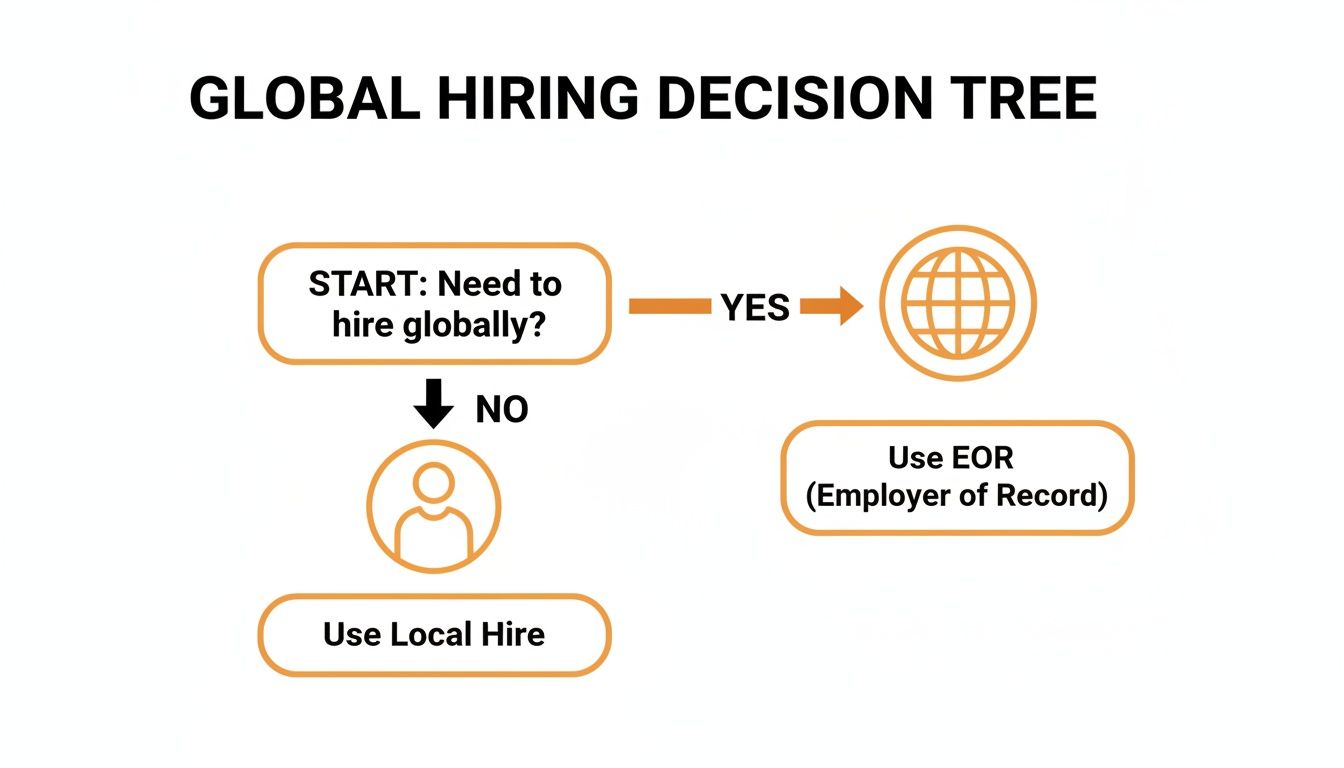
As the graphic shows, once a company commits to hiring internationally, an EOR becomes a primary tool for doing so quickly and compliantly. As you move forward, our guide on how to hire remote employees can provide more practical steps for building out your team.
Global Hiring Models Compared: EOR vs PEO vs Contractor vs Direct Hire
To help you choose the right model for your business, this table lays out the crucial differences side-by-side.
| Factor | Employer of Record (EOR) | Direct Hire (Own Entity) | Independent Contractor | PEO |
|---|---|---|---|---|
| Legal Entity Required? | No | Yes | No | Yes |
| Setup Speed | Days | 6-12+ Months | Days | Weeks |
| Compliance Risk | Low (EOR assumes liability) | High (Your full responsibility) | High (Misclassification risk) | Medium (Shared liability) |
| Best For | Market entry, remote teams, hiring in new countries | Large-scale, long-term presence | Short-term projects, specialized tasks | Outsourcing HR where you have an entity |
Each model serves a different purpose. The key is to match the tool to the job at hand—whether you're testing a new market, scaling up a permanent office, or bringing in a specialist for a single project.
When to Use an Employer of Record
Understanding the benefits of an Employer of Record on paper is one thing. Seeing it solve real business problems is when it all clicks. An EOR isn't just a back-office tool for compliance; it's a strategic lever you can pull for specific, high-stakes challenges.
An EOR really proves its worth when you need speed, global reach, and a safety net against complex local laws.
Let's walk through three common situations where bringing in an EOR partner is a game-changer. Each one shows how a tough problem gets a clean, simple solution.
Testing a New Market Without the Upfront Cost
Imagine your US-based e-commerce brand is getting a lot of buzz in Germany. It feels like a golden opportunity, but the idea of setting up a full-blown German legal entity is daunting. We're talking months of work and tens of thousands of dollars before you've made a single sale.
Instead of jumping into that massive commitment, you could use an EOR to hire a local sales manager in Berlin. This lets you get an experienced person on the ground almost immediately to "test the waters."
The EOR handles the German employment contract, payroll, and benefits administration. You get to focus entirely on sales strategy and gathering market intelligence. If the market takes off, you can establish your own entity later. If it doesn't, you can compliantly offboard the employee through the EOR without being stuck with a costly, dormant company.
Hiring Niche Talent From Anywhere
Let's say a UK-based AI firm finds the perfect machine learning expert for a critical role. The only catch? She lives in a small town in Canada. The company has zero presence there and no idea how to navigate Canadian labor laws, which can differ wildly from one province to the next.
Trying to figure this out on their own would be a legal and administrative nightmare. But with an EOR, they can put a competitive, fully compliant offer on the table in just a few days. The EOR takes care of the entire Canadian employment framework—from provincial tax rules to mandatory benefits—making sure the new hire is set up for success.
This is where an EOR truly opens up the global talent pool. It dismantles geographic barriers so you can hire the absolute best person for the job, not just the best person you can find nearby.
The core benefit here is agility. An EOR transforms a complex, cross-border hiring challenge into a simple, streamlined process, letting you secure top talent before your competitors can even consult their lawyers.
Converting a Valuable Contractor to an Employee
Many remote-first software companies rely on a mix of employees and freelancers. Picture a company that’s been working with a fantastic developer in Brazil for over a year. She’s become a core part of the team, and as her role grows, the risk of worker misclassification becomes a serious concern. The company wants to offer her the security and benefits of a full-time employee.
This is a perfect use case for an EOR. It provides a clean, compliant path to convert that contractor into a full-fledged employee. The EOR manages the Brazilian employment contract, enrolls her in local health and retirement plans, and handles unique local requirements like the mandatory 13th-month salary.
The developer gets the job security she deserves, and the company protects itself from a huge compliance headache. This is a common and smart step for companies that want to build loyal, long-term teams, as it simplifies the process of learning how to hire remote employees and ensures everyone is treated fairly.
The rise of fully distributed companies shows just how essential this kind of flexibility has become.
This list from YayRemote shows a fraction of the companies operating without a central headquarters, all of whom rely on compliant global hiring solutions. These businesses thrive by accessing talent everywhere, a strategy made possible by models like EOR.
Breaking Down the Cost of Using an EOR

Alright, let's talk money. While one of the most obvious employer of record benefits is dodging the massive cost of setting up a foreign legal entity, an EOR service isn't free. To really see the value, you need to get a clear picture of how they structure their fees so you can budget without any surprises.
Most EOR providers stick to one of two common pricing models. It’s smart to ask which model they use upfront and to specifically inquire about any hidden fees for things like onboarding a new hire or handling their departure.
Common EOR Pricing Models
When you start getting quotes, you’ll almost always run into these two structures:
Fixed Monthly Fee: This is the most straightforward approach. You pay a flat rate for each employee, every month. The fee can range from $200 to over $600, depending on how complex the labor laws are in that particular country. The big win here is predictability—your costs are the same every month, which makes budgeting a breeze.
Percentage of Total Compensation: With this model, the EOR's fee is a percentage of the employee’s salary and benefits package, usually falling somewhere between 15% and 25%. This can be great for entry-level or lower-paid roles because the fee scales down. On the flip side, it can get pricey when you're hiring for senior or executive-level positions.
A trustworthy EOR partner will be completely transparent about their pricing. Always ask for a detailed breakdown of what's covered in their fee. If they're cagey about it, that's a red flag.
But the EOR’s service fee is just one piece of the puzzle. To really understand your monthly bill, you need to look at the total cost of employment.
Calculating the Total Cost of Employment
The EOR’s fee covers their administrative and compliance heavy lifting. Your actual invoice, however, will roll up every single cost associated with having that person on your team. This consolidated number is what you truly pay.
Here’s what goes into that final number:
- Employee's Gross Salary: This is the base salary you've agreed upon with your new hire.
- Employer's Statutory Contributions: These are the non-negotiable, mandatory costs an employer must pay in that country. Think social security, pension funds, unemployment insurance, and other payroll taxes required by law. These can vary wildly from one country to another.
- Benefits Costs: This covers the price tag for any extra perks you offer, like private health insurance, dental plans, or supplemental retirement funds.
- EOR Service Fee: Finally, the provider adds their administrative fee, based on either the fixed or percentage model we just discussed.
Let’s make this real. Say you want to hire a software developer in Canada and offer them a gross annual salary of $100,000. The EOR will first calculate all the mandatory employer costs—things like contributions to the Canada Pension Plan (CPP) and Employment Insurance (EI)—and then add the cost of a competitive benefits package. For a deeper dive on this, you can check out our guide on how to pay international employees.
Once all those costs are tallied, the EOR tacks on their service fee. The result is a single, clean invoice that covers everything. You get one simple payment, and you can rest easy knowing your global team member is paid correctly and compliantly, every single time.
How to Choose the Right EOR Partner
Picking the right Employer of Record is one of the most important calls you'll make when you decide to hire internationally. This decision will directly shape your budget, your team's day-to-day experience, and how smoothly your global expansion really goes. With so many providers out there, you have to cut through the marketing fluff and focus on what actually matters.
Think of it this way: you wouldn't hire a general contractor for a major home renovation without vetting their licenses, seeing their past work, and making sure they have a solid crew. The same level of diligence applies here. Your EOR isn't just a vendor; they become an extension of your team, handling your most valuable asset—your people.
Vet Their Geographic Footprint and Expertise
First things first, ask a very simple, direct question: Does the EOR have its own legal entities in your target countries? This is a non-negotiable starting point. Some providers just patch together a network of third-party agencies, which can create a messy game of telephone, drive up costs, and bring everything to a crawl when you need answers. A partner with their own entities on the ground gives you a direct, reliable line of service.
Just as important is their actual, proven expertise in those countries. You don't want an EOR learning complex labor laws on your dime. A seasoned partner will already have a deep bench of local experts who know the ins and outs of everything from Brazil's mandatory 13th-month salary to Germany's notoriously strict termination policies.
Evaluate Their Technology Platform
A great EOR today is also a great tech company. Their platform should do more than just process payroll; it should make managing a global team feel simple and intuitive. A clunky, outdated system will only create headaches for you and your employees.
When you get a demo of their platform, here’s what to look for:
- Intuitive Onboarding: How fast and friction-free is the onboarding process? It should feel welcoming and straightforward for your new hire. For a deeper dive into making this a great experience, check out our remote employee onboarding checklist.
- Centralized Management: Can you see and manage your entire global workforce from a single, clean dashboard?
- Employee Self-Service: Does the platform empower your people to easily find their pay stubs, book time off, or check their benefits without having to file a support ticket?
Let's be clear: the complexity of global regulations is a huge reason companies turn to EORs. With laws like GDPR in Europe and CPRA in California, the compliance stakes have never been higher. Missteps can be catastrophic, leading to massive penalties like Uber's $100 million worker reclassification settlement or Deliveroo's €5 million fine in France. A top-tier EOR handles all that legal and payroll heavy lifting, protecting you from these risks.
Scrutinize Pricing and Benefits Packages
Finally, let's talk money. A trustworthy EOR will be completely transparent about their pricing. There should be no surprise fees for onboarding, offboarding, or currency conversions. Ask for a detailed, all-in cost breakdown that includes their fee, all employer tax contributions, and any other mandatory social costs.
A key part of realizing employer of record benefits is cost clarity. If a provider is vague about their pricing or can't give you a precise total employment cost, consider it a major red flag.
The quality of their benefits packages is just as crucial. To attract top talent, you need to offer more than just a paycheck. Can the EOR provide competitive, localized benefits that people in that specific market actually want? A great partner will give you the flexibility to offer premium health, dental, and retirement plans that make your company a top choice for talent, no matter where they are in the world.
Common Questions About Using an EOR
As you start to explore what an Employer of Record can do for you, a few practical questions always pop up. Let's walk through the most common ones to clear up how these services actually function day-to-day.
What Is the Difference Between My Direct Hires and EOR Hires?
Think of it this way: you still manage everyone’s work, projects, and career growth. Your team is your team. The real difference is purely administrative.
For your EOR hires, the Employer of Record is the legal employer on paper. They take care of all the complex local HR tasks—like payroll, taxes, and compliance—so you don't have to. You're still the one calling the shots on their daily work.
How Quickly Can I Onboard a New Hire?
Speed is one of the biggest employer of record benefits. An EOR already has legal entities set up in countries all over the world.
This means you can often get a new hire onboarded and working in just a few days. It's a massive shortcut compared to the 6-12 months it can take to establish your own company in a new country from scratch.
It’s worth remembering that your EOR partner is legally on the hook for any compliance issues. If there's a payroll tax mistake, a labor law misstep, or an issue with benefits, the liability falls on them, not your company.
Can I Use an EOR to Hire in Any Country?
That’s a great question, and the honest answer is almost, but not quite. While the top EORs provide incredible reach, no single provider covers every country on the planet.
Most major players cover 150+ countries, which handles the vast majority of hiring needs. The key is to always confirm that a potential partner operates directly in your target countries before you sign anything. Check their geographic footprint first.
Ready to hire the best talent, no matter where they live? YayRemote is the leading global remote job platform connecting you with skilled professionals from around the world. Post your job today and build your dream team without borders.