How to Pay International Employees Your Complete Guide for 2026
Learn how to pay international employees compliantly. Our guide covers EOR vs contractors, global payroll, tax laws, and currency management for your team.
So, you’re ready to pay your international team. The first—and most critical—decision you'll make isn't about payment providers or currency exchange. It's about how you legally structure your relationship with your new hire.
This choice sets the foundation for everything that follows. It shapes your compliance risk, administrative burden, and even how quickly you can grow your global team. Get it right, and you’re set up for smooth sailing. Get it wrong, and you could face legal headaches and steep fines down the road.
Let's break down the three main routes you can take. Each comes with its own set of pros and cons, and the best fit really depends on your company's long-term vision, appetite for risk, and available resources.
Comparing Global Employment Models: Contractor vs. Own Entity vs. EOR
To help you visualize the trade-offs, here’s a quick comparison of the three primary models for global hiring.
| Factor | Independent Contractor | Direct Hire (Own Entity) | Employer of Record (EOR) |
|---|---|---|---|
| Speed to Hire | Fast (days) | Slow (6-12+ months) | Very Fast (days to weeks) |
| Compliance Risk | High (misclassification risk) | Low (but high burden) | Very Low (EOR assumes risk) |
| Upfront Cost | Low | Very High (legal, registration) | Low (no setup fees) |
| Admin Burden | Low (invoices only) | Very High (full HR, payroll, legal) | Low (EOR handles it all) |
| Benefits | None (contractor handles own) | Full Control (you design and manage) | Provided (statutory & competitive) |
| Scalability | Limited (risk increases with scale) | Difficult (country by country) | High (easy to add new countries) |
As you can see, there isn't a single "best" option—it's about finding the best fit for your specific situation. Now, let's explore each one in more detail.
The Independent Contractor Model
Hiring talent as independent contractors is often seen as the fastest and easiest way to start. It feels simple: you agree on a scope of work and a fee, they send an invoice, and you pay it. This approach sidesteps the messy work of local payroll taxes, social security contributions, and statutory benefits.
But that simplicity comes with a huge risk: employee misclassification.
Governments around the world are paying close attention to this. If your "contractor" works exclusively for you, takes direction on how and when they work, and uses company-provided equipment, they might legally be seen as an employee. The label you put in the contract doesn't matter as much as the reality of the working relationship.
I've seen companies hit with massive penalties for misclassification, including back taxes, fines, and being forced to pay for years of benefits they skipped. This model is really only safe for truly independent, project-based work, not for your core team members.
Establishing a Local Legal Entity
For businesses making a serious, long-term commitment to a country, setting up your own legal entity or subsidiary is the ultimate move. It gives you complete control. You become the direct employer, allowing you to run your own payroll, customize benefits, and manage your team exactly how you want—all while following local laws, of course.
This is the path to maximum autonomy, but it's also the most challenging. Expect a long and expensive journey. It can take 6-12 months or more to get an entity established, with significant upfront costs for lawyers and accountants. Once you’re set up, you bear 100% of the responsibility for ongoing compliance, from tax filings to staying on top of ever-changing labor laws. This is a big-league play, usually best for companies planning to hire a large team in one specific market. Our guide on how to hire remote employees dives deeper into this process.
Partnering with an Employer of Record (EOR)
What if you want the compliance of a direct hire without the cost and complexity of setting up an entity? That’s where an Employer of Record (EOR) comes in. An EOR is a third-party company that acts as the legal employer for your hires in another country.
Think of it as compliance-as-a-service. The EOR uses its own existing legal entities to handle all the tricky HR tasks on your behalf.
This typically includes:
- Compliant Payroll: Calculating and withholding the correct taxes and social contributions.
- Localized Contracts: Drafting employment agreements that are fully compliant with local labor laws.
- Benefits Administration: Offering statutory benefits (like pensions and health insurance) that your employees are legally entitled to.
Using an EOR lets you compliantly hire talent anywhere in a matter of weeks, not months. You get to focus on managing your team's day-to-day work, while the EOR handles the legal and administrative burdens. It’s a fantastic strategy for testing new markets or hiring top talent from multiple countries without the risk.
This decision tree offers a simple framework for figuring out which path makes the most sense for you.
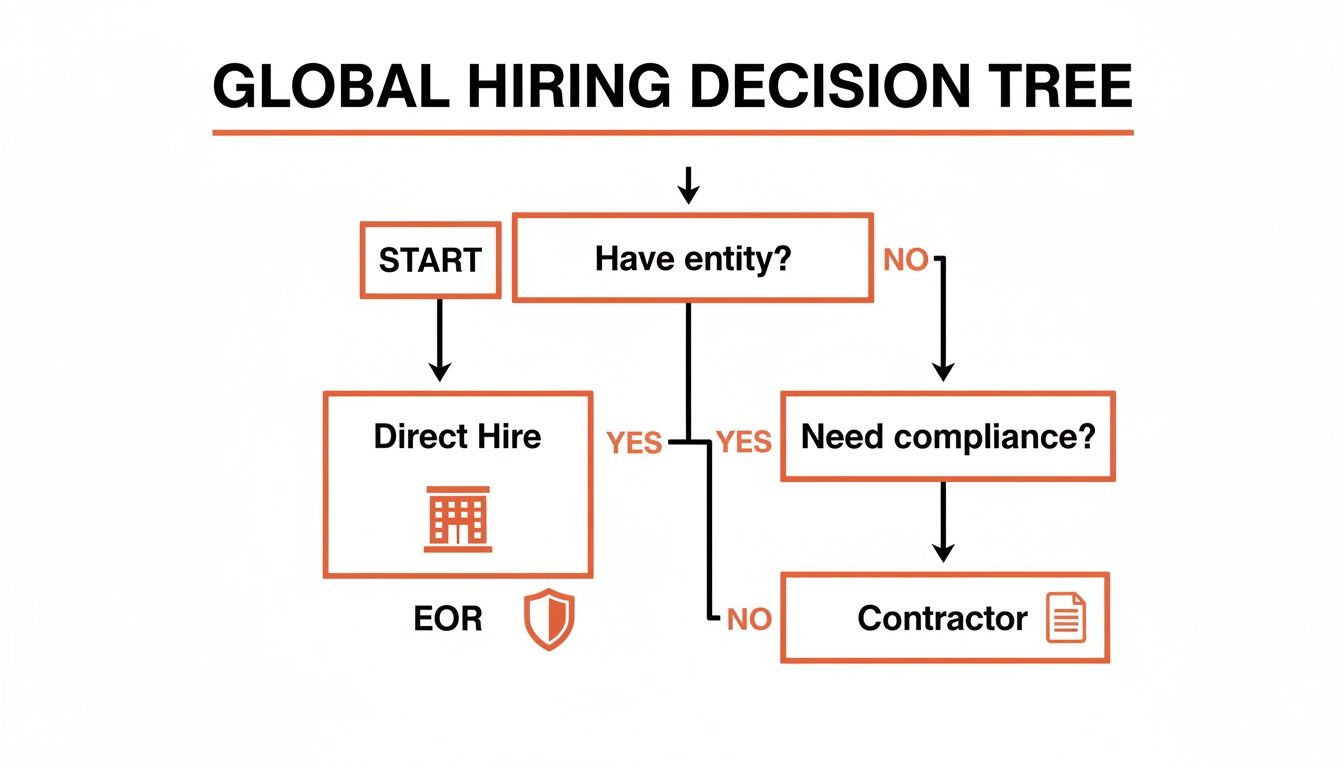
Ultimately, your choice depends on whether you already have a legal entity in the country and how much risk you're willing to take on. For most companies scaling globally, an EOR provides the safest and fastest route.
Getting Global Payroll and Taxes Right

Once you’ve figured out how you’re going to hire internationally, the real work begins: learning how to pay international employees. This goes so much deeper than just sending a wire transfer. You're stepping into a world of country-specific tax laws, social security systems, and required contributions that are completely different everywhere you go.
Let's be clear: this is one area where you absolutely cannot afford to make mistakes. Even honest errors can result in hefty fines, legal trouble, and a black mark on your company’s reputation. Getting your payroll process right from the very beginning isn't just a good idea—it's essential for any company that wants to grow globally without creating a mess.
Cracking the Code on Local Taxes and Social Security
Every country has its own playbook for payroll deductions. What’s standard practice in the US is often worlds apart from the rules in Germany or Brazil. You have to get a handle on each country's specific requirements.
Income tax is universal, but that's where the similarities end. The rates, brackets, and rules are all local. A common pitfall is trying to apply a simple flat tax rate or failing to understand a country’s progressive tax system. This inevitably leads to incorrect withholdings and compliance nightmares for everyone involved.
The real challenge for most companies is wrapping their heads around statutory social contributions. These are mandatory payments you, the employer, must make to fund a country's public services. For first-time global employers, this is often a huge, unbudgeted expense.
These employer-side costs can fund a whole range of social programs:
- Pensions and Retirement Funds: Your contribution to the national retirement system.
- Healthcare and Medical Insurance: Payments that support public health programs.
- Unemployment Insurance: Funding a safety net for workers who lose their jobs.
- Disability and Accident Insurance: Coverage for work-related injuries or long-term illnesses.
To give you an idea of how much this varies, employer social security costs in France can reach as high as 45% of an employee's gross salary. In other countries, the rate is much lower. If you don't factor these costs into your hiring budget, you're in for a nasty surprise.
The Surprise of 13th and 14th Month Salaries
One of the biggest culture shocks for companies used to North American payroll is the concept of mandatory bonuses. In many countries across Latin America, Europe, and Asia, employers are legally required to pay a "13th-month salary." Some places, like Austria and the Philippines, even require a 14th-month payment.
These are not optional holiday bonuses; they are a guaranteed part of an employee's annual compensation, and the law dictates how and when they're paid. For example, a 13th-month bonus might be paid in a lump sum in December or split into two payments over the year. Failing to plan for this is a major compliance breach and can blow a significant hole in your budget.
The Essential First Step: Payroll Registration
Before you can legally pay anyone, you have to register your business with the local tax and social security authorities. This process is how you get the employer ID numbers you need to withhold taxes and make those mandatory social contributions.
The registration process can be a real headache. It’s often detailed, slow, and requires paperwork filed in the local language. You simply cannot run a compliant payroll without it. This is another reason many businesses choose to work with an Employer of Record (EOR), which uses its own registered local entities to handle all of this for you. As you think about where to hire, it helps to research some of the best countries for remote workers and what makes their systems unique.
By taking the time to understand these core pieces of international payroll—taxes, social costs, mandatory bonuses, and registration—you can build a system that pays your team correctly and on time, every time. It's the foundational work that sets you up for long-term success as a global company.
Choosing the Right Way to Pay Your International Team
Once you’ve navigated the legal and tax frameworks, you hit the next big logistical hurdle: actually getting money into your team's bank accounts. Figuring out how to pay international employees is about so much more than just a simple bank transfer. The method you land on directly affects transfer speeds, surprise fees, and how much money your employee actually sees at the end of the day.
Your goal should be simple: find a payment channel that's reliable, transparent, and doesn't eat into your budget or your team's paychecks. Let's walk through the common options, looking past the marketing jargon to see what each one really costs in time and money.
Traditional Bank Wires and Transfers
For many businesses dipping their toes into global hiring, the default move is a classic bank wire. You head to your bank (or its online portal), plug in the recipient’s SWIFT/BIC code and account details, and hit send. While it feels safe and familiar, it’s almost always the slowest and most expensive option on the table.
International wires are notorious for their high upfront fees, which can easily run from $25 to $50 for a single payment. But the real sting comes from the hidden costs baked into the currency exchange rate. Banks rarely give you the mid-market rate—the one you see on Google. Instead, they add a hefty markup, which is pure profit for them and a direct loss for you or your employee.
This means your team member gets less local currency than they should. A wire can also take several days to land, sometimes getting passed between intermediary banks that each shave off their own fee along the way.
Modern FinTech and Money Transfer Services
A huge improvement over old-school banks are the specialized money transfer services like Wise or Remitly. These platforms were built from the ground up for cross-border payments, and as a result, they offer far more competitive rates and lower fees.
Here’s why they’ve become so popular:
- Better Exchange Rates: Their business model relies on volume, not high margins, so your money goes much further.
- Transparent Fees: You’ll typically see a small flat fee or a clear percentage of the transfer amount, so there are no surprises.
- Faster Transfers: Payments often arrive within a day or two, with some services offering nearly instant options.
These services are fantastic for paying international contractors or for one-off payments. However, they aren't a true payroll solution. They don't handle critical functions like local tax withholding, social contributions, or generating compliant payslips. That administrative work still falls squarely on your shoulders.
Don't underestimate the impact of exchange rates. A seemingly small 2% markup on a $5,000 monthly salary costs your company an extra $1,200 per year for just one employee. Scale that across a team, and you're losing thousands to hidden fees.
Global Payroll and EOR Platforms
For companies building a team of full-time international employees, the gold standard is a dedicated global payroll platform, often bundled with an Employer of Record (EOR) service. These platforms are designed to manage the entire payroll cycle, from calculations to payments, all from one place.
They don't just send money; they automate the incredibly complex calculations that have to happen first. This means correctly withholding income taxes, deducting social security, and staying compliant with unique local rules like mandatory 13th-month salaries.
The value here is undeniable:
- End-to-End Automation: The platform handles all gross-to-net calculations for every country, generates compliant payslips, and executes payments in the correct local currency.
- Bulk Payments: You can fund your entire global payroll in a single transfer to the platform, which then distributes the individual payments for you.
- Compliance Assurance: These providers live and breathe local labor laws, dramatically lowering your risk of making a miscalculation that could lead to fines or penalties.
While these platforms come with a monthly service fee, they deliver immense value by combining payment processing with the essential compliance and HR functions you need. This frees your team from a mountain of manual work and gives you peace of mind. For any company serious about scaling a distributed workforce, this is the most sustainable and strategic path forward.
Managing Currency Exchange and Banking Logistics
If you're serious about hiring globally, paying your team in their local currency isn't just a nice-to-have. It's a dealbreaker. Making someone accept a USD salary when they live in Spain or Japan pushes all the currency risk onto them, meaning their rent money could shrink from one month to the next.
Frankly, that kind of instability is a huge red flag for any experienced professional.
Yes, the logistics of juggling different currencies and international bank transfers can feel a bit overwhelming at first. But getting this right is about more than just wiring cash—it's about ensuring your people are paid the right amount, on time, every single time. It's the foundation of trust and morale in a remote team.
Navigating Exchange Rate Volatility
Foreign exchange (FX) rates are always on the move. And while a small shift might not seem like a big deal, it can have a massive impact on your payroll budget.
For example, a 2% swing in an exchange rate on a €50,000 salary translates to a €1,000 difference over the year. Now multiply that across your entire team. Suddenly, you’re looking at a serious, unplanned inflation of your payroll costs.
While you can't control the markets, you absolutely can control your exposure.
- Lock in Your Rates: Some of the better payment providers and global payroll platforms let you lock in an exchange rate ahead of time. This is a game-changer for budgeting because you know exactly what your payroll will cost each month.
- Use Multi-Currency Wallets: Other platforms offer multi-currency accounts or wallets. These let you convert a chunk of cash when the rate is good and then hold it in that currency until it's time to run payroll. This gives you a bit more hands-on control to optimize your FX spend.
Taking these steps shows you're not just an employer with a global team, but a savvy one. It's a core part of learning how to pay international employees without the financial headaches.
Getting the Banking Details Right
You wouldn't believe how often a simple typo in a bank account number brings an entire payment to a screeching halt. A failed transfer means a delayed paycheck, a frustrated employee, and an administrative mess for you to clean up.
Every country has its own unique format for bank details, and gathering the correct information from day one is critical.
I've seen it happen time and again: the number one reason for a failed international payment is simply wrong or missing bank info. It's a tiny detail that creates a huge problem, so it pays to have a system to get it right upfront.
To head off these issues, you'll need to know what to ask for. Here are the most common terms you'll encounter:
- IBAN (International Bank Account Number): This is the standard in Europe and many other countries. It’s a long string of characters that includes everything needed for a transfer: country code, bank, and account number.
- SWIFT/BIC Code: Think of this as a bank's international postal code. It tells the global banking system exactly which institution to send the money to.
- Local Routing Numbers: Some countries have their own systems, like the ABA routing number in the US or the transit number in Canada.
My advice? Have your team members fill out a standardized digital form. The best payroll platforms even have built-in validation that flags incorrect formats before you can even hit "send." Trust me, it will save you and your employees a ton of stress.
Building a Compliant Record-Keeping System
Getting your international team paid is a huge milestone, but the work doesn't stop once the money lands in their account. Paying people correctly is an ongoing cycle, and meticulous record-keeping is just as critical as the payment itself. A well-organized system is, frankly, your best defense against future audits, compliance questions, or even legal challenges.
Without one, you're essentially hoping for the best. If a tax agency asks you to prove you've calculated contributions correctly, you don't want to be scrambling to find documents. Building a solid record-keeping system from day one creates a single source of truth that protects your business and gives your team the transparency they deserve.
What to Keep in Every Employee’s File
Every person on your international team needs a secure, organized digital file. I always tell managers to think of it as their official employment story with your company—a folder that tax authorities or labor inspectors could ask to see at a moment's notice.
Here’s a baseline checklist of what absolutely must be in that file:
- Signed Employment Contracts: This is the bedrock. Make sure it's fully compliant with local labor laws and clearly outlines compensation, termination rules, and working hours.
- Proof of Identity and Work Authorization: This means clear copies of passports, visas, or any local permits that prove they have the legal right to work where they live.
- Detailed Payslips: Every single payslip should show the complete gross-to-net calculation. This includes the base salary, any bonuses, all deductions like taxes and social security, and the final take-home pay. In many countries, even the payslip's format and language are regulated.
- Tax and Social Security Filings: You need proof that you’ve submitted every required employer contribution and employee withholding to the right government bodies.
- Records of Leave and Time Off: Keep a clean log of all paid time off, sick days, and parental leave. These are often governed by strict local rules.
Keeping these records isn't just a "nice-to-have." In most places, it's a legal mandate with specific retention periods, sometimes requiring you to hold onto documents for years after an employee has moved on.
The Maze of Data Privacy Laws
Storing sensitive employee data like bank details, ID numbers, and salaries immediately throws you into the world of data privacy. You can't just toss these files into a shared cloud drive. Global privacy laws like Europe's General Data Protection Regulation (GDPR) or Brazil's LGPD have very strict rules about handling personal information.
These regulations dictate everything from how you collect and store data to who is allowed to see it. Getting this wrong can lead to eye-watering fines—under GDPR, penalties can reach up to 4% of your global annual revenue. This means security has to be built into your record-keeping system from the ground up.
I always frame it this way for our clients: you are the guardian of your team's most sensitive personal and financial data. Treating that information with the highest level of security isn't just a legal checkbox; it's fundamental to building trust with your global team.
To stay on the right side of the law, ensure your data is encrypted, access is strictly limited to authorized people, and you have a clear policy for how long you keep data and when you delete it. For more on setting company-wide standards, you can adapt our remote work policy template to include your specific data security protocols.
A Practical Checklist for Each Pay Cycle
To make this all manageable, your payroll team needs a repeatable workflow. A simple checklist for each pay run prevents costly mistakes and creates a consistent audit trail.
Before Running Payroll:
- Check for Employee Changes: Have any salaries, roles, or personal details been updated since the last cycle?
- Factor in Variable Pay: Gather and approve all the numbers for commissions, bonuses, or overtime.
- Confirm Time Off: Make sure all approved leave has been logged correctly.
- Scan for Regulatory Updates: Has a local tax rate or social security contribution changed? This happens more often than you’d think.
After Running Payroll:
- Distribute Payslips: Send secure, ideally password-protected, payslips to every employee.
- File and Pay Taxes: Remit all tax and social security payments before the statutory deadline. No exceptions.
- Archive Everything: Securely store the payslips, payment confirmations, and filing receipts in each employee's digital file.
- Reconcile Accounts: Match the final payroll outflow with your company's accounting records.
Adopting a structured process like this turns record-keeping from a stressful chore into a proactive system for managing compliance and risk. It's a non-negotiable part of paying international employees the right way.
Frequently Asked Questions About Paying International Employees

Once you decide to hire globally, the "how" questions start piling up fast. It's a new world of payroll, compliance, and currency.
We've helped countless companies build their global teams, and we've seen the same questions pop up time and again. Let's tackle some of the most common concerns you'll face when learning how to pay international employees.
Can I Just Pay My International Employees In USD?
This one comes up a lot. While it might feel easier to just pay everyone in USD, it's a critical mistake. Doing so forces your employees to shoulder all the risk of currency fluctuations. One month's stable salary could be the next month's financial headache.
Think about it from their perspective. It creates huge instability and makes your company look less professional. Top talent around the world expects—and frankly, deserves—to be paid reliably in their own local currency.
The good news is you don't have to manage this yourself. Modern global payroll solutions and Employer of Record (EOR) platforms handle currency conversion automatically. They ensure your team gets a predictable paycheck, and you avoid all the administrative hassle.
Paying in local currency isn't just a perk; it's a baseline requirement for being a competitive global employer.
What Is The Biggest Mistake To Avoid When Hiring Internationally?
The single most dangerous mistake I see is misclassifying an employee as an independent contractor. It’s an incredibly tempting shortcut to avoid payroll taxes and benefits administration, but the consequences can be catastrophic.
If local authorities investigate and decide that your "contractor" is really an employee (based on their level of integration, direction, and work schedule), the penalties are severe. The fallout often includes:
- Hefty back taxes, covering both the employer and employee portions you failed to pay.
- Steep fines for non-compliance that can date back years.
- Forced retroactive payments for social security, pensions, and other mandatory benefits.
That short-term convenience just isn't worth the immense long-term legal and financial risk. You must run a proper classification test based on local labor laws, or better yet, use an Employer of Record to ensure you're compliant from day one.
How Do I Handle Benefits Like Health Insurance And Pensions?
This is where global hiring gets truly complex. Every country has its own system of mandatory social security programs—things like public healthcare, retirement funds, and unemployment insurance. As an employer, you are legally on the hook for contributing to these.
On top of that, what's considered a standard benefits package varies wildly. To attract top candidates in many markets, you'll need to offer supplemental private health insurance or additional retirement plans. Trying to become an expert on every country's system is a full-time job in itself.
This is exactly what an Employer of Record is built for. A good EOR partner manages all statutory and supplemental benefits for you. They make sure you're offering a compliant and attractive package that makes you a top employer in any market, all without the administrative nightmare.
Do I Really Need A Lawyer In Every Country Where I Hire?
If your plan is to establish your own legal entity in each country to hire people directly, then absolutely—local legal and tax counsel is non-negotiable. The cost and time involved in this approach are precisely why so many growing companies look for an alternative.
An Employer of Record provides that alternative. The EOR already has an established legal entity in-country and acts as the official employer for your team members. They handle the employment contracts, payroll, taxes, and HR compliance under their own roof.
Using an EOR lets you bring on the best talent anywhere in the world without the huge expense and delay of setting up your own legal infrastructure. It's the faster, smarter way to scale a compliant global team.
Ready to hire the best talent, no matter where they are? YayRemote is a global remote job platform that connects companies with skilled professionals worldwide. Post your roles and access a suite of tools designed to make global hiring simpler and more effective. Find your next great hire at https://www.yayremote.com.