Global Payroll Compliance: A Practical Guide for 2026
Navigate global payroll compliance with confidence. Our 2026 guide covers legal duties, payroll models (EoR, direct), and a practical checklist for HR managers.
USD 13.21 billion. That's the projected size of the global payroll outsourcing market in 2026, with growth to USD 17.83 billion by 2031 at a 6.19% CAGR as payroll complexity rises across borders (verified market outlook). That number matters because it reflects a simple reality. Payroll is no longer an admin task you can patch together with a local accountant, a spreadsheet, and good intentions.
For companies expanding internationally for the first time, global payroll compliance is where growth strategy meets tax law, labor law, data handling, and operational discipline. If you hire in one country, you need a good process. If you hire in five, you need a system. If you hire remotely across multiple jurisdictions, you need a model that can survive scrutiny.
Most mistakes don't come from bad intent. They come from using the wrong hiring model, copying home-country assumptions into foreign markets, or letting disconnected tools create avoidable errors. The practical fix isn't memorizing every law in every jurisdiction. It's building a compliance process that is structured, auditable, and realistic for how your company hires.
Why Global Payroll Compliance Matters More Than Ever
57% of global payroll professionals say local compliance is their biggest challenge (LatHire's global payroll). For a company hiring internationally for the first time, that number is a useful warning. The hard part is rarely running payroll itself. The hard part is setting up the right hiring model, data flow, approvals, and local controls before the first pay run.
Payroll compliance gets more scrutiny than many founders expect. Employees test it every month when they receive pay, deductions, and payslips. Tax authorities test it when registrations, filings, remittances, or worker classifications do not match the local rules. If your process is improvised, the gaps show up quickly.
A domestic payroll setup usually relies on stable assumptions: one legal employer, one tax framework, one benefits structure, and one standard onboarding sequence. Cross-border hiring breaks those assumptions. A remote-first team may use an entity in one country, an Employer of Record in another, and contractors somewhere else. That mix can work, but only if payroll operations are designed around it.
That is why compliance matters more now. International hiring has become easier to start and easier to get wrong.
The practical risk is not limited to a late filing or a miscalculated deduction. Problems often begin earlier. A worker is onboarded before the company has the right registration. Contract terms do not match the payroll setup. HR collects one set of data, finance needs another, and the provider receives incomplete inputs two days before payroll cutoff. Companies then patch the issue with spreadsheets, manual approvals, and off-cycle payments. Those fixes create audit problems later.
The better approach is operational, not theoretical. Build payroll compliance as a system:
- Choose the hiring model first: entity, EOR, or contractor arrangement based on legal fit, not convenience alone.
- Define ownership: decide who approves worker classification, compensation inputs, statutory changes, and payroll sign-off.
- Standardize intake: collect the exact tax, banking, contract, and benefits data required for each country before start date.
- Use an auditable tool stack: HRIS, payroll platform, document storage, and ticketing should leave a clear record of who did what and when.
- Run a pre-payroll checklist: confirm registrations, earnings codes, deductions, payment dates, and local filing obligations before the first cycle.
This is what strong compliance changes in practice. Payroll stops being a monthly scramble. Employees are paid correctly and on time. New-country hiring becomes slower at the decision stage, which is good, and faster at execution once the model is set.
I have seen companies save money by delaying process design, then spend far more fixing classification errors, missed contributions, and broken employee trust. Global payroll compliance matters because it is one of the few operating functions where legal risk, employee experience, and finance discipline all meet in the same workflow.
Understanding Your Core Legal Obligations Worldwide
Global payroll compliance usually breaks down into five operating requirements. If a company is entering its first few countries, I tell teams to map these obligations into workflow first, then into policy. That is how you avoid finding out after payroll closes that your contract, tax setup, and reporting logic were never aligned.

The legal categories are familiar. The operational burden is where companies struggle. A remote-first business can hire in three countries using one HRIS, one finance stack, and one approval workflow, then still fail compliance because each country expects different registrations, filings, and evidence. If you are using an EOR in some markets and direct employment in others, your controls need to reflect that difference. A good starting point is understanding how an employer of record works in practice, because legal responsibility and process ownership do not sit in the same place under every model.
Tax withholding
Tax withholding is usually the first item finance asks about, but accuracy depends on upstream decisions. Worker classification, tax registration status, residency treatment, local allowances, and subnational rules can all change what should be withheld.
The practical control is simple. Confirm the employing entity or provider, the registration status, the worker's tax profile, and the earnings codes before the first live payroll. If any of those inputs are missing, hold the start date or pay cycle until they are resolved. Correcting an under-withholding issue after payment often creates amended filings, employee confusion, and manual recovery work.
Social security contributions
Social contributions are a separate compliance track with their own rates, caps, deadlines, and registrations. They may fund pension, health insurance, disability, unemployment, or other statutory programs. The mistake I see most often is teams assuming the payroll calculation is the whole job.
It is not. Contribution setup has to match the legal hiring model and the actual work arrangement. If someone is engaged as a contractor but functions like an employee, or is hired through the wrong employing entity, the contribution treatment may be wrong from day one. That problem usually surfaces during an audit, a termination, or a benefits claim.
Statutory benefits
A standard global offer starts to break down. Local rules may require paid annual leave, sick pay, parental protections, holiday premiums, 13th-month salary, probation limits, notice periods, or employer-funded insurance.
The right approach is to build a country minimums matrix and tie it to your contract template library and payroll setup. If legal says a market requires a meal voucher, transport allowance, or mandatory bonus, that requirement needs to appear in three places. The contract, the payroll earning or deduction code, and the monthly review checklist. If any one of those is missing, compliance becomes dependent on memory.
Data privacy regulations
Payroll data includes tax IDs, compensation history, bank details, home addresses, leave records, and sometimes medical or dependent information. That makes privacy compliance part of payroll operations, not just a legal review item.
Access control matters here. So does system design. HRIS permissions, payroll user roles, document retention rules, and data transfers between payroll and finance should be documented and tested. A shared inbox, an exported spreadsheet, or a locally saved payslip file is often the weak point.
Reporting requirements
Payroll is not finished when employees are paid. Many countries require periodic reporting to tax authorities, social funds, labor bodies, or benefits administrators. Deadlines and file formats vary, and the evidence standard matters if you are ever asked to prove what was filed and when.
The companies that stay out of trouble usually run three simple controls:
- A country compliance calendar: filing dates, payment deadlines, and cutoffs for payroll changes
- A document matrix: required contracts, tax forms, registrations, payslips, and proof of submission
- A responsibility map: who prepares data, who approves payroll, who files reports, and who keeps the audit trail
Once headcount spreads across multiple countries, disconnected tools become part of the compliance risk. Teams often review a platform for HR payroll to connect worker data, local payroll execution, and reporting records in one operating flow instead of managing each step in a separate system.
Choosing Your Global Payroll Model
Your payroll model determines most of your compliance exposure before payroll is even processed. The wrong model creates recurring friction. The right one makes compliance manageable.
There are three standard approaches. None is universally best. The right choice depends on your hiring volume, target countries, tolerance for legal setup, and how much control you need over employment terms.
Global payroll models compared
| Factor | Direct Hire (Local Entity) | Employer of Record (EoR) | Independent Contractor |
|---|---|---|---|
| Legal employer | Your local entity | EoR provider | Worker operates independently |
| Setup speed | Slowest | Fast | Usually fastest |
| Operational control | Highest | High, but shared with provider structure | Limited by contractor rules |
| Compliance burden | Highest internal burden | Lower internal burden, provider-supported | High classification risk |
| Best fit | Long-term presence in a market | Fast entry into a new market | Clearly project-based, genuinely independent work |
| Main risk | Registration, filings, local law ownership | Vendor quality and handoff discipline | Misclassification |
Direct hire through a local entity
This gives you the most control. You employ the worker directly, own the local setup, define payroll operations, and usually get the cleanest long-term structure if you're building a durable presence in that country.
It also creates the heaviest compliance load. You'll need local registrations, payroll administration, statutory setup, ongoing filings, and country-specific employment support. This model works when you have enough hiring concentration in one market to justify the infrastructure.
Employer of Record
For first-time expansion, this is often the most practical bridge. An EoR acts as the legal employer in-country while you direct the day-to-day work. That can reduce the upfront burden of establishing an entity while giving you a more compliant path than trying to force contractor arrangements where they don't fit.
If you're comparing providers or trying to understand how the structure works in a mature employment market, this breakdown from DynamicsHub on UK EOR is useful. It helps clarify where employer obligations sit and what the service model covers. For a broader overview of the model itself, this guide on what an Employer of Record is is also a practical starting point.
Use an EoR when speed matters, local employment is required, and you aren't ready to build your own entity stack.
Independent contractors
This model is flexible, but many companies misuse it. Contractors can be appropriate for defined deliverables, genuine independence, and non-employee work patterns. They are not a shortcut around local employment law.
What fails in practice is using contractor agreements for full-time roles with employee-style control. If the person works set hours, reports into your org chart like staff, and depends economically on your business, you may have a classification problem even if the contract says otherwise.
A good decision test is simple:
- Choose direct hire if you're building long-term local operations.
- Choose EoR if you need compliant speed in a new country.
- Choose contractor only when the working relationship is independent.
A Step-By-Step Global Onboarding and Payroll Process
The cleanest payroll run starts long before payday. Good teams don't treat onboarding, payroll, and recordkeeping as separate workflows. They treat them as one controlled process with clear handoffs and evidence at each step.
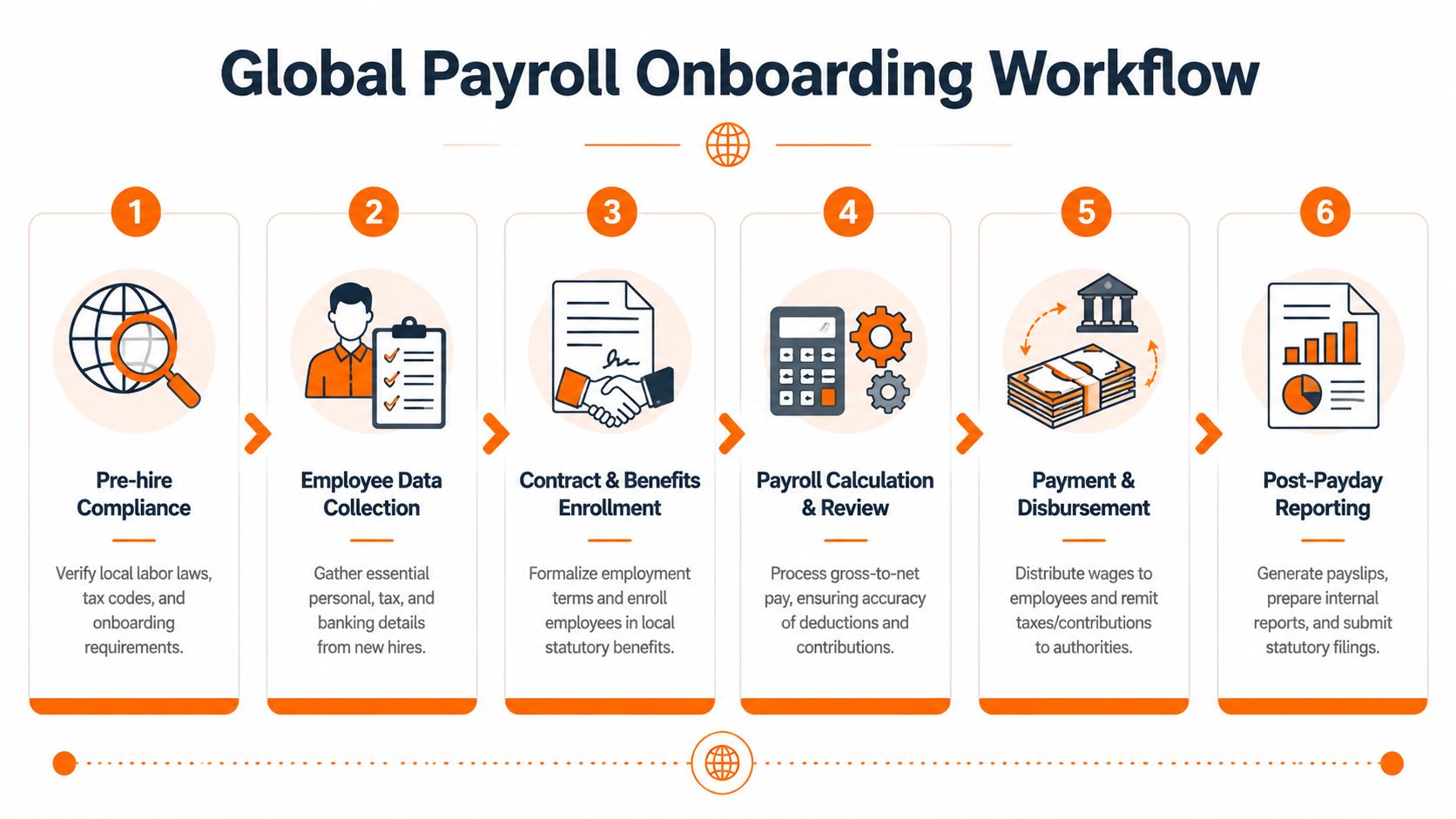
A weak audit trail creates a real compliance blind spot. Organizations with automated, centralized audit trails resolve compliance inquiries 60% faster and reduce audit preparation costs by an average of $25,000 annually (remote employee onboarding checklist).
The six-step workflow that holds up under review
Verify worker classification
Confirm whether the role should be employee, contractor, or EoR-supported employment. Don't rely on title alone. Review control, exclusivity, reporting lines, and how the work is performed.Issue a compliant employment agreement
Local requirements may affect language, notice terms, compensation structure, probation handling, and benefits wording. The contract should match both the legal model and actual practice.Collect personal, tax, and banking data securely
Manual errors often start with data collection. Standardize intake forms and validation rules early so finance, HR, and payroll aren't correcting core data by email.Enroll the worker in statutory and supplemental benefits
Required enrollments should happen before first payroll where possible. Missed enrollment often creates retroactive admin work and employee distrust.Run first payroll with review controls
First payroll is where setup mistakes surface. Review gross-to-net calculations, contribution mappings, pay frequency, and local deductions before funds are released.Generate payslips and lock the audit trail
Store the final documents, approvals, source data, and any manual overrides in one retrievable place. If someone changed a field, the record should show who changed it and when.
What an auditable process looks like
The difference between a workable process and a risky one usually comes down to evidence. If your team can't reconstruct how a worker was classified, when data was collected, which contract version was signed, and what was filed after payroll, you're depending too much on memory.
A defensible workflow usually includes:
- Controlled intake: One source for tax, identity, and bank data.
- Approval checkpoints: HR, payroll, and finance signoffs where needed.
- Version history: Contracts, policy acknowledgments, and payroll changes preserved.
- Exception logging: Every manual override documented with a reason.
If an auditor asks why a deduction changed, "someone fixed it in the system" isn't an answer. You need the record behind the change.
This doesn't require a giant enterprise program. It requires discipline, ownership, and tools that preserve context instead of scattering it across inboxes and local files.
Common Pitfalls and How to Avoid Them
Most payroll failures are predictable. They show up in the same places again and again. A company enters a new market quickly, reuses an old contract template, classifies someone as a contractor because it's convenient, then discovers the actual issue only after a complaint, resignation, or authority inquiry.

Misclassification that looked efficient at the time
A remote company hires a "contractor" in a country where that person works full time, follows set working hours, uses only company systems, and reports to one manager. On paper, the arrangement feels simple. In practice, it looks like employment.
The fix is boring but effective. Review the working relationship before engagement and again when the role changes. Classification isn't a one-time paperwork choice. It's an operating reality.
Local obligations hidden inside normal pay practices
Another common failure is assuming compensation customs are optional because they aren't familiar at headquarters. That's where teams miss mandatory benefits, local leave handling, required payroll documents, or termination-related entitlements.
What works better is maintaining a country launch checklist that includes more than tax. It should also cover document requirements, payroll timing, mandatory benefit enrollment, and exit rules.
Hybrid remote workers and digital nomad risk
This is the blind spot many remote-first businesses still haven't operationalized. A worker lives in Country A, spends meaningful time working in Country B, and moves back and forth through the year. HR may see flexibility. Tax authorities may see payroll and permanent establishment risk.
The gap is larger than most companies think. 42% of global remote workers engage in workation travel, but only 12% of HR teams have defined payroll protocols for this scenario, contributing to a 35% increase in accidental permanent establishment risk.
Hybrid mobility needs a payroll workflow, not just a travel policy.
A practical control set for hybrid remote work includes:
- Location reporting: Workers disclose where they're physically working, not just their home address.
- Threshold review: HR, tax, and payroll review extended stays before they become habitual.
- Manager training: Managers shouldn't approve long overseas work periods without compliance review.
- Payroll escalation rules: If work location changes, someone must assess withholding and employer risk.
Termination handled as an HR event instead of a legal one
Termination is where "mostly compliant" companies get into trouble. Final pay timing, accrued leave treatment, severance triggers, notice handling, and required paperwork can differ sharply by country.
The safest pattern is to route every termination through a country-specific checklist. Not because every exit is contentious, but because payroll errors at termination attract attention quickly and are harder to rectify discreetly after the fact.
Building Your Global Payroll Tech Stack
Technology determines whether your compliance process holds up once you add countries, currencies, and local reporting deadlines. In practice, global payroll problems rarely start with the final calculation. They start much earlier, when worker data is captured inconsistently across recruiting, HR, legal, and payroll systems.
For a remote-first company, the stack has one job. Capture the right data once, validate it early, and pass it through every downstream step without manual re-entry.
The stack that works in practice
A workable setup is usually smaller than founders expect. The goal is not more software. The goal is clear system ownership and clean handoffs between systems.
- HRIS as the source of truth: Store legal name, work location, employment status, compensation, manager, and job changes here.
- Payroll engine or managed payroll layer: Run calculations, statutory deductions, payslips, filings, and payment instructions at the country level.
- Document and audit layer: Keep signed contracts, policy acknowledgments, tax forms, right-to-work records, approvals, and change history in a retrievable format.
- Workflow controls: Route approvals, flag exceptions, and enforce required fields inside the system instead of relying on email or chat.
That structure gives you control without creating a heavy admin burden. It also makes ownership visible. HR owns worker data, payroll owns calculation and filing, legal approves country-specific terms, and finance handles funding and reconciliation.
Where stacks usually break
The common failure pattern is easy to spot. Recruiting marks someone as a contractor. HR later treats them as an employee. Payroll receives a spreadsheet with a different start date, a local tax ID is missing, and benefits codes do not map cleanly to the country setup. The payroll run still happens, but now the team is correcting records after the fact.
That is why data structure matters more than feature lists. If your systems cannot enforce standard fields for location, entity or EOR assignment, classification, currency, and effective dates, compliance risk shows up as rework first and legal exposure later.
A good stack should do four things well:
Standardize fields across systems
Country, worker type, employing entity, compensation basis, and tax identifiers should mean the same thing everywhere.Validate data before payroll cutoff
Missing documents, unsupported locations, unusual pay items, and status changes should trigger review before they hit payroll.Keep an audit trail
If a regulator or local provider asks why pay changed, who approved it, or when a contract was updated, you need an answer in minutes, not days.Integrate with discipline
Fewer integrations that pass clean data reliably are better than a long list of connections no one actively monitors.
Teams evaluating broader distributed operations software can use this guide to tools for remote work as a starting point, but payroll buyers should go one level deeper. Ask vendors how they handle country-specific required fields, effective-dated changes, approval logs, failed sync alerts, and evidence retention.
Choose for your operating model, not the demo
The right stack depends on how you are hiring internationally. A company using an employer of record in five countries needs different controls than a company running direct payroll through its own entities. One platform may cover both, but many do not. That is not always a problem if the boundaries are clear.
I usually advise first-time international employers to avoid fragmented setups unless there is a strong local reason. If onboarding sits in one tool, contracts in shared folders, time data in another app, and payroll adjustments in email threads, errors become routine. The stack does not need to be fancy. It needs to be boring, consistent, and easy to audit.
One final design rule matters. Your payroll stack starts at hiring, not at the first payroll run. If the hiring workflow fails to capture the actual work location, employment model, pay frequency, and employing party at the start, payroll inherits bad inputs and spends every cycle cleaning them up.
Your Next Steps Toward Compliant Global Hiring
Global payroll compliance is complex, but it isn't mysterious. Companies get into trouble when they improvise the model, split ownership across too many systems, or treat payroll as a monthly calculation instead of a controlled legal process.
If you're hiring internationally for the first time, take these steps next:
Audit your current workforce classification
Check whether every contractor, employee, and EoR arrangement matches the actual working relationship.Review your payroll model against your growth plan
Decide where direct entities make sense, where an EoR is the better bridge, and where contractor use is defensible.Map your process and data flow
Track what happens from offer acceptance to payslip delivery. Identify where data is re-entered, changed manually, or stored without an audit trail.Set a country launch checklist
Include registration, contract review, benefits enrollment, reporting obligations, payroll calendar setup, and termination handling.Evaluate your technology and provider stack
Look for strong validation, integration discipline, and evidence retention, not just payroll processing.
The companies that handle international expansion well don't chase perfect certainty. They build a system that catches issues early, documents decisions clearly, and stays usable as the team grows.
If you're building a distributed team and need a better starting point for finding international talent, YayRemote helps employers connect with remote professionals across functions and locations. It's a practical place to start when your hiring footprint is expanding faster than your old processes were built to handle.