How to Hire Remote React Developers: A 2026 Playbook
A complete 2026 playbook to hire remote React developers. Learn our step-by-step process for sourcing, assessing modern skills, and onboarding global talent.
You've got a React roadmap that isn't simple anymore. The product needs fast UI, clean state boundaries, maybe Server Components, maybe a mixed rendering strategy, and definitely developers who can work without needing a manager in every decision loop. Then the hiring pipeline fills up with resumes that all look the same: “React, Redux, Hooks, TypeScript.”
That's where many teams get stuck.
If you need to hire remote React developers, the hard part usually isn't finding people who've used React. It's figuring out who can build modern React systems, communicate well in a distributed team, and ramp up without draining your senior engineers. The old playbook of posting a generic job description, asking trivia about hooks, and hoping for a lucky hire breaks down fast.
The practical path is tighter than that. You need a job post that filters for remote behavior, a sourcing plan that matches your budget, an assessment process built for current React architecture, contracts that won't create headaches later, and onboarding that turns a new hire into a productive teammate quickly.
Crafting a Job Post That Attracts Top React Talent
Generic job descriptions fail because they read like procurement documents. Candidates see a stack list, a pile of responsibilities, and no real signal about the work, the team, or how decisions get made. Strong React developers, especially remote ones, screen you as hard as you screen them.

A better job post does two things at once. It sells the role and filters the wrong applicants out early. That matters because React has a large global talent pool, rooted in Facebook's 2013 open-source release of React, but demand stays high enough that average U.S. React developer salaries reached $120,000 in 2023 according to Arc's React hiring benchmarks. If you're hiring remotely, your post has to compete on clarity and substance, not just compensation.
What a strong remote React post must include
Use a structure like this:
Role title with real search terms
Write “Senior React Engineer” or “Frontend Engineer, React” instead of clever titles. Good candidates search by role, seniority, and stack.What you'll build
Explain the product surface area. Is this a design-heavy app, an internal platform, a data product, or a customer-facing workflow tool? React developers want to know whether they're building dashboards, design systems, collaborative interfaces, or marketing sites.Why the work is technically interesting
Mention rendering constraints, performance needs, legacy migration, shared component libraries, TypeScript discipline, testing standards, or cross-functional product work. Specifics attract people who've done similar work.How the team works remotely
State whether you're async-first, what overlap matters, how decisions are documented, and which tools you use. If someone hates writing, structured remote work will expose that quickly.A week in the life
This is one of the best filters. Describe actual rhythms: planning, shipping, code reviews, pairing, design handoff, incident response, architecture discussions.
Practical rule: If a candidate can't picture the job after reading your post, your post is too vague.
An annotated structure that works
Here's the shape I've seen work best.
| Section | What to write | Why it matters |
|---|---|---|
| Opening summary | One short paragraph on product, mission, and who the role supports | Gives immediate context |
| What you'll build | Features, systems, user problems, frontend ownership | Attracts builders, not keyword applicants |
| Tech environment | React, TypeScript, testing, deployment, collaboration tools | Helps candidates self-qualify |
| Working style | Async norms, documentation habits, review culture, meeting load | Filters for remote fit |
| First wins | What success looks like early on | Reduces ambiguity and attracts confident candidates |
| Hiring process | Interview steps and expectations | Builds trust and improves completion |
What to avoid
Don't dump every nice-to-have into a giant requirement list. That creates false negatives. It also pulls attention away from the skills that matter.
Don't write “must be excellent communicator” and leave it there. Replace it with operational expectations: writes clear pull request context, gives useful review feedback, raises blockers early, documents trade-offs.
Don't hide the hard parts of the role. If the codebase has mixed patterns, old state management, or unclear ownership boundaries, say so. Serious candidates don't expect perfection. They expect honesty.
Remote React hiring gets easier when the job post does some of the screening for you.
Sourcing and Budgeting for a Global Talent Pool
Local hiring traps teams in the noisiest version of the market. You compete for the same people, in the same cities, at the same salary bands, often with less brand advantage than larger companies. Global hiring changes the game, but only if you're realistic about budget, sourcing channels, and speed.
The economics are the main reason teams hire remote React developers in the first place. Cleveroad's React hiring cost breakdown summarizes annual salary bands from $40,000 to $158,000+, notes U.S. estimates of $84,904 to $138,554, and cites hourly rates around $59 to $120 depending on region. It also points to offshore developer rates of $15 to $50 per hour and contract rates of $30 to $100 per hour. That spread is why companies use distributed hiring to cut labor costs by more than half for comparable seniority in some cases.
Generic platforms versus curated channels
Generic job boards give you volume. Volume sounds useful until your inbox fills with loosely matched applicants who've sprayed the same resume everywhere. Your team spends time sorting instead of evaluating.
Curated remote channels usually give you less volume and better signal. That matters more for React than people think. You aren't just hiring syntax familiarity. You're hiring frontend judgment, product sense, and remote execution.
A practical sourcing mix looks like this:
Curated remote boards
Better for relevance. Candidates usually understand remote expectations before they apply.Direct outreach to React engineers
Good when you know exactly what kind of product experience you need.Referrals from distributed teams
Strong signal, especially for communication and reliability.Specialized talent marketplaces
Useful when you need contractor speed and want budget clarity fast.
If your team is still tightening its process for interviews, onboarding, and manager training, this guide to mastering virtual hiring is a solid companion resource because it focuses on operational discipline, not just candidate sourcing.
Budget by outcome, not by geography alone
A lot of teams make the same budgeting mistake. They start with country averages and stop there. That creates either under-budgeting for strong candidates or overpaying for weak fit.
Start with the job's risk profile instead:
Low-risk work
Component implementation, UI cleanup, test coverage improvements, migration supportMedium-risk work
Feature ownership, shared frontend services, API integration patterns, state designHigh-risk work
Architecture decisions, rendering strategy, design-system ownership, frontend platform work
Then match compensation to the kind of decisions the person will own.
Estimated Remote React Developer Hourly Rates by Region (2026)
| Region | Junior Rate (USD/hr) | Mid-Level Rate (USD/hr) | Senior Rate (USD/hr) |
|---|---|---|---|
| Offshore markets | $15 | $30 | $50 |
| Contract market range | $30 | $60 | $100 |
| Broader global range | $15 | Qualitative variation | $200+ |
| Platform starting benchmark | $20 | $35 | $40 |
This table uses only reported ranges from the verified sources above, so treat it as directional rather than universal pricing.
Set timeline expectations early
For contractor-style hiring, speed can be much faster than most in-house teams assume. A remote React talent platform reports hiring in about 3 to 5 days, with rates starting at $20/hour and a median of $35 to $40/hour, according to Expert Remote's React developer marketplace benchmarks.
That doesn't mean every hire should happen that fast. It means your process shouldn't drag because your team hasn't aligned on budget, interview ownership, or what “good” looks like.
Assessing Modern React Skills Not Just Resumes
Most React interviews are stuck in an older version of the stack. Teams ask about hooks, component lifecycles, memoization, maybe Redux, then act surprised when a new hire struggles with rendering boundaries, server and client trade-offs, or state ownership in a real product.
That gap matters more now. CodinGame's guide on hiring remote React developers points out that React 19 raises the bar toward architectural judgment, including server components, concurrent features, actions, and the production trade-offs around them. If your process only checks JSX fluency, you're testing for familiarity, not capability.
What outdated React interviews miss
A candidate can answer “what is useEffect” and still make poor architecture choices. They can name hooks correctly and still ship brittle code that mixes server concerns into client components, over-fetches data, or makes future refactors painful.
The interview should answer harder questions:
- Can this person choose what belongs on the server versus the client?
- Do they understand when interactivity is worth the bundle cost?
- Can they model state so the app stays understandable after six months of feature growth?
- Do they write code another engineer can review and extend?
- Can they explain trade-offs clearly in writing and conversation?
The strongest React hires usually don't sound flashy. They sound precise.
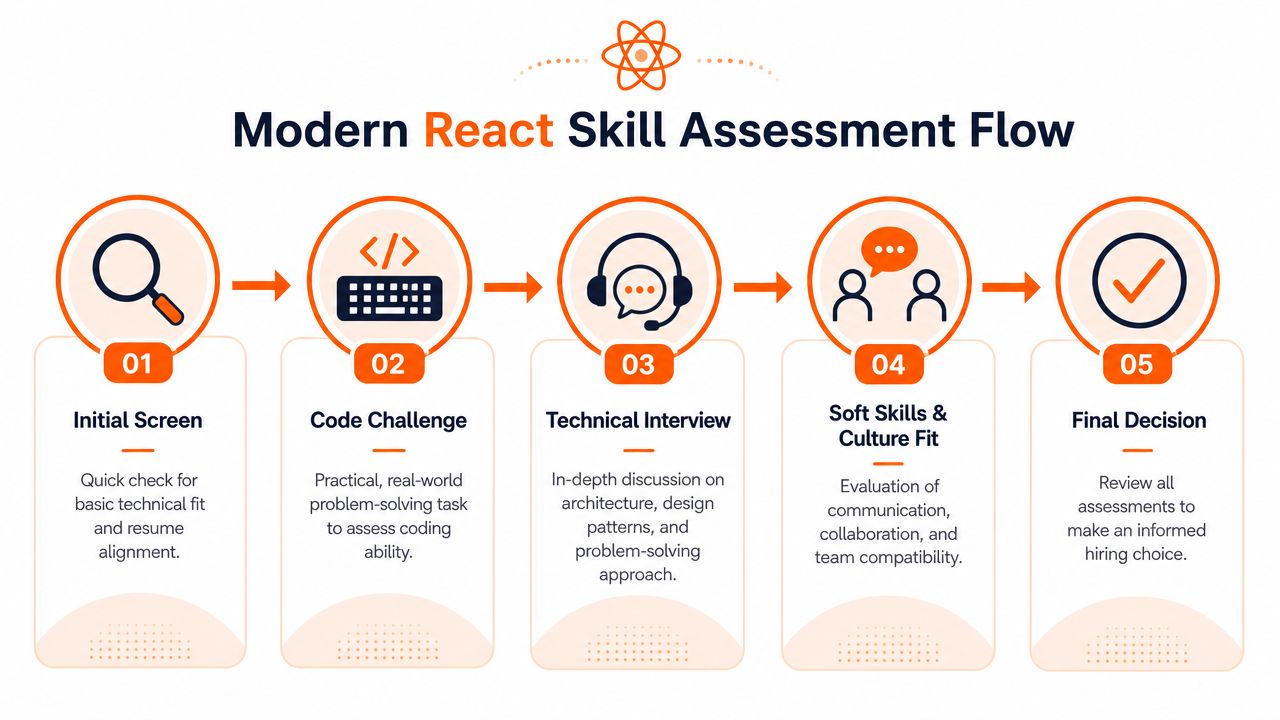
A multi-stage assessment that actually works
I prefer a sequence that mirrors real work instead of trivia.
Initial screen
Use the first pass to reject obvious mismatch, not to crown finalists. Look for product relevance, code ownership, and signs of remote fluency. Resume review should focus on what they built, how they collaborated, and where they made architectural calls.
Good signs include:
- shipping customer-facing applications,
- maintaining shared component libraries,
- discussing performance or rendering trade-offs,
- writing about ownership rather than only listing tools.
Weak signs include long stack lists with no product context, inflated titles without depth, and portfolios full of polished clones that reveal nothing about maintainability.
Practical code challenge
Give them something close to the work they'd do. Not a toy algorithm.
Three task formats work well:
| Task type | What it tests | What to watch |
|---|---|---|
| Feature extension | Reading an existing codebase, constraints handling, naming | Whether they preserve structure or bolt things on |
| Bug plus refactor | Debugging, judgment, code hygiene | Whether they improve clarity while fixing the issue |
| Rendering trade-off prompt | Modern React architecture thinking | Whether they justify server/client boundaries clearly |
A good take-home usually asks for:
- a small feature,
- one or two deliberate constraints,
- a short written explanation,
- a code review discussion afterward.
The written explanation matters. Remote teams need developers who can justify choices without a live call every time.
The interview should sound like design review
Skip gotcha questions. Put code or an architecture problem in front of the candidate and ask how they'd approach it.
Useful prompts:
- A page has heavy data dependencies and a few highly interactive controls. What would you render on the server, and what stays client-side?
- A feature is slow after adding richer filtering. Where do you investigate first?
- A component tree shares too much state. How would you reduce coupling?
- A team wants to add Actions. What would you want to know before adopting them in production?
Then run a code review conversation. Ask what they'd change, what they'd defer, and how they'd communicate risk to a product manager.
Evaluate remote behavior directly
Remote fit shouldn't be a vague “culture round.” It should be observable.
Written clarity
Ask for a short implementation note with assumptions and open questions.Review discipline
See whether they can give constructive feedback on code without bikeshedding.Async judgment
Present an ambiguous ticket and ask what they'd document before starting.
A React interview should test how someone thinks when the easy answer isn't available.
Navigating Contracts and Global Compliance
Once you've chosen the right person, the process can still go sideways if the working relationship is vague. The most common mistake isn't legal complexity. It's sloppy definition of scope, ownership, availability, and classification.

Contractor or employee
This decision affects flexibility, management overhead, and compliance exposure.
Contractors usually make sense when:
- the work is project-based or scoped,
- you need fast access to specialized React skills,
- the role doesn't require heavy internal management layers.
Employees usually make sense when:
- the engineer will own core product areas long term,
- you need deeper integration into planning and internal systems,
- the role includes strategic technical decision-making across teams.
Classification matters. If your managers direct a contractor exactly like an employee, you're creating risk whether you intended to or not. This guide to employee classification compliance is useful because it breaks down the practical differences teams often blur.
For companies that need a legal path to employ talent in countries where they don't have an entity, this overview of what an Employer of Record is helps frame when that model makes sense.
What the agreement should actually cover
A global contractor agreement doesn't need legal theater. It needs clarity.
Include these points:
Scope of work
Define what the developer is being hired to do, what's out of scope, and how new work gets approved.Intellectual property
State plainly who owns the code, documentation, designs, and derivative work created during the engagement.Confidentiality
Cover product plans, customer data, internal tooling, credentials, and any non-public business information.Payment terms
Set currency, invoicing cadence, payment timing, and who handles transaction costs.Termination terms
Spell out notice periods, handoff expectations, and what must be delivered at the end of the engagement.Working expectations
Don't leave overlap and responsiveness implied. Write down expected collaboration windows, review turnaround norms, and meeting expectations.
Prevent timezone friction before it starts
Remote React work usually fails operationally before it fails technically. The contract can't fix bad collaboration habits, but it can reduce avoidable conflict.
Document:
- expected overlap windows,
- preferred communication channels,
- response expectations for blockers,
- who approves architecture decisions,
- how urgent production issues are handled.
If your team spans multiple regions, define this before the offer goes out. Timezone disputes that surface in week three are harder to fix than timezone constraints acknowledged up front.
Onboarding Remote Developers for Long-Term Success
A bad onboarding process wastes a good hire. The person may be capable, but if they spend the first week waiting for access, guessing at team norms, and reading outdated docs, you've already lowered the odds of success.
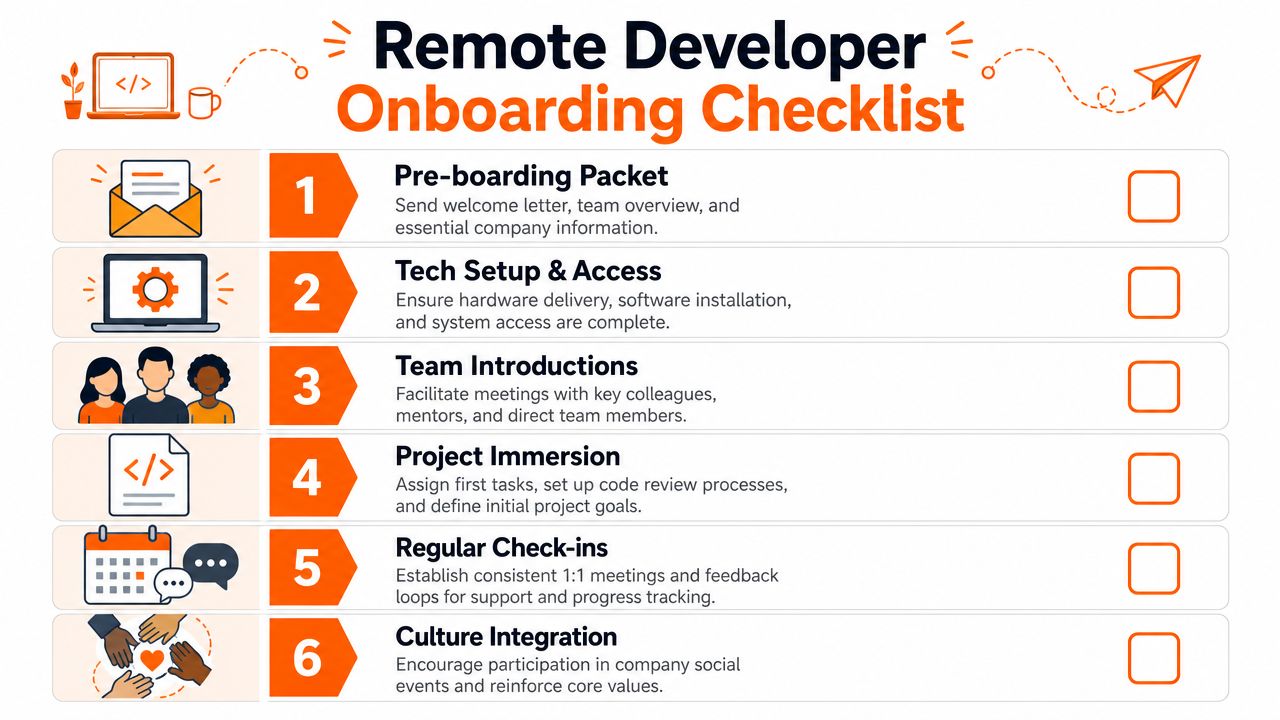
Structured onboarding matters even more in remote environments. Betterway's remote developer hiring guide recommends a workflow that includes technical interviews, a take-home project, code review, then structured onboarding with clear documentation and collaborative tools such as Jira, Asana, or Monday to reduce integration risk.
The first week should create momentum
The goal isn't to dump information. It's to help the new developer understand the product, meet the people they'll rely on, and ship something small enough to build confidence.
A simple first-week cadence works well.
Before day one
- Access and equipment
Confirm repo access, package registries, deployment visibility, design files, ticketing systems, and communication tools. - Written context
Share architecture notes, coding standards, team norms, and a glossary for product language. - Named onboarding owner
Give the new hire one clear point of contact.
Here's a useful companion resource on shaping the broader new hire experience guide if your company is still formalizing its onboarding standards.
A detailed remote-specific checklist also helps. This remote employee onboarding checklist is a practical reference for making sure the basics are covered before the first login.
A day-by-day approach
Lead with something concrete.
| Day | Focus | Outcome |
|---|---|---|
| Day 1 | Team introductions, tool setup, product walkthrough | They know who does what and where things live |
| Day 2 | Local setup, architecture overview, first small ticket | They can run the app and understand core boundaries |
| Day 3 | Pair on a real task, review open pull requests | They learn team standards through examples |
| Day 4 | Ship a small change, discuss code review feedback | Early confidence and visible contribution |
| Day 5 | 1:1 with manager, unblock issues, plan next week | Clear priorities and no silent confusion |
What good onboarding looks like in practice
Small first win Don't assign a critical migration on day two. Give them a bounded task that touches the actual codebase.
Review-heavy early days
Code review is onboarding. It teaches style, architecture, and implicit expectations faster than a handbook.Explicit communication norms
Tell them when to post in Slack, when to open a Jira ticket, when to ask for a synchronous call, and how to escalate blockers.
Good onboarding gives remote developers context before it gives them pressure.
Buddy support
A peer can answer the small questions that never make it into documentation.Manager check-ins Ask what feels unclear, not just what's complete. Confusion compounds when someone is remote.
Building a Scalable Remote Hiring Engine
Hiring one strong React developer can feel like a win. Building a repeatable system is what changes your team's capacity.
That system starts when the hiring team agrees on a few key requirements: what good React work looks like in your environment, which remote behaviors matter, who owns each interview stage, and what evidence is required before making an offer. Once those are documented, the process gets faster and less subjective.
A practical hiring engine has five parts:
A reusable role brief
Keep a living template for frontend roles so every hiring manager isn't starting from zero.A calibrated assessment loop
Save your best take-home prompts, interview rubrics, and scorecards. Review false positives and false negatives after each hire.A lightweight talent bench
Keep notes on near-miss candidates. Some weren't wrong for the company. They were wrong for that exact opening.A hiring SLA inside the team
Decide how quickly resumes are reviewed, feedback is submitted, and offers move. Delays kill good processes.An onboarding handoff
Treat hiring and onboarding as one system, not separate tasks owned by different people with different standards.
The timing data supports the value of running a tighter system. Platform-specific benchmarks show remote React developers can be hired in about 3 to 5 days, with median rates around $35 to $40 per hour, according to this remote developer hiring reference. That won't be every team's reality, but it's a useful benchmark for how much friction usually comes from internal process, not market impossibility.
The larger point is simple. If you want to hire remote React developers consistently, don't treat each search like a fresh emergency. Build the assets once. Improve them after every hire. Keep the process narrow, evidence-based, and respectful of candidate time.
A scalable hiring engine doesn't just fill seats. It gives your product team a reliable way to add frontend capacity without lowering the technical bar.
If you're building a distributed team and want a cleaner way to reach global candidates, YayRemote is worth a look. It combines curated remote job distribution with tools that make hiring and applying less messy, which helps both employers trying to fill React roles and candidates trying to find serious remote opportunities.