How to Find international jobs: A Practical Guide to Global Careers
Learn how to find international jobs with proven strategies, resume tips, visa guidance, and relocation advice to boost your global career.
So, you’re ready to take your career global. Fantastic. But before you start firing off applications, let's get one thing straight: what does an "international job" actually mean to you? This is the most important question you'll answer, and it sets the stage for your entire job hunt.
Your journey will likely follow one of two major paths: working remotely for an international company from home, or packing your bags and relocating to a new country. One isn't better than the other, but they lead to vastly different experiences. Knowing which one you want from the get-go will save you a ton of time and effort.
Remote Work: The Global Office in Your Home
The rise of remote work has completely changed the game. It used to be a niche perk; now, it's a mainstream reality. A staggering 330 million people are expected to work remotely in some capacity by 2026. That’s a massive jump from the 5-7% of workdays done from home pre-2019, a trend you can read more about on fmcgroup.com.
This shift has cracked open the international job market for professionals everywhere. You no longer need a visa sponsorship to work for that cool startup in Berlin or a tech giant in Singapore.
What does this path offer?
- Financial Advantage: Earning a salary from a company in a high-cost country while living somewhere more affordable is a powerful wealth-building strategy. Think a San Francisco salary with a Thailand cost of living.
- Unmatched Flexibility: As long as you have reliable internet, your office can be anywhere. You can stay in your hometown, try out a new city, or embrace the digital nomad lifestyle.
- A Simpler Process: You get to skip the biggest hurdles of international work—visas, work permits, and the logistical nightmare of moving your life across the globe.
Of course, it’s not all sunshine and pajamas. You'll need serious self-discipline to stay productive, master asynchronous communication, and find ways to build real connections with a team you might never meet face-to-face.
International Relocation: The Full Expat Experience
Then there's the other route: going all in. Relocating for a job is for those who crave deep cultural immersion and want to build a life abroad. This is about more than just a job; it's a complete lifestyle change.
Key Insight: Choosing to relocate means you're not just accepting a new job; you're adopting a new lifestyle. It requires a greater commitment but often leads to profound personal and professional growth.
Companies that go through the trouble of sponsoring a move are often making a big investment in you. They might offer relocation packages with housing allowances, language classes, or cultural training to help you settle in. This is especially common in fields like engineering, finance, or senior leadership, where having boots on the ground is non-negotiable.
This flowchart lays out the decision perfectly. Are you optimizing for lifestyle flexibility or deep cultural immersion? Your answer points you down your path.
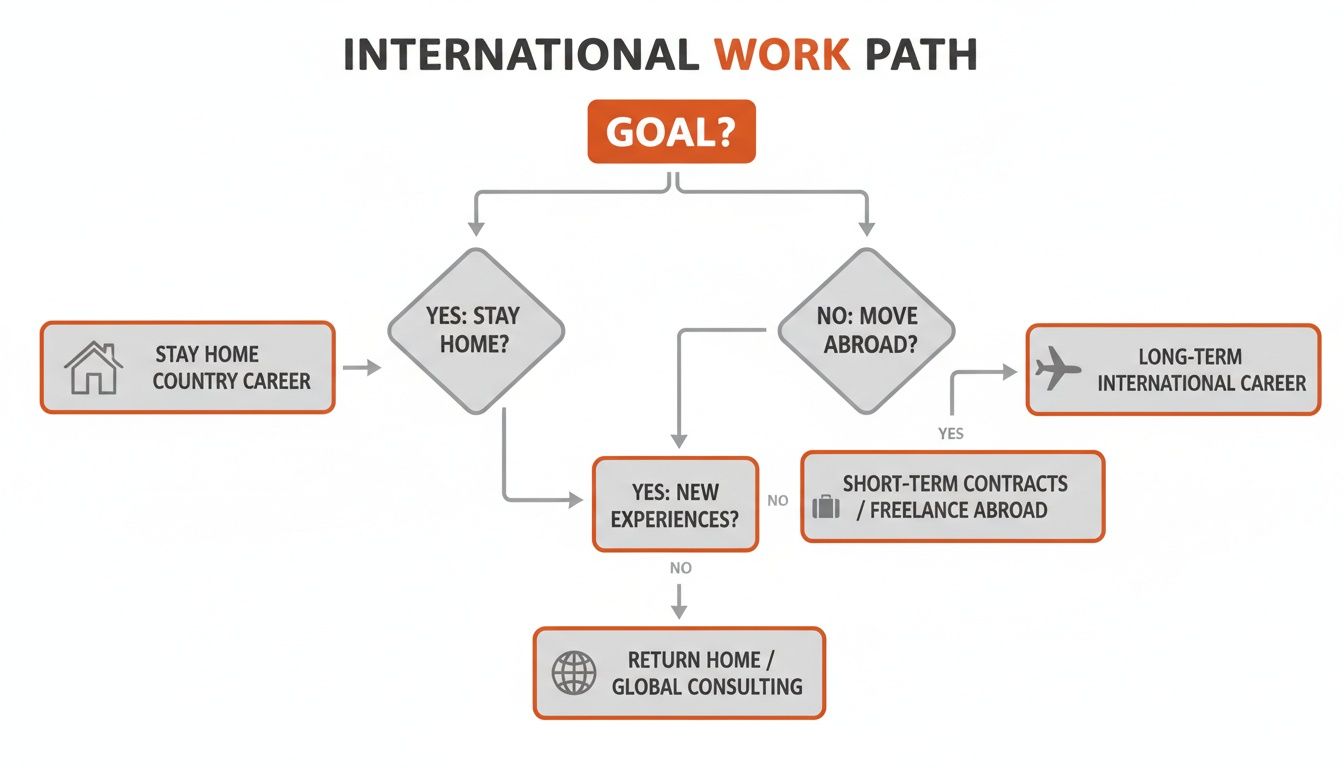
Think of it this way: your core motivation—what you really want out of this experience—is the compass for your entire international job search.
To make the choice even clearer, let's break down the practical differences side-by-side.
Comparing Remote Work vs International Relocation
This table breaks down the key differences between securing a remote international job and physically relocating for work, helping you decide which path fits your goals.
| Factor | Remote International Job | International Relocation |
|---|---|---|
| Logistics | Minimal; requires reliable internet and a workspace. | Complex; involves visas, work permits, housing, and moving. |
| Financials | Potential for geo-arbitrage (high salary, low cost of living). | Higher upfront costs, but often includes relocation packages. |
| Cultural Immersion | Limited; interaction is primarily virtual with colleagues. | Deep and immersive; you live and work within the new culture. |
| Flexibility | High; ability to work from anywhere (within timezone/legal limits). | Low; tied to a specific city and office. |
| Social Life | Requires proactive effort to build a local community. | Easier to build social circles through work and daily life. |
| Career Growth | Can be challenging to get visibility for promotions. | Direct access to leadership and in-person networking. |
Ultimately, both paths can lead to an incredibly rewarding international career. The key is to be honest with yourself about what you're looking for. Once you have that clarity, you can start building a targeted strategy to make it happen.
Mastering Your International Job Search Strategy
Now that you’ve decided whether you’re hunting for a fully remote gig or a full-on relocation, it’s time to get tactical. A successful search for an international job isn’t just about browsing—it’s about having a smart, targeted strategy. The right approach will bring the best global opportunities straight to you, instead of leaving you lost in a sea of irrelevant listings.

The global job market is hotter than ever. Recent analysis shows that a whopping 38% of professionals are either looking for a new job now or plan to soon. And while just 11% of all U.S. job postings are fully remote, the real story is in the high-paying roles. Before the pandemic, only 4% of six-figure jobs were remote; today, that number has jumped to 15%. You can dig into more of these trends in Robert Half's 2025 analysis.
This surge means competition is fierce, but it also means incredible opportunities exist for those who know where to look and how to cut through the noise.
Go Beyond the Giant Job Boards
Your first instinct might be to jump on the massive job aggregators, but that’s usually a fast track to frustration. You'll waste hours sifting through roles mistakenly tagged "remote" or, even worse, ones that are only open to candidates in a specific country.
It's time to shift your focus to specialized platforms.
For anyone serious about finding international jobs from anywhere, niche job boards are your secret weapon. They are specifically curated for remote and global roles, which saves an incredible amount of time. Our own guide on the best remote job boards is a fantastic place to start finding platforms that specialize in your industry.
A targeted job search is about quality, not quantity. Applying to five perfectly matched roles you found on a niche platform is far more effective than shotgunning 50 applications from a generic aggregator.
These specialized sites often have the advanced filters you absolutely need for an international search, letting you zero in on what truly matters.
Master the Art of the Advanced Search
Don't just search for a job title—command your search. Learning to properly use advanced filters is the single most powerful thing you can do to find relevant international work. Seriously. Look for these specific options and make them your default:
- Location Independence: This is the big one. Filter for terms like "Work from Anywhere" or "Global" to find true location-independent roles. This immediately weeds out jobs that are "remote" but still tethered to a specific country or state.
- Time Zone Overlap: For collaborative roles, this is critical. Some platforms, including YayRemote's own Time Zone Overlap tool, let you find jobs that align with your working hours. No more 3 AM meetings unless you want them.
- Salary and Benefits: Use salary filters to stop wasting time on roles that don't meet your financial needs. Also, keep an eye out for filters that highlight key benefits like health insurance, home office stipends, or wellness allowances.
By setting up these filters, you essentially turn a generic job board into your own personalized feed of high-quality opportunities.
Identify Truly Distributed Companies
Here’s a hard truth: not all companies that hire remotely have a healthy remote culture. Some are just reluctantly testing the waters, while others have built their entire DNA around a distributed team. You want to work for the latter.
So, how can you tell the difference?
- Scan Their Career Page: Look for the language they use. Phrases like "distributed-first," "asynchronous by default," or "we hire the best talent, regardless of location" are huge green flags. It shows they see remote work as a strength, not a compromise.
- Read Their Public Statements: Do a quick search for blog posts or interviews where company leaders talk about their remote work philosophy. This gives you a peek behind the curtain to see if they genuinely support it or just tolerate it.
- Use Company Directories: Platforms like YayRemote often feature directories of verified remote-first companies. This is a goldmine for finding employers who are already all-in on building a fantastic global team.
Finding a company that truly lives and breathes remote work will make all the difference. It means you’ll get the support, tools, and culture you need to not just do your job, but to thrive in an international role.
Your Application: Going from Local Hero to Global Contender
When you're applying for jobs internationally, your resume and LinkedIn profile aren't just documents—they're your ambassadors. They have to do the heavy lifting of introducing you to a hiring manager who might be thousands of miles and several time zones away. It’s not about just translating your experience; it's about making your professional story resonate with a global audience.

Think about it from their perspective. A recruiter in Dublin has no clue what "MCAT" means, and a hiring manager in Singapore won’t be impressed by a regional award they've never heard of. Your mission is to "de-localize" your background, stripping away the local jargon to make your value instantly clear to anyone, anywhere.
First things first: scrub your resume of anything that ties you to one specific spot. Ditch the full street address and local phone number. A professional email address and your LinkedIn URL are all you need for contact info. Hunt down and replace regional slang, company-specific acronyms, and inside jokes with clear, universally understood language.
Strip Out the Local Context
The name of the game is clarity and impact. You have to assume the person reading your resume has zero context for your city, country, or local industry. Will they grasp the scale of your achievements?
The easiest way to do this is with numbers. Metrics are a universal language.
- Don't say: "Managed the top-performing sales team in the Midwest region."
- Instead, write: "Led a sales team to hit 140% of its annual quota, driving $2.5M in new revenue across a multi-state territory."
See the difference? The first example is meaningless to a recruiter in Stockholm. The second one immediately proves you can deliver significant business results—a skill that's valuable everywhere. It takes a local victory and makes it globally impressive.
Your resume needs to tell a story of tangible impact, not just list your past duties. For international roles, that impact must be measured in terms that cross borders as easily as an email.
I know, combing through your resume to make these changes can feel like a chore. This is where tools like YayRemote's ATS Resume Checker come in handy. It can scan your document for the kind of red flags that get you filtered out by the automated systems used by big global companies, helping you fix problems before you apply.
Shine a Spotlight on Your Global and Remote Skills
Once you've de-localized your history, it's time to go on the offensive. You need to actively highlight the skills that make you a perfect fit for a distributed team. I’ve spoken with countless hiring managers who now say that proven remote work skills are just as critical as technical ones. Someone who can manage their own time and communicate clearly across continents is often more valuable than a slightly more skilled person who needs constant hand-holding.
Make sure these skills are front and center in your summary and throughout your experience section:
- Asynchronous Communication: Show you’re a pro with tools like Slack, Jira, or Asana. Better yet, briefly describe how you used them to keep projects on track without needing constant meetings.
- Cross-Cultural Collaboration: If you've ever worked with colleagues from different countries, that’s gold. Mention how you navigated different cultural norms and communication styles to get the job done.
- Proactive Problem-Solving: Remote work demands initiative. Give a concrete example of a time you spotted an issue, came up with a solution, and put it into action without direct supervision.
- Time Zone Dexterity: This shows you get it. Simply mentioning your flexibility to join early or late calls for important meetings demonstrates your awareness and commitment to making a global team work.
For more specific examples you can adapt, check out our deep dive on the top remote work skills for your resume.
Ultimately, tailoring your application for a global audience proves you’re self-aware. It shows you understand the unique challenges and opportunities of international and remote work. By proving you have both the hard and soft skills to excel in this environment, you’ll transform from just another name in a stack of resumes into a candidate they absolutely have to talk to.
Tackling Interviews, Visas, and Legal Hurdles
Getting that interview invitation is a huge step forward. But now, a whole new set of challenges pops up. The interview process for an international role, especially a remote one, is often a test of its own. It's not just about what you know, but how well you can manage the logistics of connecting with a team that might be a dozen hours ahead or behind you.
And then there’s the elephant in the room: visas and your legal right to work.

To get through this stage, you need to be prepared, professional, and have a solid grasp of the legal side of things. Let's break down how to handle both the interview and the visa conversation without breaking a sweat.
Acing the Time Zone Tango
A video interview with a company on the other side of the planet is your first real chance to prove you're a capable remote professional. Simply showing up on time isn't enough; you need to show them you can navigate the day-to-day realities of being on a globally distributed team.
First things first, double-check the time zone. This sounds so basic, but it's the most common and embarrassing mistake I see people make. Use a reliable time zone converter and confirm the meeting time in their local time as well as your own.
Next, you want to frame the time difference as a complete non-issue. When you're scheduling, be proactive. Try saying something like this:
"Thanks for the invitation! I'm available at 9:00 AM PST, which I believe is 5:00 PM your time in London. I'm also flexible and can easily adjust to a time that works best for your team."
That small gesture shows you’re already thinking like a global team member. You’ve done the mental gymnastics for them, which immediately signals that you're organized and easy to work with. During the interview itself, make it clear you understand the importance of asynchronous work but are also happy to be flexible for those crucial, real-time collaborations.
Untangling the Visa and Work Permit Puzzle
This is where a lot of job seekers get nervous, but it doesn't have to be a deal-breaker. The trick is knowing which questions to ask and how to frame your own situation. The kind of visa you'll need depends entirely on the job and your personal plans.
For most people hunting for international jobs, the options usually fall into three buckets:
- Employer-Sponsored Visa: This is the standard for jobs that require you to move. The company does the heavy lifting—they sponsor your application, manage the paperwork, and often cover the costs. Your main job is to provide all the necessary documents and, frankly, be patient.
- Freelance or Self-Employment Permit: Some countries let you live there as long as you're working for clients abroad. This is a solid option if you’re a contractor, but it means you're in charge of the entire application process yourself.
- Digital Nomad Visa: This is a game-changer for remote workers. More than 50 countries now offer these special visas, allowing you to live there for a year or more while working for a company based somewhere else.
It’s incredibly helpful to know the difference between these before you ever talk to a potential employer.
How to Discuss Your Visa Status with Confidence
You don't need to have everything figured out before the first interview, but you do need to sound informed. When the "right to work" topic eventually comes up, how you answer will depend on the type of role.
For a Relocation Role: Be direct and honest. You could say, "I would require visa sponsorship for this position. I'm very excited about the possibility of relocating and am prepared to help with the process in any way I can." This shows you're serious and you've thought this through.
For a "Work from Anywhere" Remote Role: The conversation is totally different here. The company is hiring you as a remote employee or contractor, and where you work from is your responsibility.
Here's the key takeaway: For most remote roles, your legal obligation is to have the right to work in the country where you are physically located. The company isn't sponsoring you to move; they're just paying you for your work.
In this situation, you could say: "I plan to be based in [Your Country], where I have the legal right to work. I’m also looking into [Country X]’s digital nomad visa as a possibility for the future." This comes across as proactive and planned.
If you're still exploring your options, our guide on digital nomad visa requirements is a great place to start understanding the landscape.
By approaching these topics with clarity and preparation, you turn what could be stumbling blocks into chances to show just how professional and valuable you are as a global candidate.
Negotiating Your International Offer and Onboarding
Getting an international job offer is a huge win, but don't pop the champagne just yet. This is where the real work begins—the negotiation. How you handle this stage can dramatically shape your financial future and overall experience, so it’s critical to get it right.
An offer from an overseas company isn't just a number. It's a complex puzzle of salary, benefits, and logistics that are completely different from a domestic role. This is your moment to make sure the package truly works for you, whether you’re packing your bags or setting up your home office for the long haul.
Benchmarking Your Global Salary
Before you even think about a counteroffer, you need to do your homework on compensation. A salary that sounds incredible in your local currency might barely cover rent in a city like Zurich or Singapore. On the flip side, you could be massively undervaluing yourself if you base your expectations on your hometown market when the company is based in a high-wage country.
Your goal is to get a realistic picture. Start by researching salary benchmarks for your specific role and experience level in the company’s primary location. This tells you what they've likely budgeted for the position. Next, weigh that against the cost of living in the city you'll actually be working from.
And don't forget taxes! A 30% tax rate in one country versus 15% in another will have a massive impact on your take-home pay. I always recommend using tools like Numbeo to compare living expenses and get a feel for the financial reality on the ground.
Key Negotiation Points for International Roles
Armed with data, you can now negotiate from a position of strength. For international offers, the conversation goes way beyond the base salary. Bringing up the following points shows the employer that you're a serious professional who understands the nuances of global work.
Think about raising these topics during your discussion:
- Relocation Package: This is a non-negotiable if you’re moving. A solid package should cover flights, temporary housing for the first month, and the cost of shipping your belongings. This support is often worth $5,000 to $15,000 or more, making a huge difference in your transition.
- Home Office Stipend: For remote roles, this is practically standard. It's a payment—either one-time or recurring—to help you build a proper workspace with a good desk, ergonomic chair, and reliable internet.
- Currency Fluctuation Clause: This is a savvy one. If your salary is paid in a foreign currency, its value can swing wildly against your home currency. Some companies will agree to a clause that adjusts your pay if the exchange rate shifts beyond a certain threshold, which protects your income from market volatility.
A strong negotiation isn't about winning; it's about building a partnership. By focusing on creating a fair package that addresses the real costs of international work, you demonstrate your value as a thoughtful, long-term asset to the company.
Each of these points represents real, tangible value. Don't be afraid to ask what’s possible. The worst they can do is say no, but more often than not, they have policies for these exact scenarios.
Ensuring a Smooth Remote Onboarding
You've signed the offer—congratulations! The final piece of the puzzle is onboarding. A great onboarding process sets the stage for your entire career with a company, and for a remote international hire, it’s even more important.
A well-defined onboarding plan is a tell-tale sign of a company that truly gets remote work. You should expect to receive a clear schedule for your first week, complete with introductory meetings with your manager, key teammates, and HR.
Here’s what your onboarding checklist should cover:
- Tech and Access: Get confirmation that your laptop and any other company hardware will be shipped to you well before your start date. Double-check that all your accounts for email, Slack, and project management tools are provisioned and ready to go.
- The "Buddy" System: This is a game-changer. Ask if the company has a buddy program that pairs you with a seasoned team member. This person becomes your go-to for all the small, informal questions you might hesitate to ask your manager.
- Documentation Deep Dive: Any strong remote company runs on excellent documentation. Block off dedicated time in your calendar during that first week to just read. This is how you'll learn the unwritten rules, communication styles, and internal processes that make the team tick.
By taking charge of your negotiation and onboarding, you’re not just finishing a job search—you're laying the foundation for a thriving global career.
Common Questions on Landing an International Job
Going after a job abroad brings up a lot of questions. It's a path filled with unique hurdles, from crafting a resume that crosses borders to figuring out visas. Here are some straightforward answers to the most common challenges you'll likely encounter.
How Do I Make My Resume Stand Out to International Recruiters?
The trick is to think universally. Recruiters from different countries need to see your value at a glance, so strip out anything that screams "local." This means ditching your full street address, which can create immediate location bias, and any regional jargon that won't translate. Instead, your LinkedIn URL and a professional email should be front and center.
Next, highlight your experience with tools that power global teams—think Slack, Asana, or Jira. But more importantly, you need to show you get how remote work functions. Mention your experience with asynchronous communication or leading projects across different cultures. This proves you can thrive without being in the same room.
Your goal is to translate your achievements into a universal language that resonates globally. Quantify your successes with hard data to show tangible value that any hiring manager can understand, regardless of their location.
For example, don't just say you "Managed regional marketing." Get specific. Try something like, "Increased European lead generation by 20% through targeted digital campaigns." That kind of metric-driven result is impressive no matter where the hiring manager is sitting.
What’s the Best Way to Find Companies That Actually Hire Internationally?
Forget the massive, generic job boards. The most effective strategy is to use specialized remote job platforms that focus exclusively on roles from globally distributed companies. This saves you from the frustration of finding a "remote" job that's actually only open to people in a specific city.
Once you're on these sites, be relentless with the filters. Look for tags like "work from anywhere" or "global" to find the truly location-independent gigs. It's also smart to follow hashtags on LinkedIn, like #remotehiring and #internationaljobs. You’ll see which companies are actively posting and get a feel for the market.
Finally, do a little digging on the companies themselves. Go to their career pages. Read their mission statements. Are they using phrases like "distributed-first" or "remote-native"? That’s a huge green flag. It tells you they’ve built their culture around global talent, not just tacked on a remote policy as an afterthought.
How Should I Talk About Salary for a Job in a Different Country?
Never walk into a salary discussion unprepared. Before the conversation even happens, you need to do your homework. Research the typical salary range for your role and experience level, both where you live and in the country where the company is headquartered. This gives you a realistic baseline and a solid anchor for negotiation.
When the topic comes up, be ready to talk numbers in the company's local currency. Frame your expectation not just on your needs, but on the value you bring and the market data you've gathered. You could say something like, "Based on my research for a senior product role in Germany and my specific experience, I'm looking for a compensation package in the range of X to Y euros."
And don't get fixated on the base number alone. The entire offer is what matters. Health benefits, equity, and potential cost-of-living adjustments can dramatically change the total value of the package.
Do I Need a Visa Before I Even Apply?
This is a huge misconception that stops so many talented people in their tracks. In almost all cases, the answer is no. The visa process really depends on the type of role you're after.
- For Relocation Roles: If the job requires you to move, the company will almost always sponsor your work visa. It’s part of the hiring package. They handle the legal heavy lifting to get you there, so you don’t need to have a visa sorted out beforehand.
- For Remote Roles (From Your Home Country): You won't need a visa for the company's country at all. Simple as that. You just need the legal right to work in the country where you are physically located.
- For Digital Nomads: If you're planning to work and travel, the responsibility shifts to you. You'll need to research and secure the right digital nomad visas for the countries you want to live in. Knowing these options ahead of time will help you focus on remote jobs that align with your travel aspirations.
Ready to find your next global opportunity? YayRemote curates thousands of hand-picked international and remote jobs from top distributed companies. Use our free tools like the Skills Analyzer and ATS Resume Checker to perfect your application, and explore our Digital Nomad Visa hub to plan your next move. Start your smarter, simpler job search today at https://www.yayremote.com.