Jobs Remote Hiring: Your Complete 2026 Guide
Master the world of jobs remote hiring. Our 2026 guide covers finding roles, recruiting talent, tools, and legal tips for candidates and employers.
About 32.6 million Americans, or roughly 22% of the U.S. workforce, were working remotely in 2025 according to state of remote work data. That changes the conversation. Jobs remote hiring isn't a side channel anymore. It's a core hiring market with its own rules, failure points, and competitive dynamics.
Most advice still treats remote hiring like a lighter version of regular hiring. Post the role. Apply broadly. Run a few Zoom calls. Hope for the best. That approach breaks down fast when candidates are filtering for flexibility and employers are screening for autonomy, async communication, and location constraints that don't show up in a standard office-based process.
The better way is to treat remote hiring as an operating model. Candidates need to prove they can deliver without supervision theater. Employers need to design a process that tests how work happens across distance, tools, and time zones. That's where the gap usually is, and where strong outcomes come from.
The New Reality of Jobs and Remote Hiring
83% of workers worldwide say a hybrid setup is ideal, based on the same remote work data cited earlier. That matters for both sides of the market. Candidates are competing for work arrangements they actively want, and employers are hiring into a model that requires more than a remote label on the job post.
Remote hiring has matured into an operating discipline. Companies that do it well define working hours, response norms, documentation habits, and location boundaries before they open a role. Candidates who perform well in this market show they can communicate clearly in writing, make progress without constant check-ins, and handle distributed teamwork across tools and time zones.
What changed in practice
Three shifts define the current market:
- Talent pools expanded: employers can hire beyond a single metro area, which improves access to niche skill sets but also increases screening complexity.
- Candidate scrutiny increased: applicants now check country eligibility, timezone overlap, travel expectations, and manager support for asynchronous work before they invest in a process.
- Operational quality became visible: remote-friendly branding means little if interview scheduling is slow, assignments are vague, or decision-making depends on hallway conversations that no longer exist.
This is the gap many teams miss. Remote hiring succeeds or fails in the mechanics.
A company may offer flexible work and still lose strong candidates if approvals drag across time zones or interviewers cannot explain how decisions get documented. A candidate may have excellent functional skills and still struggle if their examples only show meeting-heavy collaboration with little written ownership. In practice, both sides are being evaluated on how work moves when people are not in the same room.
Who needs a different playbook
Candidates and employers tend to make opposite mistakes.
Candidates often present remote work as a preference. Hiring teams need evidence that remote work is a strength. That means showing written communication, independent execution, clear status updates, and examples of shipping work with limited supervision.
Employers often separate hiring quality from operating quality. In remote teams, those are closely linked. If the process ignores timezone friction, async handoffs, or compliance limits, the hire can look strong on paper and still create delays once the work starts.
That is why jobs remote hiring needs one shared playbook. Candidates have to prove they can do the work in a distributed environment. Employers have to design a process that tests for it and supports it after the offer.
The Candidate Playbook for Finding Remote Jobs
A remote job search goes sideways when you treat every listing as equally viable. They aren't. Strong candidates narrow the field early.

Filter for the real job, not the headline
A listing that says “remote” may still require specific states, countries, travel windows, or core hours. Before you write a customized application, screen for the constraints that affect your daily life.
Start with these filters:
- Location scope: global, country-specific, state-specific, or timezone-bound.
- Schedule expectations: async-friendly or fixed overlap hours.
- Seniority and ownership: remote teams often expect faster independence.
- Benefits and support: equipment, learning budgets, leave structure, healthcare, and travel expectations.
- Compensation transparency: if a role posts a range, assess whether it fits your target before investing time.
Tailor the proof, not just the resume
Generic resumes underperform in remote hiring because they read like job history, not delivery evidence. A remote-ready resume should show how you work.
That means highlighting things like:
- Async outputs: docs, dashboards, specs, tickets, playbooks, decision logs.
- Tool fluency: the stack you've used, such as Slack, Notion, GitHub, Jira, Figma, or CRM systems.
- Independent execution: projects you owned without heavy supervision.
- Cross-functional communication: places where your written updates kept work moving.
If you're changing industries or role types, this matters even more. Your best argument may not be title match. It may be proof that you can produce clear work, document decisions, and move projects forward without constant meetings.
A practical way to tighten this is to run your application materials through an ATS checker before you send them. The strongest candidates don't only write for humans. They make their resumes parse cleanly, mirror the job language, and foreground outcomes that fit the role.
Later in the process, this video is worth watching if you want a grounded overview of remote job search strategy:
Read the job description like an operator
A good remote listing tells you how the company runs. A bad one hides the hard parts.
Look for signals such as:
| Signal in the listing | What it usually means |
|---|---|
| Mention of core overlap hours | Team relies on synchronous collaboration at set times |
| Explicit travel language | “Remote” may still include offsites, onboarding trips, or client visits |
| Clear writing requirements | Documentation is part of performance |
| Specific tool references | They expect you to contribute inside an established workflow |
| Detailed interview steps | The company has thought through remote assessment |
If the job description is vague about location, overlap, and workflow, ask before the first interview. That isn't being difficult. It's basic due diligence.
Apply narrower and deeper
Remote candidates waste time when they chase volume. A better rhythm is to build a short list of roles that fit your geography, schedule, compensation target, and skill profile, then tailor hard.
That means fewer applications, better evidence, and sharper interview prep. In remote hiring, that usually beats mass application behavior.
The Employer Playbook for Recruiting Remote Talent
Remote recruiting is more competitive than many teams admit. Virtual Vocations' 2025 year-end report and remote jobs statistics says remote job availability reached a record high in 2025, with 424,778 remote job postings reviewed and published in its database during the year. The same source says remote job postings increased 20% quarter over quarter in Q1 2026, and that senior product manager roles were commonly around $136,000, which is a useful signal that remote hiring is concentrated in high-skill, high-pay work.
Write the job like you know how the team works
Most remote job descriptions are still too generic. They list responsibilities, maybe a location line, then a standard requirements block. That's not enough.
A strong remote-first job description spells out:
- Where the role can be based
- Which hours need overlap
- How the team communicates
- What outputs define success
- What travel, if any, is expected
- How the interview process works
That level of detail does two things. It attracts candidates who can self-select accurately, and it reduces late-stage dropoff caused by hidden constraints.
Screen for autonomy, not just credentials
Many teams overweight pedigree because it feels safer. In remote work, that often produces expensive misses. The better question is whether the person can move work forward without constant prompting.
Here's a practical comparison:
| Weak signal | Stronger signal |
|---|---|
| Prestigious employer | Clear examples of independent ownership |
| Long list of tools | Evidence they used tools to coordinate effectively |
| Smooth interview style | Crisp written communication and follow-through |
| Broad role summary | Specific artifacts and decisions they drove |
A remote hiring process should test execution in the same environment the role uses. That might mean written prompts, async case exercises, collaborative review, or a structured live working session.
A polished candidate can still be a poor remote operator. Hire the person who leaves clarity behind them.
Build a funnel that respects candidate time
The best remote employers are efficient. They don't drag people through unnecessary rounds, and they don't evaluate the same thing three times.
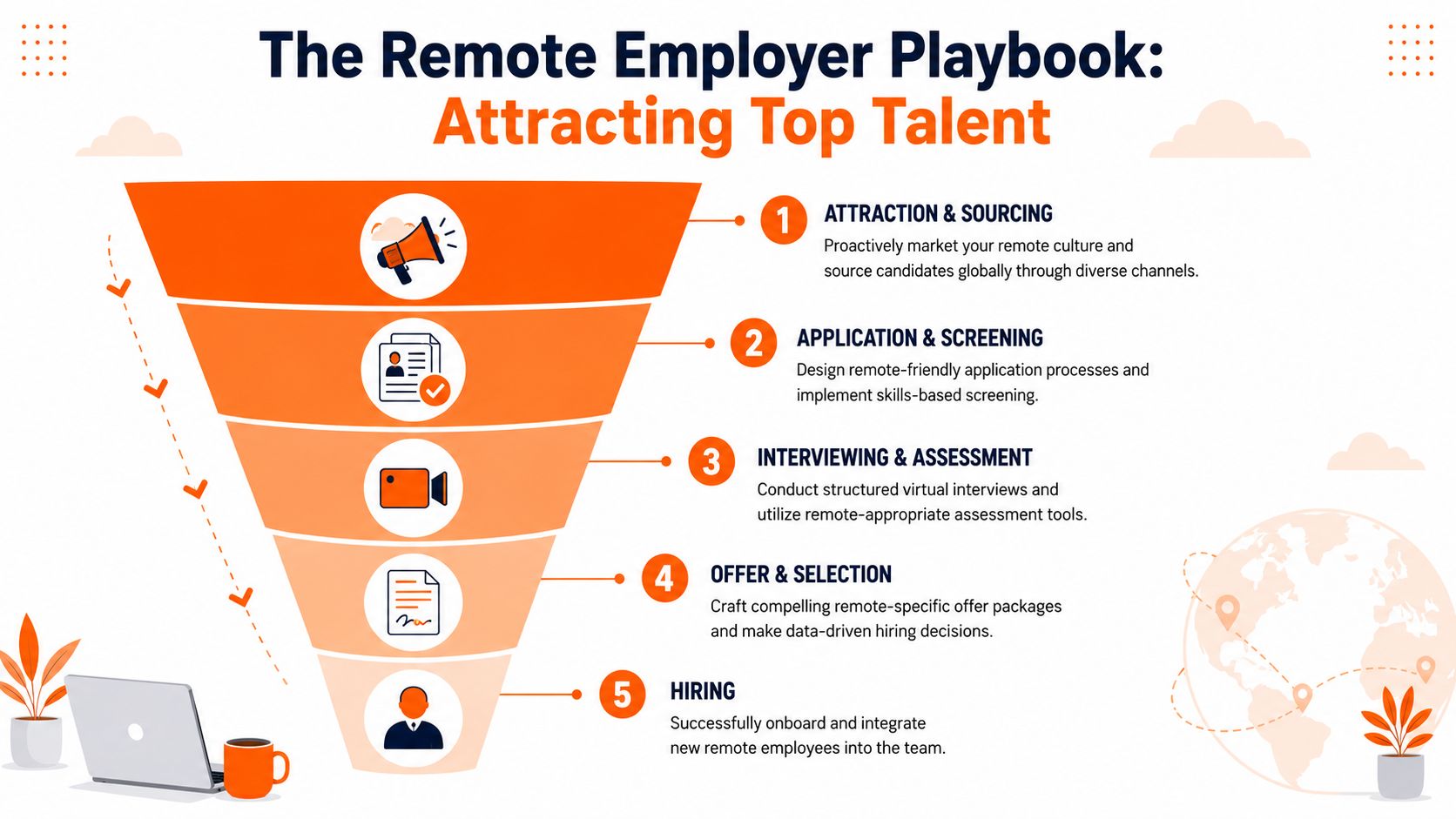
A clean structure often looks like this:
- Initial screen focused on eligibility, motivation, and communication quality.
- Skill assessment matched to the actual work.
- Panel interview for role depth and collaboration style.
- Final conversation to align on expectations, constraints, and offer details.
If your team needs a more detailed framework for designing that process, this guide on how to hire remote employees is a useful reference.
Source where intent is high
General job boards create noise. Specialized remote channels often produce better fit because candidates arrive already committed to remote work realities. That matters when you're hiring for distributed teams that depend on written communication, scheduling discipline, and location compatibility.
The goal isn't more applicants. It's fewer false positives.
Acing the Remote Interview and Assessment Process
The remote interview is where weak process gets exposed. Candidates feel it when interviews are vague, repetitive, or centered on chemistry alone. Employers feel it when polished people pass the conversation test but struggle once work becomes async and artifact-driven.
The cleanest hiring loops combine domain assessment with collaboration assessment. Remote data science hiring guidance from Nexus IT Group is especially clear on this point. Effective remote technical hiring should test core skills such as Python, R, statistical analysis, machine learning, cloud computing, data visualization, and SQL where relevant, while also evaluating time management, self-motivation, and proficiency with tools such as Slack, Zoom, and GitHub. That same guidance recommends role-fit platforms such as CoderPad, CodeSignal, and HackerRank for live coding, StrataScratch and SQLPad for SQL, and DataCamp, Deepnote, or Kaggle for AI and ML work.
What candidates should do differently
A remote interview rewards visible preparedness.
That includes:
- Technical setup: stable audio, camera angle, screen-sharing readiness, and documents open before the call.
- Artifact thinking: be ready to show how you structure work, not just talk about outcomes.
- Written clarity: many teams will judge your follow-up notes and chat communication as part of the evaluation.
- Environment awareness: remote interviews aren't casual just because they happen at home.
Candidates also need better stories. Don't only explain what you built. Explain how you coordinated, how you documented, how you handled blockers, and what happened when priorities changed without a meeting to rescue the situation.
What employers should stop doing
The most common mistake is using a standard office-style interview loop for a remote role. That misses the actual risks.
Here's what usually works better:
- Use job-relevant exercises: a take-home brief, live debugging session, account strategy review, or async writing task.
- Assess communication in context: ask for a short written summary after a scenario discussion.
- Separate charisma from clarity: someone can be engaging live and still create confusion in distributed work.
- Keep scoring structured: define what good looks like before the interview starts.
If you need sharper prompts, this list of remote job interview questions can help interviewers test for ownership, communication habits, and distributed-work fit.
The best assessment feels like a compressed version of the job, not a performance staged beside it.
A simple standard for both sides
A useful remote interview leaves both parties with more evidence, not just stronger feelings. Candidates should walk away knowing what collaboration looks like. Employers should have proof of both skill and execution style.
When either side finishes the loop with unanswered operational questions, the process wasn't rigorous enough.
Solving Remote Compensation and Compliance Puzzles
Remote hiring gets complicated the moment you move past sourcing and interviews. Compensation philosophy, worker classification, tax handling, labor law, and scheduling rules all show up fast. Teams that treat these as cleanup work usually create avoidable friction.

One of the most under-discussed constraints is time-zone design. The Ascension remote jobs page makes the point clearly in practice. Its remote and hybrid roles can include varying proximity and travel requirements, which shows why “remote” often isn't fully location-agnostic. That's why the actual question isn't just whether the role is remote. It's how many overlapping hours, which countries are eligible, and what travel obligations sit behind the label.
Pick a pay philosophy before you recruit
Employers usually end up choosing one of three approaches.
| Approach | Upside | Trade-off |
|---|---|---|
| Local market pay | Easier internal benchmarking by geography | Candidates may see inconsistency across locations |
| Geo-adjusted pay bands | Balances role value and local context | Harder to explain if the framework is opaque |
| Role-based global ranges | Simple message and strong attraction | Can raise cost pressure in some markets |
No model is perfect. What matters is consistency and explanation. If managers improvise by candidate, fairness erodes quickly.
Candidates should ask direct questions here. Is compensation tied to headquarters, employee location, or role scope? Does relocation trigger review? Are benefits equivalent across employment types? Those questions are normal in remote hiring.
Compliance is an operating choice
Once you hire across borders, you usually need a legal structure that matches the relationship. Some companies hire employees through local entities or Employer of Record providers. Others engage contractors where appropriate. The wrong setup can create downstream issues for taxes, benefits, labor protections, and IP ownership.
That's why payment and compliance decisions should be made early, not after verbal offer stage. If your team is hiring internationally, this guide on how to pay international employees is a useful operational starting point.
For candidates who want to relocate while staying remote, visa status matters just as much as employer policy. A practical example is this guide to the digital nomad visa UAE 2026, which helps frame the difference between company permission and legal right to work from a given jurisdiction.
Working principle: compensation and compliance aren't separate from hiring quality. If the structure is fuzzy, trust drops before the person even starts.
Time zones are part of compensation too
Teams often treat overlap hours as a scheduling footnote. They aren't. They shape quality of life, meeting load, handoff speed, and long-term retention.
A role with narrow overlap and strong async habits can feel flexible. A role with heavy late-night meetings can feel restrictive even if it's technically remote. Employers should state the expected overlap window plainly. Candidates should evaluate whether that schedule is sustainable, not merely possible.
Building Your Remote Hiring Tech Stack
A remote hiring stack shouldn't be a pile of disconnected tools. It should support one workflow from sourcing to onboarding, with as little manual handoff as possible. The right setup depends on role complexity, hiring volume, and how many jurisdictions you recruit across.
In specialist markets, generic pipelines start breaking. One Glassdoor listing page for New York remote data scientist jobs shows 114 remote data scientist openings in New York. The verified data tied to that market also notes 892 Insights Data Analyst postings in the same city and adjacent hybrid data listings in the $200k to $250k base range. The point isn't only volume. It's that deep remote markets need sharper qualification filters and cleaner benchmarking than a broad ATS funnel usually provides.
What each layer should do
Think in layers, not brands first.
Sourcing
Use platforms that help candidates self-qualify on location, role type, benefits, and seniority. For specialist hiring, niche boards often outperform broad marketplaces because intent is higher and mismatch is lower.
Application management
Your ATS should make it easy to screen for location eligibility, work authorization, seniority, and role-specific requirements without forcing recruiters to rebuild logic in spreadsheets. If the system can't support remote-specific screening, recruiters end up doing manual triage.
Assessment
The assessment layer should match the work. Engineering teams may use CoderPad, CodeSignal, or HackerRank. Data roles may lean on StrataScratch, SQLPad, Deepnote, DataCamp, or Kaggle. Commercial teams may use writing samples, account plans, recorded demos, or scenario briefs.
Interviewing
Video software matters less than process design, but reliability still counts. Scheduling tools, structured scorecards, and shared interview packets usually improve consistency more than another meeting platform does.
Offer and onboarding handoff
Here, many stacks fall apart. Candidate data, compensation approvals, classification documents, and device provisioning often live in different systems. If recruiters need to re-enter information repeatedly, errors multiply.
A practical selection test
Before adding another tool, ask:
- Does it remove a real bottleneck or just add features?
- Can hiring managers use it without training fatigue?
- Does it support remote-specific decisions like timezone fit and location rules?
- Will it integrate cleanly with the rest of the stack?
The best remote hiring stack reduces interpretation. It makes location, process, and evaluation criteria visible early.
A simple stack that fits your workflow beats a complex stack your team only half uses.
Beyond the Offer The Art of Remote Onboarding
A remote hire can accept the offer, clear the paperwork, receive the laptop, and still have a rough start. That happens when onboarding is treated as logistics instead of integration.

What good remote onboarding actually includes
The first week should reduce uncertainty. The first month should build rhythm. The first quarter should establish trust and ownership.
A strong remote onboarding plan usually includes:
- Pre-boarding readiness: devices, access, documentation, and a real day-one schedule.
- Role clarity: what success looks like in the first few weeks, not just the year.
- People mapping: who the new hire goes to for approvals, context, and day-to-day support.
- Written operating norms: how the team uses Slack, meetings, docs, approvals, and escalation paths.
- Regular manager check-ins: frequent enough to unblock, not so frequent that they signal distrust.
Culture needs structure online
In-office teams can rely on ambient learning. Remote teams can't. If a new employee doesn't know where decisions live, who owns what, or how to ask for help, they'll either go quiet or overcompensate with meetings.
That's why buddy systems work well. So do recorded walkthroughs, internal playbooks, and intentional introductions across key collaborators. If you want a practical complement to your own checklist, these AONMeetings tips for employee onboarding are a useful reference point for structuring early communication and expectations.
The first 90 days need visible milestones
Don't wait for a formal review to discover confusion. Define what “good progress” means in concrete terms. That could be a shipped document, a completed customer handoff, a clean code contribution, or ownership of a recurring workflow.
Remote onboarding works when people know what to do, where to look, and who can help. Everything else is support around that core.
YayRemote is a strong place to start if you're navigating jobs remote hiring from either side of the market. Candidates can use it to find hand-picked remote roles, filter by salary, benefits, experience, and location, and sharpen applications with tools like the ATS Resume Checker, Skills Analyzer, Time Zone Overlap, and Days in Country. Employers can use YayRemote to reach distributed talent, post remote roles, and support a hiring process built for how remote teams work.