Part Time Customer Service Remote Jobs: Your 2026 Guide
Find and land part time customer service remote jobs with our 2026 guide. Learn where to search, how to apply, interview tips, and what pay to expect.
You're probably looking for one of two things right now. Either you need income that fits around real life, school pickup, caregiving, another freelance client, or a health constraint. Or you want a remote role that gets you back into the workforce without forcing you into a full-time schedule you can't sustain.
That's why part time customer service remote jobs stay in demand. They can be a practical way to build stable remote experience, sharpen communication skills, and create a work setup that's flexible enough to keep. But the search gets frustrating fast because many listings use “part-time” and “remote” loosely. Some are flexible. Some are only technically remote. Some are project-based. Some look part-time until you read the training requirements.
The people who land good roles usually aren't applying more randomly. They're filtering harder, reading listings more critically, and shaping their application around the specific kind of support work the employer needs.
Why Part-Time Remote Customer Service Is a Smart Career Move
Part-time remote work isn't some tiny corner of the job market anymore. In the U.S., 22.8% of employees worked remotely at least part of the time in March 2025, which the source says is over 36 million people. Of those workers, 12.3% teleworked some hours and 10.7% teleworked all hours, which shows that partial remote arrangements are a meaningful part of how people work now, not a fringe exception, according to this March 2025 remote work breakdown.
That matters if you're targeting customer service. Employers already know that remote support can work. The question usually isn't whether a company accepts remote work in principle. The question is whether your schedule, communication style, and reliability fit the exact support window they need covered.
Why this path works for career changers
Customer service is still one of the most accessible ways to enter remote work because employers care about skills you can prove quickly:
- Clear written communication that doesn't create more confusion
- Calm problem solving when a customer is frustrated
- Process discipline so you follow scripts, tools, and policies correctly
- Consistency because support teams need dependable coverage, not bursts of effort
If you've worked retail, front desk, hospitality, admin, appointment scheduling, intake, dispatch, or any role where you had to manage people and information at the same time, you're not starting from zero.
Practical rule: The best part-time remote customer service jobs don't just give you flexibility. They fit the hours you can work repeatedly without burning out.
Why flexibility still needs boundaries
A lot of job seekers want “work from anywhere, whenever I want.” Some roles do offer that. Many don't. Good part-time remote work often looks more like controlled flexibility. You may choose from blocks, commit to certain windows, or work a minimum weekly schedule.
If location flexibility is also part of your goal, CoraTravels' guide to remote work is a useful companion because it helps you think beyond the job search and into the practical reality of where and how remote work fits your life.
Locating the Best Part-Time Customer Service Remote Jobs
Many job seekers search ineffectively. They type “remote customer service jobs” into a large job board, skim the first page, and waste time on listings that don't match their schedule, pay model, or support channel.
A better search starts with tighter intent.

Search terms that surface better listings
Don't search one phrase. Search combinations that reveal different hiring patterns.
Try variations like:
- “part-time remote customer service” for standard hourly support roles
- “remote chat support part-time” if you want less phone-heavy work
- “customer success part-time remote” for account-facing support that may be less transactional
- “remote member support” because nonprofits, healthcare groups, and service organizations often use different titles
- “remote intake coordinator” or “remote support specialist” if you have admin or scheduling experience
The point is to search by function, not just title. Strong listings often hide behind naming differences.
Read the job type before you read the perks
When people say they want part time customer service remote jobs, they usually mean one of two structures.
| Job structure | What it usually means | Best for |
|---|---|---|
| Direct-hire part-time | Set shifts, manager oversight, steadier expectations | People who want predictability |
| Project-based or contractor work | Access to work depends on project availability and output quality | People who need variable hours or side income |
This distinction matters. For part-time remote customer service roles, one practical benchmark is the assessment-plus-availability model. Candidates may need to pass an application assessment before they can access projects, and successful contractors commonly work in the 5 to 20 hours per week range, with some roles allowing up to 40 hours depending on volume and performance. One listing also showed starting pay at $20 per hour, which makes speed, accuracy, and quality control central to earnings, as described in these remote customer service listings on Indeed.
That tells you something important. In contractor-style support work, “part-time” can mean fluctuating access to work, not guaranteed weekly hours.
If a role ties future project access to submission quality, don't optimize for maximum hours first. Optimize for clean writing, accurate responses, and fast fact-checking.
Where to search without drowning in noise
Start with remote-focused platforms before broad aggregators. Curated boards reduce the number of low-fit listings you have to audit manually. If you want a broader picture of where serious remote roles get posted, this roundup of best remote job boards is a useful reference point.
After that, use larger platforms tactically, not passively. Save searches. Turn on alerts. Open the full description every time. Scan for schedule language before you get emotionally invested.
Look for terms like:
- core hours
- coverage window
- weekend rotation
- minimum availability
- training schedule
- hybrid after onboarding
- client demand
- hours not guaranteed
Those phrases tell you more than the headline does.
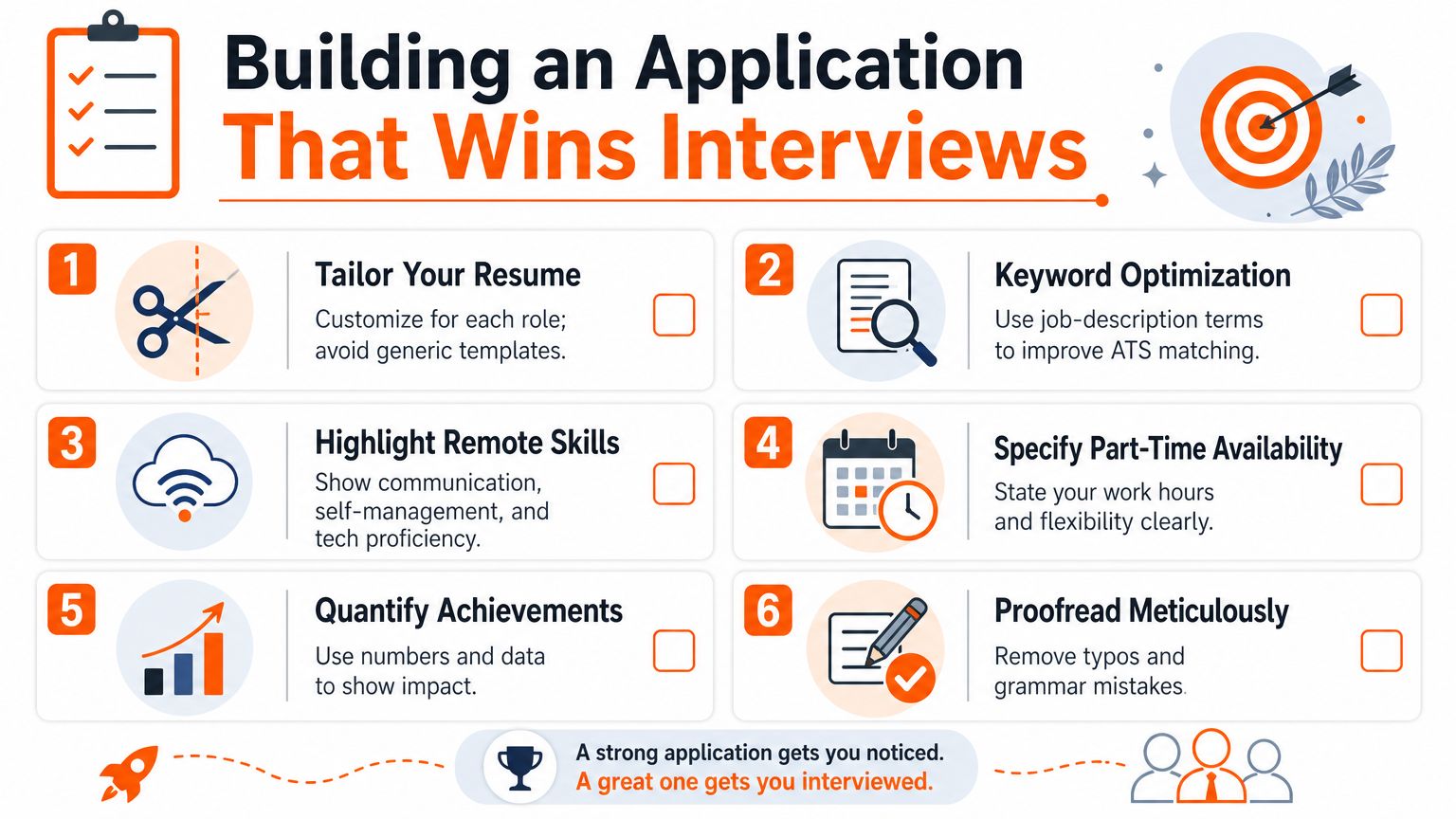
Building an Application That Beats the Bots and Wins Interviews
A generic customer service resume usually fails for remote part-time roles because it describes duties instead of fit. Hiring teams don't just want someone who answered phones. They want someone who can work independently, write clearly, follow process, and show up consistently during the hours listed.
That means your resume has to translate old experience into remote-relevant proof.
What hiring teams are actually scanning for
Recent hiring patterns show that remote customer service roles are increasingly split into specialized niches rather than broad call-center work. Current results include healthcare, telehealth, insurance, retail support, mission-driven public service, and chat or email support openings, which suggests employers are narrowing both the required knowledge and the support channel mix, based on this remote customer service hiring snapshot from Insight Global.
So if you've worked in a specific environment, use it. Don't flatten your background into “helped customers.”
Rewrite your bullets for remote relevance
Weak bullet points describe tasks. Strong bullet points show judgment, tools, pace, communication quality, or trust.
Before: Answered customer questions and resolved issues
After: Resolved customer questions across phone and email while documenting each case clearly, following escalation procedures, and maintaining a calm tone during high-friction interactions
That second version works because it signals channel handling, written process discipline, and emotional control. Those are remote support signals.
Here's another way to improve common resume lines:
Instead of “Worked with customers daily”
Write “Handled high-volume customer interactions while balancing accuracy, empathy, and policy compliance”Instead of “Scheduled appointments”
Write “Coordinated appointment scheduling, confirmed details, and reduced back-and-forth by providing complete next-step instructions”Instead of “Used CRM system”
Write “Updated customer records and case notes in CRM tools so other team members could pick up issues without lost context”
Beat ATS without sounding robotic
Applicant tracking systems don't reward stuffing. They reward alignment.
Use the exact language the employer uses when it's true for your experience. If the listing says “chat support,” “ticketing,” “member services,” “de-escalation,” or “order tracking,” reflect those terms naturally in your summary and experience bullets.
A practical way to check whether your resume matches the job language is to run it through an ATS-focused guide like how to beat ATS. It helps you catch the gap between what you meant and what the software reads.
Your availability should be obvious
Part-time applicants often bury the most important operational detail. Put your schedule fit in the application materials, especially in a short note or cover message.
For example:
Available for part-time remote support Monday through Friday in morning and early afternoon blocks. Comfortable with chat, email, and phone support, and open to consistent weekly scheduling.
That lowers friction for the recruiter. They don't have to guess whether your version of part-time matches theirs.
If you want inspiration on phrasing and layout, these customer service resume examples can help you sharpen structure and wording without sounding canned.
A short message that gets read
A good application note doesn't retell your resume. It does three things fast:
- states fit for the role
- confirms schedule compatibility
- points to relevant support experience
Example:
Hi, I'm applying because my background aligns closely with remote customer support work that requires clear communication, accurate documentation, and dependable part-time availability. I've supported customers in fast-paced environments, I'm comfortable following process, and I'm available for consistent weekly coverage in the hours listed.
That's enough. Brevity reads as confidence.
Mastering the Remote Interview and Scheduling Conversation
The remote interview is where many strong applicants drift into vagueness. They answer customer service questions well, then get blurry when the hiring manager asks about schedule, availability, and work setup.
That's the moment that decides whether you look easy to hire.

What a hiring manager wants to hear
The best answer isn't “I'm flexible.” It's a specific version of flexibility.
Say something like:
I'm looking for a part-time role I can commit to consistently. I'm available for these windows, I can maintain that schedule week to week, and I'm comfortable with a defined support process.
That tells them you understand that customer service is an operational function, not just a lifestyle arrangement.
Questions that uncover the real schedule
Ask direct questions early enough to matter. Not aggressively. Just clearly.
Use questions like:
- What does part-time mean on this team in practice
- Are the hours fixed each week or based on demand
- Is there a minimum weekly commitment
- Do you need coverage during specific time blocks
- Is training fully remote, hybrid, or on-site
- How is schedule reliability measured
Those questions save people from accepting roles that looked flexible on paper but weren't.
A schedule is only flexible if you can describe it in plain language after the interview.
How to handle the “Can you do more hours?” moment
This comes up often. A team likes you, but they're testing whether you'll stretch beyond your target schedule. Don't apologize for wanting part-time work. Frame it as a strength.
Try this response:
I'm focused on a part-time schedule because that's the arrangement where I can be most consistent and effective. I'd rather commit clearly to the hours I can sustain than overpromise and create coverage issues later.
That answer lands well because it sounds operational, not personal. Managers worry about reliability. You're addressing that directly.
A broader comprehensive guide to getting hired can also help if you want to tighten your general interview prep, especially around examples and confidence on video.
Small remote details that affect hiring decisions
Remote interviews still include silent judgments about execution. Test your microphone. Close extra tabs. Put your notes next to the camera, not on a second screen where your eyes drift. Keep examples short and structured.
For customer service interviews, I coach people to prepare three stories:
- A frustrated customer situation
- A process or policy situation
- A multitasking situation
Give each story a beginning, action, and outcome. Don't wander.
A quick refresher before your next call can help:
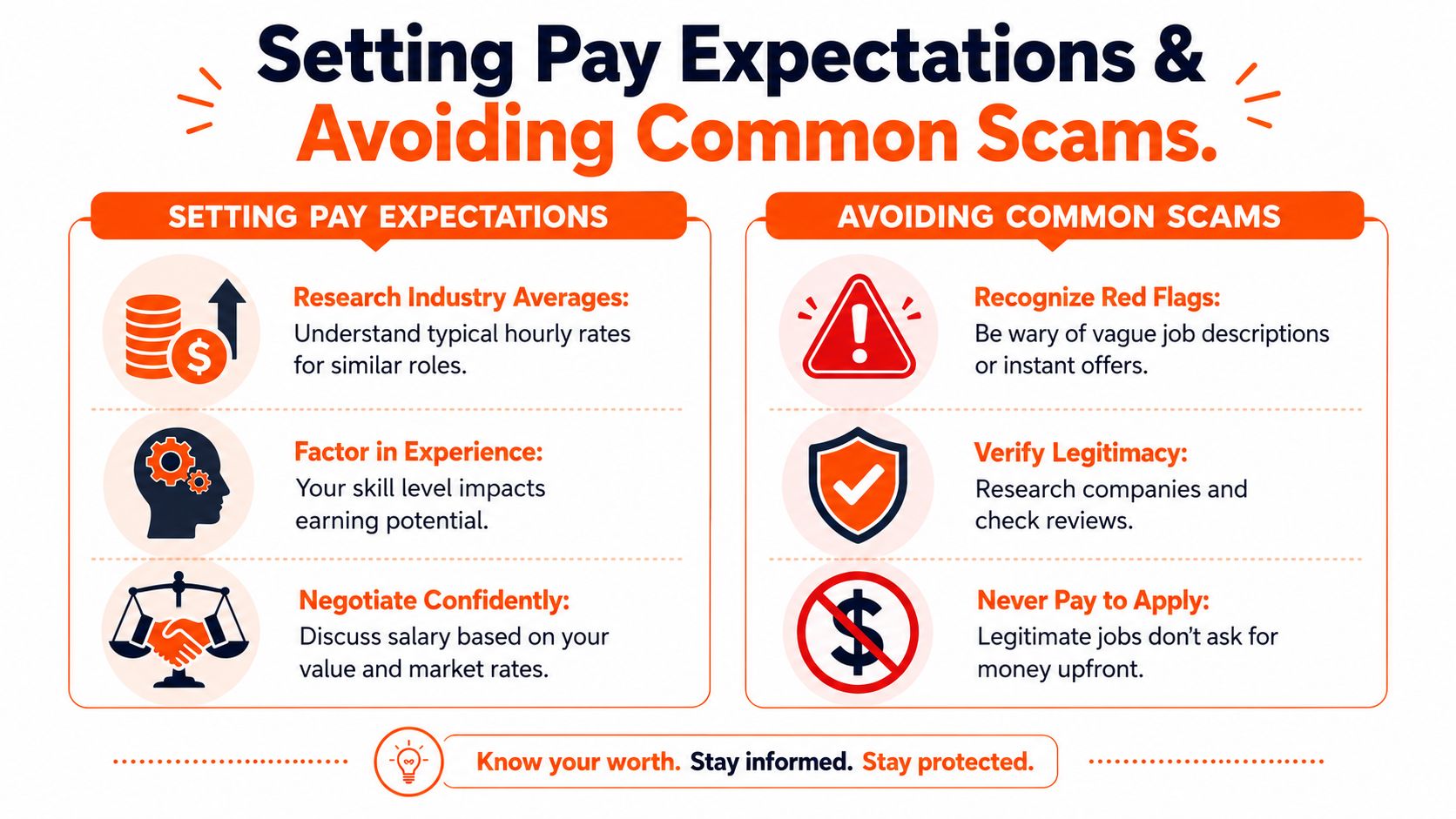
Setting Pay Expectations and Avoiding Common Scams
Job seekers either protect their time or waste weeks.
A lot of part time customer service remote jobs are legitimate. A lot are also poorly defined, misleading about hours, or structured in a way that doesn't match what applicants think they're accepting.
What pay really depends on
For these roles, pay often tracks three things more than title alone:
| Factor | What it changes |
|---|---|
| Channel mix | Phone-heavy work can feel very different from chat or email support |
| Specialization | Industry-specific support can improve your positioning |
| Employment structure | Direct-hire and contractor roles create very different income patterns |
If a role is project-based, your effective earnings may depend on how much work is available and whether your output quality keeps you eligible for future assignments. That's very different from a standard part-time employee role with fixed shifts.
The flexibility trap to watch for
One of the most common problems isn't outright fraud. It's mismatch.
Many “part-time remote customer service” listings aren't flexible in the way job seekers assume. Some require fixed coverage windows, minimum weekly hours, or hybrid and on-site onboarding before remote work begins. One listing required four to twelve weeks of office training before transitioning to hybrid remote, which is exactly the kind of buried detail applicants miss when they only read the top summary, as shown in these Fresno-area remote customer service listings.
That detail changes the job completely.
Red flags that should slow you down
Use this checklist before you apply or accept:
- Vague schedule language. If the listing says “flexible” but never defines hours, ask before interviewing.
- No clarity on training. If onboarding location, timing, or equipment requirements are fuzzy, assume there's more to uncover.
- Instant enthusiasm without scrutiny. Real employers want to assess communication, reliability, and fit.
- Requests for money upfront. Legitimate jobs don't require you to pay to access work.
- Overemphasis on earning potential. Serious customer service listings explain responsibilities and constraints, not just upside.
If you need a deeper screening framework, this guide to fraud work from home jobs is worth reviewing before you send documents or personal information.
Screening habit: Read the bottom half of the listing with more care than the top half. That's usually where the rigid requirements live.
Your Next Steps to a Flexible Customer Service Career
The strongest candidates don't chase every listing. They get sharper at identifying fit.
If you want better results with part time customer service remote jobs, keep your process simple. Search by function, not just title. Read the schedule language carefully. Build a resume that shows remote-ready judgment, not just customer-facing duties. In interviews, talk about availability with precision. Treat “flexible” as a claim that needs verification.
A lot of people struggle because they're trying to be appealing to every employer. That backfires. You'll do better when you're clear about the hours you can work, the channels you can support, and the kind of role structure you want.
Use this checklist as you move:
- Target narrower searches so you see better-fit roles
- Tailor each application to the support niche and channel mix
- State your availability directly instead of hoping it comes up later
- Ask schedule questions early before investing in multiple rounds
- Audit listings for hidden rigidity such as training or minimum-hour rules
- Walk away from bad-fit roles fast so you keep time for better ones
That's how flexible remote work becomes real. Not by applying harder, but by filtering better and presenting yourself as someone a support team can trust.
If you want a cleaner way to find remote roles and cut down on low-quality listings, browse opportunities on YayRemote. It's a practical starting point for remote job seekers who want curated roles, useful filters, and tools that make the application process easier.