Remote Australian Jobs: Your Ultimate Guide for 2026
Find the best remote Australian jobs in 2026. Our guide covers where to look, salary expectations, tax rules, and how to optimize your application to succeed.
36% of employed Australians usually worked from home in August 2025, according to the Australian Bureau of Statistics working arrangements release. That single figure changes how you should think about remote Australian jobs. This isn't a fringe search strategy for software engineers. It's a mainstream part of the labour market.
Most guides stop at job boards. That's where people get stuck. Finding remote Australian jobs now takes a more practical approach. You need to understand where remote demand is spreading, how pay works across seniority, what foreign employers can trigger from a tax perspective, and how to present yourself as someone who can work with minimal supervision from day one.
The State of Remote Work in Australia
Remote work in Australia has moved past the trial stage and settled into a durable part of the job market. The work-from-home rate noted earlier has stayed relatively steady, and that stability is the point. Employers have now had time to decide which roles can be done well outside the office, which teams need hybrid routines, and where fully remote hiring still makes commercial sense.
That shift matters for job seekers because remote roles are no longer treated as a temporary concession. They are being built into hiring plans, team processes, and budget decisions.
Australian work arrangements are also broader than many applicants assume. The same ABS release noted large numbers of independent contractors and casual employees in August 2025. For anyone targeting remote Australian jobs, that matters because remote work often sits across several employment models, not just standard permanent roles.
What this means for your job search
A stronger search starts with the work arrangement you want. That sounds obvious, but plenty of applicants skip this step, then waste time applying for roles that were never a fit.
Employers commonly hire remote talent through a few clear models:
- Permanent roles with full-time or mostly work-from-home arrangements
- Contract positions for project delivery, specialist support, or short-term capacity
- Part-time or casual roles where output matters more than office presence
- Hybrid roles with occasional office attendance, often tied to a major city
Each model comes with trade-offs. Permanent roles usually offer more stability and clearer benefits. Contract work can pay better by the hour and open doors faster, but it often shifts more tax, super, and admin responsibility onto you. Hybrid roles widen your options if you live near Sydney, Melbourne, Brisbane, or Perth, but they are not entirely location-free.
This is one of the hard parts generic remote-work guides miss. “Remote” does not tell you enough. You need to check who employs you, where they are based, whether the arrangement is employee or contractor, and what that means for tax, leave, superannuation, and day-to-day expectations.
What experienced applicants screen for early
Focus on role design before you focus on the label. Jobs tend to work well remotely when the outputs are clear, communication habits are documented, and the team already knows how to operate across distance.
I advise clients to test roles with three filters before they apply:
- Function fit. Is this work measurable and deliverable without constant in-person input?
- Employment model. Are you looking for salary, contract income, or a lower-risk part-time entry point?
- Location practicality. Is the role fully remote, Australia-only remote, or hybrid with office days that make the job unrealistic?
That simple screen cuts down weak applications fast.
The broader point is straightforward. Treat remote work as a hiring structure with real operational and legal differences, not as a lifestyle perk. That approach leads to better targeting, better interview questions, and fewer surprises once an offer is on the table.
Exploring the Australian Remote Job Landscape
The biggest mistake I see is people equating remote work with software development. That view is too narrow. Remote Australian jobs now span operations, marketing, analytics, customer success, sales, design, content, finance support, recruitment, and a long list of specialist functions that don't require daily office attendance.
One of the clearest signals comes from the analytics market. Glassdoor's remote data analyst listings in Australia show 188 remote data-analyst jobs, with a sample contract range of A$28 to A$42 per hour and 5 to 30 hours per week. That's useful because it shows remote work isn't just full-time salaried employment. There's a visible layer of part-time and contract work, especially in roles where employers need someone productive quickly.
Why contract-friendly roles matter
Analytical work is a good example because it rewards deployable skills. If you can clean data, build dashboards, forecast trends, and explain findings to non-technical stakeholders, an employer may not care whether you sit in their office.
That changes how you should position yourself. In contract-heavy segments, employers usually respond better to evidence like:
| What employers want to see | Better proof than a generic claim |
|---|---|
| SQL capability | A project showing queries, joins, and reporting outputs |
| Dashboarding | A portfolio link or screenshots of real business dashboards |
| Forecasting | A concise explanation of the business question and result |
| Stakeholder reporting | Resume bullets that show decisions influenced by your analysis |
Three common remote job paths
Not every remote role works the same way. It helps to separate the market into three lanes.
Employee roles
These suit candidates who want clearer reporting lines, paid leave, and longer-term progression. Hiring tends to be slower, and employers often care more about communication style and team fit.Contract roles
These are often easier to win if you have proven execution. Employers expect less hand-holding. They also expect you to hit the ground running.Freelance project work
This can work well for writers, marketers, designers, analysts, and operations specialists. The trade-off is that you'll spend more time managing pipeline, invoicing, and scope.
Remote work opens up when your skills are easy to evaluate from outputs rather than presence.
If you're trying to break in, don't ask only, "What remote jobs exist?" Ask, "Which parts of my experience can solve a problem with minimal onboarding?" That question usually produces better leads.
How to Find Australian-Friendly Remote Jobs
The search problem isn't a lack of roles. It's filtering. Australian remote work is broad enough now that generic job boards can bury strong opportunities under irrelevant listings, recycled posts, and roles that say "remote" but really mean office-based with occasional flexibility.
Near the top of your search, use a platform that lets you narrow by category, job type, salary, experience, and benefits instead of scanning endless result pages.
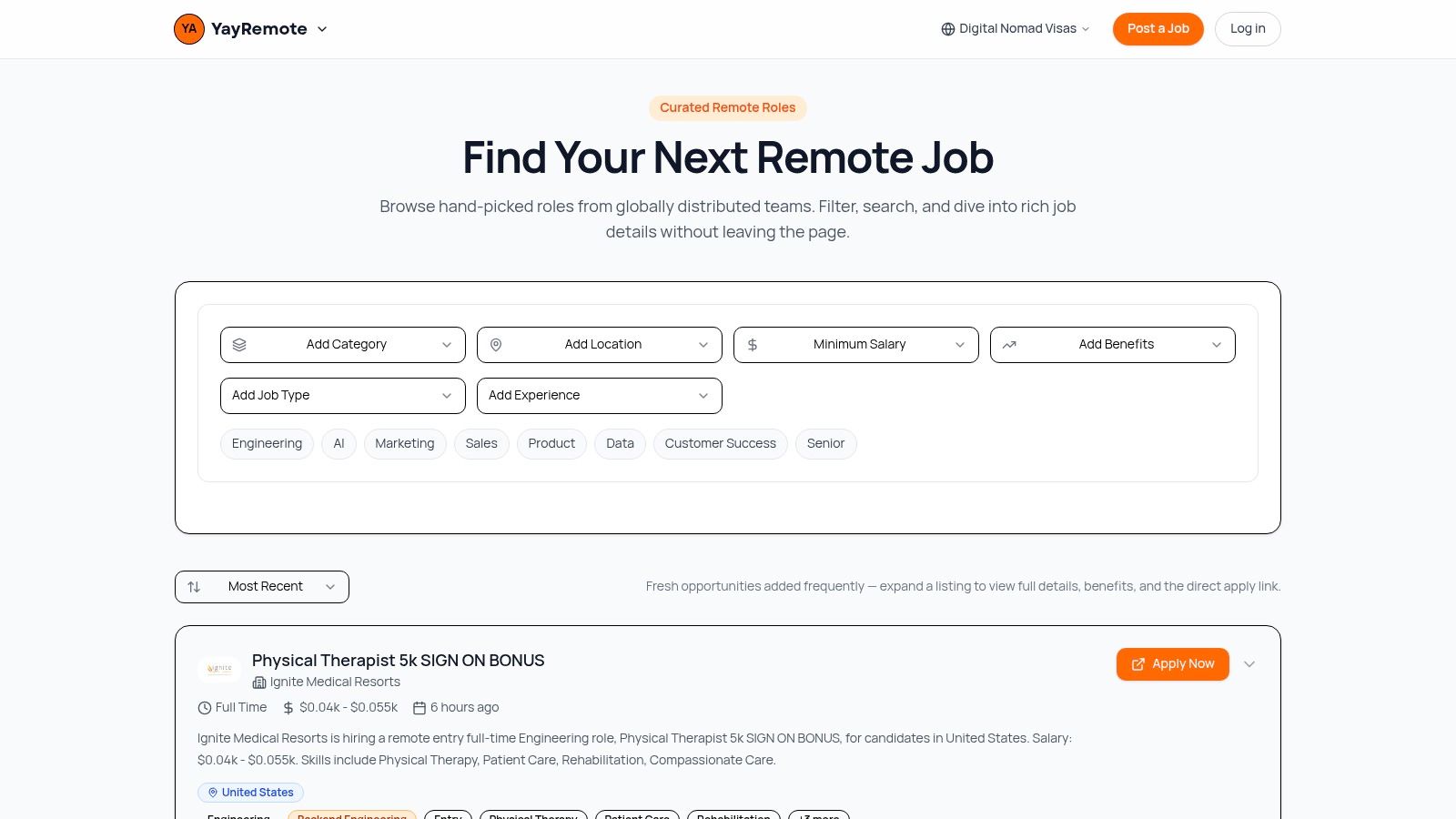
That matters because remote demand is no longer isolated to a handful of occupations. Indeed Hiring Lab's Australian remote work analysis found that on 31 August 2024, 14.3% of Australian job postings explicitly mentioned phrases such as work from home or work remotely, up from 12.2% a year earlier and more than 3 times higher than pre-pandemic levels. It also reported that remote-work mentions increased in almost 70% of occupations over the prior year. More demand creates more listings, but it also creates more clutter.
Generic boards versus targeted platforms
Large job boards are still useful. SEEK, Indeed, and LinkedIn can surface volume. The downside is that you often have to do the employer's sorting for them. You'll manually check whether a role is fully remote, whether salary information is visible, and whether the company hires in Australia or only advertises globally.
A more targeted platform can cut that admin. One example is YayRemote's guide to remote job boards, which is useful if you want to compare remote-specific options instead of relying only on generalist sites.
Here's the practical trade-off:
| Search option | Strength | Weakness |
|---|---|---|
| Large job boards | Volume and brand familiarity | More noise, vague remote labels |
| Company careers pages | Direct source of truth | Time-consuming to track manually |
| Remote-specific platforms | Better filtering by work style | Smaller pool than broad aggregators |
A tighter search process
Don't search by title alone. Build searches around conditions that affect fit.
Filter for work arrangement first
Separate fully remote, hybrid, contract, and part-time. This saves hours.Check location wording carefully
"Remote in Australia" is different from "remote anywhere". So is "Sydney preferred" or "must overlap with APAC hours".Prioritise postings with salary and benefits detail
More detail usually signals a more mature hiring process.Track employer patterns
If a company hires remotely across multiple functions, they're more likely to have workable systems.
A quick walkthrough can help if you're refining this process for the first time:
What wastes time
The least efficient pattern is applying to every listing that looks vaguely flexible. The more efficient pattern is shortlisting roles where your skills, timezone, and work arrangement line up before you write a single application.
That sounds obvious, but it's where strong candidates pull ahead. They don't just search harder. They search cleaner.
Understanding Remote Salaries and Benefits
Remote salaries in Australia can look confusing because the market mixes local pay bands, international employers, contract work, and senior specialist roles. That's why averages need context. One salary figure can be directionally useful, but it won't tell you what you should accept.
Remote Rocketship's Australia listing aggregation reports an A$165,759 average remote salary overall across 5,865 listings, rising from A$101,273 at entry level to A$231,780 for lead roles. The same dataset says employers close a remote opening in about 45 days. That combination tells you two things. Seniority strongly shapes compensation, and hiring often takes long enough that employers can be selective.

How to read salary benchmarks properly
The most common mistake is treating a market average as a personal target. Don't do that. Averages compress too many variables.
Instead, assess compensation through four lenses:
Seniority
Entry-level remote jobs are available, but the stronger salary upside usually sits in mid-level and lead positions.Scarcity of skill
Employers pay more for people who can solve expensive problems independently.Employment model
Contract roles may offer higher rates but fewer protections and fewer extras.Company geography
An Australian employer, a US employer hiring in Australia, and a global company using location-adjusted pay can all price the same function differently.
Benefits matter more in remote roles
Remote compensation isn't only about base pay. Look for the operating conditions around the role.
A healthy package may include:
- Equipment support so you're not funding your own workstation
- Professional development for certifications, courses, or conferences
- Leave policies that work for distributed teams
- Wellbeing support if the company expects sustained remote output
- Flexibility terms that are written clearly, not implied loosely
Don't negotiate only on salary. Negotiate on the conditions that make sustained remote work viable.
What to ask before you accept
Use the interview process to reduce ambiguity. Good questions include:
- Is pay tied to an Australian band or a global band?
- Is superannuation included and handled through payroll?
- Are home office costs or equipment reimbursed?
- How often does the team review compensation?
- What does the company consider normal working-hour overlap?
Those questions often reveal more than the salary number itself. A role with a slightly lower base can still be the stronger offer if the support structure is solid and the expectations are realistic.
Navigating Critical Tax and Legal Considerations
A remote role can look strong on salary, flexibility, and scope, then fall apart on the contract. I see this often with Australian candidates who only start asking tax and legal questions after the offer stage. By then, you have less room to negotiate the setup and more pressure to accept vague answers.
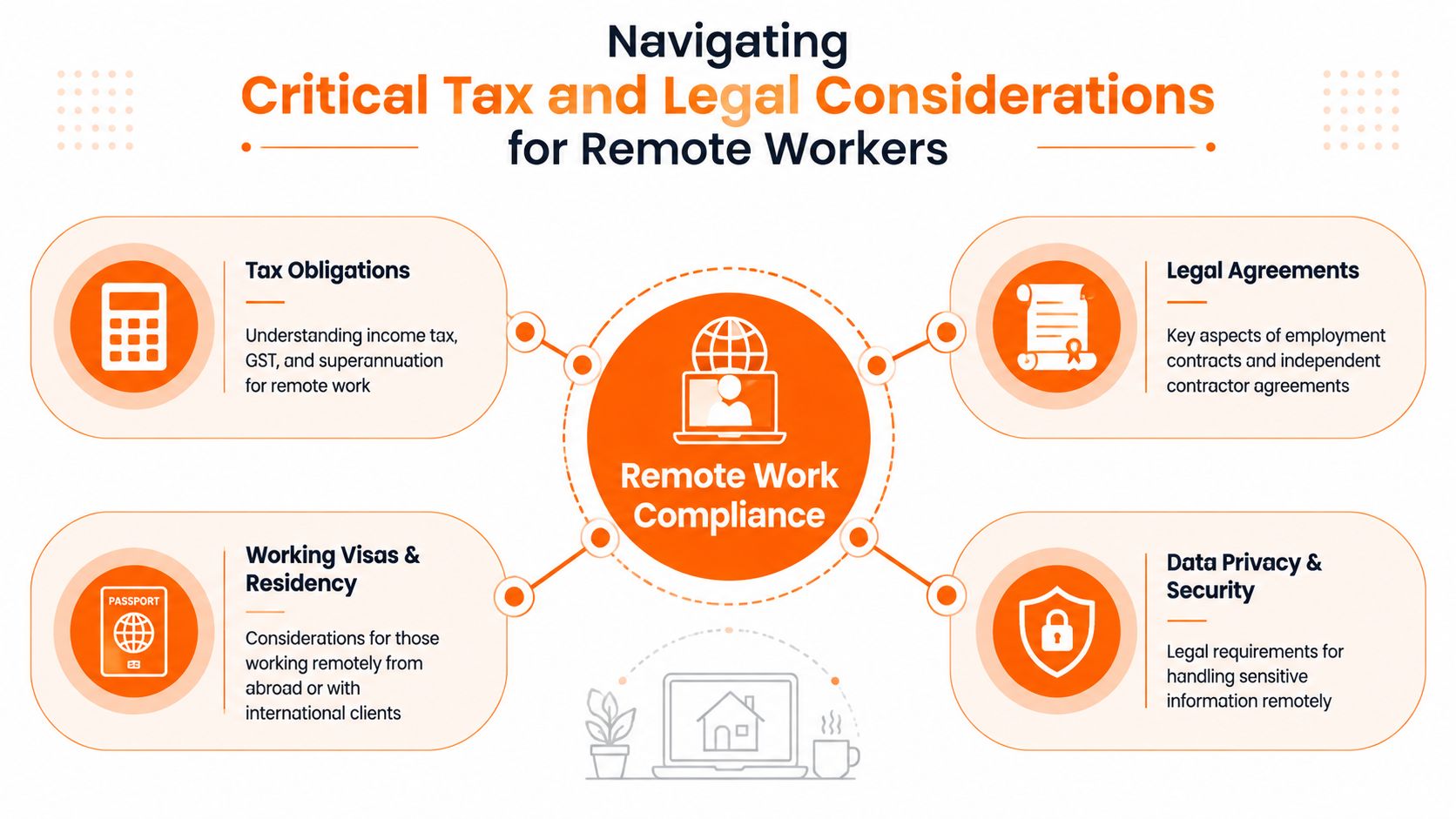
Working from Australia for a foreign employer does not place you outside Australian tax rules. Your tax position usually depends on your residency status, how you are engaged, and whether the company is paying you through local payroll, an employer of record, or a contractor arrangement. Those details affect cash flow, super, leave, and how much admin lands on you.
Employee versus contractor changes the whole setup
This is not a paperwork detail. It shapes your day-to-day working risk.
If you are hired as an employee, the main questions are who employs you legally, how PAYG withholding is handled, whether super is paid correctly, and which leave and termination rules apply. If you are engaged as an independent contractor, you may need an ABN, you usually manage your own tax set-asides, and the written contract needs to match the reality of the relationship. If the company controls your hours, work methods, and reporting structure like an employee arrangement, misclassification can become a problem.
| If you're an employee | If you're a contractor |
|---|---|
| PAYG withholding may apply | You may need to manage your own tax obligations |
| Super obligations need to be clear | Super treatment needs to be checked carefully |
| Leave and termination terms matter | Scope, deliverables, and payment terms matter more |
| Payroll setup can be complex with foreign firms | Misclassification risk becomes a practical concern |
The trade-off is straightforward. Contractor roles can pay more on paper, but they often shift compliance, cash flow management, and admin onto you.
Questions to ask before signing
Ask these questions before you discuss start dates:
Who is employing me
Is it an Australian entity, a foreign company directly, or an employer of record?How will tax be handled
Ask whether the company withholds, expects invoicing, or requires local registration steps.What happens with superannuation
Do not assume this is covered because the role is described as "Australia-friendly".Which country's contract law is named
This does not settle every issue, but it shows how the company has structured the relationship.What visa or work right assumptions is the company making
If you are not an Australian citizen or permanent resident, check that your visa conditions allow the arrangement you are being offered.
If a company cannot explain how it plans to engage and pay you in Australia, pause the process.
That answer tells you a lot about how the relationship will run after day one.
Work from home deductions and record-keeping
Once the engagement model is clear, move to records. Remote workers miss deductions less because the rules are impossible and more because they fail to keep evidence consistently.
If you work from home regularly, review this guide to claiming work from home expenses. It gives a practical summary of eligible costs, record-keeping, and the kind of documentation that matters at tax time. For a remote-specific checklist you can use before speaking with your accountant, this remote work tax deductions article is a useful starting point.
Foreign employers create the hardest edge cases
The hardest situations usually involve overseas companies that want Australian talent but have not fully set up local compliance. Some solve this well through an employer of record. Others push the uncertainty onto the worker and hope the contract covers it.
Ask for written clarity on payment currency, invoice or payroll mechanics, super, local public holiday treatment, insurance, and expected overlap hours. Written answers matter. If the company stays vague on basic employment mechanics during hiring, expect the same once you start.
Optimizing Your Application for Remote Roles
A remote application has to do more than show you can do the job. It has to show you can do the job without constant supervision, with clear written communication, and with systems that hold up in a distributed team. Most resumes don't do that well.
The first fix is tailoring. A generic resume usually reads like a career summary. A strong remote resume reads like a match to a specific operating environment.
Build from the job description, not from memory
Start with the posting. Highlight the repeated terms. Then separate them into three buckets:
Core functional skills
These are the tools, methods, and outputs the role depends on.Remote work signals
Look for phrases tied to async communication, stakeholder management, documentation, cross-functional work, or timezone overlap.Seniority cues
Notice whether the employer wants execution, ownership, mentoring, or strategy.
Then rewrite your top summary and experience bullets so they accurately mirror the role. If the role emphasises stakeholder reporting and documentation, your resume should show those things directly. Don't bury them under generic claims like "excellent communication skills."
Use tools to stress-test your application
If you use screening tools, use them for diagnosis, not decoration. A resume checker should help you identify missing keywords, weak formatting choices, and unclear evidence of impact. A skills analyzer should help you compare your profile against the role, then decide whether to reposition, upskill, or move on.
That's where a platform like YayRemote can be practical because it includes an ATS Resume Checker and Skills Analyzer alongside job listings. The value isn't in blindly chasing a score. It's in spotting whether your application reflects what the employer needs.
For broader fundamentals on phrasing and structure, Resumatic's resume writing tips are worth reading. They're especially helpful if your current resume sounds competent but not targeted.
What strong remote applications usually include
Clear evidence of autonomous work
Show where you owned a process, delivered without close oversight, or coordinated across teams.Written communication signals
Mention reports, documentation, proposals, handover notes, or client-facing updates.Tool fluency that matters
Include the actual systems relevant to the role, not a long software dump.Outcome-focused bullets
Focus on decisions supported, workflows improved, customers handled, launches delivered, or systems maintained.
A recruiter should be able to tell, within a quick scan, that you can be trusted in a low-supervision environment.
The fastest way to improve remote application quality is to cut anything that sounds broad and replace it with proof of reliable execution.
Mastering Remote Collaboration and Time Zones
Landing the role is only half the challenge. Keeping it, growing in it, and building trust across distance is where remote careers are made.
Australian professionals often work with teams spread across Asia, Europe, and North America. That creates two pressures at once. You need enough overlap for live collaboration, and enough structure that work keeps moving when people are offline.
How to manage timezone reality
Start by defining your overlap window early. Don't wait for friction to expose it. If your team spans multiple regions, agree on:
- Core hours when everyone is reachable
- Async norms for updates, approvals, and handoffs
- Response expectations so nobody assumes instant replies at all times
- Escalation rules for urgent issues
A simple planning tool helps here. The Time Zone Overlap calculator is useful for testing meeting windows before they become recurring problems.
Communication habits that build trust
Remote teams don't judge visibility the same way office teams do. They judge clarity, reliability, and follow-through.
Good remote operators tend to do a few things consistently:
Write before they speak
They document decisions, next steps, and blockers clearly.Flag risks early
They don't wait until a deadline slips to mention a dependency.Close loops
If they say they'll deliver an update, they deliver it.Respect time boundaries
They don't turn every issue into an emergency for someone in another region.
A practical way to reduce timezone stress is to separate collaboration into two buckets. Put decision-heavy, ambiguous issues into overlap hours. Put status updates, documentation, and routine approvals into async channels.
That rhythm helps remote work feel sustainable instead of always-on.
For remote Australian jobs, use YayRemote as a practical starting point for finding distributed roles, filtering by the conditions that matter, and tightening your application with tools built for remote hiring.