Your Guide to Remote Work Tax Deductions in 2026
Maximize your 2026 savings with our complete guide to remote work tax deductions. Learn what you can claim as a freelancer or employee to reduce your tax bill.
At their core, remote work tax deductions are simply business expenses that self-employed individuals can use to lower their taxable income. Think of them as a financial acknowledgment of the costs you shoulder to run your business, even if your office is just a corner of your living room.
Unfortunately, these valuable write-offs are generally off-limits for traditional W-2 employees on their federal tax returns. It all comes down to your employment status.
The Hidden Value in Your Remote Work Setup

When you start working from home, it’s easy to see the costs of a new desk, a better chair, or a faster internet plan as just personal expenses. But that’s a missed opportunity. When you look at these items through a tax lens, they transform from simple costs into strategic tools that can genuinely increase your take-home pay.
Seeing remote work tax deductions for what they are feels like finding money you didn't know you had. This isn't about navigating a complex, frustrating system; it's about using the rules to your financial advantage.
The Critical Difference: W-2 vs. 1099 Workers
The single most important factor determining whether you can claim these deductions is how you're classified for work. This one detail sends remote workers down two completely different tax paths.
- Self-Employed (1099 Contractors/Freelancers): You're essentially running a business of one. This status is your key to unlocking a wide variety of deductions for any expense the IRS considers "ordinary and necessary" for your work.
- Employees (W-2): The landscape changed dramatically with the Tax Cuts and Jobs Act (TCJA). Now, W-2 employees can no longer write off unreimbursed home office expenses on their federal returns. While some states have their own rules and employers might offer reimbursements, the federal deductions are gone for employees.
Everything starts with this fundamental difference.
Here's a simple way to think about it: A self-employed person is the owner of their office and gets to deduct the costs of running it—the mortgage interest, utilities, and supplies. A W-2 employee is more like someone renting a desk in that office; they don't get to write off the landlord's expenses.
Understanding where you fit is the first step toward taking control of your finances as a remote professional. Throughout this guide, we'll be focusing primarily on the deductions available to the self-employed, because that’s where the real potential for savings lies. We’ll break down exactly what you can claim and how to do it right, turning tax time from a headache into a strategic win.
When it comes to tax deductions for remote work, the single most important question you need to answer is: are you an employee or a freelancer? Your employment status isn't just a small detail; it fundamentally changes the entire game. The rules for W-2 employees and self-employed 1099 contractors are so wildly different, you'd think they were playing two completely separate sports.
I like to explain it with an analogy. A freelancer is like the owner of an office building. They're on the hook for every single cost—the mortgage, the lights, the internet, the furniture, the cleaning crew. But because they own the business, they get to write off all those operational costs.
A W-2 employee, on the other hand, is like someone renting a single desk in that building. You get to show up and use the space and resources, but you don't own the infrastructure. And since you don't own it, you can't deduct its running costs on your taxes.
The Reality for W-2 Employees
For most salaried W-2 employees, the tax deduction picture is, frankly, a bit disappointing. A major shift happened with the Tax Cuts and Jobs Act (TCJA) of 2017, which completely did away with the federal deduction for unreimbursed employee expenses.
This means that even if your job requires you to work from home, you cannot deduct the associated costs on your federal tax return.
That includes common expenses you're definitely paying for, like:
- A portion of your rent or mortgage for your home office space
- Your home internet and phone bills
- Desks, chairs, and other office supplies
- The extra electricity you're using
But it's not a total dead end. A few states, including California and New York, have their own rules and still allow employees to deduct some of these unreimbursed expenses on their state tax returns. It's also worth checking if your company has an "accountable plan." This is a formal reimbursement policy where the money they give you for home office costs is considered tax-free. Always ask HR about it.
The Power of Being Self-Employed
Now, if you're a 1099 freelancer or independent contractor, everything changes. In the eyes of the IRS, you're not just a worker; you're a business owner. This status unlocks the ability to deduct business expenses that are both "ordinary and necessary" for your work.
The moment you earn income as a 1099 contractor, you’ve put on the hat of a small business owner. Every dollar you spend to keep that business running—from your laptop to the Wi-Fi that connects it—becomes a potential tax deduction. This directly lowers your taxable income, and ultimately, the tax you have to pay.
This is the huge financial upside of being your own boss. You have the responsibility of managing your finances, but the tax code rewards that effort by letting you write off legitimate costs. We’re talking about everything from the home office deduction and software subscriptions to professional development courses and even a portion of your health insurance premiums.
And if your work involves clients in other countries, understanding the financial plumbing gets even more critical. You can get a better handle on this by reading our guide on how to pay international employees.
To make this crystal clear, here’s a quick comparison of how these two roles stack up.
W-2 Employee vs 1099 Contractor Deductions At a Glance
| Deduction Type | W-2 Employee Eligibility | 1099 Freelancer/Contractor Eligibility |
|---|---|---|
| Home Office Deduction | Not eligible on federal returns. | Eligible, as long as you meet the strict "exclusive and regular use" criteria. |
| Internet & Phone Bill | Not eligible for deduction. | Eligible. You can deduct the percentage of the bill that reflects your business use. |
| Office Supplies | Not eligible for deduction. | Eligible. These are considered fully deductible business operating costs. |
| Computer & Equipment | Not eligible for deduction. | Eligible. You can often deduct the full cost in one year (Section 179) or depreciate it over time. |
| Health Insurance Premiums | Not eligible for deduction. | Eligible as an "above-the-line" deduction, which is a powerful way to lower your adjusted gross income. |
This stark difference is exactly why figuring out your employment status is the first and most crucial step in any remote work tax strategy. For freelancers, the savings can be substantial, but it all hinges on meticulous record-keeping and a solid understanding of what the IRS considers a legitimate business expense.
5. The Home Office Deduction: Claiming Your Workspace
If you're self-employed, the home office deduction is easily one of the most valuable write-offs you can take. It lets you turn a slice of your everyday living expenses—like rent, utilities, and insurance—into legitimate business costs, which lowers your taxable income. It’s a game-changer. But, as you might guess, the IRS has some very specific hoops you need to jump through to get it.
This decision tree gives you a quick visual on how your work status dictates your tax journey.
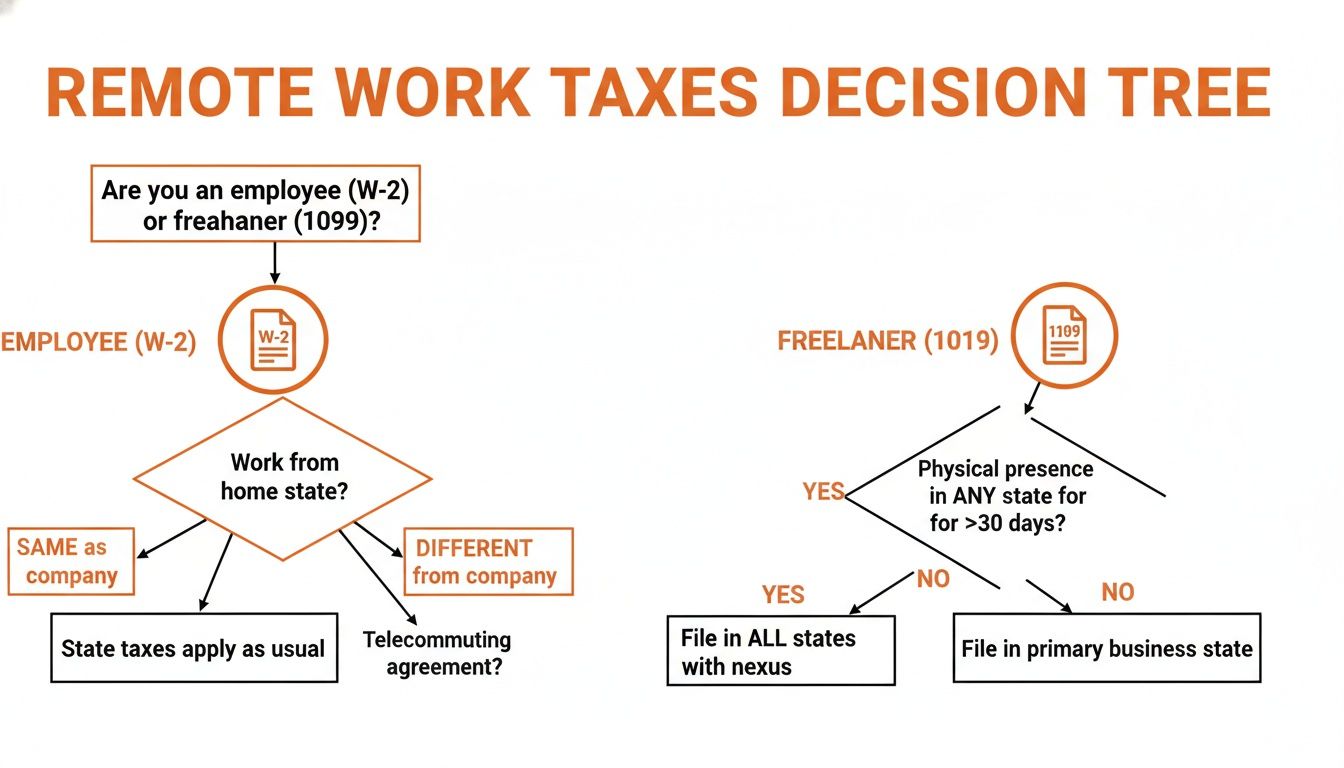
The bottom line is simple: being a freelancer or contractor (a 1099 worker) is what opens the door to the home office deduction. For the most part, W-2 employees can't claim this on their federal taxes anymore.
The Two Golden Rules for Your Home Office
To qualify for this deduction, your workspace needs to pass two main tests from the IRS. They sound a bit formal, but the ideas behind them are pretty simple.
Regular and Exclusive Use: This is the big one. Your office space has to be used regularly for your business—not just once in a blue moon. More importantly, it must be used exclusively for your business. That corner desk in the guest bedroom that’s only ever used for work? Perfect. The dining room table where you also eat dinner with your family? That won't fly.
Principal Place of Business: Your home office needs to be the main spot where you run your business. For most remote freelancers who do the bulk of their work from that space, this is usually an easy box to check.
Think of it this way: If you have a dedicated "business-only zone" in your home where the real work gets done, you're on the right track. If it's a mixed-use area where your personal and professional lives overlap, the IRS will deny the deduction.
Even a clearly defined part of a larger room can qualify, like a specific corner in a studio apartment, as long as you're strict about that exclusive-use rule.
How to Calculate Your Deduction: Two Different Paths
Once you've confirmed your space qualifies, the IRS gives you two ways to figure out the dollar amount of your deduction. The best choice really depends on how much you love (or hate) keeping records.
The Simplified Method
This is the quick-and-dirty, no-headache option. You simply deduct $5 per square foot of your office space, but only up to a maximum of 300 square feet.
- Maximum Deduction: $1,500 per year (300 sq. ft. x $5)
- Pros: It requires almost no paperwork. You don't have to calculate percentages of your utility bills or track down old receipts.
- Cons: You might be leaving a lot of money on the table, especially if you have high rent or mortgage interest.
This method is perfect if you want to claim the deduction without the hassle of meticulous bookkeeping.
The Actual Expense Method
This approach takes more work, but it can often lead to a much bigger deduction. Here, you calculate the percentage of your home that's used for business and apply that percentage to your actual home-related expenses.
First, figure out your business-use percentage. For instance, if your home is 2,000 square feet and your office is 200 square feet, your business-use percentage is 10%.
You can then deduct that percentage of your indirect costs, which include things like:
- Rent or mortgage interest
- Homeowners or renters insurance
- Utilities (electricity, gas, water)
- General home repairs
- Depreciation on your home (if you own it)
On top of that, you can deduct 100% of any direct expenses—costs that are only for your office, like having that room painted or buying a dedicated router. While it demands careful tracking of bills and receipts, the payoff can be huge. It's always a good idea to run the numbers both ways to see which method saves you more money.
For more deep-dives and helpful guides, our remote work resources library is packed with information to help you navigate the world of remote work finance.
Essential Deductions Beyond Your Home Office

Sure, the home office deduction gets a lot of attention, but it's really just the starting line. If you’re self-employed, a whole world of write-offs exists beyond the four walls of your workspace. The trick is to stop thinking of these as just "expenses" and start seeing them as smart business decisions that lower what you owe the tax man.
Every dollar you spend on your business is a potential deduction. While each one might seem small on its own, they add up quickly to create some serious tax savings. Let's dig into the other essential remote work tax deductions you should be keeping a close eye on.
Equipment and Software Purchases
Think about the gear and apps you rely on every single day—they're almost always deductible. This bucket includes the physical hardware on your desk and the software subscriptions that keep your business running smoothly. When it comes to big-ticket physical items like a new laptop or that fancy ergonomic chair, you’ve got options.
You can typically write off the entire purchase price the year you buy it, thanks to something called the Section 179 deduction. The other route is to depreciate it, which means you spread the deduction out over the asset's useful life.
Here’s a quick list of what usually qualifies:
- Hardware: Laptops, monitors, printers, keyboards, and office furniture.
- Software: Your project management suite (like Asana or Trello), design programs (like Adobe Creative Cloud), and communication tools (like Slack).
- Subscriptions: Any recurring payments for software-as-a-service (SaaS) platforms that are essential to doing your job.
Internet and Phone Bills
Your internet and phone are your connection to the working world, but let's be honest, you use them for personal stuff, too. That’s why you can’t just deduct the whole bill. What you can do is deduct the business-use portion of it.
For example, if you figure you use your phone for work 60% of the time, you can legally deduct 60% of your monthly bill. The key is to be realistic and consistent with your estimate—the IRS will expect you to be able to explain how you got that number. Of course, if you have a separate phone line used exclusively for business, that’s 100% deductible.
Professional Development and Training
When you spend money to get better at what you do, you're making a direct investment in your business. The good news is that the costs of maintaining or sharpening the skills needed for your current work are deductible. This is a pretty wide category.
Any expense that helps you become better at your current job is a potential write-off. This includes costs for courses, workshops, industry conferences, and even subscriptions to professional journals that keep you on top of your field.
There’s one crucial catch, though: you can't deduct educational expenses that qualify you for a completely new career. So, if you're a freelance writer taking an advanced SEO course, that's deductible. But if that same writer decides to go to law school, the tuition isn't, because it's training for a new profession.
The Powerhouse QBI Deduction
On top of all these specific expenses, there’s a game-changing deduction for most self-employed people: the Qualified Business Income (QBI) deduction. This isn't tied to anything you buy. Instead, it lets you simply deduct up to 20% of your business income straight off your taxable income. It's easily one of the most valuable tax breaks out there for freelancers and independent contractors.
While the rules have some twists and turns, the payoff is huge. Let's say you're a freelance developer on YayRemote, working from Bali as you prep for your 2026 taxes. The enhanced QBI deduction has been made permanent at 20%, and it even jumps to 23% for many self-employed remote workers. You've earned $100,000 from your engineering and AI gigs. With QBI, you can instantly knock $20,000 off your income, meaning you only pay taxes on $80,000. This perk from the Tax Cuts and Jobs Act, extended into 2026, is a major advantage for 1099 contractors that W-2 employees can't access.
Now, combine that with your home office. The simplified deduction is up to $6 per square foot (for up to 300 sq ft), giving you another $1,800 write-off. To get ahead of the curve, you can read more about the upcoming 2026 tax changes for remote workers at Allwork.space. This deduction alone shows just how much you can save by being your own boss.
Navigating the Maze of State and Global Taxes
For anyone working remotely, taxes get complicated the moment your work crosses a border—whether it's a state line or an international one. The simple rule is that your physical location dictates where you owe tax. This can create a tangled web of rules that feels overwhelming, but staying on top of it is the only way to avoid costly penalties and surprise tax bills down the road.
The complexity kicks in right here in the U.S. Just working remotely from a state different from where your employer is based can trigger a tax filing requirement in that new state. This is what's known as creating tax nexus, where your physical presence forges a tax obligation.
The Headaches of State-by-State Rules
Most states have a "physical presence" rule. Spend enough days working there, and you're on the hook for paying income tax on the money you earned during that time. For many, this leads to the dreaded task of filing multiple state tax returns.
A handful of states, including New York and Pennsylvania, take this a step further with the notorious "convenience of the employer" rule. This aggressive policy means if your company is based in one of these states, but you choose to work remotely from another state for your own convenience, you still owe income tax to your employer's state.
Think about it this way: your company is in New York, but you decide to work from your apartment in Florida for a few months. Because you weren't required by your employer to be in Florida, New York can still tax the income you earned while sitting on your couch hundreds of miles away. It’s a crucial detail that catches a ton of remote workers off guard.
This creates the potential for double taxation—getting taxed on the same income by both your home state and your employer's state. While some states offer tax credits to offset this, navigating the paperwork is a significant challenge.
Going Global: Tax Residency and Double Taxation
When your remote work takes you abroad, the stakes get even higher. The first concept you absolutely have to grasp is tax residency. This determines which country has the primary right to tax your worldwide income. For U.S. citizens and green card holders, the answer is simple: it’s always the United States, no matter where you live or work.
However, if you spend a significant amount of time in another country—often more than 183 days—you can become a tax resident there, too. This opens up a serious risk of double taxation, where both the U.S. and your host country want a piece of your earnings. This is a common hurdle for digital nomads, and it's why understanding country-specific rules, like those in our guide on working from home in Spain, is so important.
Powerful Exclusions for Americans Working Abroad
Thankfully, the IRS provides a couple of powerful tools to help Americans overseas lighten their U.S. tax load.
- Foreign Earned Income Exclusion (FEIE): This allows you to exclude a large portion of your income earned abroad from U.S. taxes. The exclusion amount is adjusted for inflation each year.
- Foreign Tax Credit: This gives you a dollar-for-dollar credit for income taxes you've already paid to a foreign government. It's a direct way to avoid paying tax twice on the same income.
To claim these benefits, you have to pass one of two key tests:
- Bona Fide Residence Test: You must prove you're a legitimate resident of a foreign country for an uninterrupted, full tax year.
- Physical Presence Test: You must be physically outside the U.S. in a foreign country (or countries) for at least 330 full days during any 12-month period.
The global tax landscape is always evolving. Looking ahead, the FEIE is projected to reach an impressive $130,000 exclusion by 2026 for those earning income abroad. This is a massive advantage for professionals working in Europe or Asia who can meet the 330-day Physical Presence or Bona Fide Residency tests. As you can discover how global remote work trends will impact you, carefully planning your travel and work schedule around these rules is the key to maximizing your savings.
Here's the rewritten section, designed to sound completely human-written and natural:
A Simple Process for Claiming Your Deductions
Let’s be honest, nobody enjoys the last-minute scramble to find receipts and make sense of a year's worth of spending. The real secret to a stress-free tax season isn't some complicated software; it’s treating your record-keeping as a simple, ongoing habit.
Think of it this way: get organized now so you can thank yourself later. The single best thing you can do is open a dedicated business bank account and get a separate credit card used only for work purchases. This one move cleans up your bookkeeping instantly. No more digging through grocery and gas receipts to find that one software subscription.
Your Step-by-Step Filing Plan
Once your finances are separated, filing your taxes becomes a much calmer process. Instead of facing a mountain of paperwork, you're just following a few simple steps you've prepared for all year.
- Round Up Your Income: First, gather all the 1099-NEC forms you’ve received from clients. These are the official records of what you earned, and they're the starting point for your whole return.
- Categorize Your Spending: Now, pull out your business bank and credit card statements. Go through them line by line and tally up your expenses into clear categories like office supplies, software, internet, and travel.
- Figure Out Your Home Office: It's time to choose your home office deduction method. Will you use the straightforward Simplified Method or the more detailed Actual Expense Method? It's worth running the numbers for both to see which one saves you more money.
- Grab the Right Forms: As a self-employed professional, you'll report all this on Schedule C (Form 1040), which is where you detail your business's profit or loss. If you opt for the Actual Expense method for your home office, you’ll also need to fill out Form 8829.
The goal here is to build a system so smooth that tax season is just about compiling information you've already organized. Consistent tracking is your best defense against tax-time anxiety and, more importantly, against leaving money on the table.
Plan for Quarterly Taxes
One last, crucial point: as a freelancer or contractor, you don't just pay taxes once a year in April. You're responsible for paying them as you go.
Use your neatly organized income and expense records to calculate and pay quarterly estimated taxes. This simple habit helps you avoid a massive, shocking tax bill next spring and keeps your cash flow predictable. It's the hallmark of a true professional who has their financial house in order.
Your Remote Work Tax Questions Answered
Even with a good grasp of the basics, a few specific questions always seem to come up. Let's tackle some of the most common ones I hear from remote professionals trying to make sense of their taxes.
Can W-2 Employees Claim These Deductions?
This is a big one, and for most employees, the answer for your federal return is a straightforward no. The Tax Cuts and Jobs Act (TCJA) did away with the miscellaneous itemized deduction for unreimbursed employee expenses. So, even if your job is fully remote, you can't write off your internet bill or that new ergonomic chair on your federal taxes.
But don't stop there. Some states, like California and New York, have their own rules that do allow for these deductions on your state return. It's absolutely worth checking your state's specific guidelines. Also, many companies offer tax-free reimbursements through an "accountable plan," so be sure to ask your employer about their policy.
What Is the Easiest Way to Track Expenses?
Honestly, the simplest thing you can do is keep your business and personal finances completely separate. Open a dedicated business bank account and get a credit card you use only for work-related purchases.
This simple habit creates a clean, ready-made record of every deductible expense. When tax season rolls around, you won't be scrambling to sort through a year's worth of mixed-up receipts. Pair this with basic accounting software or even a well-organized spreadsheet, and you'll be set.
Do I Really Need a Separate Room for a Home Office?
Not necessarily, but the IRS is a stickler on one thing: the space must be used exclusively for your business. A desk in the corner of your guest room can qualify, as long as you only use it for work.
Where people get into trouble is trying to claim a multi-use area. That dining room table where you also eat dinner and the kids do their homework? That won’t fly. The key is having a clearly defined, business-only area, no matter how small.
The world of taxes is always evolving. Looking ahead to 2026, we know U.S. tax brackets will adjust, and many remote workers will find some relief through inflation-adjusted thresholds and larger standard deductions. On top of that, states like California now require employers to reimburse for necessary remote work expenses—a huge win for employees there. It pays to stay informed, so you can explore more about the upcoming tax breaks for the remote workforce to stay ahead of the curve.
Finding your next great remote opportunity or the perfect global candidate is simpler than ever. YayRemote curates the best remote jobs and provides the tools you need to succeed in a distributed world. Explore your future at YayRemote today.