Mastering Remote Contract Jobs in 2026
Discover how to land high-paying remote contract jobs. Learn expert strategies for finding top roles, negotiating rates, and succeeding as a modern contractor.
If you’ve been paying attention to the job market lately, you know that remote contract work isn't just a niche anymore—it’s a mainstream career path. At its core, a remote contract job is a specific role you perform for a company, but without being a full-time employee.
Think of it this way: you’re brought on for your expertise to tackle a particular project or fill a need for a set period. It's all defined by a clear scope of work, a known timeline, and an agreed-upon rate of pay. This setup gives skilled professionals a ton of autonomy while letting companies tap into specialized talent without the overhead of a permanent hire.
The New Era of Remote Contract Work
Let's be real—the way we work has completely transformed. This isn't just some passing trend; it's a fundamental shift in how careers are built and businesses operate. The growth in remote contract jobs has been explosive, especially in the U.S. market.
Back in 2020, remote positions made up a mere 4% of all job opportunities in the country. Fast forward to today, and projections show that number soaring to over 15% by 2026. This isn't a fluke. It's an economic evolution driven by better technology and a hunger from companies for agile, skilled talent they can bring in on-demand.
This infographic really puts that growth into perspective, showing just how quickly we've moved from an office-first culture to one where location is secondary.
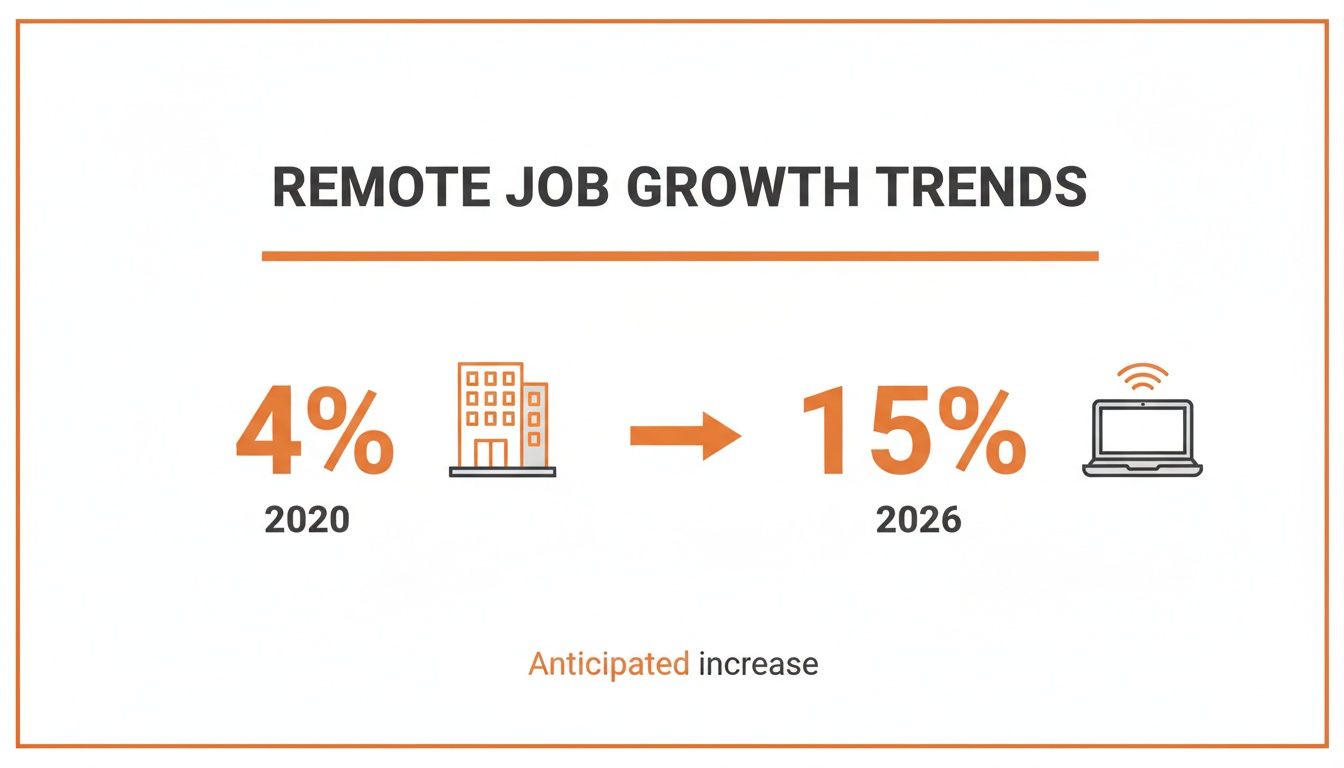
The data doesn't lie. Opportunities in remote work have more than tripled in just a handful of years, signaling a permanent change in the professional world.
Differentiating Contract, Freelance, and Full-Time Remote Roles
It's easy to throw all these terms into the same bucket, but knowing the difference is crucial for finding the right fit for you. Let's break it down.
- Remote Contractor: You’re usually working with one company on a substantial, project-based assignment for a defined term, like 6 or 12 months. You're often deeply integrated with the team but operate as your own business, handling your own taxes and benefits.
- Freelancer: This is often more about short-term, transactional work. A freelancer might be juggling multiple smaller projects for several different clients at once. Picture a graphic designer creating logos for three startups in the same week.
- Full-Time Remote Employee: This is your standard W-2 job, just without the commute. You have one employer, a steady salary, and all the usual benefits like health insurance, a 401(k), and paid time off.
To help clarify these distinctions, here’s a quick comparison of what you can expect from each path.
Full-Time vs Remote Contract Jobs At a Glance
| Attribute | Full-Time Employee | Remote Contractor |
|---|---|---|
| Stability | High; ongoing employment with a steady paycheck. | Medium; stable for the project's duration, then you find the next gig. |
| Benefits | Typically includes health insurance, retirement plans, and paid leave. | None; you are responsible for your own benefits and insurance. |
| Flexibility | Varies by company, but generally less autonomy over schedule and work. | High; more control over your schedule, location, and project choice. |
| Tax Responsibility | Taxes are automatically withheld from each paycheck by the employer. | You receive your full rate and are responsible for paying your own taxes (usually quarterly). |
Ultimately, choosing between these roles depends entirely on your personal and financial goals.
Key Takeaway: The sweet spot for contract work is that it blends stability with freedom. You get to sink your teeth into a meaningful project, often for several months, without the indefinite commitment of a full-time role. It puts you squarely in the driver's seat of your career.
Why Companies and Professionals Are Embracing Contract Work
From the company's perspective, hiring contractors is a no-brainer. It gives them instant access to specialized skills for exactly as long as they need them. Why hire a full-time mobile developer when you just need someone for six months to build and launch your new app? It’s efficient and keeps them agile.
For professionals like us, the benefits are just as compelling. You can often earn a higher hourly rate, pick projects that genuinely excite you, and build an incredibly diverse portfolio that showcases a wide range of skills. If you're new to this world, a solid guide on how to become a contractor can be a lifesaver.
This model is all about taking back control—of your schedule, your location, and your career path—in a way that traditional employment just can't offer.
Finding High-Paying Remote Contract Jobs
If you want to consistently land high-paying remote contract work, you have to stop mindlessly scrolling through those massive, generic job boards. The best contractors I know don't just wait for opportunities to fall into their laps; they hunt for them. Think of it less like a job search and more like a targeted sales campaign where you're the high-value product.
First things first, you need to know where to aim. The remote contract market is hot, but it's absolutely scorching in certain fields. We're seeing a huge surge in remote postings for roles in engineering, sales, and administration, with some projections showing these nearly doubling in 2025 alone.
Unsurprisingly, digital-first fields like software development, IT support, product management, and marketing are leading the pack. In the U.S. specifically, the majority of fully remote openings are concentrated in Computer & IT, Project Management, and Sales. Companies are eager to bring on specialists for these roles without the overhead of a full-time hire. By focusing your search here, you're fishing where the fish are biting.
Ditch the Generalists and Go Niche
Sending your application into a giant, all-purpose job site can feel like shouting into the void. Your time is far better spent on platforms built specifically for remote work. Niche boards like YayRemote do the initial filtering for you, curating high-quality contract roles so you don't have to wade through irrelevant or sketchy listings.
These specialized sites often have features that are a lifesaver for contractors, like clearly displayed pay ranges and direct application links that let you bypass those clunky, third-party portals. The whole idea is to spend your time on platforms with a high signal-to-noise ratio.
For a more detailed look at the best platforms out there, our guide on the best remote job boards is a great place to start.
Build Your Own Opportunity Pipeline
A passive search just isn't going to cut it. You need to build a system that actively funnels quality remote contract jobs straight to you. This comes down to a few key habits:
- Get Granular with Job Alerts. Don’t just set an alert for "marketing." Get super specific, like "remote B2B SaaS content marketing contract." This precision ensures you only see notifications for roles that are a dead-on match for your skills and goals.
- Reconnect with Your Network. Your next great client might just be a previous one. Make a quick list of past employers or clients who loved your work. A simple, friendly "checking in" email can often uncover project needs long before they hit the public job market.
- Be a Problem-Solver, Not a Job-Seeker. Identify 10-15 companies you'd be thrilled to work with. Do a little digging to understand their current projects or challenges, then send a concise, value-focused email to the right person (think Head of Marketing, not a generic HR address).
A Quick Tip from Experience: Your outreach should be about them, not you. Frame your introduction as a solution. For instance: "I saw your company just launched a new AI feature. My background in crafting go-to-market strategies for similar products could help you boost user adoption in Q3. Are you open to a quick 15-minute chat about it?"
Make Job Board Filters Your Best Friend
Smart job platforms are powerful search engines, not just simple lists. You have to get aggressive with the filters to cut through the clutter and find what you're actually looking for.
This screenshot from YayRemote is a perfect example. You can instantly filter by job type (contract), salary expectations, and even specific benefits. This is how you find the high-paying roles efficiently.
By using filters this way, you can immediately eliminate any opportunities that don't meet your financial or lifestyle needs. It makes your search infinitely more productive. When you combine these niche platforms with a proactive outreach system, you stop being just another job seeker and start becoming a specialist that companies are actively looking for.
Building Your Contract-Winning Application
If you want to land the best remote contract jobs, your old full-time resume and cover letter just won't cut it. It’s a completely different ballgame. When companies hire contractors, they’re not gambling on potential—they’re paying for proven results, and they need them yesterday.
Your application needs to make one thing crystal clear from the moment they open it: you are a problem-solver. You have to stop thinking like a job applicant and start acting like a business-of-one. You're making a case that you are the fastest, most reliable solution to their specific pain point. Every single document should be proof of that.
From Job Duties to Quantifiable Achievements
The most common mistake I see contractors make is listing vague responsibilities on their resume. Things like "managed social media" or "responsible for email marketing" are instant red flags for a hiring manager. They don't care what you were supposed to do; they care what you actually accomplished.
The fix is simple, but powerful. Go through your resume line by line and ask, "So what?" What happened because you did that thing? That's where the magic is.
Let's look at how to transform those bland duties into achievements that get you noticed:
Instead of: "Managed social media channels."
Try this: "Grew organic Instagram engagement by 45% in six months by rolling out a new content pillar strategy and A/B testing post formats."
Instead of: "Wrote blog content."
Try this: "Authored a series of 12 long-form SEO articles that achieved page-one rankings for our target keywords, boosting organic blog traffic by 30%."
See the difference? This approach turns your resume from a passive history lesson into an active portfolio of your wins. It shows a potential client exactly what kind of return they can expect from bringing you on board.
Crafting a Proposal That Solves Their Problem
A generic cover letter is the fastest way to get your application deleted. For contract work, you need to send a proposal, not a cover letter. The distinction is crucial. A cover letter is all about you. A proposal is all about them and their business challenge.
Your proposal has to show you've done more than just skim the job description—you truly get what they're struggling with. A winning proposal usually follows this simple flow:
- Show You Understand: Start by rephrasing their problem in your own words. This immediately proves you're listening and on the same page.
- Outline Your Solution: Give a high-level overview of how you'll tackle the project. What's your game plan?
- Provide Relevant Proof: This is the clincher. Connect their project to a similar one you've nailed in the past. For example, "This project reminds me of my work with Company X, where I also rebuilt their lead nurturing sequence. By implementing a new segmentation strategy, we saw a 25% lift in their lead-to-customer conversion rate."
This structure makes it impossible for them to ignore you. You're not just another applicant asking for work; you're a strategic partner offering a clear, credible solution.
Your application is your first deliverable. If it's generic, they’ll assume your work will be too. If it's sharp, specific, and focused on their success, they’ll see you as a partner, not just another contractor.
The market for top-tier remote contractors is getting more crowded. With 38% of professionals expected to look for new roles in early 2026, the gig economy is set to explode, especially for those with in-demand skills in AI and data. This means a perfectly tailored application is no longer a nice-to-have; it's essential. You can explore more remote work trends to see how the landscape is shifting.
Beating the Resume Robots
Here's a tough truth: before a human ever reads your resume, it’s almost certainly being scanned by an Applicant Tracking System (ATS). These software "robots" are programmed to look for specific keywords and formatting, and they'll toss out a great candidate if the resume isn't optimized for them.
To get past the bots, you need to make your resume easy for them to read. That means weaving in keywords directly from the job description and sticking to a clean, simple format. You can get tips for creating an ATS-friendly resume to make sure you're not getting filtered out by mistake. A quick scan with a tool like YayRemote’s ATS Resume Checker can give you instant feedback, helping you fix issues before you apply. It’s a small step that can make a huge difference.
Negotiating Rates and Terms Like a Seasoned Pro

Congratulations, you've landed the offer! It’s a great feeling, but don't break out the champagne just yet. The next step is arguably the most important: negotiating a contract that actually works for you. This is the moment you shift from being a candidate to a business partner.
I’ve seen too many talented contractors, especially early on, just nod and accept the first rate offered. That’s one of the biggest rookie mistakes you can make. Your rate isn't pure profit—it has to cover everything from self-employment taxes (which can be a nasty surprise) and health insurance to your own retirement savings and business expenses.
Calculating Your True Contract Rate
Pulling a rate out of thin air is a surefire way to shortchange yourself. You need a solid, defensible baseline. A good rule of thumb is to start with your ideal full-time salary, tack on 30-40% to cover all those extra contractor costs, and then divide it by your annual billable hours.
Let's break it down with a real-world example:
- Desired Salary: $100,000
- Contractor Markup (35%): + $35,000
- Total Target Revenue: $135,000
- Annual Billable Hours (48 weeks x 40 hours): 1,920
- Your Minimum Hourly Rate: $135,000 ÷ 1,920 = $70.31 per hour
This number is your starting point, not your final answer. Now, you can confidently adjust it up based on the project’s complexity, its duration, or the specific value you know you can deliver. You’re a specialist, and your rate should reflect that.
Never be shy about discussing money. Stating your rate with confidence shows that you know your worth. If a client hesitates, think of it as the start of a negotiation, not a flat-out rejection. Be ready to explain exactly how your expertise justifies the rate.
Responding to Lowball Offers
Sooner or later, it will happen. A potential client will come in with a number that's way below your minimum. How you handle this sets the tone for the entire relationship. Instead of getting defensive, use it as a chance to reinforce your value and open a conversation about scope.
Here’s a script I’ve used to great effect:
"Thank you for the offer and for being transparent about the budget. My standard rate for this scope of work is [Your Rate], which is based on my experience delivering [mention a specific result, like 'a 25% increase in lead conversions'] for clients in your industry. I'm genuinely excited about this project, so I'm open to discussing how we might adjust the deliverables to fit within your budget."
This response does three things beautifully:
- It immediately re-anchors the value to your higher rate.
- It demonstrates flexibility without devaluing your expertise.
- It shifts the conversation from "can you work for less?" to "what can we accomplish with this budget?"
Defining the Scope and Key Contract Terms
A great rate means nothing if the project’s demands are endless. A poorly defined contract is a one-way ticket to "scope creep"—that slow, painful process where the work keeps piling up but your pay stays the same. Think of your contract as your shield.
Before you sign anything, you need clear, written answers to these critical questions:
- Deliverables: What, exactly, are you creating? "Build a website" is a trap. "Develop a 5-page WordPress site with a theme customization, contact form, and blog setup" is a clear deliverable.
- Payment Terms: How and when do you get paid? Net-30 (payment 30 days after invoicing) is common, but Net-15 is better and often negotiable. Also, be sure to clarify the invoicing and approval process.
- Termination Clause: How does either party end the relationship? Insist on a clause requiring at least 30 days' written notice. This gives you a crucial buffer to find new work if the project ends unexpectedly.
- Intellectual Property (IP): Who owns the final work? It's standard for the client to own the IP upon final payment, but this absolutely must be spelled out in the contract.
These details can feel tedious, but they are the foundation of a professional and stress-free engagement. Getting them right from the start ensures that once you begin that new remote contract job, your focus is on delivering amazing work, not arguing over misunderstandings.
Managing the Logistics of Global Contract Work
You've landed the contract—congratulations! That's a huge milestone. But the real work, the part that separates seasoned pros from struggling freelancers, starts now. It's time to get a handle on the backend logistics of being your own boss: taxes, time zones, legal stuff, and all the little details that keep your business running smoothly.

Let's break down the practical side of managing a global contract business, starting with the one thing you absolutely can't ignore: your money.
Handling Your Taxes and Finances
If you're contracting in the U.S. for a U.S.-based client, you'll get a Form 1099-NEC at the end of the year, not a W-2. This is a critical distinction. It means the client isn't withholding any taxes for you; you're on the hook for paying your own income and self-employment taxes (which cover Social Security and Medicare).
The biggest mistake new contractors make is treating their entire paycheck as take-home pay. Don't do it. A solid rule of thumb is to immediately stash 25-30% of every single payment into a separate savings account. This is your tax fund, and it will save you from a world of hurt when quarterly estimated payments are due.
Pro Tip: From day one, open a dedicated business bank account. Funnel all client payments into it and pay all business expenses out of it. It’s the single best way to keep your finances clean and avoid a bookkeeping nightmare.
Mastering Time Zone Differences
Working across continents is one of the coolest parts of remote work, but it can also be a fast track to burnout. You can’t sustain a schedule filled with late-night calls and 5 AM meetings. The key is finding a healthy middle ground that works for both you and your client.
The best time to sort this out is before you even start. In the final stages of a contract negotiation, have a direct conversation about core collaboration hours. A visual tool, like the Time Zone Overlap calculator on YayRemote, is fantastic for this. It shows you exactly where your workdays intersect, making it easy to agree on a realistic schedule.
From my own experience, this is a structure that works:
- Define a 3-4 hour overlap window for team meetings, quick syncs, and real-time collaboration.
- Block off "deep work" time on your calendar outside that window. Communicate this as your focused, heads-down time.
- Lean on asynchronous communication via tools like Slack, Asana, or Notion for updates that don't need a live conversation.
This approach gives you the structure for critical team interaction without sacrificing your personal well-being. Many of these principles apply whether you're a solo contractor or managing a team, a topic we touch on in our guide on how to pay international employees.
The Digital Nomad Dream: Visas and Legalities
The explosion in remote contracting has fueled the rise of the digital nomad. It's not a niche lifestyle anymore—over 40 million people now identify as digital nomads worldwide. In the U.S. alone, that number is 18.1 million, a jump of 147% since 2019. If you're dreaming of working from a cafe in Lisbon or a beach in Bali, you have to get the legal side right first.
Every country has its own set of rules. For instance, anyone looking at becoming an autonomo in Spain needs to understand the specific registration and tax requirements. Researching digital nomad visas, self-employment laws, and local tax obligations is a non-negotiable first step before you book a flight.
This trend is only growing. The total remote workforce, including full-time employees and contractors, is expected to reach 330 million people by 2026. Having the right tools and information is no longer just helpful; it's essential.
Essential Tools for the Remote Contractor
Getting your systems in place early will save you countless hours and headaches down the road. Having a go-to stack of tools for the business side of your work is a game-changer. Here are some of the essentials that successful contractors rely on.
| Tool Category | Example Tools | Primary Use |
|---|---|---|
| Invoicing & Accounting | FreshBooks, Wave, QuickBooks | Creating professional invoices, tracking payments, and managing expenses. |
| Time Tracking | Toggl Track, Harvest | Accurately logging hours for hourly projects and improving productivity. |
| Project Management | Asana, Trello, Notion | Organizing tasks, tracking project progress, and collaborating with clients. |
| Communication | Slack, Zoom | Real-time chat, video calls, and maintaining clear lines of communication. |
This isn't an exhaustive list, but it's a fantastic starting point. The right tools automate the tedious parts of running a business, freeing you up to focus on what you do best: delivering great work for your clients.
Answering the Big Questions About Remote Contracting
When you're thinking about jumping into contract work, a lot of practical questions pop up. It's not just about finding the work; it's about managing a whole new way of professional life. Let's get into the nitty-gritty and tackle the things that are probably on your mind.
The freelance market is huge—we're talking about a global talent pool of 1.57 billion people, which is nearly 46.6% of the entire workforce. Just in the U.S., there are 64 million of us. With remote digital jobs expected to jump by 25% by 2030, knowing how to navigate this world is more important than ever. You can read more about the growth of remote professions to get a sense of where things are headed.
How Do I Handle Health Insurance and Retirement on My Own?
This is the big one. When you go contract, you become your own HR department. It sounds intimidating, but it also gives you incredible control over your financial health.
For health insurance, you have a few solid paths:
- Public Marketplaces: These are the government-run exchanges where you might qualify for subsidies depending on your income.
- Private Plans: You can always go straight to the insurance carriers to shop for plans directly.
- Health-Sharing Ministries: An alternative for some, but you need to do your homework to understand they aren't traditional insurance.
Treat your health insurance premium like any other critical business expense—it's non-negotiable.
For retirement, contractors actually have some fantastic, high-leverage options like a SEP IRA or a Solo 401(k). These plans let you contribute far more than a typical IRA, which is a huge advantage for catching up or saving aggressively. I'd strongly suggest a chat with a financial advisor to make sure you set everything up correctly from day one.
What’s the Best Way to Manage a Fluctuating Income?
The feast-or-famine cycle is a real fear for new contractors, but you can absolutely manage it. The key isn't to hope the fluctuations disappear; it's to build a system that smooths them out.
Your first move should be to build a solid cash cushion. I’m talking about having 3-6 months' worth of essential living expenses tucked away in a savings account. This isn't just money; it's peace of mind that keeps you from taking a bad project out of desperation.
Here's a pro tip: Open a separate business bank account. All your client payments go in there. Then, pay yourself a consistent monthly "salary" to your personal account. This simple habit makes even the lumpiest income feel like a steady paycheck.
And the most important part? Always be marketing. Even when you're completely booked, carve out a few hours a week to check in with your network, pitch a new lead, or just stay visible. The work you do today to line up your next project is what prevents an income gap three months down the line.
Can I Really Take on Multiple Remote Contracts at Once?
Yes, you can, and honestly, it’s one of the best parts of being a contractor. Juggling a few projects at once diversifies your income and lets you learn new skills at a much faster pace. The trick is to become a master of your own time and be upfront about your availability without spilling the details of your other clients.
Start by getting all your deadlines and tasks organized in one place. A tool like Asana or Trello is perfect for this. My advice? Start with two smaller contracts to see how it feels. Once you're confident you can deliver high-quality work without burning out, you can think about adding more.
Are There Any Remote Contract Jobs for Beginners?
Of course. While you see a lot of talk about senior-level specialists, there are plenty of doors open for people just starting their careers. Look for entry-level contract roles in fields like:
- Virtual Assistance
- Customer Support
- Data Entry
- Social Media Coordination
- Content Writing
To land one of these, you need to get creative with your resume. Focus on transferable skills from any previous experience—even from college classes or volunteer work. Put together a small portfolio that shows what you can do. It doesn't have to be from a paid gig; personal projects work just fine. You might even want to start with a slightly lower rate to get your first few clients and collect some powerful testimonials. Those reviews will be gold when you're ready to land bigger, higher-paying contracts.
Ready to put this advice into action? With YayRemote, you can filter your job search by salary, benefits, and contract type to find the perfect remote role that matches your skills and career ambitions.