Land Your Remote Job It: A 2026 Action Plan
Struggling to find a remote job it? This 2026 guide provides actionable steps for sourcing roles, tailoring your resume for ATS, and acing interviews.
35.5 million people in the U.S. teleworked in Q1 2024, representing 22.9% of people at work according to the U.S. Bureau of Labor Statistics. That number matters because it changes the conversation around a remote job in IT. Remote work isn't a fringe perk anymore, but remote IT hiring still punishes vague positioning and generic applications.
I've seen candidates lose months chasing the wrong target. They apply to software engineering jobs because that's what most “remote tech” advice talks about, even when their actual strengths fit support, systems, cloud operations, or security monitoring far better. The better move is to stop treating remote IT like one category and start treating it like a set of distinct operating roles.
The strongest candidates in this market usually do three things well. They pick a narrow lane. They show evidence instead of ambition. And they understand that a remote company is hiring for communication discipline as much as technical skill.
Defining Your Remote IT Niche Beyond Coding
The biggest myth in remote job IT is that your only real option is “learn to code.” That advice is too broad to be useful and often wrong for people trying to break in quickly. A lot of remote IT work now sits closer to operations than pure software development.
Recent role-focused coverage points to strong demand for service desk analysts, IT support specialists, network administrators, cloud administration and DevOps, and cybersecurity monitoring, with many remote openings focused on keeping distributed systems secure, connected, and observable rather than centered only on programming, as discussed in this role-focused overview of remote IT shifts.

If you're trying to land a remote job in IT without a computer science degree, that shift is good news. It opens doors for people who can troubleshoot, document, communicate clearly, and follow process under pressure.
Match your current skills to actual remote IT work
Start with a blunt inventory. Ignore job titles for a moment and list the work you already do well.
- Support-minded work could include customer service, call center work, internal operations, onboarding, or technical triage.
- Systems-minded work could include device setup, account permissions, tool administration, spreadsheet-heavy process management, or basic scripting.
- Security-minded work could include compliance checklists, access reviews, incident handling, and careful documentation.
- Project-minded work could include vendor coordination, ticket follow-up, status reporting, and process improvement.
A candidate coming from recruiting, accounting, or customer support often underestimates how much of that translates. Ticket handling, issue escalation, documentation hygiene, and expectation management are core remote IT behaviors.
Practical rule: Pick a niche where your past work already gives you proof. It's faster to reposition existing evidence than to invent a new career identity.
For a broader view of how different remote career paths map to distributed work, this guide to remote working careers is useful context.
Choose credentials that support the niche, not your ego
Certifications help when they clarify your target role. They hurt when they become a pile of unrelated badges.
Use this simple decision table:
| Target niche | What employers want to infer | Strong proof to build |
|---|---|---|
| Help desk or support | You can troubleshoot, communicate, and escalate cleanly | Ticket examples, lab walkthroughs, support-focused certs |
| Systems administration | You can manage users, devices, permissions, and reliability | Home lab, admin documentation, platform certs |
| Cloud operations | You understand cloud services and operational basics | Cloud labs, deployment notes, infrastructure demos |
| Network roles | You can think in terms of connectivity and failure points | Network diagrams, troubleshooting writeups, cert-backed basics |
| Security operations | You can follow process, investigate, and document clearly | Alert analysis samples, incident notes, security training |
Don't choose a certification because it sounds prestigious. Choose it because it supports the story your resume and portfolio need to tell. A narrow, believable profile beats a scattered one every time.
Sourcing Opportunities on Niche and Broad Platforms
A lot of job seekers search badly. They open a massive job board, type “remote IT,” apply to everything remotely relevant, and call that momentum. It isn't. It's noise.
The market is active but crowded. In 2025, Virtual Vocations said it published 424,778 remote job postings, its strongest year ever, yet another benchmark in the same report found that only 6% of all new job postings in early 2025 were remote, which means remote openings remain a smaller and more competitive slice of the overall market, according to this 2025 remote jobs statistics roundup.
That competition changes how you should source roles. Breadth alone won't save you. Filtering quality matters more.
Build a three-layer search system
I recommend a tiered approach.
Curated remote boards first
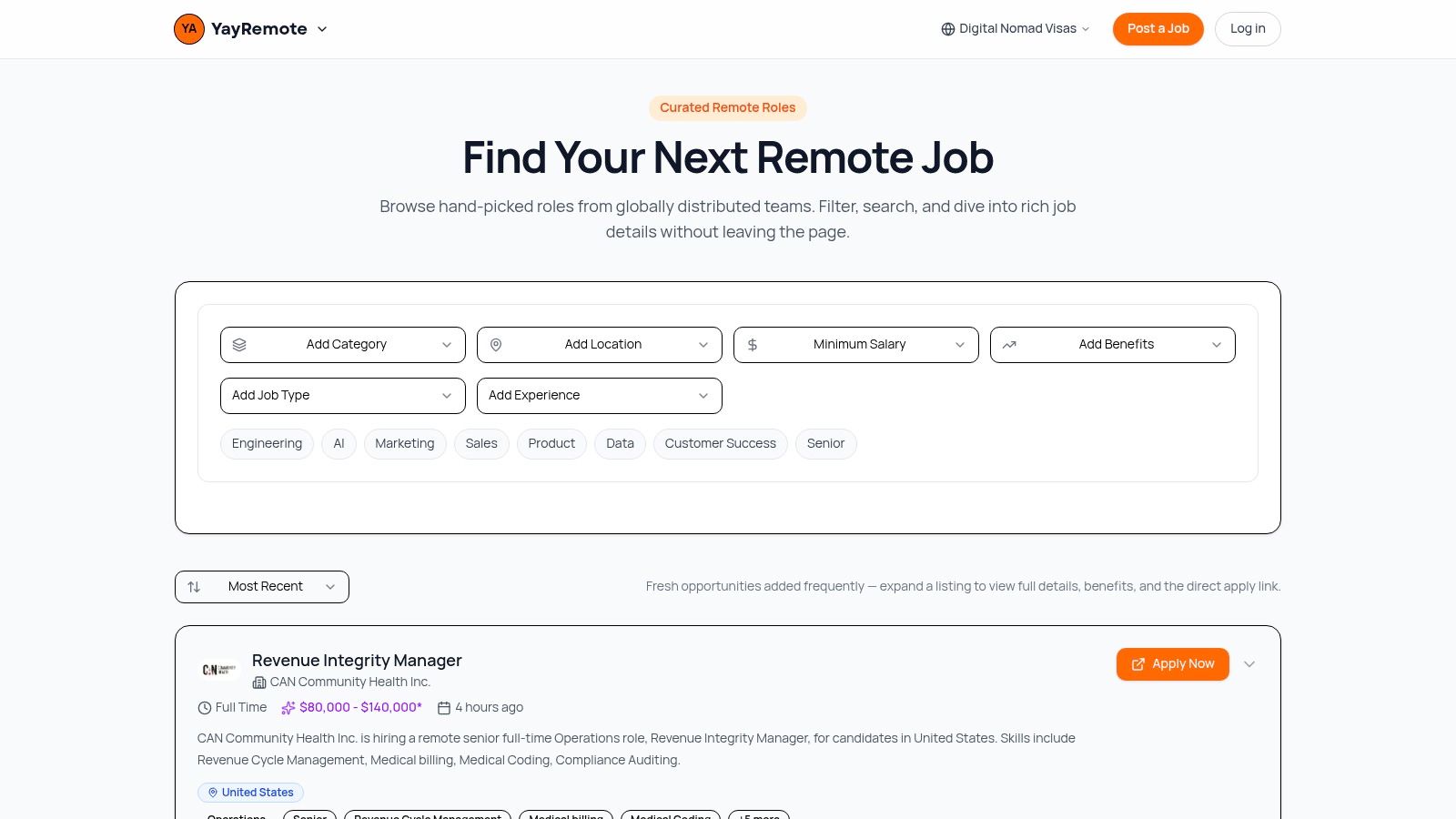
Start where remote work is the default, not an afterthought. Curated boards reduce junk listings, duplicated posts, and fake flexibility. If you want a useful shortlist of platforms to compare, this roundup of the best remote job boards is a good place to start.Broad platforms second
Use LinkedIn and major job sites after you know your niche keywords. Search specific titles like “IT support specialist,” “systems administrator,” “cloud operations,” or “security analyst” instead of generic terms like “tech” or “IT remote.”Communities third
Slack groups, Discord servers, GitHub communities, alumni circles, and product-specific forums often surface jobs before they spread widely. These channels work best when you participate before you need something.
Search by problems, not only by titles
Many candidates frequently overlook promising opportunities. Companies don't always describe the same work the same way.
Search combinations like:
- Support and service desk terms such as “service desk analyst,” “technical support specialist,” or “desktop support.”
- Infrastructure language like “systems administrator,” “identity and access,” “device management,” or “network administrator.”
- Cloud and operations terms such as “cloud ops,” “DevOps,” “site reliability,” or “platform support.”
- Security operations language like “SOC analyst,” “security monitoring,” or “incident response.”
If you're exploring sector-specific roles, it can also help to scan adjacent ecosystems. For example, remote roles on Blockchain Jobs can reveal operations, infrastructure, support, and security openings in companies that hire globally.
Your search terms should reflect how teams describe work internally. “Remote IT” is a category. Hiring managers search for functions.
Track applications like an operator
Use a spreadsheet, Notion board, or task manager. Track title, company, source, date applied, contact person, stage, and next action. The point isn't bureaucracy. The point is memory.
A clean tracker lets you notice patterns. If support roles reply but cloud roles don't, your profile is telling you something. If one version of your resume gets interviews, keep that version as a baseline and tune from there.
Crafting a Remote-Ready Application and Portfolio
A generic resume is usually a rejection slip wearing business casual. That's even more true in remote IT, where recruiters screen for role fit fast and hiring teams look for evidence that you can operate independently.
This matters even more for non-traditional candidates. Remote IT roles in help desk, support, systems administration, and network engineering can be entered through certifications and portfolio projects rather than a traditional computer science degree, and those pathways are often undercovered in mainstream career advice, as noted in this guide to non-tech-based remote jobs that transition into IT-adjacent work.

Treat each application like a targeted briefing
Read the job description once for scope and once for language. Then mark the repeated nouns and verbs.
If a role mentions ticketing, user provisioning, documentation, stakeholder communication, endpoint support, and escalation management, your resume should reflect those exact themes when they're true for your background. Don't keyword-stuff. Translate your experience into the employer's vocabulary.
For ATS-focused tuning, this guide on how to beat ATS is worth reviewing before you send another resume.
What belongs in a remote IT resume
A strong remote job IT resume usually has four useful traits:
Clear title alignment
Your headline should match the role you want. “IT Support Specialist” works better than “Tech Professional Open to Opportunities.”Operational bullets
Describe the work, not your personality. Good bullets show troubleshooting, system ownership, documentation, escalation, and tools used.Remote proof
Mention async communication, distributed collaboration, written handoffs, documentation ownership, and independent issue handling when you've done them.Focused tool stack
List tools that support your target role. A support resume should not read like a half-finished full-stack developer profile.
Build a portfolio that proves how you think
For many remote IT roles, a portfolio doesn't need flashy design. It needs to reduce doubt.
Here's what works:
| Portfolio element | Why it helps |
|---|---|
| Lab project writeups | Shows process, not just outcomes |
| Screenshots with explanation | Helps non-technical reviewers understand the work |
| README files | Demonstrates written clarity |
| Troubleshooting notes | Proves structured thinking |
| Short walkthrough videos | Shows communication and confidence |
If you don't yet have a site, a simple portfolio for freelancers can be enough to organize projects, links, and case-style summaries without overbuilding the presentation layer.
Show the handoff quality of your work. Remote teams care less about “genius” and more about whether another person can understand what you did and continue from it.
A one-page project with a clear problem statement, tool list, screenshots, and a short reflection will often outperform a vague GitHub full of unfinished repos.
Acing the Multi-Stage Remote Interview Process
Remote interviews don't just test whether you can do the job. They test whether people trust you to do it without constant supervision.
Consider a candidate named Maya. She's applying for a remote systems support role after several years in customer operations and some recent lab work in Microsoft 365 administration. She isn't trying to pretend she's a senior engineer. She's presenting herself as someone who can handle users, tools, access issues, and process discipline.

Stage one screens for signal, not depth
The recruiter call is usually less technical than candidates expect. Maya doesn't win this stage by sounding impressive. She wins it by sounding clear.
When asked why she wants the role, she ties together three facts: she has support-facing experience, she enjoys troubleshooting structured problems, and she has built a small admin lab to deepen her technical foundation. That story is coherent. Recruiters remember coherence.
A few remote-specific questions tend to show up early:
- How do you stay organized working independently
- How do you communicate when a problem spans time zones
- How do you ask for help without blocking progress
- How do you document work for others
Bad answers stay abstract. Good answers reference habits, tools, and examples.
Stage two is often a take-home or practical exercise
Maya gets a short assignment: review a mock support scenario, propose a troubleshooting path, and write a customer-facing update plus an internal handoff note.
That's a realistic remote test. It checks judgment, writing, and structure. She doesn't just solve the problem. She shows her reasoning. She separates assumptions from facts. She notes what she would verify next.
A take-home assignment is partly a writing test. If your thinking is solid but your explanation is messy, the team will picture messy handoffs inside a distributed environment.
Later in the process, it helps to hear remote interviewing advice in another format. This video covers common mistakes and presentation basics for distributed hiring conversations:
Final rounds check working style
The last stage often includes future peers or a manager. At this stage, candidates try too hard to sound “culture fit” and start speaking in slogans. Maya does the opposite. She answers concretely.
Here's the pattern that works:
- State the situation briefly
- Explain the action you took
- Show how you communicated
- Mention what happened or what you learned
For remote job IT interviews, your setup matters too. Use stable audio, a simple background, and camera framing that doesn't make you look distracted or dimly lit. None of that replaces substance, but poor setup creates friction you don't need.
Negotiating Salary and Global Benefits Packages
A remote offer is rarely just base salary. Even when the headline number looks acceptable, the actual quality of the package depends on how the company handles geography, equipment, benefits, and employment structure.
Start by figuring out what kind of compensation philosophy the employer uses. Some companies anchor pay to your location. Others use a location-agnostic band. Neither model is automatically fair or unfair. What matters is whether the company explains the logic clearly and applies it consistently.
Break the offer into negotiable parts
Use a simple review framework:
| Offer component | What to check |
|---|---|
| Base salary | Is the band clear, and is your level defined correctly |
| Bonus | Is it guaranteed, discretionary, or tied to company targets |
| Equity | What type is offered, what vesting terms apply, and what you can realistically value today |
| Equipment support | Laptop policy, peripherals, replacement rules |
| Remote work support | Home office, internet, coworking, travel for meetups |
| Benefits | Health coverage, leave, local compliance, retirement access |
Candidates often focus too narrowly on base salary because it feels easiest to compare. In global remote hiring, that's incomplete. A lower base with strong equipment support, predictable travel policy, and solid health coverage may be better than a slightly higher salary attached to weak infrastructure and unclear employment terms.
Ask the compensation questions that matter
You don't need aggressive phrasing. You need direct phrasing.
Try lines like:
“Before I respond to the offer, I'd like to understand how compensation is calibrated for this role across locations and levels.”
Or:
“I'm excited about the role. I'd also like to review the full package, including equipment support, any home office allowance, health coverage, and how the company handles employees in my location.”
If the company offers equity, ask practical questions. Don't perform startup enthusiasm. Ask what type of grant it is, what the vesting schedule looks like, and what happens if the company is acquired or you leave before full vesting.
Negotiate from scope and fit
The strongest advantage is usually not “I want more.” It's “here is the level of responsibility I'm prepared to carry.”
If you're being hired to own a support queue, improve documentation, handle admin tasks, and work cross-functionally with security or infrastructure teams, say that clearly. Tie your request to the work, the coverage expected, and the value of being reliable in a distributed environment.
Remote companies also vary widely on contractor versus employee status in global roles. Before you accept, clarify who employs you, which country governs the agreement, how taxes are handled, and whether benefits are direct or routed through an employer-of-record partner.
Managing Logistics From Visas to Time Zones
Getting the offer doesn't mean the hard part is over. It means the practical part begins.
Remote work is now embedded enough in the labor market that 35.5 million people in the U.S. teleworked or worked at home for pay in Q1 2024, representing 22.9% of people at work, up by 5.1 million from the prior year, according to the BLS telework trends data. But daily success still comes down to logistics that many candidates ignore until they become painful.
Time zones are an operating constraint
A globally distributed role can work well if the overlap expectations are explicit. It can become exhausting if the team treats everyone's calendar as infinitely flexible.
When you join, get clarity on four points:
- Core overlap hours that the team expects everyone to protect
- Response time norms for chat, tickets, and email
- Escalation paths when the primary owner is offline
- Meeting rules for recurring cross-time-zone calls
The best distributed teams rely on written updates, recorded walkthroughs, documented decisions, and clear ownership. If a company says it's async-first but everything important happens live, take that as a warning.
Global mobility adds paperwork fast
If you plan to work while moving between countries, treat visas, tax residency, and employment compliance as separate issues. A country may allow entry while still creating tax or labor complications. Your employer may also restrict where you can work, even if you personally have permission to enter.
Ask early:
| Logistics area | Question to clarify |
|---|---|
| Work location policy | Which countries can I legally work from under company policy |
| Visa status | Does my right to stay match my right to work remotely |
| Tax exposure | Who should advise on residency and filing obligations |
| Equipment security | Are there restrictions on device use or data access abroad |
Your home setup becomes part of your performance
For remote IT roles, your workspace isn't cosmetic. It affects concentration, call quality, and stamina. Prioritize stable internet, decent lighting, an external keyboard if you work long hours, and a repeatable daily routine.
The bigger adjustment is boundary management. Support and ops roles can leak into evenings if you let every notification feel urgent. Decide when you start, when you stop, and what counts as an emergency on your team.
Remote careers reward people who make invisible work visible. Good documentation, predictable availability, careful handoffs, and location planning don't look glamorous, but they're often the reason someone keeps thriving after the offer letter is signed.
If you're serious about landing a remote IT role and building a career that can travel with you, YayRemote is worth using as both a job platform and a practical toolkit. You can search hand-picked remote roles, compare filters that matter, and use resources for ATS optimization, time zone planning, and digital nomad logistics without piecing everything together yourself.