High-Paying Remote Jobs Data Analyst Guide for 2026 Success
Unlock your career with our guide to remote jobs data analyst opportunities. Learn skills, strategies, & tactics to land a top-tier role in 2026.
The demand for skilled data analysts has exploded, and the best part? A huge number of these roles are now fully remote. If you've been considering a career that blends high earning potential with the freedom to work from anywhere, there's never been a better time to dive into the world of remote jobs data analyst roles. It's a competitive field, but the rewards are well worth it.
Why Remote Data Analyst Roles Are Booming
The move to remote work isn't a temporary fad—it's a fundamental shift in how businesses operate. And data analytics is right at the center of it. Companies have realized they're no longer confined to hiring talent within a 30-mile radius of their office. This has opened the floodgates, creating a global marketplace for top-tier analysts.
From what I've seen in the industry, this boom is being fueled by a few key factors:
- Smarter Spending: Companies are trimming significant overhead by reducing their physical office footprint. Less money on rent and utilities means more budget for top talent.
- A Global Talent Pool: Hiring managers can now find the perfect analyst with a rare, niche skill set, whether they're in another state or another country.
- Genuine Productivity Gains: It's a proven fact. Without the typical office interruptions, many analysts find they can get into a deeper state of flow and produce higher-quality work.
- The Rise of Data-Driven Culture: More than ever, businesses are relying on data to make critical decisions. This means they need sharp analysts to interpret that data, regardless of their location.
The Financial and Growth Outlook
The market for remote data analysts isn't just expanding; it's becoming incredibly lucrative. A recent analysis of 2,916 remote data analyst job postings in 2026 revealed an average annual salary of a staggering $112,849. This isn't just an entry-level figure; it reflects the high value companies place on analysts who can deliver insights from anywhere.
By 2026, it's expected that 40% of all data analytics jobs will be remote-first. Think about that—it represents a massive shift and a golden opportunity if you're prepared.
This visual breakdown really drives home the potential for both salary and career growth in this field.
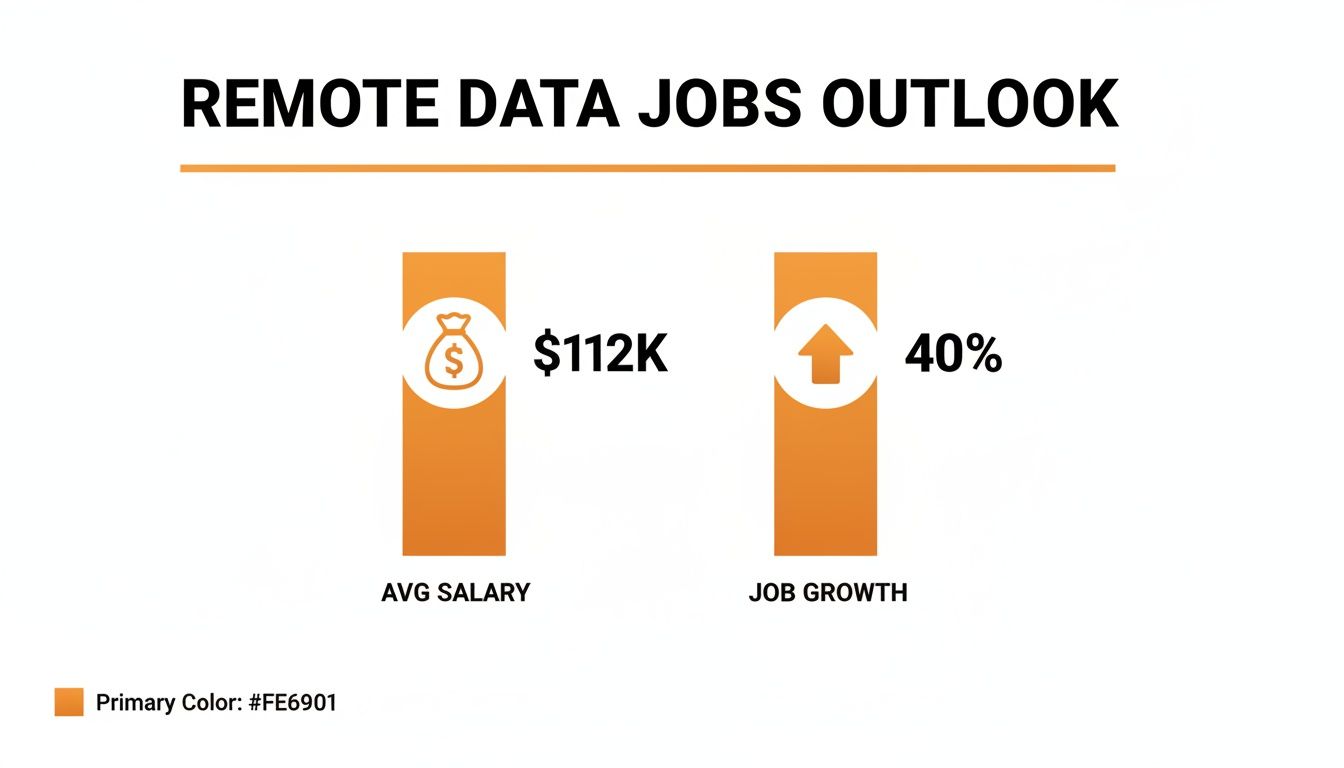
The numbers make it clear: pursuing a remote data analyst career is a strategic move that offers both financial stability and long-term growth.
To give you a clearer picture of what you can expect, here’s a breakdown of typical salary ranges by experience level.
Remote Data Analyst Salary Snapshot 2026
| Experience Level | Typical Salary Range (USD) | Key Skills Often Required |
|---|---|---|
| Entry-Level (0-2 years) | $65,000 - $85,000 | SQL, Excel, Tableau/Power BI, Python basics |
| Mid-Level (2-5 years) | $85,000 - $120,000 | Advanced SQL, A/B Testing, R/Python, Cloud (AWS, Azure) |
| Senior (5+ years) | $120,000 - $160,000+ | Statistical Modeling, ETL Processes, Mentorship, Strategy |
These figures are a great benchmark to have in mind as you start your job search and head into salary negotiations.
Positioning Yourself for Success
Knowing the market trends is just the start. To really stand out, you need to understand what hiring managers are looking for. They don't just want someone who can run a query. They need a proactive, self-starting problem-solver who can communicate effectively and drive results without constant supervision.
This guide is designed to walk you through exactly how to become that ideal candidate. We'll cover everything from building the right skills to acing the interview. To get a feel for what's out there, you can start by exploring current remote data analysis jobs on our platform. Let's get you ready to land your dream role.
Mastering the Essential Remote Data Analyst Skillset

To land a remote jobs data analyst role today, you need more than just a passing familiarity with SQL and Excel. Remote-first companies operate differently. They need analysts who are not only technically sharp but can also work with a ton of autonomy, plugged into a modern, cloud-based data stack.
It's about demonstrating how you apply your skills in a distributed environment. In fact, even with all the buzz around AI, the demand for human analysts remains incredibly strong. Job postings for data analysts have actually seen a +0.5% increase, standing firm while the overall job market has dipped by 8%. This tells us one thing loud and clear: companies are still betting big on human insight, especially when it’s paired with the right tools.
The Modern, Remote-Ready Tech Stack
In a remote world, the cloud is king. Forget about on-premise servers. Your ability to work with cloud-native tools is non-negotiable because they’re built for the kind of seamless, location-agnostic collaboration that distributed teams depend on.
Simply listing "Python" on your resume won't cut it. You need to show you speak the language of the modern data stack. Here’s what top remote companies are hiring for in 2026:
- Cloud Data Platforms (Snowflake, BigQuery): Modern data teams live on platforms like Snowflake because they let multiple analysts run heavy-duty queries at the same time without tripping over each other. It’s a core feature that makes remote work not just possible, but efficient.
- Data Transformation Tools (dbt): Think of dbt (data build tool) as the "Git for data analytics." It introduces version control and clear documentation to data models, which is a lifesaver when you can't just turn to your coworker and ask how a certain metric was built. It’s all about creating a transparent, collaborative workflow.
- Business Intelligence & Visualization (Looker, Tableau): While Tableau is still a powerhouse, tools like Looker are gaining huge traction in remote-first cultures. Its centralized modeling layer (LookML) ensures everyone is working from a single source of truth—critical for keeping the entire company aligned on key metrics when you're spread across different time zones.
Proficiency with these tools signals more than just technical skill. It tells a hiring manager you already understand the operational realities of a distributed data team and can hit the ground running.
The Non-Negotiable Soft Skills for Remote Success
Your tech stack gets you the interview. Your soft skills get you the job and help you build a career. When you’re working remotely, these traits are magnified, and I guarantee hiring managers are actively looking for them.
A great remote analyst isn’t some lone wolf crunching numbers in isolation. They are a proactive, reliable hub of information for the entire team.
Core Soft Skills for Remote Analysts
| Skill | Why It's Critical for Remote Roles | How to Demonstrate It |
|---|---|---|
| Asynchronous Communication | Your team won't always be online together. You must be able to share findings, provide context, and ask questions so clearly that a colleague can pick it up hours later and act on it without any back-and-forth. | In your portfolio, write crystal-clear summaries for each project. In an interview, talk through your thought process so thoroughly that the interviewer rarely has to ask "why?" |
| Proactive Ownership | You can't just wait for tasks to be assigned. The best remote analysts spot anomalies or opportunities in the data and start digging in on their own. They have an owner's mindset. | Instead of saying you're a "problem-solver," give a real example: "I noticed a dip in user engagement and proactively investigated the root cause." This shows initiative. |
| Disciplined Self-Management | With no office environment to provide structure, you are 100% in charge of your schedule, your priorities, and your deadlines. It's all on you. | Keep a well-organized GitHub profile for your projects. It’s tangible proof that you can manage your own work, document it professionally, and see it through to completion. |
Ultimately, landing one of the top remote jobs data analyst roles comes down to proving you're the full package. You have the modern technical chops to handle the data, and just as importantly, the professional maturity to thrive in an environment built on trust and autonomy.
Crafting an Application That Actually Gets You Hired

Think of your application as the very first analysis you submit to a potential employer. In the crowded market for remote jobs data analyst roles, a generic resume is a guaranteed dead end. To even get a look, your application materials have to clear two major hurdles: the automated screeners and the all-too-human hiring manager.
First, you have to get past the robots. Over 90% of large companies use Applicant Tracking Systems (ATS) to filter resumes before a person ever sees them. These systems aren't impressed by cool designs; they're programmed to scan for specific keywords and a predictable structure.
Your job is to make your resume as machine-friendly as possible. That means sticking to a clean, single-column format with standard fonts (like Calibri or Arial) and simple headings. Ditch any images, tables, or fancy graphics that can trip up the parsing software.
Getting Past the Bots with Smart Keywords
To get a high ATS score, you need to mirror the language in the job description. I like to think of it as SEO for your resume. If a posting for a remote data analyst mentions "Tableau," "A/B testing," and "customer churn" multiple times, you better believe those exact phrases should show up in your skills and experience sections.
But don't just stuff keywords in a list. Weave them into the stories of your accomplishments.
- What most people write: "Used SQL to query databases."
- What gets you the interview: "Wrote complex SQL queries with window functions to analyze user behavior data, leading to a 15% improvement in a key marketing metric."
See the difference? The second one not only satisfies the ATS but also shows a recruiter the direct business impact you can make. If you want to dive deeper, our guide on how to beat the ATS has a full checklist.
And don't forget your digital footprint. A polished online presence is non-negotiable these days, so make sure you're optimizing your LinkedIn profile to catch the eye of recruiters.
Building a Portfolio That Proves Your Worth
While a keyword-optimized resume gets your foot in the door, a great portfolio is what convinces them you can actually do the work. So many aspiring analysts make the classic mistake of filling their portfolio with textbook projects, like the Titanic survival dataset. Frankly, that tells a hiring manager almost nothing about your ability to solve their real-world problems.
A great portfolio doesn't just show you can analyze data; it shows you can answer important business questions and drive tangible outcomes. It's your proof of work.
Your goal should be to create 2-3 high-quality projects that look and feel like something a remote data analyst would actually work on. Present each one as a mini case study.
A Winning Project Case Study Structure:
- The Business Problem: Frame it as a question. Think, "Why did our user retention drop by 10% last quarter?" or "Which marketing channel is giving us the highest customer lifetime value?"
- The Process and Tools: Briefly walk them through your method. What data did you use? How did you clean it? Which tools (Python, SQL, Looker) helped you find the answer?
- The Key Findings: Show, don't just tell. Present your insights with clear language and compelling visuals—a sharp-looking dashboard, a simple chart, or a key table works perfectly.
- The Business Impact: This is where you seal the deal. End with a concrete recommendation. For example, "My analysis suggests reallocating 20% of our ad budget from Channel X to Channel Y, which I project will increase LTV by 18%."
Stuck on ideas? Here are a few projects that always get a positive reaction from hiring managers:
- Customer Cohort Analysis: Dig into user retention over time to figure out what makes your best customers stick around.
- Acquisition Funnel Optimization: Build a dashboard that tracks where users are dropping off during sign-up and recommend specific fixes.
- A/B Test Analysis: Analyze the results from a simulated product experiment and give a clear "go/no-go" recommendation backed by statistical significance.
When you build a portfolio that shows you understand the business side of data, you stop being just another applicant. You become a problem-solver they can’t afford to lose.
A Smarter Strategy for Finding Remote Jobs
If your job search feels like you're just throwing resumes into the void, you're not alone. Mindlessly scrolling through massive job boards is one of the fastest ways to burn out. The key to landing a great remote jobs data analyst role isn’t about applying to more jobs—it’s about applying to the right jobs.
Think of it as your first project for a new employer. You have a massive, messy dataset (every job listing on the internet) and your task is to clean it, filter it, and pull out the real opportunities. You need to stop being a passive applicant and start thinking like the analyst you are.
Filtering for the Perfect Fit
Most job sites have filters, but they often barely scratch the surface. To really zero in on the best remote data analyst roles, you need to get more specific. This is where platforms built specifically for remote work, like YayRemote, have a serious edge because their filters are designed for the realities of a distributed team.
Here's how to use advanced filters to stop wasting your time:
- Filter by Salary: Be honest about your financial needs. Setting a realistic salary floor is the quickest way to weed out roles that aren’t a good fit, letting you focus on companies that value your skills appropriately.
- Filter by Tech Stack: Are you a wizard with Python and Snowflake? Or is your happy place working in R and Power BI? Don't just search for "data analyst." Filter for the specific tools you love to use and are an expert in. This ensures you’re a strong match from day one.
- Filter by Time Zone Overlap: This is a huge, often-overlooked filter for remote work. Many companies need a few hours of overlap for team meetings and collaboration. Filtering by time zone means you only see jobs that work with your actual schedule.
You can see how powerful this is in practice. The filters on YayRemote let you instantly turn a giant, overwhelming list into a handful of highly relevant openings.
Suddenly, you’re not just looking for a job; you’re looking at a curated list of roles that match your salary needs, tech skills, and location.
Beyond the Application Form
Hitting "apply" and moving on feels productive, but it’s often the least effective part of the process. It's the digital equivalent of shouting into a hurricane. A much better approach is to make a genuine human connection. A little personalized outreach on LinkedIn can be the thing that gets your resume moved from the "maybe" pile to the "must-interview" list.
The key is to be helpful and respectful, not demanding. Find the hiring manager or a team lead for the role you're targeting. A short, personalized note can work wonders.
A well-crafted outreach message isn't about asking for a job. It's about starting a conversation, showing genuine interest, and demonstrating your proactivity—a key trait for any successful remote employee.
Here's a simple template you can tweak. Notice how it focuses on their needs and your specific value.
"Hi [Name],
I came across the Remote Data Analyst position at [Company Name] and was really impressed by [mention something specific, like their recent product launch or a blog post on their data culture].
My background in [mention 1-2 key skills, e.g., building customer retention models with Python and SQL] seems to line up perfectly with the role. I actually tackled a similar challenge in a recent portfolio project where I analyzed [briefly describe a relevant project, e.g., user churn trends], which uncovered [mention a key outcome or insight].
I've already applied through the career portal, but I wanted to reach out directly to express how excited I am about this opportunity.
Best, [Your Name]"
This does two things: it proves you've done your homework and it makes it incredibly easy for them to see your potential.
Navigating International and Time Zone Nuances
When you're looking at remote jobs data analyst roles globally, you have to pay attention to the fine print. Even a "work from anywhere" job can have hidden geographic restrictions due to taxes, legal reasons, or time zone preferences.
- Look for Geographic "Tells": Scan the job description for phrases like "US only," "EU residents," or "requires a 4-hour overlap with PST." This will save you from applying to jobs you aren't eligible for.
- Show Your Flexibility: If you're willing to adjust your hours, make that clear. Mentioning that you are "experienced in collaborating across multiple time zones" in your cover letter or outreach can be a huge plus for a hiring manager worried about logistics.
By using this targeted, proactive strategy, you shift from being just another applicant to a standout candidate. You’ll save yourself a ton of time and frustration, and dramatically increase your odds of finding a remote role that’s a fantastic next step for your career.
Acing the Remote Interview and Take-Home Project

This is where you prove you can deliver the goods from anywhere. For a remote jobs data analyst role, the interview process is less about a firm handshake and more about demonstrating clear thinking, proactive communication, and solid technical skills through a screen. It requires a whole different kind of prep.
Think about it: your interview setup is the first piece of data they get on you. A chaotic background or muffled audio can signal a lack of attention to detail—a major red flag for any data professional. Before that first call, you need to get your environment dialed in.
Your Pre-Interview Tech Check
A professional remote setup isn't about dropping cash on fancy gear; it's about being thoughtful. It shows you respect the interviewer’s time and already understand the fundamentals of working remotely.
Here’s a quick checklist to run through:
- Lighting: Face a window or another soft light source. The biggest mistake people make is sitting with a window behind them, which instantly turns you into a silhouette. A cheap ring light can solve this in a pinch.
- Background: Keep it simple and clean. A tidy bookshelf, a blank wall, or a professional virtual background are all great options. Just make sure it’s not distracting.
- Audio: This is non-negotiable. Use a headset with a built-in microphone. It cuts out echo and background noise, ensuring your brilliant answers are actually heard. Do a quick test call with a friend to be sure.
- Camera Angle: Prop your laptop on some books or use a stand to get the webcam to eye level. It makes the conversation feel much more natural and engaging than an awkward up-the-nose angle.
Treat it like you're creating your own little broadcast studio. That small bit of effort establishes your professionalism before you even say hello. And when it comes to what you'll say, it pays to practice. Reviewing some crucial data analyst interview questions will help you feel ready for anything they throw at you.
"Thinking Out Loud" for the Win
During a video call, you can't just quietly work through a problem on a whiteboard while the interviewer watches. You have to narrate your entire thought process, especially during a technical screen or live coding exercise.
Verbalize every single step. When you get a problem, start by repeating it back and clarifying your assumptions. A simple, "Okay, just so I'm clear, when you say 'active user,' are we defining that as someone who logged in within the last 30 days?" immediately shows you're collaborative and precise.
As you code, explain why you're choosing a LEFT JOIN over an INNER JOIN or what makes a particular Python library the right tool for the job. This isn't just for their benefit—it helps you organize your own thoughts and even catch mistakes before they happen.
The goal isn’t just to get the right answer. It’s to show them how you think. Your clear, step-by-step narration proves you can communicate complex ideas asynchronously—a core skill for any remote team.
Nailing the Take-Home Project
The take-home assignment can feel like the final boss of the interview process. This is your single best chance to flex your real-world skills, but it's also where a lot of candidates slip up by either over-complicating things or missing the business context entirely.
First, before writing a single line of code, get crystal clear on the scope. What is the fundamental business question they need answered? If anything is vague, send a polite email to clarify. This isn't weakness; it's proactivity, and hiring managers love it.
Next, manage your time. Don't sink 10 hours into a project with a suggested time of two. They want to see what you can accomplish within reasonable constraints, just like on the job.
Finally, focus on your presentation. Your final deliverable needs to be incredibly easy to understand. A polished dashboard, a well-commented Jupyter Notebook, or a brief slide deck all work well. The key is to always lead with a short executive summary that states your main finding and recommendation right up front.
Tell a story with the data. Start with the problem, walk them through your method, use clear visuals to show your findings, and end with a concrete business recommendation. This approach turns your technical work into measurable business value, proving you’re ready for any remote jobs data analyst role.
If you're looking for more tips on this front, check out our guide on common remote job interview questions and how to craft the perfect answers.
Common Questions About Remote Data Analyst Careers
Thinking about going fully remote as a data analyst? It's a big move, and it naturally brings up a lot of questions. I hear the same worries all the time: "What's the pay really like?" "How do I prove I'm working hard if my boss can't see me?" "Do I even need a fancy degree?"
Let's cut through the noise. Here are the straight-up answers to the most common questions I get from analysts looking to land their first remote role.
What Should I Expect to Earn as a Remote Analyst?
Let's get right to it—the money question. The good news is that the pay for remote data analysts is not just competitive; it's often better than for in-office roles. Companies are willing to pay a premium to attract the best talent, no matter where they live. Your specific salary will hinge on your experience level, the company's size, and the tech stack you've mastered.
Looking ahead to 2026, the numbers are pretty compelling. Senior analysts can pull in averages around $112,849 a year. If you're in an entry-to-mid-level spot, you can realistically expect something in the $75,000 to $120,000 range.
At highly competitive companies like Thrive Market, senior roles can command $130,000-$170,000 annually, especially if you have deep expertise in tools like Pandas, SQL, and Redshift. And for the true specialists—the ones who can pull insights from massive, messy datasets with incredible efficiency—salaries can push as high as $200,000. This remote pay bump, often 20-30% higher than on-site jobs, is a direct result of the talent war that kicked into high gear after 2020. You can see this trend for yourself by digging into the latest salary data for remote data analyst jobs on Indeed.
Do I Need a Specific Degree for a Remote Job?
Honestly, not anymore. While a degree in stats, math, or computer science definitely doesn't hurt, that old requirement is fading fast. More and more remote-first companies now care a lot more about what you can do than where you went to school.
What they really want is proof. Can you actually deliver? That means you need:
- Real-world skills with the core tools: SQL, Python, and a major BI platform like Tableau or Power BI.
- A project portfolio that shows you solving real business problems, not just completing academic assignments.
- Relevant certifications that line up with the jobs you’re applying for.
At the end of the day, a hiring manager wants to see if you can turn raw data into smart business decisions. A killer portfolio project will always say more about your abilities than a diploma will.
How Can I Prove My Value Without Face Time?
This is the big one. When you're not physically present in an office, you can't rely on "looking busy." You have to be deliberate and strategic about showing your impact.
In a remote team, your ability to communicate your work clearly and asynchronously is just as important as the quality of the analysis itself. Visibility equals credibility.
The key is to become a master of proactive communication. Post regular, quick updates in your team's Slack or Teams channel. When you finish a project, don't just drop a link to the dashboard. Write a short, sharp summary of the key findings and what you recommend doing next.
Take ownership. Don't just sit back and wait for someone to assign you a task. If you see a weird spike in the data or notice a process that could be improved, jump on it. Document what you found and share it. That kind of initiative is gold in a remote setting. Your GitHub profile, filled with well-documented projects, becomes your silent, always-on testament to your professionalism and self-discipline.
Are Most Remote Data Analyst Jobs Based in One Country?
While the U.S. still has the largest number of remote jobs data analyst listings, the "work from anywhere" movement is genuinely global. More companies are realizing that locking themselves into one country means missing out on incredible talent.
The trick is to read the job descriptions like a hawk for clues about location.
- "US Only" or "EU Residents": These are hard restrictions, usually for legal or tax reasons. Don't waste your time if you're not eligible.
- "Time Zone Overlap Required": This is very common. A company might need you to have a 4-hour overlap with their team on the Pacific coast (PST). Be honest with yourself about whether that's sustainable for you.
- "Global / Anywhere": This is the holy grail. These are the true work-from-anywhere roles that offer the most freedom.
Job boards with good filters are your best friend here, as they let you weed out the roles that aren't a fit for your location. Your ability to land a truly global role will come down to your flexibility and your skill in working with a team scattered across different time zones.
At YayRemote, our entire focus is making your remote job search easier. We hand-pick thousands of quality remote roles and provide free tools to help you create an application that gets noticed. Find your next opportunity at YayRemote.