How to Become a Remote Software Engineer in 2026
Learn how to become a successful remote software engineer. This guide covers the essential skills, salary expectations, and job-hunting strategies for 2026.
So, what exactly is a remote software engineer? At its core, it's a software engineer who builds, tests, and maintains software from anywhere but a central office. It’s a role that demands the same technical chops as an on-site position but adds a layer of self-discipline and excellent communication skills to make it all work.
The Global Shift to Remote Software Engineering

Not too long ago, working remotely was a rare perk. Today, it’s rapidly becoming the default for a huge part of the tech industry. Being a remote software engineer is about more than just coding in your slippers; it represents a fundamental change in how companies create products and how talented developers can shape their careers.
This shift isn't happening by accident. Companies realized they no longer had to limit their search for talent to a 30-mile radius around an office. Suddenly, they could hire the best person for the job, period. At the same time, engineers began pushing for more freedom, better work-life balance, and the autonomy that a traditional 9-to-5 office job often can't provide.
The Data Doesn't Lie
The numbers really tell the story here. Projections show that by the end of 2026, an incredible 80% of software engineers around the world will be working either fully or partially from home. This isn't a fad; it's the new reality.
A Stack Overflow survey from May 2024 found that 42% of developers were already hybrid and another 38% were fully remote. That leaves only 20% of developers working from an office full-time, which speaks volumes about what tech professionals really want.
For anyone looking to become a remote software engineer, this trend means one thing: opportunity. The door is open wider than ever before.
To get a clearer picture, let's break down the core differences between the old and new ways of working.
Remote vs On-Site Engineering: A Quick Comparison
This table offers a high-level look at how the daily realities of on-site and remote engineering roles differ.
| Aspect | On-Site Engineer | Remote Software Engineer |
|---|---|---|
| Work Location | Company office | Home, co-working space, anywhere with internet |
| Collaboration | In-person meetings, spontaneous desk chats | Video calls, chat tools, asynchronous communication |
| Work Schedule | Typically a fixed 9-to-5 schedule | Flexible hours, often focused on output over hours |
| Autonomy | Direct, in-person supervision | High degree of trust and self-management required |
| Talent Pool | Limited to the local commuting area | Global; can hire the best talent worldwide |
| Key Skills | Strong technical and in-person communication | Technical skills plus written communication & discipline |
While the core programming work is similar, you can see how the environment and the skills needed to succeed in it are fundamentally different.
Benefits for Everyone Involved
This move to remote work has created clear advantages for both companies and the engineers they hire.
What Companies Gain:
- Access to a Global Talent Pool: They can hire the perfect developer, whether they're in another city or another continent.
- Lower Overhead Costs: Less money spent on rent, utilities, and office supplies for a large physical space.
- Potentially Higher Productivity: Many engineers find they can focus better and get more done without constant office interruptions.
What Engineers Gain:
- Real Flexibility: You can fit your work around your life, not the other way around.
- Live and Work Where You Want: Your career is no longer tied to an expensive tech hub.
- Deep Work Time: It's easier to block off time for complex problem-solving without someone tapping you on the shoulder.
This guide is designed to give you everything you need to succeed in this exciting field, from honing the right skills to landing that first great remote role.
Mastering the Skills for Remote Success
To really thrive as a remote software engineer, you need more than just solid coding chops. Your technical skills are the price of admission, but it's the combination of that expertise with sharp soft skills that will truly make your career take off.
Think of it this way: your hard skills build the product, but your soft skills build the team. One without the other just doesn't work in a distributed environment. You need both to prove you can not only get the job done but also be a fantastic, low-friction teammate from anywhere in the world.
The Technical Toolkit for Remote Engineers
When you're remote, you can't just tap a senior dev on the shoulder for help. Companies need to know you can operate independently within their modern, distributed tech stack. This means being self-sufficient is the name of the game.
Here are the technical skills that hiring managers are really looking for:
- Cloud Platform Fluency: You have to be comfortable in the cloud. Whether it's Amazon Web Services (AWS), Microsoft Azure, or Google Cloud Platform (GCP), remote teams live here. You'll be expected to navigate these environments for everything from deployments to database management, often on your own.
- CI/CD Pipeline Mastery: Continuous Integration and Continuous Deployment (CI/CD) is the engine of a modern remote team. Having experience with tools like Jenkins, GitLab CI, or GitHub Actions signals that you understand how to contribute to a fast-paced, automated workflow without slowing things down.
- Core Programming Languages: This one never changes. A deep understanding of workhorse languages like Python and JavaScript is still fundamental. At the end of the day, writing clean, efficient, and well-documented code is your primary job.
Being a successful remote software engineer is about proving you can be productive and collaborative from anywhere. Your technical skills are your ticket to entry, but your soft skills are what will make you truly excel and grow in a remote-first culture.
The Soft Skills That Differentiate You
This is the part that so many engineers overlook. In an office, you can often get by with "good enough" communication. When you're remote, your communication skills are your visibility. They're how you build trust, solve problems, and move up.
Asynchronous Communication: This is the absolute cornerstone of remote work. It's the art of writing things down—in Slack, Jira, or a pull request—with enough context that a teammate in another time zone can pick it up and run with it. No "quick sync" needed. You have to anticipate questions and provide answers before they're even asked.
Self-Discipline and Autonomy: When your boss isn't in the same room, or even the same country, the responsibility to stay on task is entirely on you. Successful remote engineers are self-starters. They own their projects, hit their deadlines without needing reminders, and have the discipline to stay focused when surrounded by the comforts (and distractions) of home.
These skills don't just benefit you; they create a healthier and more productive environment for everyone. A big piece of the remote puzzle involves actively improving developer experience for the whole team.
Of course, becoming a great programmer is a journey that goes beyond any single tech stack. For a broader look at building a strong foundation, check out our guide on how to get a job in programming. Getting a handle on both the technical and the human side of the job is your direct path to a rewarding remote career.
Understanding Remote Salaries and Job Market Realities
Let's talk about the number one question on everyone's mind: money. The dream of a hefty remote salary is a huge draw for software engineers, but what you’ll actually earn is a lot more nuanced than you might think. Your paycheck isn't just about your skills; it’s a mix of your experience, where your company is based, and even where you live.
You’ll quickly run into the great remote work debate: should companies pay based on your location or pay based on the role? Some adjust salaries for the local cost of living, while others offer a flat rate no matter where you are. This single factor creates a massive spread in what you can expect to earn.
The Global Salary Landscape
The worldwide hunt for top engineering talent has created a pretty wild salary market. As of 2026, the global average for a remote software engineer hovers around $70,877 USD per year. But that's just an average. Dig a little deeper, and you'll see huge regional differences—engineers in North America average $82,757, while those in Oceania pull in $86,004, and their counterparts in Latin America average $60,363. For a closer look at regional pay, the salary research from arc.dev is a great resource.
Here’s the key takeaway: US-based companies tend to pay their global remote talent far more than local companies in other regions do. It’s a major market advantage. For example, a senior remote engineer working for a US company might command a salary between $90,000 and $150,000, while a European firm might offer $70,000 to $120,000 for the exact same skill set.
So, what skills are companies actually paying for? The data gives us a clear picture.
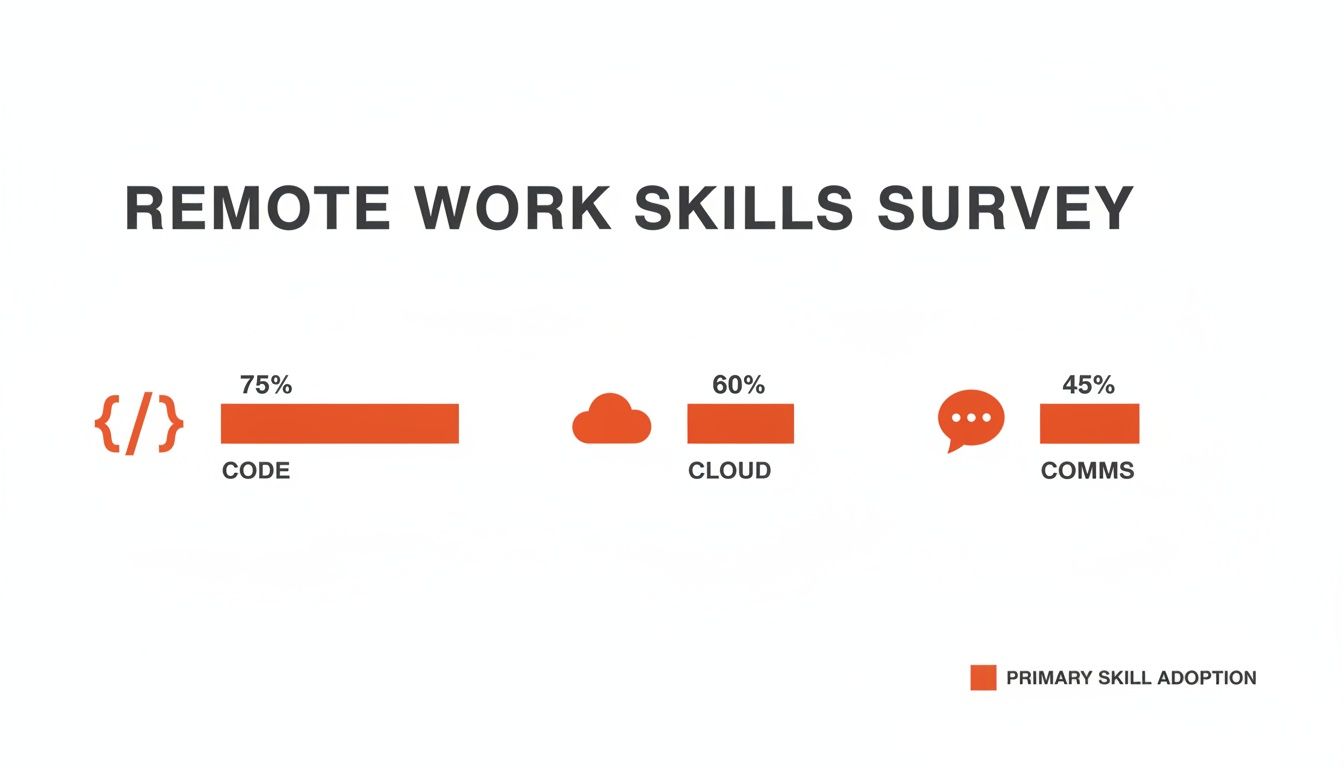
As you can see, being able to code is just the ticket to the game. It’s the cloud and communication skills that truly set you apart and increase your value in a remote-first world.
Current Job Market Trends and In-Demand Specializations
The good news is that the job market for remote software engineers is still incredibly strong. Companies everywhere are still pushing to go digital, and there just aren't enough skilled developers to go around. They’re looking for people who can do more than just write code; they need engineers who can thrive in a distributed team.
Right now, if you have expertise in these areas, you’re in the driver's seat:
- Cloud & DevOps: Anyone who can manage cloud infrastructure on platforms like AWS, Azure, or GCP and automate deployment pipelines is worth their weight in gold.
- Cybersecurity: With teams spread out across the globe, securing company data and applications has become a massive priority. Security-minded engineers are in high demand.
- AI & Machine Learning: Companies are scrambling to build AI into their products. If you have skills in ML and data science, you have serious negotiating power.
- Full-Stack Development: The classic full-stack developer—someone comfortable on both the front-end and back-end—is always sought after for their sheer versatility.
Your specialization is your biggest salary lever. Niche skills in hot fields like AI or cybersecurity consistently command premium pay because the talent pool is small and the business impact is huge.
Experience Level and Salary Expectations
It probably comes as no surprise that your years on the job are one of the biggest factors in your salary. Companies organize roles into tiers—junior, mid-level, and senior—and the pay scales up accordingly. A junior engineer might spend their days on bug fixes and small features, but a senior is expected to lead projects, mentor teammates, and design entire systems.
To give you a clearer idea of how this all plays out, here is a look at typical salary ranges based on your experience and where the hiring company is located.
2026 Global Remote Software Engineer Salary Ranges (USD)
This table breaks down what you might expect to earn based on your years of experience and the type of company you're working for.
| Experience Level | US-Based Company (Hiring Globally) | EU-Based Company (Hiring Globally) | Global Startup |
|---|---|---|---|
| Junior (0-2 years) | $70,000 - $110,000 | $45,000 - $70,000 | $40,000 - $65,000 |
| Mid-Level (3-5 years) | $110,000 - $150,000 | $70,000 - $100,000 | $65,000 - $90,000 |
| Senior (6+ years) | $150,000 - $220,000+ | $100,000 - $140,000+ | $90,000 - $130,000+ |
Remember, these are just general guidelines. The final number can shift based on the company's funding, its industry, and the specific tech stack they need. By understanding these market forces, you can go into your job search and salary negotiations with a clear head, ready to land a role that truly matches your worth.
How to Craft a Standout Remote Application
When you apply for a remote software engineer role, you're competing against a global talent pool. Your application isn't just a list of skills; it's your one shot to prove you can deliver incredible work, no matter where you're logging in from. You have to build a resume, portfolio, and cover letter that tell a clear story of your technical skill, self-discipline, and collaborative spirit.
But here's the catch: your application has to pull double duty. It needs to impress a human hiring manager, but only after it gets past the Applicant Tracking System (ATS). These bots scan every resume for specific keywords and formatting before a real person ever lays eyes on it. If your resume isn't built for an ATS, it could be rejected in seconds, even if you're the perfect fit for the job.
Optimize Your Resume for ATS and Human Eyes
Think of your resume as having two gatekeepers: first the robot, then the human. You need a strategy for both.
To get past the ATS, you need to play by its rules. It's not complicated, but it is critical.
- Match the Keywords: Scour the job description for the exact technologies ("AWS," "Python," "Kubernetes") and soft skills ("asynchronous communication," "self-managed") the company is looking for. Make sure those same words appear naturally in your resume.
- Keep It Simple: Stick to a clean, single-column layout. Fancy fonts, columns, and graphics can confuse the software. Use standard headings like "Work Experience" and "Skills."
- Use the Right File Type: Unless the application says otherwise, stick with .docx or .pdf. They're the most reliable formats that virtually all ATS platforms can read correctly.
Tools that check your resume against a job description can give you a huge advantage, showing you exactly where the gaps are.
Once your resume gets past the bot, it needs to grab a human's attention. The best way to do that is with hard numbers. Don't just say you "improved performance." Instead, say you "Reduced API response time by 30% by optimizing database queries." Concrete results are always more powerful.
Build a Portfolio That Tells a Story
Your GitHub profile or personal portfolio website is your main stage. It's where you move beyond a list of skills and actually show how you solve problems. A top-tier portfolio for a remote role doesn't just show the finished product—it reveals the thinking behind it.
Your portfolio should be a narrative of your technical journey. Each project should have a clear
README.mdfile that explains the problem it solves, the technologies used, and your specific contributions, especially if it was a team project.
This is your chance to walk a potential employer through your process. Document a tricky bug you squashed and how you did it. Explain the architectural decisions you made. This demonstrates the exact kind of resilience and clear thinking hiring managers look for in remote engineers who can't just tap a colleague on the shoulder for help. For a deeper dive into the entire job search process, check out this excellent guide on How to Get a Software Engineering Job in 2026.
Write a Cover Letter That Proves Remote Readiness
The cover letter is where you connect all the dots and directly address the "remote" part of the job. This isn't the place to just repeat your resume. Instead, use this space to show you understand the unique challenges and opportunities of working on a distributed team. You can find more advice in our guide on highlighting the right skills for your resume.
Talk about your experience using asynchronous communication tools to stay aligned with your team. Mention a project where you successfully collaborated across different time zones. You could even share your personal strategies for staying focused and productive in a home office. This shows you're not just looking for a job that happens to be remote; you are actively prepared and equipped to thrive in this environment.
Navigating and Winning the Remote Interview

The remote interview process is a different kind of beast. It’s not just your typical interview done over a video call; it’s a carefully structured gauntlet designed to test your coding chops and your ability to work well without someone looking over your shoulder. You’re there to prove you're a talented remote software engineer, but also a clear communicator and a reliable, self-starting teammate.
Most remote hiring processes follow a predictable path. It usually kicks off with a quick screening call with a recruiter, moves into one or more technical rounds, and often wraps up with a behavioral interview. To succeed, you have to nail each stage, which means paying attention to everything from your camera setup to how you talk through a coding problem.
Preparing Your Remote Interview Space
Before you ever click "Join Meeting," your environment has to scream professionalism. A sloppy setup can unintentionally signal that you aren't taking the opportunity seriously, creating a distraction that pulls focus from your skills. You don't need a fancy home office—you just need to be thoughtful.
Run through this quick checklist to make sure you're ready:
- Lighting: Always have your primary light source in front of you, not behind. Natural light from a window is fantastic, but a desk lamp works just as well. The goal is simple: your face should be clearly visible without weird shadows.
- Audio: Please, use a headset or an external mic. Your laptop’s built-in microphone picks up every keyboard click and room echo. Crisp, clean audio is an absolute must for effective communication.
- Background: Keep it simple and free of clutter. A blank wall or a tasteful virtual background is infinitely better than a view of your messy bedroom. Make sure there are zero distractions for you or the interviewer.
- Internet Connection: Run a speed test before the call. A stable connection is your lifeline, preventing awkward freezes that make you look unprepared for the basic requirements of remote work.
Think of it like setting a stage for a performance. When you control the environment, your talent can finally take the spotlight.
Conquering the Technical Challenge
For most engineers, the technical interview is the main event. Whether you get a take-home project or a live coding challenge, the objective is the same: the interviewer wants to see how you think. They are less concerned with a flawless, bug-free solution and far more interested in your problem-solving process.
The single most important skill in a live coding session is articulating your thought process. Before you write a single line of code, talk them through your plan. Explain the trade-offs of the approach you're taking and what you might do differently if you had more time.
Silence is your worst enemy here. As you code, narrate what you’re doing and why. If you hit a wall, don't just freeze up—explain what you’re stuck on and describe how you would normally go about debugging the problem. Showing your work out loud demonstrates the communication and collaboration skills that are vital for any remote position.
Nailing the Behavioral and Cultural Fit Interview
The final hurdle is often a behavioral interview where the focus shifts to your soft skills and how you'd fit into their team culture. This is where they decide if you have the independence and communication habits to thrive on a distributed team. Get ready for questions about handling conflict, managing your time, and collaborating across time zones.
Structure your answers using the STAR method (Situation, Task, Action, Result) to give concrete, real-world examples. Don't just say you're a good communicator. Instead, describe a specific time you wrote clear documentation for a pull request that helped a teammate in another country avoid confusion. To get a head start, you can dive into these common remote job interview questions and learn how to frame your answers. Proper prep shows you’re not just looking for a job—you’re serious about building a successful remote career.
Alright, you know what it takes to be a great remote engineer. Now for the fun part: finding the actual job. While you could spend hours scrolling through massive job boards, a specialized site like YayRemote is built to cut through the noise. It’s designed specifically for remote software engineers, helping you go from searching to applying with way less friction.
Think of it less like a job board and more like a smart filter for the entire global job market. Instead of getting a firehose of irrelevant listings, you can get straight to the opportunities that actually fit your life and your skills.
Targeting Your Perfect Job with Advanced Filters
A good job hunt is an efficient one. The secret is getting specific, and that's where YayRemote’s filters come in. They let you move beyond just typing "React developer" and hoping for the best.
Here’s how you can really dial in your search:
- Salary Range: Let's be real—you need to know if a job pays what you're worth from the start. Set your minimum and you'll only see roles that meet your financial goals.
- Time Zone Compatibility: Tired of the idea of 5 AM stand-ups? You can filter for roles with a specific time zone overlap, making it easy to find companies that respect your work-life balance.
- Tech Stack: This is a big one. You can filter by the exact technologies you love working with, whether that’s Python, React, AWS, or Kubernetes. It’s the fastest way to connect with teams that need your specific experience.
- Company Benefits: Looking for something more? You can even narrow your search by perks like a 4-day work week, wellness stipends, or an equipment budget to find a company culture that truly supports you.
Here’s a look at how these filters can turn a chaotic search into a clean, targeted list of jobs you’d actually want.
This view puts all the important details—from tech stack to salary—in one place, so you can quickly decide what’s worth your time.
More Than Just a Job Board: Powerful Career Tools
YayRemote also has a few unique tools built in to help you plan your career, especially if you have global ambitions. These features tackle some of the real-world challenges that come with being a remote software engineer.
The demand for developers is not slowing down. The US alone is expected to add 327,900 software engineering jobs by 2033, and there's already a 1.2 million talent shortage. With a global developer population of 47 million, this is a huge opportunity for remote engineers. You can read more about what these market trends mean for you.
One of the most practical features is the Time Zone Overlap Calculator. It’s a simple but brilliant tool that shows you exactly how your working hours will align with a team in another country. It takes the guesswork out of figuring out if that job in Berlin is really feasible from your home in Vancouver.
And for anyone with a bit of wanderlust, the Digital Nomad Visa Hub is a game-changer. It has a step-by-step wizard that helps you check your eligibility for digital nomad visas in dozens of countries. Whether you're dreaming of Europe, Asia, or the Americas, it gives you a clear, actionable path to working from almost anywhere.
From finding the right role with pinpoint filters to planning your next adventure, YayRemote is set up to support your entire journey. It’s a launchpad for building a career that’s not just remote, but also truly fulfilling.
Common Questions About Remote Engineering Careers
Thinking about making the leap to a remote software engineering career? It's an exciting prospect, but let's be honest, you probably have a ton of questions about what it’s really like day-to-day. Beyond the code, you’re thinking about job security, avoiding burnout, and actually moving up the ladder.
These are the exact same questions every engineer has before going remote. Let's tackle them head-on so you can move forward with confidence.
What Is the Difference Between a Contractor and a Full-Time Employee?
This is a big one, because the answer directly shapes your income, benefits, and how you work. The easiest way to think about it is this: a full-time employee is part of the core team, while a contractor is a specialist hired for a specific mission.
Full-Time Remote Employee: You're on the company payroll. This means a steady salary and, just as importantly, benefits like health insurance, paid time off, and retirement plans. You get more job security and a predictable career path within one company.
Remote Contractor (Freelancer): You're your own boss. You work on a project basis, which means you handle your own taxes, insurance, and retirement. The trade-off? You get immense flexibility, the power to set your own rates (which are often higher), and the freedom to work with several clients at once.
There's no single "right" answer here. It all comes down to what you value more right now: the stability and integrated benefits of a full-time role, or the autonomy and higher earning potential that comes with contracting.
How Do I Maintain a Healthy Work-Life Balance?
This is the most common trap of remote work. When your office is always just a few steps away, the lines between "work time" and "personal time" can get dangerously blurry, leading straight to burnout. You have to build boundaries on purpose.
A healthy work-life balance doesn't happen by accident in a remote setting. It requires creating a "digital commute"—a clear ritual to start and end your workday—that mentally separates your professional responsibilities from your personal time.
So, how do you do it? Start by setting firm working hours and actually communicating them to your team. Carve out a dedicated workspace—even if it's just a specific desk in the corner of your living room—to mentally signal when you're on the clock. Most importantly, take real breaks, and when the day is done, be done. Shut the laptop, turn off Slack notifications, and reclaim your evening.
How Can I Grow My Career and Get Promoted Remotely?
Okay, but what about climbing the ladder? Out of sight can't mean out of mind. In a remote setup, you can't rely on your manager seeing you stay late or overhearing your great ideas at the coffee machine. You have to make your contributions impossible to miss.
Get into the habit of sharing your progress and celebrating wins in public team channels. Make your one-on-one meetings with your manager count by actively discussing your career goals and asking for direct feedback on how to get there.
Be the one who raises their hand for challenging projects that push you out of your comfort zone—it’s the fastest way to show you have leadership potential. Keep learning new skills, and don't just keep that knowledge to yourself. Share what you learn with the team; it positions you as an expert and a valuable mentor.
Ready to find a remote role that fits your life and career goals? YayRemote curates the best remote software engineer jobs from around the world, complete with advanced filters for salary, time zones, and tech stacks. Start your search and find your perfect role today.