Remote Work in UK: The 2026 Practical Guide
Your complete guide to remote work in UK for 2026. Learn about UK employment law, tax rules, finding jobs on YayRemote, and employer best practices.
In Great Britain, 28% of working adults were hybrid workers between January and March 2025, and that share had been rising since 2022 according to the Office for National Statistics. That single figure changes the whole conversation around remote work in uk. The question isn't whether remote and hybrid work survived. It did.
The harder question is where the actual opportunities are now, who still gets access to them, and what both workers and employers need to do differently now that the easy-pandemic phase is over. Fully remote roles are harder to find than they were at the peak. Hybrid has settled in. Access is uneven by salary, education, sector, and region.
That's why broad advice like “just search remote jobs” fails people. A software engineer in Manchester, a customer support specialist in Glasgow, a disabled candidate who needs homeworking, and a US company hiring one person in England are all dealing with different constraints. The practical details matter. Contracts matter. Tax setup matters. Search strategy matters.
The New Normal of Work in the UK
In Great Britain, 28% of working adults were hybrid workers in early 2025. That matters, but the bigger point is how unevenly remote access is distributed across the UK job market.
As noted earlier from ONS reporting, access to hybrid work is concentrated among higher-paid and more highly qualified workers. Degree holders were far more likely to work this way than people with no qualifications, and higher earners had far more access than workers in lower-paid roles. In practice, remote and hybrid work in the UK follow occupational status, sector, and manager confidence far more than any broad statement about workplace flexibility.
That changes how candidates should read the market. “Remote” is rarely a standalone category now. It is usually tied to specific functions, seniority bands, and employers that have already built their operations around distributed work.
For job seekers, that means filtering hard and early. A job ad that says “flexible” may still mean two or three office days a week, or an expectation that you can commute in at short notice. A fully remote role can also come with UK-only hiring limits, regional pay bands, or attendance requirements for quarterly meetups. Those details decide whether a role is workable.
For employers, the trade-off is just as clear. Offering remote work widens access to talent, but only if the role, management habits, and internal processes support people who are not in the office. I often see firms advertise remote hiring while keeping promotion, onboarding, and decision-making heavily office-based. That setup attracts applicants, then frustrates them once they join.
The market has settled into something more selective than the pandemic-era version. Hybrid is common. Fully remote roles still exist, but they are harder to win, more concentrated in certain sectors, and often clustered around employers with established remote systems rather than companies testing the idea for the first time.
Geography also still matters. A worker in London, Belfast, Cardiff, or rural Yorkshire will not face the same mix of employers, commute assumptions, and local salary benchmarks, even when all of them search for remote work in uk. Sector matters just as much. Software, digital services, and some professional services remain more open to remote setups than retail, healthcare, education support, or many operations roles.
The practical rule is simple. Read location terms precisely, check how the company operates, and treat remote access as something that has to be verified, not assumed.
Understanding the UK Remote Work Landscape
The UK remote market isn't one market. It's a patchwork of role types, local labour conditions, legacy office footprints, and employer habits. That's why two people can search the same week for “remote work in uk” and get completely different results.
A useful starting point is vocabulary. Remote-first usually means work is designed to happen off-site by default. Hybrid means some combination of home and office work, but the actual balance can vary a lot. Flexible working is broader. It can include hours, location, compressed schedules, or other arrangements, often shaped through an employee request rather than a role being built as remote from day one.

How the pattern developed
The UK didn't jump from fully office-based work to remote overnight. Statista's Britain working location data shows that the share of people primarily home working in the UK rose from 11.1% in 1998 to about 17.4% in 2020. By March 2026, about 12% of people in Great Britain worked from home exclusively, while a further 30% worked from home and travelled to work, showing that hybrid had become more common than fully remote work. Statista also notes that the highest share of hybrid working was reached in November 2023, at 31%.
That historical view matters because it explains why so many employers now prefer blended arrangements. UK organisations have had time to test remote operating models. Many kept flexibility, but not always the fully remote version workers expected.
Geography and sector shape your odds
Remote opportunity is distributed unevenly across the country. Indeed Hiring Lab's UK analysis found that job postings marked remote were up 187% from pre-pandemic levels, but the growth was concentrated rather than universal. Worthing saw a 760% increase in remote roles, and the sectors with stronger remote availability included IT & Telecoms, Media/Digital/Creative, and Charity.
That concentration creates a practical divide.
| Area of the market | What usually happens |
|---|---|
| Digital and knowledge work | More roles can be done remotely or hybrid |
| Place-bound service work | Flexibility is usually limited or informal |
| Regional talent hubs outside London | Some towns saw strong remote role growth |
| Broad national searches | Results look larger than the realistically accessible pool |
A national keyword search can make the market look wide open. It often isn't. Many listings are geographically restricted, tied to periodic office attendance, or clustered in functions that already had stronger digital workflows.
Remote work in uk is less about “can this be done online?” and more about “did this employer design the role, manager habits, and compliance setup for distributed work?”
What works and what doesn't
What works is targeting specific job families where remote delivery is already normal. Product, engineering, design, content, data, support operations, and some sales functions tend to produce clearer remote paths than roles tied to physical sites or front-line staffing.
What doesn't work is assuming every “flexible” listing offers the same thing. In practice, flexible can mean staggered hours, one day at home, homeworking during probation only, or an office role with occasional exceptions. Candidates who read job ads at face value often end up in the wrong pipeline.
Your Employment Rights as a UK Remote Worker
Remote work changes where you work. It doesn't remove your employment rights. In the UK, the key issue is whether your remote arrangement is informal, policy-based, or written into your contract. That distinction affects equipment, expectations, and what happens if the company later changes course.
If you're an employee rather than a contractor, don't rely on verbal assurances. A manager saying “we're relaxed about homeworking” is not the same as a contractual home-based role.
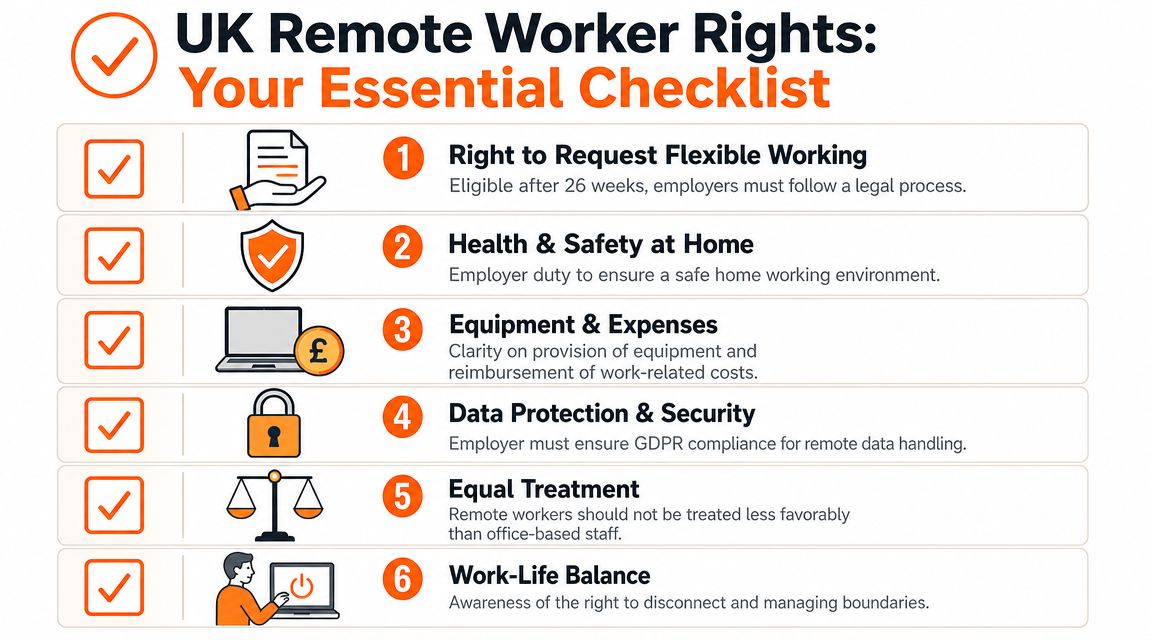
What to check in your contract
A strong remote arrangement usually spells out the basics clearly. Check for these points before you accept a role or sign a variation letter:
- Place of work: Does the contract list your home address, a broader UK home-based setup, or a named office with remote working allowed by policy?
- Attendance expectations: Are there fixed in-office days, occasional travel requirements, or wording such as “as business needs require”?
- Equipment responsibility: The contract or policy should say who provides laptops, monitors, headsets, and replacements.
- Expense treatment: Some employers cover homeworking-related costs. Others cover only business travel and core equipment.
- Data and confidentiality rules: If you handle customer, financial, or health data from home, the employer should set clear security standards.
Flexible working rights and practical reality
Employees in the UK may have the right to request flexible working, but a request is not a guarantee of permanent remote status. Employers still need to assess operational impact, role suitability, and team needs. The practical mistake many people make is treating the request process like an entitlement to a home-based contract. It isn't.
What usually works is presenting a role-specific case. Show how work will be done, how you'll handle meetings, availability, output tracking, and any customer-facing constraints. A vague request framed only around preference is easier for an employer to resist.
Working rule: If you want long-term remote stability, ask for precise wording. “Hybrid subject to manager discretion” gives you far less protection than a defined schedule or a home-based contractual arrangement.
Health and safety still applies at home
An employer's duties don't vanish because your desk is in a spare room. If you're working remotely on a regular basis, employers still need to think about workstation setup, screen use, risk assessment, and safe working practices.
That doesn't mean every home office gets a formal site visit. In practice, many employers use self-assessment forms, guidance on display screen equipment, and manager check-ins. The important part is that someone takes responsibility for the process. If nobody has asked how you're working, what equipment you need, or whether your setup is suitable, that's a warning sign.
Equal treatment matters more than policy slogans
Remote workers shouldn't be disadvantaged because they're less visible. The common failure points aren't dramatic. They're small and cumulative.
- Promotion access: Office-based staff get pulled into stretch work first.
- Information flow: Decisions happen after meetings or in corridor conversations.
- Training visibility: Remote employees get invited late or not at all.
- Performance judgment: Presence gets mistaken for contribution.
The legal and cultural answer is the same. Employers need consistent systems, not improvised exceptions. If your team relies on spontaneous office access to make decisions, remote workers will always be a step behind.
Navigating UK Tax and Residency Rules
Tax is where many remote setups stop being simple. A role can be operationally remote and still be complicated from a payroll or residency angle. The first question is not “Can I do the work from anywhere?” It's “Who is employing me, where am I tax resident, and how is income being reported?”
For most UK employees working for a UK employer, the basics are straightforward. Salary is generally handled through PAYE, National Insurance is dealt with through payroll, and your employer manages the routine deductions. The complexity starts when employer location, worker location, and contractual entity don't line up neatly.
A few common scenarios
Here's the practical way to consider this:
| Situation | Main issue to clarify early |
|---|---|
| UK resident working for a UK employer from home | Payroll, expenses, and contract wording |
| UK resident working remotely for an overseas company | Whether there is a UK payroll solution or local employing entity |
| Non-UK national living and working in the UK remotely | Immigration status, tax residence, and lawful right to work |
| UK employee working abroad temporarily | Whether the stay changes tax, social security, or local employment exposure |
A remote arrangement can look casual from the outside and still create real compliance obligations. International employers sometimes assume they can hire one person in the UK as if they were paying a freelancer anywhere in the world. That may not fit UK employment or tax realities if the person is functioning like an employee.
Homeworking expenses and relief
People often overestimate what they can claim personally. The answer depends on your status, what your employer reimburses, and whether the expense is wholly tied to work. Broadband, heating, equipment, and use of space don't all get treated the same way in every setup.
For a grounded overview of what counts and where people often misunderstand the rules, this guide on tax deduction working from home is a useful reference. If you want a second perspective focused on remote-friendly deductions, this roundup of remote work tax deductions is also worth reviewing.
The questions worth asking before you accept the role
Ask these before signing, not after your first payslip:
- Who is the legal employer? A UK entity, an overseas company, or an intermediary?
- How will payroll run? Through PAYE, a local partner, or another arrangement?
- What is your worker status? Employee, contractor, consultant, or agency worker?
- What expenses are reimbursed directly? Equipment, internet contribution, coworking, travel to meet the team?
- Are you expected to work outside the UK for extended periods? If yes, get written guidance.
Where people get into trouble
The most common problem isn't deliberate avoidance. It's vagueness. People accept a remote role because the work itself is clear, but nobody documents payroll responsibility, overseas reporting obligations, or where the worker is expected to be physically based.
If an employer says “we can hire anywhere” but can't explain the UK payroll route, don't treat that as a finished answer. Treat it as an unresolved risk.
For international employers, the safe approach is simple. Decide whether you're hiring a UK employee, engaging a genuine independent contractor, or using an intermediary structure. Blurring those lines usually creates the mess later.
How to Find Genuine UK Remote Jobs
Remote hiring in the UK is still active, but the easy phase has passed. Research from Lancaster University's Work Foundation reports that advertised remote-only positions in the UK are down by about 50% versus their 2020/21 peak, and 85% of disabled remote and hybrid workers say homeworking is essential or very important when job hunting in the same research summary on the decline in remote jobs. That gap matters. Demand for remote roles remains high while fully remote supply has narrowed, especially outside a few sectors and salary bands.
The practical consequence is simple. Job seekers need better filters, and employers need to describe roles with more precision.
Read the ad like an operating document
A good remote listing does more than say "remote." It explains how the job works.
Scan for the details that change whether the role is a fit:
- “Remote within the UK” usually means the employer wants someone based in the UK for payroll, compliance, meeting hours, or occasional in-person days.
- “Hybrid” can mean one office visit per quarter or three days a week. If the pattern is vague, assume the employer has not settled it internally.
- “Flexible” often refers to start and finish times, not freedom to live anywhere.
- “Distributed team” may describe the company, while the role itself still sits in a commuting radius.
The strongest ads answer basic operating questions early. Where can the person live? Which hours matter? How often does travel happen? What tools and habits does the team use to work remotely? If those points are missing, treat the role as unqualified until proven otherwise.
Search by fit, not by volume
Broad remote searches produce a lot of noise in the UK market because many listings are technically remote but geographically restricted, tied to London pay assumptions, or remote in only a narrow sense.
A tighter process works better:
- Start with job families that stay remote more often. Software engineering, product, design, data, digital marketing, customer support, and some operations roles still produce more credible remote listings than generic remote job boards full of mixed admin work.
- Filter for UK hiring scope early. A role may be remote but still unavailable to someone who needs UK employment terms.
- Check sector reality. Tech, SaaS, digital agencies, and online education tend to be more remote-friendly than healthcare delivery, public-facing operations, or heavily site-based functions.
- Watch for regional imbalance. Some employers say UK-wide but still favour candidates near London, Manchester, Bristol, or Edinburgh for team days and informal access.
- Qualify before you apply. Ten well-screened applications usually outperform fifty hopeful ones.
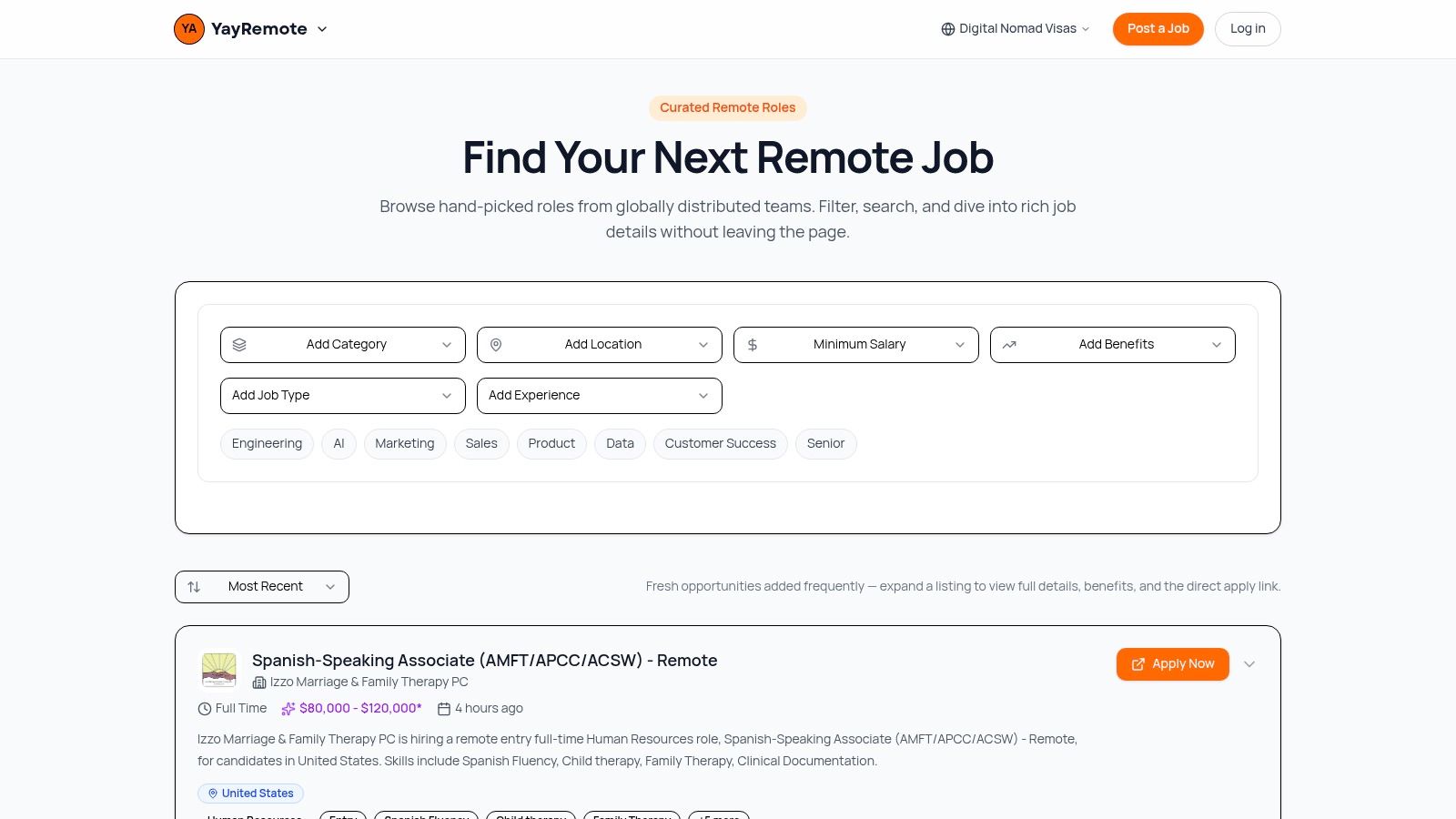
YayRemote is one useful option for filtering roles by category, location, salary, benefits, and experience level. That helps candidates test whether a job fits their working pattern before they spend time on applications. Employers building a stronger process on the other side of the market can review this practical guide on how to hire remote employees.
Show evidence that you can work well without supervision
Remote employers do not need a slogan about being self-motivated. They need proof that you can produce work with limited hand-holding, write clearly, and stay reliable when nobody is watching your screen.
Make that visible in your CV and application:
- Show async communication. Mention written updates, handover notes, decision logs, knowledge base work, or project documentation.
- Show independent execution. Include projects you owned from brief to delivery.
- Show tool fluency. Name the systems that matter for your role, such as GitHub, Jira, Notion, HubSpot, Figma, Zendesk, or Salesforce.
- Show remote coordination. Cross-time-zone work, stakeholder management, client calls, and distributed team delivery all count.
Weaker candidates lose ground here. They describe responsibilities. Stronger candidates describe how they worked.
A short screening resource can also help if you are exploring entry-level categories where vague or misleading ads are common. This guide to work from home data entry is useful because it shows what legitimate remote admin-style work usually includes and what should raise concern.
Here's a useful walkthrough to pair with your search process:
A simple screening framework
Use this before every application:
| Question | Why it matters |
|---|---|
| Is the role fully remote, hybrid, or only flexible on hours? | UK employers often use these terms loosely |
| Is the UK an approved hiring location? | It avoids wasted time on roles you cannot legally or practically take |
| Are office visits optional, occasional, or scheduled? | A monthly train journey and a twice-weekly commute are different jobs |
| Does the employer explain how remote work is managed? | Clear systems usually signal a team that has done this before |
| Can your CV prove remote readiness with examples? | Generic applications rarely survive screening |
Apply with more discipline. In a tighter UK remote market, clear fit beats application volume.
A Guide for Employers Hiring UK Remote Talent
Employers hiring in the UK often focus first on sourcing. The bigger risk usually sits in setup. A remote hire fails faster when the contract is vague, payroll choices are improvised, equipment arrives late, or managers treat remote work as an exception instead of an operating model.
The strongest UK remote hiring processes are boring in the right way. They are clear, documented, and repeatable.

What employers need to lock down first
Before you advertise the role, decide these points internally:
- Employment model: UK employee, contractor, or another formal structure. Don't leave this until offer stage.
- Location scope: UK-wide, England only, specific commuting radius, or named office catchment.
- Remote policy: Fully remote, hybrid with defined attendance, or role-by-role flexibility.
- Manager expectations: Response times, meeting windows, documentation, and availability rules.
- Equipment and support: Shipping, replacements, security tools, and who handles setup.
A remote contract should align with the reality of the job. If the role is marketed as remote but the contract names an office as the normal place of work without clear remote terms, you create uncertainty on day one.
Hiring practice that actually supports retention
Remote hiring in the UK isn't just about legal compliance. It's also about reducing preventable friction in the first months.
A reliable remote onboarding process usually includes:
- Pre-start logistics completed early. Laptop, accounts, security access, and reporting lines ready before day one.
- Written operating norms. New hires shouldn't need to infer how to communicate or escalate issues.
- Structured manager contact. Frequent check-ins at the start, then a stable rhythm.
- Visible inclusion. Remote staff need access to decision-making channels, not just task lists.
If your team runs heavily on Microsoft 365, this onboarding guide for M365 firms is a practical reference because it focuses on the system and process side of remote onboarding, not just welcome calls.
Avoid office-first drift
A lot of employers think they run hybrid well because policy allows homeworking. The test lies in operations. Are meetings documented? Are decisions captured in shared systems? Can someone outside headquarters build influence without travelling in constantly?
That matters because UK remote access is already uneven by job type and salary, as covered earlier. Employers who want broader talent access need to remove hidden office bias from promotion, feedback, and project allocation.
For a broader framework on structuring distributed hiring, this guide on how to hire remote employees is a useful reference point.
Good remote hiring is mostly disciplined management. Clear expectations beat generous slogans every time.
Essential Resources for UK Remote Success
The most useful remote toolkit in the UK isn't a single app or policy. It's a combination of decisions. Where you search, how you check legal fit, whether you can work effectively from home, and whether your employer operates well at a distance all matter more than the label on the job ad.
For job seekers, build a small stack of resources you'll use repeatedly:
- A focused jobs workflow: Save searches by function, location eligibility, and contract type.
- A document-first application process: Keep role-specific CV versions, remote-work examples, and interview notes ready.
- A backup workspace option: If home isn't ideal every day, look at local coworking directories or day-pass spaces in your area.
- A core tools checklist: Calendar discipline, secure password management, video setup, and a reliable note system matter more than trendy software.
For employers, the toolkit looks different. You need written policies, a clean onboarding path, remote-capable managers, and systems that don't rely on office proximity to function well.
If your plans extend beyond the UK, a broader library of remote work resources helps with the next layer of questions, including international working arrangements, practical tools, and location planning.
The remote work in uk market is still full of opportunity. It's just less forgiving of vague assumptions than it was a few years ago. Candidates who search strategically and employers who design clearly will keep finding good matches. The rest will keep arguing about flexibility while losing time in preventable confusion.
If you're actively looking for location-flexible roles or building a distributed hiring process, YayRemote is a useful place to start. It brings together remote job listings, application tools, and practical guides in one place, which makes it easier to evaluate fit before you commit time to an application or a hiring workflow.