Remote Work Part Time: Find remote work part time Jobs That Fit Your Schedule
Discover practical steps to land remote work part time roles, from resume tweaks to interviews, and start your flexible career today.
Welcome to a world where flexibility isn't just a perk; it's the whole point. The demand for part-time remote work isn't some passing fad—it's a permanent shift, driven by millions of us who want to build a career that fits our lives, not the other way around.
If that sounds like you, you're in the right place. This guide is all about actionable advice to help you land that perfect role.
The New Career Landscape is Flexible
Let's be honest, the traditional 9-to-5 office job feels like a relic for many of us. Today, professionals are actively looking for arrangements that give them real control over their schedules and location. This isn't just a trend; it's a fundamental change in how we think about the relationship between our careers and our lives.
This shift is powered by real people with real needs. Maybe you're a parent juggling school runs, a student balancing classes, or a creative professional building a side hustle. Part-time remote work is the practical solution that lets you earn a living and grow your skills without putting the rest of your life on hold.
Why Part-Time Remote is Gaining Momentum
The numbers don't lie. By 2026, projections show that over 330 million people will be working remotely in some way, from full-time home offices to hybrid setups.
Right now, 27% of full-time employees are fully remote. Add in the 52% who work in a hybrid model, and you'll see that flexible work is already the reality for nearly 80% of all remote-capable jobs. If you're interested in the data, you can read more about these global workforce analyses to see just how big this movement is.
This massive growth has created a job market that's both competitive and brimming with opportunities. Smart companies have realized that offering flexibility is non-negotiable if they want to attract and keep great people.
The ability to work part-time from anywhere is a game-changer. It empowers people to design their own careers, which leads to higher job satisfaction and better mental well-being. It’s all about integrating work into your life, not structuring your life around your work.
As you start looking for a part-time remote work position, remember you’re part of a huge global shift. Platforms like YayRemote are built specifically to connect you with these forward-thinking companies, making it easier than ever to find a role that clicks. Let's get you equipped with the strategies to navigate this landscape with confidence.
How To Find Great Part-Time Remote Jobs
Finding the right part-time remote job is less about endless scrolling and more about searching smart. It’s easy to get lost in the sea of job postings, but the right approach helps you cut through the noise and zero in on roles that actually fit your life. This means looking beyond the massive, generic job boards and focusing on platforms built specifically for remote work.
Specialized sites like YayRemote are designed for this exact purpose. Instead of wading through thousands of irrelevant full-time, in-office listings, you can apply specific filters right from the start. Think: job type (part-time), salary expectations, and even required time zones. This control is everything when you need a job that works with your schedule, not against it.
Master Your Search Strategy
A great search is all about precision. A few simple tweaks to how you look for jobs can make a world of difference in the quality of your results.
This is where knowing a little bit of search logic comes in handy. Using Boolean operators can help you give the job board very specific instructions:
"part-time" AND "marketing"will show you roles that contain both terms."customer support" NOT "full-time"will filter out all the full-time positions.("writer" OR "editor") AND "remote"is great for broadening your search to include similar roles.
Making this small change helps you weed out jobs that aren’t a good fit from the get-go, saving you a ton of time and frustration.
Another pro move? Set up job alerts. Once you’ve dialed in your filters and keywords, let the platforms do the work for you. You’ll get relevant part-time remote work opportunities sent straight to your inbox, making sure you’re one of the first to see—and apply for—the best new openings.
This flowchart can help you visualize that initial decision-making process when you’re aiming for a more flexible career.
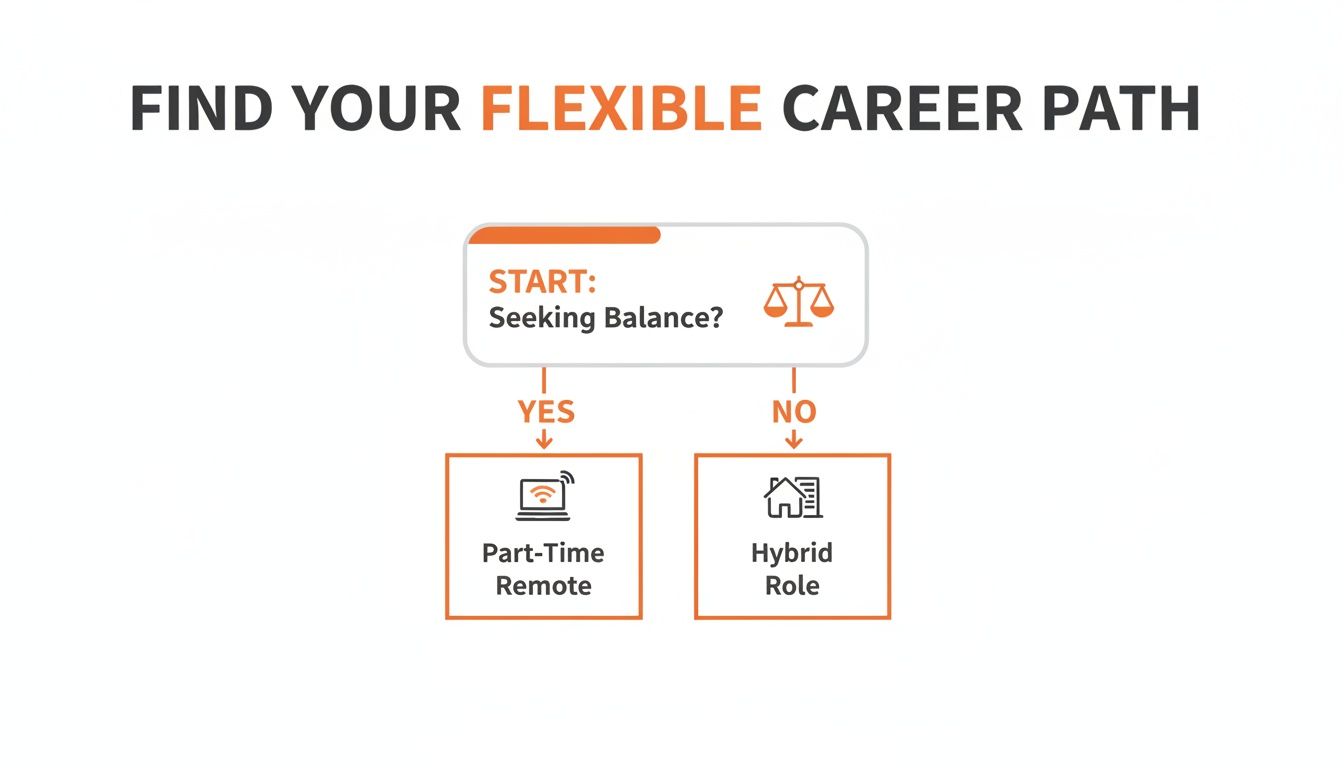
Whether you land on a part-time remote role or something more hybrid, the goal is the same: finding a better balance that works for you.
When you're starting your search, it helps to know where to focus your energy. Not all job boards are created equal, especially for part-time remote roles.
Comparing Job Search Channels for Part-Time Remote Roles
| Channel | Best For | Key Features | Search Tip |
|---|---|---|---|
| YayRemote | Dedicated remote job seekers looking for curated, high-quality listings. | Advanced filters (part-time, time zone, salary), company profiles, daily alerts. | Use the "Part-Time" filter and save your search to get immediate notifications. |
| FlexJobs | Professionals seeking vetted flexible work, including part-time and freelance. | Scam-free listings, skills tests, career coaching resources. | Leverage their "Job Type" category to filter specifically for part-time roles. |
| Networking and leveraging professional connections to find opportunities. | Robust company pages, direct messaging with recruiters, job alerts. | Combine keywords like "part-time contractor" with the "Remote" location filter. | |
| Niche Industry Boards | Experts in specific fields (e.g., We Work Remotely for tech, Dribbble for design). | Highly relevant roles, community-focused, access to industry leaders. | Go straight to these boards for targeted roles that might not appear elsewhere. |
Ultimately, using a mix of a dedicated remote board like YayRemote and a niche industry site often yields the best results.
Vet Companies for a True Remote Culture
Finding a part-time job is one thing. Finding one at a company that actually gets remote work is another entirely. A genuine remote-first culture is about so much more than just letting you work from your kitchen table; it's rooted in asynchronous communication, deep-seated trust, and giving you the tools to succeed from anywhere.
A company’s commitment to flexibility often shines through in the details. Scour the job description and their careers page. Do they talk about flexible hours, a home office stipend, or specific collaboration tools like Slack, Notion, or Asana?
These aren't just buzzwords; they’re strong indicators of a supportive remote environment. You can also get a head start by checking out curated lists of the best remote companies to work for. Doing this homework upfront helps ensure you land in a role where you can truly thrive.
Crafting an Application That Gets Noticed
When you're applying for remote work, your resume isn't just a list of past jobs. It's your digital handshake, your first impression, and your one shot to convince someone you're the right person for the role. This is especially true when you're going for remote work part time—you have to prove you can deliver results without someone looking over your shoulder.
It's not enough to just list your skills. You need to build a narrative that shows you’re a self-starter who thrives with autonomy. Let's break down how to do that.
Showing You’re Ready for Remote Work
Hiring managers for remote roles have one big question on their minds: can this person be trusted to get the job done from a distance? Your job is to answer that question with a resounding "yes" throughout your application.
Start by weaving these critical remote-work traits into your resume and online profiles:
- Self-Discipline & Time Management: Don't just say you're organized. Give examples. Frame your past projects in terms of how you managed deadlines, prioritized tasks, and took the lead on scheduling without any hand-holding.
- Asynchronous Communication: Being a great remote worker means being a great writer. Highlight your experience with tools like Slack, Asana, or Trello. Talk about how you use clear written updates to keep teammates aligned, even if they're in a completely different time zone.
- Proactive Problem-Solving: Think of a time you spotted a problem and fixed it before your boss even knew it existed. That's gold for a remote role. It shows you take initiative, which is exactly what they're looking for.
For every bullet point on your resume, ask yourself: "How does this prove I can do great work independently?"
A hiring manager's biggest fear is that a part-time, remote hire will feel disconnected and struggle with productivity. Your application needs to proactively dismantle that fear, building confidence that you can jump in and contribute from day one.

Tailor Your Resume for Every Single Application
Let's be blunt: a generic, one-size-fits-all resume is a waste of your time. Most companies use Applicant Tracking Systems (ATS) to scan resumes for keywords before they ever land in front of a human. If your resume doesn't have the right words, it gets tossed out.
Getting past these digital gatekeepers requires a bit of strategy. Read the job description like you're studying for a test. Pull out the key skills and responsibilities they mention. Now, make sure those exact phrases are woven naturally into your resume.
If you're not sure where to start, you can get a huge leg up by using a free resume skills analyzer to see how well you match up.
Here’s a real-world example. Imagine a company is looking for a part-time social media manager and the posting keeps mentioning "community engagement" and "content scheduling."
A Real-World Resume Summary Makeover
Before (Too Generic): "Experienced social media manager looking for a new opportunity."
After (Optimized for a Remote, Part-Time Role): "Self-motivated Social Media Manager with 5+ years of experience driving community engagement and executing content schedules for distributed teams. Proficient in asynchronous collaboration tools and skilled at delivering measurable results within a flexible, part-time framework."
See the difference? The "after" version immediately hits all the right notes. It showcases relevant experience, drops in the keyword "self-motivated," and signals that you understand how remote teams work. This is how you turn an application into an interview.
Mastering the Remote Interview and Negotiation
Getting the interview is a huge step, but now it's time to seal the deal. Think of the remote interview as a performance. It’s not just a test of your skills, but a real-world demonstration of how well you communicate and connect through a screen. For remote work part time, the stakes feel even higher.
Hiring managers aren't just looking for someone who can do the job. They need to see that you can slot into their team, manage your own time, and deliver real value in fewer hours. Your mission is to show them you’re not just capable, but a perfect fit for their distributed culture.
Acing the Video Interview
Long before you answer a single question, your video presence is already telling a story. A professional, distraction-free setup shows you take remote work seriously. You don’t need a fancy studio, just a bit of thoughtful prep.
- Tech Check First: Always test your camera, microphone, and internet connection ahead of time. Nothing kills the momentum of an interview faster than a frozen screen or garbled audio.
- Set the Scene: Find a quiet spot with good lighting. A simple, uncluttered background is your best bet. Make sure pets, kids, or roommates won’t make a surprise appearance.
- Show You Know the Tools: If the company uses Slack or Asana, casually mention your experience with them. It’s a small detail that signals you're ready to hit the ground running.
Once the interview begins, make a conscious effort to look at the camera lens, not just the person's face on your screen. It feels a little weird at first, but it's the digital equivalent of making eye contact and it helps build genuine rapport.
When you get asked, "How will you stay connected with the team?"—that's your moment. Talk about your experience with async updates, how you actively participate in virtual meetings, and your habits for proactively reaching out to colleagues. This proves you get the unique communication rhythm of a successful remote team.
Navigating Part-Time Negotiation
When the offer comes through, the conversation shifts. For part-time roles, this isn't just a standard salary negotiation. It's a much more detailed discussion where you're essentially co-designing the structure of your role.
The goal is to land on an agreement that fairly reflects your value while giving you the flexibility you came for. Come to the table ready to talk through a few key areas to make sure there are no surprises later on.
Key Negotiation Points for Part-Time Roles
- Compensation Structure: Are they offering an hourly rate or a pro-rated salary? An hourly rate is common and works well for workloads that might ebb and flow. A pro-rated salary offers more stability. Know the pros and cons of each before you start talking numbers.
- Benefits Eligibility: Never assume. Ask directly about access to health insurance, retirement plans, and paid time off. Some companies offer pro-rated benefits to part-time employees, which can be a huge win.
- Schedule and Availability: This is where you get specific. Will you work a fixed schedule, like 9 AM to 1 PM every day? Or will it be a more flexible arrangement based on a total number of hours per week? It’s also critical to discuss expectations around meetings, especially if the team is in a different time zone.
- Scope and Expectations: You need to clearly define what success looks like. How will your performance be measured? Getting a firm handle on your key responsibilities is the best way to prevent "scope creep" and ensure you can make a meaningful impact within your agreed-upon hours.
Negotiating for a part-time remote role is really about building a sustainable partnership from day one. By getting clarity on these points upfront, you’re setting the stage for a position that truly gives you the work-life balance you’re after.
How to Succeed in Your New Part-Time Role
You did it. You landed the job. That’s a huge win, but now the real work begins: proving that a part-time pro can deliver full-time impact. Thriving in a remote work part time role isn’t automatic; it takes a smart, deliberate approach right from day one.

Think of your first couple of weeks as a sponge phase. Your mission is to absorb everything—the team’s communication quirks, who the key players are, and all those unwritten rules of the company culture. Don’t just sit back and watch. Be proactive. Ask questions, and get some quick 15-minute intros on the calendar with your new teammates.
Master Your Time and Set Clear Boundaries
Let’s be honest: the biggest challenge in a part-time remote gig is managing expectations. Without firm boundaries, your 20-hour week can quietly creep into 30 hours or more, and that's a fast track to burnout. Your success hinges on being ruthlessly efficient with the time you do have.
First, give your workweek a solid structure. Block out "focus time" on your shared calendar for deep, uninterrupted work. It’s a simple move, but it signals your availability to colleagues and protects your most valuable hours from getting sliced and diced by random meetings.
Just as important is knowing when to shut it all down. It’s so tempting to fire off one last Slack message after hours to show you’re dedicated. Resist. All that does is set an unsustainable precedent. Your team will learn to respect your boundaries, but only if you respect them first.
The goal is to be known for the quality and impact of your work, not the number of hours you're online. When you're working, be fully present and productive. When you're off, be fully off.
This isn’t just about work-life balance; it’s about long-term sustainability and performance.
Be Proactive and Over-Communicate
In a remote team, you can’t rely on people seeing you hard at work at your desk. Visibility is something you have to create yourself. This is where proactive communication becomes your superpower.
- Provide Regular Updates: Don't make your manager chase you down. Share brief, regular summaries of your progress in a shared Slack channel or your project management tool. It builds trust and keeps everyone in the loop.
- Clarify Expectations Early: Before diving into a big task, double-check that you’re crystal clear on the goal and the deadline. A quick "Just to confirm..." message can save you from hours of rework.
- Participate in Team Channels: It’s not all business. Chime in on the non-work channels when it feels natural. Sharing a bit of your personality helps you build real connections and feel like part of the crew.
Juggling schedules across the globe can be tricky. You can check out our guide on finding the perfect time zone overlap to make that collaboration a whole lot smoother.
Understand Your Role in the Bigger Picture
Part-time remote work isn’t some niche arrangement anymore—it’s a core part of how modern companies operate. They’re using it as a strategic tool to attract the best talent. The numbers back this up: 52% of global full-time employees are now on a hybrid schedule, and over 80% of employers say remote work is critical for hiring and keeping top performers. You can learn more about the trends shaping remote work and see just how vital your role is.
Finally, don’t forget the administrative stuff. Get a handle on how your part-time status impacts your taxes and benefits. Knowing these details from the start means no unpleasant financial surprises later. By mastering these strategies, you won't just succeed—you'll become an indispensable part of the team.
Got Questions About Part-Time Remote Work?
Diving into the world of part-time remote work can bring up a lot of questions. It's a different beast than the traditional 9-to-5, so it's smart to know what you're getting into. Let's tackle some of the most common things people wonder about.
How Do Companies Figure Out Pay for Part-Time Roles?
Compensation for part-time remote jobs is all over the map. Unlike a standard full-time salary, you'll find that many part-time gigs pay by the hour. What that hourly rate looks like really depends on the industry, your own experience, and the specific skills they need you to bring to the table.
You'll often see a higher hourly rate for specialized contract or freelance work compared to a permanent part-time employee role. Some companies, however, might offer a pro-rated salary. This just means you get a slice of the full-time salary based on your hours. For instance, a job that’s 20 hours per week could pay 50% of the full-time equivalent salary. Make sure you get this crystal clear during the offer stage—are we talking hourly or pro-rated?
What's the Deal with Benefits Like Health Insurance?
This is a big one, and honestly, the answer is: it depends. In the U.S., companies aren't typically required by law to provide benefits like health insurance to someone working less than 30 hours per week. That said, a lot of the really great companies do offer pro-rated benefits to attract the best people, no matter how many hours they're logging.
Don't just assume benefits are off the table. It's crucial to ask directly about their policies for health insurance, retirement plans, and paid time off. A company willing to invest in its part-time team is usually a sign of a healthy remote culture.
Some places might offer a stipend for healthcare or wellness instead of a full plan. When you're looking at an offer for remote work part time, you have to weigh the value of those benefits (or lack thereof) into your total compensation package.
How Can I Steer Clear of Job Scams?
It's an unfortunate truth: the more popular remote work gets, the more scams pop up. The golden rule is that a legitimate employer will never ask you to pay for your own equipment, training, or a background check. They also won’t run an entire interview process through a chat app like Telegram.
Keep an eye out for these red flags:
- Super Vague Job Descriptions: Real jobs have clear duties and expectations.
- Unprofessional Emails: Be wary of messages full of typos or sent from a personal email address (like a Gmail account instead of a company domain).
- An Offer That's Too Good to Be True: If they're offering a massive salary for a simple data entry role, something's probably not right.
Your best defense is sticking to reputable job boards that actually screen their listings. A real hiring process has multiple steps, usually including video calls and clear, professional communication from official company email addresses. That's how you know you're dealing with a genuine opportunity.
Ready to find a legitimate, high-quality remote role that actually fits your life? YayRemote hand-picks the best part-time opportunities from trusted companies all over the world. Start your search and filter for your perfect job today.