Salary for Community Manager 2026: In-Depth Guide
Discover the salary for community manager in 2026. This guide covers pay by experience, location, and skills, plus negotiation tips to earn more.
You find a community manager role that fits your background almost perfectly. The mission is good. The product is interesting. The responsibilities sound like work you've already done. Then you hit the compensation line and it says “competitive,” “depends on experience,” or nothing at all.
That's where most candidates lose their advantage. They either anchor too low because they don't want to scare the company off, or they throw out a number based on a random salary calculator and hope it lands. Neither approach is strong.
A better approach is to stop chasing one magic average and start reading the market like a recruiter would. The salary for community manager roles isn't one neat number. It moves based on location, specialization, seniority, scope, and how clearly you can tie your work to outcomes. If you're in Canada and need help translating gross pay into what matters for budgeting, this essential guide for Canadians is useful context. And if your background overlaps with audience growth or content-led engagement, this breakdown of remote social media manager roles can help you separate adjacent jobs that often get mislabeled as community.
The candidates who earn more usually do three things well. They know where they sit in the market. They target roles with the right pay architecture. And they negotiate from evidence, not hope.
Decoding Your Earning Potential as a Community Manager
A lot of people searching for salary for community manager roles ask the wrong first question. They ask, “What's the average?” The better question is, “Which version of this role am I being hired to do?”
A community manager who moderates posts, welcomes members, and keeps the calendar moving is not competing in the same pay band as someone who owns lifecycle strategy, runs executive-facing reporting, translates product feedback, and manages a technical user base. Same title. Different economic value.
Why one average won't help much
The market punishes vague positioning. If you describe yourself as “good at engagement,” employers hear junior or generic. If you describe yourself as the person who reduced friction in onboarding, handled member escalations calmly, ran events, and surfaced product insights to internal teams, you sound more expensive. That's because you are.
Practical rule: Community titles are messy. Your pay depends more on scope than title.
That's why candidates get confused. They compare themselves to one public number, then wonder why one company offers far less while another seems willing to go much higher. The gap usually comes from role design, not candidate quality.
What to focus on instead
Use these levers to frame your value before you talk money:
- Your community type: Customer community, creator community, gaming, B2B SaaS, developer, marketplace, and membership communities all expect different strengths.
- Your operating level: Are you an executor, an owner, or a strategist who can influence cross-functional decisions?
- Your business fluency: Can you explain retention risk, product feedback loops, support deflection, advocacy, or expansion signals in plain language?
- Your technical comfort: If you can work credibly with product, support, or developer audiences, your ceiling rises.
The strongest salary conversations start before the interview. They start with a clear read on what kind of community manager you are and what kind of company is likely to pay for that version of the role.
The 2026 Community Manager Salary Landscape
If you want a grounded salary expectation, start with the spread, not the headline number. In the United States, Built In's community manager salary data shows a range of $36,000 to $162,000, with an average salary of $68,536 and average total compensation of $75,883, including $7,347 in additional cash compensation. In the same U.S. market, that source also notes Indeed's average at $63,678 per year. Those numbers don't contradict each other. They show how much methodology changes the result.
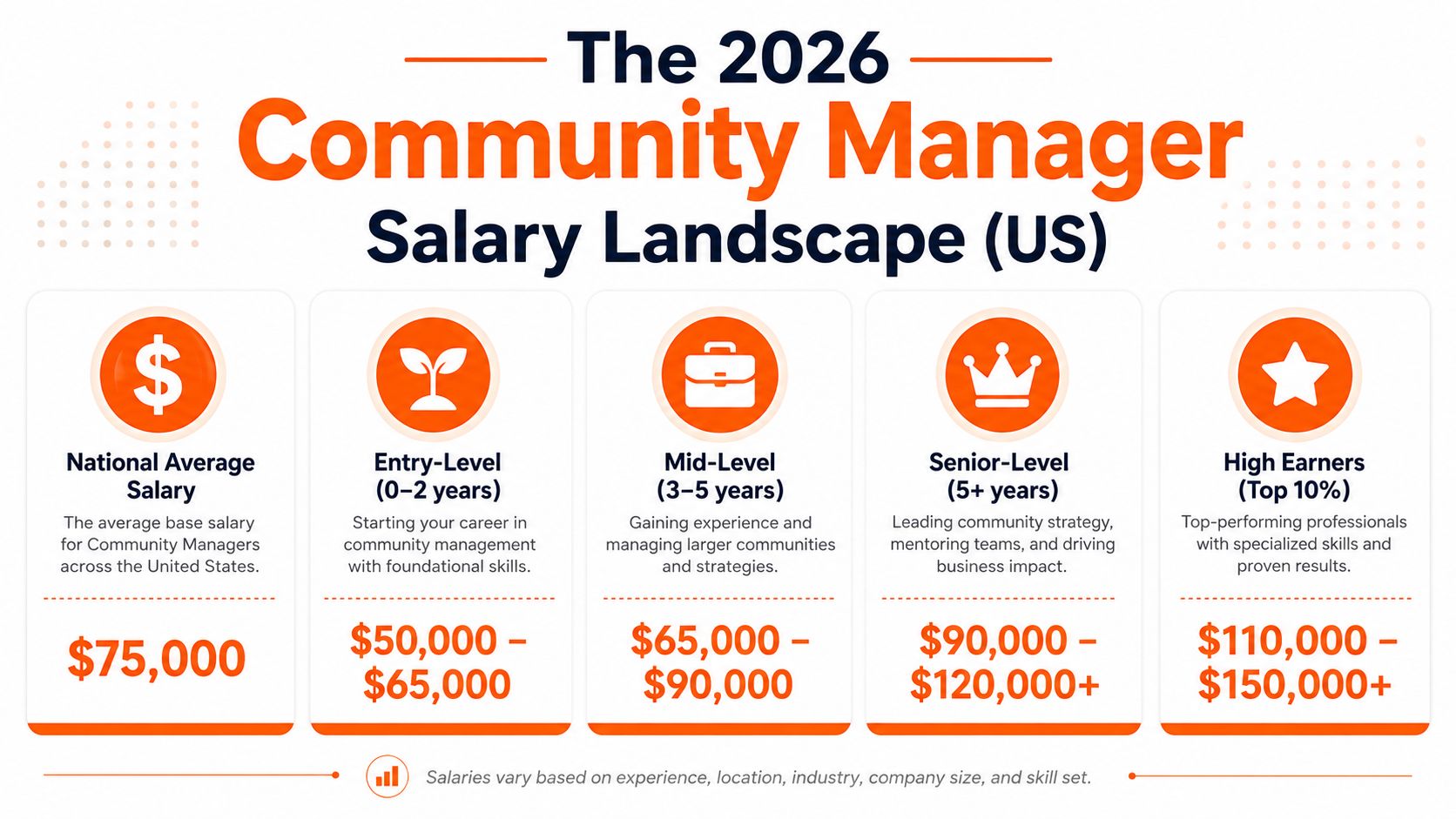
What those U.S. numbers actually tell you
Here's the takeaway I'd use if I were coaching a candidate for interviews this week:
| Market view | What it says |
|---|---|
| Built In average | Useful for seeing employee-reported compensation patterns |
| Indeed average | Useful for seeing job-posting-based salary trends |
| Full U.S. range | More useful than either average when you're setting expectations |
That wide U.S. band matters. It tells you the salary for community manager roles is not standardized. It's shaped by company type, job scope, and labor market context. If you're aiming for a number just because you saw it once in a salary widget, you're negotiating blind.
Read the range like a recruiter
A recruiter won't look at “community manager” and assume one compensation band. They'll ask questions such as:
- Is this role reactive or strategic?
- Will this person just engage members, or will they influence product, customer success, or brand?
- Is the company hiring in a broad national market or a premium metro market?
- Does the role include variable pay or cash compensation on top of salary?
The spread is the signal. The average is just a reference point.
That's why I tell candidates to build a target range, not a target number. If your work is closer to general audience engagement, you may sit nearer the core of the market. If you're being asked to own systems, reporting, escalation handling, and cross-functional communication, your case should move upward.
One more point. Additional cash compensation matters, but only if the company explains it clearly. If they mention bonus, ask what it's tied to, how it's paid, and whether it's been consistently funded. Never treat vague upside as guaranteed pay.
Key Factors That Influence Community Manager Pay
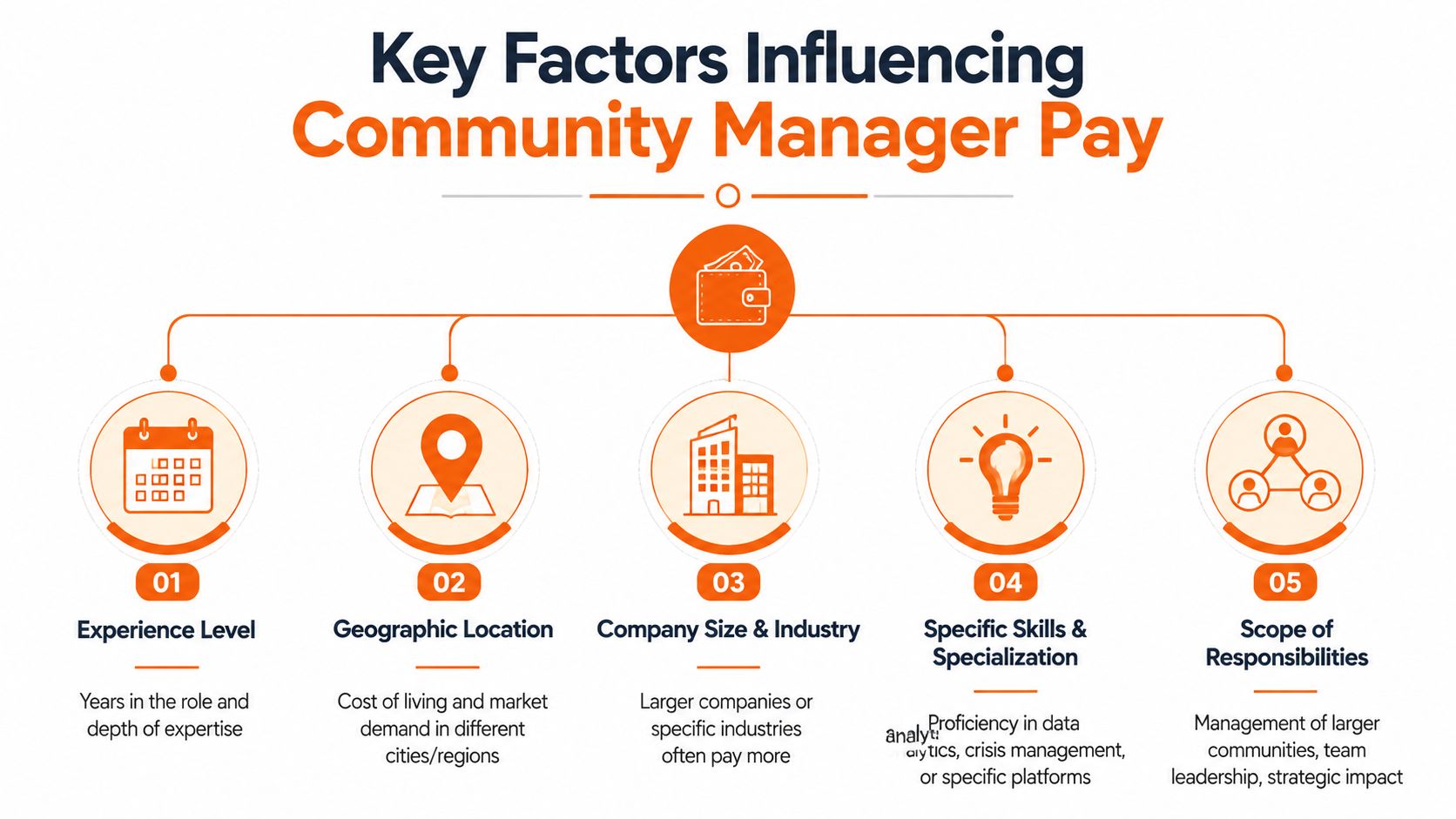
The title doesn't determine compensation. The operating environment does. Two people can both be called community managers, and one can be paid dramatically more because the company needs harder skills, broader judgment, or market-specific expertise.
Geography changes the baseline
Location still matters, even in remote hiring. In Canada, Robert Half's 2026 community manager salary guide lists $53,500 to $74,000, with a midpoint of $62,500. That's a tighter and more standardized band than the broader U.S. range.
The same source points to major geographic differences elsewhere. In France, an entry-level community manager earns €20,000 to €25,000 gross per year, experienced professionals make €35,000 to €40,000, and senior community managers reach €45,000 to €55,000. It also notes that freelance community managers can reach €50,000 with experience. Then you look at Miami, where a cited Salary.com figure reports a median annual salary of $103,215 and an entry-level average of $87,699. That's not a minor variation. That's market segmentation.
If you're interviewing for a remote role, don't assume “remote” means neutral pay. Some companies benchmark nationally. Others anchor to a headquarters market. Others adjust by location while calling the role fully remote.
Specialization raises your ceiling
Many community professionals tend to underprice themselves. Specialized community work pays more because fewer candidates can do it well.
Glassdoor's technical community manager salary page lists a U.S. average salary of $109,443 for Technical Community Manager roles. The verified comparison against broader community manager estimates places that roughly 30%+ above generalist roles. That premium makes sense. Technical community work often requires product fluency, developer empathy, troubleshooting ability, and the skill to translate user pain into internal action.
If you can speak both member and product, you're more valuable than a pure engagement generalist.
Other pay levers employers actually use
Not every lever comes with neat public numbers, but they show up in offers all the time:
- Seniority and ownership: Running daily operations is one thing. Owning strategy, reporting, and cross-functional alignment is another.
- Industry fit: SaaS, gaming, platforms, and technical ecosystems often pay for domain fluency faster than lifestyle or creator-led brands do.
- Company stage: Early startups may offer broader scope and less structure. Mature companies may pay more for process, consistency, and stakeholder management.
- Public proof of value: Strong portfolios matter. If your LinkedIn positioning is weak, fix that before you negotiate. This guide on how to optimize LinkedIn presence with AI is worth reviewing if your profile undersells your commercial impact.
- Team complexity: Solo community ownership, moderation at scale, executive reporting, event programming, and support coordination all change what the company thinks it's buying.
The pattern is simple. The more your role touches product, retention, customer insight, or technical trust, the less you should benchmark yourself like a generic social role.
How to Benchmark Your Personal Market Value
Most candidates benchmark badly because they use one data source and one job title. That's lazy research. You need a short working model based on your background, target companies, and the actual scope in front of you.

Build your benchmark in four passes
Start with a practical worksheet, not a fantasy number.
Define your closest role type
Write down the last two roles you held and list what you owned. Moderation, member support, lifecycle, partnerships, product feedback, events, reporting, community ops, ambassador programs, or technical education. Then match yourself to the role type you most closely resemble.Study live job descriptions
Ignore titles for a moment. Read the responsibilities and sort them into buckets. If a posting asks for product collaboration, escalations, analytics, and strategic planning, that's a stronger role than one focused mostly on posting, replying, and scheduling.Check adjacent pay markets
Some community roles overlap with support, customer success, social, developer relations, or product education. That overlap matters. It helps you avoid underestimating your value. This overview of technology job salaries is useful for seeing how adjacent functions can shift compensation expectations.Create a target range with a floor
Set three numbers privately: your ideal target, your realistic target, and your walk-away floor. Don't share all three. Use them to stay disciplined.
Look for hidden compensation clues
Companies reveal more than they think in job descriptions. Watch for signals like these:
- Cross-functional exposure: If the role reports insights to product, marketing, support, or leadership, the company sees it as more than moderation.
- Tool stack complexity: Community platforms, CRM systems, support tools, event tools, analytics tools, and workflow systems usually indicate broader ownership.
- Responsibility language: “Own,” “lead,” “drive,” and “shape” generally point upward. “Assist,” “support,” and “help manage” usually point downward.
Your market value isn't your last salary. It's the price of the next problem you can solve.
Sanity-check your benchmark
Before any interview loop, ask yourself three blunt questions:
| Question | Why it matters |
|---|---|
| Would I be replacing an executor or a builder? | Builders usually command more |
| Does this company need trust, growth, or technical translation? | Harder needs support stronger asks |
| Can I prove I've handled similar complexity? | Proof beats confidence every time |
If you can't explain your value in plain language, your benchmark is still too abstract.
Finding High-Paying Roles and Negotiating Your Offer
Job seekers often waste time applying to roles they should've filtered out in minutes. If compensation matters, screen hard at the top of the funnel.
Filter the market before the market filters you
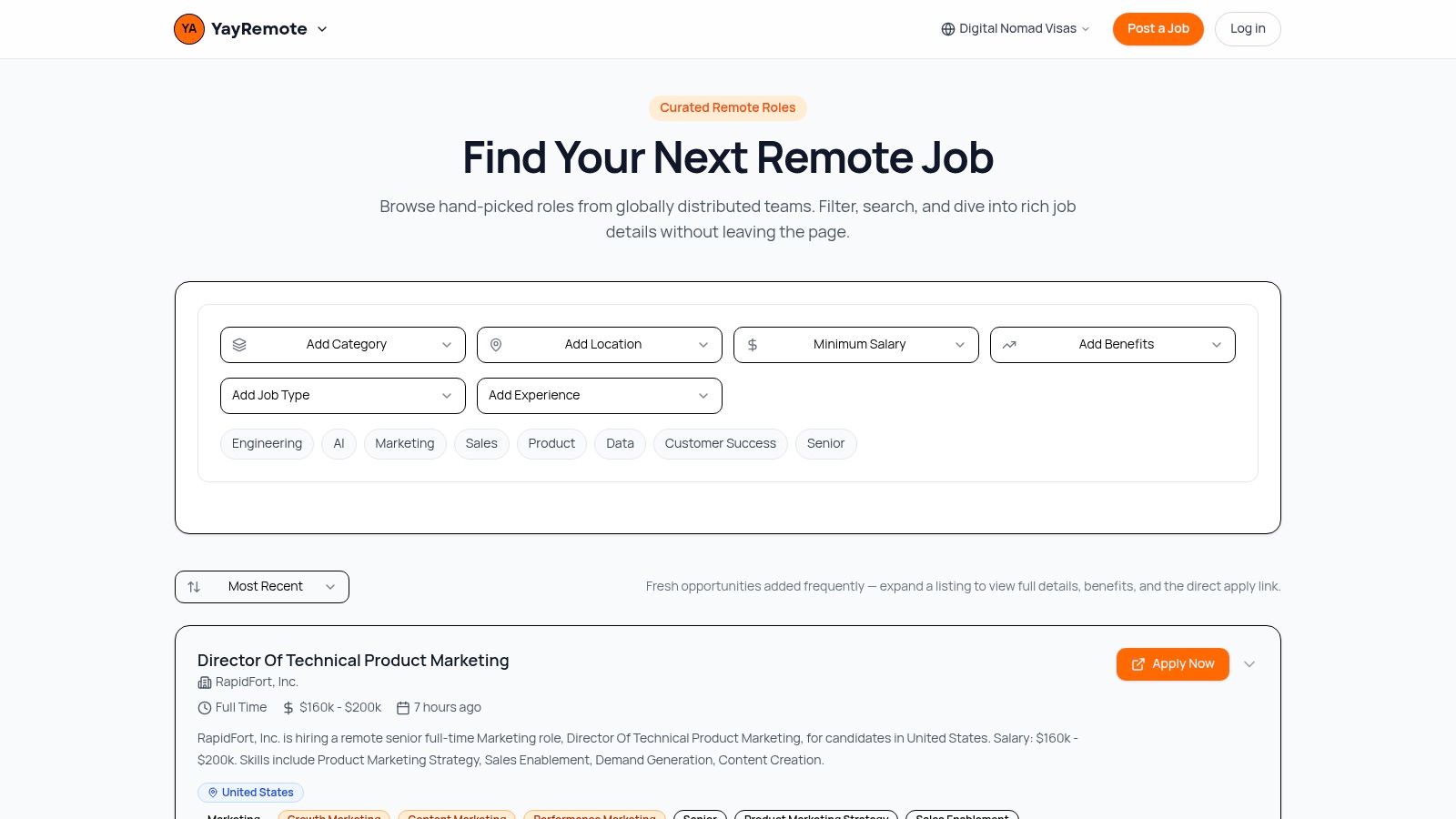
Use job platforms that let you narrow by salary, remote fit, experience level, and job type. Broad boards create noise. Curated boards help you spend time where the compensation and role design are more likely to align. If you're expanding your search stack, this list of the best remote job boards is a practical starting point.
Then read postings with a recruiter's eye. Skip roles that hide scope behind soft language or blend three jobs into one. If a company wants community, social, support, content, partnerships, and events under one title without clear compensation, that's not a hidden gem. That's usually a messy budget.
Use language that anchors you higher
Negotiation gets easier when you stop talking like an applicant and start talking like a solution.
Try responses like these:
- When asked for expectations: “Based on the scope, cross-functional work, and the level of ownership described, I'm targeting a range that reflects strategic community work rather than a coordination-only role.”
- When they ask for salary history: “I'm focused on the value and scope of this position, not anchoring the conversation to a previous role that may have been structured differently.”
- When the first offer comes in low: “I'm interested, but the current figure doesn't yet reflect the level of ownership, judgment, and stakeholder management the role requires.”
Those lines work because they redirect the conversation to scope. That's where your advantage lives.
Don't defend your worth. Frame the role correctly and let the number follow.
A lot of candidates also neglect package design. Salary matters most, but you should still ask about bonus logic, equity, benefits, learning budget, and flexibility. If you want a sharper negotiation framework, these 10 essential negotiation tips are worth reviewing before final rounds.
Here's a useful refresher on compensation conversations in hiring:
What to do after the offer lands
Don't answer on the call unless the offer is clearly excellent. Ask for the details in writing. Review the title, salary, variable pay, reporting line, scope, and any terms around remote work.
Then make one clean counter if needed. Not five scattered asks. One clear response with rationale is stronger than a nervous list of requests.
A good counter sounds calm. It doesn't sound apologetic. The company already decided they want you. Your job now is to close the gap professionally.
Next Steps for Candidates and Hiring Teams
Candidates should stop treating community as a vague creative field and start presenting it as a business function. That means documenting your scope, translating your work into commercial language, and targeting roles that match your level. If you're job hunting, tighten your positioning, benchmark your range, apply selectively, and practice two or three salary responses out loud before interviews.
Use this quick checklist:
- Clarify your version of community work: Generalist, customer, technical, creator, product-facing, or lifecycle-heavy.
- Build a realistic salary range: Include a target and a walk-away floor.
- Audit your profile materials: Resume, LinkedIn, and portfolio should show scope, not just enthusiasm.
- Negotiate from role complexity: Don't anchor on your last paycheck if the next role is broader.
Hiring teams need to clean up their side too. If you want strong candidates, write narrower job descriptions, separate community from pure social work, and publish compensation ranges that reflect the scope of the role. Candidates notice when the title says “community manager” but the work combines support lead, event producer, content marketer, and customer success manager.
The companies that hire best usually do two things well. They define outcomes clearly, and they pay for the level of judgment they expect.
If you're looking for remote roles with clearer salary visibility and better filters, YayRemote is a strong place to start. It helps you focus on hand-picked remote jobs, sort by salary and role criteria, and spend less time digging through listings that were never a fit.