Remote Social Media Manager: 2026 Career Guide
Your 2026 guide to becoming a remote social media manager. Master skills, explore salaries & best practices to land your job with YayRemote.
You’re probably already doing part of the job.
You notice which brands sound human and which sound like three approvals and a style guide stitched together. You can tell when a caption was written for engagement versus when it was written to satisfy someone’s internal checklist. You may even be managing your own account, a side project, or a small client page and wondering whether this could become real work you can do from anywhere.
It can. But the career is more demanding than generally perceived.
A remote social media manager isn’t just someone who posts on Instagram from a laptop in a nice apartment or airport lounge. The role sits at the intersection of marketing strategy, audience research, brand voice, community management, reporting, and operational discipline. It’s one of the more accessible paths into remote marketing, but the people who build durable careers in it don’t treat it like casual content work. They treat it like revenue-adjacent business work.
That matters because the opportunity is real. The job market has widened, the tool stack has matured, and distributed companies now expect marketing teams to operate across time zones without constant meetings. If you’re also exploring what a location-independent career looks like in practice, this guide on working remotely abroad adds useful context around the lifestyle side of the decision.
Your Gateway to a Global Career
The appeal of this field is obvious. Social media is public, visible, and easier to experiment with than many other marketing functions. You can build samples without waiting for someone to hire you first. You can learn platform behavior by watching what works, then testing your own ideas.
The mistake is assuming accessibility means simplicity.
A sustainable remote career in social media comes from stacking three things at the same time:
- Strategic thinking so your work maps to business goals
- Operational reliability so a remote team can trust you without chasing you
- Career positioning so you don’t get stuck looking like “the person who posts”
Most weak advice stops at job descriptions. It tells you to learn Canva, write captions, and schedule content. That’s entry-level hygiene. Useful, yes. Sufficient, no.
What moves you forward is learning how distributed teams make decisions. You need to communicate clearly in writing, document your reasoning, present results in a way non-marketers understand, and manage platform changes without turning every small issue into a meeting. That’s where remote work changes the role.
A good remote social media manager doesn’t wait for direction on every post. They surface patterns, propose action, and reduce decision fatigue for the rest of the team.
That’s the standard worth aiming for. It’s also the standard that helps you get hired, keep your role, and eventually grow beyond it.
What a Remote Social Media Manager Actually Does
At a basic level, a remote social media manager is a brand’s digital ambassador. They speak for the brand in public, but they also listen on the brand’s behalf. They translate company goals into content, community interactions, and reporting that leadership can use.
The size of the opportunity is hard to ignore. The global social media management market reached $29.93 billion in 2025 and is projected to reach $171.62 billion by 2033, with a projected 24.8% CAGR from 2026 to 2033, according to Grand View Research’s social media management market report. That growth is tied to AI analytics, automation, and omnichannel engagement, all of which make remote execution more practical.
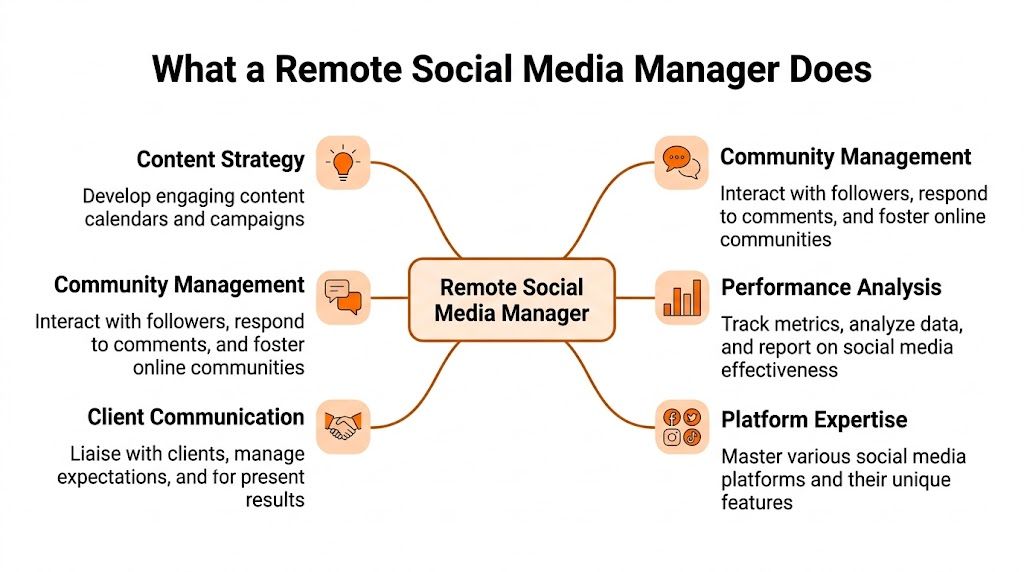
Strategic planning
A lot of juniors think strategy starts after content. It’s the reverse. Strategy decides what content is for.
If a company wants pipeline, awareness alone isn’t enough. If it needs customer trust, reach without consistency won’t help. A remote social media manager has to align channel choices, content themes, campaign timing, and reporting with a specific business outcome.
That usually means answering questions like:
- Business goal first: Is the team trying to support demand generation, employer brand, retention, product education, or executive visibility?
- Audience definition: Are you speaking to buyers, users, candidates, partners, or existing customers?
- Channel role: Which platforms deserve original effort, and which ones should mainly support distribution or repurposing?
- Decision criteria: What signals will tell the team to continue, refine, or stop a tactic?
Without that layer, you’re just producing motion.
Content curation and creation
Content work isn’t just “make posts.” It includes editorial judgment.
You decide what deserves a post, what deserves a thread, what should become short-form video, and what shouldn’t be published at all. You preserve brand voice while adapting to platform expectations. A message that lands on LinkedIn can feel stiff on TikTok. A polished Instagram asset can underperform if the caption reads like a press release.
Strong remote managers also build systems around content. They don’t rewrite from scratch every day. They create content libraries, reusable formats, approval rules, and workflows that make quality repeatable.
Community engagement
It is in this context that social stops being broadcasting and starts becoming market intelligence.
Comments, DMs, mentions, stitched videos, quote posts, and recurring objections reveal how people react to the brand. Community management also tests tone. You learn quickly whether the company sounds helpful, evasive, too formal, or oddly defensive.
A remote team often underestimates this pillar because engagement looks reactive from the outside. It isn’t. Handled well, it sharpens positioning, informs product feedback, and protects brand reputation.
Practical rule: If you only measure output, you’ll overvalue posting and undervalue listening.
Analytics and reporting
Reporting is where the role becomes business-critical.
A remote social media manager needs to show what changed, why it likely changed, and what the team should do next. That means more than exporting platform dashboards. It means building a narrative that leadership can follow without needing a social media background.
The strongest reports tend to include:
- Context: What the team tested and why
- Performance pattern: Which themes, formats, or audience segments moved
- Business implication: What this means for future campaigns, budget, messaging, or content priorities
- Recommended next move: Keep, cut, or revise
That final step matters. Reporting without recommendations is documentation, not management.
The Essential Skills and Software Toolkit
If the previous section describes the job, this is the operating system behind it. A remote social media manager needs both craft and judgment. One without the other creates problems fast.
The role also demands platform-specific depth. Coursera’s overview of social media manager skills notes that managers need deep knowledge across TikTok, Facebook, X, Instagram, and emerging platforms, plus the ability to apply SEO knowledge differently across them. In remote work, that need for autonomous decision-making gets stronger because you won’t always have someone available for a quick sanity check.
Hard skills that actually matter
Some skills are nice extras. These aren’t. These are the ones hiring teams notice in interviews and on the job.
- Analytics interpretation: You need to read dashboards, spot patterns, and separate signal from noise. The valuable part isn’t collecting metrics. It’s deciding what the metrics mean.
- Copywriting: Social copy has to be brief without becoming flat. It also has to match the platform. Good product messaging can still fail if the cadence feels wrong for the feed.
- Creative direction: You don’t need to be a full-time designer, but you do need taste. You should know when a visual supports the message and when it’s just filler.
- Social SEO awareness: Search behavior now affects discoverability on multiple platforms. Captions, hooks, keywords, profile setup, and video framing all play a role.
- Budget judgment: If paid social sits in your remit, you need basic comfort with spend allocation, audience testing, and creative iteration.
One useful shortcut for early-stage ideation is a social media content generator. Not because AI should replace your judgment, but because it can speed up first drafts, angle exploration, and repurposing when you already know the audience and message.
Soft skills that remote teams reward
Many candidates undersell the job. Remote employers don’t just hire for output. They hire for low-friction collaboration.
Here’s what that looks like in practice:
- Written communication: If your Slack updates, briefs, and status notes are vague, people lose confidence quickly.
- Time management: Social work expands to fill every available hour. You need to know what deserves live attention and what can wait.
- Adaptability: Platforms change, stakeholders change their minds, and campaigns rarely go exactly as planned.
- Creative resilience: Some strong ideas flop. Some average ideas unexpectedly work. You can’t take either result too personally.
- Judgment under ambiguity: Remote teams value people who can make sensible decisions without escalating every minor question.
A realistic tool stack
A professional setup usually spans categories rather than a single all-in-one platform.
| Tool category | What it’s for | Common examples |
|---|---|---|
| Scheduling | Queueing, approvals, publishing | Sprout Social, Hootsuite, Buffer, Later |
| Analytics | Tracking results and trend patterns | Native platform analytics, Sprout Social |
| Design | Fast asset creation and resizing | Canva, Figma, Adobe Express |
| Listening | Monitoring mentions, sentiment, topics | Sprout Social, Brandwatch |
| Collaboration | Reviews, handoffs, async updates | Notion, Airtable, Slack, Loom |
A beginner mistake is collecting tools before learning process. Buy or adopt software after you know the bottleneck. If approvals are slow, a better scheduler helps. If ideation is weak, a whiteboarding or planning tool matters more.
For a broader look at how distributed teams combine communication, planning, and execution software, this roundup of tools for remote teams is worth keeping handy.
The software doesn’t make you strategic. It makes your strategy easier to repeat.
Mastering the Remote Work Landscape
Remote social work looks flexible from the outside. Internally, it rewards discipline more than spontaneity.
The challenge isn’t just doing the marketing. It’s doing it in a system where teammates may be asleep while you’re making decisions, stakeholders may review things hours later, and platform moments often don’t wait for ideal coordination. That’s why remote social managers need strong async habits.
Async communication that people can act on
The strongest insight here comes from skills, not software. The 2025 Sprout Social Index identifies social listening and data storytelling as the most important functional skills. In a remote team, that means managers use social intelligence tools to monitor metrics and then package findings so stakeholders can act without needing a live meeting.
That changes how you should communicate.
Instead of saying, “Engagement is down, thoughts?” write something like: “Engagement declined after we shifted from founder-led posts to product graphics. Comments also became less specific. I recommend restoring one founder post each week and testing customer language in the first line.” That kind of update reduces back-and-forth.
Useful async habits include:
- Decision-ready updates: End every recap with a recommendation, not just observations.
- Recorded walkthroughs: Use Loom when a dashboard or content calendar needs explanation.
- Central documentation: Keep briefs, brand notes, and campaign learnings in a shared system people can search.
- Clear escalation rules: Define what counts as urgent, especially for customer complaints or reputation issues.
Time zone management without chaos
Scheduling content across regions sounds simple until your audience, internal approvers, and customer support team all work on different clocks.
A remote social media manager has to think in at least three layers:
- Audience timing for publishing and response windows
- Team timing for approvals and collaboration
- Personal timing so your whole day doesn’t become fragmented reaction work
A lot of juniors over-index on posting time and under-index on response coverage. If a campaign goes live while no one can answer comments or DMs, you create avoidable friction. It’s better to choose a slightly less ideal publishing window that the team can support than a perfect timing window nobody can monitor.
Digital wellbeing and boundaries
Social media can create the feeling that you should always be available. That’s one of the faster ways to burn out in a remote role.
Set explicit rules for yourself:
- Monitoring windows: Decide when you’re actively checking notifications.
- Escalation thresholds: Know which brand issues justify after-hours attention.
- Batching: Group planning, creation, scheduling, and reporting instead of switching context all day.
- Offline recovery: Don’t confuse endless scrolling with staying informed.
Remote freedom is real, but it only feels like freedom when your workflow has boundaries.
Career Paths Salaries and Job Types
The role offers intriguing possibilities. Social media management can be a starting point, a specialization, or a platform into broader marketing leadership. Which path makes sense depends on how you want to work and how you want to be paid.
There’s also strong demand behind the category. Contra’s 2025 remote marketing forecast reports that remote marketing job postings, including social media roles, grew 156% over the past three years through 2025. The same source reports average salaries now match or exceed office-based roles, with Social Media Managers averaging $91,508, a median of $85,000, and directors at $147,086 after a 14% year-over-year increase.
What the salary data suggests
The headline salary numbers are encouraging, but they hide an important truth. Employers don’t pay more just because someone can post consistently. They pay more when that person can tie social work to business outcomes, manage cross-functional relationships, and operate with minimal supervision.
That’s why compensation often tracks role framing as much as task list.
If your work is positioned as “content support,” you’ll usually be treated like a mid-level operator. If your work is positioned as audience growth, brand demand support, campaign strategy, customer insight, or executive visibility, the ceiling rises. Same tools, very different career narrative.
Remote Social Media Manager Job Types Compared
| Attribute | Full-Time Employee | Freelance Consultant | Contractor (Fixed-Term) |
|---|---|---|---|
| Stability | Highest | Lowest | Moderate |
| Income structure | Salary | Project or retainer based | Fixed contract payment |
| Scope clarity | Often broad and evolving | Depends on proposal and client discipline | Usually tied to campaign, leave cover, or defined need |
| Benefits | Often included | Self-managed | Usually limited |
| Growth path | Better for internal promotion | Better for specialization and client variety | Good for proving fit or bridging into permanent roles |
| Main trade-off | Less flexibility over priorities | More admin, sales, and boundary-setting | Less long-term security |
None of these paths is automatically superior. They reward different strengths.
Full-time roles
Full-time work suits people who want deeper access to brand context, better cross-functional involvement, and clearer upward mobility. You’ll usually have more influence on strategy, more visibility with leadership, and more chances to shape systems instead of just deliver assets.
The downside is that scope can expand subtly. Social often becomes the catch-all channel for requests no one else owns.
Freelance consulting
Freelancing gives you flexibility, portfolio range, and control over positioning. It can also trap you in endless production work if you don’t define your offer carefully.
The best freelance social managers don’t sell “posting packages.” They sell outcomes tied to audits, strategy, content systems, campaign execution, reporting, or paid social support. That framing attracts better clients and protects your time.
Contract roles
Fixed-term contracts are underrated. They’re often cleaner than freelance work because the company already knows it needs help, and they can be easier to land than permanent roles because the hiring risk feels lower on the employer side.
They’re especially useful if you want to test a company, industry, or operating style before committing long term.
The title ceiling most people hit too late
This is the part many career guides ignore.
For senior remote professionals, pure “social media manager” titles can become restrictive. The role is often coded as mid-level, even when the person is handling significant strategic responsibility. Jobgether’s remote social media manager overview highlights this title ceiling and recommends repositioning toward roles such as Head of Social, Director of Content, or Digital Marketing Lead, with emphasis on business impact rather than engagement metrics.
That advice is correct, and it matters earlier than one might expect.
If you’ve been in social for years, stop describing yourself mainly by channels and content volume. Start describing yourself by organizational value. Examples:
- From channel execution to audience strategy
- From engagement reports to demand and revenue support
- From content scheduling to editorial leadership
- From platform management to cross-functional campaign ownership
Senior growth usually doesn’t come from becoming “more social.” It comes from becoming more commercially legible.
That shift affects resumes, interviews, and internal promotion conversations. It also protects you from being stuck in jobs where the responsibilities keep expanding but the title never catches up.
How to Land Your First Remote Social Media Job
Most applicants lose before the interview because they apply like generalists. Hiring teams don’t need another person who says they’re creative, organized, and passionate about social. They need evidence that you can think clearly, work asynchronously, and contribute without heavy supervision.
Start with role selection, not resume editing.
If you want a focused list of openings, browse remote social media marketing jobs and pay attention to how employers describe ownership, collaboration style, seniority, and expected channels. Those details tell you whether the company wants a strategist, a coordinator, or a content producer wearing a bigger title.
Find openings with the right shape
Don’t just search job titles. Read for operating conditions.
A good early-career remote role usually has some mix of:
- Clear channel ownership: You know which platforms matter.
- Reasonable scope: You’re not secretly applying to be strategist, designer, editor, video producer, and paid ads lead all at once.
- Async compatibility: The team values written updates, documented process, and independent work.
- Reporting expectations: Someone at the company cares about outcomes, not just activity.
Bad listings often reveal themselves through vague language. If the post asks for someone to “own all social, build brand, create video, run ads, support events, manage influencers, and help with email” without clarifying priorities, expect chaos.
Build an application around evidence
If you’re new, your portfolio doesn’t need famous brands. It needs good thinking.
That could include a personal account, volunteer work, a student project, a mock strategy deck, a content calendar for a niche brand, or a teardown of how you’d improve an underperforming social presence. If you need inspiration on format and presentation, these social media manager portfolio examples are useful for seeing how others package their work.
What your resume should emphasize:
- Decisions you made
- Systems you built
- Platforms you managed
- Stakeholders you supported
- Business context you understood
Keep bullets grounded and honest. Good examples:
- Managed a multi-platform content calendar and adapted messaging by channel
- Turned social performance data into weekly reporting with recommended next steps
- Responded to comments and DMs using brand voice guidelines and escalation rules
- Built repeatable workflows for approvals, scheduling, and asset handoff
Avoid inflated claims you can’t defend. If you didn’t own strategy, don’t imply you did.
Prepare for interview questions that test judgment
Interviewers often ask social questions that sound tactical but are really testing decision-making.
Strong answers tend to include context, trade-offs, and process. For example:
How would you handle a negative comment spike remotely?
Start by clarifying whether it’s routine criticism, customer support overflow, or a reputation issue. Then explain how you’d document patterns, coordinate with the right internal team, use approved response language, and define what needs immediate escalation.
How do you measure social media ROI?
Don’t pretend one metric answers everything. Explain that measurement depends on the role of the channel. Some work supports awareness, some supports consideration, some supports trust or retention. Then describe how you’d connect reporting to the company’s stated objective.
A useful way to hear how hiring managers frame practical hiring questions is this short video:
Position yourself for long-term growth from the start
Even if you’re applying for an early role, avoid framing yourself as only a poster or scheduler. The long-term risk is getting trapped in the same label.
As noted earlier, senior professionals often hit a title ceiling unless they reposition toward broader business impact. That same principle helps juniors too. In interviews, talk about how social supports audience understanding, brand trust, content strategy, and business goals. It signals maturity without pretending you already have senior experience.
Hiring teams trust candidates who understand the work around the work.
If you do have enough experience to target stronger roles, shape your materials around leadership language. Use terms like cross-functional collaboration, audience insight, campaign ownership, editorial systems, and business impact where they are accurate. That’s often the difference between being read as a mid-level executor and being considered for something bigger.
Launching Your Remote Social Media Career
A remote social media manager builds far more than posts. The role combines audience insight, messaging, process, reporting, and calm decision-making across distributed teams. That’s why it can become a durable career instead of a short-term content job.
The people who last in this field don’t chase every trend. They learn platform behavior, communicate clearly, protect their time, and present their work in business terms. They also know when to widen their scope so their title and pay can grow with their impact.
If you’re serious about making the move, start with one practical step today. Audit your current skills, tighten one portfolio sample, and apply to roles that match the kind of operator you want to become. A location-independent career in social media is within reach, but it rewards intention more than enthusiasm.
Frequently Asked Questions
Do I need a degree to become a remote social media manager
No. A degree can help in some hiring processes, but it isn’t the gatekeeper many people assume it is.
Recent remote paid social job listings have emphasized “no experience needed” for proactive communicators, and credibility can be built through tool proficiency in platforms like Sprout Social or Hootsuite and a strong portfolio, according to Indeed’s remote paid social no-degree job listings overview.
What matters more is proof of competence. Show that you can manage a calendar, adapt content by platform, engage professionally, and present your thinking clearly. If you don’t have client work, create sample work with a clear rationale behind it.
Can I get hired without professional social media experience
Yes, but you need substitute evidence.
Use some combination of personal projects, volunteer work, freelance samples, mock brand teardowns, or niche account growth experiments. The key is showing decisions, not just finished visuals. Explain why you chose certain platforms, hooks, formats, or response tactics.
A candidate with modest experience and sharp thinking can beat a candidate with more generic experience and weak communication.
What’s the fastest way to stand out in remote applications
Show that you already work like a remote professional.
That means your application materials should be easy to scan, specific, and written with clean judgment. Include concise examples of workflows, platform knowledge, and reporting habits. In interviews, answer in a way that reduces uncertainty. Hiring managers want to know whether you’ll create clarity or create extra management work.
Here’s a quick reference:
| Question | Answer |
|---|---|
| Do I need a degree? | No. Practical skill, tool familiarity, and a portfolio can be enough. |
| Can I start without experience? | Yes, if you replace formal experience with credible sample work and clear reasoning. |
| How do I stand out remotely? | Write clearly, show platform judgment, and demonstrate that you can work asynchronously without constant direction. |
If you’re ready to turn interest into action, start exploring hand-picked remote roles on YayRemote. It’s a practical place to search across distributed companies and find opportunities that match the way you want to work.