Your Guide to Using a Skills Gap Analysis Tool for Remote Jobs
Struggling to land a remote job? Learn how to use a skills gap analysis tool to pinpoint your weaknesses, create a targeted upskilling plan, and win.
Think of a modern skills gap analysis tool as your personal career strategist. It's designed to take the guesswork out of your next move by giving you a clear, data-backed roadmap. Instead of just hoping you have what it takes, you can map your current abilities directly against your dream remote job and see exactly where you stand.
Why a Skills Gap Analysis Tool Is Your Secret Weapon

In a job market as competitive as the one we see shaping up for 2026, simply having skills isn’t the whole story—you need the right skills. But how can you be sure you're focusing on the ones that will actually open doors? This is where a good skills gap analysis tool really shines.
These tools are no longer just for big-company HR departments. They've become powerful instruments for anyone looking to navigate their own career path with more confidence. Forget endlessly scrolling through job descriptions trying to read between the lines. A dedicated tool gives you an objective look at the distance between your current skillset and the one you need for your next big role.
From Guesswork to a Data-Driven Strategy
Let's be honest, the old way of planning a career move was a mix of intuition and wishful thinking. You’d polish your resume with skills you thought were in demand or sign up for an online course that seemed popular. It's a reactive approach that often feels like you're just throwing things at the wall to see what sticks.
A skills gap analysis tool completely changes the game. It allows you to be strategic. Instead of guessing, you get a direct comparison of your abilities versus what hiring managers are actively looking for.
To put it in perspective, think about the difference between the traditional method and using a modern tool.
| Aspect | Traditional Method (Guesswork) | Modern Method (Skills Gap Analysis Tool) |
|---|---|---|
| Skill Identification | Reading job posts and guessing what's most important. | Automatically extracts and prioritizes required skills from a job description. |
| Self-Assessment | Subjective self-rating based on feelings ("I think I'm good at this..."). | Objective comparison of your listed skills against required ones. |
| Action Plan | Taking a course that seems relevant or popular. | Creates a targeted upskilling plan based on specific, identified gaps. |
| Outcome | Hopeful and uncertain. You might miss the mark. | Confident and focused. You know exactly what to learn next. |
This shift from hoping to knowing is more critical than ever, especially with how quickly the talent landscape is changing.
The World Economic Forum found that 44% of workers' skills will need a refresh by 2027. Without a clear way to see and track your gaps, you risk falling behind. A tool gives you the clarity to stay relevant.
The Seismic Shift Toward AI Skills
Nowhere is this need for strategic assessment more obvious than with the recent explosion in demand for AI capabilities. We've hit a turning point in the global talent shortage where artificial intelligence skills have become the most sought-after abilities.
For the first time ever, skills like AI Model & Application Development (20%) and AI Literacy (19%) have jumped past traditional engineering roles. In fact, general IT & Data skills have now dropped to seventh place. You can read more about these findings on the AI skills shift and see the data for yourself.
This proves a vital point: the skills that got you to where you are today won't necessarily get you to where you want to go tomorrow. A proper analysis tool gives you the intelligence to navigate this new reality. It helps you make smart decisions about where to invest your time and money, turning your career development from a game of chance into a deliberate, focused mission.
Define Your Objective: The Crucial First Step
I've seen countless people get excited about doing a skills gap analysis, only to end up with a messy, confusing report. The most common mistake? Kicking things off without a crystal-clear goal. It’s like firing up your GPS without typing in a destination—you’ll see a lot of data, but none of it will get you where you want to go.
A generic goal like, “I want a new remote job,” is just too fuzzy. It gives you no real direction, so the analysis you get back will be equally vague. To make this process work, you need to turn that wishful thinking into a precise professional target.
From a Hunch to a Bullseye
So, how do you get that level of clarity? It’s all about doing a bit of homework upfront to define what your next career move actually looks like.
Let’s walk through a real-world example. A vague goal is easy to come up with:
- Vague Goal: "I want a remote marketing job."
Now, let's sharpen that into a truly useful objective. This is what you should be aiming for:
- Precise Objective: "Land a Senior Product Marketing Manager role in a remote-first B2B SaaS company, targeting businesses with 50-200 employees, within the next nine months."
That second version is a game-changer. It immediately gives you a filter. You’re no longer looking at every marketing job; you’re focused on a specific industry (B2B SaaS), company size, and seniority level. This is the kind of precision that powers an effective skills gap analysis and tells a tool exactly what to measure your current skills against.
A well-defined objective transforms your skills analysis from a simple self-assessment into a strategic career weapon. It ensures every gap you spot is directly tied to your goal, so you don't waste a single minute learning skills that won't move the needle.
With this newfound clarity, your next step is to start digging into the specific roles and companies that fit your new, focused criteria.
Research Your Target Roles and Companies
Once you have a solid objective, it’s time to get your hands dirty with research. This is where you gather the raw material that will feed your skills gap analysis tool and make the results meaningful.
Here’s what I recommend focusing on:
- Collect Job Descriptions: Start by finding 5-10 real job postings that match your target role. Pay close attention to how different companies title the position. A "Growth Marketer" at one startup might be a "Demand Generation Manager" at another.
- Build a Company Shortlist: Create a list of 10-15 companies that genuinely interest you and fit your criteria. Look beyond the job itself—check out their mission and what their employees are saying. Remote company directories are a fantastic resource for finding organizations with a remote-first culture.
- Zero in on a Niche: Is there a specific corner of your industry that you’re passionate about? In B2B SaaS, for example, you could focus on fintech, health-tech, or developer tools. Specializing in a niche can make you a much stronger candidate.
Let's consider a practical scenario. A friend of mine, a mid-level content marketer, wanted to pivot into a "Content Strategist" role at a remote company focused on sustainability.
By diving into job descriptions for that specific role and niche, she quickly discovered that the best candidates all had a few things in common: advanced SEO knowledge, the ability to use data to prove content ROI, and hands-on experience with video and podcast production.
That information was pure gold. Armed with those specifics, she could use a skills analysis tool to benchmark her skills directly against those three critical areas. The report she got wasn't just a list of her skills; it was a personalized roadmap showing exactly what she needed to learn to land the job. That's the power of a focused approach.
How to Map Your Skills and Uncover Critical Gaps
Alright, you've got a career destination in your sights. Now for the most important part: figuring out how to get there. This is where we get into the nitty-gritty of the analysis, and honestly, where a modern skills gap analysis tool is a game-changer. It helps you take a complete inventory of your abilities and see exactly how they measure up to the job you actually want. The goal is to move past a simple resume list and create a living, breathing map of your professional self.
This whole process is about turning a fuzzy career dream into a concrete plan. You have to get specific before you can get strategic.
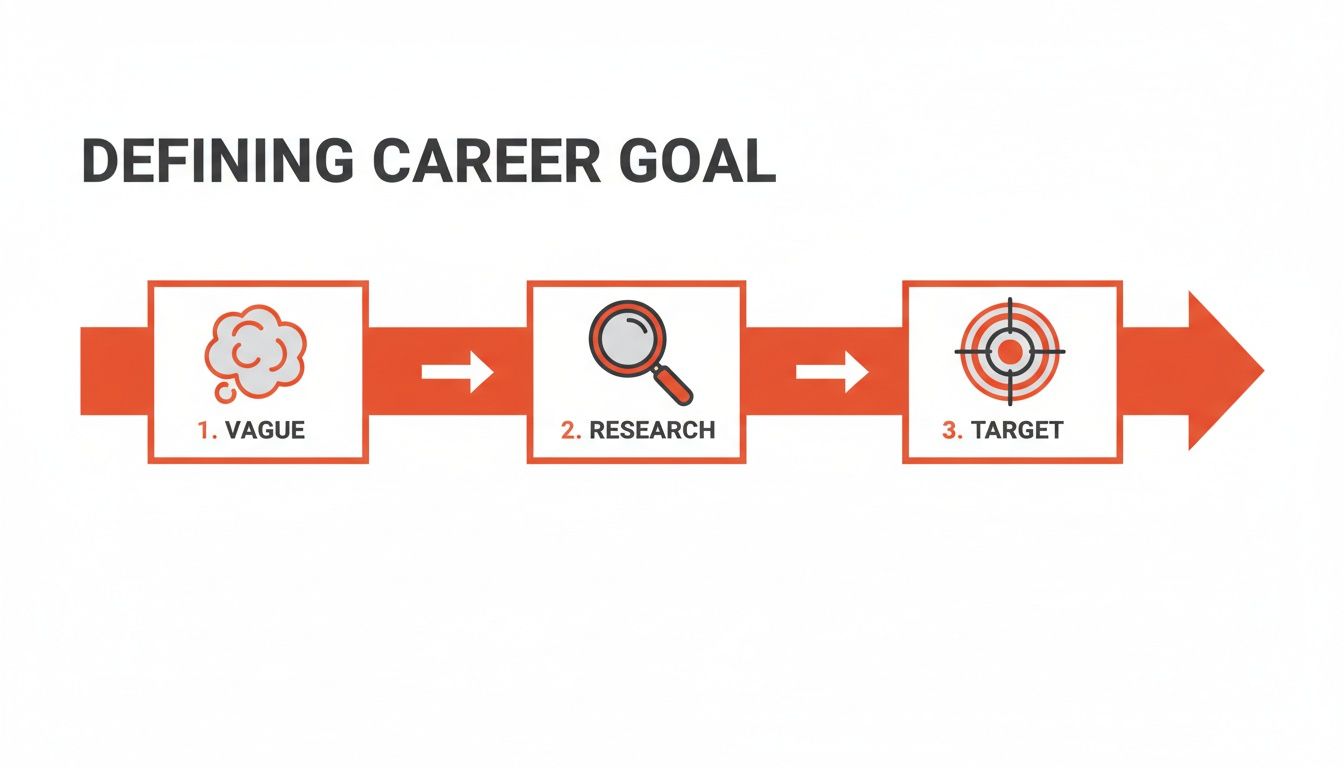
As you can see, great career planning starts by cutting through the fog. You do your homework, and that research helps you lock onto a clear target.
Start with a Full Skills Inventory
First things first, you need to do a thorough audit of what you can do right now. This isn't just about polishing your resume; it's a deep dive into every skill you have, both the obvious and the hidden. Think of it as building your personal skills database.
To make sure you don't miss anything, it helps to break your skills down into a few key buckets:
- Technical Skills: This is the "hard stuff." Think software you've mastered (like Salesforce, Figma, or Python), programming languages you know, or specific hardware you're comfortable with.
- Soft Skills: These are the human skills that dictate how you work with others—communication, teamwork, problem-solving, and being adaptable. They can be harder to pin down, but they're incredibly valuable.
- Industry-Specific Knowledge: Do you have deep expertise in a certain market, like e-commerce logistics or B2B SaaS marketing? This specialized knowledge can really make you stand out.
- Certifications and Credentials: Make a list of every official qualification you've earned, whether it's a PMP certification or a Google Analytics credential.
Don't just go by memory. Dig through old projects, look at past performance reviews, and even think about casual feedback you’ve gotten from coworkers. A good tool can help you organize all this information so it's easy to manage and, more importantly, easy to compare.
Match Your Skills to Your Target Role
Now, let's see how this works with a real-world example. Meet Sarah, a Content Marketing Manager. Her goal is crystal clear: she wants to become a "Head of Growth" at a remote tech company.
Using a skills gap analysis tool, Sarah uploads her resume. Then, she grabs the job descriptions for a few Head of Growth roles that look interesting and feeds those into the tool as well. The software crunches the data, pulling out the skills required for the job and mapping them directly against her current skill set.
This kind of visualization instantly gives Sarah a clear picture of where she’s strong and, more importantly, where her gaps are. It turns those vague job requirements into hard data points she can actually work with.
Pinpoint and Prioritize Your Gaps
The results are in. The tool shows Sarah's content and SEO skills are top-notch, but she has some major gaps in areas like paid acquisition (PPC), A/B testing frameworks, and data analysis with SQL.
Just knowing the gaps exist isn't enough. You have to prioritize.
Not all skill gaps are created equal. Some are deal-breakers, while others are just "nice-to-haves." Here’s how you can score them to figure out what to focus on first:
- Frequency: How often does this skill pop up in your target job descriptions? If 8 out of 10 postings mention "SQL for marketing analytics," that’s a massive signal. It's a high-priority gap.
- Impact: How critical is the skill to the actual job? For a Head of Growth, data analysis is essential. "Basic graphic design," on the other hand, might be a secondary skill.
- Industry Trends: Are there new skills gaining traction in your field? For Sarah, getting a handle on AI-powered marketing tools is becoming a must-have, not just a bonus.
The most powerful analysis doesn't just show you what's missing—it tells you which gaps are actively holding you back. Your mission isn't to learn everything. It's to strategically close the 2-3 gaps that will give you the biggest bang for your buck.
By scoring each gap, Sarah can build a focused learning plan. SQL and A/B testing jump to the top of her list, while less critical skills can wait. A great way to start this process is with a tool like YayRemote’s free Resume Skills Analyzer, which can quickly show you which skills from a job description are missing from your resume.
Find Your "Skill Adjacencies" for Faster Growth
One last pro tip: look for skill adjacencies. These are skills you already have that give you a leg up on learning something new.
For example, Sarah’s deep background in SEO means she already gets keyword research and analytics. This is a perfect bridge to learning paid search (PPC). Both disciplines rely on similar ideas about audience targeting and conversion tracking.
By finding these connections, the path to learning new skills feels a lot less intimidating and way more efficient. She’s not starting from zero; she’s building on a foundation she already poured. This kind of strategic thinking, powered by the clear insights from a skills gap analysis, can turn what feels like a huge career leap into a series of small, manageable steps.
Building Your Personalized Upskilling Roadmap
Finding out where your skills fall short is just the first step. The real win comes from actually closing those gaps—that’s what gets you noticed and hired. Now that your skills gap analysis tool has laid out a clear map of what’s missing, it’s time to build a development plan you can actually stick with.
This isn’t about just jumping on the first online course that pops up in your feed. You need to be more strategic than that. With your most critical gaps identified, creating a personalized roadmap is your next move. It helps to remember that upskilling is key to advancing your career; that perspective alone can give you the push you need to get started.
Diversifying Your Learning Portfolio
Your upskilling journey should be as unique as you are. The world of learning extends far beyond a traditional classroom. Think of it like building an investment portfolio, but instead of stocks, you're investing in your own capabilities.
Here are a few powerful ways to build out your skillset:
- Formal Courses & Certifications: These are fantastic for building foundational knowledge and adding a credential that recruiters recognize. Think along the lines of a Google Analytics certification or becoming a Certified ScrumMaster.
- Project-Based Learning: This is where the rubber meets the road. It’s about applying what you've learned. Build a simple website, run a small social media campaign, or analyze a public dataset. A portfolio showcasing real work often speaks louder than a certificate.
- Mentorship: Find someone who’s already doing the job you want and learn directly from their experience. A good mentor can provide priceless shortcuts and insights you won’t find in any textbook.
- Strategic Volunteering: Offer your developing skills to a non-profit. It's an excellent, low-pressure way to get hands-on experience in a new area, like managing a small budget or leading a project team.
Each of these avenues has its own rhythm. Some offer structure, others give you complete freedom. Your job is to mix and match them into a plan that fits your life. Many people also find that starting with their existing strengths, often called transferable skills for a career change, makes the whole process feel much more manageable.
Choosing Your Upskilling Path
Choosing the most effective way to learn is a crucial step in bridging your skills gap. Different methods offer distinct advantages, and what works for one person might not be the best fit for another. You need to weigh the pros, cons, costs, and time commitment of each learning style before you dive in. A self-directed portfolio project, for instance, is a world away from a structured, expensive coding bootcamp.
To help you decide, this table breaks down the most common upskilling options.
Choosing Your Upskilling Path
An analysis of different learning methods to help you choose the most effective path for your career goals.
| Upskilling Method | Best For | Average Cost | Time Commitment | Pros & Cons |
|---|---|---|---|---|
| Online Courses | Gaining specific, targeted knowledge from experts. | $50 - $500 | 10-40 hours | Pro: Flexible and affordable. Con: Requires self-discipline. |
| Certifications | Proving proficiency in a standardized skill or tool. | $200 - $2,000 | 20-100 hours | Pro: Industry-recognized credential. Con: Can be costly and test-focused. |
| Portfolio Projects | Demonstrating practical, hands-on ability. | Free - $100 | Varies | Pro: Shows real-world skills. Con: Lacks formal structure. |
| Mentorship | Gaining specific industry insights and career guidance. | Free - Varies | 1-2 hours/month | Pro: Personalized advice. Con: Finding the right mentor can be hard. |
As you can see, there’s no single "best" way to learn. The right path depends entirely on the skill you're trying to build, your budget, and how you learn best. A blended approach often works wonders—pair an online course with a portfolio project to really solidify your new knowledge.
Building a Realistic Timeline
Once you’ve picked your learning methods, it’s time to get real about scheduling. A classic mistake is trying to do too much, too fast. That’s a one-way ticket to burnout. The smarter approach is to set small, achievable milestones.
Let’s say you need to learn SQL. A manageable plan could look something like this:
- Month 1: Complete a well-regarded introductory SQL course online.
- Month 2: Work through a guided project where you analyze a sample sales database.
- Month 3: Find a real-world dataset on your own and perform a unique analysis to add to your portfolio.
This approach breaks a big, intimidating goal into bite-sized pieces and helps you build momentum. The key is to weave learning into your life as it is now, not to try and completely overhaul your entire schedule overnight.
One crucial thing to keep in mind is that the demand for skills isn't the same everywhere. Regional differences have grown, with North America pushing to scale AI, Europe focusing on sustainability in digital projects, and Asia-Pacific balancing rapid expansion with industrial growth. For remote professionals, this means a skill's value can change dramatically based on where a company is located. A skills gap analysis tool is essential for navigating these variations and making sure your efforts are well-spent. You can discover more about these global skills in demand to align your upskilling path with the global market.
Weaving Your New Skills Into Your Job Search

Alright, you’ve done the hard work of analyzing your skills. But don’t let those brilliant insights get buried in a spreadsheet. Now comes the fun part: turning that self-awareness into a job offer.
This is where your skills gap analysis becomes your secret weapon in the job hunt. You're no longer just another applicant; you're a strategic candidate who knows exactly what skills are valuable and can prove you have them. It’s time to put that knowledge to work on your resume, in your cover letter, and especially in your interviews.
Remodeling Your Resume and Cover Letter
Stop thinking of your resume as a simple history of your jobs. It’s a marketing brochure, and you are the product. A skills gap analysis gives you the clarity to spotlight the skills and achievements that matter for the job you want, not just the one you have.
Let's imagine a project manager aiming for a more data-heavy role.
Before:
- Managed cross-functional projects from inception to completion.
This is fine, but it’s vague. It could describe almost any PM. It’s forgettable.
After:
- Led a Q3 product launch, leveraging SQL queries to analyze user behavior data and inform a 15% improvement in the project timeline.
Now that gets a hiring manager's attention. The "after" version doesn't just list a skill (SQL); it showcases it within the context of a real business win. Go through your resume and transform your bullet points to be this powerful.
Your cover letter is where you can tell the story behind the bullet points. Don't just rehash your resume. Explain why you learned a new skill and connect it directly to a pain point in the job description. This shows genuine interest and initiative—a rare and valuable combination.
Once you know which skills you need to build, creating a structured approach is key. Learning how to write a development plan will help you set clear goals and track your progress, which is a massive career accelerator.
Talking About Your Gaps in an Interview
Sooner or later, you'll get that question: "What's your biggest weakness?" or "Tell me about a skill you don't have."
Instead of dreading this moment, get excited. Your analysis has prepared you to turn a potential pitfall into a major strength. Forget a canned answer like, "I'm a perfectionist." You're going to tell a compelling story.
Here's how you can frame your response:
Start by confidently acknowledging the gap you identified. You could say something like, "That's a great question. In mapping out the skills for this kind of senior role, I realized I needed to get deeper experience with enterprise-level budget management."
Then, immediately show your work. "To address that, I enrolled in a financial modeling certification and volunteered to lead the budget allocation for a new department-wide initiative."
Finally, share the outcome. "Through that project, I got hands-on experience managing a $50,000 budget from start to finish, which was exactly the skill I was aiming to build."
This kind of answer is a game-changer. It demonstrates self-awareness, proactivity, and a commitment to growth—the top traits employers are really looking for. You just turned a question about a weakness into one of the strongest points of your interview.
Finding Roles That Match Your New Skills
With your updated resume and a powerful interview strategy, you’re ready to hunt for roles that truly fit your new and improved skillset.
It's time to be strategic with your search. On job boards like YayRemote, use the filters to search by the specific skills you’ve just worked so hard to acquire. Don't just type in a job title; search for keywords like "Python," "Salesforce," or "Figma."
You invested in yourself. Now, go find a company that will recognize and reward that investment. And before you start applying, make sure your resume is ready to get past the initial screening. Our guide on how to beat ATS systems can help you ensure a human actually sees your hard work.
Turn Your Skills Analysis Into a Career-Long Habit
Think of your first skills gap analysis as drawing a map. It’s incredibly useful, but it’s a snapshot in time. The terrain of the job market is constantly shifting under your feet. A skill that's in high demand today might be standard tomorrow, and new technologies can appear on the horizon almost overnight.
That's why a skills gap analysis can't be a one-off project you tick off a list. To stay relevant and ahead of the curve, you have to treat it like a continuous cycle—a routine for keeping your career in great shape. You wouldn't go to the gym once and expect to be fit for life, right? The same principle applies here.
From a Single Snapshot to a Living Strategy
The real power comes when you shift from being reactive ("I need a new job, I'd better see what skills I'm missing") to being proactive. A proactive approach means you’re always looking ahead, making sure your skills are aligned not just with your next job, but with your long-term career ambitions.
So, how do you build this into a habit that sticks? It's all about creating a rhythm.
- Set a Quarterly Check-In: Block out just 30 minutes every three months. This isn't a deep dive; it's a quick pulse check. Did you make progress on that online course? Did you add that new project to your portfolio? This keeps your goals top-of-mind.
- Schedule a Bi-Annual Deep Dive: Twice a year, set aside a couple of hours for a more thorough review. This is when you'll really dig in. Re-run your analysis with fresh job descriptions for your target roles. What new keywords are popping up? Have the requirements changed?
- Adjust Your Course: Use what you learn from these reviews to fine-tune your upskilling plan. You might find a skill you were chasing isn't as critical anymore, or maybe a new piece of software has become a must-have in your field.
This combination of frequent, quick check-ins and less frequent, deeper assessments ensures you're never caught flat-footed by industry changes.
How Do You Know It’s Actually Working?
Tracking your progress is crucial, but don't just count course certificates. The real proof is in the results you can see and feel in your professional life. Are your efforts translating into tangible opportunities?
The best professionals I know are relentless learners. They don't see learning as a task to be completed, but as a fundamental part of their job. The moment you decide you're 'done' learning is the moment your career starts to stagnate.
Look for real-world evidence that your upskilling plan is paying off. Here are a few things to watch for:
- Are you getting more interview callbacks? This is often the first sign that your updated resume and profile are resonating with recruiters and hitting all the right keywords.
- Do you feel more confident in interviews? Can you now speak fluently about a technical topic that used to intimidate you? When you can share concrete examples of how you've used a new skill, you're on the right track.
- Is your new work getting positive feedback? Whether it’s praise from a manager on a new task, a happy freelance client, or positive comments on a personal project, external validation is a fantastic measure of your growing competence.
When you start tracking these outcomes, your skills gap analysis tool transforms. It stops being a simple audit device and becomes the compass for your career growth, keeping you prepared, confident, and in control, no matter what the job market throws your way.
Common Questions About Skills Gap Analysis
Even with a solid plan, you're bound to have questions once you start digging into a skills gap analysis tool. Let's tackle some of the most common ones I hear from professionals trying to map out their next career move.
How Often Should I Run a Skills Gap Analysis?
My go-to recommendation for most people is to do a deep dive once a year. Think of it as an annual check-up for your career health, making sure your skills are still pointing toward your long-term goals.
However, that cadence changes if you're in a field that's moving at lightning speed, like AI, or if you're actively plotting a career change. In those cases, a lighter review every six months is a much smarter move. It keeps you agile and ready to pivot before a new skill becomes a deal-breaker.
Is This Really for Senior Professionals, Too?
Absolutely. In fact, it might be even more crucial. For senior leaders, the conversation shifts from fundamental abilities to high-level, strategic competencies. A good skills gap tool is fantastic for spotting these more nuanced gaps.
Instead of just technical skills, it helps you see where you stand on:
- Executive leadership and the ability to scale teams effectively.
- Emerging strategic needs, like AI governance or applying machine learning to business problems.
- Specific market knowledge that C-suite roles demand.
This isn't about checking boxes; it's about ensuring your expertise stays relevant and aligns with what modern companies truly need from their leaders.
The biggest trap I see people fall into is "analysis paralysis." They get so caught up identifying every tiny gap that they never actually do anything about it. A successful analysis is one that leads to a focused, actionable plan. The goal isn't to master everything—it's to strategically close the 2-3 most important gaps that will unlock your next opportunity.
Remember, action beats perfect analysis every time.
Ready to stop guessing and start building a career roadmap based on real data? Use the YayRemote Skills Analyzer to instantly see how your resume stacks up against your dream job and find your most critical skill gaps today.