UK Remote Jobs: The Ultimate 2026 Finding Guide
Your complete 2026 guide to finding UK remote jobs. Explore the market, top roles, salaries, search strategies, and legal tips to land your next remote role.
Remote work in Britain still attracts huge attention, but the easiest version of the story is no longer true. In the first half of 2025, searches for remote roles by UK jobseekers were over 140% higher than in 2023, while average remote job postings fell by more than 51% over the same period. If your applications feel ignored, that gap explains a lot.
That doesn't mean UK remote jobs have disappeared. It means generic tactics fail faster now. Sending the same CV to every “work from home” listing, ignoring hybrid requirements, and applying without proof that you can operate well in a distributed team is how strong candidates get filtered out.
The people who still land good remote roles tend to do three things well. They target the right slice of the market, they present remote-specific evidence instead of broad claims, and they evaluate contracts carefully before accepting an offer. That's the practical path through the current UK market.
The Reality of the UK Remote Job Hunt in 2026
The competition problem is structural, not personal. Candidate appetite for flexibility is still rising, but employer supply hasn't kept pace. That creates a hiring environment where even qualified applicants can spend weeks applying without traction.
A lot of job seekers respond the wrong way. They apply wider, faster, and with less specificity. That usually makes things worse because remote hiring managers are screening for precision. They want candidates who read the listing closely, understand whether the role is remote or partly office-based, and can show evidence of independent execution.
Why broad applying stops working
Remote roles attract applicants from more locations and more backgrounds than office-only jobs. That wider pool changes the standard. Employers can be pickier about writing quality, tool familiarity, communication style, and role alignment.
Three habits usually hurt candidates most:
- Keyword-only matching: A CV that says “excellent communicator” and “self-starter” without examples doesn't carry much weight.
- Ignoring contract reality: Many listings say remote, but still expect UK working hours, occasional travel, or office attendance.
- Treating all remote jobs the same: A fully distributed software company hires differently from a hybrid financial services team.
Practical rule: Apply to fewer roles, but make each application look like you understand how that company actually works.
What still works
A remote job search works better when you narrow your lane. Pick a function, a seniority range, and a contract type. Then build your documents around that target instead of trying to look broadly employable.
That sounds slower, but it usually produces better interviews because your profile feels coherent. In a crowded market, clarity beats volume.
Understanding the UK Remote and Hybrid Market
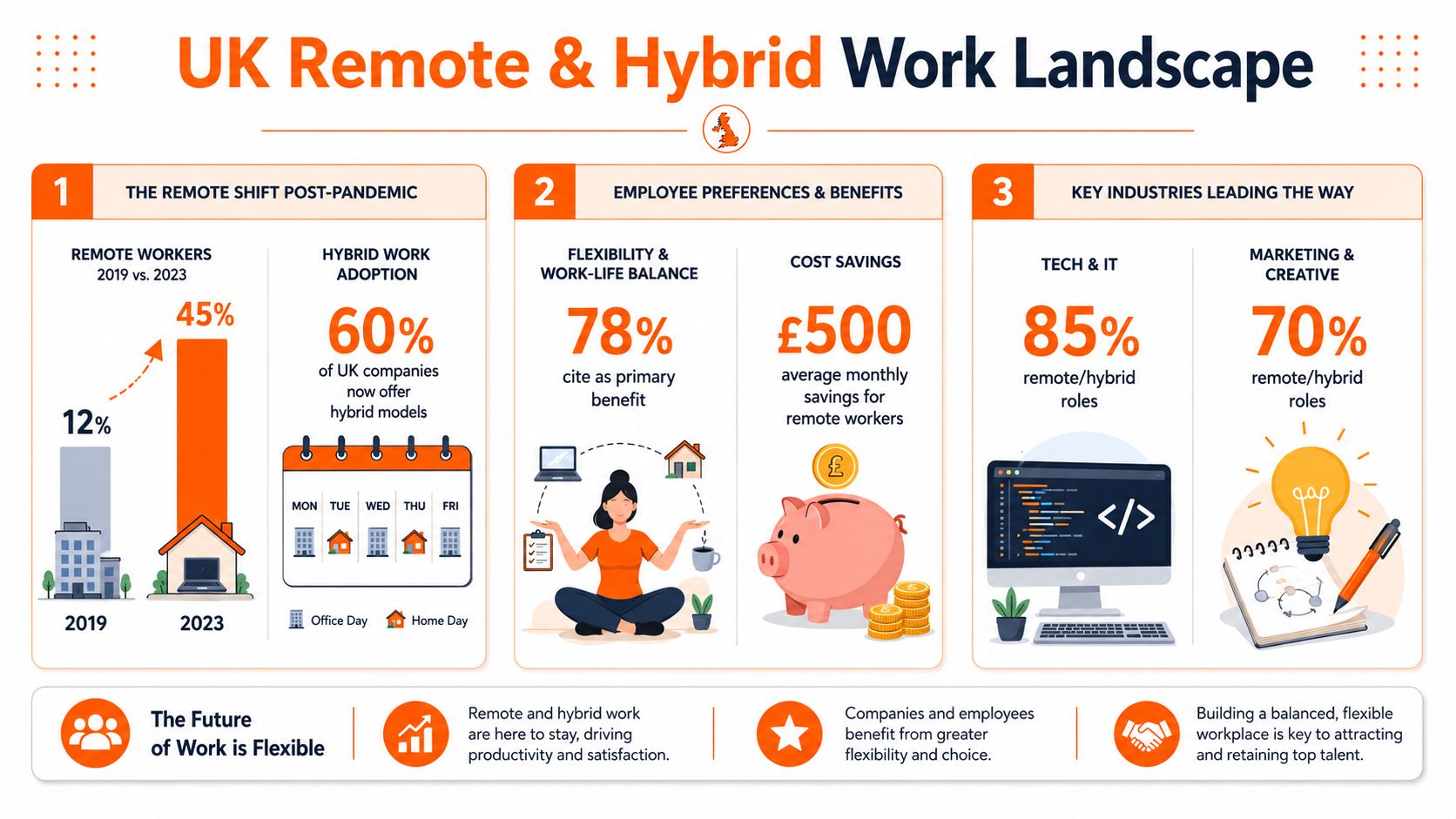
In 2020, 5.64 million people in the UK mainly worked from home, equal to 17.4% of those in employment. That spike changed candidate expectations for good, but it did not turn the UK into a fully remote labour market. By 2026, the practical reality is simpler. Remote exists, hybrid dominates, and employers are much more precise about the terms.
That distinction matters because "remote" in a job title often means "remote within limits."
The labels employers use
The wording in a job advert usually gives away the actual working model:
- Fully remote: Home-based as standard, but often tied to UK residency, set working hours, or occasional travel for team meetups.
- Hybrid: Regular office attendance is part of the role, even if the employer sells it as flexible.
- Remote-friendly: The company supports remote work in principle, but the role may still be built around an office team.
- UK remote: You can work from anywhere in the UK. It rarely means you can work abroad full-time.
This is one of the biggest points of confusion I see with UK applicants. People search for freedom and apply to roles with hidden attendance rules, then lose time in screening calls that were never a fit.
Geography still shapes the market
The strongest remote hiring is not spread evenly across the country. Indeed Hiring Lab found that Worthing recorded a 760% increase in remote roles versus pre-pandemic levels, while remote postings across the UK remained only just above one-in-ten of all postings despite a 187% rise from pre-pandemic levels. London still matters, but serious job seekers should also watch high-growth pockets outside it, especially commuter towns, regional tech hubs, and cities with strong digital, finance, or professional services employers.
That changes how to search. Use location filters creatively. A "remote" role tied to Manchester, Bristol, Leeds, Edinburgh, or a South Coast hub can be easier to win than a broad UK-wide listing with no regional anchor.
Sector concentration is still real
Remote access also varies sharply by function. The Office for National Statistics reported that information and communication had the highest rates of homeworking in the UK, with many roles in the sector carried out remotely or in hybrid arrangements. In practice, that means software, data, cybersecurity, product, digital marketing, and some finance roles stay overrepresented in remote search results, while operations, facilities, healthcare, retail, and site-based jobs do not.
If you work in tech, salary expectations also need to be grounded in the current UK market, not US-led remote salary chatter. This UK technology salary guide is a useful reference point when you compare remote listings by level and specialism.
Candidates who understand remote working as an operating model usually interview better. If you want to sharpen that side of your pitch, take time to discover remote work strategies that improve communication, focus, and day-to-day structure.
Remote work in Britain is now a hiring filter, a contract term, and, in many sectors, a regional strategy rather than a blanket perk.
In-Demand Roles and UK Remote Salary Benchmarks
Across more than 27,430 openings, aggregated UK remote salary data shows an average of £59,641, with entry-level roles at £36,991, junior at £43,433, mid-level at £50,347, senior at £73,762, and lead roles at £94,657. That gap matters because the 2026 UK remote market is still tight at junior level and far more forgiving once you can show independent delivery.
Salary benchmarking only helps if you separate title from level. A remote operations coordinator and a remote product manager may both work from home, but they do not sit in the same pay band, hiring queue, or interview process. Candidates who treat remote work as a single salary category usually misread both their market value and their odds of getting hired.
Average UK remote salary by seniority level
| Seniority Level | Average Annual Salary |
|---|---|
| Entry-level | £36,991 |
| Junior | £43,433 |
| Mid-level | £50,347 |
| Senior | £73,762 |
| Lead | £94,657 |
The practical read is simple. Seniority changes both pay and access.
Early-career applicants can still win remote roles, but the bar is higher than many job ads suggest. Hiring managers are often screening for proof that you can work without heavy day-to-day direction, write clearly, keep momentum, and ask good questions in the right channels. If that experience is thin, a portfolio, side project, internship evidence, or quantified freelance work carries more weight than broad claims about being “self-motivated”.
Mid-career candidates usually have the strongest balance of demand and credibility. I observe UK applicants gaining the most ground in negotiation as a result, especially in product, data, software, customer success, and digital marketing. Employers are paying for judgment as much as execution, and remote teams value people who can resolve ambiguity without waiting for a meeting.
Senior and lead roles pay better because the scope is broader. You are often expected to set standards, document decisions, coach others, and keep cross-functional work moving across time zones or asynchronous schedules. The salary lift reflects that responsibility, not just extra years on a CV.
Data roles show this pattern clearly. Reed's UK data analyst job profile and salary guide is a better benchmark than generic global remote boards because it reflects the local hiring market and the actual skills employers ask for, including SQL, Excel, Python, and BI tools. If you are targeting analytics work, stack fit often decides whether you get shortlisted.
That same rule applies across functions. Remote employers rarely hire on title alone. They hire on evidence.
A marketing manager needs channel ownership and reporting discipline. An account executive needs proof of pipeline management in a CRM. A product manager needs concise written specs, prioritisation judgment, and clean stakeholder communication. The narrower the brief, the more specific your examples need to be.
Use broad averages as a starting point, then adjust for scope, sector, reporting line, pension, bonus, equipment budget, and any travel hidden behind the word "remote". For a role-by-role comparison in tech, this UK technology salary guide by role and level is useful context before you negotiate.
Once you reach interview stage, salary only stays on the table if your communication holds up. Practise how you explain outcomes, trade-offs, and remote working habits before the call. Tools that prepare for confident interviews can help you tighten those answers without sounding scripted.
Your Search Toolkit for Finding Genuine Remote Jobs
A better remote search starts with one principle. Stop treating job boards like noticeboards. Use them like filtering systems.
Most candidates waste time because they browse passively. They type “remote” into a search bar, skim titles, and apply to whatever looks close enough. In a crowded market, that creates noise. You need a repeatable workflow that helps you separate real remote roles from hybrid jobs with vague wording.

Build a narrower search system
Start with filters that remove obvious mismatch before you read a single description.
- Job type first: Decide whether you're targeting permanent employee roles, contract work, or freelance engagements.
- Function second: Pick one or two role families. Engineering and customer success have different screening signals, so your search should reflect that.
- Experience level third: If you're applying across too many levels, your profile will look unfocused.
- Location constraint: “UK remote” often still means UK-based only. If you need visa support or want global flexibility, check that early.
Once the filters are set, read for friction. Look for phrases such as “occasional travel,” “team offsites,” “must be able to attend,” “within commuting distance,” or “right to work in the UK.” Those details decide whether a role fits your real life.
Vet the company, not just the vacancy
A polished advert doesn't guarantee a healthy remote setup. Look for signs that the employer has thought about distributed work beyond policy wording.
I pay attention to a few things:
- Clarity in the advert: Specific collaboration expectations usually signal a more mature remote culture.
- Written process: Companies that explain hiring steps, onboarding, or communication norms often run more predictably.
- Tool language: Mentions of Slack, Notion, Jira, HubSpot, GitHub, Linear, or other workflow tools can reveal how work moves.
- Consistency: If the website says remote-first but the advert sounds office-centric, trust the advert.
The strongest remote adverts remove ambiguity. The weakest ones sell flexibility while hiding attendance requirements in the final paragraph.
A curated list can save time here. If you're comparing platforms, this roundup of the best remote job boards is useful for understanding where different types of remote roles tend to appear.
Optimise before you press apply
Most applicants jump from search to submission too quickly. A stronger rhythm is search, shortlist, adapt, then apply.
Before applying, check whether your CV mirrors the role language. If the job asks for asynchronous collaboration, stakeholder management, and independent delivery, those ideas should be visible in your experience bullets. If there's a portfolio, it should be easy to scan and relevant to the role.
Interview prep should start before you're invited. If you want to prepare for confident interviews, using a tool that helps you rehearse answers and sharpen delivery can reduce the flatness that often shows up in virtual conversations.
A short explainer can help you think more clearly about remote search patterns and common mistakes:
How to Build a Remote-Ready CV and Portfolio
UK employers are still filtering hard for remote roles, which means your CV has to answer one question fast. Can this person deliver without constant supervision?
A remote-ready CV shows how you communicate, organise work, and keep projects moving when the team is spread across locations and time blocks. Hiring managers are looking for evidence, not claims. If your bullets read like a job description, they learn very little. If your bullets show how you handled handovers, written updates, documentation, and independent delivery, they can picture you doing the job.
Translate office experience into remote proof
You do not need years of remote work on your CV. You need proof of remote-compatible behaviour.
That usually means rewriting vague responsibility-led bullets into outcome-led bullets that show autonomy and communication.
Instead of this:
- Weak bullet: Managed client projects and worked with internal teams to deliver campaigns.
Write this:
- Stronger bullet: Coordinated campaign delivery across marketing, design, and sales, using written updates, shared timelines, and clear ownership notes to keep deadlines on track.
Instead of this:
- Weak bullet: Responsible for reporting and analysis.
Write this:
- Stronger bullet: Built recurring reports, explained findings to non-technical stakeholders, and documented definitions so colleagues could use the work without waiting for a live walkthrough.
The difference is practical. The stronger version gives a recruiter evidence of how you work. It signals judgment, clarity, and follow-through.
A few details often help more than candidates expect:
- Name the tools you used if they matter to the role.
- Show who you communicated with, such as clients, product managers, or finance stakeholders.
- Include outcomes where you can prove them.
- Make written communication visible. In remote hiring, that carries weight.
Your portfolio should remove uncertainty
For analytical, technical, design, and product roles, a portfolio often decides whether you get an interview. In a crowded UK market, it helps employers assess your work asynchronously and compare you against candidates with similar titles on paper.
The bar is not flashy presentation. The bar is clear proof.
For data analyst roles, many UK adverts still ask for a familiar mix of SQL, Excel, a BI tool such as Tableau or Power BI, and the ability to explain findings to non-technical people. The hiring pattern is also slow enough that weak portfolios get filtered out long before a conversation starts. Reed's data analyst job listings are a useful reference point for the kinds of requirements that appear repeatedly in the UK market: Reed data analyst jobs in the UK.
A strong portfolio usually does four things well:
- Shows the tool stack clearly: If the role asks for SQL and Power BI, make both easy to spot.
- Frames the business question: State the problem, not just the output.
- Explains your choices: Brief notes on assumptions, trade-offs, and method show maturity.
- Stays easy to scan: One strong case study beats six half-finished ones.
Good remote portfolios also show how you communicate. Add a short summary above each project. Explain what you were asked to solve, what data or constraints you had, what you chose to do, and what happened next. That is often more persuasive than a polished screenshot with no context.
What to cut
Remove anything that sounds inflated, generic, or hard to verify. Phrases like “works well independently”, “excellent multitasker”, and “team player” do very little on their own.
Cut dense personal statements, long software lists with no context, and bulky paragraphs that hide your best evidence. Remote hiring often starts with fast scanning across dozens of applications. Make the strongest signals visible in seconds.
If a line does not prove skill, judgment, or results, it is probably taking space from something that could.
Acing the Virtual Interview and Technical Assessment
Virtual interviews reward a different kind of polish. The strongest candidates don't just answer well. They make it easy for the interviewer to imagine working with them through a screen, in documents, and across time gaps.
That means your examples should sound like remote work, not normal work retold over video.
Answer with remote scenarios
Use a structured method such as STAR, but adapt your examples for distributed teams. Choose stories that show judgment without close supervision, clarity in written communication, and calm handling of blockers.
Good topics include:
- Asynchronous coordination: Times when you moved a project forward without waiting for a meeting.
- Cross-functional communication: Moments where you aligned people with different priorities.
- Independent problem-solving: Situations where you clarified ambiguity and proposed a path.
- Documentation: Examples of leaving work in a state others could pick up easily.
If the role is technical, explain your thought process clearly. In remote hiring, communication quality often matters almost as much as the answer itself.
Handle assessments like real work
Take-home tasks and technical exercises are often less about perfection than about how you approach constraints. A messy but well-explained solution can outperform a polished one with no reasoning.
What usually helps:
- Clarify assumptions early: State what you're assuming if the prompt is ambiguous.
- Show your working: Add brief notes, comments, or rationale where useful.
- Respect the brief: Don't overbuild. Employers often use scope discipline as a signal.
- Write for another person: Make your submission easy to review asynchronously.
At this stage, many candidates slip. They treat the task as a private test instead of a collaboration preview.
Ask questions that reveal the culture
Your questions matter because remote culture is hard to fake when described in specifics.
Ask things like:
- How does the team share status updates?
- What does a normal week of collaboration look like?
- How are decisions documented?
- What tends to be synchronous versus asynchronous?
- How does onboarding work for someone joining remotely?
Those questions do two jobs. They help you judge fit, and they signal that you already understand the realities of distributed work.
If an employer struggles to explain how remote collaboration actually happens, that's useful information.
Small details still matter
Yes, the basics count. Test your camera, microphone, and lighting. Keep your environment quiet and your screen setup clean. But don't stop there.
Remote interviews also reward pacing, concise answers, and comfort with slight delays. Don't rush to fill every pause. A measured answer usually lands better than a fast one.
Navigating UK Right to Work and Tax Essentials
A remote offer can look attractive until you read the contract closely. That's where “remote” stops being a lifestyle word and becomes a legal and financial arrangement.
The British market is now heavily mixed. In April 2026, 13% of people in Great Britain worked from home exclusively and another 24% worked in a hybrid pattern, meaning roughly 37% were doing at least some work remotely. When so many roles sit somewhere between fully remote and partly office-based, contract terms matter as much as job title.
Employee or contractor
The first distinction to understand is whether you're being hired as an employee or engaged as an independent contractor.
As an employee, you're usually paid through PAYE and receive the package that comes with employment, such as statutory protections and employer-managed payroll deductions. As a contractor, you're usually handling more of your own tax administration, and the trade-off often involves more flexibility paired with less built-in security.
Neither model is automatically better. The right choice depends on your goals, risk tolerance, and how the company is set up to hire.
Questions to ask before accepting
Use the offer stage to remove ambiguity.
- Work location: Is the role fully home-based, hybrid, or remote with travel requirements?
- Right to work: Does the company require existing UK work eligibility?
- Tax handling: Will you be paid through payroll, an umbrella setup, or as a self-employed supplier?
- Equipment and expenses: What does the employer provide, and what are you expected to cover?
- Availability: Are there fixed core hours or location-based overlap expectations?
These aren't awkward questions. They're standard due diligence.
IR35 and contract reality
If you're considering freelance or contract-based remote work, IR35 can affect how your engagement is treated for tax purposes. You don't need to become a tax specialist overnight, but you do need to know when to get guidance. For a plain-English starting point, this overview offers practical IR35 advice for freelancers.
Cross-border work adds another layer. Some candidates assume a UK remote role automatically allows them to work from anywhere in Europe. Often it doesn't. Residency, payroll setup, tax exposure, and employer policy can all limit that flexibility. If you're exploring that angle, this guide on working remotely from Europe is a sensible next read.
Read the offer like an operator
Don't just check salary and title. Read notice periods, exclusivity clauses, place-of-work wording, confidentiality terms, and any attendance language in the small print.
A strong remote candidate isn't only good at interviews. They're also careful at the offer stage. That's where a good opportunity stays good.
Your Checklist for Landing a UK Remote Job
The remote market in Britain rewards focus. If you want better results, simplify your plan and execute it consistently.
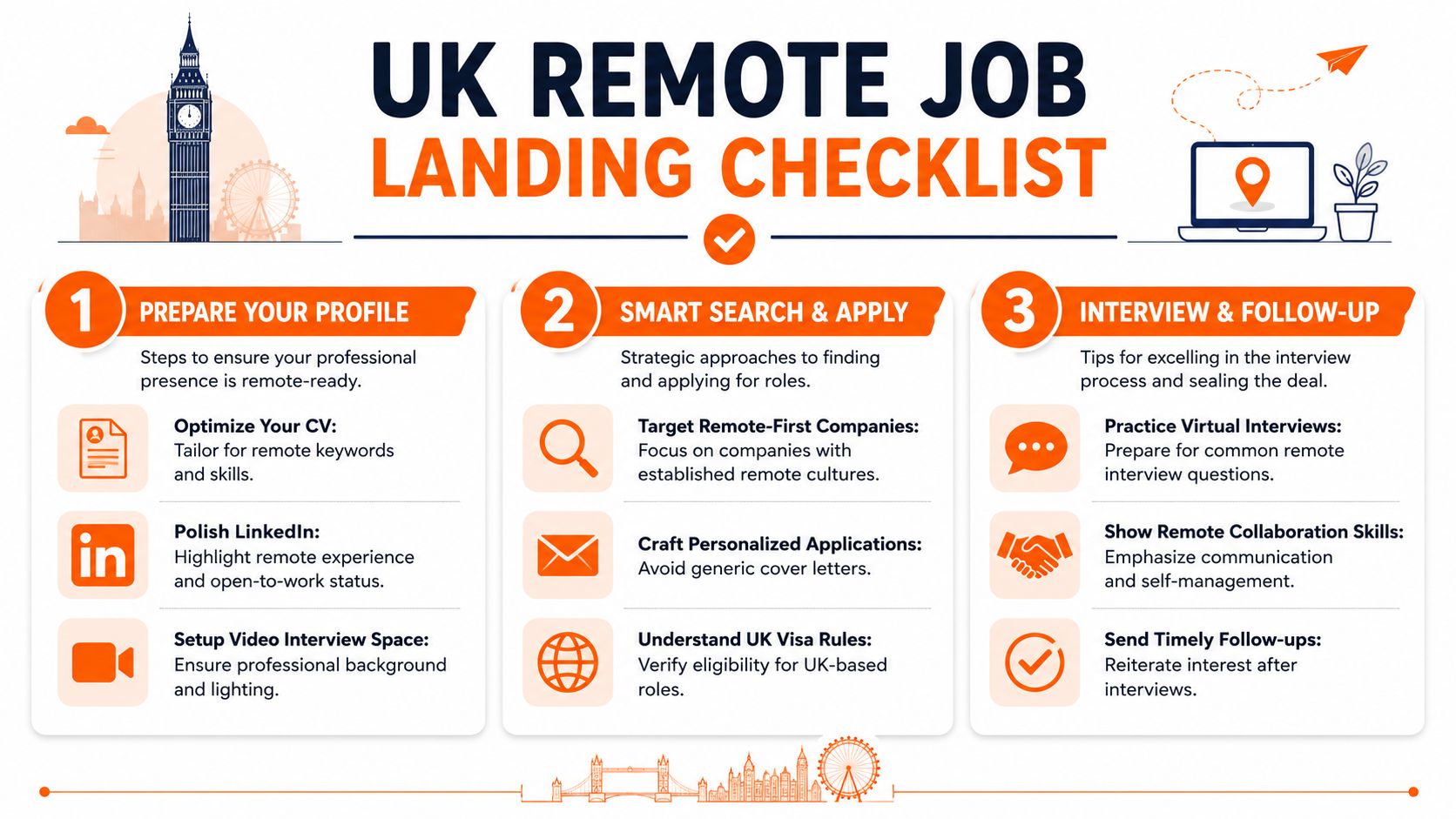
Use this checklist before your next round of applications:
- Choose your target lane: Pick a function, seniority level, and contract type. Don't market yourself to everyone.
- Search by reality, not headline: Separate fully remote, hybrid, and remote-friendly roles based on actual wording in the advert.
- Look beyond London: Search regional hotspots, nearby talent hubs, and commuter-accessible employers instead of relying only on broad UK-wide queries.
- Benchmark your level: Use seniority-based salary expectations to judge whether a role is aligned with your experience.
- Rewrite your CV for remote work: Show written communication, autonomy, documentation, stakeholder management, and tool fluency.
- Build a proof-first portfolio: Give employers examples they can assess asynchronously.
- Prepare remote-specific interview stories: Focus on independent delivery, collaboration across distance, and problem-solving with limited supervision.
- Treat assessments like live collaboration: Explain assumptions, write clearly, and keep submissions easy to review.
- Check the contract carefully: Confirm right-to-work expectations, tax setup, office attendance, and travel obligations before accepting.
- Stay selective: In a crowded market, better-fit applications beat bulk applying.
Landing one of the better UK remote jobs isn't about chasing every listing. It's about making it obvious that you can thrive in the exact kind of remote environment the employer is trying to build.
If you're ready to put that checklist into action, YayRemote is a strong place to start. It brings together hand-picked remote roles, useful filters, and practical tools that help you search more precisely, present yourself better, and spend less time on poor-fit applications.