Work from Europe: A Practical Guide for 2026
Want to work from Europe? Our 2026 guide covers legal pathways, finding remote jobs, visas, taxes, and setting up your life abroad. Start your journey today.
You’re probably in one of three situations right now.
You have a remote job and want a legal base in Europe instead of working on a tourist stay. You want to get hired by a European company and need to understand whether sponsorship is realistic. Or you’re freelancing, piecing together client work, and trying to figure out which country will let you live there without turning your paperwork into a second full-time job.
That’s where most work from Europe advice falls short. It tells you the dream. It doesn’t help you choose the right route.
The practical question isn’t “Can I work from Europe?” For many professionals, the answer is yes. The practical question is which legal setup fits your work arrangement, tax risk, and tolerance for bureaucracy. Get that choice wrong and everything downstream gets harder, from job applications to banking to residency renewals.
Your European Work Dream Is Closer Than You Think
The appeal is easy to understand. You finish work and step outside into a walkable neighborhood. Your commute is gone. Your social life doesn’t depend on driving everywhere. Weekends open up. Europe stops being a vacation backdrop and starts becoming regular life.
That shift is more realistic than it was a few years ago. In 2025, the EU employment rate for people aged 20 to 64 reached a record high of 76.1%, and 52.9% of EU enterprises held remote meetings in 2024, while the Netherlands saw 52% of workers engage in remote work according to Eurostat’s employment and remote work update. That matters because it signals something bigger than a passing trend. European employers, teams, and systems have already adapted to flexible work.

What the dream gets wrong
The romantic version of moving to Europe usually skips the admin. It skips the part where a company says “remote” but only means within one payroll jurisdiction. It skips the part where your visa category doesn’t allow the work you plan to do. It skips the tax residency questions that only become urgent after you’ve signed a lease.
That doesn’t make the move unrealistic. It means the move needs a framework.
Practical rule: Don’t start with countries. Start with your current work arrangement. Your legal path should follow the way you earn money, not the city you saw on Instagram.
What actually works
Three profiles usually succeed fastest:
- Employees with an existing remote role who can get formal employer support
- Professionals targeting local European hiring in fields where companies already recruit internationally
- Freelancers and contractors who can document income cleanly and meet visa requirements consistently
The strongest moves are usually boring on paper. Clean contracts. Clear residency purpose. Matching payroll and tax setup. Good records. That’s what keeps a European move stable after the first wave of excitement wears off.
If you want to work from Europe for more than a short experiment, treat it like a systems problem. The dream is the easy part. The right structure is what makes it last.
Choosing Your Legal Pathway to Work from Europe
There are three routes to consider. Local employment with a European company. Remote work for your current employer through a formal international setup. Or a digital nomad or freelancer visa tied to your independent income.
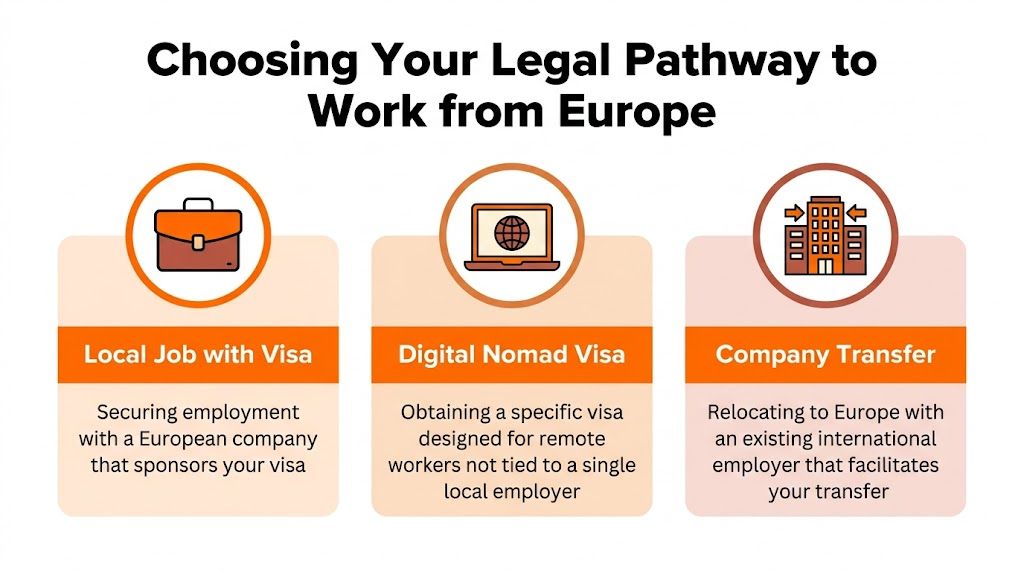
The mistake I see most often is people choosing the path that sounds easiest, not the one that fits how they’re paid. That’s how you end up with a legal mismatch. A remote employee tries to use a freelancer route. A contractor targets employer sponsorship before proving demand for their profile. A company says “sure, work from Spain” without understanding what that triggers.
The three paths side by side
| Pathway | Best For | Key Benefit | Main Challenge |
|---|---|---|---|
| Local job with visa | People who want stability and a direct employer relationship | Cleaner integration into local payroll, benefits, and residency | Slower hiring and sponsorship friction |
| Remote with employer support or EOR | Existing employees whose company wants to keep them | Lets you keep your role while relocating legally | Employer cooperation is non-negotiable |
| Digital nomad or freelancer visa | Independent workers or remote employees whose visa allows foreign-source work | Flexibility and location choice | Ongoing proof of income and strict compliance details |
Local job with visa
This route suits people who want the most conventional setup. You get hired by a company in the country where you’ll live. They place you on local payroll or sponsor the immigration process directly, depending on the country and role.
It works especially well for engineers, product specialists, data professionals, multilingual customer teams, and some sales roles. If you want long-term residency, local benefits, and fewer gray areas, this is often the cleanest option.
The trade-off is speed. European hiring can move slower than many candidates expect, and sponsorship adds another layer of caution. Employers often prefer someone who already has work authorization. That doesn’t mean sponsorship is impossible. It means your profile needs to solve a real hiring problem.
Remote with employer support or EOR
This route is usually best for people who already have a job they’d like to keep. Your employer either establishes a compliant setup directly or uses an Employer of Record so you can live in Europe while staying formally employed.
This is the most overlooked option because it doesn’t feel like a “job search” route. But for many people it’s the least disruptive. You keep your manager, your work history stays intact, and you avoid starting over with a new company just to change countries.
What doesn’t work is informal approval. A manager saying “I’m fine with it” is not enough. HR, payroll, legal, and tax all need to align. If your company isn’t willing to do that work, the plan usually stalls.
If your employer won’t put the arrangement in writing, assume it isn’t approved yet.
Digital nomad or freelancer visa
This route fits consultants, creators, agency owners, contractors, and some remote employees whose visa category allows income from abroad. The attraction is obvious. You’re not tied to one local employer, and you can choose a country based on lifestyle, language, or cost of living.
It’s also the route people misunderstand most. A digital nomad visa isn’t a magic remote-work pass. Each country defines acceptable income sources, required documents, insurance rules, and renewal standards differently. Some are comfortable with foreign employers. Others are better for freelancers with multiple clients. Some are straightforward at application stage but strict at renewal.
How to choose honestly
Ask yourself these questions first:
- Who pays you today: A local employer route rarely makes sense if most of your income is from freelance clients and you want flexibility.
- How much admin can your company handle: If your employer resists cross-border compliance, don’t build your plan around corporate support.
- Do you want permanence or optionality: Local employment is usually stronger for long-term settlement. Nomad routes are usually stronger for mobility.
- Can you document income cleanly: Freelancers with messy invoicing or inconsistent records usually struggle more than they expect.
- Do you need family dependents included: Some pathways are far easier than others for partners and children.
The right answer is often less glamorous than the wrong one. But it will survive contact with immigration, payroll, and tax offices, which is the standard that matters.
How to Find and Secure a Remote European Job
The job search gets easier when you stop treating Europe as one market. It isn’t. Remote policies, hiring norms, payroll constraints, and language expectations vary widely by company and country. A good search is less about volume and more about filtering for jobs that can effectively support your move.
One useful benchmark comes from the data market specifically. An analysis of remote data jobs in Europe found an average salary of €35,088 annually for data analytics roles, with fully remote listings still relatively scarce at around 10% to 15%, and success depending heavily on 80% to 90% skill alignment plus avoiding location mismatches that account for 70% of application failures. Even if you’re not in data, the lesson carries over. Precision beats mass applying.
Read the job description like an operator
A posting can say “remote” and still be useless for your plans. You need to read for constraints, not just perks.
Look for signals like these:
- Jurisdiction language: “Remote in Germany,” “must reside in the EU,” or “open to EMEA” all mean different things.
- Employment wording: If the company says “contract only” or “must have the right to work,” that changes your legal path immediately.
- Timezone expectations: Core hours matter more than a generic remote label.
- Travel clauses: Frequent in-person meetings can make a distant setup impractical even if technically allowed.
When you’re searching across platforms, it helps to keep one written checklist and score every role against it. That prevents excitement from overriding fit.
Build a narrower search than you think you need
A targeted search usually produces better interviews than a broad one. I’d focus on:
Role families with transferable demand
Engineering, product, data, design, customer success, sales, and marketing all show up regularly in cross-border remote hiring.Companies that already hire distributed teams
If a company has workers spread across several countries, you’re not asking them to invent a system from scratch.Regions that match your hours
Timezone friction kills otherwise strong applications. If you’re keeping clients or employers outside Europe, prove your overlap early.
For practical search tactics and application workflow, the guide on how to find remote work is a good reference point because it focuses on filtering, fit, and application quality rather than just sending more applications.
Tailor your application for Europe
A US-style resume can still work, but many applicants improve results by adapting tone and structure. European hiring teams often respond well to CVs that are direct, chronological, and less inflated.
A few adjustments matter:
- State work authorization clearly: If you need sponsorship or plan to relocate under a nomad route, be explicit.
- Match tools and keywords tightly: Don’t assume transferable skill will be inferred.
- Address location head-on: If you’re outside Europe, explain the compliance path you plan to use.
- Show timezone realism: Mention working hours overlap if relevant.
Later in the process, practical communication matters as much as credentials.
What works and what usually doesn’t
What works is applying to roles where the company’s setup, your legal route, and your hours fit. What doesn’t work is chasing every “remote Europe” listing and hoping compliance gets solved later.
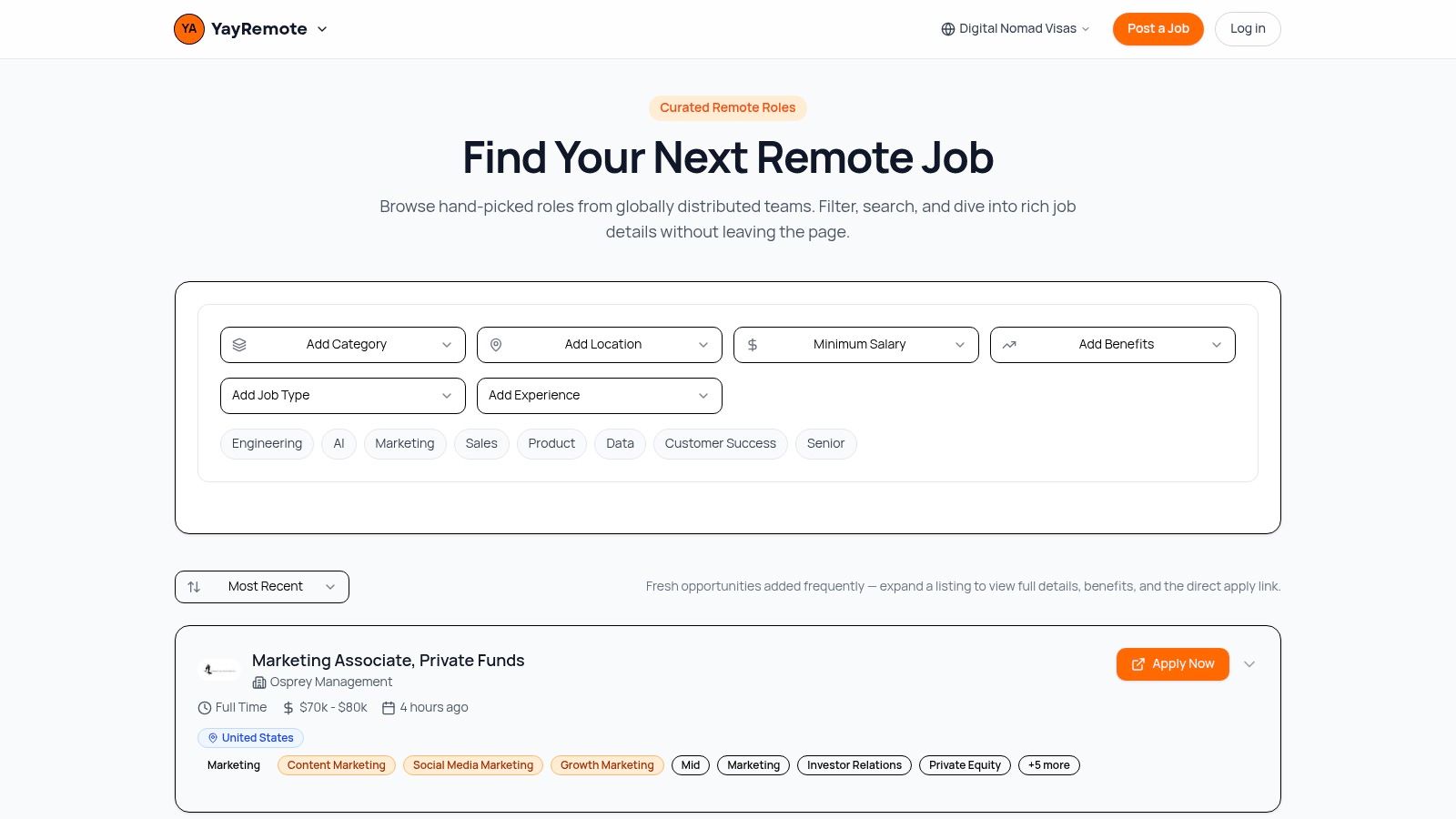
One platform in this space is YayRemote, which lets candidates filter curated remote roles by category, experience, job type, salary, and location, and also offers tools like a Skills Analyzer, ATS Resume Checker, and Time Zone Overlap tool. That kind of workflow is useful because it helps you test fit before you apply, not after a recruiter asks where you’re legally allowed to work.
The strongest application says two things at once. “I can do this job” and “my work arrangement won’t become your problem.”
Navigating Visas, Residency, and Legal Essentials
Enthusiasm often meets paperwork. Working from Europe legally isn’t just about getting into a country. It’s about having the right status for the way you earn income, the place you’ll reside, and the obligations that follow once you’re there.

One of the least discussed realities is cross-border telework inside Europe itself. Hiring Lab’s analysis of European cross-border work notes that 1.8 million cross-border workers were recorded in 2023, and that this rise has created real compliance complications around tax, social security, A1 certificates, and double taxation treaties. Those issues don’t only affect EU citizens. Non-EU remote workers run into the same underlying questions once they start living in one country and getting paid from another.
Tourist stay versus work-authorized stay
A short stay and a work-authorized stay are not the same thing. Many people arrive first and try to sort it out later. That can work for housing searches or exploratory travel. It’s a poor strategy for actual work authorization.
If you plan to live in Europe while earning remotely, your first question should be simple: Does my status allow this specific type of work?
That usually means distinguishing between:
- Tourist presence, which is generally for visiting, not for establishing an ongoing work base
- National long-stay residence, which may permit employment, self-employment, or remote work under defined conditions
- Nomad or freelancer categories, which often sit somewhere between classic employment immigration and self-employment frameworks
The real compliance traps
The legal traps usually aren’t dramatic. They’re administrative. You miss a registration deadline. Your employer assumes foreign payroll doesn’t matter. You stay long enough to trigger tax residency without planning for it. Your insurer doesn’t satisfy visa standards. None of this looks serious until a renewal, border check, or tax filing forces the issue.
These are the areas that deserve attention early:
- Tax residency exposure: Living most of the year in one country can shift where you owe tax.
- Social security coordination: This gets especially tricky when employer, employee, and residence country aren’t the same.
- Proof of lawful income: Immigration officers usually care less about your job title than about whether your income is documented, stable, and permitted under that visa category.
- Address registration: In many places, local registration is foundational. Without it, everything else gets harder.
Ask two separate professionals when needed: an immigration specialist for right-to-stay questions, and a tax adviser for right-to-work-across-borders questions. Those are not the same problem.
A practical way to research country options
If you’re narrowing countries, use side-by-side visa research rather than reading isolated forum posts. A resource like this guide to the remote work visa Europe options is useful because it frames the issue comparatively. That’s the right mindset. You’re not just asking which country has a visa. You’re asking which visa matches your income source, renewal prospects, and paperwork tolerance.
For country-specific planning, the digital nomad visa guide for Europe is also worth reviewing because it helps you compare routes before you commit to a single destination.
What to prepare before you file anything
A strong application package usually starts with organization, not forms. Gather your records before you choose an appointment date.
Use a document stack that includes:
- Identity documents: Passport copies, photos, and civil status documents if relevant
- Income proof: Contracts, client agreements, employer letters, invoices, or pay records
- Accommodation evidence: Temporary booking first, then a more durable address once allowed
- Insurance documents: Coverage that matches local visa requirements
- Background records: Criminal record certificates or apostilled documents where required
Don’t underestimate document formatting. Consulates often care about translations, issuance dates, apostilles, and consistency between documents. A file can be substantively valid and still get delayed because the paperwork package is sloppy.
What usually works best
The cleanest approvals tend to come from applicants who can explain their situation in one sentence. “I’m employed by X and my employer supports my residence in Y.” “I have recurring freelance income from these clients and will reside in Z.” If your explanation takes five minutes and several caveats, your setup probably needs tightening.
Europe rewards clarity. Immigration systems don’t want your lifestyle story. They want a lawful category, matching documents, and a coherent paper trail.
Your Financial and Healthcare Setup in Europe
Once the visa piece is moving, everyday systems take over. Banking, taxes, and healthcare are what make your move functional instead of theoretical. This is the part that affects your first few months the most.
Banking without getting stuck
Opening an account can be simple or annoyingly circular. The bank wants proof of address. The landlord wants a bank account. Utilities want both. That’s why many newcomers start with a digital-first option for daily spending while they sort out local documentation.
A practical approach is to separate your needs:
- Daily payments: Use an account that works quickly for cards, transfers, and recurring charges
- Income reception: Make sure your employer or clients can pay into the account you choose
- Longer-term local use: Once registered locally, add a domestic account if your landlord, employer, or tax office expects one
If you plan to stay for years rather than months, think ahead. Credit history, local statements, and regular filings become more important when you later apply for rentals, financing, or a mortgage. For self-employed expats who want to understand that longer arc, this guide on how an expatriate self-employed borrower can obtain a mortgage gives a useful view of what lenders typically look for.
Tax setup before tax trouble
Tax is where many otherwise organized moves become messy. The key issue is usually not whether you owe tax somewhere. It’s whether you’ve aligned your residence, income source, invoicing, and filings properly.
Start with these actions early:
- Learn your filing obligations: Residence country rules often kick in before people expect.
- Keep clean records: Save contracts, invoices, payslips, and travel dates.
- Separate business and personal spending: This matters even more if you freelance.
- Check deduction rules carefully: Remote workers often assume expenses are deductible when local rules say otherwise.
For a practical overview of what remote workers should think about, including expense categories and documentation habits, the guide on remote work tax deductions is a solid starting point.
Healthcare you can actually use
Healthcare planning has two layers. One is what satisfies immigration. The other is what helps you get treatment smoothly after arrival. Those are related, but they aren’t always identical.
Focus on this sequence:
Get visa-compliant coverage first
The policy needs to meet the immigration requirement, not just look good on paper.Understand the local system after registration
Public enrollment, private supplements, and reimbursement rules vary widely.Find care pathways in your language if that matters to you
This becomes important faster than people expect, especially for ongoing medication or specialist care.
Don’t buy insurance only because it gets the visa approved. Buy something you can actually navigate when you need a doctor.
The first ninety days are mostly about making these systems boring. Once money moves reliably, tax records are clean, and healthcare is usable, daily life gets much easier.
Logistics for Your New Life and Work Routine
The first month in Europe rarely feels like the polished version people imagine. You might be working from a temporary apartment with weak lighting, waiting on a registration appointment, and trying to figure out why every housing inquiry has gone quiet. That’s normal.
Housing is usually the first real test. Short-term accommodation gives you speed, but it often doesn’t give you the paperwork needed for registration. Long-term leases offer stability, but landlords may want local documents you don’t have yet. In practice, many people need a staged approach. Arrive with temporary housing, complete the essential registrations, then search for a longer lease once you can present cleaner paperwork.
Build your routine around friction points
Remote work in Europe often works well once the routine is deliberate. It works poorly when people assume the same habits from home will transfer untouched.
A few friction points show up often:
- Housing search fatigue: Apartment hunting can easily consume work hours if you don’t contain it
- Timezone spillover: Late meetings with US teams can eat into evenings quickly
- Cultural pacing: Service schedules, lunch hours, and local admin windows may be less accommodating than you expect
- Workspace quality: A beautiful flat isn’t necessarily a good place to work all day
According to European hybrid work data and implementation trends, 22% of EU workers worked from home in 2023 and 52.9% of enterprises held remote meetings, but hybrid arrangements often fail because of poor timezone management, and the same source notes a 15% burnout risk without clear well-being policies. That matches what many remote workers learn the hard way. A flexible schedule can subtly become an always-on schedule.
A moving checklist that saves headaches
Book temporary housing that allows enough time for local admin.
Confirm whether your address can support registration if required.
Test your internet before your first full workday.
Set core working hours in writing with your team.
Keep digital copies of every lease, invoice, and registration receipt.
Find one backup workspace before you need it.
Make local work culture your ally
Europe isn’t one work culture. Still, a few broad habits help. People often respond well to direct communication, clear agendas, and respecting local boundaries around time off. If you schedule across continents, define your overlap hours instead of renegotiating them every week.
What usually doesn’t work is assuming availability equals commitment. If you let every timezone pull at your calendar, your day loses shape. The healthier pattern is to create a fixed rhythm for meetings, admin, focused work, and local life.
That rhythm matters more than the city. A glamorous base with chaotic hours gets old fast. A modest setup with a sustainable routine is what makes work from Europe feel good after the honeymoon phase.
Your Top Questions About Working from Europe Answered
Can I move first and figure out the legal setup later
You can visit first. You shouldn’t assume you can regularize everything later without consequences. In practice, the cleaner route is to decide your legal basis before you build a life around it. Leases, tax residency, and employer permissions become much harder to unwind once you’re already living in country.
Is Europe still a good place to look for remote work
Yes, but you need realistic expectations. Europe’s labor market is flexible and broad, not frictionless. This overview of flexible work across Europe notes that the gig economy is projected to include 43 million platform workers by 2025, while overall EU unemployment reached a post-2014 low of 6.1% in 2023. That supports the basic thesis that remote and flexible work is a serious path, not a niche lifestyle experiment.
Which route is usually easiest for a first-timer
The easiest route is the one that matches your existing income. If you already have a supportive employer, a formal employer-backed setup is often simpler than changing jobs and countries at the same time. If you’re an established freelancer with clean records, a nomad or freelancer route can be straightforward. If you want long-term settlement and local benefits, a direct local hire is often worth the slower start.
The hardest route is usually the mismatched one. That’s the candidate trying to force a country or visa onto an income setup it wasn’t designed for.
Can I bring family with me
Often yes, but it depends heavily on the residence category and the country’s dependent rules. The practical issue isn’t only whether dependents are allowed. It’s whether the process stays manageable once you add school planning, insurance, housing size, and extra document requirements. If family relocation is part of the plan, treat that as a first-round filter when comparing pathways, not a detail to solve later.
How long does the whole process take
Longer than people hope, shorter than people fear if their paperwork is clean. The biggest delays usually come from indecision, missing documents, inconsistent income records, and vague employer support. People who choose the right route early and document everything well tend to move faster than people who chase three options at once.
The practical next step is simple. Pick your legal pathway first, then build the move around it.
If you’re actively trying to work from Europe, start with YayRemote to browse remote roles, compare job filters, and use practical tools that help you assess fit before you apply.