What Is Skills-Based Hiring? a Comprehensive Guide
Discover what is skills-based hiring, why it's crucial for modern recruitment, and how to implement it. Shift from credentials to capabilities with our guide.
Skills-based hiring is a method that prioritizes a candidate's demonstrable abilities over traditional proxies like degrees or years of experience, and 85% of employers reported using it in 2025 while resume use fell to 67%. In practice, that means using assessments, work samples, structured interviews, and scored rubrics to predict job performance more directly.
That shift matters because many hiring managers still hear the phrase and assume it means one simple change: remove degree requirements and call it modern recruiting. That's not enough. Real skills-based hiring changes how a team defines the role, screens candidates, evaluates evidence, and makes decisions, especially when the team is remote and can't rely on office presence, polished resumes, or familiar employer brands as shortcuts.
For distributed teams, this approach is even more useful. Remote hiring widens the candidate pool, but it also increases variance. You'll see applicants from different countries, education systems, job-title conventions, and career paths. If your process depends on pedigree, you'll miss strong people. If your process depends on clear skill signals, you'll make better calls.
An Introduction to Skills-Based Hiring
A large majority of employers now say they use skills-based hiring, but many teams still run the same old process with new language. They remove a degree requirement, keep resume screens, keep vague scorecards, and still make decisions based on pedigree.
That gap between intent and execution is where most initiatives stall.
What is skills-based hiring? It is a hiring method that tests whether a candidate can do the work, instead of assuming they can because of a degree, a brand-name employer, or a familiar title. The shift sounds simple. In practice, it changes how a team defines the job, chooses assessment methods, and makes hiring decisions under time pressure.
That matters even more in remote-first teams. Distributed hiring expands access to talent, but it also strips away many of the shortcuts managers are used to trusting. Titles vary by country. School prestige does not travel well. Office-style impressions do not help when the actual job depends on written communication, self-direction, and handoffs across time zones.
A workable process starts before you post the role. Hiring teams need to name the skills that affect performance, decide which ones are required on day one, and separate them from traits that only sound attractive. A simple way to do that is to map the role's first 90 days to the work itself, then use a skills gap analysis tool to identify which capabilities are missing on the team.
From there, the process gets more concrete:
- Define the role by outputs: List the tasks and decisions the person will own, not just qualifications.
- Choose evidence on purpose: Use work samples, job-relevant exercises, and structured interviews tied to the role.
- Score consistently: Use shared rubrics so interviewers judge the same evidence against the same standard.
- Reflect remote conditions: Test async communication, prioritization, documentation, or independent execution if those skills matter in the job.
This is the part many articles skip. Skills-based hiring is not just a sourcing message. It is an operating model for selection.
Managers usually push back for a sensible reason. They worry that dropping familiar filters will lower signal and flood the pipeline with harder-to-compare candidates. That can happen if the process is loose. It also happens when teams add assessments without tightening the job definition first.
A strong system solves that problem by making evidence easier to compare. Instead of arguing over whether one candidate's background feels more impressive, the team reviews the same work against the same criteria. For technical roles, skills-based hiring in tech is a useful example of how that shift works when hiring managers need proof, not slogans.
The practical test is simple. If a requirement does not clearly predict success in the role, it should not carry much weight in screening. That standard forces better hiring discipline, especially in remote teams where clarity beats familiarity.
The Fundamental Shift from Credentials to Capabilities
Think about hiring a chef. You can learn something from their culinary school, the restaurants on their resume, and how long they've worked in kitchens. But if you need to know whether they can cook, you ask for a tasting menu.
That's the difference between credentials-based hiring and skills-based hiring.
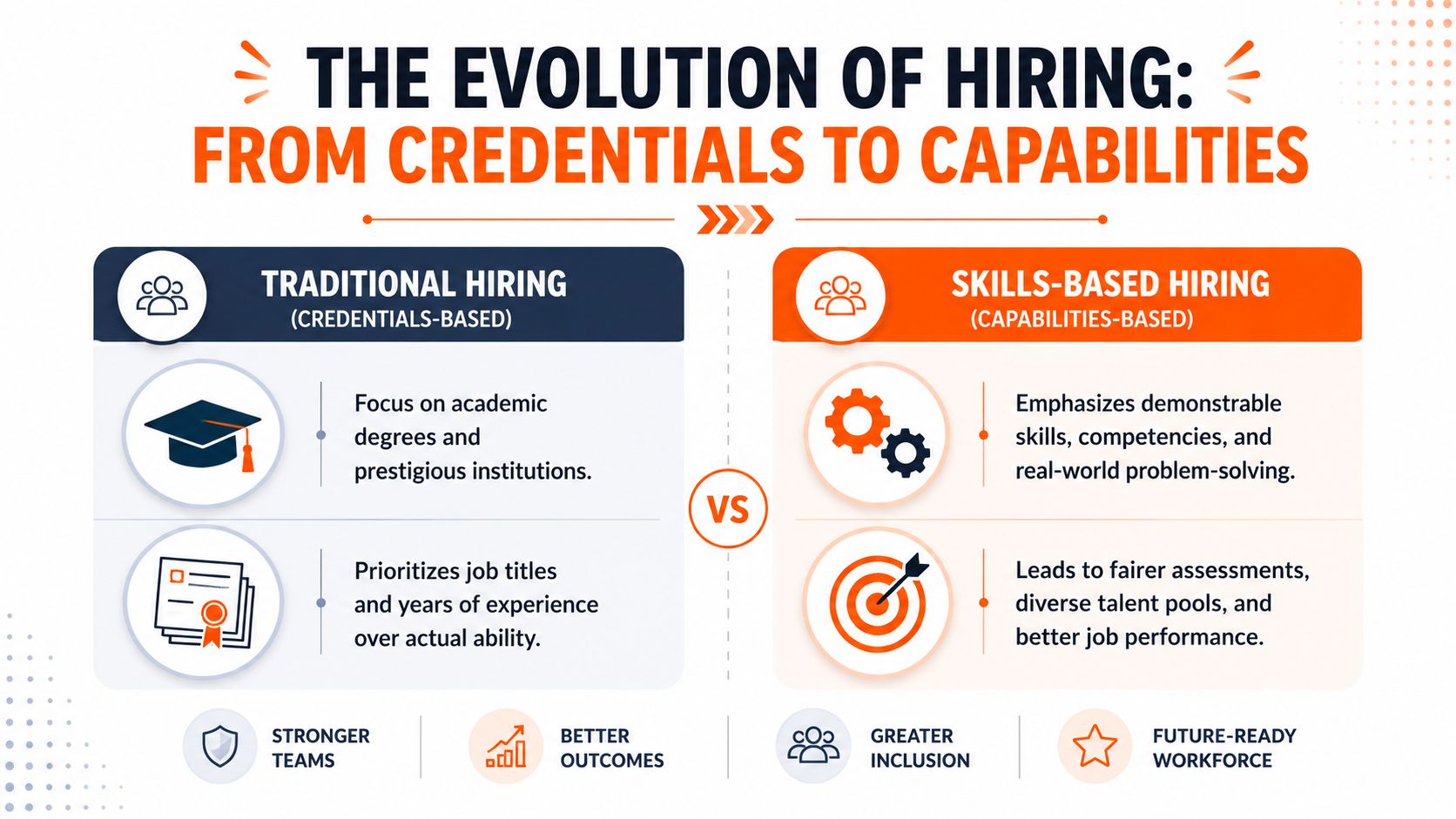
Traditional hiring often evaluates proxies. Skills-based hiring evaluates evidence. In remote hiring, that distinction gets sharper because proxies travel badly across borders. Job titles vary by country. Degrees aren't always comparable. Prestigious employers aren't equally visible to every recruiter.
What proxy signals miss
A resume can tell you where someone has been. It doesn't reliably tell you what they can do today, under your conditions, with your tools, on your team.
That's why capability-based evaluation usually uses a mix of methods:
| Hiring signal | What it tells you | Common weakness |
|---|---|---|
| Degree | Formal education completed | Doesn't show current job performance |
| Years of experience | Time spent in a field | Time and skill depth aren't the same |
| Job title | Stated level or scope | Titles differ widely between employers |
| Work sample | Demonstrated execution | Requires thoughtful design |
| Structured interview | Comparable evidence across candidates | Fails if interviewers freestyle |
| Behavioral assessment | Patterns in decision-making or interaction | Needs context and careful interpretation |
If you're refining the interview layer, this Synopsix guide for HR leaders is useful because it separates behavioral assessment from general interviewing and shows where each fits.
Why this shift feels harder than it sounds
Teams are used to making fast judgments from familiar markers. Skills-based hiring asks them to slow down and define what “qualified” means in more concrete terms.
That usually starts with a capability map. Before you assess people, you need a clear picture of the gap you're trying to close. A structured skills gap analysis tool can help teams move from vague role descriptions to explicit capabilities, especially when multiple interviewers are involved.
Hiring gets cleaner when every interviewer scores the same evidence against the same skill definitions.
That's the fundamental shift. Not from one checklist to another, but from assumption to proof.
The Business Case for Skills-Based Hiring
A lot of hiring changes sound sensible in theory and collapse when they meet cost, speed, or manager attention. Skills-based hiring has a stronger case because it addresses an operational problem: companies need better ways to identify capable people when traditional signals are incomplete, inconsistent, or too restrictive.
It expands access to talent
NACE reported that 70% of employers in its 2026 Job Outlook survey used skill-based hiring, up from 65% the previous year. The same labor-market summary notes that evaluating skills instead of formal credentials can expand talent pools by 15.9× in the U.S. and 6.1× globally, which helps explain why many employers now treat this as a structural response to talent shortages rather than a short-term recruiting trend (NACE coverage of employer use of skills-based hiring practices).
For remote teams, that matters even more. The wider your geography, the less useful narrow credential filters become. A skills-first approach gives you a more practical way to compare candidates across countries, career paths, and employer brands.
It improves performance prediction
BCG reported that, in Lightcast's analysis of 13 million U.S. profiles, a hire made on the basis of skills was five times more likely to predict job performance than a hire made on education alone, while being only 2% less likely to be promoted over the same period as traditionally hired peers (BCG on the rise of skills-based hiring).
That's a useful trade-off for skeptical managers. The point isn't that education never matters. The point is that direct evidence of capability appears to be a much stronger signal for on-the-job performance than education by itself.
Manager's shortcut: If the role depends on execution from day one, test for execution from day one.
It creates a fairer path for candidates
Candidates benefit when the process asks, “Can you do the work?” instead of, “Do you match our usual template?” Career switchers, self-taught professionals, returners to work, and candidates from less recognizable institutions all have a better chance when evaluation focuses on output.
That doesn't mean fairness happens automatically. A sloppy assessment can exclude people just as easily as a degree screen can. But when the process is well designed, candidates know what is being measured and why.
It's not just good intent
The business case isn't that skills-based hiring feels progressive. It's that it can make recruiting more aligned with actual performance, broaden the reachable market for talent, and produce decisions that are easier to defend internally.
For hiring managers, that usually lands in one simple question: do you want to hire the person who looks right, or the person who can do the work?
A Practical Roadmap for Implementation
Many teams stall at this stage. They agree with the principle, then keep using the old process with a few cosmetic edits. Effective implementation needs a real operating model.
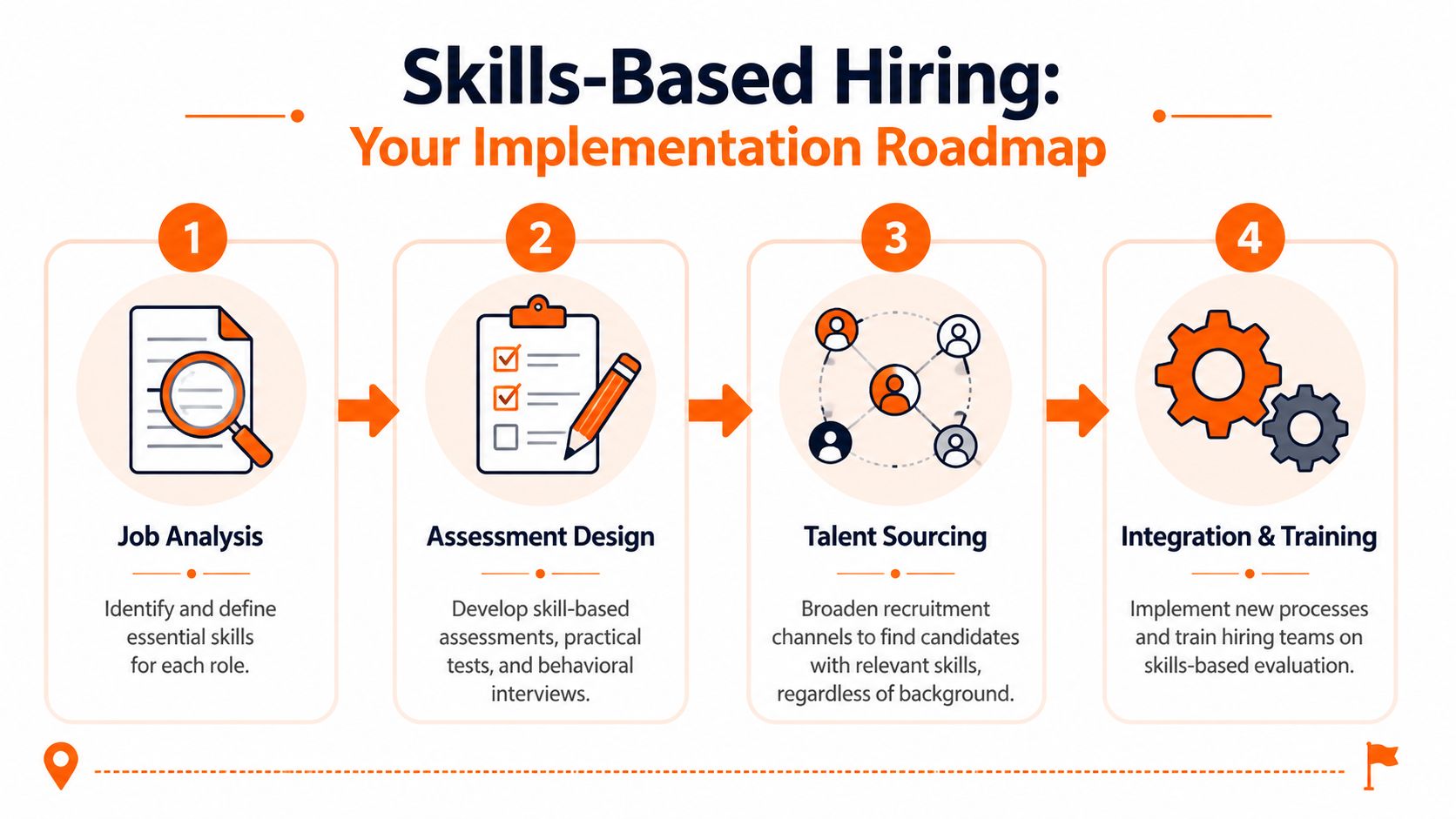
A useful implementation pattern is to map each role to about 5–8 core skills, define observable indicators for each skill, and then use standardized scoring to reduce subjectivity (practical guidance from PIN).
Start with job analysis
Most hiring errors begin before sourcing. The team writes a job description built from old requirements, copied responsibilities, and generic language like “excellent communication” or “self-starter.” That gives candidates very little to respond to and interviewers very little to assess.
Instead, deconstruct the role.
Ask:
- What outcomes must this person produce?
- What skills are essential in the first phase of the role?
- Which requirements are essential, and which are inherited habits?
- In a remote setting, what parts of the work happen asynchronously, independently, or cross-functionally?
For example, a remote customer success role might require product fluency, written communication, prioritization, stakeholder management, and calm problem-solving. “Has worked at a SaaS startup” may help, but it isn't the skill.
Rewrite sourcing around proof, not pedigree
Once the skill map is clear, your job post and sourcing channels should reflect it. Tell candidates what they'll be expected to do and how you'll evaluate them.
This often changes where you find people. If you're hiring technical talent, practical sourcing often works better when you combine structured assessment with specialized outreach. Teams looking for engineering talent can borrow useful tactics from these strategies for hiring elite developers, especially when role quality matters more than familiar resumes.
A broader remote search also helps. If you're opening roles beyond one geography, practical guidance on how to hire remote employees can help align sourcing, compliance, and collaboration expectations early.
Don't ask for “rockstars,” “ninjas,” or “top-tier communication.” Ask for the work. Candidates can respond to that.
To make job ads more useful, include:
- Core skills: Name the capabilities that matter most.
- Evidence expected: Mention work samples, technical exercises, or structured interviews.
- Remote conditions: Clarify timezone overlap, async expectations, and collaboration norms.
- Nice-to-haves: Separate them from must-haves so candidates don't self-reject unnecessarily.
A short explainer can help teams align on process before launch:
Build assessments that resemble the work
This is the part people either overcomplicate or trivialize. The goal is not to create a perfect simulation. The goal is to gather useful evidence.
Good assessments are:
- Relevant: They reflect tasks or decisions that occur in the role.
- Manageable: They respect candidate time.
- Consistent: Every candidate gets the same instructions and scoring basis.
- Interpretable: Evaluators can explain what strong, acceptable, and weak performance looks like.
For remote work, written exercises are especially valuable because they reveal clarity, judgment, and async communication. For technical roles, a scoped work sample usually tells you more than abstract trivia. For managerial roles, scenario-based prompts can reveal prioritization and stakeholder handling.
Run structured interviews, not resume tours
By the time a candidate reaches interviews, your team should already know what it needs to verify. Each interviewer should own specific skills and score them against predefined indicators.
A simple interview scorecard usually works better than freeform discussion. It forces the team to compare evidence instead of comparing impressions.
Common failure points include asking different candidates different questions, changing standards mid-process, or treating “culture fit” as a catch-all veto. Skills-based hiring doesn't remove judgment. It gives judgment a framework.
Powering Your Strategy with YayRemote Tools
A skills-based process often breaks down before interviews start. Candidates describe their background in titles and tasks. Hiring teams screen for capabilities. In remote hiring, that mismatch gets worse because applicants come from more varied companies, markets, and career paths.
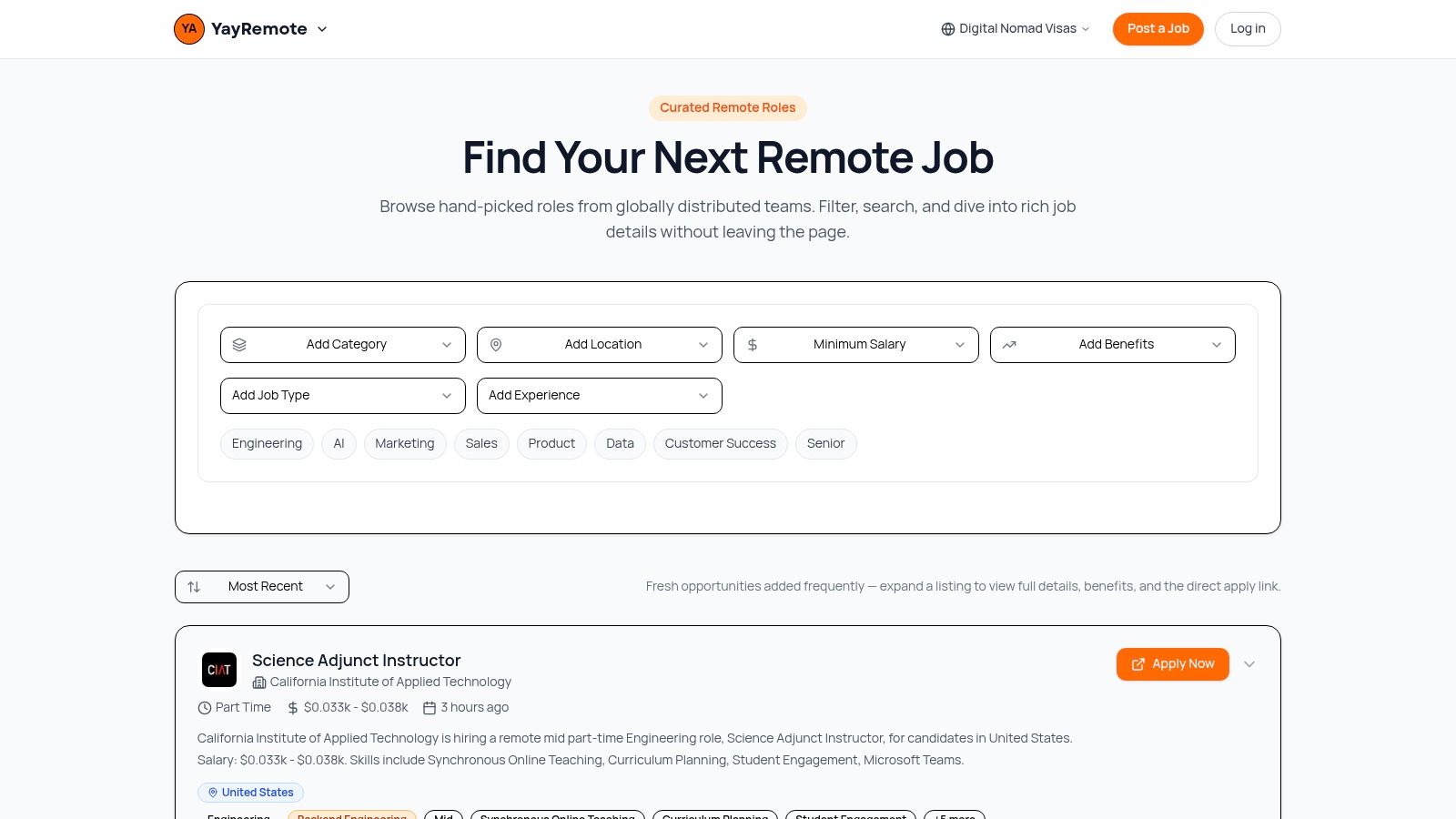
A candidate-side view of skills clarity
A marketer moving into product marketing may not have the title your team expects. The hiring question is whether that person can show positioning judgment, research synthesis, cross-functional communication, and launch support.
The YayRemote Resume Skills Analyzer helps candidates translate past work into skill language that matches the role. That matters because strong applicants are often filtered out for presentation problems, not capability gaps. The tool does not validate skill on its own. It improves the quality of the input your team sees.
That distinction matters in practice.
Teams that only remove degree requirements usually see limited change if resumes still hide relevant experience behind unclear titles or company-specific language. A better front-end signal gives recruiters and hiring managers a fairer starting point, especially for career changers and applicants coming from less familiar employers.
A hiring-side view of cleaner inputs
For employers, the value is simple. Better skill visibility makes early screening less dependent on pedigree shortcuts.
In a remote-first environment, that has real operational value. Recruiters spend less time guessing whether "owned growth" meant strategy, execution, or reporting. Hiring managers get resumes that map more clearly to the capabilities defined for the role. Candidates can also see likely gaps earlier, which reduces mismatched applications and weak first-round screens.
Used well, tools like this support four practical outcomes:
- Career changers present stronger evidence: transferable skills are easier to spot when titles do not line up neatly.
- Distributed teams compare candidates more fairly: evaluation relies less on familiar brands, schools, or local networks.
- Recruiters run sharper intake conversations: they can probe for proof behind a skill claim instead of decoding vague resume language.
- Hiring managers defend decisions more easily: shortlist choices tie back to stated capabilities, not gut feel or résumé prestige.
Tools support the process. They do not define it.
The teams that get results use them to improve signal quality at the top of the funnel, then back that up with structured assessments and interviews. That is the operational difference between talking about skills-based hiring and running it.
Navigating Implementation Challenges and Considerations
The biggest mistake teams make is thinking skills-based hiring starts and ends with deleting a degree requirement. That may remove one barrier, but it doesn't create a reliable evaluation system.
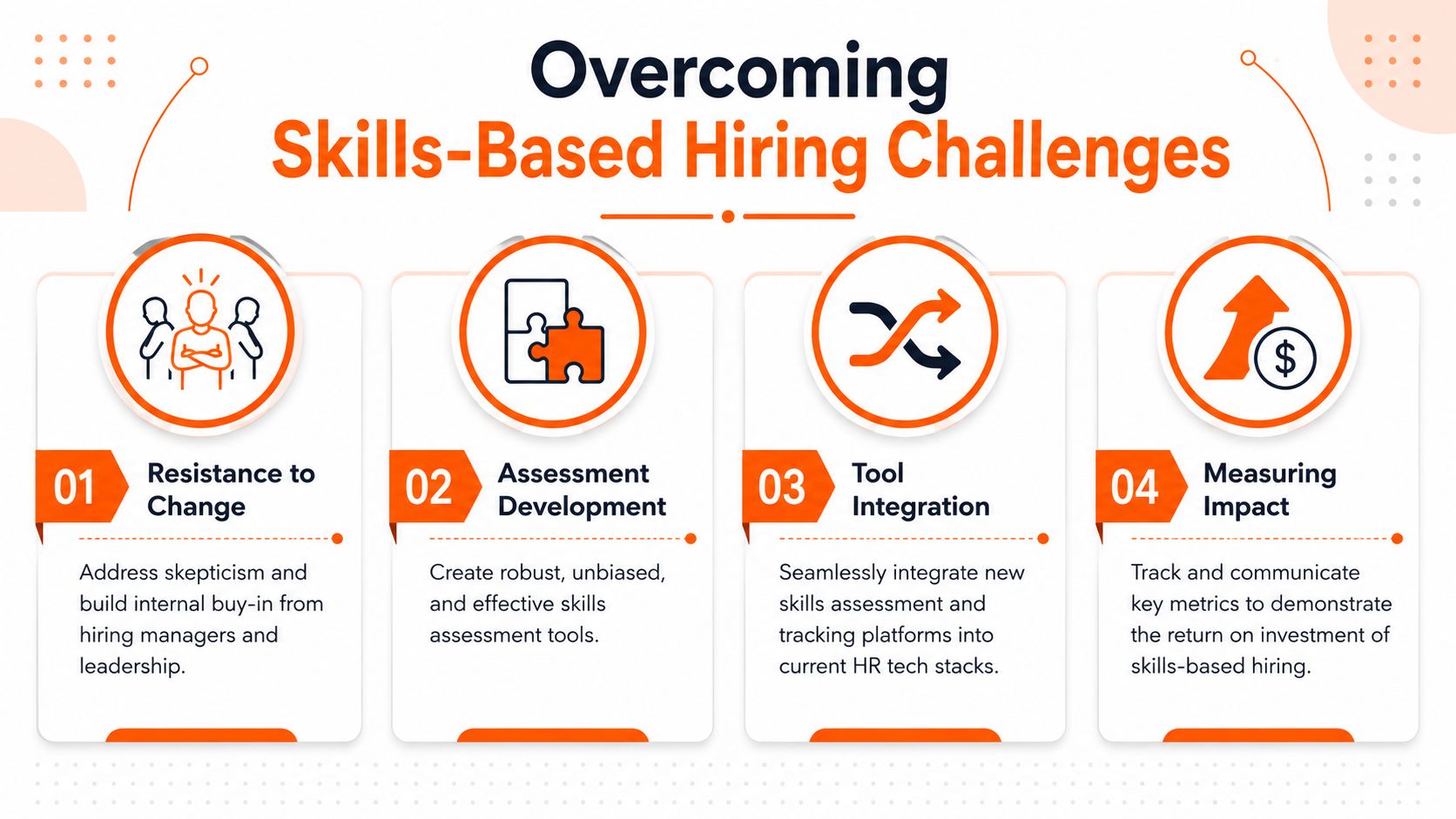
Brookings notes that skills-based hiring is often oversold as merely “removing degree requirements,” but evidence-based versions require structured job analysis, transparent competencies, and assessment design. It also notes that over 20 governors have committed to dropping degree requirements, which shows how policy momentum can outpace operational readiness (Brookings on what must change beyond degree removal).
Where teams get stuck
The first problem is internal resistance. Hiring managers often trust the old filters because they're familiar, not because they're accurate. If the new process looks slower or less intuitive, adoption will be uneven.
The second problem is assessment quality. A poor test introduces noise. If the exercise is disconnected from the role, overloaded with trick questions, or scored inconsistently, candidates lose trust and the team learns very little.
The third problem is systems integration. A skills-first process affects job design, recruiter screens, interview training, evaluation forms, and data tracking. If those pieces don't line up, the initiative becomes a slogan instead of a system.
What responsible implementation looks like
A more realistic approach includes a few guardrails:
- Define competencies clearly: Every skill should have observable indicators.
- Train interviewers: Structured scoring only works when interviewers use it consistently.
- Audit for fairness: Review whether the process disadvantages candidates for reasons unrelated to job performance.
- Track outcomes: Look at quality of hire, ramp time, retention, and interview consistency after implementation.
Burning Glass Institute's 2024 research argues that implementation lags behind the rhetoric, which is a useful caution. Many organizations are still early in implementation, and adoption depends on a broader ecosystem of employers, HR vendors, credentialing organizations, standards, learners, and policymakers (Burning Glass Institute research on skills-based hiring in 2024).
The hard part isn't deciding to value skills. The hard part is building a hiring process that can recognize them consistently.
For remote teams, that means designing assessments and interviews that work across time zones, cultures, and communication styles without lowering rigor.
The Future of Work is Skills-First and Remote
Remote hiring widened the available talent pool overnight. It also exposed how weak many traditional hiring signals are once candidates come from different countries, education systems, and career paths.
In a remote-first team, skills-based hiring is less a progressive idea and more an operating requirement. Managers cannot rely on office presence, pedigree, or shared networks to judge potential. They need clearer evidence that someone can write, analyze, sell, support customers, manage projects, or lead across distance.
That is the part many companies miss. Removing degree requirements is easy. Rebuilding the process so recruiters, hiring managers, and interviewers can judge capability consistently is harder, especially when candidates complete work from different time zones and communication norms. Remote hiring raises the standard for clarity.
The teams that get this right tend to make a few practical shifts. They define what good performance looks like before opening the role. They test for the work that matters. They document how decisions are made so hiring quality does not depend on who ran the interview that day.
For hiring managers, the takeaway is straightforward. A remote team becomes easier to scale when hiring is based on demonstrated ability instead of familiar backgrounds. For candidates, the bar also becomes fairer. Strong people with nontraditional experience have a clearer path to compete if the process gives them a real chance to show their work.
Skills-first hiring will keep growing because remote work keeps exposing the same question: can this person do the job well, with consistency, across distance? Companies that can answer that question with evidence will hire faster, widen access to talent, and make better decisions under pressure.
YayRemote helps remote professionals and distributed teams manage that shift with curated global job opportunities, practical hiring resources, and free tools that make skills-first remote work easier to understand and act on.