Canadian Work at Home: Your 2026 Guide to Finding a Job
Find your ideal Canadian work at home job. Our guide covers where to search, how to apply, negotiate pay, and navigate Canadian taxes for remote workers.
Remote work in Canada didn't snap back to its old baseline. It reset. The share of employees working mostly from home rose from 4% in 2016 to 18.7% in May 2024 according to Canadian work-from-home statistics. That single shift changes how you should search, apply, negotiate, and manage a career from home.
If you're trying to build a real Canadian work at home career, the big mistake is treating remote work like a generic internet job hunt. It isn't. In Canada, your province matters. Your employment status matters. Your tax paperwork matters. And the industries that hire remotely are not spread evenly across the economy.
The New Landscape of Remote Work in Canada
Nearly one in five Canadian employees now works mostly from home, as noted earlier. That figure is well below the pandemic peak, but it is still far above the old baseline. Remote work has settled into a permanent place in the Canadian job market, and the practical rules are clearer now.
That shift changed employer behaviour. Canadian companies that kept remote roles usually did it with intent. They built policies for onboarding, equipment, communication, security, and performance. Hiring managers now look for candidates who can document their work, write clearly, and stay productive without constant supervision.

What this means for Canadian job seekers
Competition is wider than it used to be.
A remote posting based in one province can attract applicants from several others, especially for knowledge-work roles. That creates more opportunity, but it also means a generic application gets buried fast. Employers expect proof that a candidate understands remote routines and the Canadian realities around them, including time zones, payroll setup, and whether the role is limited to one province or open across the country.
Location still matters in a work-at-home job. It affects employment standards, public holiday rules, termination requirements, workers' compensation coverage, and payroll deductions. In practice, a company may be happy to hire remotely but still restrict hiring to provinces where it already runs payroll or knows the legal requirements.
Provincial rules shape remote work more than many applicants expect
I frequently see Canadian applicants make avoidable mistakes. They read "remote" and assume the rest will sort itself out later. It often will not.
An Alberta-based company hiring someone in Nova Scotia may need to handle a different set of employment standards than it uses for local staff. A worker in Quebec can run into language, payroll, and documentation considerations that do not come up elsewhere. Home office tax questions also vary based on your employment arrangement, and employees who plan to claim workspace expenses need the right paperwork, including the T2200S when it applies.
That is why strong candidates read the posting for province limits, core working hours, employment status, and reporting structure before they apply. For a broader view of current remote jobs in Canada by role and hiring scope, use listings that separate fully remote Canadian roles from hybrid or location-restricted ones.
A useful companion read is this practical guide for remote work, especially if you want to understand how employers think about communication, accountability, and team coordination.
What strong remote employers usually make clear
The better Canadian remote employers are not vague. Their postings usually spell out:
- Hiring location: remote in one province, remote anywhere in Canada, or hybrid near a specific office
- Work hours: fixed local hours, overlapping time-zone requirements, or asynchronous expectations
- Employment setup: employee versus contractor, and which province's rules will apply
- Home office support: equipment, internet reimbursement, security requirements, and onboarding process
Those details matter because remote work in Canada is now structured, not improvised. Applicants who treat it like a real operating model usually make better choices and waste less time on roles that were never a fit.
Finding Your Ideal Remote Role in Canada
A strong remote search starts by narrowing the field. Don't open five giant job boards and type “work from home.” That gives you clutter, reposts, vague contractor gigs, and jobs that require relocation without explicit mention.
The better approach is to search by role family, industry fit, and Canadian hiring scope. If you do that well, you'll spend less time scrolling and more time applying to roles you can win.
Start with the sectors that truly support remote work
Canada's remote opportunities are not evenly distributed. Over 84% of telework capacity is concentrated in finance, insurance, and professional services, while accommodation, food services, agriculture, and forestry have almost no capacity according to the C.D. Howe Institute analysis on working from home across Canada.
That single fact should shape your search strategy.
If you're in software, product, design, marketing, customer success, finance, operations, or business analysis, you're searching in sectors that already support remote workflows. If you're in hospitality, trades, or hands-on service work, a fully remote role may require a pivot into adjacent office-based functions such as scheduling, customer support, dispatch, account coordination, recruiting, estimating, or documentation.
The cleanest remote career moves often happen sideways, not upward. A field technician may become a technical support specialist. A retail supervisor may move into customer operations. A coordinator in a clinic may transition into remote admin for a health-adjacent employer.
Use a narrower search system
Here's a practical way to search without wasting hours.
Define your role in plain language
Write down the exact titles you can do now. Then add adjacent titles an employer might use instead. “Content marketer” may also appear as “content specialist,” “SEO writer,” “editor,” or “growth content manager.”Search for Canada-specific remote listings
Use a dedicated page for remote jobs in Canada when you want to avoid sorting through listings that look remote but aren't open to Canadian applicants.Filter for what affects daily life
Prioritize time zone, employment type, benefits, and seniority before you look at branding or buzzwords. A great title with a poor hours fit becomes a bad job fast.Cross-check the posting language
Strong listings usually explain reporting structure, tools, communication expectations, and whether the role is remote-first or hybrid by policy.

Search terms that pull better results
Generic terms attract generic listings. Use combinations that reflect how Canadian employers label remote roles.
| Search goal | Better query ideas |
|---|---|
| National remote roles | “remote Canada” + your title |
| Hybrid-flex roles | “hybrid” + your title + province |
| Distributed teams | “distributed team” + your title |
| Async-friendly jobs | “asynchronous” + your title |
| Customer-facing roles | “remote customer success Canada” |
| Marketing roles | “remote content marketing Canada” |
On LinkedIn and Indeed, I'd also filter out vague “independent contractor” posts unless I'm intentionally looking for contract work. That one move removes a lot of low-clarity listings.
Judge the job, not just the title
A remote role can look perfect and still be poor quality. Read for signs of maturity.
Good signs include:
- Clear expectations: You can tell what success looks like.
- Defined tools: Slack, Asana, Jira, Notion, HubSpot, or other systems are named directly.
- Location honesty: The employer tells you whether the role is remote within Canada, remote within a province, or tied to a city for payroll purposes.
Weak signs include hype-heavy copy, unclear reporting lines, missing salary context, and “must be flexible” language with no boundaries.
Benefits deserve the same scrutiny. Before accepting a role, compare the basics against a guide to remote job benefits. It's a helpful checklist for evaluating health coverage, equipment support, time off, and policy details that get overlooked when people focus only on salary.
Crafting a Remote-Ready Application Package
Most resumes still read like office resumes pasted into a remote job market. That's why good candidates get ignored. A remote application has to prove you can work without constant supervision, communicate clearly in writing, and stay organized when no one is looking over your shoulder.
Hiring managers don't need a speech about how much you love flexibility. They need evidence that you can operate inside a distributed team.
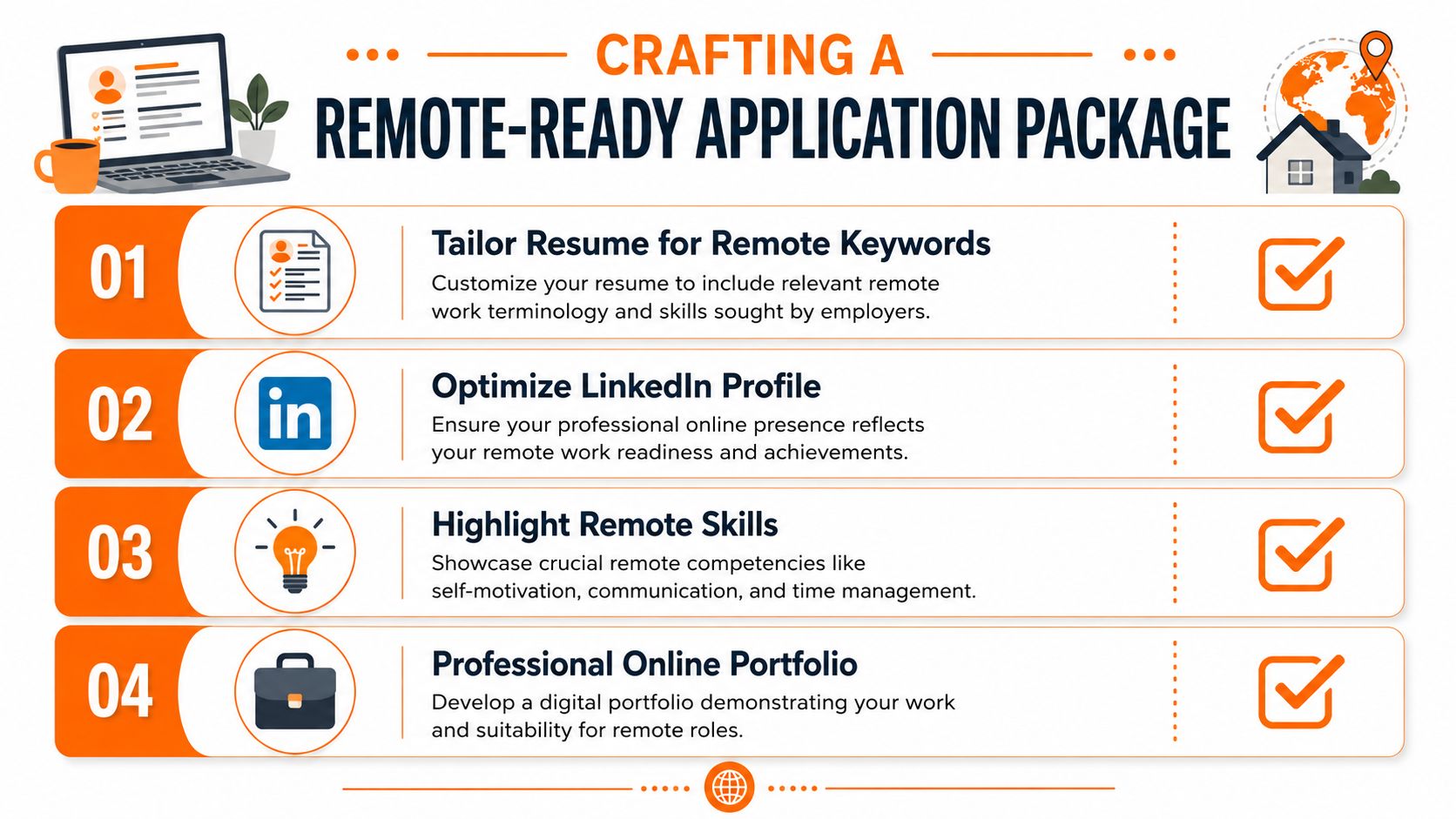
Rewrite your experience for remote relevance
The biggest upgrade is usually language. Many people have done remote-friendly work without describing it that way.
Compare these two resume bullets:
- Before: Managed client projects and updated team members regularly.
- After: Coordinated client deliverables across distributed stakeholders, maintained project timelines in Asana, and shared weekly written status updates.
The second version signals tools, cadence, and remote behaviour. It gives the reader something concrete.
Another example:
- Before: Helped team stay organized.
- After: Built documentation in Notion, tracked open tasks, and reduced handoff confusion by keeping process notes current.
That's the pattern. Show the system, not just the effort.
Keywords that belong in a remote resume
Don't stuff your resume with trendy terms. Use words that match the actual posting and reflect how remote teams work.
Useful terms often include:
- Distributed teams
- Asynchronous communication
- Cross-functional collaboration
- Documentation
- Project management
- Slack
- Asana
- Jira
- Notion
- Zoom
- Self-directed
- Stakeholder updates
If the job description leans heavily on process, mirror that language. If it emphasizes client work, foreground communication, follow-through, and responsiveness.
Application rule: Every bullet on your resume should answer one of two questions. What did you own, and how did you deliver it in a way that works remotely?
Fix your LinkedIn profile so it matches
A remote-ready resume with a vague LinkedIn profile creates friction. Recruiters click through. If the profile doesn't reinforce the same story, your application loses force.
Update these areas first:
- Headline: Replace generic titles with role plus specialty. Example: “Customer Success Manager | Remote Onboarding, Retention, and Cross-Functional Operations.”
- About section: Keep it plain. Mention distributed teams, communication style, and the types of outcomes you support.
- Featured section: Add portfolio links, writing samples, project summaries, or case snapshots if your field supports them.
- Experience entries: Use the same remote-capable language that appears on your resume.
Tailor faster, not sloppier
You don't need a brand-new resume for every job, but you do need a tuned version for each role family. I'd keep a base document and build variants for different tracks such as content, customer success, operations, or project coordination.
One practical move is to compare your draft against the posting before you submit. A tool like this ATS resume guide is useful for spotting keyword gaps and alignment issues before your application reaches a recruiter.
A strong remote application package usually includes four things:
| Item | What it should show |
|---|---|
| Resume | Ownership, tools, remote habits |
| Consistent positioning | |
| Cover note | Why this role fits your working style |
| Portfolio or samples | Proof, not promises |
The cover note matters more than many people think. Keep it short. Mention the type of remote environment you've worked in, the tools you know, and one reason the role lines up with your experience. That's enough.
Acing the Remote Interview and Negotiation
The remote interview starts before anyone asks a question. Your camera angle, lighting, audio, background, and pacing already tell the employer whether you understand remote professionalism.
I've seen capable candidates hurt themselves with preventable mistakes. A weak microphone, a cluttered background, a laptop balanced too low, constant notifications, or long rambling answers can make a strong person look unprepared.

What a strong remote interview looks like
Think of a typical sequence.
You join early. Your name appears clearly. Your camera is at eye level. The lighting is in front of you, not behind you. Your answers are concise, and when you describe past work, you naturally mention how you communicated, tracked tasks, and handled ambiguity.
That's the baseline.
Then the interviewer asks a remote-specific question such as, “How do you handle distractions at home?” A weak answer sounds defensive. A strong answer sounds operational: you have a dedicated workspace, clear working hours, notification habits, and a method for prioritizing deep work versus meetings.
Questions you should expect
Remote interviews often circle around autonomy and communication. Prepare short, specific examples for questions like these:
- How do you organize your day when priorities shift
- How do you communicate when a project gets blocked
- What does effective remote collaboration look like to you
- How do you stay visible on a distributed team
- How do you handle working across time zones
Your answer structure should be simple. Name the situation, explain your action, and end with the result in qualitative terms if you don't have citable metrics.
A calm, specific example beats a polished but generic answer every time.
For more current tactical advice on setup, body language, and common video-call mistakes, this ResumeToJobs' 2026 remote interview advice is worth reviewing before your next interview.
A sample answer that works
If asked, “Describe your remote work style,” a strong answer sounds like this:
I work best with clear priorities, written documentation, and regular check-ins that don't become micromanagement. I keep task status visible, flag blockers early, and document decisions so teammates don't have to chase context. That helps me stay reliable even when the team isn't online at the same time.
That answer signals maturity. It doesn't oversell. It shows you understand distributed work as a system.
A useful walkthrough on remote interview prep is below.
Negotiating in a Canadian remote context
Once the employer wants you, the conversation shifts. At this point, many candidates get timid.
Don't negotiate only on salary. Ask about the full working arrangement:
- Equipment support: Will they provide a laptop, monitor, or reimbursement?
- Home office policy: Is there a stipend or approved expense process?
- Benefits structure: Which benefits apply in your province?
- Hours: Are you expected to match a specific time zone?
- Travel: How often are in-person meetings required?
If the role is remote but the employer has provincial limits, ask directly where payroll is set up and which employment standards govern the role. That affects far more than people realize.
Canadian Legal and Tax Rules for Remote Workers
Roughly 41% of jobs in Canada can be done from home, and many remote workers report steady or better productivity, according to research published by PMC. That makes the paperwork matter. A remote offer can look straightforward until you get to taxes, provincial rules, and the question that shapes almost everything else. Are you being hired as an employee or as a contractor?
That distinction affects your pay deductions, legal protections, benefit eligibility, and year-end tax work.
Employee versus contractor
In Canada, an employee is usually covered by provincial or territorial employment standards. That includes rules on vacation pay, public holidays, overtime in many cases, and termination. The employer also withholds income tax, CPP, and EI from your pay.
An independent contractor runs more of the business side personally. You invoice for your work, track your own expenses, and plan for taxes yourself. The trade-off is familiar to many experienced remote workers. You may get more flexibility and possibly a higher rate, but you also absorb more risk, more admin, and fewer built-in protections if the relationship ends.
Here is the practical difference:
| Status | Usually means |
|---|---|
| Employee | Payroll deductions, employment standards protections, employer-directed work structure |
| Contractor | Invoicing, self-managed taxes, contract-based relationship, fewer built-in protections |
I pay close attention to any role labeled "contract" where the company sets fixed hours, controls the tools, and manages the day like regular employment. In Canada, labels help, but the actual working relationship matters too. If the contract language and the day-to-day reality do not match, get advice before you sign.
The T2200 and T2200S issue
Home office tax claims trip up a lot of Canadian remote workers.
For employees, the T2200 and T2200S forms deal with conditions of employment and whether certain expenses may be deductible. The practical point is simple. Working from home does not automatically mean you can write off internet, rent, utilities, or office equipment. Your eligibility depends on CRA rules, your work arrangement, and the form your employer is willing and able to complete.
Before tax season, confirm what your employer expects to issue and keep records that match your actual setup. This guide to remote work tax deductions in Canada gives a solid overview of the forms, common expense categories, and the limits people often miss.
Provincial law still follows the job
Remote work does not cancel provincial employment law. If you live in Alberta and work from home for a company headquartered in Ontario, the agreement still needs to state which province governs the employment relationship and how payroll is set up. That choice affects more than many candidates expect.
Review these points carefully before accepting the offer:
- Province of employment: Which province's standards are named in the contract?
- Hours and overtime: Are expectations clear, and do they match the role classification?
- Equipment and expenses: Who covers the laptop, phone, internet, or other required tools?
- Termination terms: Are the clauses clear and consistent with the applicable employment rules?
This is the part of remote work that rewards slow reading. A well-written contract saves a lot of trouble later.
Thriving in Your Canadian Work at Home Career
Remote work in Canada is established enough now that the bigger challenge is not getting a home-based role. It is building a career that keeps growing after year one. The people who do well over time usually treat remote work as a long-term operating model, not a temporary convenience.
That matters in Canada because remote careers can plateau without clear notice. A worker in Halifax may report to a manager in Toronto, support clients in Vancouver, and still get overlooked for larger projects if promotion paths are vague or tied to head office relationships. Good remote work needs career management, not just good daily habits.
Build a career plan that works remotely
Start with your role, then look one level above it. Ask a simple question. What skills, results, and business context does the next job require?
In Canadian companies, promotion often goes to the person who can handle broader ownership across time zones, departments, or client groups. That means your growth plan should include more than output. It should also include judgment, written communication, and the ability to work independently without creating confusion for the rest of the team.
A practical plan usually includes:
- One technical area to deepen: Become the person people trust with a system, workflow, or process.
- One business skill to strengthen: Prioritization, client communication, reporting, or project scoping often matter as much as tools.
- One cross-functional exposure point: Volunteer for work that connects you with finance, operations, sales, or product teams.
- One measurable outcome to own: Cost savings, faster turnaround, cleaner documentation, stronger retention, or fewer errors.
This is how remote employees become promotion candidates instead of reliable task finishers.
Make distance less expensive for your employer
Canadian employers hire remotely for access to talent, but they still worry about coordination costs. If working with you feels clear, dependable, and low-friction, you become easier to retain and easier to promote.
That shows up in small choices. Write updates that answer the next question before it is asked. Flag risks early. Close loops with clients and teammates. Keep decisions easy to find months later when someone in another province needs context.
Managers remember that.
Protect your earning power
Remote workers sometimes stay too long in a role because the setup is comfortable. Comfort is useful, but it can hide a flat salary path.
Review your market position at least once a year. Compare your pay, scope, and title with similar Canadian remote roles, not just local office jobs in your city. A fully remote marketing manager in Winnipeg may be competing in a national market. So may a software support specialist in New Brunswick or a bookkeeper in Saskatchewan.
Keep a record of work that changed a result, not just work that kept things running. Save performance feedback, project outcomes, process improvements, and client praise. Those records help during compensation reviews and make external applications much stronger if you decide to switch employers.
Work in a way that lasts
Long-term remote success is partly operational and partly personal. The Canadian version of this challenge is familiar. Winter gets dark early, homes are not always built for quiet office space, and many workers share space with family, roommates, or both.
So build a setup you can maintain in February, not just in a good week in September.
That may mean setting firmer work hours, using a coworking space a few days a month, or planning regular in-person time if your employer offers regional meetups. A career lasts longer when your routine is realistic.
The strongest Canadian work at home careers usually have three things in common. Clear results. Skills that keep expanding. Boundaries that protect your energy. If you keep those in place, remote work can be more than convenient. It can be a stable, well-paid career with room to grow.
If you're ready to turn this into action, YayRemote is a practical place to start. You can search hand-picked remote roles, focus on jobs open to Canadian candidates, and use tools that make applications tighter and faster instead of more chaotic.