Flexible Work Arrangements: The 2026 Employer & Talent Guide
Explore flexible work arrangements in 2026. Our guide covers types, benefits, policy creation, legal issues, and negotiation tips for employers and job seekers.
About six in 10 employees with remote-capable jobs want hybrid work, about one-third prefer fully remote, and fewer than 10% prefer fully on-site, according to Gallup's hybrid work indicator. That isn't a side preference anymore. It's a market signal.
Leaders who still treat flexibility as an exception policy usually run into the same problem. Candidates ask about it early, managers improvise inconsistent answers, and the company ends up with a patchwork of arrangements that feels unfair to everyone. The fix isn't “more freedom” in the abstract. It's a workable system with clear rules, the right tools, and managers who know how to run it.
The End of the Office-First Era
24% of new roles were hybrid and 12% were fully remote in Robert Half's job-posting snapshot, a pattern discussed in this comprehensive guide on remote work. That matters less as a trend headline and more as an operating reality. Employers are already hiring into mixed work models, whether their internal systems are ready for them or not.
The office-first era did not end because offices stopped mattering. It ended because the old default no longer matches how many teams produce good work. Hiring happens across wider geographies. Collaboration runs through documentation, chat, project tools, and scheduled touchpoints instead of desk proximity alone. Managers who still rely on visibility as a proxy for performance usually create friction fast. Decisions slow down, exceptions pile up, and employees end up negotiating basic working norms one manager at a time.
I have seen the same failure pattern repeatedly. A company says it supports flexibility, but leaves the details to local manager judgment. One team gets clear hybrid norms and strong documentation. Another team gets calendar sprawl, unclear availability expectations, and quiet resentment from people who feel they have less access than colleagues in the office. The problem is not flexibility itself. The problem is weak design.
Why office-first assumptions fail now
Office-first can still work for some environments, especially roles tied to physical equipment, high-touch client service, or regulated on-site processes. But for knowledge work, office-first has become a strategic choice with costs attached. It narrows the hiring pool, adds commuting friction to retention risk, and often masks process issues that would be obvious in a better-documented system.
That is why strong flexible programs focus on operating mechanics, not slogans. Teams need explicit norms for response times, meeting cadence, documentation, manager availability, and performance measurement. Companies built around distributed team operating models tend to make those choices earlier because distance forces clarity. Office-first organizations often postpone that work, then struggle when they try to scale hybrid arrangements across functions.
A bad flexible model creates confusion. A well-run one creates consistency.
What this means for employers and talent
For employers, the question is not whether flexibility sounds attractive. The question is whether the company can support it with policy, tooling, and management discipline. That includes who is eligible, how location decisions are approved, what hours overlap is required, which roles need in-person time, and how success is measured. Without that backbone, flexibility becomes a series of exceptions instead of a usable system.
For employees, flexibility now shapes job quality in practical ways. It affects commute time, care responsibilities, focus time, access to leadership, and the ability to build a sustainable week. People are not only choosing a workplace. They are choosing a set of working conditions.
That shift is why flexible work deserves the same rigor companies apply to compensation bands, performance reviews, and org design. Treated casually, it creates inconsistency. Built properly, it becomes a hiring advantage, a retention tool, and a better way to run modern teams.
The New Work Blueprint What Are Flexible Work Arrangements
Flexible work arrangements are best understood as a menu, not a single model. Teams don't typically choose between “office” and “remote.” They combine decisions about location, hours, workload structure, and handoff patterns.
The Australian Bureau of Statistics makes that broader view hard to ignore. In August 2025, 30% of employees had agreements for flexible hours, and the top reason people usually worked from home was to work more flexibly or choose their own hours (23%), according to the ABS working arrangements release. That's a useful correction for employers who only think about flexibility as a location policy.

The main models in practice
A clean way to think about flexible work arrangements is to separate them by what changes.
| Flexible Work Arrangements at a Glance | |||
|---|---|---|---|
| Model | Core Concept | Best For | Key Consideration |
| Fully remote | Work happens away from a central office by default | Distributed teams, specialist hiring, async-heavy work | Documentation quality has to be high |
| Hybrid office-centric | Office attendance anchors the week, with remote days built in | Teams that need regular in-person collaboration | Commute burden and fairness can become friction points |
| Hybrid remote-first | Remote is the default, office time is intentional | Companies with hubs, offsites, or team meetups | Managers must avoid creating an in-office inner circle |
| Flextime | Employees choose start and end times within agreed limits | Knowledge work, caregiving-heavy teams, global collaboration | Shared core hours still need definition |
| Compressed workweek | Full workload delivered across fewer days | Roles with deep-focus blocks or predictable cycles | Handoffs and coverage need planning |
| Job sharing | Two people split one role's responsibilities | Part-time senior talent, continuity-sensitive functions | Clear ownership boundaries are essential |
How employers usually get this wrong
The most common mistake is trying to apply one model to every team. Engineering, customer success, design, recruiting, and finance don't all operate with the same cadence. A support team may need strict coverage windows. A product design team may do better with long uninterrupted blocks. A sales team may need office time only for training, deal reviews, or onboarding.
Another mistake is using labels without operational definitions. “Hybrid” can mean three fixed office days, manager discretion, monthly gatherings, or optional coworking access. If a company hasn't defined the working pattern in concrete terms, employees fill in the gaps themselves.
Practical rule: If two managers in the same company describe the same arrangement differently, the policy isn't ready.
If you want a deeper model-selection lens, this comprehensive guide on remote work is useful because it frames work design around business realities instead of ideology.
The better way to define flexibility
Start with constraints, not preferences alone.
- Role demands: Does the role require live customer coverage, secure equipment, or physical presence?
- Coordination needs: Does the team rely on fast feedback loops or can it work asynchronously?
- Talent strategy: Are you hiring in one market or multiple time zones?
- Employee autonomy: Can people control when they work, where they work, or both?
That's the blueprint. Flexible work arrangements are the set of choices a company makes across those dimensions.
The Business Case Benefits and Risks for Everyone
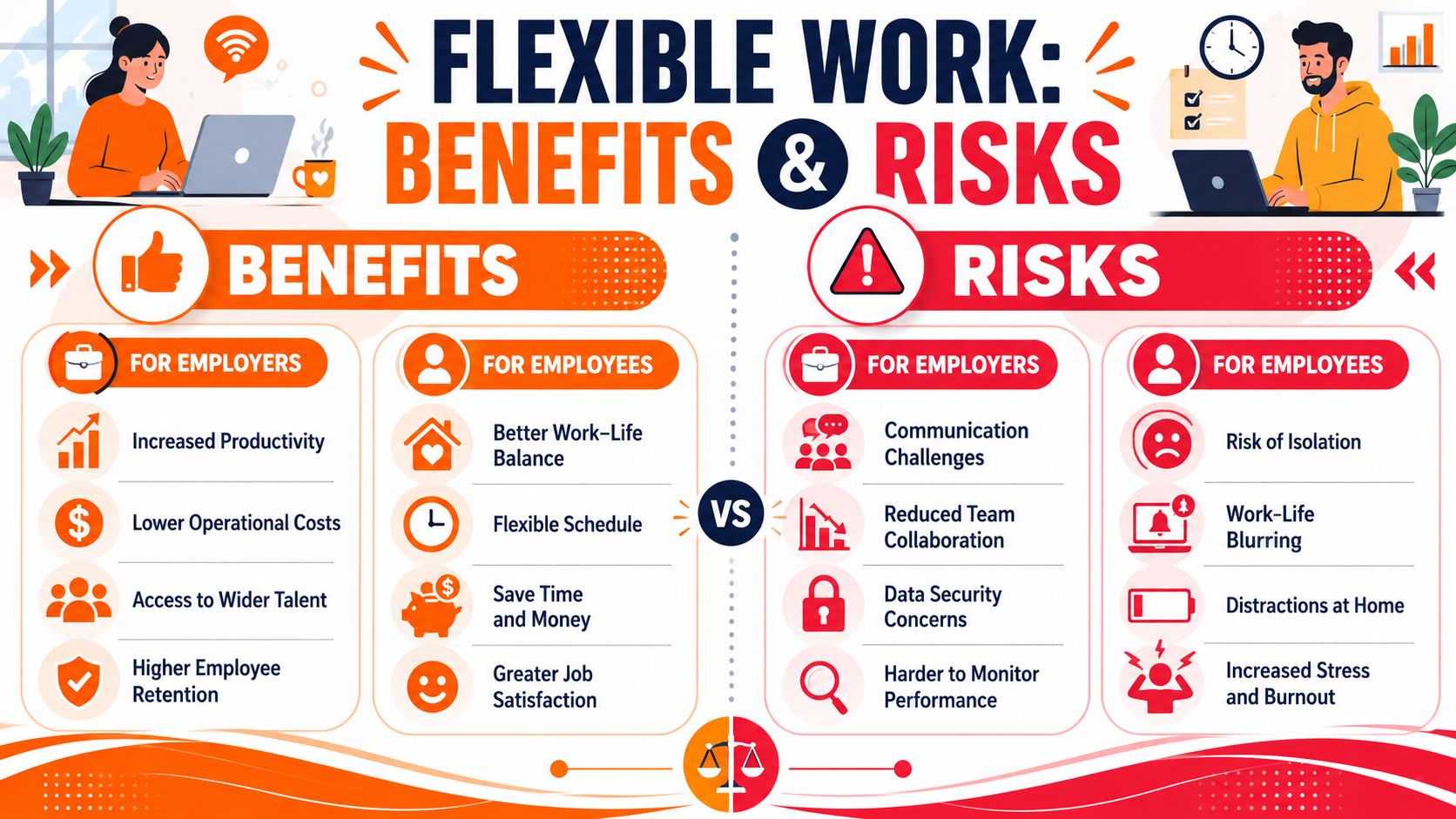
Flexible work creates significant advantages. It also exposes weak management fast. Companies that benefit usually have disciplined communication, strong documentation, and clear standards for performance. Companies that struggle often blame the model when the underlying issue is inconsistent leadership.
For employers
The upside starts with talent access. Flexible arrangements widen the hiring pool, make niche hiring easier, and give employers more options when local markets are tight. They can also improve retention because employees don't have to reorganize their lives around rigid attendance patterns.
The operational benefits are real too. Teams often gain more uninterrupted work time, fewer low-value commutes, and better handoffs across time zones when the workflow is designed well.
But there are costs.
- Management quality gets exposed: Weak managers can no longer rely on visual supervision.
- Coordination needs structure: If ownership is fuzzy, flexible teams create duplicate work or missed handoffs.
- Fairness becomes a live issue: Different roles need different arrangements, and employees notice inconsistency quickly.
- Culture needs design: Informal bonding doesn't happen automatically when people see each other less.
For employees
From the employee side, the benefits are obvious but still easy to mishandle. Flexibility can give people more control over focus time, family logistics, commuting, and energy management. For many workers, that autonomy is a quality-of-life improvement, not just a convenience.
The risk is boundary failure. Some employees end up always on. Others feel invisible if their manager equates presence with contribution. Flexible work can also amplify isolation when teams rely too heavily on chat and too lightly on real relationship-building.
A flexible arrangement only feels flexible if expectations are stable. Constant exceptions feel like instability, not freedom.
What works and what doesn't
What works is explicit design.
A healthy flexible environment usually includes documented norms for response times, meeting windows, decision-making, escalation paths, and performance reviews. It also makes room for different work styles without lowering the bar on accountability.
What doesn't work is symbolic flexibility. That's when a company says employees have freedom, but promotions still favor office visibility, urgent messages arrive at all hours, and “optional” attendance is only optional on paper.
A useful test is simple: can an employee explain how success is measured without mentioning where they sit? If not, the business case hasn't been translated into management practice.
Building Your Flexibility Framework An Implementation Checklist
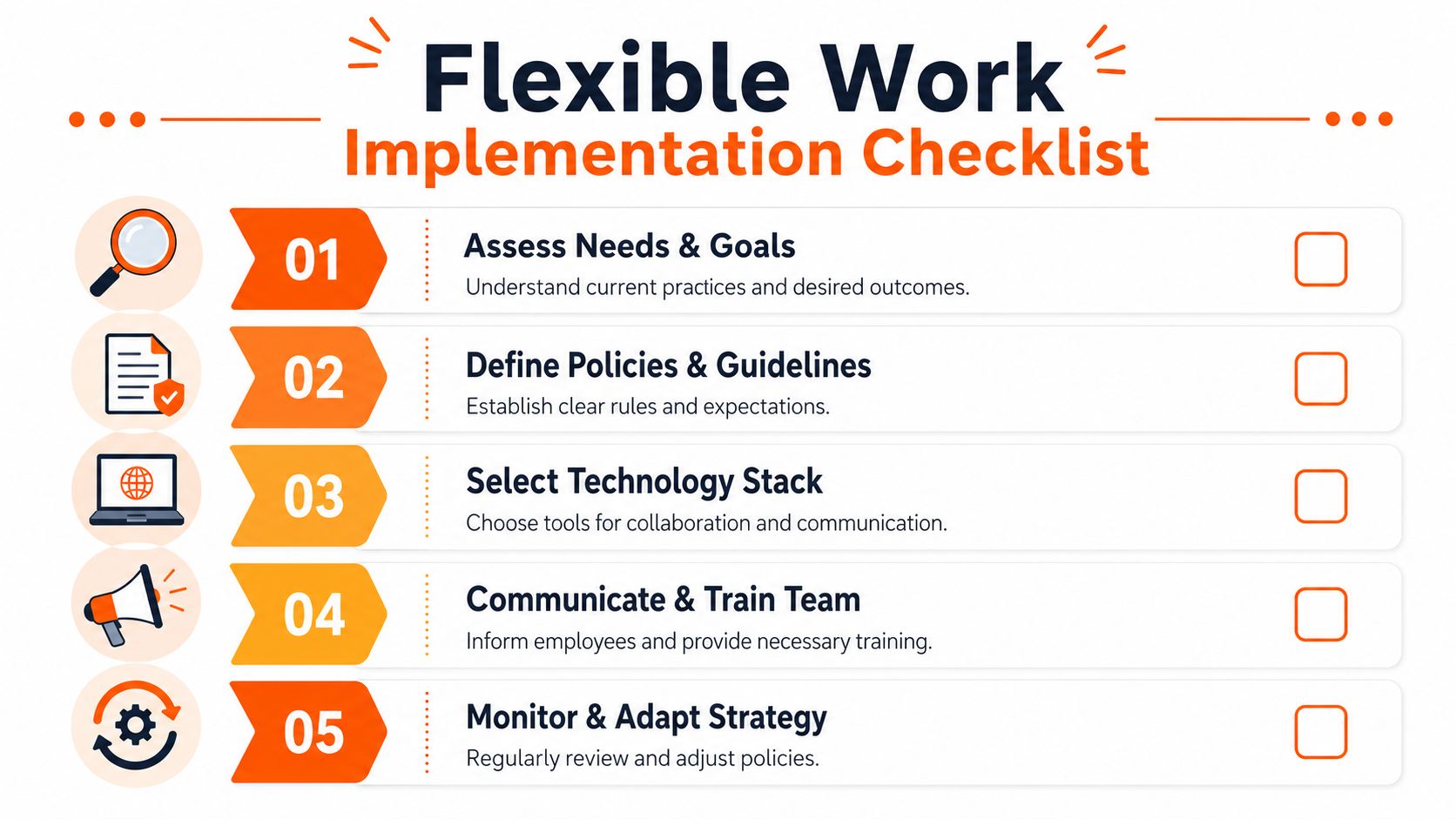
Most failed flexible work programs don't fail because employees dislike them. They fail because nobody translated intent into operating rules. Good programs are designed in layers. Goals first, role logic second, policy third, pilot fourth.
Start with business outcomes
Before writing policy language, decide what problem flexibility is supposed to solve. Hiring reach? Retention? Space utilization? Better coverage across time zones? Reduced burnout from rigid scheduling?
Then define the signals you'll use to judge it. Info-Tech's framework recommends piloting flexible work programs for 30 to 90 days and tracking quantitative indicators such as attendance, utilization, and productivity proxies alongside qualitative feedback, as outlined in its guidance on developing a targeted flexible work program.
- Operational signals: attendance patterns, delivery consistency, meeting load, utilization
- Employee signals: feedback on focus time, manager support, schedule clarity
- Team signals: handoff quality, response reliability, customer or stakeholder friction
Segment roles before writing rules
One policy for all roles sounds fair. In practice, it usually creates resentment because different jobs have different constraints.
Group roles by work pattern. Customer-facing, deep-focus, secure-access, field-based, collaborative, and manager-heavy roles all need different treatment. Once you segment the work, you can define what flexibility means in each context.
A useful policy document should answer these questions clearly:
- Who is eligible: by role type, not by manager mood
- What flexibility means: location, hours, schedule variation, or some mix
- What team norms apply: core hours, meeting expectations, communication channels
- What support is provided: equipment, workspace guidelines, reimbursement rules
- How exceptions work: temporary accommodations, approvals, escalation paths
For teams drafting from scratch, a solid remote work policy template can speed up the process and prevent obvious omissions.
Here's a useful training primer before rollout:
Pilot before full rollout
Don't launch company-wide on day one unless you already have mature distributed practices. Use a pilot group with a clear start date, manager training, and explicit success criteria.
Small pilots reveal hidden friction faster than broad rollouts. You'll find gaps in meeting habits, scheduling logic, and approval workflows within weeks.
Run the pilot long enough to see normal operating patterns, not just first-week enthusiasm. Then adjust. Tighten language where managers are improvising. Remove approvals that add no value. Add structure where teams need more predictability.
The Tech Stack for Distributed Success
Flexible work is not just a policy layer. It's an operating system change. Teams need tools that support coordination when people aren't in the same room, and they need data that shows whether the system works. DeskFlex's guidance makes that point clearly. Successful programs need a defined stack for collaboration, scheduling, HR management, and analytics because flexible models fail when teams can't measure usage or coordinate asynchronous work across locations and time zones, as described in this flexible work arrangement operations guide.
The core categories that matter
Most companies don't need dozens of apps. They need a coherent stack with clear ownership.
- Communication tools: Slack and Microsoft Teams for fast coordination, with rules for when to use channels, direct messages, or meetings
- Project and task systems: Asana, Jira, Linear, Trello, or ClickUp to make work visible without constant status meetings
- Documentation hubs: Notion, Confluence, or Google Drive so decisions, processes, and specs don't live in someone's head
- Meeting and async collaboration: Zoom, Google Meet, Loom, Miro, and Figma for review, design, walkthroughs, and recorded updates
- People systems: BambooHR, HiBob, Workday, or similar platforms for leave, employee records, approvals, and policy access
- Space tools for hybrid teams: desk booking, room scheduling, and attendance planning when office use is intentional rather than fixed
What separates a functional stack from app sprawl
A functional stack has clear defaults. Employees know where decisions are documented, where tasks live, and which channels count as official communication. App sprawl happens when each team picks tools independently and nobody defines the source of truth.
The strongest flexible teams usually standardize around a few habits:
- Write first: decisions are documented, not left in meeting memory
- Default to transparency: project status is visible without chasing updates
- Use meetings selectively: live time is for decision-making, coaching, and relationship-building
- Track actual usage: hybrid office patterns and team attendance are measured, not guessed
If you're building distributed collaboration norms, this practical roundup of tools for remote teams is a useful companion because it focuses on the tool categories that support real daily work rather than novelty features.
Global Rules of the Road Legal and Tax Considerations
Many flexible work policies fall apart. Leaders assume that if the work can be done online, the arrangement is compliant. That assumption causes trouble fast.
Cross-border flexibility touches employment law, payroll obligations, tax residency, work authorization, data handling, and sometimes permanent establishment risk. Even companies with strong internal operations can create avoidable exposure if they let employees work from anywhere without setting boundaries.
Flexible work doesn't equal legal portability
A worker may be remote from the company's point of view and still be in the wrong legal setup from the country's point of view. That's especially true when travel, long stays, or loosely defined hybrid schedules enter the picture.
The sharpest warning sign in the available data concerns digital nomads. A verified summary notes that 68% of digital nomads face visa rejection or tax penalties due to undefined flexible work policies, and 34% of nomads in emerging economies were denied tax residency because their flexible work hours violated physical presence rules, according to this research starter on flexible work arrangements and compliance issues. Those figures highlight a simple reality. “Work from anywhere” is often far less portable than it sounds.
If your policy doesn't specify where people may work, for how long, and under what approval process, you don't have a global flexibility policy. You have a legal exposure.
What employers should lock down
The best policies answer operational questions before employees ask them in Slack from an airport lounge.
- Approved work locations: Which countries or regions are permitted
- Time limits: How long someone may work from another jurisdiction before review
- Employment setup: Whether the company hires directly, uses a local entity, or works through an employer-of-record model
- Tax and payroll responsibility: Who reviews withholding, reporting, and local obligations
- Visa compatibility: Whether the proposed arrangement matches the employee's legal right to work there
Companies that are new to international hiring often benefit from practical overviews that spell out the basics. This guide on how to avoid international hiring headaches is useful because it frames compliance as an operating issue, not a paperwork afterthought.
What employees should ask before relocating
Employees should never assume their manager's approval settles the matter. Before relocating or working abroad for an extended period, ask HR or legal four things: Is the location approved? Will payroll change? Does the visa allow this work pattern? Is there a maximum stay?
That feels cautious. It's also how professionals avoid expensive surprises.
How to Negotiate Your Ideal Flexible Work Arrangement
The strongest negotiation tactic is to treat flexibility as a design problem, not a personal preference. Managers respond better when you show how the arrangement will support delivery, communication, and team coverage.
Start by reading the company correctly. If the role is already advertised as hybrid, your negotiation should focus on specifics: office cadence, core hours, travel expectations, and exceptions. If the role is listed as on-site, don't jump straight to “I want remote.” Build a business case around the parts of the job that can be done independently and propose a structure that lowers risk for the employer.
A simple negotiation framework
Use this sequence.
- Anchor to outcomes: Explain how you'll maintain responsiveness, quality, and visibility
- Name the model: Ask for a defined pattern, not vague flexibility
- Offer safeguards: Suggest review points, communication norms, and availability windows
- Propose a trial: A temporary arrangement is often easier to approve than a permanent exception
Sample language that works
For a hybrid request:
“I'm confident I can deliver this role best with a structured hybrid schedule. I'd propose in-office time for collaboration, planning, and stakeholder meetings, with remote days reserved for focused execution. If helpful, we could test that arrangement for a defined period and review how it affects delivery.”
For a fully remote ask in a traditionally on-site environment:
“I understand this role has usually been office-based. The parts of the work I'd own are highly documentable and don't rely on constant in-person coordination. I'd be happy to set clear response windows, weekly reporting, and regular check-ins so the arrangement stays low-risk for the team.”
What weakens your position
Don't frame flexibility as something you want because commuting is annoying. That may be true, but it's not persuasive. Also don't ask for “complete freedom” unless the company already operates that way. Employers approve clarity faster than open-ended autonomy.
The best negotiation asks for a pattern the manager can picture. Which days, which hours, which meetings, which reporting cadence. Flexible work arrangements are easiest to approve when they look manageable from day one.
If you're exploring flexible roles or hiring across borders, YayRemote is a practical place to start. It brings together curated remote opportunities, global work resources, and tools that help candidates and teams handle applications, time zones, and international work logistics with less friction.