A Practical Remote Work Policy Template for Global Teams
Stop guessing. Use our battle-tested remote work policy template to manage security, legal compliance, and productivity for your global team. Download now.
Having a formal remote work policy template is about more than just checking a box. It's the blueprint for how your distributed team will function, succeed, and grow. This document sets clear, consistent guidelines on everything from who can work remotely to how data is kept secure, creating a fair and productive environment for everyone.
Why a Formal Remote Work Policy Is Non-Negotiable

The move to remote work isn't a temporary fad—it’s a permanent shift in how we build great companies and attract top talent. Trying to manage a remote team with informal agreements and unwritten rules is a recipe for disaster. It leads to confusion, inconsistency, and serious business risks.
A formal, well-documented policy is what transitions your company from putting out fires to proactively managing your workforce.
Without a clear framework, simple questions can quickly snowball. Who is actually eligible to work from home? Who pays for a new monitor? How do we handle work hours when the team is spread across three different continents? A solid policy answers these questions right from the start, creating a level playing field for every single person on your team.
Establishing Clarity and Consistency
Think of your remote work policy as the single source of truth for your entire organization. It ensures every employee, no matter their role or location, understands the rules of the game and operates under the same standards.
This consistency is crucial for fostering a fair and equitable culture. It stops individual managers from making up their own rules, which almost always leads to feelings of favoritism and tanks team morale. When everyone is clear on the guidelines for communication, availability, and how performance is measured, it creates trust.
A strong remote policy isn't about control; it's about empowerment. It gives your team the structure they need to do their best work from anywhere, while protecting the business from ambiguity and legal exposure.
Mitigating Legal and Security Risks
Let’s be honest: operating without a formal policy is just asking for trouble. From a legal perspective, a clear policy helps define employment terms, ensures you're compliant with local labor laws (which can vary wildly by state and country), and gives you a defensible position if a dispute ever arises.
Imagine an employee’s performance drops while they're working from home without any childcare. A policy that clearly outlines expectations around dependent care during work hours gives you a non-discriminatory foundation for addressing the situation. For more on navigating these tricky scenarios, check out our guide on remote work best practices.
The security risks are just as real. A robust policy puts essential safeguards in place, such as:
- Secure Networks: Mandating the use of company VPNs and strictly prohibiting work on unsecured public Wi-Fi.
- Data Protection: Laying out the ground rules for handling sensitive company and client data.
- Device Management: Defining clear protocols for both company-issued equipment and personal devices (BYOD).
Before diving deeper into each clause, here’s a quick overview of the key components every effective remote work policy should have.
Key Components of an Effective Remote Work Policy
This table summarizes the essential pillars of a comprehensive policy, highlighting what each section aims to achieve and why it's especially important for globally distributed teams.
| Policy Section | Core Objective | Why It Matters for Global Teams |
|---|---|---|
| Eligibility & Approval | Define who can work remotely and the process for approval. | Ensures fairness and prevents compliance issues across different job roles and jurisdictions. |
| Equipment & Expenses | Clarify who provides and pays for necessary equipment and supplies. | Manages budget expectations and adheres to local labor laws, which often have specific reimbursement rules. |
| Security & Data Protection | Set non-negotiable rules for protecting company and client data. | Crucial for mitigating cyber threats that increase with a distributed workforce using varied networks. |
| Communication & Availability | Establish core working hours, time zone overlap, and communication norms. | Keeps teams connected and productive across different time zones, preventing silos and burnout. |
| Performance & Productivity | Outline how performance will be measured based on results, not presence. | Shifts the focus to output, which is essential for managing a team you don't see in person every day. |
These core sections form the backbone of a policy that not only protects your company but also empowers your team to thrive.
A Strategic Tool for Talent Acquisition
The numbers don't lie—remote work is a massive advantage in the war for talent. The global work dynamic has fundamentally changed. Before 2020, only 5-7% of paid workdays were from home. That number shot up to 60% during the pandemic and has now stabilized at a new baseline of 25%.
This isn't just a statistic; it's a reflection of what employees now expect. At YayRemote, we've seen firsthand why over 80% of employers view remote options as essential for hiring. It makes sense, especially when you consider that nearly 60% of employees would think about quitting if forced back to the office full-time. You can dig into more of these transformative remote work statistics to see just how powerful this shift is.
Laying the Groundwork: Your Policy's Core Clauses

This is where the rubber meets the road. A great remote work policy template isn't just a document; it's the operating system for your distributed team. Each clause you write here moves your policy from a high-level idea to a practical, day-to-day guide that builds clarity and trust.
Let's get into the nitty-gritty of crafting the foundational pieces that prevent future headaches. We're talking about eligibility, equipment, communication norms, and expenses—the real-world stuff that trips companies up. Get these right, and you're building a foundation that supports growth instead of creating confusion.
Who Can Work Remotely? Defining Eligibility and Scope
First things first: who is this policy for? Deciding who can work remotely is one of your most critical decisions. While a company-wide, all-remote policy sounds beautifully simple, it’s not always realistic for every business.
Think about the actual jobs people do. A role that requires daily access to specialized lab equipment isn't a great candidate for full-time remote work. A software engineer or a marketing manager, on the other hand, can likely thrive from anywhere. Your policy needs to spell this out to manage expectations from day one.
Here are a few ways I’ve seen companies successfully structure this:
- Role-Based: This is the most common approach. Certain job functions are designated as remote-eligible, while others might be hybrid or fully in-office. It’s practical for companies with diverse operational needs.
- Performance-Based: Some organizations make remote work a privilege earned over time. An employee might become eligible after their initial probationary period or once they’ve hit specific performance goals.
- Remote-First: The default for every role is remote. The office exists as a resource—a "clubhouse" for collaboration or quiet work—but it’s not mandatory.
Whatever you decide, be explicit about the scope. Is this a full-time remote policy? A hybrid model with two required office days? Ambiguity here is a guaranteed recipe for employee frustration.
What Are the Hours? Setting Clear Availability Expectations
The old 9-to-5 workday is dead, especially for teams spread across different time zones. Forcing everyone to be online at the same time is a surefire way to burn people out. The real goal is to find a sweet spot that balances collaboration with deep, focused work.
The most effective solution I've seen is establishing "core collaboration hours." This is a set window of time—usually just 2-4 hours per day—when everyone commits to being available for meetings and real-time problem-solving. Outside of that window, people have the freedom to structure their day in a way that works for them.
For example, if you have team members in New York, London, and Berlin, you could set core hours from 9:00 AM to 12:00 PM EST. This creates a predictable overlap for synchronous work without forcing your European colleagues to work deep into their evenings.
Your policy should also set a baseline for asynchronous communication. A 24-hour response time for non-urgent emails or Slack messages is a reasonable standard that respects people's need for uninterrupted focus.
Who Pays for What? A Fair Equipment and Technology Policy
This is a huge source of confusion if you don't address it head-on. Your policy needs to be crystal clear about who is responsible for buying and maintaining equipment, software, and home office essentials. Getting this in writing prevents countless misunderstandings down the road.
Generally, you have two main options:
- Company-Provided Gear: The company ships laptops, monitors, and any other required hardware directly to employees. This gives you maximum control over security and standardization, but it comes with shipping and IT support logistics.
- BYOD (Bring Your Own Device) with a Stipend: Employees use their own personal equipment, and the company provides a stipend to help cover the cost. This is more flexible, but it demands robust security policies, like requiring specific antivirus software or a mobile device management (MDM) solution.
No matter which route you take, spell it out. A simple table can make it incredibly clear.
| Item | Provided by Company | Employee Responsibility (with Stipend) |
|---|---|---|
| Laptop | Yes (Standard Issue) | No |
| Monitor | No | Yes ($300 one-time stipend) |
| Keyboard/Mouse | No | Yes (Part of general home office stipend) |
| High-Speed Internet | No | Yes ($50 monthly stipend) |
| Headset | Yes (Upon request) | No |
How Do We Talk? Setting Communication Norms
How your team communicates is just as important as when. A good policy should be a guide to your digital toolkit. Why do we use Slack instead of email for a quick question? When should a discussion become a task in Asana or Jira?
Without these ground rules, important updates get buried, and everyone suffers from notification overload. A solid policy should define:
- The Right Tool for the Job: Clarify your "single source of truth" for project updates (e.g., Asana).
- Meeting Etiquette: Encourage agendas for every call and treat "camera-on" as a guideline, not a mandate, to help fight video fatigue.
- Status Updates: Explain how to use statuses in your chat tools (e.g., "in a meeting," "deep work," "OOO") so people can respect each other's time and focus.
These clauses are the backbone of your policy, but it's important to remember they don’t exist in a vacuum. They're a direct response to a massive shift in what employees expect from work.
The demand for flexibility isn't just a fleeting trend. Research shows that a staggering 98% of professionals want to work remotely in some capacity for the rest of their careers, with 55% preferring a hybrid model. For talent browsing job boards like YayRemote, a policy that also considers mental health support and ergonomic stipends is a huge draw—especially when 69% of remote workers report a better work-life balance. With 39% of professionals ready to leave a job that doesn't offer remote flexibility, a thoughtful policy has become a critical retention tool. You can dive deeper into these employee-driven remote work trends to see just how much the landscape has changed.
Weaving Security and Performance into Your Policy
When your team goes remote, your company's security perimeter shatters. It's no longer the four walls of your office; it's dozens, maybe hundreds, of individual home networks. This reality makes robust security and smart performance management the two most critical pillars of your entire remote work policy. Get them wrong, and you're inviting data breaches and watching productivity nosedive.
Suddenly, protecting company data and client information isn't just IT's job—it becomes a shared responsibility. At the same time, keeping your team productive and engaged means swapping old-school supervision for a culture built on trust and accountability. Let’s walk through how to build these crucial elements right into your policy.
Fortifying Your Digital Defenses
Your policy has to lay down some non-negotiable security rules that every single remote employee understands and follows. Think of these as your first line of defense against the cyber threats that have exploded with the rise of remote work. There's no room for ambiguity here.
Start with the absolute must-haves for network security. Your policy needs to be crystal clear on these points:
- Mandatory VPN Use: Anyone accessing company systems, files, or data must be connected to the company's Virtual Private Network (VPN). No exceptions. This encrypts their connection, turning their home Wi-Fi into a secure pipeline.
- Secure Wi-Fi Only: Working from a coffee shop or airport on their open, unsecured Wi-Fi? Absolutely not. Your policy should strictly prohibit this. If an employee has to work outside their home, they need to use a password-protected personal hotspot.
- Device Security: Every device touching company data—whether you issued it or it’s a personal laptop (BYOD)—must have up-to-date antivirus software, a strong password, and an automatic screen lock that kicks in after a short period of inactivity.
These aren't just helpful suggestions; they are mandatory requirements to protect the business. It only takes one breach to cause a world of pain, making these clauses absolutely essential.
Managing Performance Without the Micromanagement
One of the biggest fears I hear from leaders is about productivity dropping off a cliff. This anxiety often pushes them toward micromanagement or, even worse, creepy employee monitoring software. Both are guaranteed ways to kill trust and morale.
The real key is to shift your entire mindset from tracking activity to measuring outcomes.
Great remote performance management isn't about watching green dots on a screen; it's about defining what success looks like and then trusting your team to get there. Your policy should champion this philosophy.
Instead of counting hours or tracking keystrokes, build a framework around clear goals and consistent communication. This means working with managers to define Key Performance Indicators (KPIs) for each role that are directly tied to what the business is trying to achieve. An engineer's success is measured by clean code commits and shipping features, not hours at a keyboard. A marketer's value is tied to lead quality and campaign ROI.
Your policy should outline a performance review process that actually works for a remote team:
- Set Clear, Documented Goals: Use a framework like OKRs (Objectives and Key Results) so every person on the team knows exactly what they're responsible for delivering each quarter.
- Schedule Regular One-on-Ones: Weekly or bi-weekly video calls are the lifeblood of remote management. They're dedicated time for managers and their reports to talk through progress, knock down roadblocks, and give real-time feedback.
- Conduct Formal Quarterly Reviews: These are bigger-picture conversations focused on hitting goals, talking about career growth, and making sure everyone is pulling in the same direction.
A Quick but Critical Note on Dependent Care
This is an easy one to overlook, but it's a critical piece of a realistic remote work policy: expectations around dependent care. While the flexibility of remote work is a huge benefit for parents, it's not a replacement for childcare. It's simply not possible for someone to be a fully focused employee and the primary caregiver for a young child at the same time.
Your policy needs to state clearly that employees are expected to have a dependent care arrangement in place during their working hours. This isn't about being insensitive; it's about setting fair and sustainable expectations for everyone.
For example, you could include a simple clause like: "Employees are expected to maintain a safe, distraction-free work environment. If dependents requiring supervision are in the home, employees must have separate care arrangements in place during their scheduled work hours." This protects your employee from burnout and ensures the company is getting their focused attention.
By weaving in these tough security measures and a modern, results-driven performance philosophy, your remote work policy template becomes more than just a rulebook. It becomes a strategic tool that enables security, builds trust, and drives high performance across your entire team, wherever they are.
Navigating Global Legal and Tax Compliance
Expanding your team across borders opens up a world of talent, but it also means wading into the often murky waters of international laws and tax rules. A solid remote work policy is your starting point, but it has to be built on a foundation of global awareness. Get this part wrong, and you could be facing some serious financial and legal headaches down the road.
This isn’t just a box-ticking exercise; it's about smart, proactive risk management.
Think about it: something as seemingly simple as how you define an employee's "place of work" in their contract can have huge ripple effects, determining which country's labor laws even apply. A vague definition can leave your company wide open to disputes over everything from overtime pay to termination rules.
And when you start hiring people in other countries, you might be doing more than just adding a new team member—you could be accidentally creating a taxable presence for your company abroad. This is a critical concept to get your head around.
Understanding Permanent Establishment Risk
One of the biggest tripwires for companies hiring internationally is what’s known as permanent establishment (PE) risk. Put simply, this is the danger that your remote employee's activities in another country could be interpreted as creating a fixed place of business for your company there. If a foreign tax authority decides you have a PE, your company could suddenly be on the hook for corporate taxes in that country.
For example, if you have a senior sales executive in Spain who regularly signs major contracts on behalf of your U.S.-based company, the Spanish government might just argue that you have a permanent business presence there. Your policy can help fend this off by clearly spelling out the scope and limits of an employee's authority.
Here are a few common triggers for PE risk:
- Authority to Conclude Contracts: Allowing employees to sign legally binding contracts in the company's name.
- Fixed Place of Business: An employee consistently works from a home office that becomes publicly associated with the company.
- Revenue-Generating Activities: Key business functions, like sales or core development, are performed by an employee in a foreign country.
Your goal isn't to become a global tax expert overnight. It's to know the right questions to ask your legal and tax advisors so you can build a policy that minimizes these risks from day one.
A clear policy that details where employees can work and what they're authorized to do is a fundamental first step. For more on how these rules affect both sides of the hiring table, check out our guide on finding remote jobs abroad.
Local Labor Laws and Statutory Benefits
Never, ever assume that your home country's labor laws apply everywhere. Each country has its own non-negotiable rules on things like minimum wage, working hours, paid time off, and mandatory benefits like health insurance or pension contributions. Ignoring these can lead to expensive penalties and seriously damage your reputation as an employer.
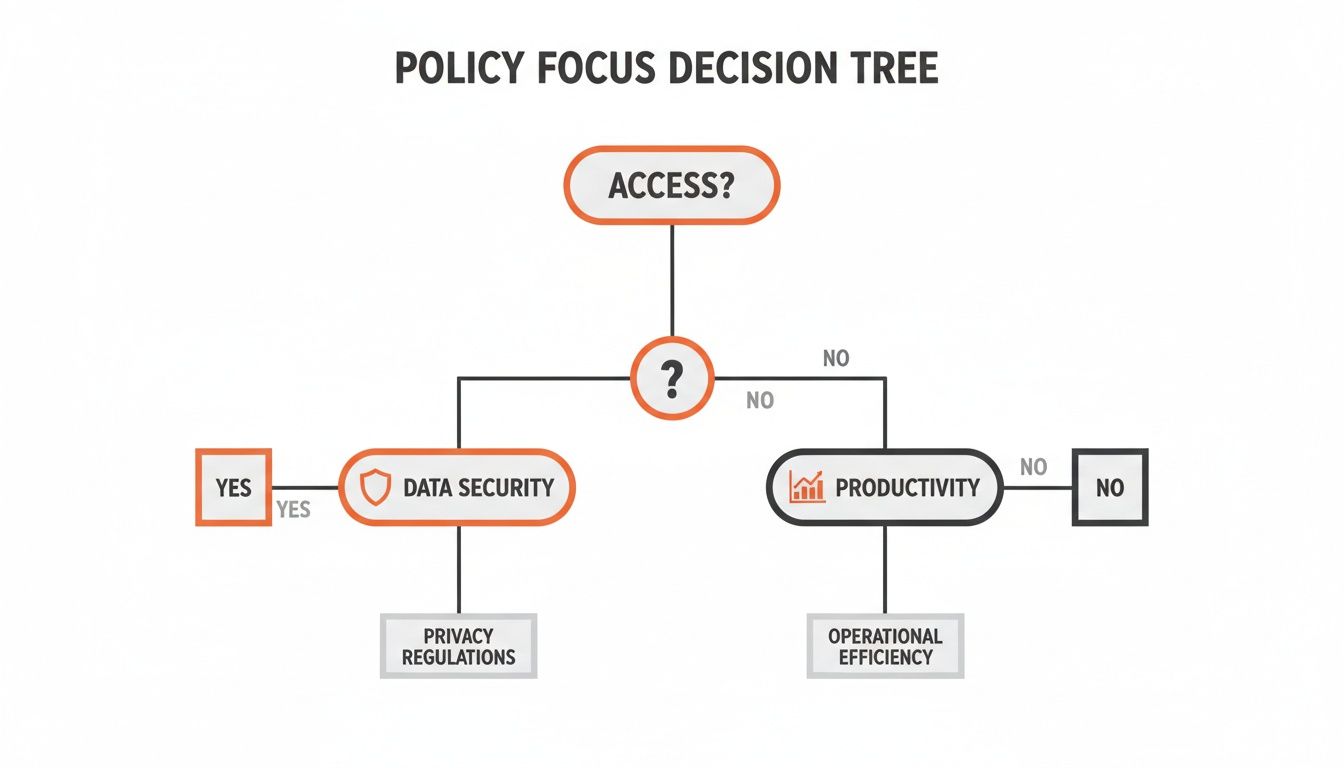
This decision tree helps visualize how you can focus your policy. For instance, once you've defined who has access to what, you can then decide whether your next priority should be locking down security protocols or fine-tuning productivity frameworks.
To give you a real-world example, letting an employee go in Germany is a completely different legal ballgame than it is in the United States. Your remote work policy needs to be flexible enough to accommodate these local nuances, often through country-specific addendums.
The shift to remote work has been a massive economic force. In the U.S., the remote segment of the workforce tripled between 2019 and 2021 to hit 17.9%, while the EU reached 22%. This boom has made standardized guidelines for things like taxes and visas more important than ever. With 50% of U.S. full-time jobs being remote-compatible and a global remote workforce of 330 million, having a rock-solid policy is no longer optional—especially when 60% of workers say they prefer a hybrid model.
International Compliance Checklist for Your Policy
When you're ready to talk to legal counsel about your international hiring plans, you need to know what to ask. This checklist is designed to get that conversation started and ensure you cover the most critical compliance areas.
| Compliance Area | Key Question to Ask Your Legal Advisor | Potential Impact |
|---|---|---|
| Employment Contracts | "Do we need a localized contract for this country, or can we use an addendum to our standard agreement?" | Using a non-compliant contract can render key clauses (like confidentiality) unenforceable. |
| Statutory Benefits | "What are the mandatory social security, health, and pension contributions we are responsible for?" | Failure to contribute can result in fines, back payments, and legal action from the employee. |
| Paid Time Off & Leave | "What are the legal minimums for vacation, sick leave, and parental leave in this jurisdiction?" | Miscalculating leave entitlements is a common and costly compliance mistake. |
| Termination & Severance | "What is the legally required process for termination, and what are the typical severance obligations?" | Wrongful termination claims can be incredibly expensive and damaging to your brand. |
| Data Privacy (GDPR, etc.) | "How do local data privacy laws affect how we handle this employee's personal information?" | Breaches of laws like GDPR can lead to massive fines (up to 4% of global revenue). |
| Tax Withholding | "What are our obligations for withholding payroll taxes and reporting them to the local authorities?" | Getting payroll wrong creates significant financial liability and administrative headaches. |
This table isn't exhaustive, but it highlights the big-ticket items. Each country presents a unique set of rules, and a one-size-fits-all policy just won't cut it. Use this as a guide to ensure you're protecting both your company and your employees.
How to Adapt Your Policy for Different Teams

A generic, one-size-fits-all remote work policy is a recipe for headaches. While your core template provides a solid foundation, its real power comes alive when you adapt it to the unique workflows of different departments. After all, what empowers your engineering team could easily hamstring your customer success agents.
Applying a blanket policy without considering role-specific needs is one of the most common mistakes I see companies make. It creates unnecessary friction and can make the whole policy feel more like a bureaucratic hurdle than a supportive framework. The goal is to build a document that actually helps people do their best work, not one that just gets in their way.
Customizing for Your Engineering Team
Engineers live and breathe in long, uninterrupted blocks of "deep work." It's how they solve complex problems and ship clean code. An ideal policy for them prioritizes focus and autonomy while maintaining Fort Knox-level security over your company’s intellectual property.
Think about what truly matters for this team. They need flexibility in their work hours, but they also need rock-solid rules around data handling and system access.
Here’s what an addendum for engineers might include:
- Flexible Hours: Ditch rigid core hours. Instead, focus on sprint deadlines and daily stand-ups, allowing for the kind of unconventional schedules that boost productivity.
- Strict Access Protocols: Make two-factor authentication (2FA) mandatory for all development tools. Explicitly state that proprietary code must never be stored on personal devices or unapproved cloud services.
- Hardware Requirements: Specify minimum hardware specs for machines powerful enough to handle local development environments, whether they're company-provided or part of a stipend program.
For engineers, the policy is a success if it eliminates distractions and locks down your code. It's less about when they work and more about how securely and effectively they deliver.
Fine-Tuning for Marketing and Sales
In sharp contrast, your marketing and sales teams operate on a completely different rhythm. Their work is highly collaborative and often time-sensitive, revolving around campaign launches, client calls, and fast-moving market trends. For them, clear communication channels and defined collaboration norms are everything.
While engineers often need isolation, these teams thrive on connection. Their policy addendum should emphasize how they can work together seamlessly, even when they're physically apart.
Consider these adjustments:
- Synchronous Check-Ins: Set clear expectations for availability during key campaign periods or for client-facing calls. This is especially critical when you're coordinating across multiple time zones.
- Tool-Specific Guidelines: Define how tools like Slack, Asana, and your CRM are used to maintain visibility and ensure smooth project handoffs between team members.
- Professional Environment for Calls: Outline clear expectations for a professional, quiet, and well-lit background during video calls with clients, prospects, or partners.
Tailoring for Customer Success and Support
Finally, there’s your customer success and support team—the very voice of your company. Their policy needs to be laser-focused on creating a consistent and professional experience for your customers. For this team, the home office environment and their technical setup are absolutely non-negotiable.
Their work directly impacts customer satisfaction, so the policy must enforce standards that ensure reliability and quality. This is one area where you need to be prescriptive about their remote setup.
Key policy points for customer success should include:
- Minimum Internet Speeds: Require and verify a minimum standard for internet bandwidth (e.g., 50 Mbps download / 10 Mbps upload) to guarantee stable video and VoIP calls.
- Quiet Workspace Requirement: The policy must explicitly state that employees are required to work from a dedicated space free from background noise and interruptions during all customer interactions.
- Dependent Care Clause: Clearly communicate that employees must have separate childcare or dependent care arrangements in place during their work hours. This isn't about being inflexible; it’s about ensuring they can provide customers with their full, undivided attention.
By thoughtfully tailoring your remote work policy template for each department, you create a far more effective, relevant, and respected document. It shows your teams you understand the nuances of how they work and that you’re committed to setting them up for success, wherever they are.
How to Roll Out Your New Policy Successfully
Let's be honest: creating a brilliant remote work policy is only half the battle. You can craft the most thoughtful, detailed document in the world, but it's completely useless if it just gathers dust in a shared drive, unread and ignored. A successful launch isn't about firing off a single all-hands email and calling it a day. It’s a strategic campaign, one designed to build understanding, get genuine buy-in, and weave the policy into your company’s DNA.
Your real goal here is to make the policy feel less like a set of rigid rules handed down from on high and more like a shared agreement that helps everyone do their best work.
Communicate Early and Often
Whatever you do, don't just spring the new policy on your team out of the blue. A surprise rollout feels authoritarian and is a surefire way to create immediate resistance. Instead, start dropping hints and communicating your intentions weeks in advance.
Let everyone know you're formalizing the approach. More importantly, explain the why behind it—you're doing this to create fairness, lock down security, and give everyone the clarity they need to succeed.
When the document is ready, don't just dump it in Slack. Plan a multi-channel communication blitz:
- Host a company-wide meeting: Get everyone together for a town hall where you can walk through the key sections. This is your chance to explain the thinking behind the clauses and tackle questions live, right then and there.
- Arm your managers first: Your managers are on the front lines. Hold a separate briefing just for them. Make sure they understand the policy inside and out so they can field their team's questions with confidence.
- Share a bite-sized summary: Not everyone will read a 10-page document cover-to-cover. Alongside the full policy, create a one-page summary or an FAQ that hits the highlights. This makes the crucial information much easier to digest.
Train Your Managers to Lead Remotely
Your managers are the ones who will make or break this policy. If they aren't fully equipped to lead a distributed team, the best-written policy in the world is destined to fail. Their training has to go beyond simply knowing the rules; it must focus on the crucial soft skills of remote leadership.
I've seen companies succeed when they focus manager training on a few key areas:
- How to manage based on outcomes, not on hours spent online.
- The art of giving clear, effective feedback over a video call.
- Tips for running inclusive meetings where everyone, not just the loudest voices, gets a chance to speak.
- How to spot the subtle signs of burnout and isolation in their direct reports.
Solid management is the bedrock of a healthy remote culture. For more ideas on keeping your team engaged and connected, check out our guide on virtual team-building activities.
Get Formal Acknowledgment
This is a simple step, but it’s absolutely critical for both legal protection and basic accountability. Don't just cross your fingers and hope everyone read it. You need to require every single employee to formally acknowledge that they have received, read, and understood the policy.
A digital signature process is your best friend here. Using your HR platform or a tool like DocuSign creates a clean, time-stamped record. This tiny step makes the policy official and can be invaluable if a dispute ever pops up. It reinforces that this isn't just a suggestion—it's the new way of working.
Treat It as a Living Document
The world of work is constantly shifting, and your policy has to keep up. The version you launch today shouldn't be set in stone. I always advise companies to schedule a formal review of their remote work policy at least once a year.
Make a habit of gathering feedback. Ask employees and managers what’s actually working. Which clauses are causing friction? Are there new collaboration tools or security threats you need to account for?
When you treat your policy as a living document, you ensure it stays relevant and genuinely supportive of your team as the company grows. This iterative mindset is how you build a framework that actually lasts.
Got Lingering Questions About Your Remote Work Policy?
Even the best remote work policy templates can leave you with a few "what if" scenarios. As companies like yours wade into the day-to-day reality of managing a distributed team, some questions just keep cropping up. I've heard them all, so let's tackle the most common ones head-on.
Getting these details right is about more than just checking boxes; it’s about preventing those small, nagging uncertainties from turning into real problems down the road.
How Often Should We Update Our Remote Work Policy?
Your policy should be a living document, not something you write once and file away forever. I always recommend a full, formal review at least annually. This carves out dedicated time to look at what’s actually working, what’s causing headaches, and how the world of work has shifted.
That said, some events should trigger an immediate review, no matter when your annual check-in is scheduled:
- Hiring in a new state or country: This is a big one. You absolutely have to review the policy to make sure you're compliant with local labor laws.
- Rolling out new security software: Your policy needs to reflect the new tools and protocols you expect your team to use.
- Getting consistent feedback: If you keep hearing from managers or employees that a certain rule is clunky or causing friction, that's your cue to fix it.
The most effective policies are the ones that grow and change right alongside the business.
What’s the Real Difference Between a Hybrid and a Fully Remote Policy?
It all boils down to complexity and whether you expect people to show up in person. A fully remote policy is designed for a team that works outside a central office 100% of the time. It naturally leans into things like asynchronous communication and trusting people to work from wherever they are most productive.
A hybrid policy is a different beast entirely. It has to manage the delicate balance between office time and remote work, which means you have to get specific about:
- The Schedule: How are in-office days decided? Is it a fixed schedule (e.g., Tuesday-Thursday in the office) or is it flexible? Who decides?
- Mandatory Days: Are there specific events, like project kickoffs or all-hands meetings, where everyone must come in?
- Fairness and Equity: This is crucial. How do you make sure the person who comes in five days a week doesn't get preferential treatment over the person who is mostly remote?
Can We Legally Monitor Our Remote Employees?
The short answer is, you often can, but the much more important question is whether you should. If you go down this path, transparency is non-negotiable. Your policy must state, in no uncertain terms, exactly what you are monitoring and why you're doing it.
Honestly, I've found a much healthier and more effective approach is to manage for outcomes, not activity. Trust is a far more powerful motivator than surveillance. When you focus on the quality of the work and the results people deliver, you don't have to worry about counting keystrokes.
Who’s on the Hook for a Remote Employee’s Health and Safety?
At the end of the day, an employer’s duty of care extends to the home office. Your policy needs to set clear expectations for what constitutes a safe and ergonomic workspace.
One of the simplest ways I've seen companies handle this is with a home office self-assessment checklist. It’s a straightforward tool that lets employees walk through their own space and confirm it’s free from obvious hazards, like trailing cables or poor lighting. It’s also a great spot to remind everyone about taking regular breaks and maintaining a healthy boundary between work and personal life.
Ready to build a world-class distributed team? Find top talent or your next great role on YayRemote, the global platform for remote work. Explore remote jobs today