Front End Software Engineer Jobs: The 2026 Remote Playbook
Your step-by-step guide to finding remote front end software engineer jobs in 2026. Learn the skills, resume tips, and interview strategies to land a top role.
Most advice about front end software engineer jobs is outdated.
“Build a few React projects, fire off applications, and wait for the calls” was never great advice, and it's much worse now. The remote market still has real opportunity, but generic UI implementation isn't enough. Employers want engineers who can ship product, work across boundaries, and make good technical trade-offs without a lot of hand-holding.
That change confuses people because the loudest conversation is still binary. Front end is either “dead” or “easy.” Neither is useful. However, the role has narrowed in some places, expanded in others, and become much more demanding in remote teams where clear communication and broader ownership matter.
Navigating the New Front-End Job Market
The front-end market isn't dead. It's harder, narrower, and less forgiving.
A February 2025 analysis found that software developer vacancies were at 65% of January 2020 levels, a 35% decline, and about 3.5x fewer than the mid-2022 peak, according to The Pragmatic Engineer's market analysis. That's the part people latch onto. They see the cooldown and assume the entire career path disappeared.
That conclusion misses what occurred. Hiring didn't vanish. Companies stopped hiring as if every team needed to double overnight. In practice, that means remote front end software engineer jobs still exist, but employers are more selective about who they bring in and what they expect that person to own.

What changed after the hiring boom
The old market rewarded speed. Teams hired specialists who could jump into a component library, ship tickets, and stay inside a narrow lane.
The current market rewards scope and judgment. A front-end engineer now gets more credit for asking the right product questions, shaping API contracts, spotting accessibility issues before QA, and writing clean documentation for async teammates.
That's why so many candidates feel stuck. They're applying for “front end” jobs with portfolios that prove they can style interfaces, while employers are screening for engineers who can reduce product friction, collaborate with design, and reason about systems beyond the browser.
Practical rule: Don't ask whether front end is alive or dead. Ask which kind of front-end work is still valuable.
Where the pressure is highest
The most crowded part of the market is the generic layer. Think polished landing pages, standard dashboards, and another CRUD app built with familiar tools and no clear business context.
The stronger positions usually sit in more defensible territory:
- Performance-sensitive work where slow rendering, bundle weight, and bad loading states hurt the product
- Accessibility-heavy interfaces where compliance and usability require careful implementation
- Design systems and developer experience where teams need consistency, tooling, and maintainability
- Product-facing ownership where the engineer can move from UI requirements into API integration, edge cases, and release quality
A lot of candidates still search for front end software engineer jobs as if the title means the same thing it did a few years ago. It doesn't. The title stayed familiar. The expectations changed.
What works now
Treat the market like a filter, not a lottery. Broad panic doesn't help. Precision does.
A strong candidate in 2026 looks less like a “React developer” and more like a product-aware engineer with front-end depth. That's the through-line for everything that follows: what you build, how you present it, where you apply, and how you interview all need to signal that you can do more than make screens look finished.
Building a High-Impact Skillset and Portfolio
A strong front-end portfolio answers a hiring manager's real question fast: can you take a product problem, make good technical decisions, and ship something another team would trust?
That bar is higher than it was during the hiring spike. Back then, plenty of candidates got interviews with a polished React app and a clean UI. In 2026, remote teams usually want more signal. They want to see product judgment, implementation depth, and evidence that you can work across the messy edges where front end meets APIs, performance, accessibility, and collaboration.

Build a skill stack that matches the job now
The title has stayed the same. The work behind it has not.
Browse current Indeed front-end software engineer listings and the pattern is obvious. Teams still care about UI craft, but a lot of postings now expect comfort with API integration, TypeScript, testing, performance work, and backend-adjacent tasks. Some roles are close to product engineering with a front-end emphasis.
That does not mean every front-end engineer should chase full-stack breadth for its own sake. It means you need enough range to handle the parts of the system that shape the user experience and unblock delivery.
A practical stack looks like this:
| Layer | What to show |
|---|---|
| Foundations | Strong HTML, CSS, and JavaScript. Semantic markup, state handling, layout control, and browser awareness. |
| Framework depth | Real fluency in one major framework such as React, Vue, or Angular. Architecture choices, debugging, and maintainability. |
| Integration skills | Fetching and shaping data, auth flows, error handling, API coordination, and basic Node.js familiarity. |
| Product judgment | Accessibility, loading and empty states, edge cases, analytics implications, and collaboration with design or PMs. |
| Delivery habits | Git hygiene, testing, concise READMEs, and clear trade-off documentation. |
The trade-off is simple. Breadth gets you into more conversations. Depth gets you hired. For most candidates, the better move is deep skill in one front-end stack plus credible range in the adjacent work that affects shipping.
Build projects with real constraints
Portfolio projects should prove judgment, not just activity.
Clone apps and tutorial builds still have some practice value, but they rarely help much in a serious job search because they hide the hard parts. Reviewers cannot tell what you decided, what you copied, or how you handle product ambiguity.
Better projects create surface area for engineering decisions. Good options include:
- A complex interface such as faceted search, role-based navigation, or a multi-step onboarding flow
- A performance-sensitive experience where you explain rendering choices, bundle trade-offs, or caching decisions
- An accessibility-heavy workflow that shows semantic structure, keyboard support, and screen reader behavior
- A collaboration-oriented project with tickets, documentation, or notes that show how design and engineering decisions connect
I usually tell candidates to build fewer projects and make each one more believable. One thoughtful project with clear trade-offs, polished states, and solid documentation beats four shallow apps every time.
Strong portfolio work feels close to production. It handles failure states, explains decisions, and respects the user's context.
If you need calibration, it helps to find inspiring developer portfolios and study how stronger candidates explain scope, trade-offs, and outcomes instead of relying on visuals alone.
Show specialization without boxing yourself in
Generalist front-end candidates face the most competition. A visible specialty gives employers a reason to remember you.
That specialty can be design systems, accessibility, performance, data-heavy product surfaces, commerce flows, or developer experience for front-end teams. The point is not to niche down so hard that you limit your options. The point is to show a clear area where you are stronger than the average applicant.
A useful portfolio mix is one flagship project, one project that highlights your specialty, and one smaller example that shows range.
For example, a candidate targeting remote product teams might show:
- a dashboard with messy API coordination and error states
- a design system or component library with documentation
- a performance case study that explains what changed and why
That mix says more than another generic “full-stack app” ever will.
Your README does real hiring work
A README is part of the portfolio, not admin work.
Hiring teams use it to estimate how you think when nobody is on a call to explain things for you. That matters even more for distributed teams. Clear written communication lowers review friction and signals maturity.
Include these four things:
Problem context
Explain what the project does, who it serves, and what constraints shaped it.Technical choices
State why you chose the framework, state model, data-fetching approach, or test setup.Trade-offs
Be honest about what you skipped, what you would change next, and where the implementation is intentionally simple.Run and test instructions
Make setup easy. Reviewers should not have to reverse-engineer your project.
This is also where remote readiness shows up. Teams hiring across time zones need engineers who leave clean artifacts behind. If you want a better sense of what distributed teams value, this guide on what remote software engineers should optimize for is a useful reference.
Add proof, not polish for its own sake
A short video walkthrough can help when the product has interaction details that screenshots miss. A concise architecture note can help when the codebase is large enough that a reviewer will not read every file.
What matters is relevance. Do not add motion, diagrams, or writeups just to look busy. Add them when they reduce reviewer effort or make your decisions easier to understand.
A good portfolio leaves very few unanswered questions. Why this project. Why this structure. Why these trade-offs. Why you would be useful on a real team.
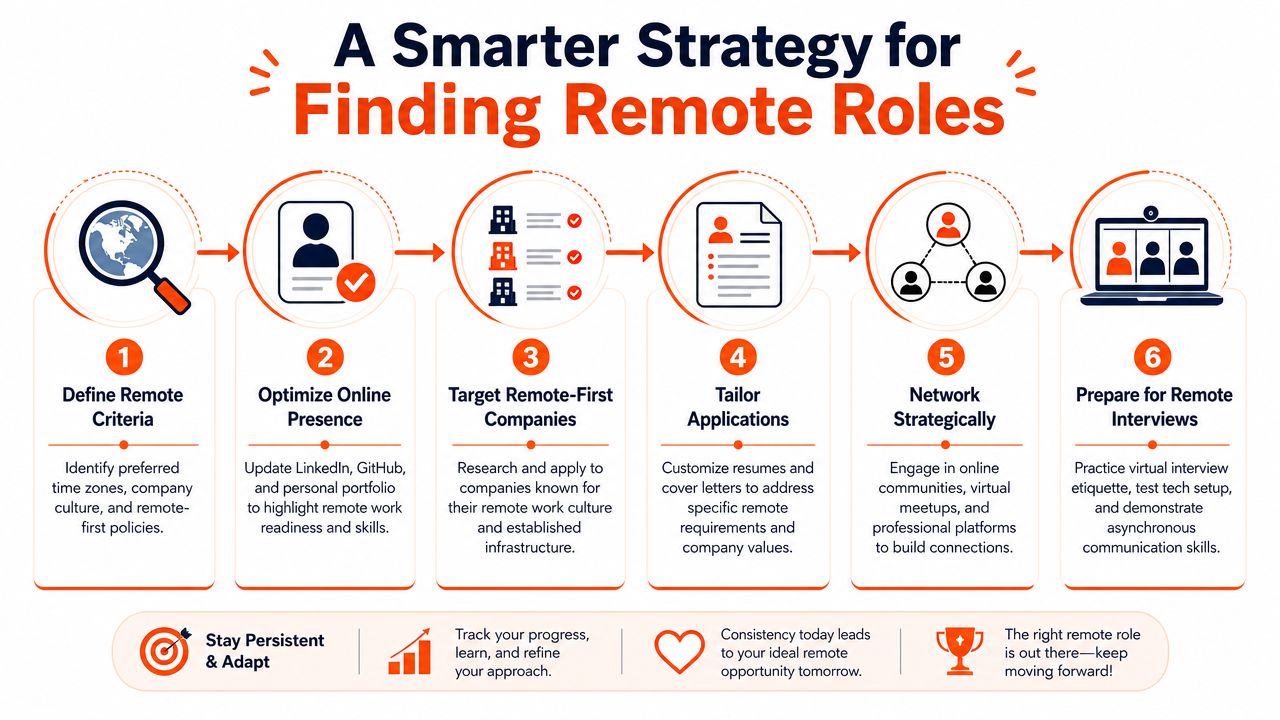
A Smarter Strategy for Finding Remote Roles
Most candidates waste time in the search phase. They apply too broadly, too early, and with too little signal.
Cold applications can convert at only about 0.1% to 2%, and one practical benchmark recommends starting with 5 to 10 applications per week, moving to 10 to 15, and eventually sustaining 20 to 30 after your materials and targeting improve, according to this software job search funnel guide. Those numbers matter because they force you to think in systems, not moods.
Stop treating all applications as equal
A remote application is not a raffle ticket. It's a bet that your profile matches the company's actual problem.
That's why a smaller number of sharply targeted applications usually beats a larger number of generic ones. If a role asks for component architecture, API integration, accessibility, and cross-functional work, your resume, portfolio, and intro message should all point at those exact strengths.
Use this decision filter before applying:
- Role fit means the job matches your strongest current work, not your aspirational someday stack.
- Team shape means the posting signals real engineering collaboration, not a vague list assembled by HR.
- Remote reality means the company appears to understand distributed work, not merely tolerate it.
- Ownership level means the role gives enough scope to show the kind of engineer you are.
Build a weekly remote search rhythm
Remote job hunting gets easier when you remove daily indecision. A simple cadence works better than random bursts of effort.
| Day type | Focus |
|---|---|
| Search day | Collect roles, reject bad fits fast, save the strongest few |
| Application day | Tailor resume, adjust project links, write concise intros |
| Network day | Reach out to engineers, recruiters, or hiring managers with specific context |
| Review day | Track patterns, identify where interviews stall, refine materials |
This rhythm matters because front end software engineer jobs often look similar at a glance but differ a lot in what they really need. One team wants a design systems builder. Another wants a product engineer who can work across frontend and backend seams. Another wants a UI specialist who can stabilize performance on an existing app. If you don't sort roles that way, your applications blur together.
Use channels that create signal
Job boards still matter. So do referrals. So does direct outreach. The difference is how you use them.
Good outreach is brief and specific. Mention the product area, team problem, or technical surface you're aligned with. Bad outreach sounds like a copied template sent to fifty people before lunch.
Remote search habit: Track where you got traction. If interviews come from referrals and tailored outreach, shift more energy there and less into bulk applications.
For remote roles, practical details matter early. Time zone overlap, communication norms, and documentation culture can make a great title turn into a bad fit. Ask those questions before the late-stage interviews, not after the offer.
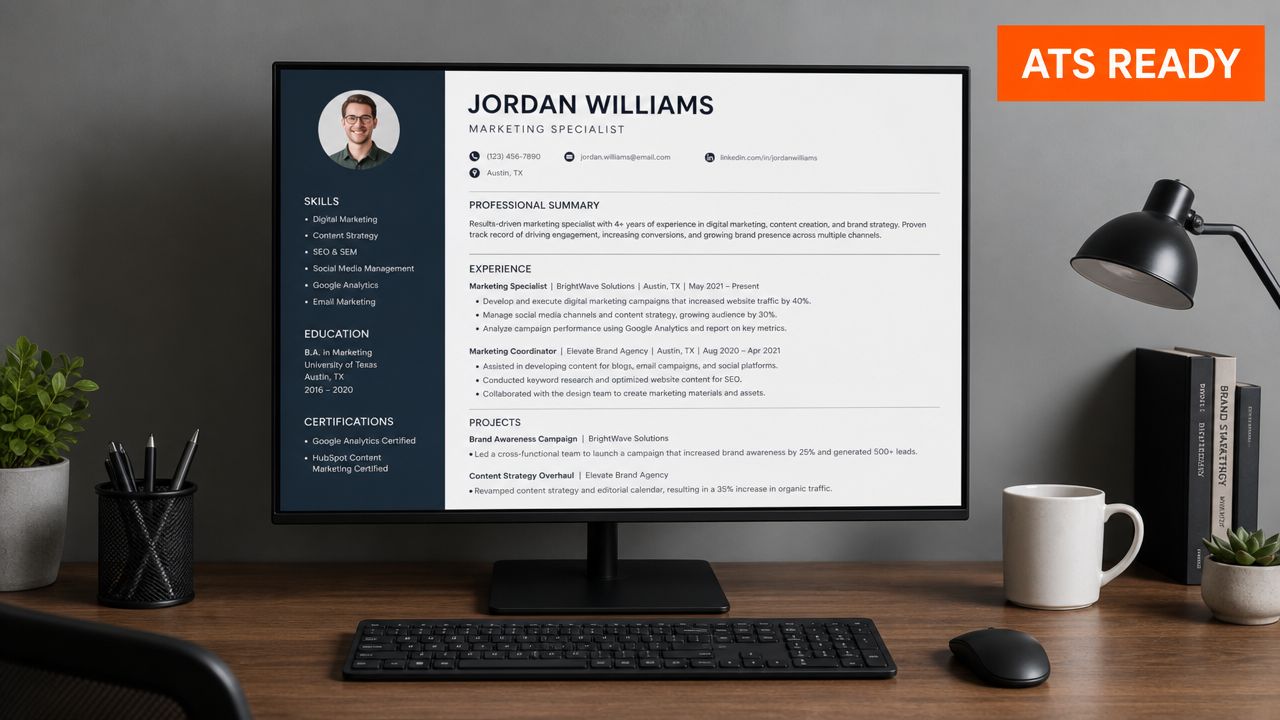
Crafting a Resume That Beats the ATS
Your resume is not a biography. It's a routing document.
It has two jobs. First, it needs to survive keyword filtering and recruiter skim time. Second, it needs to make a hiring manager think, “This person has solved the kind of problems we have.”
Format for parsing, not decoration
A clean single-column layout still wins. Fancy sidebars, charts, and design-heavy templates often create more parsing problems than value.
Keep the structure simple:
- Header with name, role, location, and relevant links
- Summary only if it says something specific
- Skills grouped by meaningful categories
- Experience with role, company, dates, and impact-focused bullets
- Projects if they materially strengthen your case
For LinkedIn alignment, it helps to make sure the same core story appears in both places. If you want a walkthrough for that, Postline.ai's guide for LinkedIn users is a practical reference for attaching and presenting your resume on the platform recruiters already scan.
Write bullets with challenge, action, result
Most resume bullets are weak because they describe responsibilities. Responsibilities don't sell you. Outcomes and decisions do.
Compare the difference:
| Weak bullet | Stronger bullet |
|---|---|
| Built React components for internal dashboard | Reworked dashboard components in React to simplify state flow, reduce UI inconsistency, and improve maintainability across shared screens |
| Worked with designers and backend team | Coordinated with design and backend engineers to define API needs, handle edge cases, and ship a reliable account settings flow |
| Improved website performance | Identified rendering bottlenecks, removed unnecessary client-side work, and documented trade-offs for a faster, more stable experience |
If you don't have hard metrics you can verify, don't invent them. Use precise qualitative outcomes instead. “Reduced UI inconsistency,” “simplified onboarding flow,” and “made release handoff easier for QA” are all stronger than vague filler.
Match language without sounding copied
ATS optimization isn't keyword stuffing. It's vocabulary alignment.
If the role mentions accessibility, design systems, REST APIs, TypeScript, or async collaboration, those terms should appear naturally where they truthfully apply. You're not gaming the system. You're removing ambiguity.
A good final check is to compare your draft resume against the posting and ask:
- Are the important terms present?
- Are the most relevant projects visible fast?
- Do my bullets show ownership, not task completion?
If you want a framework for tightening that process, this guide on how to beat ATS filters for remote roles is worth reading before you send another batch of applications.
Mastering Technical Interviews and Coding Challenges
Front-end interviews got harder after the 2022 hiring wave, not because companies suddenly expect everyone to be algorithm specialists, but because the bar is less forgiving. Remote teams can choose from a wider pool, so they screen for engineers who can code, explain decisions, and show product judgment under pressure.
Cramming random problems rarely works. A phased plan does.
One useful roadmap is to spend the first stretch on daily algorithm practice, then shift into system design, then finish with mock interviews, as outlined in this interview preparation guide. The value of that structure is simple. It isolates different failure points instead of blending syntax, architecture, and communication into one messy routine.
Build the baseline first
Algorithm practice still shows up in front end loops. The point is not to become a puzzle expert. The point is to show clear reasoning, catch edge cases, and write working code while someone is watching.
A practical routine looks like this:
- Solve one problem slowly and explain your reasoning out loud
- Solve a second with time pressure
- Review where your thinking got sloppy, not just whether you reached the answer
For front-end roles, that baseline also needs platform knowledge. Expect questions about the event loop, rendering, browser storage, accessibility, caching, state ownership, memoization, and async behavior. In 2026, strong candidates are rarely judged on React syntax alone. They are judged on whether they understand the browser, the user experience, and the trade-offs behind implementation choices.
Treat front-end system design like product work
A lot of candidates still answer design prompts as if the job is only about assembling components. That misses how the role changed. Teams now want front-end engineers who can design a maintainable product surface, not just ship a polished screen.
A good answer usually covers:
- component boundaries
- state ownership
- API interaction patterns
- caching and loading behavior
- performance constraints
- accessibility requirements
- testing approach
- maintainability across teams
Clarifying questions matter more than clever architecture. Ask about users, traffic patterns, failure cases, device constraints, analytics needs, and what has to ship now versus later. That conversation signals maturity fast.
The strongest interview answers sound like real collaboration. State your assumptions. Name the trade-offs. Explain what you would postpone and why. Product-aware engineers do this well because they understand that every abstraction has a cost.
Communication decides a lot of interview outcomes
Plenty of candidates know enough to pass, then talk themselves into a rejection by becoming hard to follow.
Mock interviews help because they expose habits you do not notice alone. Long pauses. Rambly explanations. Coding before confirming the requirements. Getting stuck and going silent.
Practice these four moves:
- Restate the problem in plain language
- Confirm assumptions before coding
- Explain trade-offs without turning every answer into a lecture
- Recover cleanly when you hit a dead end
Remote interviews raise the cost of weak communication. On video, concise thinking reads as confidence. Rambling reads as uncertainty.
If you are interviewing across salary bands, it also helps to calibrate what different companies expect at each level. This breakdown of technology job salaries for remote roles is useful context before seniority conversations start affecting the interview loop.
Submit take-home work that feels shippable
Take-homes are often a better test of front-end ability than live coding because they expose judgment. Reviewers can see how you structure code, handle states, write documentation, and make scope decisions without the noise of a timed whiteboard exercise.
The common failure pattern is predictable. Candidates add features nobody asked for, skip edge states, leave setup unclear, or submit code that works but feels expensive to maintain.
A strong take-home usually does these things well:
| Area | What good looks like |
|---|---|
| Requirements | You complete the requested scope before adding extras |
| Code quality | Naming is clear and structure is simple to review |
| UX detail | Loading, error, and empty states are handled |
| Testing | Core logic and risky paths are covered |
| Documentation | Setup steps are short and trade-offs are explained |
Boring code is often the right answer here.
For post-2022 hiring, that matters even more. Teams are less impressed by flashy abstractions than by code that another engineer can extend next week without a handoff call. You do not need a perfect submission. You need one that looks like it could survive real product work.
Negotiating Your Offer and Handling Remote Logistics
Offers are where a lot of front-end candidates give money away or accept a remote setup that makes the job harder than it needs to be.
That mistake was easier to survive during the hiring surge. In 2026, companies have options, and strong candidates still need to evaluate offers like operators, not just coders. A front-end role can look great on salary and still be a poor fit if the team treats UI work as ticket delivery, keeps product context locked in meetings, or expects constant availability across time zones.
Negotiate the whole package
Base salary matters. So do equity, bonus terms, title, level, review cycle, equipment budget, and learning support. For post-2022 hiring, level and scope often matter more than candidates expect because they shape the projects you get, the people you work with, and how quickly you can grow into product-facing ownership.
Use a clear range and tie it to the job you are being asked to do. If the company wants someone who can own design-system quality, improve performance, and work directly with product, negotiate like a specialized engineer, not like a generic implementation hire.
For salary calibration before that conversation, review this breakdown of technology job salaries for remote roles. It helps you separate a fair offer from one that only sounds competitive.
A simple question often changes the negotiation: “What does success in the first six months look like at this level?” The answer tells you whether the title, expectations, and pay are aligned.
Clarify remote conditions before signing
Remote logistics are part of the offer. Treat them that way.
Ask how the team works, not how the recruiter describes it in broad terms. A company may say it is asynchronous, then run four hours of recurring meetings each day. It may say remote-first, then implicitly favor people near headquarters for roadmap discussions and promotion paths.
Get specific on these points:
- Time zone overlap and whether core hours are fixed
- Meeting load across a normal week
- On-call or incident expectations for front-end engineers
- Equipment and home office reimbursement
- Onboarding support during the first 30 to 90 days
- Documentation quality in product, design, and engineering
- Travel expectations for offsites, planning, or customer work
- Decision-making access, especially if designers and PMs are in another region
Good remote roles create clear expectations and leave room for focused work.
The market still rewards front-end engineers who adapt, but the bar is different now. Teams are hiring fewer people to “build screens” and more people who can own user-facing quality, work across functions, and make sensible product trade-offs without constant supervision. Your offer should reflect that reality in both compensation and working model.
If you want a cleaner way to search remote roles, compare distributed companies, and use tools that make applications less chaotic, YayRemote is a strong place to start. It's especially useful if you want hand-picked remote jobs, better filters, and practical resources for navigating the hiring process without wasting time on weak-fit listings.