Global Talent Acquisition: A Strategic Guide for 2026
Master global talent acquisition in 2026. Our guide covers strategy, compliance, remote challenges, and tools to build a world-class distributed team.
Companies spend $160 to $200 billion annually on talent acquisition globally, according to SHRM's summary of the Josh Bersin Company's market sizing work on recruiting trends and spend. That number changes how leaders should think about global talent acquisition. This isn't an HR side project. It's a capital allocation decision tied directly to speed, capability, and growth.
A company without a global hiring strategy usually behaves like a fisherman working one crowded pond while ignoring the ocean nearby. It keeps searching in the same cities, on the same platforms, for the same profiles as everyone else. Then it calls the hiring market “tight” when the actual issue is self-imposed constraint.
Global talent acquisition works best when it's treated as a business capability. The goal isn't only hiring people in other countries. The goal is accessing scarce skills wherever they exist, building reliable hiring operations across borders, and turning that access into an advantage competitors can feel in product velocity, customer coverage, and execution quality.
The operational side matters just as much as the strategy. A leadership team can say it wants global talent, but if finance can't support cross-border payments, legal can't define engagement models, and hiring managers can't run structured remote interviews, the strategy collapses into exceptions and delays. That's why the best operators connect board-level ambition to workflow design, tool choices, and accountability.
If you want a useful outside perspective on how hiring teams are adapting their playbooks, the Hire Sense blog is worth browsing alongside your own planning. It's helpful for pressure-testing assumptions before you lock in process.
The New Global Talent Landscape
Scarcity has changed shape
The old model of recruiting assumed labor markets were mostly local, and expansion followed office geography. That's not how fast-growing companies hire now. Teams are often trying to find specific capabilities, not just fill seats in one headquarters city.
That shift matters because the constraint usually isn't headcount approval. It's access to the right skill mix at the right time, under the right legal structure, with a candidate experience that doesn't break when time zones and local norms enter the picture.
Global talent acquisition is strongest when it starts with a business problem, not a requisition.
A product team might need backend engineers with experience in distributed systems. A customer team might need support coverage across multiple languages and working hours. A sales organization might need country-specific market familiarity long before it's ready to open an entity. In each case, the hiring question is strategic. Where can we access that capability efficiently, compliantly, and repeatedly?
What strong teams do differently
Weak global hiring motions tend to look reactive. They start after a role has been open too long, or after domestic recruiting channels fail. Strong teams build global talent acquisition into workforce planning from the start.
They usually operate with a few clear principles:
- Start with skills, not location assumptions. Don't default to a market because it's familiar.
- Separate signal from habit. Just because LinkedIn works in one region doesn't mean it dominates elsewhere.
- Design for repeatability. If each cross-border hire requires executive intervention, the model won't scale.
- Protect candidate trust. Delays around legal structure, compensation, or onboarding create avoidable drop-off.
Many companies find themselves stuck. They understand the opportunity, but they don't have an operating model. That's fixable. The rest of the work comes down to building a framework that aligns business priorities, hiring channels, compliance choices, and measurable outcomes.
Building Your Global Talent Acquisition Framework
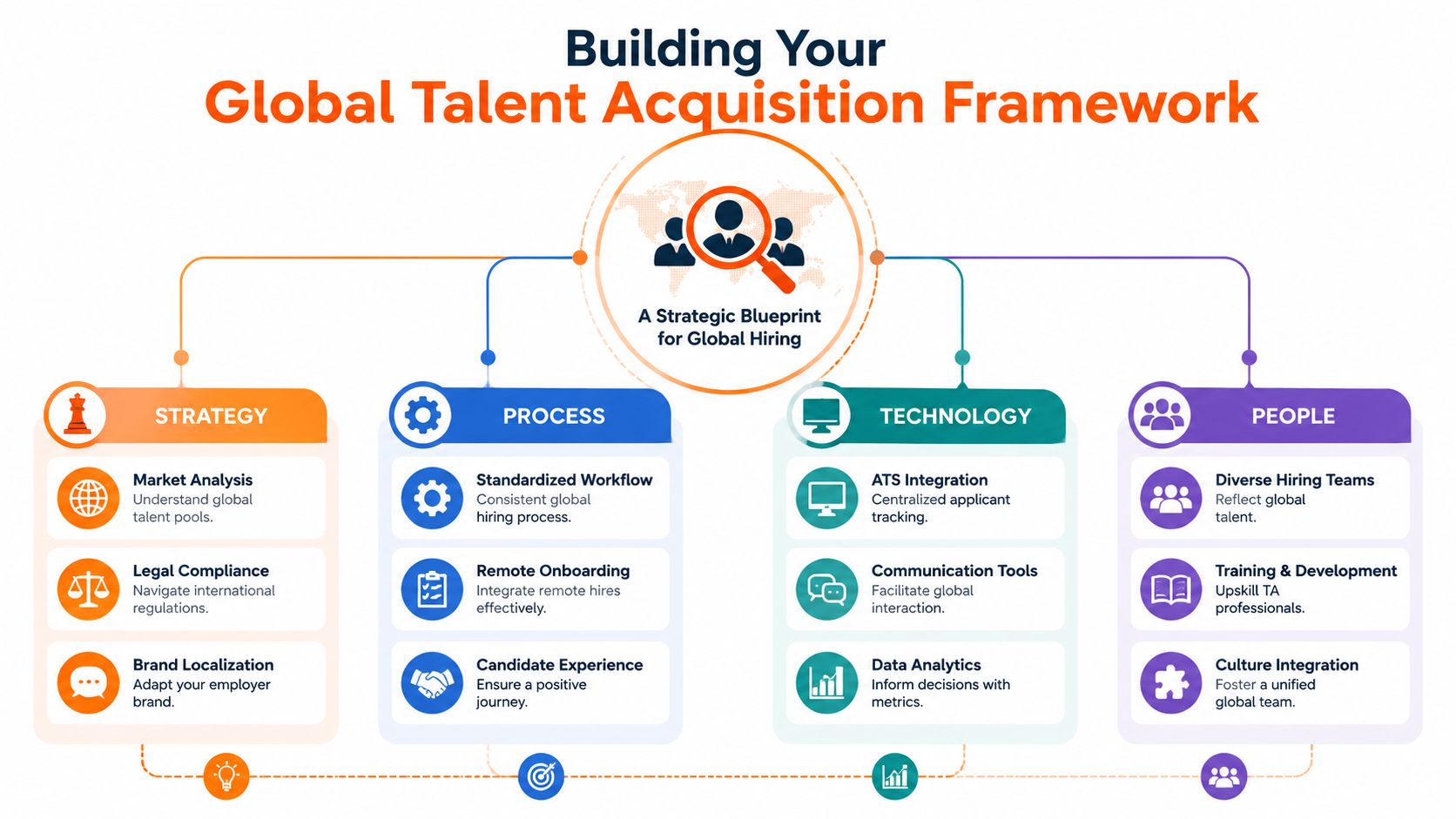
A global hiring engine needs structure. Without it, companies drift into opportunistic hiring, fragmented processes, and uneven candidate quality. The most durable model I've seen uses four pillars: business alignment, employer brand, compliance, and operational excellence. Miss one, and the others carry unnecessary weight.
Business alignment
This pillar decides whether global talent acquisition serves the company strategy or only creates more activity. Start with role clusters, not isolated open reqs. Which functions are repeatedly hard to hire? Which capabilities are revenue-critical or product-critical? Which roles need local market context, and which can be location-flexible?
Lightcast makes an important point in its guidance on building a global talent acquisition strategy with data. Market selection is increasingly a skills-supply optimization problem, not just a sourcing problem. Teams can compare role demand through job-posting volume, then prioritize regions where competition for a skill set is relatively lower. The same source also notes that channel mix should vary by geography because platform dominance differs by market.
That changes the planning conversation. Instead of asking, “Where can we post this role?” ask, “Where is the skill available with manageable competition, and what channels reach it there?”
Employer brand that travels well
Many employer brands are written as if every candidate shares the same career motivations, communication style, and risk tolerance. That doesn't hold up globally. What resonates in one market can sound vague, overly aggressive, or culturally tone-deaf in another.
Your core message should stay consistent. Your expression of it shouldn't. Companies need a brand architecture that keeps the mission stable while adapting examples, benefits language, manager expectations, and even application flow to the local audience.
A practical check is to review your job ads and career content for hidden assumptions. Are you praising “scrappiness” when candidates in some markets want clarity and stability? Are you overusing office-centric cues in fully remote roles? Are you describing benefits in ways that don't translate?
Compliance before velocity
A surprising amount of hiring friction comes from trying to solve legal structure after candidate selection. That's backwards. Before roles go live, define what hiring models are acceptable in target markets. Can you hire directly? Do you need an employer of record? Is contractor engagement appropriate for the role? Who owns the approval path?
Operating principle: Don't let recruiters create demand in a market the business can't legally support.
When compliance decisions happen early, recruiters can speak with confidence, candidates get straight answers, and finance can model costs without surprises.
Operational excellence
This pillar is where strategy becomes muscle memory. Standardize what should be standard, and localize what warrants local treatment.
Use a framework like this:
- Workflow design: Build one global hiring process with clear local decision points.
- Interviewer training: Teach managers how to assess capability without relying on cultural similarity.
- Service levels: Define who responds to offers, legal questions, and onboarding blockers, and by when.
- Feedback loops: Review candidate drop-off, assessment quality, and market-level conversion patterns regularly.
The result isn't rigid centralization. It's disciplined execution. Global talent acquisition works when teams know exactly where consistency matters and where local flexibility improves outcomes.
The End to End Global Hiring Process
A global process should feel predictable to your team and credible to the candidate. That means each stage needs a clear purpose, a handoff owner, and market-specific judgment. The biggest mistake is copying a domestic process and assuming remote logistics will somehow fill the gaps.
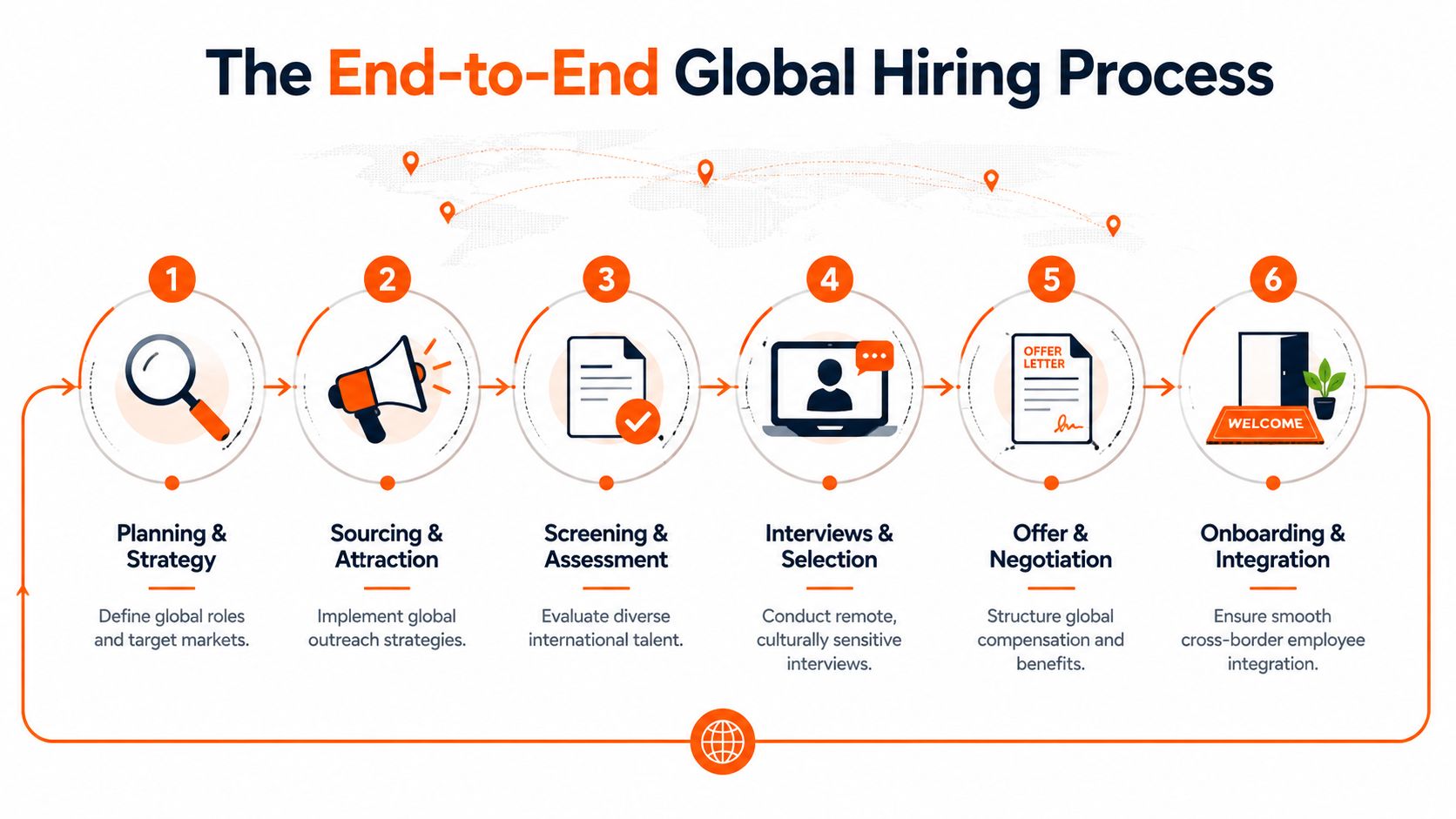
Planning and sourcing
Before anyone posts a role, lock down the basics. What problem is this hire solving? What work must happen in specific hours, languages, or jurisdictions? What engagement models are available? If those questions aren't answered up front, recruiters end up attracting candidates they can't hire.
Sourcing globally also requires more than one channel. General platforms are useful, but they rarely cover every geography or function well. Strong teams combine broad platforms, niche communities, local job boards, referral networks, and recruiter outreach suited to the market.
A simple sourcing brief should include:
- Target capability: The hard skills and business outcomes the role owns.
- Market hypothesis: Which countries or regions are likely to have the right talent supply.
- Channel mix: Which platforms, communities, and referrals fit that market.
- Screening rules: What's essential, what's trainable, and what's irrelevant noise.
Assessment and interviews
Assessment quality drops quickly when teams confuse familiarity with fit. Accent, communication style, resume format, and local career paths often influence interviewer perception more than anyone admits. That's why global hiring needs structure.
Use work-sample tasks and scorecards tied to job outcomes. If you're hiring a product marketer, assess messaging, prioritization, and cross-functional judgment. If you're hiring an engineer, assess actual technical reasoning and collaboration habits. Avoid interview prompts that reward country-specific norms or polished storytelling over substance.
The cleanest interview process asks one question only: can this person do the work in our environment?
Remote interviews add another layer. Time-zone fairness matters. So does panel design. Don't force candidates into marathon interview days if they're joining calls outside normal working hours. Spread stages sensibly, and tell candidates who they're meeting and why.
Offer design and compensation
Many cross-border hiring processes frequently wobble. Companies often source globally, then present compensation and contract terms as if local context doesn't matter. Candidates notice immediately.
Benchmarking should account for local market practice, not just headquarters logic. That includes salary positioning, paid time off norms, statutory benefits, notice periods, and whether equity is understood as meaningful upside or abstract jargon. The offer should also answer practical questions fast: legal employer, payment timing, equipment support, and start-date dependencies.
For teams weighing contractor routes, payment mechanics deserve more attention than they usually get. This overview from Zaro on the best way to pay international contractors is a useful primer on the operational choices involved. If you're comparing hiring structures more broadly, this guide to employer of record benefits is also worth reviewing before you finalize your model.
Onboarding and early integration
A global hire isn't complete on signature. It's complete when the new joiner can contribute without chasing basic answers across time zones. That takes coordination between talent, HR, IT, finance, and the hiring manager.
Good global onboarding has two layers. The first is globally consistent: company context, security practices, role expectations, communication norms, and key stakeholders. The second is locally relevant: employment documentation, payroll setup, required policies, and practical guidance for the worker's location.
Common onboarding misses include:
- Delayed equipment planning: Hardware gets treated as an afterthought.
- Manager silence: The new hire gets process but no real relationship-building.
- No async design: Important context lives only in live meetings.
- Unclear first-month outcomes: People can't tell whether they're ramping well.
The companies that do this well don't rely on welcome energy alone. They design the first month as carefully as they design the interview loop.
Navigating Remote Specific Hiring Challenges
Remote global hiring adds complexity that office-based international expansion often hides. When people never share a physical workplace, every weak assumption becomes visible. Communication, legal structure, security, and equipment logistics all need explicit design.
Time zones affect more than scheduling
Time zones are often perceived as a calendar issue. They're really an operating model issue. If a company relies on instant replies, live approvals, and recurring meetings for routine decisions, adding remote hires across regions will expose that dependency fast.
The fix isn't forcing overlap everywhere. It's building clearer async norms. Document decisions. Record context. Define response expectations by urgency. Make sure project ownership survives when someone signs off for the day.
A healthy remote team usually distinguishes between work that needs overlap and work that only needs clarity. That distinction makes hiring across continents practical instead of painful.
Legal mobility and work authorization
Right-to-work questions get harder in remote environments because employee location, tax residency, and visa status don't always line up neatly with what the company assumes. A candidate may be legally employable in one country, temporarily based in another, and planning to move again.
That's why remote hiring leaders need a simple decision tree. Where will the person work? Under what legal arrangement can the company engage them? What restrictions apply to duration, employer registration, or local labor protections? Guessing here creates risk for both sides.
If your team needs a practical starting point for remote hiring models and setup considerations, this resource on how to hire remote employees gives a useful operational overview.
Remote hiring gets easier when location is treated as a compliance input, not a profile field.
Security and equipment across borders
IT often enters the process too late. By the time a candidate accepts, no one has decided how devices will be shipped, what security controls are mandatory, or who supports failures in-country. That creates a bad first impression and avoidable risk.
A stronger remote playbook covers:
- Device strategy: Decide whether the company ships equipment, reimburses local purchase, or uses approved vendors.
- Access control: Provision accounts based on role, with least-privilege access from day one.
- Recovery process: Define what happens if a device is delayed, damaged, or lost.
- Local practicality: Check customs, delivery reliability, and support options before promising timelines.
Culture without proximity
Many leaders still use “culture fit” as a shortcut for ease of collaboration. In remote global teams, that shortcut usually screens for familiarity instead of effectiveness. The better question is whether someone can operate inside the company's communication norms, decision style, and accountability model.
That means culture should be visible in behaviors. How does the team disagree? How are deadlines clarified? How is feedback given? Which decisions require consensus, and which don't? The more explicit those norms are, the more fairly you can hire across different backgrounds and working styles.
Measuring Success with Global KPIs
Most recruiting dashboards aren't built for global talent acquisition. They emphasize hiring speed and top-of-funnel activity because those metrics are easy to collect. They're not enough to judge whether cross-border hiring is working.
AIHR makes the strongest practical case here in its article on global talent acquisition. A robust program should track time-to-productivity, not just time-to-hire, because cross-border hiring introduces compliance, onboarding, and training delays that can postpone the moment a new hire becomes fully effective. The same source also argues for monitoring regional retention and location-specific diversity benchmarks separately, since the same process can perform differently by country.
Why standard metrics fall short
A candidate can move through interviews quickly and still take too long to become effective because equipment arrived late, payroll setup lagged, manager onboarding was weak, or role expectations weren't localized properly. Time-to-hire misses all of that.
Global averages create a second problem. They flatten local reality. A process may look efficient overall while one country suffers poor retention, weak hiring-manager alignment, or recurring compensation mismatches. If you only review one rolled-up dashboard, you'll miss the operational issue until it becomes a pattern.
Measurement rule: Track global strategy centrally, but diagnose performance locally.
Key Global Talent Acquisition KPIs
| Metric | What It Measures | Why It's Critical for Global TA |
|---|---|---|
| Time-to-productivity | How long it takes a new hire to become fully effective in role | It captures the real impact of compliance, onboarding, training, and manager enablement across borders |
| Time-to-hire | How long it takes to move from opening a role to accepted offer | It shows process speed, but should never be used alone in a global model |
| Regional retention | Whether hires stay and succeed in specific countries or regions | It reveals location-specific issues that global averages can hide |
| Location-specific diversity benchmarks | Representation outcomes by market | It prevents teams from assuming one process produces equitable outcomes everywhere |
| Channel effectiveness by market | Which sourcing routes produce viable candidates in each geography | It helps teams stop overspending on channels that don't match local candidate behavior |
| Offer acceptance patterns | Whether candidates accept terms by role and location | It surfaces problems in compensation, benefits, legal structure, or candidate communication |
How to use the data well
A good dashboard supports decisions, not reporting rituals. Review metrics by region, role family, and hiring manager cohort. Pair the numbers with recruiter notes and onboarding feedback so context stays attached to performance.
Tie measurement to action. If time-to-productivity is slow in one market, don't just ask recruiting to move faster. Audit onboarding, legal setup, manager readiness, and equipment delivery. Global talent acquisition is cross-functional by nature, so its metrics need cross-functional ownership too.
Essential Tools for Your Global TA Tech Stack
Technology doesn't fix a weak hiring strategy, but it does determine whether a good strategy can scale. In global talent acquisition, the right stack reduces manual handoffs, preserves candidate context, and keeps legal and operational details from falling through the cracks.

The four categories that matter
Buying tools one problem at a time usually creates overlap and broken workflows. A cleaner approach is to organize the stack into four categories and decide how information should move between them.
Sourcing platforms
These tools help you reach candidates where they already search and evaluate roles. In a global setup, that often means combining broad visibility with more curated channels for remote-friendly talent.
Use sourcing platforms to answer practical questions: Are roles discoverable by geography? Can candidates filter for remote work terms that matter to them? Does the platform support the kind of role mix you hire most often?
Applicant tracking systems
The ATS is your control layer. It should centralize job approvals, candidate progression, scorecards, communication history, and reporting. If your ATS can't handle global workflows, recruiters will route work through spreadsheets and side channels, and quality will drop.
Look for systems that make it easy to standardize interview kits while preserving local flexibility. That balance is more important than flashy automation.
Employment and compliance platforms
This category covers employer of record services, contractor management, payroll coordination, and document workflows. These tools matter because they turn a selected candidate into a legally engaged worker without forcing the recruiting team to manage compliance manually.
The key question isn't just “Can this vendor hire in that country?” It's “Can our team explain the model clearly to candidates, managers, and finance?”
After the hiring flow is designed, this short video is a useful complement for thinking about remote hiring operations in practice:
Collaboration and onboarding tools
Once the offer is signed, collaboration systems carry the new hire into productive work. Documentation tools, async messaging, knowledge bases, task tracking, and secure identity management all shape the first months more than many TA leaders realize.
A remote global hire who enters a messy collaboration environment often gets judged for slow ramp-up when the failure sits in tooling and process design.
How the stack should work together
A practical workflow looks like this: a recruiter attracts a candidate through a sourcing platform, the ATS manages screening and interview data, the employment platform handles contract and compliance steps, and collaboration tools deliver onboarding and manager support. Each system has a job. None should become the accidental source of truth for everything.
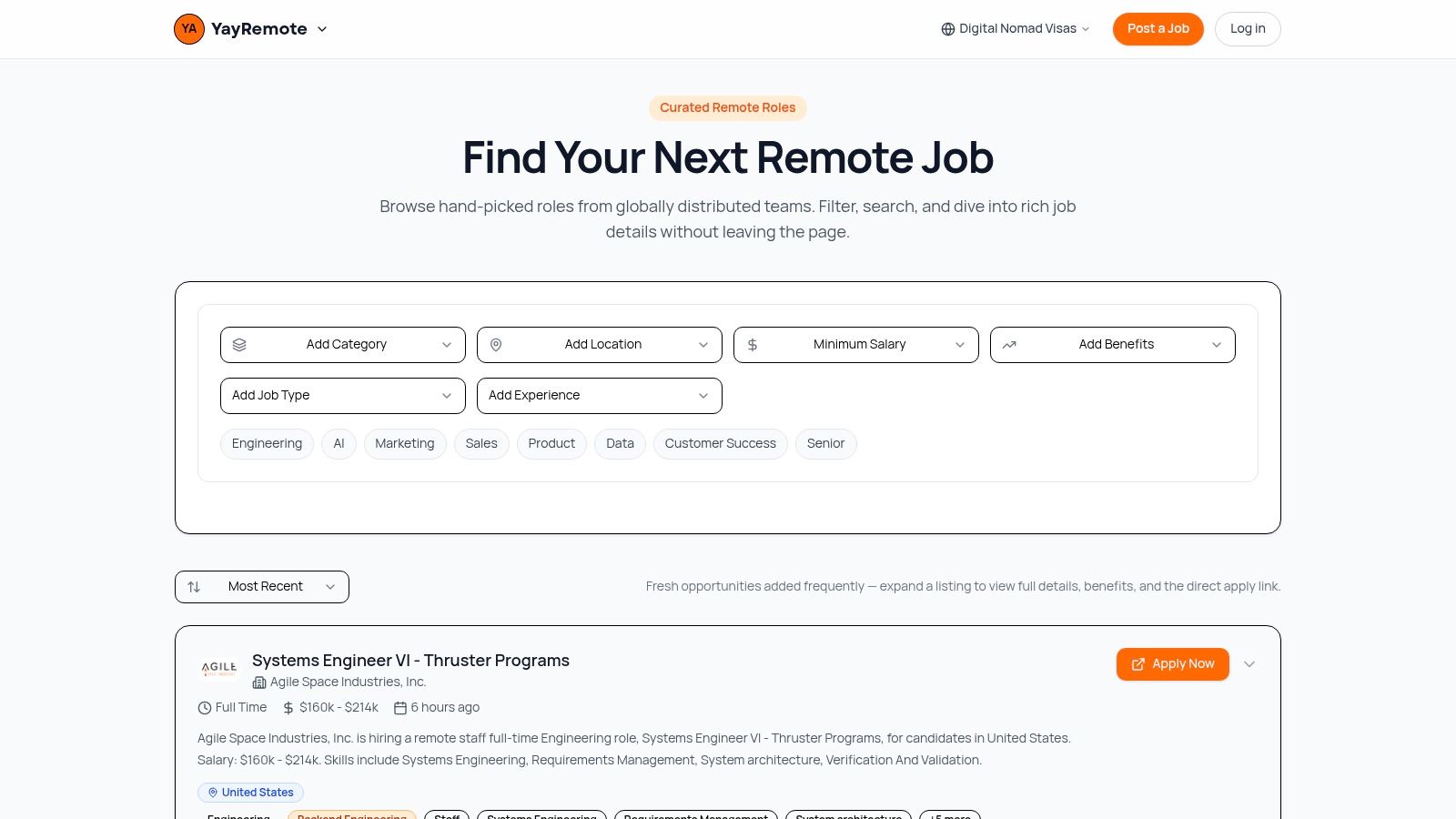
Using a platform like YayRemote as a simple running example proves useful. A company might discover a remote-ready candidate through a curated global jobs platform, move that person through an ATS with structured scorecards, then use an EOR or payroll platform to hire legally in the target country. That sequence is straightforward when the stack is designed intentionally. It becomes chaotic when each team buys tools in isolation.
What not to do
A few patterns reliably create pain:
- Tool sprawl: Recruiters, HR, legal, and finance all keep separate records.
- No integration plan: Candidate data has to be re-entered at every stage.
- Compliance hidden from recruiters: Frontline teams can't answer basic hiring model questions.
- Onboarding outside the stack: New hires receive critical information through ad hoc messages and PDFs.
Good tools don't remove complexity. They put it in the right place and make it manageable.
Your Global Talent Acquisition Implementation Checklist
Most companies don't need a massive transformation to start hiring globally well. They need a disciplined first operating model. Build it in phases, and make each phase solve a real execution constraint.
Phase one foundation
Start with scope. Decide which roles are appropriate for global hiring, which are location-bound, and which markets are viable from a legal and operational standpoint. Align finance, legal, people ops, and hiring leaders before recruiters begin outreach.
Use this foundation checklist:
- Define priority roles: Focus on skill clusters that are repeatedly hard to fill.
- Set market criteria: Choose regions based on talent fit, language, time-zone needs, and hiring feasibility.
- Clarify engagement models: Decide when you'll use direct employment, an EOR, or contractors.
- Lock ownership: Assign clear decision-makers across recruiting, legal, finance, IT, and onboarding.
Phase two setup
This phase turns policy into machinery. Select the systems and documents that let the first hiring sprint run without improvisation.
Core setup items include:
- Choose your ATS and workflow rules: Every candidate should move through a consistent process.
- Prepare interview kits: Build scorecards, work samples, interviewer training notes, and rejection templates.
- Document offer logic: Define compensation philosophy, approval paths, and who communicates what.
- Map payment operations: Review how your team will handle cross-border payroll using guidance like this resource on how to pay international employees.
The first goal isn't elegance. It's a process your team can execute without guessing.
Phase three execution and iteration
Launch with a contained hiring sprint instead of rolling global hiring across every function at once. Pick a role family, a short list of markets, and a manageable number of hiring managers. Then watch where the process strains.
Track the basics that matter operationally: pipeline quality, offer friction, onboarding blockers, and early productivity signals. Debrief every closed role. If recruiters are hearing the same compensation objections, fix the offer architecture. If onboarding keeps stalling, pull IT and people ops into the review.
The companies that mature fastest don't assume the blueprint is correct. They treat the first few hires as process design work, then standardize what proves repeatable.
YayRemote can help teams and candidates manage remote work more cleanly, whether you're hiring across borders or searching for distributed roles. Explore YayRemote for remote job discovery, practical hiring resources, and tools that make global work easier to manage.