Hiring Front End Developer: Playbook for 2026
Master hiring front end developer talent with our 2026 remote-first playbook. Get practical steps for defining roles, sourcing, and effective interviews for
Most advice on hiring front end developer talent starts too late. It jumps straight to React questions, portfolio reviews, and coding tests, as if the hard part is picking between candidates. In practice, the expensive mistake happens earlier. Teams write a vague role, attract the wrong applicants, and then blame the market when interviews feel noisy.
That mistake gets worse in remote hiring. Once you remove location barriers, you don't just get access to more talent. You also get more ambiguity, more applicant volume, and more ways to hire the wrong shape of developer for the work you need done.
Your New Playbook for Hiring a Front End Developer
The common assumption is that the hard part is finding front end developers. I don't buy that. The harder part is deciding what kind of front end developer your team needs, what evidence should count as proof, and what unstated constraints you're imposing before the search even starts.
The role is worth getting right. The U.S. Bureau of Labor Statistics projects employment for web developers and digital designers to grow 7% from 2024 to 2034, with about 14,500 openings per year over the decade, and reports median annual wages of $90,930 for web developers and $98,090 for web and digital interface designers in May 2024 according to the BLS occupational outlook for web developers and digital designers. That tells hiring managers something simple. This is still a specialized role tied directly to product quality and user experience.

Start with the business problem, not the skill checklist
A front end hire can own very different kinds of work.
One team needs someone who can turn a messy design system into consistent, accessible UI components. Another needs a product-minded engineer who can ship experiments with weak specs and collaborate across time zones. A third says they want a front end developer, then slips API integration, CMS maintenance, analytics tagging, and build tooling into the posting.
Those are not the same job.
Practical rule: If two interviewers can't describe success in the role the same way, the hiring process is already off track.
That is why generic hiring advice fails. It assumes the title is clear enough. It usually isn't.
Treat the hire as a systems decision
A good process aligns four things before outreach starts:
- Scope of ownership. Decide whether the person owns UI implementation only, or also testing, component architecture, API integration, and release support.
- Collaboration model. Remote teams need clarity on async communication, handoffs, review cycles, and overlap expectations.
- Level of autonomy. Some candidates are strong executors with good guidance. Others can shape requirements and reduce ambiguity.
- Signals you trust. Real code, reasoning, and communication matter more than polished resumes.
If your team also hires across functions, this kind of expert advice for B2B hiring is useful because it pushes the same discipline. Define outcomes first, then build a process around them.
For remote-specific planning, the most useful starting point is to hire remote developers with a clearer process instead of treating distributed hiring like local hiring with Zoom added on top.
Define Your Ideal Developer Before Writing the Job Post
The job post should document a decision, not replace one.
Many organizations open a blank doc and start listing tools. React. TypeScript. CSS. Next.js. Maybe GraphQL. Maybe Node. Maybe Figma. Then they wonder why applicants don't match. The problem is that the role hasn't been scoped. It has been decorated.

Current listings often blur the line between a pure front end role and a broader one by asking candidates to handle back-end tools, CMS work, and build tooling, which makes the specialist versus T-shaped decision central in remote hiring, as shown by current front end developer listings.
When a specialist is the better hire
Hire a pure front end specialist when the hard part of the job is interface depth.
That usually means one or more of these conditions are true:
- Design complexity is high. Your product has demanding UI states, rich interaction patterns, or a design system that needs discipline.
- Accessibility matters day to day. You need someone who catches semantic issues, keyboard traps, focus order problems, and contrast mistakes during normal development.
- Front end performance is product-critical. Rendering behavior, bundle discipline, and component composition affect user experience directly.
- Design and engineering need a stronger bridge. A specialist often works better with product designers because they care about implementation detail.
A specialist is not narrow in a bad way. A good one reduces rework, raises UI quality, and gives the rest of the engineering team a cleaner surface to build against.
When a T-shaped engineer wins
Hire a T-shaped engineer when the bottleneck isn't visual complexity. It's handoff friction.
Remote teams often need someone who can implement the interface, wire API calls, adjust build tooling, work inside a CMS, and unblock release work without waiting on three other people. That doesn't mean hiring a weak generalist. It means hiring someone with clear front end strength plus enough range to keep delivery moving.
If your roadmap dies every time work crosses the line between browser code and backend integration, a broader hire may be worth more than a deeper specialist.
A common misstep in many hiring front end developer searches occurs when the team says "front end," but the operating reality says "product engineer with a front end bias."
A simple decision filter
Use this before writing the post:
| Team situation | Better fit |
|---|---|
| Design system debt, UI inconsistency, accessibility gaps | Front end specialist |
| Small remote team with broad ownership | T-shaped engineer |
| Complex customer-facing application with interaction-heavy flows | Front end specialist |
| CMS-driven site with mixed implementation tasks | T-shaped engineer |
| Separate platform and backend support already exist | Front end specialist |
| One hire must unblock multiple functions | T-shaped engineer |
Candidates also read titles through the lens of career direction. If you want a useful view of how developers think about progression, this overview of the front-end developer career path helps explain why vague job scope can attract the wrong people.
Write the post after this decision is made. Not before.
Source Talent Beyond Your Local Time Zone
Once the role is defined, sourcing gets easier because your filters get sharper. Without that clarity, opening the funnel just produces more noise.
That matters because the market is crowded. Front-End Focus described an "overwhelming supply of front-end developers" in 2025 and noted that hiring managers can receive 100s or 1000s of applications due in part to AI-generated resumes and applications in its 2025 market commentary on front end hiring. High volume doesn't mean high fit.
Write the post to repel the wrong candidates
A strong remote posting doesn't try to appeal to everyone. It filters.
Use concrete language around the actual work:
- Name the product surface. Say whether the person will build dashboards, marketing pages, design-system components, onboarding flows, or internal tools.
- Separate required from preferred. If API integration is occasional, don't list it like a core responsibility.
- State the async reality. Mention review expectations, written communication habits, and collaboration windows.
- Ask for proof tied to the role. Portfolio links are fine, but ask candidates to highlight one shipped interface, one hard trade-off, and one example of debugging or optimization.
This approach screens out resume spray. It also helps serious candidates self-select in.
Source where signal exists
A remote-first search should mix channels. Relying on a single large job board usually produces the least useful work per application reviewed.
Use a combination like this:
- Curated remote platforms for candidates already oriented to distributed work. For example, teams can hire remote React developers through remote-focused channels when the role centers on modern front end stacks.
- Niche communities where developers show their work and discuss implementation details.
- Targeted outreach to developers whose public code, UI work, or writing already matches your product needs.
- Referral loops from designers, engineering managers, and senior engineers who know what good front end execution looks like.
Ignore low-signal shortcuts
A few things waste time fast in distributed hiring:
- Keyword-only resume screening. This misses strong candidates and advances weak ones who know how to mirror job descriptions.
- Overweighting polished personal branding. Some excellent front end engineers are bad at self-promotion.
- Judging GitHub by activity alone. Public contribution volume is not the same as product judgment.
- Using generic application questions. "Why do you want to work here?" rarely helps. "Show one UI you built and explain one trade-off" does.
The remote hiring advantage isn't access to more applicants. It's access to more selective sourcing.
The point of global hiring isn't volume for its own sake. It's reach. If your local market doesn't have the exact mix of interface depth, product sense, and async communication you need, your search should not stop at your city limit.
Run Technical Screens That Predict Real-World Performance
Most front end interviews still overvalue performance in artificial settings. A candidate solves a puzzle on a whiteboard, explains a hook from memory, or answers framework trivia under pressure. None of that tells you much about how they ship UI in a real codebase.
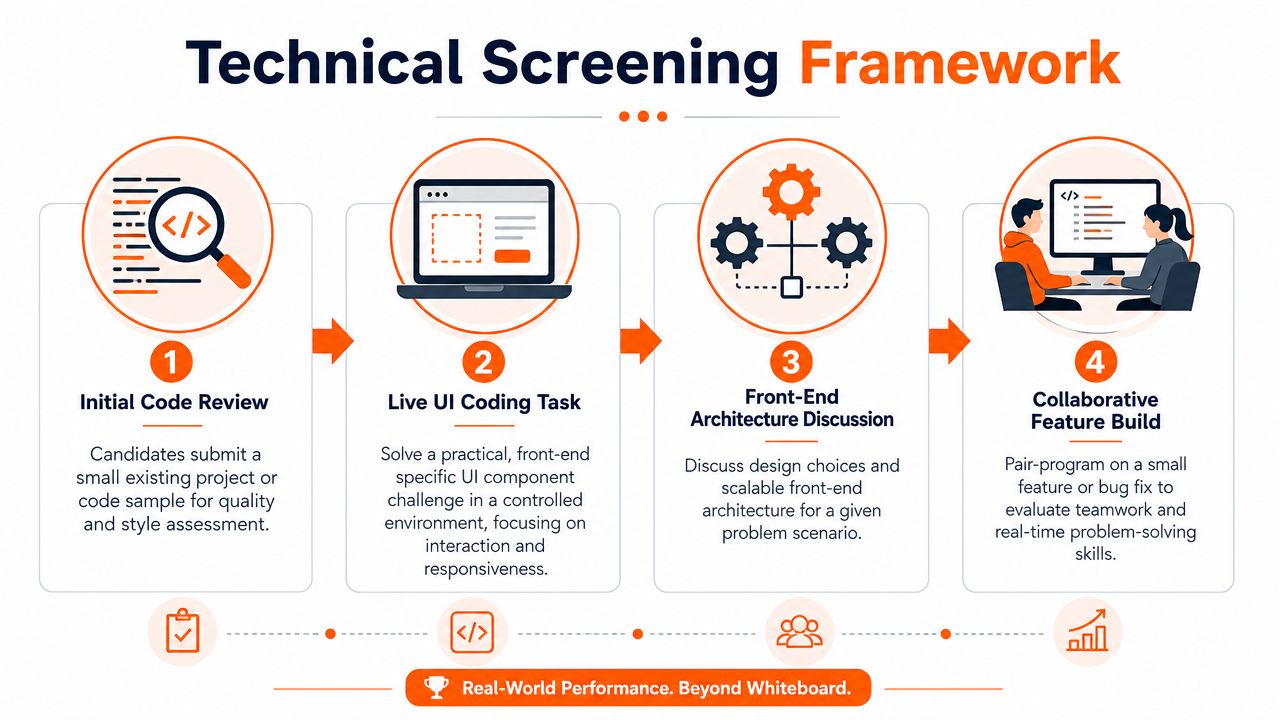
A better workflow uses multiple stages. Revelo recommends a 30–45 minute async task, followed by a reasoning-focused technical interview, then a pair-programming session in its guide to hiring front-end developers with a multi-stage screen. That sequence is useful because it tests actual working behavior. You see code quality, debugging, judgment, and collaboration instead of just recall.
To make the process easy to communicate internally, use a simple framework:
Stage one should be small and specific
The async screen should respect candidate time and mirror your stack.
Good prompts look like this:
- Refactor a messy component that mixes logic, styling, and state transitions.
- Fix a broken UI flow with obvious accessibility and responsiveness issues.
- Review a pull request and explain what you'd change before merging.
- Optimize a component that re-renders too often or handles loading and error states poorly.
Bad prompts are broad take-home projects that ask candidates to build half an app. Those mostly test free time, not fit.
What you're looking for in the submission:
- Clear structure
- Sensible naming
- Thoughtful state handling
- Practical CSS decisions
- Awareness of accessibility basics
- Notes that explain trade-offs instead of pretending every choice is obvious
Use the live interview to probe reasoning
The next interview should not repeat the task. It should unpack it.
Ask the candidate why they chose a component boundary, why they rejected another approach, how they'd test the interaction, and what would change if the app had to scale. Strong candidates usually reveal themselves here. They don't just defend their code. They show how they think.
Hiring rule that holds up: ask candidates to explain trade-offs in their own code before asking them to solve something new.
A front end engineer who can reason about rendering, semantics, maintainability, and user behavior is usually more valuable than one who can recite API details from memory.
A short explainer can also help align your interview panel on what modern front end evaluation looks like:
Pair on something close to the work
The final technical stage should feel like a real collaboration session.
Use one of these formats:
| Format | What it reveals |
|---|---|
| Pair-program a small bug fix | Debugging style, communication, comfort with incomplete information |
| Extend an existing component | Ability to work within constraints instead of starting from scratch |
| Review and improve a rough implementation | Judgment, code review quality, maintainability instincts |
Keep the exercise bounded. Share context up front. Let the candidate ask questions. The point is not to trap them. The point is to observe how they work with another engineer when requirements are only partially defined.
What does not work
These patterns still fail too often:
- Trivia-heavy interviews that reward memorization.
- Pure algorithm screens with no UI context.
- Unstructured panel interviews where everyone asks whatever comes to mind.
- Oversized take-homes that create resentment and dropout.
- Tool fetishism where one library choice gets treated like a moral issue.
Hiring front end developer talent well means evaluating implementation judgment in context. Real front end work involves ambiguity, constraints, feedback, and user-facing consequences. Your interview loop should reflect that.
Evaluate Skills Holistically with a Structured Scorecard
Once the interviews end, the stated desire is for objectivity. Then everyone shares vibes.
That is where good hiring loops collapse. One interviewer loved the candidate's energy. Another thought they were too quiet. A third liked the code but worried about "seniority." None of that is usable unless the team is scoring against the same definition of success.
Build the scorecard around the job you actually scoped
Your scorecard should include technical ability, but it should also include the remote-specific constraints that change whether a hire works in practice. Many hiring guides ignore cross-border friction such as work authorization, location constraints, and time-zone fit, even though those can shrink the candidate pool more than skill requirements, as reflected in remote front end listings with work authorization and location constraints.
A remote scorecard should answer questions like:
- Can this person communicate clearly in writing when context is incomplete?
- Can they collaborate asynchronously without constant meetings?
- Does their time-zone overlap match the team's operational needs?
- Is there any work authorization constraint that affects the hire?
- Can they balance product speed with UI quality?
A scorecard the whole panel can use
Here is a practical template.
| Competency | What to Look For | Rating (1-5) | Notes |
|---|---|---|---|
| Front end implementation | Clean component structure, maintainable code, sensible state handling | ||
| UI judgment | Good decisions around interaction, responsiveness, accessibility, and polish | ||
| Debugging and problem-solving | Can isolate issues, explain root causes, and test fixes calmly | ||
| Technical communication | Explains trade-offs clearly in speech and writing | ||
| Async collaboration | Leaves useful context, asks good questions, works well without live supervision | ||
| Product sense | Understands user impact, edge cases, and pragmatic scope decisions | ||
| Scope fit | Matches the role definition, whether specialist or T-shaped | ||
| Remote logistics fit | Time-zone alignment, work authorization, and practical availability match team needs |
Calibrate before debriefs
A scorecard only works if interviewers use it consistently.
Do three things:
- Define what a 3 means before interviews begin. If one interviewer treats 3 as "solid" and another treats it as "weak," your scores are fiction.
- Require written evidence for strong yes or strong no decisions.
- Separate concerns. A candidate can be technically strong and still be a poor fit for the role scope or remote operating model.
Strong hiring teams don't ask, "Did I like this person?" They ask, "What evidence did this person give us for the work we need done?"
That shift reduces bias fast. It also makes final decisions easier when candidates have different shapes of strength.
Craft a Winning Offer and Onboard for Remote Success
A good process can still fail at the end. Teams move slowly, send a vague offer, or treat onboarding like an IT checklist. Then they lose momentum before the hire has shipped anything useful.
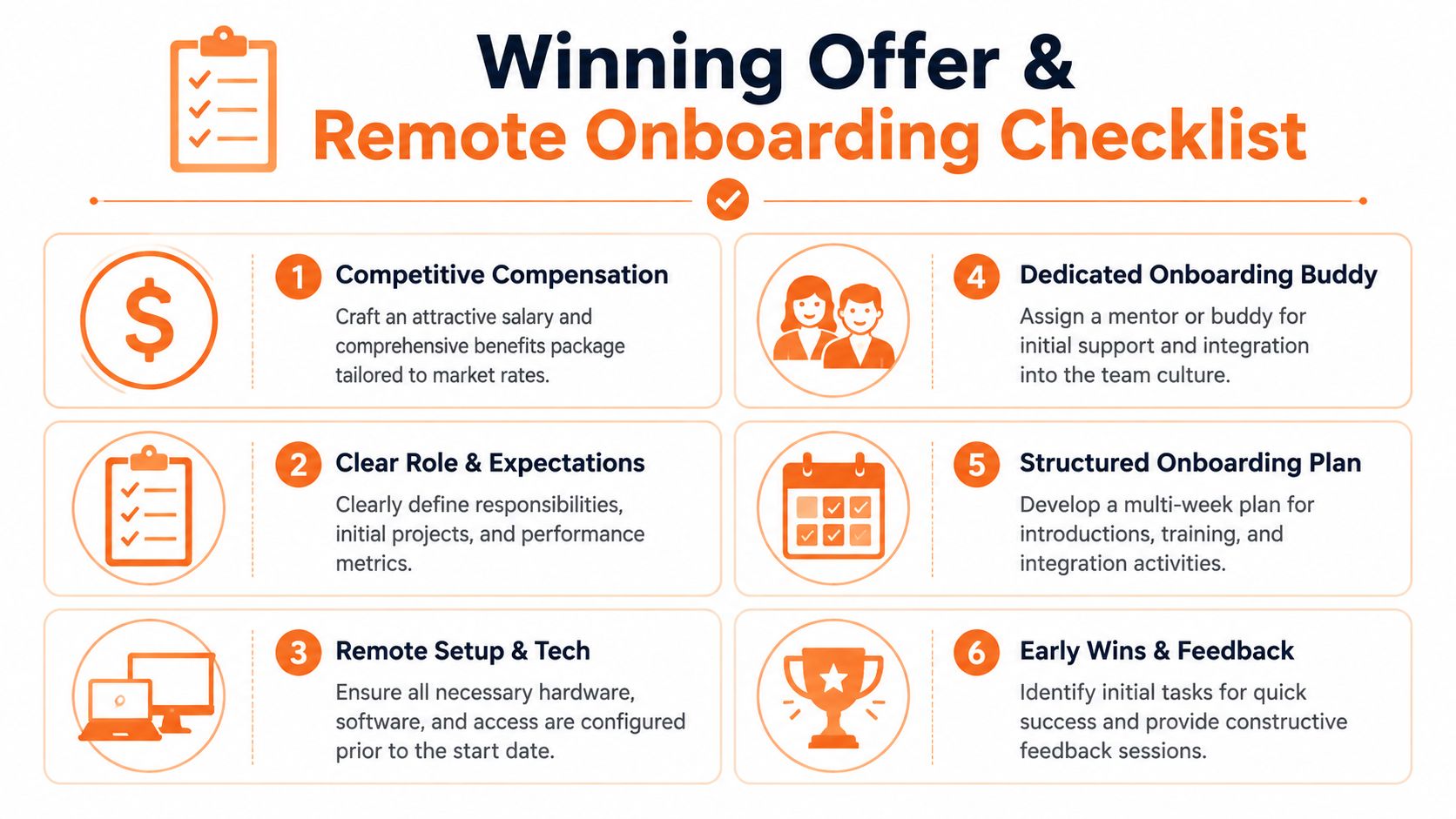
The offer and the first few weeks need as much structure as the interview loop.
Write offers that remove uncertainty
A strong remote offer is explicit.
It should clearly state:
- Compensation approach. If your company uses location-based pay or geography-neutral pay, say so plainly.
- Role scope. Reconfirm whether the hire is joining as a specialist or a broader product-oriented engineer.
- Working model. Spell out time-zone expectations, communication norms, and any travel or onsite requirements.
- Support details. Equipment, home-office setup, benefits access, and legal employment structure should not be vague.
Candidates don't just evaluate pay. They evaluate whether your team feels organized.
Onboarding should create momentum, not paperwork
Most remote onboarding fails because it front-loads information and delays ownership. New hires sit through calls, get twenty tool invites, and still don't know what they are supposed to achieve first.
A better plan gives them context, relationships, and an early win.
Use a checklist like this:
- Give access before day one so the person is not blocked on accounts, repos, docs, and design files.
- Assign a real onboarding buddy who can answer practical questions quickly.
- Set the first project early. It should be meaningful but bounded.
- Schedule key introductions with engineering, product, design, and whoever reviews their work.
- Document expectations in writing so the new hire can revisit them asynchronously.
- Create feedback loops early with manager check-ins and code review guidance.
For teams refining the people side of distributed onboarding, these strategies for onboarding distributed teams are useful because they focus on communication habits and integration, not just logistics.
The first month should answer three questions
A new front end developer should know, quickly:
| Question | What the company should provide |
|---|---|
| What am I responsible for | Clear scope, ownership boundaries, and examples of good output |
| How do people work here | Review norms, documentation habits, meeting expectations, and escalation paths |
| How will I know I'm doing well | Defined early goals, feedback cadence, and visible success criteria |
If you need a practical reference, use a remote employee onboarding checklist to make sure nothing operational slips.
The best remote onboarding feels calm. The new hire knows where to look, who to ask, and what to ship first. That confidence matters. It turns a signed offer into productive work.
If you're hiring across borders or trying to widen your search beyond a single local market, YayRemote is one practical place to explore fully remote roles, global talent reach, and employer tools built around distributed hiring.