Internet of Things Jobs: Your 2026 Guide to Landing a Role
Explore the top Internet of Things jobs in 2026. This guide covers roles, skills, salaries, and how to find remote IoT positions on platforms like YayRemote.
In March 2026 alone, nearly 23,000 new IoT jobs were listed globally, while 53,181 total active listings remained open across the market, according to Automation.com's reporting on the rise of IoT jobs. That's the number I'd want any serious candidate to see before they assume internet of things jobs are a niche corner of tech.
They aren't.
Hiring teams don't treat IoT as one narrow discipline. They hire across firmware, systems, cloud infrastructure, UI, analytics, security, and operations because connected products fail when any one layer is weak. If you're trying to break in, that's good news. It means there are multiple entry points. It also means vague “I want to work in IoT” positioning won't help much. Employers want to know which layer you can own, what constraints you understand, and whether you can work across the full device-to-cloud chain.
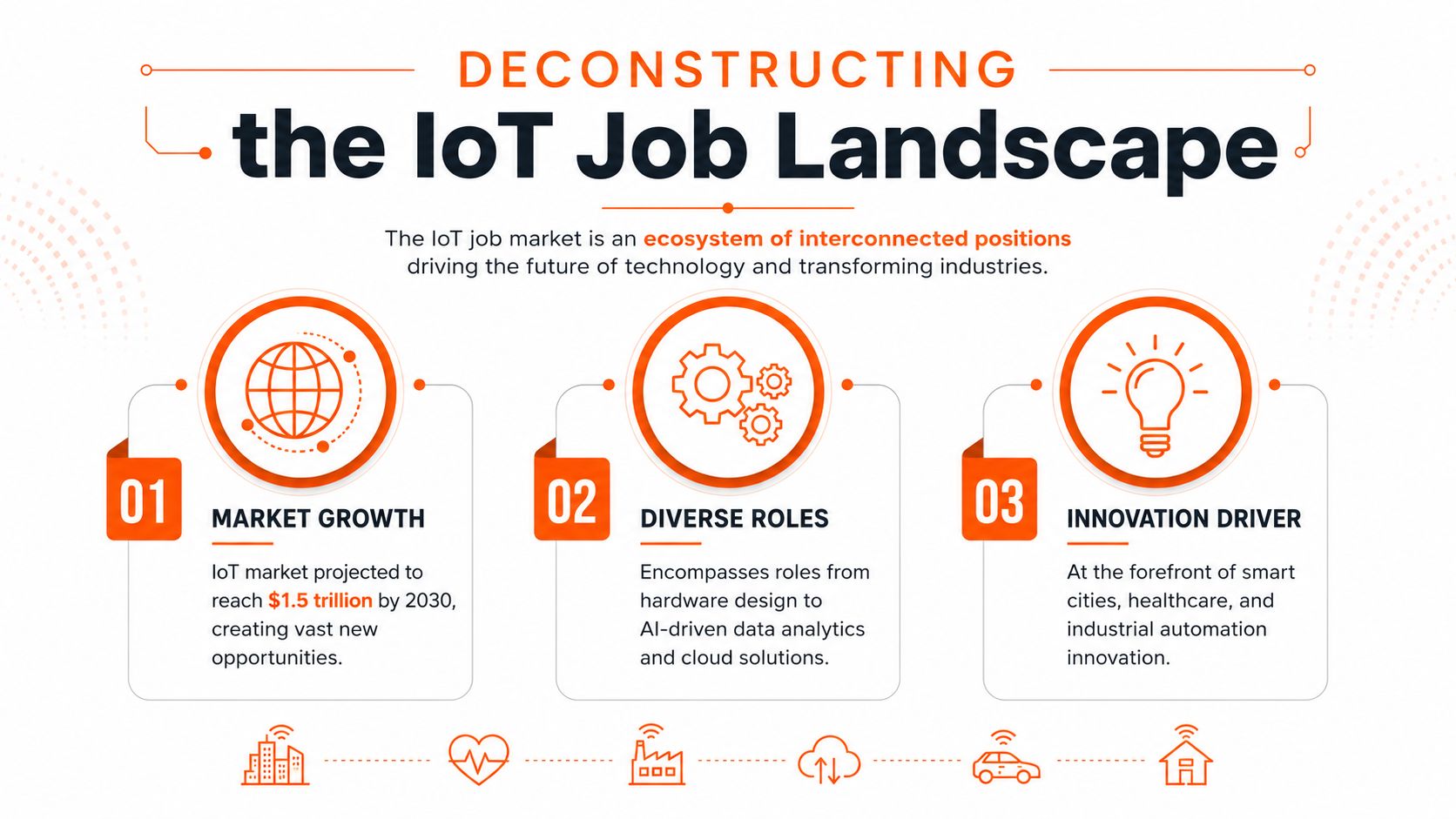
Deconstructing the IoT Job Landscape
IoT hiring is easier to understand once you stop treating it as one job family.
Companies hire around connected products as operating systems, not single features. A device has to be designed, powered, connected, provisioned, monitored, updated, secured, and supported in the field. That creates hiring demand across firmware, hardware validation, cloud infrastructure, mobile integration, analytics, DevOps, QA, product, and security. Candidates who see only the device miss half the market.
That gap shows up in interviews. Many applicants can describe sensors, boards, or cloud platforms in isolation. Fewer can explain how data moves from device to gateway to backend, what breaks in production, and who owns the fix. Hiring managers notice the difference fast.
What hiring demand looks like in practice
The strongest signal is not one title. It is the spread of openings across the product lifecycle.
Early-stage teams usually hire people who can build and test fast under hardware constraints. More mature companies add specialists in fleet management, data pipelines, compliance, field reliability, and device security. That is why two postings with "IoT engineer" in the title can have very different requirements. One company may need board bring-up and RTOS experience. Another may need MQTT, Kubernetes, OTA updates, and observability across thousands of deployed devices.
In hiring reviews, I see one pattern repeatedly. Companies pay for execution first. They want people who can ship, debug, and support connected systems under real-world conditions. Pure strategy roles exist, but they are rarely the first hire.
Practical rule: If a job description mentions firmware, cloud integration, telemetry, and field issues in the same posting, the team is looking for someone who can work across handoffs and reduce failure points.
Why demand keeps expanding across industries
Industrial firms hire for uptime, protocol knowledge, and resilience under ugly operating conditions. Consumer teams care more about user experience, app behavior, and cost-sensitive hardware decisions. Healthcare employers add tighter requirements around privacy, traceability, and reliability.
The common thread is lifecycle ownership.
IoT work does not end at launch. Devices need provisioning, monitoring, patching, certificate rotation, support workflows, and retirement planning. That creates room for candidates beyond classic embedded roles. It also creates overlooked career paths, especially in embedded security, device identity, edge operations, and fleet reliability. Those specialties are harder to fill because they sit between hardware, software, and security teams.
This matters for job seekers mapping a long-term career. A junior candidate may start in firmware test, systems integration, or cloud support. Later, that same background can lead into platform engineering, solutions architecture, or embedded security, where companies often struggle to find people who understand both constrained devices and production risk.
Remote hiring follows the same pattern. Board-level lab work and field validation are often tied to a site, but cloud, platform, security, data, DevOps, and parts of systems integration can be done remotely. Candidates who want distributed teams should understand the broader market for remote tech career paths and then target the IoT functions that do not require daily bench access.
Key Roles in the Internet of Things
Hiring demand in IoT rarely maps cleanly to job titles. The same title can describe test-heavy bench work at one company and cross-functional product ownership at another. Candidates who read only the headline miss good fits and waste time on the wrong roles.
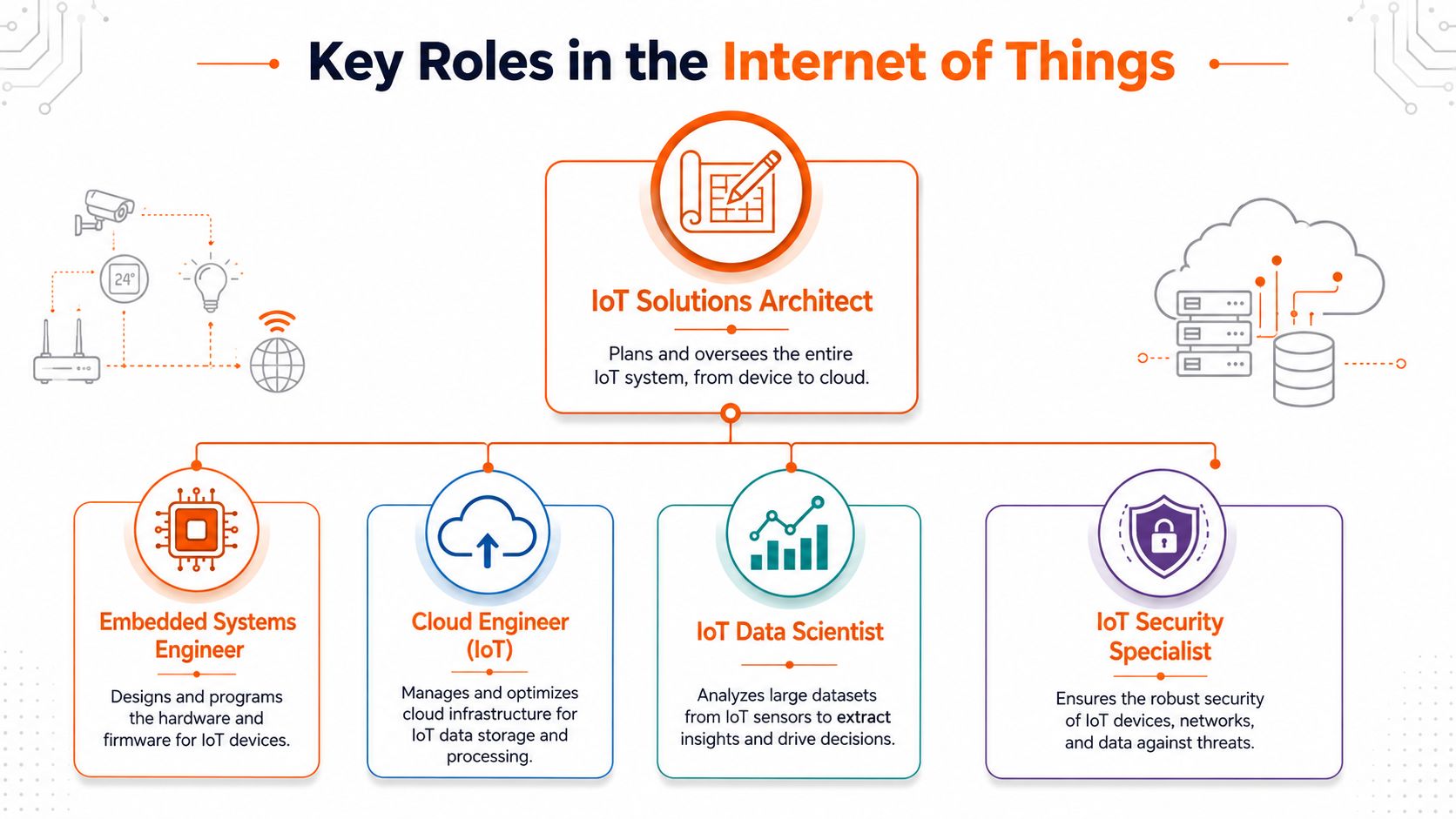
The practical way to assess IoT jobs is to ask three questions. Are you closest to the device, the data pipeline, or the operating environment? Do you spend your time building, integrating, or reducing risk? Is the role tied to a lab or site, or can the work be done from distributed teams? Those answers tell candidates more than the title does.
Embedded systems engineer
Embedded systems engineering remains one of the clearest entry points into internet of things jobs. These engineers sit nearest to device behavior. They write firmware, tune power use, integrate peripherals, and diagnose failures that application teams often cannot reproduce.
Hiring managers screen hard for evidence of constraint-based thinking. Strong candidates can explain why they chose one communication pattern over another, how they handled limited memory, or what changed after field testing exposed timing issues. Bench competence matters. So does judgment.
What gets interviews:
- C or C++ fluency tied to hardware: Interrupts, RTOS basics, memory handling, and interface protocols such as SPI, I2C, or UART.
- Real debugging experience: JTAG, serial logs, oscilloscopes, logic analyzers, and structured fault isolation.
- Production awareness: OTA updates, failure recovery, and how firmware decisions affect support costs later.
Weak signals show up fast. A portfolio full of hobby demos without reliability, power, or update considerations will not carry much weight for commercial IoT products.
IoT solutions architect
Solutions architects connect devices, edge systems, cloud services, and business requirements into something a company can ship and support. In practice, this role often sits between engineering leads, security teams, operations, and customer stakeholders.
Analysts at IoT Analytics report a projected net increase of 350,000 Industrial IoT jobs in Germany over the next decade and list IT/IoT Solution Architects among the highest-potential roles. That matches what employers ask for in interviews. They want architects who have seen rollout problems, integration failures, and support escalations firsthand.
The strongest candidates usually come up through engineering, infrastructure, or systems integration. They know where identity breaks, where telemetry gets lost, and where edge versus cloud decisions create cost or latency problems. Teams working on addressing complex IoT software challenges often hire for exactly that kind of cross-stack judgment.
IoT data scientist
IoT data scientists turn noisy telemetry into operational decisions. Their work often covers anomaly detection, predictive maintenance, usage analysis, and model validation against real device behavior.
This role is less about polished notebooks and more about messy inputs. Good candidates understand missing sensor data, drift, delayed events, and weak labels from field systems. They can also work with engineers who know why a sensor spikes, not just that it spikes.
In hiring loops, I look for candidates who can connect model choices to deployment realities. A model that performs well on curated data but fails under field conditions creates rework for product, support, and operations teams.
Industrial UI and UX designer
Industrial UI and UX roles are easy to underestimate until teams start watching real operators use the product. Dashboards, maintenance tools, operator panels, and alert flows shape whether the system gets trusted or bypassed.
The same IoT Analytics report also names Industrial UI/UX designers as a high-potential Industrial IoT role. That makes sense. In industrial and field settings, poor interface decisions slow down technicians, hide faults, and increase training burden. Employers want designers who understand workflows, environment, safety context, and the cost of ambiguity.
Candidates from consumer product backgrounds can still break in here, but they need to show they can design for constrained attention, repetitive tasks, and error prevention rather than novelty.
Cloud engineer for IoT platforms
Cloud engineers keep IoT platforms stable after devices start sending data at production volume. Their scope often includes ingestion pipelines, identity and access controls, observability, event routing, storage choices, and fleet-facing APIs.
This path is a strong fit for candidates with platform or infrastructure backgrounds, especially if they can explain how cloud decisions affect devices in the field. Employers often evaluate these roles with criteria similar to adjacent platform hiring for a remote DevOps engineer. The overlap is real, but IoT adds device lifecycle pressure, intermittent connectivity, and long-tail support concerns that standard SaaS teams do not face.
One more role deserves attention here, even when companies bury it under broader security titles.
Embedded security engineer
Embedded security is one of the most overlooked specialized paths in IoT hiring. These engineers work on secure boot, device identity, key storage, firmware signing, update integrity, certificate handling, and hardware-rooted trust. They often sit between firmware, cloud, and product security teams, which is exactly why they are hard to hire.
For candidates thinking long term, this is a strong specialization. It builds on firmware or systems experience, supports remote-friendly work in some organizations, and maps to a clear business problem. Connected devices stay exposed for years. Companies need people who can reduce that risk before and after launch.
Core Skills and Salary Expectations for IoT Professionals
Companies don't hire “IoT people” in the abstract. They hire for combinations of skills that solve a concrete problem. One role may lean on firmware and BLE. Another may require MQTT, edge processing, Linux, and cloud event pipelines. A third may be mostly security analysis for embedded products.
The skill stack employers actually screen for
The hiring pattern usually starts with one anchor skill, then expands outward.
- Hardware awareness: You don't need to be an electrical engineer for every role, but you do need to understand microcontrollers, sensor behavior, power constraints, and device limitations well enough to make sound decisions.
- Embedded and systems programming: C, C++, Python, and embedded Linux come up often because they sit at the boundary between device logic and system behavior.
- Connectivity and protocols: Recruiters look for proof that you know how data moves. That might mean MQTT, BLE, Zigbee, LoRaWAN, Wi-Fi, cellular, or industrial protocols depending on the product.
- Cloud and backend fluency: Employers value engineers who can follow the data path beyond the device into brokers, databases, APIs, monitoring, and alerting.
- Security fundamentals: Secure boot, authentication, encryption choices, key handling, and update strategies matter because connected devices stay exposed long after launch.
Soft skills matter more in IoT than many candidates expect. Teams need people who can explain failures across disciplines. Firmware blames hardware, hardware blames cloud, cloud blames networking, and product wants an answer by afternoon. The people who stay valuable are the ones who can narrow ambiguity and communicate clearly.
Salary expectations without invented ranges
I'm not going to make up salary figures. A lot of content in this category does exactly that, then hands readers ranges with no sourcing. That's useless in practice.
Instead, use a benchmarking table like this as a planning tool and fill the salary column with live market data from the specific geography, seniority level, and product category you're targeting.
| Job Role | Key Skills | Average Salary Range (USD) |
|---|---|---|
| Embedded Systems Engineer | C/C++, microcontrollers, RTOS, debugging tools, hardware interfaces | Varies by market, seniority, and industry |
| IoT Solutions Architect | systems design, device-to-cloud integration, security architecture, stakeholder communication | Varies by market, seniority, and industry |
| IoT Data Scientist | sensor analytics, Python, data pipelines, model evaluation, industrial context | Varies by market, seniority, and industry |
| Cloud Engineer (IoT) | cloud infrastructure, message brokers, APIs, observability, automation | Varies by market, seniority, and industry |
| IoT Security Specialist | firmware analysis, threat modeling, secure updates, device hardening | Varies by market, seniority, and industry |
What raises your market value
The fastest way to stand out is to show that you can work across boundaries. A firmware engineer who understands cloud ingestion is stronger than one who only writes device code. A cloud engineer who can speak credibly about provisioning and OTA updates is more useful than one who treats devices like generic clients.
For candidates trying to sharpen that full-stack perspective, this write-up on addressing complex IoT software challenges is useful because it focuses on the integration problems teams wrestle with once a connected product leaves the prototype stage.
Building Your IoT Job Application Toolkit
Most IoT candidates undersell themselves in one of two ways. They either submit a generic software resume and hope the recruiter infers the device work, or they drown the resume in jargon and forget to prove outcomes, ownership, and technical scope.
Neither approach works.
Build a portfolio that shows system thinking
A portfolio for internet of things jobs should demonstrate that you understand the full lifecycle, not just isolated code snippets. Small, well-documented projects beat oversized side projects that never stabilize.
Good portfolio examples include:
- A sensor data logger: Show device input, local processing, transmission, storage, and a simple dashboard.
- A home automation workflow: Include messaging, trigger logic, failure handling, and basic security decisions.
- An OTA update demo: Even a simple proof of concept tells employers you understand maintainability after deployment.
- A device monitoring dashboard: Highlight alerting, telemetry quality, and how you'd troubleshoot failures.
- A firmware security exercise: Document how you inspected a binary, analyzed behavior, or identified attack surfaces.
What hiring teams want to see is your thinking. Add a short README for each project with the architecture, constraints, trade-offs, and what broke during testing.
Hiring signal: A candidate who can explain why a design changed is often stronger than one who only presents a polished final version.
Choose credentials that match the role
Certifications can help, but only when they support a target path. Cloud credentials matter more for platform and backend roles. Security credentials help when you're pivoting toward device security. Linux, networking, and embedded coursework can strengthen an application if your work history is thin.
I don't recommend collecting random badges. Pick one that closes an obvious credibility gap. If you already have hands-on experience, your project evidence will usually matter more than the certificate logo.
Write a resume for recruiters and ATS systems
Most applicant tracking systems won't reject your resume because it's “bad.” They'll fail to surface it because the language doesn't match the job. That's a fixable problem.
Use this checklist:
- Mirror the target vocabulary: If the role asks for firmware, RTOS, MQTT, and OTA updates, those terms should appear where they apply.
- Separate technologies from outcomes: Don't bury your stack inside long paragraphs. Give it a dedicated skills area, then show how you used it in experience bullets.
- Show product scope: Mention device type, connectivity, deployment context, and whether the work touched edge, cloud, or mobile.
- Include operational responsibility: Recruiters want to know whether you supported devices after release, not just during development.
- Trim generic claims: “Team player” and “hard worker” waste space. Concrete technical context wins.
If your resume keeps disappearing into black holes, review practical guidance on how to beat ATS. The same keyword and structure issues show up constantly in IoT hiring.
Your application package should feel coherent
Your resume, GitHub, LinkedIn, and project write-ups should all tell the same story. If you say you want embedded security roles, your projects and headline should support that. If you're applying for IoT cloud roles, don't lead with unrelated frontend work unless it clearly connects to the platform.
Consistency earns trust. Inconsistent positioning makes recruiters hesitate.
How to Find and Secure Remote IoT Positions
Remote IoT work exists, but it isn't evenly distributed across the stack. That's the first reality job seekers need to accept. Roles involving board bring-up, lab validation, device testing, or factory integration may require partial onsite time. Roles in cloud infrastructure, platform engineering, analytics, security research, developer tooling, and technical product work are more likely to be remote-friendly.
That doesn't mean hardware-heavy candidates are locked out. It means you need to read the role through the lens of what requires physical access.
Where remote IoT roles usually show up
The strongest remote opportunities tend to cluster in a few categories:
- Platform and cloud teams: They own ingestion, orchestration, APIs, observability, and internal tooling.
- Security roles: Especially research, threat analysis, firmware review, and product security advisory work.
- Data and analytics functions: Teams that model or operationalize sensor data often work well in distributed settings.
- Technical product and solutions work: Some architect and solutions roles are remote if they don't require frequent field visits.
A broad remote job search can help you map employers that already know how to hire distributed technical talent. This guide for tech talent seeking remote jobs is useful for building a target company list before you narrow into IoT-specific openings.
How to judge whether a “remote” role is actually remote
Some postings say remote but expect lab visits, customer site travel, or residency in one hiring region. Read the full description carefully.
Check for:
- Device access language: If the role mentions hardware validation, bench testing, or physical debugging, ask how often that happens and where.
- Time zone expectations: Global teams may be remote but still need overlap with a core engineering group.
- Travel language: Customer deployments and factory support can change the job materially.
- Equipment setup: Ask whether the company ships hardware kits or expects local lab presence.
A strong remote candidate addresses these points early instead of waiting until final rounds.
Interview for the realities of IoT work
IoT interviews are often uneven because multiple teams assess you from different angles. Firmware wants depth. Cloud wants architecture. Product wants clarity. Security wants threat awareness. Your job is to keep the story coherent.
Use a simple structure when discussing projects:
- Problem: What the device or system needed to do.
- Constraints: Power, latency, connectivity, cost, usability, or security.
- Decisions: Why you chose that protocol, architecture, or implementation.
- Failure mode: What broke and how you diagnosed it.
- Operational lesson: What you'd change before scaling it.
That last part matters. Companies don't just hire people who can build demos. They hire people who can support products after deployment.
Here's a useful walkthrough before interviews:
When a candidate can explain one real debugging story end to end, interviewers usually trust them more than someone who lists ten technologies without context.
What closes the offer
The candidates who win remote IoT roles usually do three things well. They present technical depth, they explain trade-offs in plain language, and they show they can operate without constant supervision. Remote hiring managers care about all three.
If you need hand-holding to move work forward, distributed teams notice quickly. If you can document clearly, ask good questions, and unblock yourself without disappearing, you become much easier to hire.
The Future of IoT Careers and Specializations
A lot of people enter IoT through one technical lane and stay there too long. The better long-term move is to develop depth first, then add adjacent capability that changes the kind of problems you can own. That's how firmware engineers become platform leads. That's how systems engineers become architects. That's how product security specialists become indispensable.

A practical career ladder
A common progression looks like this:
| Starting Point | Mid-Career Expansion | Senior Direction |
|---|---|---|
| Embedded engineer | systems ownership, device lifecycle planning, cross-team debugging | principal engineer, architect, engineering manager |
| Cloud or platform engineer | edge integration, telemetry design, security ownership | platform lead, IoT architect, head of infrastructure |
| Data specialist | operational analytics, domain expertise, product collaboration | analytics lead, applied AI lead, IoT data director |
| Security analyst | firmware analysis, product security strategy, secure update design | embedded security lead, security architect, product security head |
The pattern is simple. Early career value comes from hands-on execution. Senior value comes from making better system decisions across disciplines.
The specialization many candidates overlook
One of the most promising niches is embedded systems cybersecurity. It's often buried inside generic software or security conversations, which causes candidates to miss it entirely. Yet Northeastern's IoT careers guide describes embedded systems cybersecurity as a “particularly hot market” within IoT and notes the need for specialized skills such as root cause analysis and firmware reverse engineering. That same guide connects the path to 21% projected growth in software development roles to 2028.
This is not the same as general cloud security work. Embedded security teams care about firmware behavior, hardware interfaces, exploitability on constrained devices, boot integrity, update mechanisms, and the gap between theoretical risk and field reality.
The candidates who break into this niche usually bring patience for low-level investigation. They don't just scan dashboards. They trace behavior until they understand the device.
What to watch next
AIoT, edge inference, and smarter industrial interfaces are expanding the scope of IoT work. I'm being qualitative on purpose here because hype moves faster than hiring reality. Not every company needs edge AI. Many still need stable telemetry, maintainable firmware, and sane security practices more urgently.
That said, candidates who combine a strong foundation with one future-facing specialty tend to age well in this market. The safest bet isn't chasing every new tool. It's building expertise in one layer, then adding a specialization that companies struggle to hire for.
Your Next Steps in the IoT Job Market
Internet of things jobs reward candidates who can do more than talk about innovation. Employers want people who can ship connected products, diagnose failure across layers, and communicate clearly with teams that don't share the same technical vocabulary.
Start small, but start with intent. Build one project that proves device-to-cloud thinking. Rewrite your resume so the target role is obvious. Prepare two or three project stories that show constraints, trade-offs, and debugging under pressure. Then apply selectively instead of spraying generic applications across every role with “IoT” in the title.
If you're working with recruiters, be direct about your target lane. A lot of wasted time comes from candidates saying they're open to “anything in IoT” when they really mean firmware, platform, or security. This piece on DataTeams' advice on recruiters is worth reading because it captures how to make recruiter conversations more productive and less vague.
The market is active. The bar is still real. That combination is good for serious candidates.
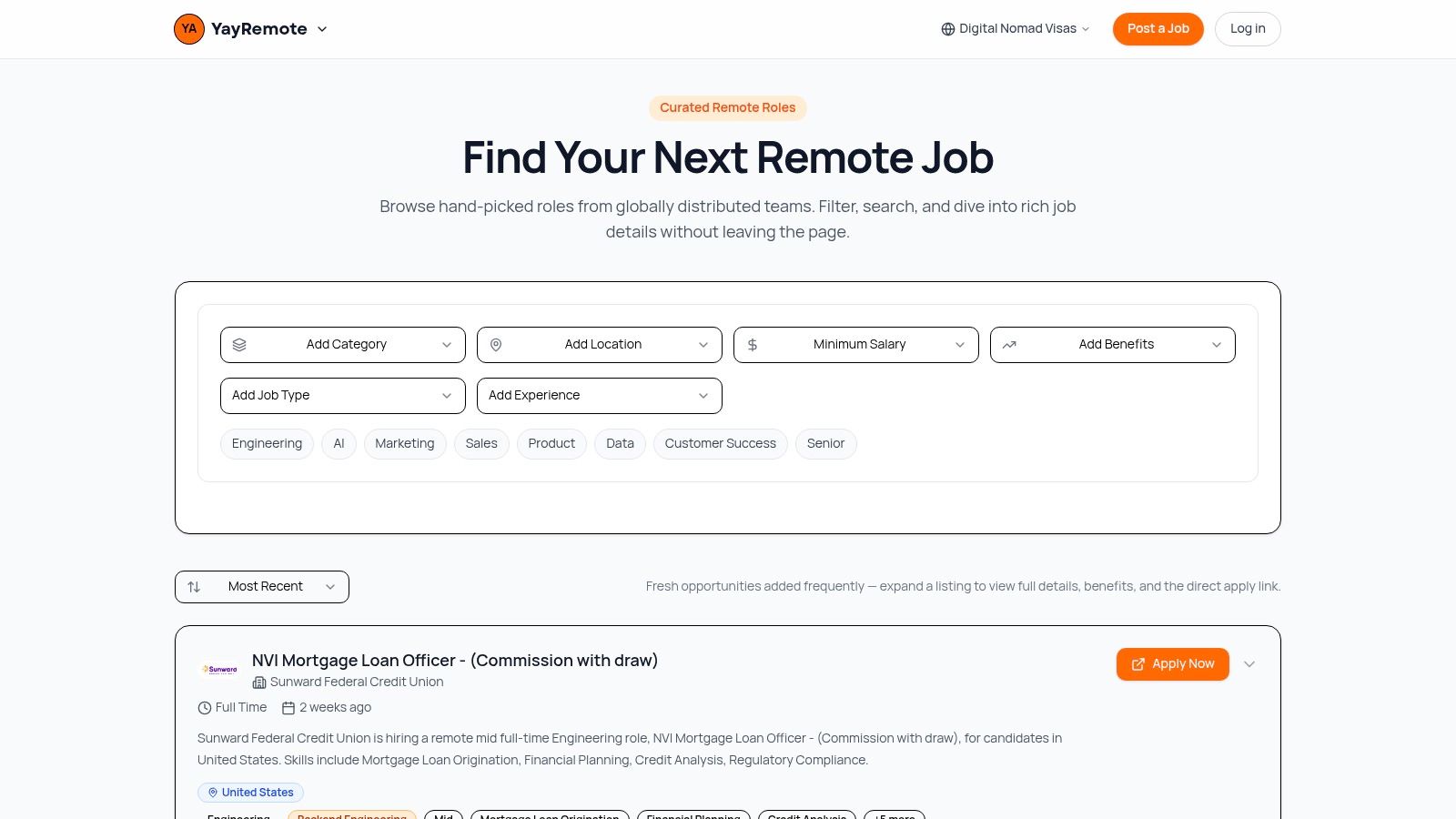
If you're ready to turn preparation into applications, YayRemote is a practical place to start. You can browse hand-picked remote roles, filter by experience and job type, and use tools like the ATS Resume Checker and Skills Analyzer to tighten your application before you apply.