Remote DevOps Engineer: Your 2026 Ultimate Guide
Become a remote DevOps engineer in 2026. Our guide covers key skills, salary trends, CI/CD workflows, and how to find vetted remote jobs on YayRemote.
You're probably in one of two situations right now. You already work in DevOps and you're tired of being judged by office visibility instead of delivery, or you're in cloud, infra, or SRE-adjacent work and trying to figure out whether a fully remote DevOps role is still the right move in 2026.
That tension is real. Remote work sounds simple from the outside, but a remote DevOps engineer doesn't just do the same job from a different chair. The remote context changes the work itself. It changes how releases are coordinated, how incidents are handed off, how documentation is written, and even how you should search for jobs. It also changes which teams are good fits and which teams will burn you out fast.
The good news is that this role maps well to distributed work when the company is built for it. DevOps already lives in cloud consoles, pull requests, CI pipelines, runbooks, dashboards, and ticket queues. The best remote teams lean into that reality instead of pretending hallway conversations are still the operating model.
The Dawn of the Truly Global DevOps Role
A lot of engineers first start looking for remote DevOps work after hitting the same wall. They've automated half the company's delivery pipeline, migrated workloads to cloud infrastructure, and tightened deployment hygiene, yet they still spend hours a week commuting so they can sit in meetings that should've been docs or pull request comments.
That frustration usually points to something bigger. The role itself has changed. DevOps used to be tightly associated with office-bound ops teams and physical infrastructure. Now the center of gravity is cloud-native systems, infrastructure as code, managed services, and release automation. The work already happens in distributed systems. Remote work is often the more natural operating mode.
That's also why the strongest remote teams don't just hire for tools. They hire for written clarity, calm incident handling, and the ability to move work forward without waiting for synchronous approval on every small decision. If you want a useful perspective on how engineering maturity and culture affect these environments, ARPHost's insights into DevOps leadership are worth reading.
The shift to a remote DevOps engineer role isn't only about flexibility. It's about joining teams that already operate through automation, documentation, and trust.
What a Remote DevOps Engineer Actually Does
The simplest description is this: a remote DevOps engineer owns the path between code and production, then keeps production healthy after the release.
That sounds broad because it is. On a strong team, you're part release engineer, part platform enabler, part infrastructure operator, and part reliability partner to developers. You aren't just “managing servers.” You're building and maintaining the operating system for software delivery in a distributed company.

A useful way to think about the role is as the logistics layer for engineering. Developers create change. Product wants that change live. Customers expect reliability. Security wants controls. Leadership wants predictable delivery. The remote DevOps engineer makes that flow work without constant manual coordination.
One reason this role fits remote work so well is that the market already treats it that way. In one 2025 analysis, 77.1% of DevOps roles offered some form of remote work, with 44.8% listed as fully remote, which signals that many employers now expect DevOps teams to operate through async collaboration and distributed systems design (remote DevOps job analysis).
The three parts of the job that matter most
Most remote DevOps work falls into three overlapping lanes.
| Focus area | What you actually do | What good looks like |
|---|---|---|
| Developer enablement | Build CI workflows, improve feedback loops, standardize environments | Developers ship without waiting on ops tickets |
| Release ownership | Control deployment paths, rollback safety, staged rollout patterns | Releases are boring in the best way |
| Production reliability | Monitor systems, tune alerts, support incident response | Teams detect and fix issues fast without chaos |
If a job description focuses only on tools and ignores those three lanes, be careful. That usually means the company wants a catch-all infrastructure person, not a mature DevOps hire.
How the day differs from office-based DevOps
In-office teams often compensate for weak systems with quick conversations. Someone walks over to clarify a deployment step. Someone else remembers where a Terraform variable lives. A release happens because the right people are online at the same time.
Remote work punishes that style.
A remote DevOps engineer has to turn tribal knowledge into visible process. That means:
- Pipelines must be explicit: Build, test, deploy, approval, rollback, and post-deploy verification can't live in someone's head.
- Runbooks must be usable: If an alert fires at an awkward hour for half the team, the responder needs context without chasing people.
- Ownership must be clear: Ambiguous handoffs create downtime and resentment.
A remote team can survive imperfect tooling for a while. It can't survive hidden process.
The technical definition of the role reflects that. Remote DevOps work centers on ownership of the CI/CD control plane, including release pipelines, source control flow, phased deployment, and production monitoring. Market listings consistently tie that work to tools like Jenkins or Azure CI, Git, Docker, Kubernetes, and AWS, GCP, or Azure, which is why process discipline matters more than physical location (remote DevOps tooling expectations).
Later in the day, the job usually shifts from building systems to reducing friction in them. You might review a pull request that changes Kubernetes manifests, tune a noisy Grafana alert, document a safer rollback step, or help a developer understand why a pipeline failed only in staging. Good remote DevOps work often looks quiet from the outside. That's because the chaos got engineered out earlier.
A practical primer on the role is helpful before going deeper:
The Essential Remote DevOps Skill Stack
There's a tendency to over-focus on the stack and under-focus on the operating habits. You need both. A remote DevOps engineer who knows Kubernetes but writes poor handoff notes will slow the team down. A great communicator without real infrastructure depth won't last long either.
The strongest candidates combine technical range with remote execution discipline.
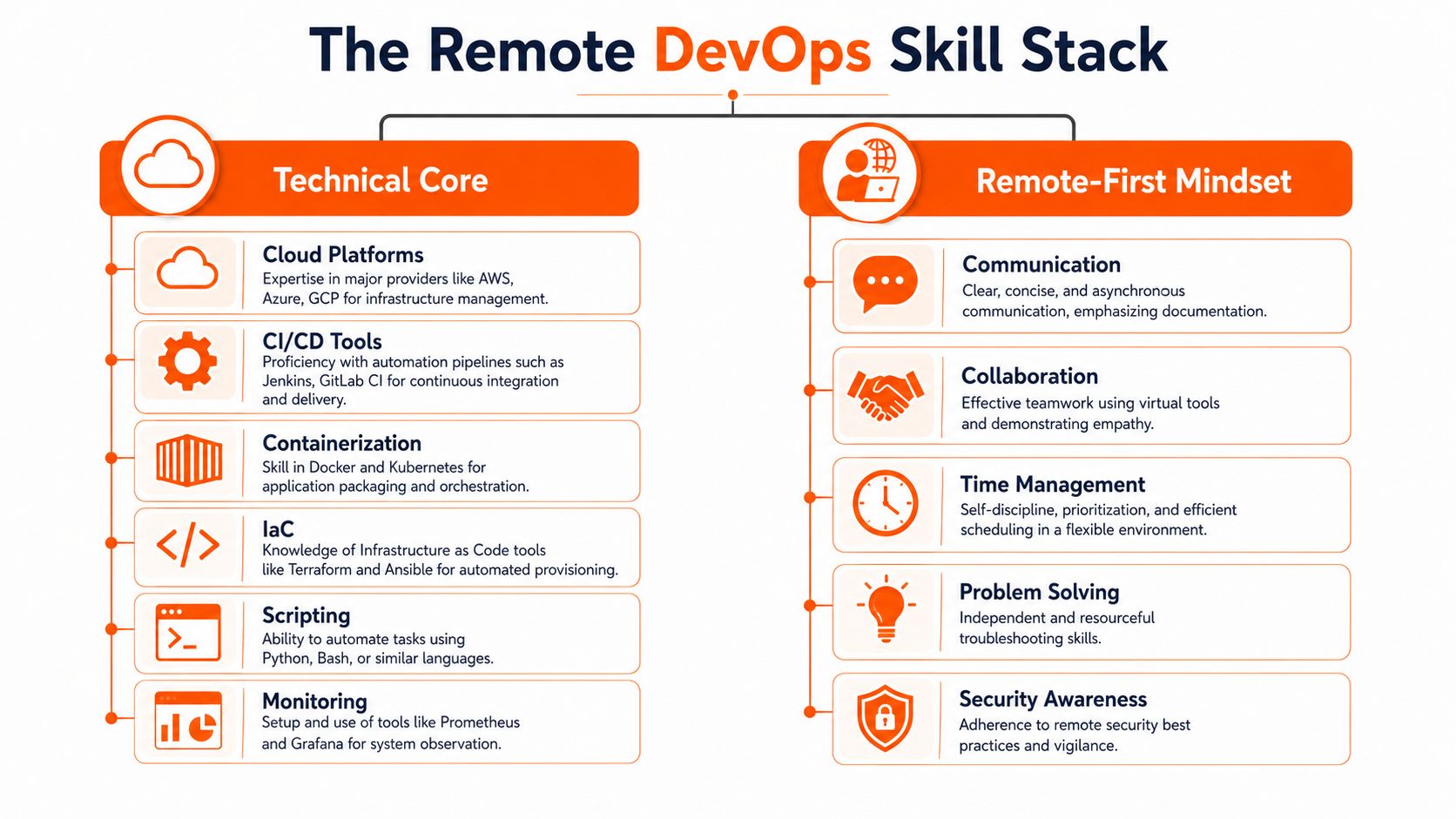
The technical core
You don't need every tool in every listing. You do need to understand the categories well enough to adapt.
- Cloud platforms: AWS, Azure, and GCP are the common anchors. Hiring teams want engineers who can reason about networking, IAM, compute, storage, and managed services, not just click through consoles.
- Containers and orchestration: Docker and Kubernetes remain central because they standardize how applications run across environments.
- Infrastructure as code: Terraform is still the most common expectation in these roles. You should be comfortable reading modules, managing state workflows safely, and reviewing infra changes like application code.
- CI/CD systems: Jenkins, GitHub Actions, GitLab CI, and Azure-native tooling all show up. What matters is understanding pipeline design, dependency flow, artifact handling, and release safeguards.
- Scripting: Python and Bash are still practical currencies. They help you glue systems together, automate repetitive work, and debug problems quickly.
- Observability: Metrics, logs, traces, alert routing, and dashboard design matter because production visibility is part of the job, not a side task.
The remote-first mindset
Many mid-level engineers struggle when moving remote. Their technical work is fine, but their working style still assumes someone will fill in the gaps.
Here's what changes in a distributed environment:
Documentation becomes part of the deliverable
If you build a deployment workflow and nobody else can safely operate it, the work isn't done.
Good remote DevOps documentation includes decision records, rollback notes, assumptions, failure modes, and ownership details. It doesn't need to be elegant. It does need to be usable under pressure.
Practical rule: Write docs for the tired engineer who gets paged later, not for the engineer who built the system this morning.
Async communication becomes an engineering skill
A vague Slack message creates more latency than a detailed ticket comment. Strong remote engineers learn to package context cleanly.
Use this pattern often:
- State the issue clearly
- Add the affected system or environment
- Show what changed
- List what you already checked
- Ask for the exact input you need
That's better than “pipeline broken, anyone know why?”
Autonomy matters, but silent autonomy doesn't
Remote teams need people who can move independently. They also need visibility. If you disappear for six hours and return with a fix, that may be fine once. As a habit, it creates anxiety and duplicate work.
A good remote DevOps engineer leaves a trail. Ticket updates. Pull request notes. Incident timeline entries. Short status posts. Not because management wants theater, but because distributed teams need shared state.
What hiring managers usually notice first
Many résumés list the right tools. Fewer show proof of operational maturity.
A hiring manager usually notices these signals quickly:
| Strong signal | Weak signal |
|---|---|
| Clear ownership of pipeline or infra changes | Generic tool list with no context |
| Public GitHub repos with README files and repeatable setup | Bare repos with no explanation |
| Examples of cross-team work with developers or security | Resume bullets that sound isolated |
| Evidence of documentation and incident follow-through | Heavy focus on “built” with no maintenance story |
If you're moving into remote work for the first time, improve the second column before you apply broadly. That shift alone changes how your experience reads.
Core Toolchains and Workflows for Distributed Teams
A remote DevOps team feels the quality of its workflow every day. If a release needs three people online at once, or an infrastructure change depends on someone remembering a manual step, the system will stall as soon as time zones spread out.
That is why remote DevOps work shifts from tool familiarity to workflow design. The job is often centered on the CI/CD control plane, source control flow, environment promotion, policy checks, and release safety. The tools matter, but the bigger question is whether the path from commit to production can keep moving while people hand work off across regions.
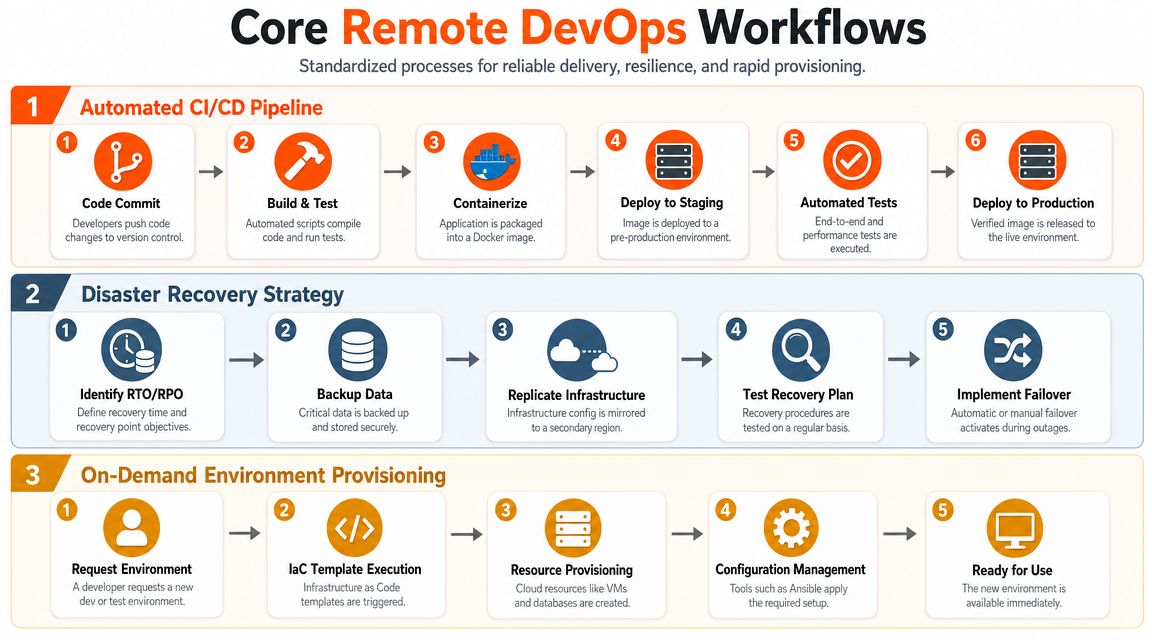
A code change moving across time zones
A developer opens a pull request at the end of their day. Tests start immediately. A reviewer in another region picks it up later, leaves comments, and approves. The merge triggers image builds, security scans, and a deployment to staging. Integration tests finish overnight. If the checks are clean, the next engineer online can promote the release through a controlled production path.
That workflow works remotely because the system carries context forward. Nobody needs a private Slack thread to explain what happened.
The handoff points matter more than brand names. Git preserves intent and history. CI verifies the change. Container tooling packages a repeatable artifact. Kubernetes, a platform team abstraction, or a managed deployment system handles rollout. Monitoring and logs answer the question every remote team asks after deploys: did this change improve the system, break it, or do nothing at all?
This is also where the market shift from classic DevOps titles to platform and SRE roles shows up in day-to-day work. Companies may post for a Platform Engineer or Site Reliability Engineer, but the remote workflow expectations are often the same. Build delivery paths that are observable, reproducible, and safe without constant live coordination.
Infrastructure changes need the same discipline as application changes
Teams still get this wrong. Application delivery is automated, but infrastructure changes happen through console clicks, one-off scripts, or tribal knowledge. In a distributed team, that creates slow reviews, weak audit trails, and painful incident recovery.
A solid infrastructure workflow usually includes:
- Change proposed in code: Terraform or another IaC tool defines the intended state.
- Review before apply: Reviewers check blast radius, naming, identity access, networking assumptions, and rollback options.
- Plan output attached to the change: Reviewers should see what will be created, changed, or destroyed.
- Apply gated by environment rules: Production changes should follow approval and execution rules, not whoever happens to be awake.
- Verification captured after apply: The engineer confirms expected state, notes drift or surprises, and closes the loop in the ticket or pull request.
Trade-offs matter here. Terraform is strong for provisioning and managing stateful infrastructure. Ansible is usually a better fit for configuration tasks after the resources exist. Teams blur that line all the time, then wonder why their automation is hard to reason about. The AuditYour.App blog gives a clear comparison of where each tool fits.
Monitoring and incident response have to survive async work
Remote teams do not get fast incident response from physical proximity. They get it from observability, ownership clarity, and runbooks that reduce guesswork.
Good dashboards answer concrete questions fast:
| Question during an incident | System should show |
|---|---|
| Did the release cause this? | Deployment markers and recent changes |
| Is the problem isolated or broad? | Service and dependency health views |
| Is this user-facing? | Error rates, saturation, latency, and logs |
| Who owns the next action? | Clear runbook and escalation path |
If the first responder has to reconstruct ownership from chat history, the workflow is incomplete.
Alerts also need discipline. A noisy pager setup is bad in any team, but it is worse in a remote one because it trains engineers to ignore weak signals and leaves the next time zone inheriting confusion. Good alerting points to an action, links to the service owner, and includes enough context to decide whether to roll back, mitigate, or escalate.
The collaboration layer matters too. Incident channels, ticketing hygiene, pull request conventions, and handoff notes shape how well these systems work under pressure. This guide to remote team collaboration tools is useful for evaluating the non-cloud part of the stack that keeps releases and incidents moving across distributed teams.
For job seekers, this is a practical filter. When you review remote roles on YayRemote, look past the headline title. A posting labeled DevOps, Platform, or SRE is worth serious attention if it describes mature delivery workflows, infrastructure as code, documented incident practices, and async-friendly ownership. Those details tell you far more about the actual job than the title does.
Salary Benchmarks and Global Market Trends
Compensation is one of the reasons engineers target remote DevOps roles in the first place, and the salary picture is still strong. A 2026 salary analysis reported an average base salary of $131,556 for DevOps engineers, with total annual compensation reaching about $150,355 when additional compensation is included (2026 DevOps salary benchmarks).
Treat those numbers as benchmarks, not promises. They're useful for framing your market value, especially if you're interviewing with US-based companies or firms that peg compensation to US engineering bands. They don't automatically tell you what a company will pay in your region, what it expects for overlap hours, or how it prices seniority.
What the pay is really buying
Companies don't pay well for the title alone. They pay for the advantage.
A skilled remote DevOps engineer improves release reliability, shortens the path from merge to production, reduces operator toil, and lowers the odds that every deploy becomes a cross-team incident. Their contribution is expensive to replace once a team reaches scale.
In interviews, frame your experience around that impact. “Built CI/CD pipelines” is fine. “Owned release workflows and improved deployment safety across staging and production” is better because it sounds like business-critical work.
Why title strategy matters now
The bigger market question isn't only salary. It's title drift.
Remote job searches have gotten trickier because the market has split the old DevOps bundle into narrower categories. Some companies now hire Platform Engineers to build internal tooling and paved roads. Others hire Site Reliability Engineers to focus on reliability, incident response, and service health. Cloud Engineers may own infrastructure patterns without using the DevOps title at all.
That means you need to think in capabilities, not labels.
| If your strength is... | Titles worth targeting |
|---|---|
| CI/CD, developer workflows, platform enablement | Platform Engineer, DevOps Engineer |
| Reliability, observability, incident handling | SRE, Production Engineer |
| Cloud infra, provisioning, networking, IAM | Cloud Engineer, Infrastructure Engineer |
A lot of candidates lose good opportunities because they search only for “DevOps Engineer.” If your stack includes Kubernetes, Terraform, automation, and production operations, your actual market is wider than the title suggests.
How to read a role before you apply
Salary is one filter. The operating model matters just as much.
Look for these clues:
- Healthy signal: The posting describes ownership boundaries, release practices, and collaboration with developers.
- Risk signal: The company expects one person to cover cloud architecture, compliance, support, security, platform, and on-call without clear support.
- Healthy signal: It explains remote expectations, overlap windows, and written communication norms.
- Risk signal: It says “remote” but describes a team that still depends on constant real-time access.
For a broader view of how engineering pay compares across technical roles, this breakdown of technology job salaries is a useful reference point when you're deciding whether to stay broad or move toward a more specialized platform or SRE path.
Crafting Your Winning Remote DevOps Application
A generic DevOps résumé underperforms in remote hiring because it hides the two things distributed teams care about most. Can you operate independently, and can you make your work legible to other people?
Plenty of applicants mention Kubernetes, Terraform, Docker, and cloud providers. That doesn't separate you. What separates you is evidence that you can own systems in a remote environment without creating confusion.
Recent market commentary also makes the search strategy more important. The DevOps role is fragmenting into platform engineering and SRE, while demand stays concentrated around Kubernetes, Terraform, Python, and CI/CD. That means a strong 2026 search often depends less on chasing the exact title and more on positioning yourself around the capabilities companies still need (remote DevOps title shift and capability demand).
Rewrite your résumé around ownership
Most mid-level candidates write task lists. Remote-first companies want outcomes and scope.
Compare these approaches:
| Weak bullet | Better bullet |
|---|---|
| Managed Jenkins pipelines | Owned CI pipeline reliability for staging and production releases |
| Worked with AWS and Kubernetes | Supported application delivery on AWS and Kubernetes across multiple environments |
| Used Terraform for infrastructure | Reviewed and applied Terraform changes through pull request workflow with documented rollback steps |
You'll notice what changed. The stronger bullets imply process, safety, and collaboration. That reads as remote-ready.
Your GitHub matters more than people admit
You don't need a famous open source profile. You do need a visible body of work that proves you can think clearly.
Good repo examples for this field include:
- IaC samples: Terraform modules with clean variable structure and a README that explains usage and assumptions
- Pipeline examples: GitHub Actions, Jenkinsfiles, or GitLab CI templates that show real flow, not toy syntax
- Kubernetes manifests: Practical deployment patterns, config handling, and environment separation
- Automation scripts: Python or Bash that solves a real ops problem and includes documentation
Remote hiring managers often use your repository hygiene as a proxy for how you'll behave in shared infrastructure.
A well-written README is not fluff. It shows you can hand work off cleanly.
Tailor for ATS without sounding machine-generated
Applicant tracking systems still matter. The fix isn't keyword stuffing. It's controlled alignment.
Take the job description and reflect its language where it matches your real experience. If the role emphasizes Kubernetes, Terraform, CI/CD, observability, and AWS, those terms should appear naturally in your summary, skills, and experience sections.
For a tactical guide on structuring your resume so it survives automated screening, this resource on how to beat ATS systems is worth using before you send applications.
Prepare for remote interviews differently
Remote interviews test more than technical depth.
Expect some variation of these questions:
- How do you debug a failing deploy when the developer is offline?
- How do you document an infra change so another engineer can safely review it?
- What do you do when alerts are noisy but not actionable?
- How do you handle disagreement in a pull request on production-affecting changes?
Your answers should show judgment, not just tool familiarity.
A strong answer usually includes context gathering, visible communication, small blast radius, rollback planning, and written follow-up. If your answer relies too much on “I'd jump on a quick call,” that's a sign you're still optimizing for office habits.
How to Find and Vet Roles on YayRemote
A remote DevOps job search gets messy fast if you treat every listing the same. The fastest way to waste time is to apply broadly before you've filtered for stack fit, overlap expectations, and role shape.
The better approach is to narrow in stages.
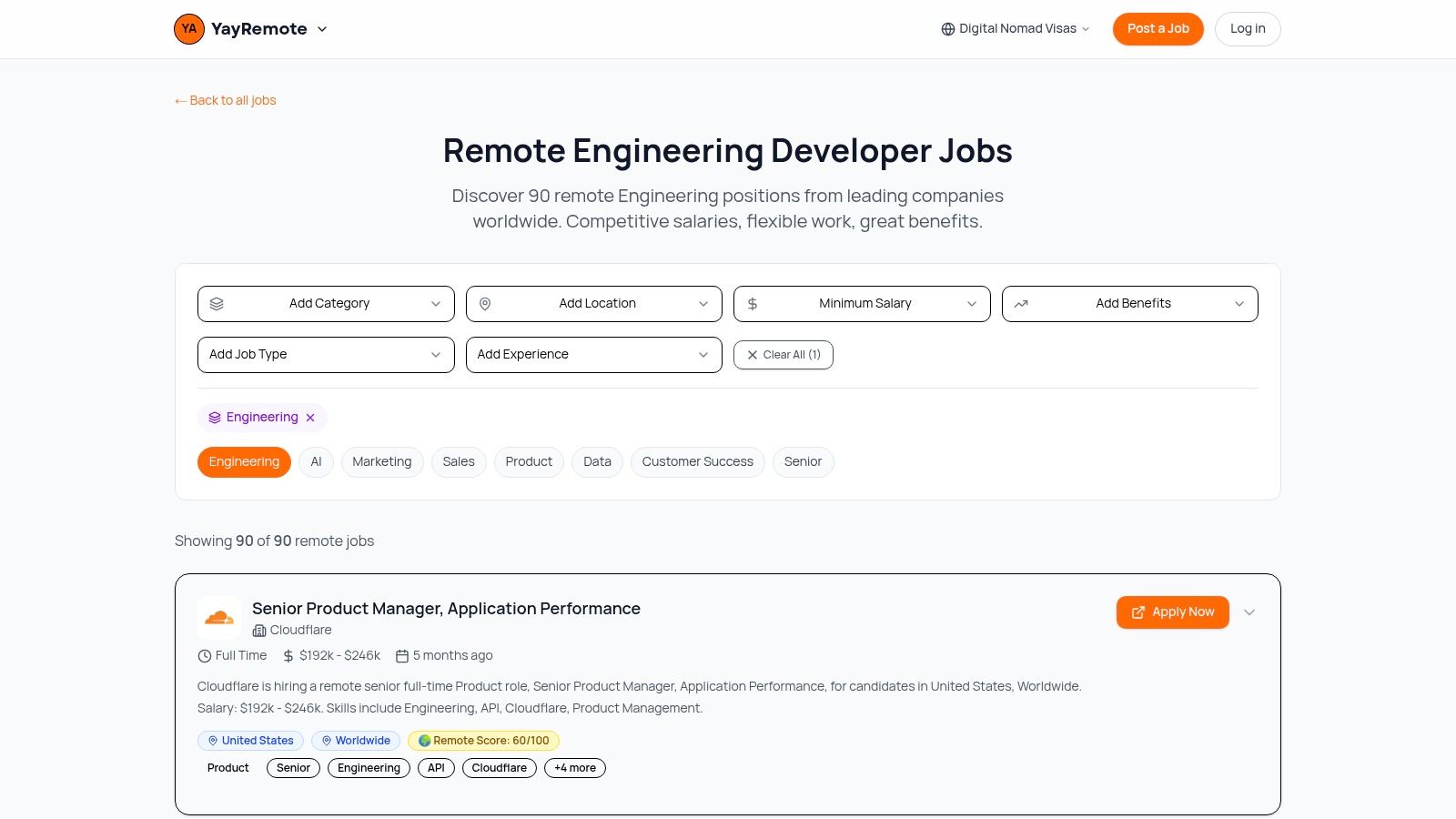
Start broad, then cut hard
Begin with engineering listings and filter for the technical spine you want to work on. That usually means some combination of cloud infrastructure, Kubernetes, CI/CD, Terraform, platform, or SRE-related terms.
Then cut aggressively.
Remove roles that look like support-heavy operations work if you want platform engineering. Remove vague “DevOps” jobs that read like a catch-all admin role. Remove jobs with no indication of async norms or timezone expectations. Good remote roles explain how the team operates.
Use timezone fit as a real filter
A lot of engineers ignore this until late in the process, then regret it after joining.
You need to know whether the team expects full-day overlap, a few core collaboration hours, or mostly async work. That affects your schedule, energy, and long-term sustainability more than a perk list does. A timezone mismatch can make a good technical role feel miserable.
Use the platform's Time Zone Overlap feature to sanity-check whether your working day will fit the company's collaboration window before you invest heavily in interviews.
Compare your profile against the role, not your self-image
Most applicants either undersell themselves or overestimate fit. The fastest correction is side-by-side comparison.
Use the Skills Analyzer against the job description and your current résumé. You're looking for three things:
| What to check | Why it matters |
|---|---|
| Missing technical keywords | Helps you spot real gaps or simple wording problems |
| Missing workflow language | Shows whether your résumé reflects ownership, not just tools |
| Missing remote signals | Reveals whether you've shown async communication and documentation habits |
This isn't about gaming applications. It's about making the match legible.
Vet the role before you commit
Before you apply, answer these questions from the listing and company materials if possible:
- What will I own in the first few months?
- Is this role closer to DevOps, platform, SRE, or cloud operations?
- Does the company describe on-call clearly?
- Are the tools current enough to support good remote practice?
- Does the listing mention documentation, collaboration, or release process?
If you can't tell what success looks like, the team may not know either.
The best remote DevOps roles are rarely the loudest ones. They're the roles where expectations, workflows, and collaboration patterns are already visible before you join.
If you're ready to search with more precision, YayRemote is a practical place to start. You can filter remote engineering roles, compare job requirements against your current skills, and check timezone overlap before you commit to an interview loop. That makes it easier to find remote DevOps, platform, and SRE roles that fit how you want to work.