Job Description for Human Resources Administrator 2026
Job description for human resources administrator - Find the perfect job description for human resources administrator with our 2026 ATS-friendly template.
You’re probably here because the version sitting in your ATS isn’t working.
It’s either too generic, so strong candidates skim it and move on, or it’s trying to cover every HR task under the sun and ends up attracting the wrong profile. In remote-first companies, that problem gets worse. A standard HR Administrator posting usually assumes one office, one payroll rhythm, one legal environment, and a lot of in-person handoffs. That’s not how distributed teams operate.
A good job description for human resources administrator roles needs to do two jobs at once. It has to define the operational core of the role clearly, and it has to signal whether the person can handle digital workflows, confidentiality, and coordination across locations without constant supervision. When that balance is off, hiring managers feel the pain quickly. Onboarding slips, records drift, payroll inputs get messy, and HR becomes reactive.
The template below is the one I’d use when hiring for a remote-first team. It’s practical, specific, and built for the way modern HR administration works.
The Complete HR Administrator Job Description Template
If you need something you can paste into your hiring system today, use this version and customize the bracketed fields. Keep the structure intact. It’s clear for candidates, easy for hiring managers to align on, and simple to adapt for different seniority levels.
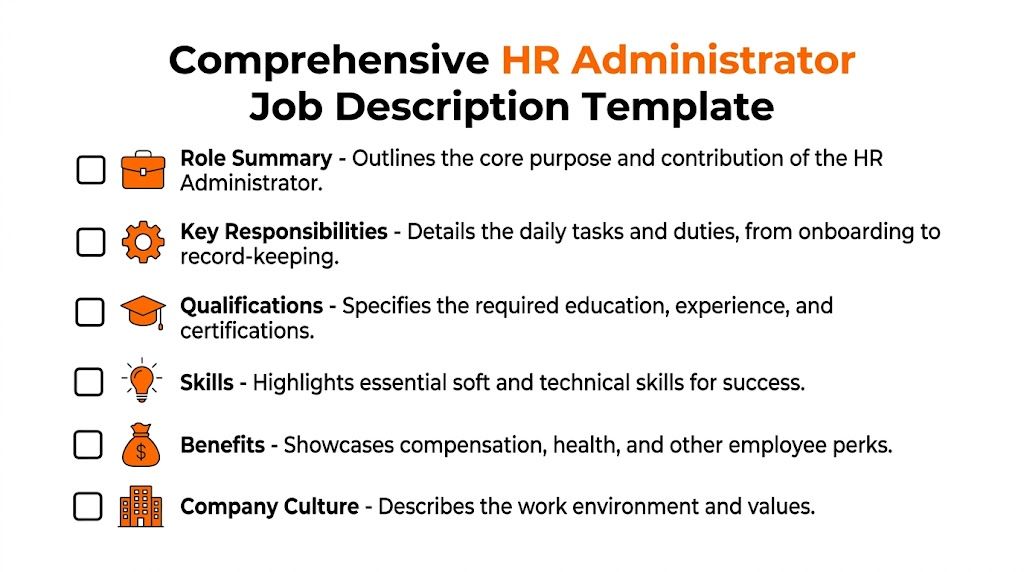
Copy and paste template
Job title
Human Resources Administrator
Location
[Remote / Hybrid / In-office]
[Country, region, or time zone expectations]
Reports to
[Head of People / HR Manager / People Operations Lead]
Role summary
We’re hiring a Human Resources Administrator to support accurate, timely, and confidential HR operations across the employee lifecycle. This role will maintain employee records, coordinate onboarding and offboarding, support payroll and benefits administration, manage HR documentation, and help keep internal processes compliant and well organized. The right candidate is detail-oriented, systems-minded, responsive, and comfortable working in a digital-first environment.
Key responsibilities
- Maintain employee records in our HRIS, including new hire data, job changes, compensation updates, leave records, and departures
- Coordinate onboarding and offboarding tasks, documentation, and workflow handoffs
- Prepare HR letters, contracts, templates, and routine people documentation
- Support payroll inputs and resolve data discrepancies with internal stakeholders or external providers
- Track leave, attendance, and employment status changes accurately
- Schedule interviews and support recruitment administration as needed
- Organize and maintain digital personnel files with strong confidentiality
- Generate recurring HR reports for headcount, onboarding progress, turnover, and related operational needs
- Support compliance-related recordkeeping, audits, and policy administration
- Respond to employee questions on HR processes, documentation, and standard policies, escalating when needed
Required qualifications
- Experience in HR administration, people operations, office administration, or another detail-heavy coordination role
- Hands-on experience using an HRIS or related system
- Strong written communication and organizational skills
- Ability to handle sensitive information with discretion
- Comfort working with spreadsheets, documents, and recurring workflows
- Ability to manage deadlines without sacrificing accuracy
Preferred qualifications
- Experience supporting remote or distributed teams
- Familiarity with payroll coordination, benefits administration, or compliance documentation
- Exposure to platforms such as BambooHR, Workday, or similar systems
- Knowledge of documentation standards and process checklists
Skills
- HRIS data accuracy
- Record keeping
- Confidentiality
- Process discipline
- Cross-functional coordination
- Written communication
- Time management
- Problem escalation judgment
Success in this role looks like
- Employee data stays current and reliable
- Onboarding and offboarding run on time
- HR documents are accurate and easy to retrieve
- Payroll inputs are submitted cleanly
- Employees get clear answers or fast escalation paths
- HR workflows are documented and repeatable
Why join us [Add your mission, team setup, values, and what makes the role meaningful.]
Compensation and benefits [Add salary range, bonus approach if applicable, benefits, flexibility, and remote support.]
Application process [Add stages, expected timelines, work sample if any, and accessibility statement.]
A quick note on legal language. If your team needs a stronger compliance review before posting, use a practical framework like How to Write a Compliant Job Description to tighten phrasing around duties, requirements, and protected considerations.
Practical rule: If a hiring manager can’t tell the difference between this role and an HR Generalist after reading the posting, the job description still isn’t specific enough.
What to customize first
Don’t start by rewriting every bullet. Change these parts first:
- Scope of geography. State whether the role supports one country or multiple jurisdictions.
- Work pattern. Clarify remote, hybrid, or office expectations, including time zone overlap if needed.
- Systems environment. Name the tools the person will touch.
- Decision boundary. Show what they own directly and what they escalate.
That last point matters more than is generally recognized. Great HR Administrators don’t need a vague promise of “many responsibilities.” They need a precise operating lane.
Understanding the Modern HR Administrator Role
The HR Administrator role has been part of HR operations since the mid-20th century. What changed is the center of gravity. Once HR teams moved from paper files to digital systems, especially with broader HRIS adoption in the 1990s, the role became much more than clerical support. It became a data, workflow, and compliance role.

In practice, this is the person who keeps the employee lifecycle coherent. They update job details, attendance records, onboarding status, payroll inputs, and core employee changes. They also support recruitment administration, reporting, and confidential file management. When this role is strong, the rest of HR can move faster with fewer avoidable errors.
That operational backbone is one reason the role remains in demand. The Bureau of Labor Statistics projects employment of human resources specialists, including HR Administrators, to grow 6 percent from 2024 to 2034, with about 81,800 openings projected each year according to this HR Administrator outlook summary.
Why the role matters more in distributed teams
Remote work didn’t invent HR administration. It exposed every weak process inside it.
A paper-heavy, verbally coordinated, office-dependent HR function can limp along when everyone sits in one location. It breaks down fast when hires join from different places, documents move digitally, and no one can rely on walking over to someone’s desk to fix an issue. That’s why the modern HR Administrator often acts as the owner of consistency.
A short explainer is useful if you’re hiring managers who still see this as a support-only role:
The best HR Administrators don’t just process tasks. They prevent small operational mistakes from becoming employee trust problems.
Defining Key Responsibilities and Duties
Most weak postings fail in the same place. They list responsibilities that are technically true but too broad to be useful. “Assist with onboarding” tells a candidate almost nothing. “Maintain HR records” is accurate, but it doesn’t show scope, systems, or ownership.
Write duties around workflows
A strong responsibilities section should mirror real work. Start with the recurring workflows this person will handle, then write each bullet around a visible outcome.
Here’s the difference.
| Weak phrasing | Stronger phrasing |
|---|---|
| Assist with onboarding | Coordinate onboarding documentation, HRIS setup, and handoffs needed for a smooth new hire start |
| Maintain employee records | Maintain accurate employee records in the HRIS, including job changes, compensation updates, leave entries, and departures |
| Help with payroll | Prepare and validate payroll inputs, flag discrepancies, and follow documented payroll update procedures |
| Support compliance | Maintain required documentation, organize digital personnel files, and support recurring HR audits |
That wording gives candidates something concrete to assess themselves against.
Name the systems and standards
An HR Administrator should be comfortable operating inside an HRIS. That includes maintaining personal data, employment history, compensation details, benefits enrollment, and leave tracking. AIHR also notes that using standard operating procedures and checklists for recurring work like payroll updates can reduce errors by 30 to 50 percent, and that regular audits help maintain compliance with standards such as GDPR in this HR administration guide.
Use that reality in the job description. Don’t just ask for “attention to detail.” Ask for comfort with documented workflows, system accuracy, and recurring audits.
A practical responsibility mix
Typically, this section should cover five areas:
- Employee data administration. HRIS updates, status changes, leave records, reporting fields.
- Lifecycle coordination. Onboarding, offboarding, transfers, documentation routing.
- Payroll and benefits support. Input preparation, follow-ups, issue tracking.
- Recruitment administration. Interview scheduling, candidate records, hiring documentation.
- Compliance and file control. Digital records, audit readiness, confidentiality.
What doesn’t work is overloading the role with employee relations investigations, strategic workforce planning, and policy ownership if the role is administrative. That creates confusion in the hiring funnel and disappointment after hire.
Crafting Clear Qualification Requirements
Qualification sections often narrow the candidate pool for the wrong reasons. Teams ask for an impossible mix of deep HR experience, advanced systems fluency, broad legal knowledge, and strategic judgment, then wonder why good operators don’t apply.
Separate must-haves from trainable skills
Use required qualifications for skills a person needs on day one. Use preferred qualifications for tools, certifications, or context that would shorten ramp time but aren’t essential.
A clean split looks like this:
Required
- Experience in an administrative environment with high accuracy expectations
- Comfort using digital systems and spreadsheets
- Ability to handle confidential data carefully
- Written communication strong enough for employee-facing documentation
Preferred
- Prior HR or people operations experience
- Experience in remote or distributed teams
- Exposure to BambooHR, Workday, or similar systems
- Knowledge of payroll support or benefits workflows
That structure widens your pool without lowering the bar.
Don’t write a unicorn profile
The role succeeds on reliability, organization, and judgment inside defined processes. If you overload qualifications with every possible HR competency, you’ll attract either overqualified candidates who don’t want the work, or underqualified ones who apply because the posting reads like a catchall.
Hire for evidence of precision, discretion, and process ownership. Train for your exact tools and internal workflow quirks.
For remote-first teams, add one filter that matters more than it seems. Ask whether the candidate can work without constant synchronous support. The right person doesn’t need to know everything already. They do need to communicate clearly, follow documented processes, and close loops reliably.
Adding Remote-Specific Considerations
Most HR Administrator templates still assume a local office model. That’s the gap that causes the most hiring mistakes in distributed companies.
Standard descriptions usually mention record keeping, onboarding, and compliance. They rarely explain how those responsibilities change when the team works across countries, time zones, and digital-only systems. Yet that shift is exactly what determines whether someone thrives in the role. As noted in this overview of HR administrator role expectations, standard job descriptions often miss asynchronous workflows, multi-jurisdiction compliance, and digital-first documentation needs.

What to add for a distributed company
If your team is remote-first, your posting should say so in operational terms, not culture slogans.
Include responsibilities like these:
- Asynchronous coordination. Managing documentation, approvals, and status updates without relying on live meetings.
- Time zone-aware handoffs. Keeping onboarding and payroll inputs moving when stakeholders work in different regions.
- Digital-only document control. Maintaining complete, accessible, secure records without paper-based backups.
- Location-sensitive support. Handling benefits questions, local documentation differences, and region-specific process variations.
- Escalation discipline. Knowing when an issue is procedural and when it needs legal, finance, or senior HR review.
You should also define communication expectations. “Strong communicator” is weak. “Able to write clear process updates and close loops across time zones” is useful.
Remote language that attracts the right candidates
These lines tend to work better than generic remote phrasing:
You’ll support a distributed workforce by keeping HR processes clear, documented, and moving across time zones.
This role requires comfort with asynchronous work, digital documentation, and careful coordination across multiple stakeholders.
If you value formal HR grounding, it can help to note relevant development paths in the posting or interview process. For candidates exploring recognized HR credentials, SHRM Certification is a useful reference point. And if your remote operating model needs to be clearer before you hire, a strong remote work policy template will do more for hiring quality than any amount of vague culture copy.
Providing Salary and Benefits Guidance
Salary transparency changes the quality of conversations you get. Candidates can self-select faster, hiring managers spend less time on misaligned screens, and the role feels more credible from the first impression.
For a remote HR Administrator role, the main decision is pay philosophy. Some teams use location-based pay. Others use a location-agnostic range. Neither approach is automatically better. What matters is that your posting is internally consistent with how your company hires and compensates.
A simple salary framework
The table below is a formatting model you can use in your own posting. Replace the placeholders with your actual ranges.
Sample Salary Ranges for HR Administrator (USD, Annual)
| Experience Level | Tier 1 Market (e.g., SF, NYC, London) | Tier 2 Market (e.g., Austin, Berlin, Sydney) | Global/Location-Agnostic |
|---|---|---|---|
| Junior | [Insert range] | [Insert range] | [Insert range] |
| Mid | [Insert range] | [Insert range] | [Insert range] |
| Senior | [Insert range] | [Insert range] | [Insert range] |
What to include beyond salary
Benefits matter a lot in this role because HR candidates notice bad HR design immediately. Be specific.
- Work flexibility. State core hours, time zone overlap, and whether the role is fully remote or hybrid.
- Home office support. Mention equipment, setup support, or reimbursement policy if offered.
- Time off and leave. Give candidates a real sense of how the company handles rest and planned absence.
- Health and wellbeing. List actual coverage categories or allowances, not generic “great benefits.”
- Growth support. Mention training budgets, certifications, or structured development if they exist.
What doesn’t work is hiding compensation and trying to sell the role on mission alone. HR candidates read that as a warning sign, especially when the role itself is responsible for maintaining fairness and operational trust.
Example Postings for Different Contexts
The same template shouldn’t produce the same posting in every company. Here are two versions built from the same foundation, each tuned to a different environment.
Junior HR Administrator for a remote startup
A fast-growing software company usually needs range, adaptability, and comfort with changing processes. The risk here is hiring someone who needs a fully mature HR function to operate well.
Human Resources Administrator
Location: Remote, with overlap preferred across shared working hours
Reports to: People Operations Manager
We’re looking for a Junior HR Administrator to help us run clean, reliable people operations as we grow. You’ll support employee records, onboarding coordination, people documentation, and day-to-day HR administration in a digital-first environment. This role is a fit for someone who likes process, learns systems quickly, and stays calm when priorities shift.
Responsibilities
- Maintain employee data in the HRIS and update records for job changes, leave, and departures
- Coordinate onboarding checklists, document collection, and internal handoffs for new hires
- Support interview scheduling and candidate record organization
- Prepare routine HR documentation, including letters, templates, and internal forms
- Assist with payroll inputs and flag missing or inconsistent data
- Organize digital personnel files and keep documentation easy to retrieve
- Respond to employee questions on standard HR processes and route complex issues appropriately
Qualifications
- Experience in administration, operations, coordination, or HR support
- Strong written communication and organizational skills
- Comfort working in remote tools and digital workflows
- Ability to manage confidential information carefully
Preferred
- Exposure to HR systems such as BambooHR or Workday
- Experience supporting a distributed team
Why this version works
It keeps the bar on precision and learning ability, not years of specialization. That’s right for a startup where the hire will likely help shape the process as much as run it.
Senior HR Administrator for a multinational hybrid company
A larger organization usually needs deeper process discipline, stronger reporting capability, and comfort operating inside more formal controls.
Senior Human Resources Administrator
Location: Hybrid
Reports to: Regional HR Manager
We’re hiring a Senior HR Administrator to support accurate HR operations across a complex employee population. You’ll manage employee data integrity, compliance documentation, onboarding and offboarding execution, payroll administration support, and recurring HR reporting. This role requires strong judgment within defined procedures and a high standard of confidentiality.
Responsibilities
- Own accurate HRIS maintenance across employee records, employment changes, compensation updates, and leave administration
- Coordinate end-to-end onboarding and offboarding processes with internal stakeholders
- Support recurring payroll administration through validated data inputs and documented controls
- Maintain audit-ready personnel files and required HR documentation
- Produce standard operational reports for headcount, turnover, and onboarding progress
- Support policy administration and internal process adherence
- Mentor junior administrators on documentation standards and workflow discipline
- Escalate exceptions, anomalies, and compliance concerns appropriately
Qualifications
- Prior HR administration experience in a structured environment
- Strong HRIS proficiency and confidence with recurring reporting
- Excellent document control, accuracy, and confidentiality practices
- Ability to work across multiple stakeholders and deadlines
Preferred
- Experience supporting multiple jurisdictions or business units
- Familiarity with formal payroll, benefits, or compliance workflows
- HR certification or equivalent professional development
Why this version works
It signals scale, control, and consistency. It also introduces mentorship and escalation judgment without turning the role into an HR Generalist position.
Optimizing with ATS Keywords
ATS optimization isn’t about cramming keywords into a posting. It’s about using the language qualified candidates already search for, and the language their resumes are likely to contain.
A practical keyword set for an HR Administrator posting should cover systems, workflows, and competencies.
Keyword groups worth including
Core function terms
- Human Resources Administrator
- HR Administrator
- People Operations
- HR Operations
- Employee Records
- Onboarding
- Offboarding
- Payroll Support
- Benefits Administration
- Compliance Documentation
Systems and process terms
- HRIS
- BambooHR
- Workday
- Record Keeping
- Data Entry
- Documentation
- Audit Support
- SOPs
- Checklists
- Reporting
Skill terms
- Confidentiality
- Data Accuracy
- Cross-functional Coordination
- Time Management
- Written Communication
- Process Improvement
- Administrative Support
How to use them naturally
Don’t create a keyword dump at the bottom of the post. Place terms where they belong.
- Put title keywords in the job title and opening paragraph.
- Use workflow keywords inside responsibilities.
- Put tool keywords in qualifications only if those tools are real requirements.
- Mirror the phrasing candidates will likely optimize for when they read guides on how to beat ATS.
A simple test helps. Read the posting and ask whether each keyword improves clarity. If it doesn’t, cut it.
Sample Interview Questions for HR Administrators
Once the posting is live, the next mistake teams make is interviewing too broadly. They ask generic culture questions, then act surprised when the hire struggles with the actual work.
Interview questions should test whether the person can execute consistently, communicate clearly, and protect confidentiality under pressure.
Behavioral questions
Use these to assess past evidence of the habits the role needs.
- Tell me about a time you caught an error in a record or workflow before it caused a bigger problem.
- Describe a process you had to follow repeatedly. How did you keep accuracy high?
- Walk me through a situation where you handled confidential information carefully.
- Tell me about a time you had competing deadlines from different stakeholders. How did you prioritize?
Situational questions
These show how a candidate thinks inside administrative boundaries.
- An employee asks for information you aren’t authorized to share. What do you do?
- A manager wants a change made in the system immediately, but the required documentation is missing. How would you handle it?
- You notice a mismatch between a payroll input and the underlying HR record. What happens next?
- A new hire is starting soon, but several onboarding steps are incomplete. How would you manage the risk?
Remote-specific questions
For distributed teams, these are essential.
- How do you keep work moving when the people you depend on are in different time zones?
- What does good asynchronous communication look like in an HR operations role?
- How do you organize digital documentation so other approved stakeholders can find what they need without creating confusion?
- When do you switch from written updates to live escalation?
Ask for examples, not opinions. “I’m detail-oriented” tells you nothing. A real story about catching a bad status change tells you a lot.
Posting Your Job on YayRemote Effectively
A strong posting still needs smart packaging. Remote candidates scan quickly, and they’re comparing your role against other distributed employers who may be clearer about expectations.
Lead with the operating reality of the role. Put remote setup, geography, time zone expectations, and salary transparency near the top. Don’t bury them. An HR Administrator candidate wants to know how the team works before they invest in the application.
Then tighten the listing around the details that matter most in remote hiring:
- Make location logic obvious. If the role is global, say so. If it’s limited to specific countries, say that too.
- Show the work environment clearly. State whether the role is fully remote or hybrid, and describe any overlap expectations.
- List benefits concretely. Candidates compare on substance, not adjectives.
- Use your company profile well. The posting should match what candidates will see elsewhere about your team and culture.
- Align with your broader remote hiring process. If you need a reset, this guide on how to hire remote employees is a practical place to start.
When the job description, process, and platform presentation line up, better candidates tend to identify themselves quickly.
If you’re ready to hire an HR Administrator who can operate confidently in a distributed environment, YayRemote helps you reach remote talent that already understands digital-first work. Post the role with clear salary, benefits, and location details, then meet candidates who are looking for exactly that level of transparency.