Marketing Jobs in Video Games: Your 2026 Career Guide
Explore marketing jobs in video games. This guide covers roles, salaries, skills, and remote job search tips to help you launch or advance your career in 2026.
You're probably in one of two spots right now.
You either work in marketing already and want into games, or you love games and you're trying to figure out whether that passion can become a real career instead of a side obsession. Both are legitimate starting points. What trips people up is not lack of interest. It's lack of clarity about what these jobs look like, where they sit, and how to get hired without living next door to a major studio.
Game marketing isn't one job. It's a cluster of roles that sit between developers, publishers, creators, platforms, community spaces, store pages, ad channels, and launch calendars. If you understand that system, you stop applying blindly and start positioning yourself for the work companies need done.
Why Game Marketing Is a Booming Career Path
A lot of people still think game marketing is a niche lane with only a few glamorous jobs at big studios. That's outdated. LinkedIn Jobs currently lists over 2,000 active video game marketing positions in the United States alone, with new openings added daily. That matters because it tells you this isn't an edge-case career. Companies are hiring across levels and specialties.
The demand also reflects how games are sold now. A launch isn't just a trailer and a press beat. Teams need people who can manage paid campaigns, coordinate creators, build store presence, maintain community trust, support live-service beats, and connect product decisions with player behavior. Good games still fail when nobody understands how to reach the right audience, explain the hook, or keep momentum after launch.
Why the field is bigger than most people expect
A game can need marketing support long before release and long after launch. Pre-launch work includes positioning, audience research, wishlists, creator outreach, community seeding, and campaign planning. Post-launch work includes retention messaging, updates, events, sentiment management, and performance analysis.
That creates room for different kinds of marketers:
- Analytical marketers who like dashboards, attribution, and testing
- Creative marketers who write, edit, concept, and ship content
- Relationship-driven marketers who thrive in community, partnerships, or PR
- Operational marketers who keep launches, approvals, and assets moving
Practical rule: If you can connect player motivation to a business goal, you can build a career in games.
The underreported piece is remote work. A lot of older career advice still assumes you need to relocate to a game hub and network in person. That's less true now, especially for roles tied to content, social, lifecycle, creator relations, product marketing, and broader digital campaign work. Distributed teams still need marketers. In many cases, they prefer them.
The Core Marketing Roles in Gaming Explained
The easiest way to understand a game marketing team is to compare it to a multiplayer squad. Everybody's trying to win the same match, but each person has a different role and a different scoreboard.
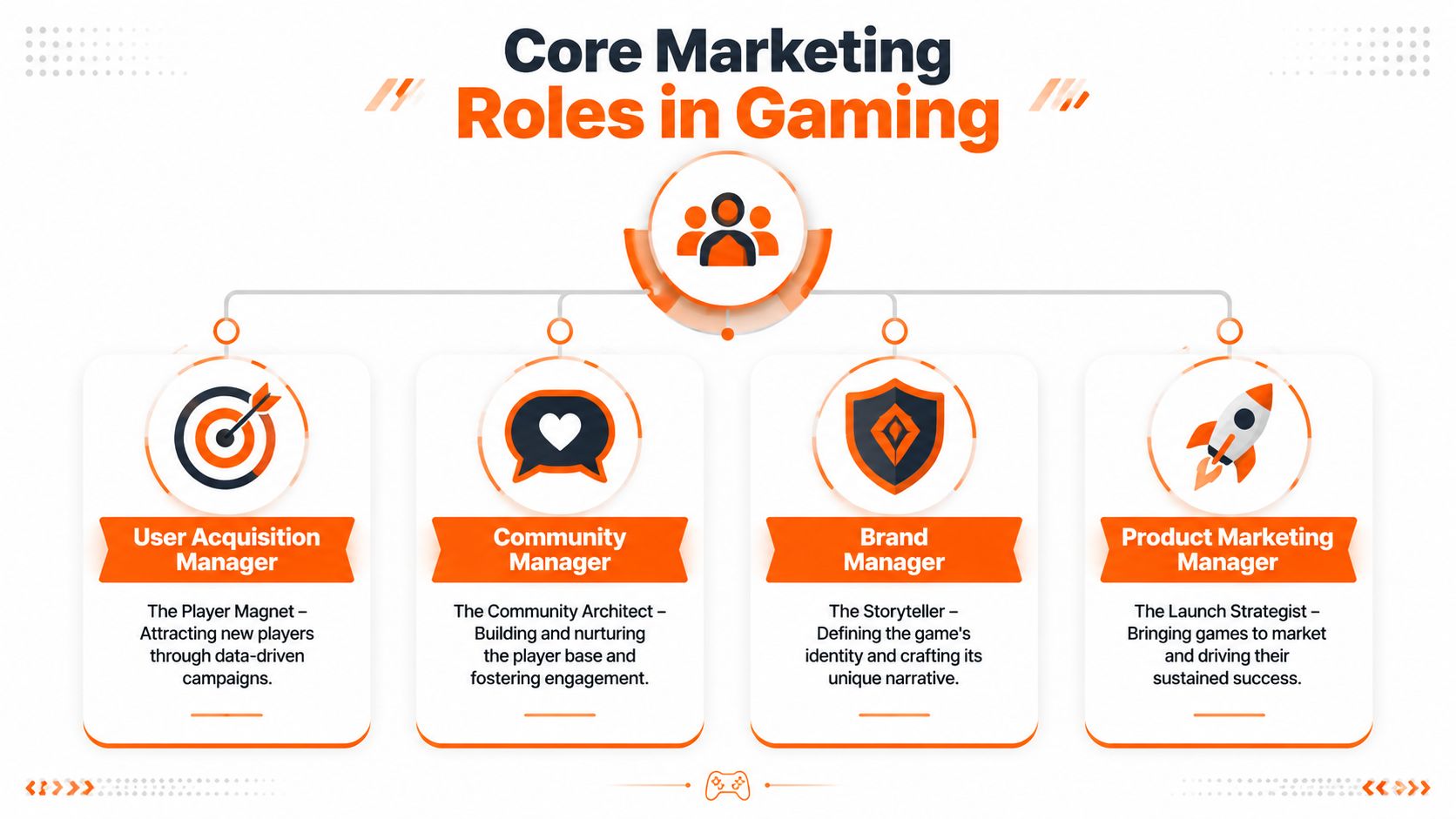
User acquisition and performance marketing
The User Acquisition Manager is the player scout. Their job is to bring in new players through paid channels, creative testing, targeting, landing pages, app store assets, and reporting. They don't get points for making ads that look clever. They get points for finding players who install, convert, return, and spend.
In games, UA people usually live in spreadsheets and ad platforms as much as creative decks. They work closely with artists, editors, analysts, and product teams. If you like Meta Ads Manager, Google Analytics, funnel thinking, and creative iteration, this lane fits.
Community and social
The Community Manager is the tavern keeper. They make players want to stay, talk, return, and care. That means running Discord, Reddit, social channels, patch-note messaging, feedback loops, event comms, moderation standards, and player sentiment reporting.
Good community work isn't just posting memes. It's translating between players and internal teams without sounding defensive to either side. If a patch lands badly, the community lead often knows before leadership does. If you're interested in adjacent social-focused roles, this guide to a remote social media manager role is useful because a lot of the same discipline carries over into gaming.
Brand and product marketing
Brand Marketing is the storyteller. This role defines what the game means, who it's for, what emotional territory it owns, and how its voice stays coherent across channels. Brand marketers work on identity, campaign themes, trailers, social concepts, key art direction, and broader market perception.
Product Marketing is the launch strategist. They sit close to the product and turn features into reasons to care. They build positioning, messaging, go-to-market plans, feature narratives, launch beats, and sales enablement for internal and external teams. In practical terms, they answer the question every game team eventually faces: why should this audience care now?
For teams working with creators, partnership and influencer work often overlaps with these roles. If you want a grounded overview of how creator programs are structured, especially across campaigns and talent fit, this resource on understanding influencer marketing in the UK is a helpful companion.
PR, partnerships, and content
PR and partnerships sit in a different rhythm. PR focuses on coverage, messaging discipline, embargoes, media relationships, and reputation management. Partnerships can mean platform collaborations, hardware deals, brand tie-ins, creator programs, affiliate relationships, or cross-promotions.
Content marketers are the builders. They turn strategy into actual output: blog posts, shorts, trailers, social copy, store assets, email, event support, creator briefs, and campaign variations.
Here's the simplest way to separate the jobs.
| Role | Primary Goal | Key Responsibilities | Example Tools |
|---|---|---|---|
| User Acquisition | Acquire new players efficiently | Paid campaigns, creative testing, attribution, reporting | Google Analytics, ad platforms, spreadsheets |
| Community Manager | Build trust and engagement | Discord, social replies, moderation, sentiment tracking | Discord, social schedulers, CMS |
| Brand Manager | Shape perception of the game | Positioning, campaign themes, voice, creative direction | Creative briefs, asset trackers, presentation tools |
| Product Marketing Manager | Drive launch and market fit | Messaging, launch plans, feature framing, cross-team alignment | Roadmaps, go-to-market docs, analytics dashboards |
Most hiring mistakes happen because candidates apply for “marketing” roles without knowing which scoreboard the hiring manager actually cares about.
Skills and Portfolios That Get You Hired
Hiring managers don't want enthusiasm by itself. They want evidence. In entry-level roles, employers commonly look for familiarity with social platforms such as Discord, basic analytics tools like Google Analytics, and CMS workflows, along with a willingness to play across game genres so you can analyze mechanics and player motivation with some depth, as reflected in entry-level video game marketing role expectations on ZipRecruiter.
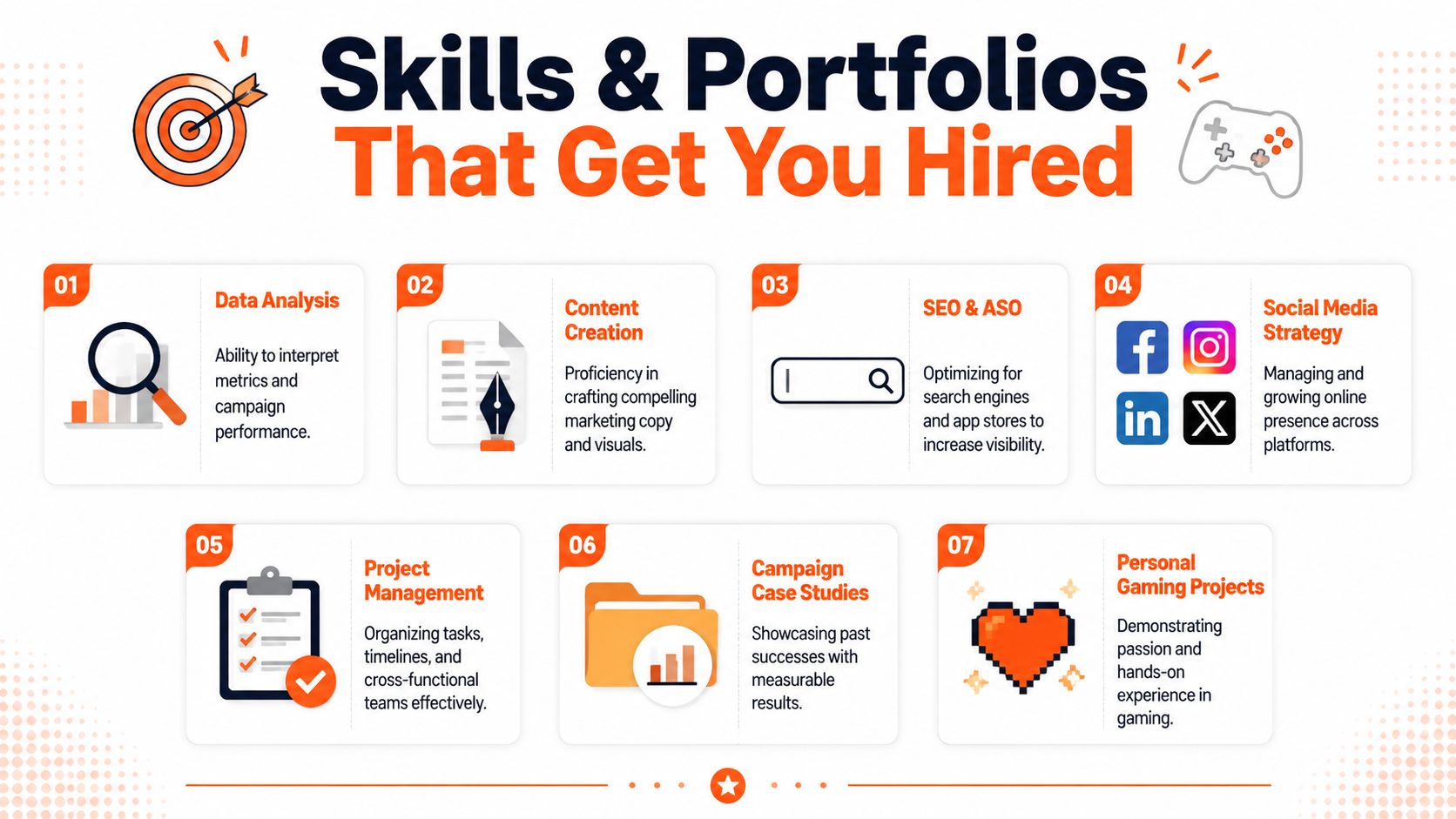
What hiring managers actually scan for
They're usually looking for three things within a few minutes:
- Can you understand a game and its audience?
- Can you communicate clearly in the format this role needs?
- Can you show proof, even if it's self-directed work?
If your resume says “passionate gamer,” that helps almost nobody. If your portfolio includes a teardown of a game's Steam page, a launch messaging doc, a sample Discord activation plan, or a paid social creative test matrix, now you're talking like someone who can contribute.
Build portfolio pieces that match the role
A good portfolio for game marketing is role-specific. Don't make one generic website and expect every hiring manager to map your work to their need.
- For user acquisition roles, build a mock paid campaign for a real game. Show audience hypotheses, ad concepts, sample copy, store-page friction points, and what you'd test first.
- For community jobs, create a Discord or subreddit audit. Outline channel structure, moderation guidelines, event ideas, escalation logic, and how you'd relay feedback to internal teams.
- For brand or product marketing, write a positioning memo. Include target audience, player promise, differentiators, tone, key beats, and a launch message hierarchy.
- For content roles, produce the assets. Trailer hooks, short-form video concepts, patch-note formatting, creator briefs, store descriptions, and social cutdowns all count.
One caution. Don't fill your portfolio with vague “campaign ideas” that never touch execution. Strategy without deliverables reads junior. Deliverables without reasoning read careless. You need both.
The strongest junior candidates often look less like students and more like people already doing the job on their own.
AI tools can help with speed, but don't outsource your judgment. If you're prototyping ad concepts or short video variations, a tool like ShortGenius AI ad generator can help you mock up creative directions quickly. The important part is still your brief, your audience logic, and your explanation of why a concept fits the game.
Skills that transfer well
People coming from ecommerce, SaaS, media, or creator marketing often underestimate how much transfers over.
Bring these with you:
- Channel discipline from paid social, email, CRM, or organic content
- Analytics habits such as reporting cleanly and asking better questions
- Creative operations including briefs, approvals, and asset pipelines
- Audience thinking that goes beyond demographics and gets into behavior
What doesn't transfer well is generic corporate copy, weak taste, or the assumption that every game audience responds like a consumer app audience. Game players notice when a marketer doesn't understand the product.
Understanding Salary and Compensation in 2026
Pay in game marketing varies by experience, employer type, location, and how specialized the role is. The cleanest baseline available is this: as of June 2026, the average hourly pay for video game marketing professionals in the United States is $18.56, with entry-level positions averaging approximately $49,574 annually. That gives you a starting reference point, not a universal offer template.
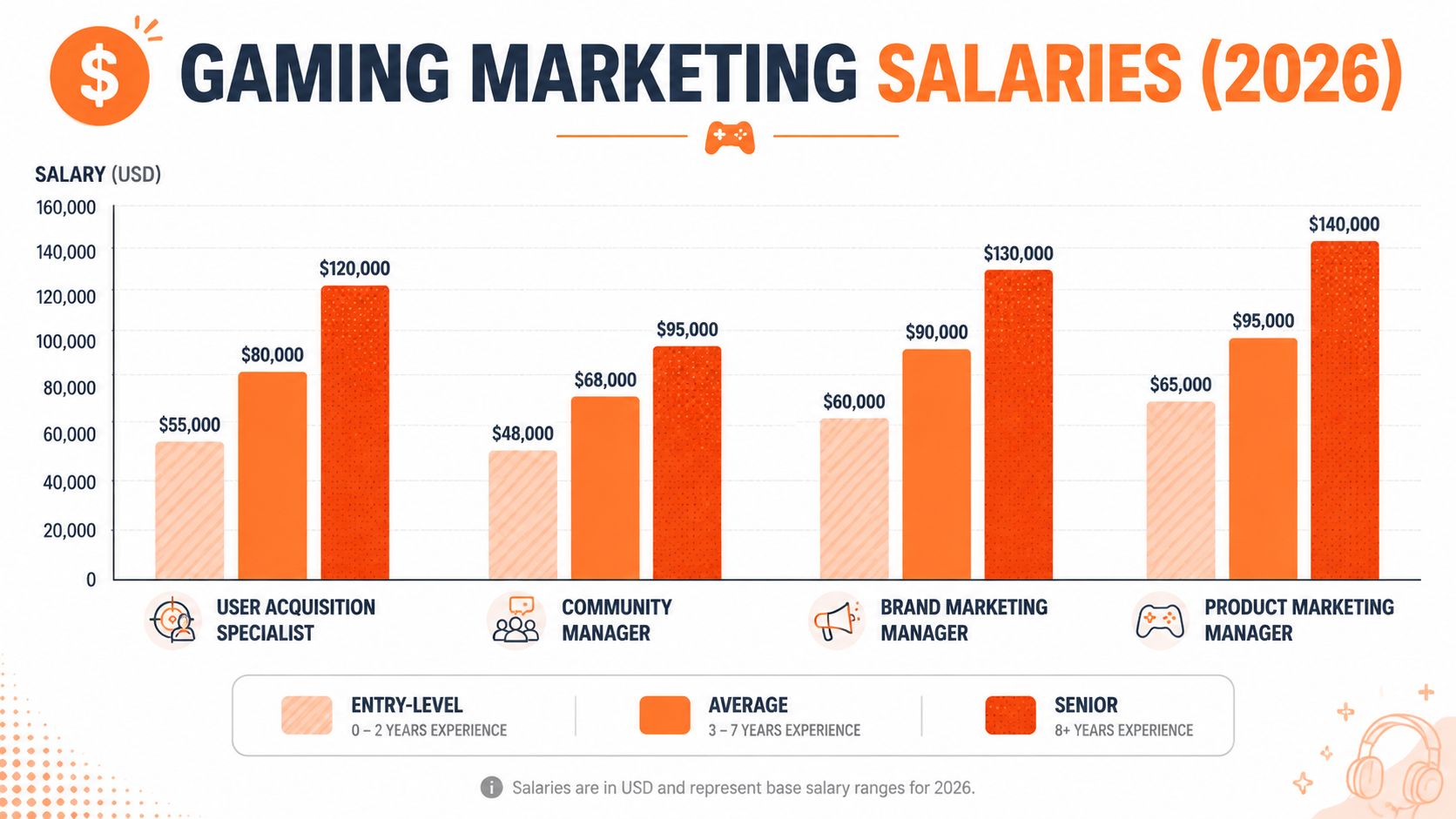
Why offers vary so much
Two jobs can share a title and feel nothing alike.
An indie studio may ask one marketer to handle social, creator outreach, patch messaging, store updates, and launch coordination. A large publisher may hire for a narrower specialty with bigger budgets, more process, and more stakeholders. The indie role can give you broader reps. The publisher role can give you clearer scope, stronger support systems, and better long-term title progression.
Remote roles add another layer. Some companies benchmark pay to the employee's market. Others use wider bands tied to role seniority and business stage. You need to ask how compensation is structured before you compare offers. If you don't, you can misread a decent offer as weak or a weak offer as competitive.
What to evaluate beyond base pay
Compensation in this field often comes with details that matter more than junior candidates realize.
- Scope of ownership tells you whether you'll learn one lane thoroughly or do a little of everything.
- Manager quality affects growth more than perks. A strong lead will teach positioning, feedback handling, analytics, and stakeholder management.
- Team structure changes stress. A one-person marketing function sounds exciting until every asset, post, report, and campaign issue lands on you.
- Support for remote work matters if the role is distributed. Async culture, documentation, and decision clarity make a real difference.
If you're evaluating community-oriented roles specifically, this breakdown of salary for a community manager can help frame what to compare when a title sounds broad but the day-to-day looks very community-heavy.
Don't negotiate from excitement alone. Negotiate from scope, expectations, and whether the role sets you up for your next move.
A lower-paying role can still be smart if it gives you ownership of launches, creators, analytics, or product-market learning you couldn't get elsewhere. A higher-paying role can still be a trap if the title is inflated and the function is chaotic.
Charting Your Career Path in Game Marketing
Career growth in games rarely follows a clean ladder. It usually looks more like a branching map. Some people deepen into one specialty. Others move from execution into strategy, then into team leadership or broader publishing roles.
One path inside a publisher
Start with a junior coordinator or specialist role. You might own campaign support, community calendars, reporting prep, creator logistics, or asset trafficking. If you get good at shipping reliable work, writing clearly, and spotting player insight before others do, you become the person managers trust on harder launches.
From there, a common move is into specialist ownership. Community becomes senior community. Product marketing becomes launch ownership for a title or region. Brand becomes campaign lead. Then the work shifts. You stop just executing and start making decisions about budget allocation, message hierarchy, channel mix, risk, and timing.
That path matters because in games, the publisher often holds the larger marketing machine. Senior marketing roles are predominantly located at the publisher rather than the developer, while AAA developers typically retain only 1 to 2 marketing personnel and the publisher manages the broader marketing function. If you want senior strategic responsibility, targeting publishers usually makes more sense than chasing only developer-side roles.
Another path from outside gaming
A lot of strong game marketers didn't start in games. They came from agencies, consumer brands, media companies, or SaaS. The transition works best when they translate their experience instead of trying to reinvent themselves from scratch.
If you've run influencer campaigns for a non-gaming brand, talk about creator briefing, content fit, approvals, and performance analysis. If you've managed lifecycle marketing, show how that thinking applies to retention and live ops communication. If you've worked agency-side, you may already understand client management, deadline pressure, and multi-channel execution. The decision between staying external or moving in-house is also worth thinking through carefully, and this look at in-house marketing vs agency is useful if you're weighing where your skills will grow fastest.
What progression actually depends on
Titles help, but they aren't the main driver. Advancement usually follows from a few repeatable behaviors:
- Strong judgment under pressure during launches, delays, community flare-ups, or campaign pivots
- Clear communication with developers, executives, creators, agencies, and players
- Reliable execution on calendars, briefs, approvals, and reporting
- Taste in messaging and creative direction
- Commercial awareness so you understand what the business is trying to achieve
If you're early in your career, optimize for exposure to real decisions. If you're mid-career, optimize for ownership. If you're aiming senior, learn how to align product, audience, and revenue without creating chaos inside the team.
How to Find Remote Marketing Jobs in Video Games
The old advice was simple. Move to a hub, take meetings, and hope your local network opens a door. That still works for some people, but it's no longer the only serious route. Emerging data indicates a 35% increase in distributed company hiring for global marketing talent in gaming over the last 12 months. That shift is bigger than most job guides acknowledge.
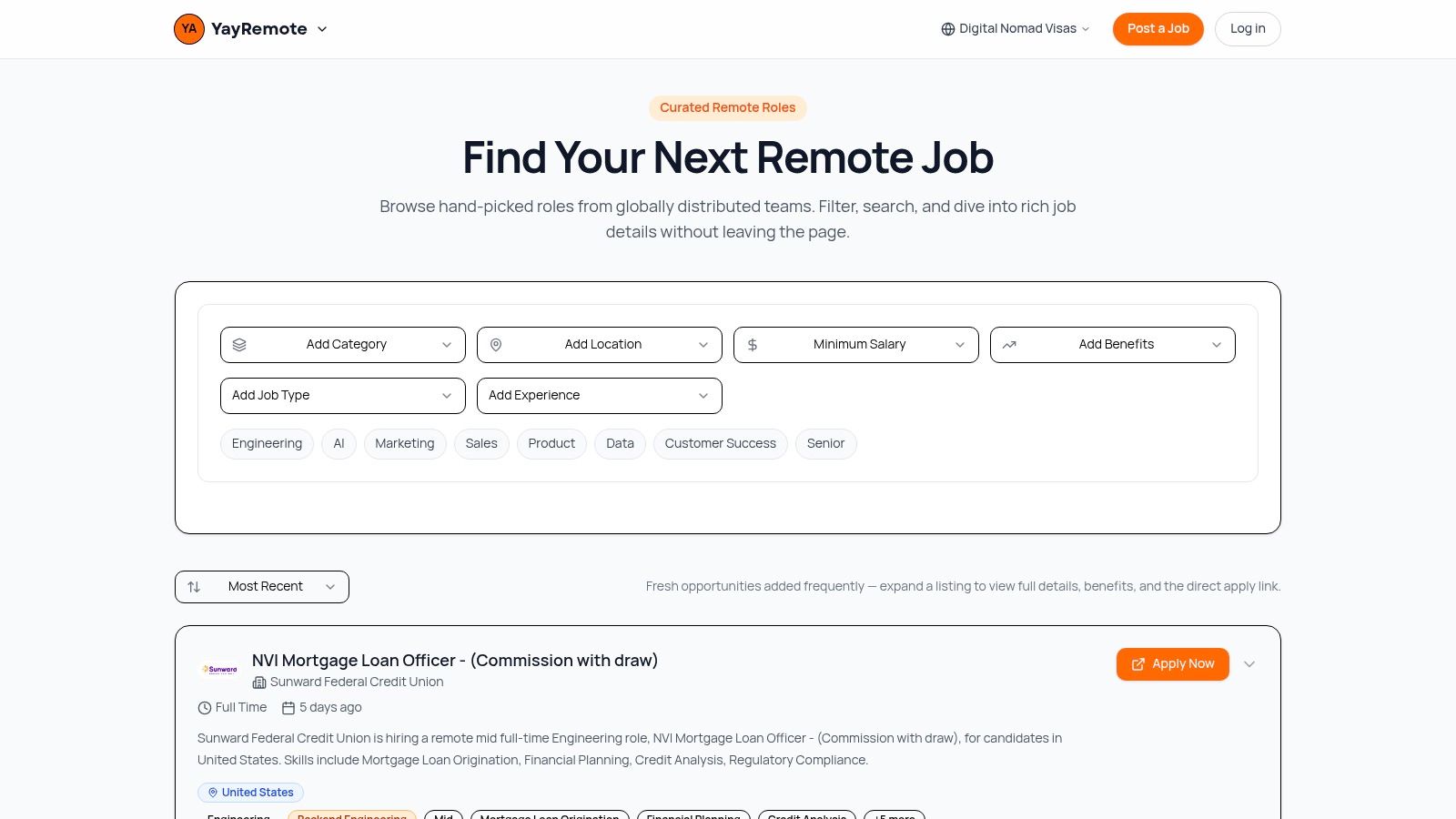
Remote marketing jobs in video games are growing because a lot of the work is already digital, collaborative, and cross-time-zone by nature. Creator management, content planning, CRM, paid media, social, reporting, store optimization, and launch coordination can all happen in distributed environments if the company documents well and hires people who can operate with autonomy.
Where candidates go wrong
Job seekers often search badly. They type “game marketing” into one large job board, skim titles, and apply to anything that looks adjacent. That wastes time.
Remote hiring requires tighter filtering. Use a board built around distributed roles, and focus on job descriptions that explicitly mention async communication, cross-functional collaboration, ownership, and timezone expectations. A broad search page for remote marketing jobs is useful because it narrows the field to companies that already hire remotely instead of forcing you to decode every listing from scratch.
How to search with intent
Treat the search like a campaign. Segment, qualify, and tailor.
- Filter by function first. Community, product marketing, social, lifecycle, PR, partnerships, and content are different searches.
- Read for operating style. If the description is vague about communication norms or decision-making, ask in screening.
- Check the company's product reality. A live-service title needs a different marketer than a premium single-player launch.
- Look for evidence of documentation. Remote teams that write clearly tend to onboard and manage better.
- Match your application to the scoreboard. If it's a community role, lead with moderation, player comms, and sentiment handling. If it's product marketing, lead with positioning and launch planning.
Remote teams hire people who reduce coordination drag. Show that you can think clearly without waiting for constant supervision.
Make your resume remote-ready
A good remote resume doesn't just list channels and tools. It signals trustworthiness.
Add proof of:
- Async communication, such as writing briefs, updates, decision docs, or campaign recaps
- Cross-functional collaboration with design, production, analytics, creators, or support
- Ownership, where you ran a project or process without heavy hand-holding
- Tool fluency in systems like Google Analytics, CMS platforms, social schedulers, asset trackers, and collaborative docs
If you've worked across time zones or with agencies and contractors, include that. Distributed companies care because they need people who can keep projects moving while other teammates are offline.
Here's a useful walkthrough that complements resume prep and interview pacing for distributed work.
How to interview for distributed teams
Remote interviews test different muscles than office-based hiring. You're not just being assessed on enthusiasm. You're being assessed on signal quality.
Expect questions around:
- How you manage ambiguity
- How you communicate progress
- How you prioritize without immediate feedback
- How you handle collaboration across functions and time zones
Bring examples. Talk through a campaign plan you organized, a difficult stakeholder conversation you handled, a content calendar you owned, or a player-facing issue you de-escalated. Specifics beat charm.
If you want remote marketing jobs in video games, stop assuming they're hidden. They exist. The better move is to search where distributed companies already hire, present yourself as someone who can operate independently, and tailor every application to the exact function on offer.
Your First Quest in Game Marketing Starts Now
The path into game marketing is more open than commonly assumed. The jobs are real, the role types are distinct, and the hiring bar is more practical than mystical. Companies want marketers who understand players, can communicate clearly, and can prove they know how to execute.
You also don't need to build your plan around a single expensive city. Remote work has changed the shape of the market, especially for digital-first marketing roles that depend more on judgment, coordination, and output than physical location. That gives smart candidates a wider field than the old playbook allowed.
Start small if you need to. Build one role-specific portfolio piece. Rewrite your resume for the exact lane you want. Audit a game's store page, mock up a creator brief, or map out a Discord recovery plan. Then apply with intent, not volume.
Your first quest isn't “get lucky.” It's to become legible to the hiring manager.
If you want a practical place to start looking, YayRemote is built for people who want distributed work without location barriers. You can browse hand-picked remote roles, filter by category and experience, and focus your search on companies that already know how to hire beyond a single hub.