Remote Jobs in Finance: The 2026 Ultimate Guide
Find remote jobs in finance with our 2026 guide. Explore roles, salaries, skills, and get expert tips for landing a location-independent career in finance.
About 942,500 openings a year are projected for business and financial occupations from 2024 to 2034, and the group's median annual wage was $80,920 in May 2024, well above the $49,500 median for all occupations, according to the U.S. Bureau of Labor Statistics overview of business and financial occupations. This provides the proper perspective for remote jobs in finance. This isn't a side market anymore. It's a large, durable hiring category with enough demand to support specialists, operators, analysts, and managers.
I recruit for remote finance roles, and the biggest misunderstanding I still see is simple. People hear “remote” and assume “work from anywhere.” In finance, those are not the same thing. A role can be fully remote and still be limited by state residency, entity setup, licensing, payroll rules, client coverage, or time-zone expectations.
That nuance matters more than the usual remote-job advice. If you want a remote finance job that lasts, you need to know which roles travel well, which ones don't, and how to spot restrictions before you waste time in a hiring process.
The New Era of Remote Finance Work
Finance used to treat remote work as an accommodation. Now it treats it as operating reality.
The reason is practical, not ideological. A large share of finance work is already digital. Reporting, reconciliations, close support, cash forecasting, budget variance analysis, payroll review, controls testing, and board-package prep all happen inside cloud systems, spreadsheets, ERPs, and communication tools. Once the workflow lives in a system, location matters less than reliability.
That doesn't mean every finance job belongs at home. It means enough of them do that remote delivery is now normal for many teams. In hiring, I see this most clearly in accounting operations, FP&A, revenue operations support, internal reporting, compliance documentation, and finance systems work.
Why employers keep hiring remotely
Most finance leaders aren't trying to be trendy. They're trying to solve coverage, speed, and skill gaps.
A remote model helps them do three things:
- Broaden the candidate pool: They're not boxed into one commuting radius.
- Fill specialized seats faster: Roles like analyst, controller support, and systems-heavy accounting often need niche experience.
- Build follow-the-sun or cross-market coverage: Especially useful when companies serve multiple regions or have distributed stakeholders.
Practical rule: In finance hiring, remote works best when the job can be measured by accuracy, turnaround time, documentation quality, and decision support, not by visible desk time.
What changed from the old model
The old office-first setup rewarded responsiveness in person. The new remote setup rewards clean handoffs, strong written updates, and comfort with system-based work. That sounds minor, but it changes who gets hired.
The candidates who do well in remote jobs in finance usually share one trait. They can make their work legible. They don't just finish a forecast or clear a reconciliation queue. They leave a trail others can follow, review, and trust.
That's why remote finance isn't just “finance, but at home.” It's a different operating style. The people who recognize that early tend to move faster.
Exploring the Landscape of Remote Finance Careers
Remote finance is not one lane. It's a ladder.
At the lower end, you have transaction-heavy roles such as accounts payable, billing support, and bookkeeping. In the middle, you see accounting, payroll, staff analyst, and reporting jobs. Higher up, the work shifts toward planning, modeling, advisory, and decision support. That progression shows up in pay as well. Indeed's overview of work-from-home finance jobs reports U.S. average salaries from about $48,131 for accounts payable specialists to $84,474 for data analysts and $93,622 for finance consultants.
The easiest mistake is chasing title prestige instead of remote fit. Some attractive titles look remote-friendly on paper but depend on client location, branch alignment, or regulated activity. Others sound less glamorous but are highly portable because the work is structured, documented, and system-based.
The main role clusters
Here's how I break down the market when I'm advising candidates.
- Accounting operations: Accounts payable, accounts receivable, billing, payroll, and bookkeeping. These roles suit candidates who are process-oriented and comfortable with recurring deadlines.
- Corporate accounting: Staff accountant, senior accountant, close specialist, technical accounting support. These jobs usually require stronger controls awareness and cleaner documentation.
- Financial planning and analysis: Financial analyst, FP&A analyst, budget analyst, reporting analyst. For these roles, presentation quality, business judgment, and spreadsheet discipline matter more.
- Data and finance systems: Data analyst, finance systems analyst, reporting automation support. These roles sit at the intersection of finance logic and tooling.
- Advisory and consulting: Finance consultant, outsourced finance manager, fractional support. Good fit for candidates who can own recommendations, not just output.
A useful niche example is virtual accounting for SaaS and agencies, where the work is naturally cloud-based and highly standardized across recurring monthly workflows.
Remote Finance Roles at a Glance
| Role | Average Remote Salary (USD) | Core Responsibilities | Essential Skills |
|---|---|---|---|
| Accounts Payable Specialist | $48,131 | Invoice processing, vendor management, payment runs, record accuracy | AP workflow knowledge, ERP use, attention to detail, spreadsheet basics |
| Bookkeeper | About $47,427 | Transaction recording, account categorization, reconciliations, monthly reporting | Bookkeeping fundamentals, accounting software, consistency, organization |
| Data Analyst | $84,474 | Data cleanup, reporting, dashboard support, trend analysis | Excel or spreadsheet fluency, data handling, business context, communication |
| Finance Consultant | $93,622 | Financial review, process improvement, planning support, stakeholder advice | Analysis, executive communication, judgment, client-facing polish |
What actually hires well remotely
The strongest remote hiring markets tend to favor work that is repeatable, reviewable, and digitally auditable. That includes month-end support, recurring reporting, variance commentary, budget tracking, payroll processing, and finance data cleanup.
A remote-friendly finance role usually has clear inputs, a defined review path, and output that can be checked without watching the person do it.
What doesn't travel as cleanly? Roles that hinge on local client trust, branch relationships, in-person selling, paper-heavy workflows, or regulated advising tied to local licenses. Those jobs still exist remotely, but they usually come with constraints that people miss on first read.
Essential Skills and Certifications for Remote Success
The strongest remote finance candidates don't win because they list more software. They win because they prove they can produce accurate work without daily supervision.
That changes how you should think about qualifications. Degrees and certifications still matter in plenty of finance roles, but employers also hire for operating habits. They want people who can manage deadlines asynchronously, write updates that reduce confusion, and keep documentation clean enough for someone in another city or country to pick up the file.

Hard skills that hold up in distributed teams
If you're targeting remote jobs in finance, these are the practical hard-skill buckets employers look for first:
- Spreadsheet fluency: Not basic formatting. Real working ability with formulas, error checking, data cleanup, reconciliations, and model hygiene.
- ERP and accounting systems comfort: Employers want candidates who can learn workflows inside systems, not just talk theory.
- Reporting discipline: Can you turn raw data into a board-ready summary, variance note, or decision-support memo?
- Tool adaptability: Remote teams often blend finance systems with collaboration tools, ticketing tools, and documentation platforms.
The market is also widening at the edges. One undercovered shift is the rise of finance-adjacent roles with remote flexibility. Live listings in Orange County show demand for roles such as AI trainer or quantitative analyst, along with entry-level remote openings that emphasize skills, not just degrees. That's important for junior candidates and career switchers. You may not need the perfect traditional profile if you can show strong analytical execution.
The soft skills that actually decide offers
Many qualified candidates often lose out.
A hiring manager can teach a smart analyst a new workflow. It's much harder to teach someone how to communicate clearly in a distributed environment. In remote finance, weak communication creates late closes, duplicated work, unclear assumptions, and preventable mistakes.
Look for evidence of these on your own resume and in your day-to-day habits:
- Asynchronous communication: Writing updates that answer the next question before it's asked.
- Time management: Handling recurring deadlines without external pressure.
- Issue escalation judgment: Knowing when to solve independently and when to flag risk early.
- Documentation habits: Leaving process notes, assumption logs, and version clarity.
If your manager vanished for two days, could another teammate understand your files, your assumptions, and your blockers? That's remote readiness.
Certifications still help, but they don't fix weak execution
For some roles, licenses or formal credentials remain highly relevant. For others, they're secondary to demonstrated output. I've seen candidates with great initials after their name struggle because they couldn't manage a distributed workflow, and I've seen less traditional candidates outperform them because they documented everything and communicated crisply.
If you're unsure what you're missing, benchmark yourself against actual postings rather than generic advice. A practical starting point is reviewing examples of remote work skills for your resume and then mapping those skills to the finance roles you want.
How to Find and Secure Your Remote Finance Job
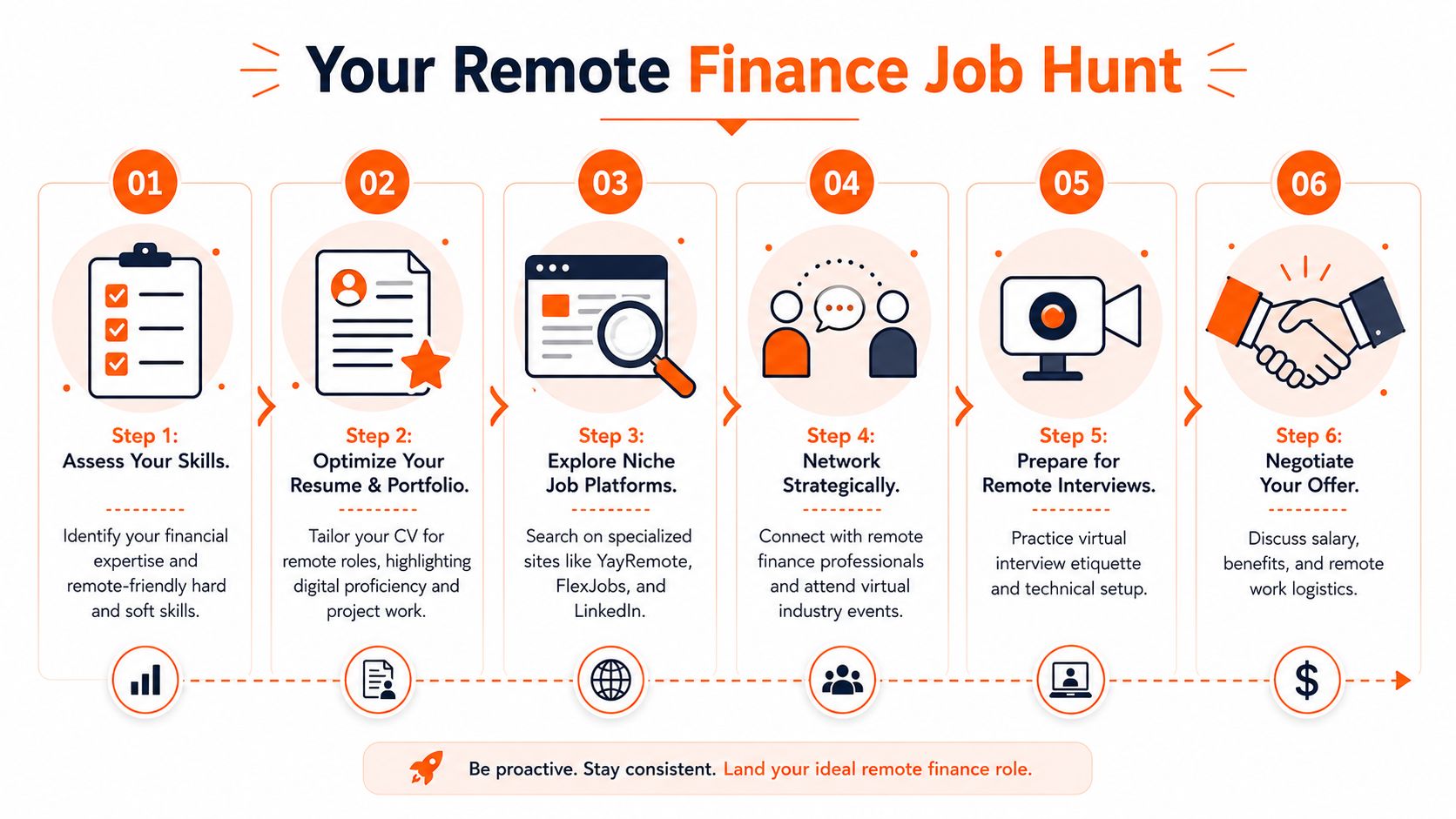
Most candidates search for remote finance roles the wrong way. They type one title, skim headlines, and apply everywhere. That produces noise, not traction.
A better search starts with market reality. In major U.S. markets, remote finance hiring is substantial. One job board shows 474 remote finance openings in Houston, while another lists 1,000+ remote finance roles in Houston with an estimated pay range of $71k–$128k, based on Indeed listings for remote finance jobs in Houston. That tells you two things. First, remote finance isn't just clerical work. Second, broad markets generate enough volume that filtering matters more than raw searching.
Search by work pattern, not just title
A remote “financial analyst” role can mean budgeting, pricing, reporting, revenue analytics, strategic finance, or glorified spreadsheet cleanup. If you search titles only, you'll miss the fit.
Build searches around these filters:
- Workflow type: month-end, FP&A, payroll, reporting, finance systems, advisory.
- Seniority signal: coordinator, specialist, analyst, senior, manager, consultant.
- Restriction language: U.S. only, state-specific, time-zone overlap, licensing required.
- Tool clues: ERP, data stack, CRM-adjacent finance support, reporting automation.
If you need a broader process for structuring your search, this guide on how to find remote jobs is useful because it pushes you to narrow by actual fit instead of endless browsing.
Your resume needs remote proof
Finance candidates often submit resumes that read like internal HR records. They list responsibilities, software, and dates. That's not enough for remote roles.
Hiring teams need signals that you can operate independently. Your bullet points should show ownership, clarity, and digital fluency. Good remote finance resumes make these things obvious:
- Output: monthly close support, variance reporting, reconciliations, forecasting models, stakeholder decks.
- Environment: cross-functional, distributed, async, multi-entity, high-volume, recurring deadlines.
- Judgment: flagged discrepancies, improved reporting flow, handled exceptions, supported leadership decisions.
Bad bullets say “Responsible for financial analysis.” Better bullets show the actual work product and the environment in which you delivered it.
Applications that survive screening
Most companies still use some version of structured screening, whether a recruiter, an ATS, or both. That means clarity beats cleverness.
Use the job description's language where it's accurate. If they ask for budgeting, forecasting, variance analysis, cross-functional support, and remote collaboration, your resume should reflect those exact concepts when you have real experience. Don't force keywords you can't defend in an interview.
Hiring shortcut: The first pass is often a pattern match. Make it easy for someone to see title fit, workflow fit, and remote fit in under a minute.
Networking helps most when it's specific
Generic networking is a waste of time. Asking strangers to “keep you in mind” rarely works.
Specific networking works better:
- Reconnect with former finance stakeholders: Controllers, finance managers, auditors, payroll leads, operations partners.
- Ask narrow questions: “Are your teams hiring remote staff accountants with multi-entity close exposure?” is better than “Know of anything?”
- Show a clean target: One short summary of your lane, tools, and preferred work pattern is enough.
Interview before you're invited
Remote job seekers often underprepare for the practical part. They get ready for behavioral questions but not for working-style scrutiny.
Before applying heavily, prepare answers for these:
- How do you manage deadlines when priorities shift?
- How do you communicate blockers asynchronously?
- How do you keep version control clean?
- How do you document assumptions in reporting or forecasts?
- How do you work across departments without relying on meetings?
When you can answer those with concrete examples, you stop sounding like someone who wants remote work and start sounding like someone who already knows how to do it.
Navigating Remote Interviews and Time Zones
Remote interviews test more than finance knowledge. They test whether people can imagine working with you every day through a screen, shared documents, and written updates.
That's why small operational details matter. If your audio cuts out, your background is chaotic, and your answers ramble, the hiring team doesn't just see interview mistakes. They see future friction.

Remote work is mainstream enough now that employers expect fluency, not novelty. In the U.S., about 34.6 million employed people teleworked in August 2025, and the remote work rate was 22.1% that month, according to Vena's roundup of remote work statistics. So when you interview for remote jobs in finance, nobody is impressed that you can join a video call. They want to know whether you can collaborate cleanly inside a distributed model.
What finance interviewers are actually checking
They're checking three things at once:
- Can you do the finance work?
- Can you be trusted without constant oversight?
- Will communication with you be easy or draining?
That last one decides more offers than candidates realize. A precise answer with a clear example beats a long, polished answer that never lands.
Use a simple structure when answering remote-work questions. State the situation, the task, the tools or process, and the outcome. Keep the focus on how you operated, not just what happened.
“For remote roles, I care less about polished theory and more about whether the candidate can explain their working rhythm clearly.”
Time zones are not a footnote
A lot of candidates treat time zones like an HR admin issue. Finance teams don't. Time-zone mismatch affects close schedules, approvals, handoffs, and access to decision-makers.
Here's where people get into trouble:
- They assume async solves everything: It doesn't, especially during close, forecast cycles, and urgent variance review.
- They overpromise overlap: Then the team discovers they're unavailable during key reporting windows.
- They ignore stakeholder geography: A finance role may be remote but still centered around one leadership team's working hours.
You should be ready to state your working window in plain language and explain how you handle recurring deadlines if your team sits elsewhere.
A good candidate says, “I'm based in X, but I can overlap with your core hours for close and forecast reviews, and I document handoffs so the team isn't waiting on me.” A weak candidate says, “I'm flexible,” and leaves everyone guessing.
Prepare your interview setup like client-facing work
Treat the interview the same way you'd treat a board-prep meeting or executive review. Test audio. Close tabs you don't need. Keep one note page with bullet reminders, not full scripts. Have one or two examples ready that show calm problem-solving under deadline.
For a quick refresher on virtual interview habits and remote communication, this clip is worth reviewing before a final round:
Understanding Compensation and Location Nuances
The phrase “fully remote” hides a lot.
Candidates often read it as freedom. Employers often mean something narrower: fully remote within a state, a country, a payroll footprint, a licensing boundary, or a workable time zone. In finance, that distinction matters more than in many other fields because compensation, compliance, and client service often sit on top of jurisdiction rules.
Remote doesn't always mean location-agnostic
A major gap in most advice is eligibility. Better-paying, client-facing finance roles often come with hard constraints tied to residency or credentials. One example is a remote finance specialist role that explicitly required the candidate to be in California. The posting may say remote. The job is still geographically bounded.
That affects more than where you live. It can affect whether the employer can hire you directly, whether you can serve certain clients, whether your license is valid for the work, and whether their compliance team will approve your location at all.
Questions you should ask before the second interview
Don't wait until offer stage to surface the constraints. Ask early.
- Location scope: Is this remote anywhere, remote in specific states, or remote in one country?
- Payroll structure: Will I be hired directly, through an employer-of-record, or as a contractor?
- License expectations: Are there role-specific registrations, state requirements, or residency rules?
- Client geography: Does the role support clients in regions that require specific local credentials?
- Compensation method: Is pay benchmarked to role scope, employer market, or employee location?
The best remote finance candidates ask eligibility questions early because they know “remote” is an operating model, not a legal category.
How compensation gets messy
In practice, employers tend to use one of a few approaches. Some pay by role and keep bands relatively consistent. Others adjust by employee location. Some anchor compensation to headquarters logic even when the employee never sets foot there.
You won't always get a clean answer in the job ad. That's why I advise candidates to focus on the whole package: base pay logic, bonus structure if any, benefits, equipment, working-hour expectations, and tax or payroll implications if you move.
This also matters if you expect international flexibility later. Payment mechanics can become a significant issue when a company hires across borders or pays contractors in different countries. If you want a practical primer before those conversations, this guide to compare global payment platforms for creators is useful because it highlights how cross-border payout infrastructure shapes the employee or contractor experience.
The Digital Nomad Financier Legal and Tax Considerations
Some finance professionals eventually want more than a home office. They want mobility. That can work, but finance is one of the worst fields for casual assumptions about working abroad.
A company may approve remote work and still prohibit work from certain countries. Your visa status may allow tourism but not local work activity. Tax residency can shift faster than people expect. And if you handle sensitive financial data, the employer may restrict where that work can be performed.
What to check before you move
You don't need to become an international tax lawyer, but you do need to stop treating mobility as an informal perk.
Check these before changing countries:
- Visa permission: Tourist access is not the same as work permission. Review country-specific rules around remote work visa eligibility before you commit.
- Employer approval: Some companies restrict countries for legal, security, or payroll reasons.
- Tax exposure: Days spent in-country can trigger filing or residency questions. This overview of remote work tax deductions is a helpful starting point for understanding the broader tax side.
- Data handling limits: Finance teams often work with information that falls under stricter internal controls.
The practical way to think about it
If your finance role depends on licenses, client coverage, payroll registration, or regulated advice, mobility gets harder. If your role is internal, system-based, and documentation-heavy, mobility is often more feasible, but only with advance planning.
Mobility works best in finance when you treat location as a compliance variable, not a lifestyle accessory.
The people who make digital nomad finance work are rarely improvising. They plan around employer policy, tax timing, work authorization, and the operational reality of deadlines.
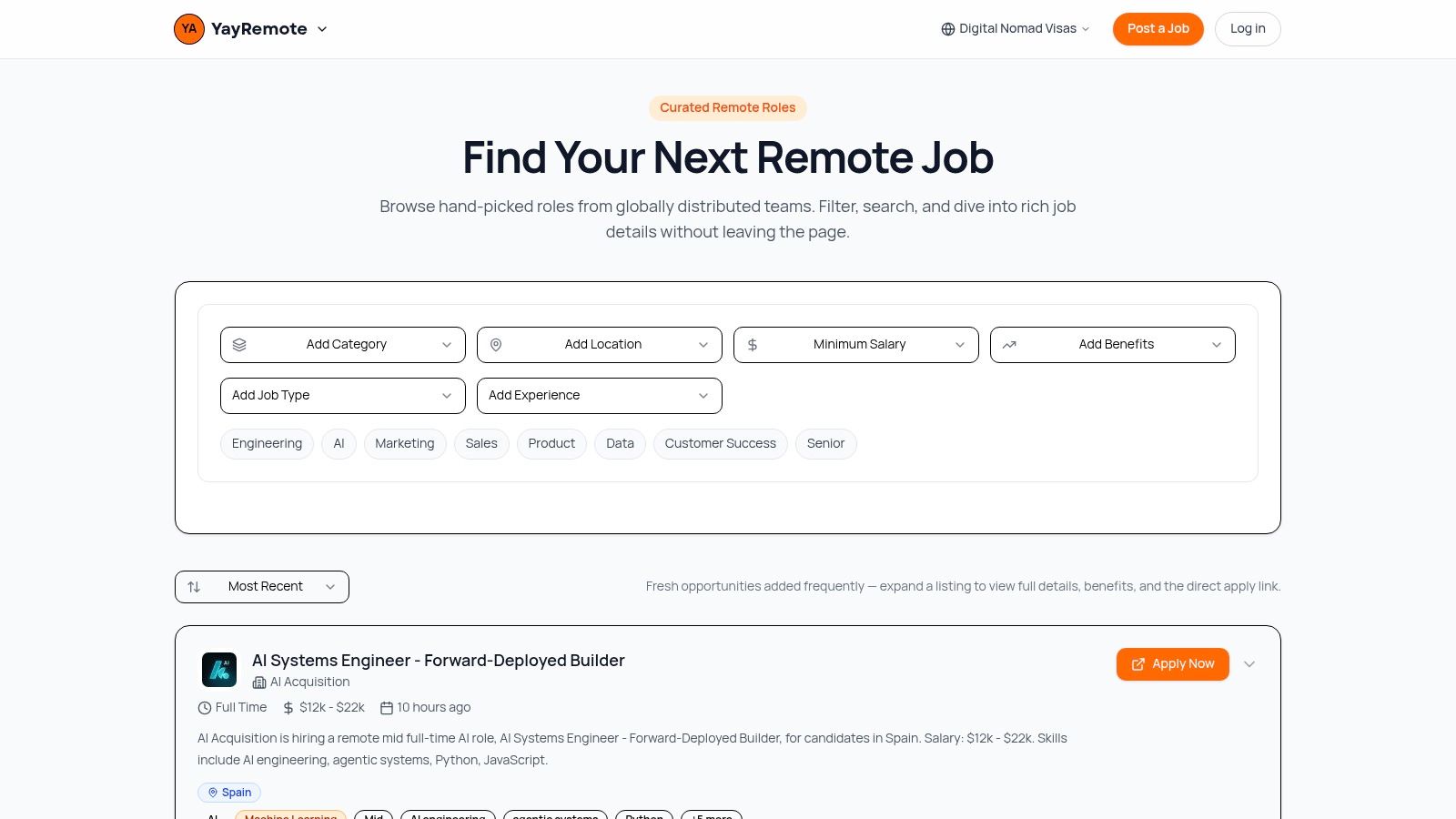
If you're serious about remote jobs in finance, use YayRemote to find curated remote roles, sharpen your application materials, and research the practical realities of working across borders and time zones. It's one of the few platforms built for people who need more than job listings.