Top Remote Legal Jobs: Your 2026 Guide
Find top remote legal jobs in our 2026 guide. Explore roles, salaries, application tips, and best platforms for your remote law career. Start here.
87% of law firms allow lawyers to work remotely in 2025, according to the ABA-reported data summarized here. That single number changes the conversation. Remote legal jobs are no longer a fringe option for contract reviewers and solo practitioners. They now sit inside mainstream legal hiring, even if the best opportunities are still unevenly distributed by firm type, practice area, and policy maturity.
I’ve seen the same pattern repeatedly in legal recruiting. Candidates assume remote means easier. Hiring managers usually mean something else. They want lawyers, paralegals, legal ops professionals, and compliance hires who can deliver without hand-holding, write clearly, manage risk, and stay reliable across distance. The people who win these roles understand that remote work is not just a location perk. It’s an operating model.
That’s why the strongest remote legal candidates don’t just chase listings. They target the right role type, present their experience in remote-ready language, and remove friction from the hiring process before a recruiter ever gets on the phone.
The Shifting Landscape of Legal Work
Remote legal hiring changed for a simple reason. Employers learned which parts of legal work hold up well without shared office space, and which parts still break down when supervision, client access, or court requirements are too tied to place.

What changed inside legal teams
I’ve watched firms and in-house teams shift from treating remote work as an exception to treating it as an operating choice. That does not mean every legal function became location-agnostic. It means employers now know where remote delivery works, where hybrid works better, and where in-person presence still protects quality, speed, or client confidence.
Document-heavy work moved first. Contract review, employment advice, regulatory monitoring, legal research, discovery coordination, intake triage, and a large share of commercial drafting can be handled remotely if the team has clear workflows and responsive people. Work that depends on local court appearances, partner shadowing, physical closings, or high-touch client management still gets pulled back toward the office more often.
That split affects job seekers more than the posting title does.
A “remote legal job” can mean three very different arrangements:
- True remote roles with systems, supervision, and expectations built for distributed teams
- Hybrid roles marketed with flexible language but tied to regular office attendance
- Remote-capable roles where the work can often be done off-site, but licensing rules, hearings, or client demands can change the arrangement fast
Hiring managers care about whether candidates understand that distinction. Candidates who ask smart policy questions early usually avoid the worst mismatches. Ask where the team is based, how often people come on-site, whether meetings run in one core time zone, and whether remote status changes after onboarding or probation.
Why tools now matter as much as credentials
Remote legal hiring still rewards strong judgment, clean writing, and subject-matter depth. It also puts more weight on execution habits that were easier to overlook in person. Slow follow-up, messy version control, weak status updates, and poor tool adoption stand out faster when nobody sees your effort in the hallway.
That is why practical software knowledge now carries more weight in interviews. A candidate who can explain how they track edits, manage approvals, organize matters, and keep review cycles moving will usually beat a similarly qualified applicant who speaks only in broad terms. Tools such as legal document comparison software matter because remote teams need clean draft control, faster redline review, and fewer avoidable errors.
This is also where candidates can create an edge before they apply. YayRemote’s free ATS checker helps tighten resume language so legal operations terms, contract systems, compliance tools, and document workflows are easier for screening software to read. The skills analyzer helps identify whether your background is being framed like a remote-ready legal hire or like a general applicant. The time zone tool is especially useful for global employers, because hiring teams want to know whether collaboration hours will work before they invest time in interviews.
The old office model rewarded visibility. Remote legal teams reward reliability, clear documentation, and work product that arrives on time without cleanup.
Understanding Common Remote Legal Roles
Most candidates search too narrowly. They type “remote attorney” and miss half the market. The better search starts by separating practicing roles from legal-adjacent roles, then matching them to the kind of employer that hires remotely.
Attorney roles that translate well to remote work
Remote attorney jobs exist, but they cluster in specific functions. Commercial work is one of the strongest areas because much of it is document-driven and deadline-based. In-house legal teams also hire remote counsel where business clients are distributed and advice can be delivered asynchronously.
Common titles include:
- Commercial Counsel handling customer agreements, vendor contracts, procurement support, and internal escalation points
- Employment Counsel advising on workplace issues, investigations, policy review, and multistate compliance
- Privacy or Product Counsel working with technology, data handling, AI-related issues, and cross-functional product teams
- Litigation Support or Discovery Attorneys focused on review strategy, document workflows, and matter support
- Staff Attorneys in high-volume practices where process and output consistency matter
These roles usually favor candidates who can show clean drafting, dependable turnaround time, and comfort with contract systems, ticketing, or matter management tools.
Paralegal, compliance, and legal ops jobs
A large share of remote legal jobs sits outside traditional attorney tracks. Consequently, many candidates underestimate the market.
Paralegals with strong calendar control, filing discipline, and client communication skills often do well remotely if the underlying practice doesn’t depend on constant in-person handling. Compliance specialists and legal operations professionals are also strong fits because their work often revolves around policy tracking, process design, spend oversight, and workflow management.
The most durable remote categories tend to include:
| Role Title | Key Responsibilities | Common Industries |
|---|---|---|
| Contract Manager | Drafting, redlining, negotiating routine agreements, managing templates and approvals | SaaS, healthcare, finance, procurement-heavy businesses |
| Compliance Specialist | Monitoring regulatory obligations, policy updates, internal controls, training support | Financial services, healthcare, tech, insurance |
| E-discovery Attorney | Review strategy, privilege calls, production coordination, platform-driven workflows | Litigation support, law firms, alternative legal services |
| Paralegal | Case support, filings, client intake, document prep, docketing, records management | Litigation, immigration, labor and employment, corporate |
| Legal Operations Specialist | CLM administration, outside counsel coordination, reporting, intake design, process improvement | In-house legal departments, scaling companies |
| Commercial Contracts Counsel | Negotiating commercial paper, advising sales teams, refining playbooks, supporting deal velocity | Technology, software, enterprise services |
The legal tech layer
In a rapidly evolving market, the demand for legal tech skills is rising, and roles like Commercial Contracts Counsel increasingly ask for experience in AI prompt engineering and legal ops transformation, according to this remote legal technology jobs analysis. The same source notes that tools such as DocJuris and Ironclad can reduce contract review cycles by up to 70% and lower error rates from over 15% to under 5% when teams use them well.
Those numbers matter because they explain why hiring managers keep asking the same practical questions:
- Which CLM platforms have you used?
- Can you work from templates and playbooks without slowing the business?
- Have you built or improved approval workflows?
- Do you know how to surface risk in plain English for sales, procurement, or operations stakeholders?
The candidate who says “I supported contract review” is average. The candidate who says “I managed redlines, fallback language, approval routing, and issue escalation inside a CLM” gets interviews.
What hiring managers really mean by experience
In remote legal hiring, “experience” often means one of three things:
- Can you own work without constant check-ins
- Can you communicate risk clearly in writing
- Can you use the team’s systems without becoming the bottleneck
That’s why a nontraditional background can still work. A JD who moved into legal ops, a paralegal who became excellent in e-billing and vendor management, or a contracts professional who learned scalable review workflows can all be competitive in the right market slice.
The 2026 Remote Legal Job Market
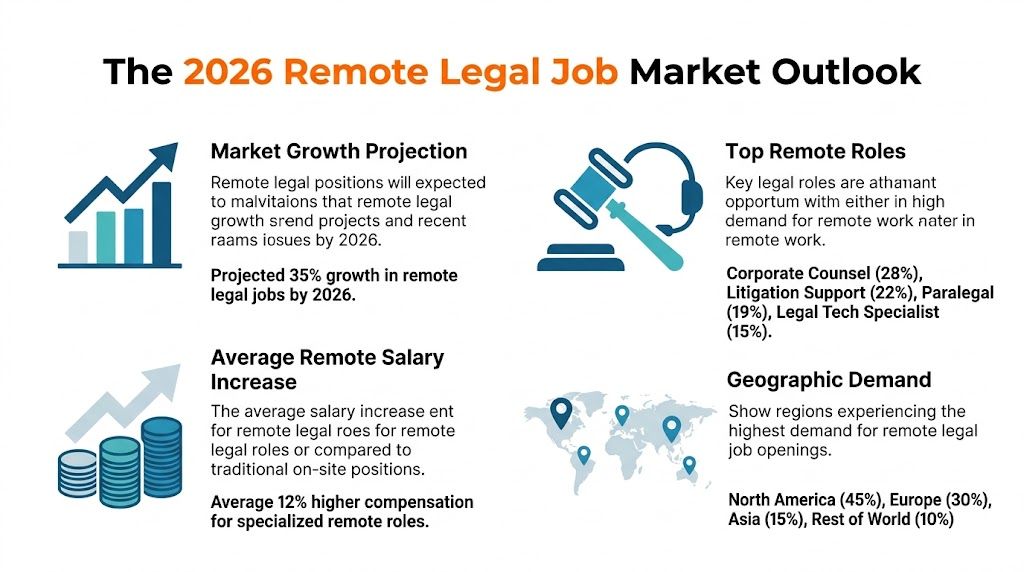
The broader legal market remains healthy, but remote legal jobs sit inside a market that is growing while also becoming more selective about who gets flexibility. According to this legal job market summary, the legal job market is projected to expand 5% annually through 2033, and tech-related practice areas such as AI and cybersecurity law are forecasted to grow 15% to 20% annually from 2025 to 2030. The same source says overall legal demand rose 2.8% in 2024.
That combination matters. Growth supports hiring. Specialization shapes where the best remote roles appear.
Where the strongest demand sits
Remote-friendly legal hiring is strongest where legal work intersects with business operations, regulation, and scalable systems. Employers with recurring contract volume, privacy exposure, employment complexity, or product risk tend to be more open to distributed legal talent. That usually means in-house teams, legal tech companies, alternative legal service providers, and some specialized firms.
Practice areas tied to AI, cybersecurity, and data privacy are especially important because the work is current, cross-functional, and less dependent on courtroom presence. Candidates with the ability to translate legal requirements into business guidance have an advantage here.
If you're comparing remote legal careers against broader distributed work trends, a wider labor-market view like Top 10 Work From Home Jobs In Demand for 2026: A Global Guide helps show where legal roles fit relative to other remote-capable functions.
The trade-offs candidates need to price in
Compensation in remote legal jobs is rarely just about title. Employers still look at jurisdiction, internal pay bands, specialty, and whether the role is employee or contractor. A remote posting can still carry location logic, especially if the employer benchmarks against major legal markets or requires occasional office access.
Three practical points matter:
- Hybrid is still dominant in many traditional employers. A posting may sound flexible but still reward local candidates.
- Specialization travels better than generalism. Employers will stretch on location faster for a privacy counsel than for a broad generalist with no clear niche.
- Contract arrangements can look attractive on paper but shift risk to the worker. Candidates need to evaluate benefits, workflow stability, and supervision expectations, not just headline pay.
A remote legal role is worth less than it appears if the employer has no process discipline, vague expectations, and a culture that rewards whoever stays online the longest.
The market is good. It isn’t loose. Employers still hire carefully, and they move fastest for candidates who already look operationally remote-ready.
How to Find Your Ideal Remote Legal Role
Most legal professionals waste time on search volume instead of search quality. They scan hundreds of listings, apply too broadly, and then wonder why the callbacks are thin. The better approach is to narrow by role mechanics first, then by employer type, then by policy language.
Start with the work, not the keyword
“Remote legal jobs” is too broad to search by itself. Use the function you perform. A contracts lawyer should search commercial counsel, contracts counsel, contract manager, legal operations, and CLM-related titles. A litigation candidate may need to search e-discovery, litigation support attorney, staff attorney, review counsel, and case management roles.
Many lawyers self-sabotage. They identify with a credential instead of a workflow. Employers hire workflows.
Try a search structure like this:
- Primary title terms tied to your current or target role
- Adjacent titles that describe similar work in another employer category
- Software and process terms such as Ironclad, DocJuris, Relativity, e-billing, redlining, playbooks, privacy, investigations, or regulatory
- Policy qualifiers such as remote, distributed, work from home, asynchronous, global, or hybrid
Prioritize employer types that actually support remote work
A fully remote legal job is often easier to find in an employer built around distributed work than in a traditional office-first institution trying to accommodate flexibility. In practical terms, that means looking harder at:
- In-house legal teams in software, fintech, healthcare, and digital services
- Alternative legal service providers with process-based delivery models
- Legal tech companies that hire counsel, legal specialists, and product-facing legal talent
- Mission-driven organizations that support distributed teams across regions
- Remote-first startups where legal sits close to product, compliance, or commercial operations
A classic firm may still offer a remote legal job. But when it does, check whether the exception is tied to one partner’s preference, a temporary hiring need, or a documented companywide model. Only one of those is stable.
Use job boards with a legal filter and a remote filter
You need both. General remote boards can surface legal-adjacent roles that legal-only boards miss, especially in contracts, compliance, privacy, and legal ops. Legal-specific boards can still be useful for niche attorney work, but they often under-label remote flexibility or bury it in the posting text.
A practical search stack usually includes:
- General remote boards for broad discovery
- Legal-specific boards for specialty terms
- LinkedIn and recruiter pipelines for in-house visibility
- Company careers pages for direct applications
- Bar and alumni networks for referral-led openings
If you want a broader benchmark for where remote opportunities are surfacing, a roundup like remote job boards worth checking can help compare discovery channels instead of relying on one source.
Read postings like a recruiter
A good posting tells you more than the title.
Look for signs of a healthy remote role:
- Clear ownership language such as “manage,” “advise,” “lead,” or “support cross-functional teams”
- Named systems like Ironclad, Relativity, ContractPodAi, e-billing, or ticketing tools
- Defined business partners such as sales, HR, procurement, product, or security
- Stated work model that specifies remote, hybrid cadence, or location limits
Red flags are just as useful:
- “Remote” in the headline with office attendance hidden below
- No mention of tools, process, or reporting lines
- Extremely broad responsibilities that suggest understaffing
- Vague language around time zones or availability
If a legal employer can’t describe how work gets assigned, reviewed, and escalated, the remote experience usually becomes chaotic fast.
Use recruiters the right way
Legal recruiters can help, but only if you give them a marketable story. “I’m open to anything remote” is not a usable brief. Recruiters respond better to precision.
Give them this instead:
- Your current function and years of experience
- Practice area or business niche
- Preferred work model
- Jurisdiction or licensing constraints
- Tools you know
- Role types you’ll consider and those you won’t
That makes it easier for a recruiter to remember you when the right role appears.
A useful video on building a smarter remote search process is below.
Build a shortlist, not a giant spreadsheet
Candidates who get hired fastest usually work from a focused target list. They choose a manageable set of employers and role types, then tailor outreach and applications. That produces better documents, better interviews, and better follow-up.
For remote legal jobs, precision beats volume nearly every time.
Preparing Your Application for a Remote World
Strong legal candidates still lose remote jobs because their application reads like it was written for an office-bound role. It lists matters, credentials, and duties, but says nothing about how the person works. Remote employers notice that immediately.

Show remote competence on the resume
Your resume needs to do more than prove you’re legally qualified. It has to show that you can produce high-quality work without physical proximity. Recent 2025 to 2026 trends show 25% year-over-year growth in non-barred remote legal ops jobs, and 40% of new remote attorney postings prioritize tech fluency over traditional practice areas, according to this remote attorney and legal ops market summary.
That should change how you write your experience.
Instead of this:
- Assisted with contract review and legal support
Use language closer to this:
- Managed contract redlines, playbook alignment, and stakeholder approvals across distributed sales and legal teams
- Coordinated discovery workflows and document review using platform-based processes
- Supported policy and compliance updates through written guidance, intake tracking, and cross-functional follow-up
The point isn’t buzzwords. The point is operational proof.
Translate your experience into systems and outcomes
Hiring managers for remote legal jobs usually look for signs that you can work inside structure. Show the systems, tools, and routines you’ve used.
Focus on details like:
- Platforms you’ve worked in, such as CLM tools, e-discovery tools, e-billing systems, or matter trackers
- Communication habits like written status reporting, handoff notes, internal guidance, and stakeholder updates
- Workflow ownership such as intake, triage, escalation, review, approvals, and closing loops
- Cross-functional work with HR, finance, security, procurement, sales, or product teams
This is also where a tactical check matters. Before sending your application, run it through a guide on how to beat ATS for remote roles so your document aligns with job-language patterns and doesn’t get screened out for avoidable formatting or keyword issues.
The resume that wins remote interviews makes the hiring manager feel calm. It signals, “This person will know what to do when Slack is quiet and the issue is still urgent.”
Cover letters still matter in legal hiring
In many legal searches, the cover letter remains a writing sample in disguise. For remote roles, it also proves whether you understand the employer’s operating context.
A useful cover letter for remote legal jobs should do three things well:
Name the fit clearly
Tie your experience to the role’s actual work, not just the employer’s reputation.Demonstrate remote behavior
Mention distributed collaboration, written advisory work, systems use, or cross-time-zone coordination if you have it.Reduce perceived risk
Address licensing, location, or work authorization issues if they might create doubt.
Keep it tight. Legal employers don't need a memoir.
Upskill where the market is moving
The fastest-growing gap I see is not legal intelligence. It’s legal-tech fluency. Candidates often have the underlying judgment, but they can’t speak credibly about CLM workflows, AI-assisted review, prompt discipline, or process design.
If you’re aiming at remote legal jobs, your upskilling list should be practical:
- Contract lifecycle tools
- E-discovery or review platforms
- Privacy and data governance workflows
- AI-assisted drafting and review practices
- Legal ops vocabulary, including intake, routing, playbooks, spend, reporting, and workflow improvement
Don’t claim expertise you don’t have. But do get specific about what you’ve touched and what you can learn quickly.
Interview for trust, not charisma
Remote interviews are less forgiving of vague answers. Hiring managers are trying to picture you handling real work with limited supervision. The best answers are concrete and process-based.
Prepare examples around:
- A time you managed urgent legal work with incomplete information
- How you keep stakeholders updated without being chased
- A situation where you improved a workflow, template, or review process
- How you prioritize when multiple teams need legal input at once
- Your setup for remote work, including communication habits and availability norms
Technical setup also matters. Reliable audio, decent lighting, and a neutral background are basic. In legal hiring, sloppy setup reads as sloppy judgment.
Navigating Global Opportunities and Work Logistics
Global remote legal work is where many candidates get excited and then run into hard legal limits. The main one is simple. A role may be remote without being borderless. Bar admission, local practice rules, client jurisdiction, data handling obligations, and employment law all shape the true scope of “remote.”
Jurisdiction still controls the market
International candidates often assume that remote legal jobs are open if the work is online. In practice, employers may still require a specific bar status, local law knowledge, or eligibility to work in a named country. That’s especially true for attorney roles involving advice, regulated filings, or direct client representation.
This is why non-practicing and legal-adjacent roles can be strategically stronger for global applicants. Contract management, compliance operations, legal ops, review work, privacy support, and process-heavy legal tech roles often travel more easily than classic practicing-lawyer positions.
A useful starting point for anyone considering border-crossing work is working remotely abroad, because the job is only one part of the equation. Immigration status, tax exposure, employer policy, and local work rules matter too.
Compensation and schedule trade-offs are real
Salary conversations get more complicated once a role crosses borders. A key unanswered question for many remote lawyers is salary disparity. US-centric pay bands are often quoted at $103k to $142k for directing roles, while remote jobs in Europe and Asia may offer 20% to 30% lower base pay but stronger benefits, according to this discussion of global remote legal pay and work patterns. The same source notes that 35% of 2026 postings demand non-standard hours.
That leads to practical choices rather than universal rules.
- Higher base pay may come with US-time coverage requirements
- Better benefits may come with lower salary bands
- Global teams may require early mornings, late evenings, or split-day schedules
- Location flexibility may still exclude certain countries for payroll or compliance reasons
Remote doesn't eliminate trade-offs. It just moves them from commuting and office politics to jurisdiction, schedule, and pay structure.
Time zone fit is part of candidacy
Candidates often focus on qualifications and ignore operating overlap. Hiring managers don’t. If your target role requires close collaboration with US counsel, product teams in Europe, or operations staff in APAC, your availability becomes part of the hiring decision.
The strongest candidates address this directly in interviews. They explain when they work, how they handle handoffs, and what overlap they can reliably provide. That signals maturity and reduces uncertainty.
For lawyers who want global flexibility, that mindset matters as much as licensing. The practical question is never just “Can I do this job remotely?” It’s “Can this employer run the work cleanly with me where I am?”
Building Your Future Remote Legal Career
Remote legal hiring will keep rewarding narrower expertise, better remote judgment, and stronger operating reliability. The candidates who stay competitive over the next five to ten years will not be the ones with the broadest title. They will be the ones who can show clear value in a defined slice of work and prove they can deliver it in a distributed team.
That usually means choosing a lane and getting sharper in it. Contract review tied to a specific industry. Privacy work tied to product counseling. Legal ops tied to intake design, CLM administration, or outside counsel management. Hiring managers remember candidates who are easy to place in a real business need.
The other long-term separator is evidence. Remote employers increasingly want proof, not claims. A resume that matches the role language, a skills profile that shows where you are strong and where you need work, and a realistic answer on time-zone fit all reduce hiring risk. That is where free tools can help if you use them well. YayRemote’s ATS checker helps tighten your resume against the posting. Its skills analyzer helps you spot gaps before an interview exposes them. Its time zone tool helps you assess whether a role is workable before you spend weeks in process.
Use those tools early, not after a rejection.
If you're ready to put this into practice, start with YayRemote. It brings together curated remote roles, practical filters, and application tools that help legal candidates compete more effectively in a crowded remote market.