Working Remotely Abroad: Your 2026 Guide
Your complete guide to working remotely abroad. Find jobs, secure visas, manage taxes, and navigate logistics for a successful 2026 move.
You’re in one of two places right now.
Either your job already works fine from a laptop and you’re wondering if you can stop organizing your life around one expensive city, one lease, and one commute. Or you’ve already tested remote work from home, realized it’s viable, and now you want to take the next step without turning your tax, visa, payroll, and housing situation into a mess.
That second part is where most advice falls apart. Plenty of articles sell the lifestyle. Far fewer explain how to make working remotely abroad function week after week when you have deadlines, employer policies, immigration rules, local registration requirements, and a real salary to protect.
The practical upside is that this is no longer a fringe setup. In 2025, approximately 32.6 million Americans, representing 22% of the U.S. workforce, work remotely, while 55% of U.S. jobs are telework-eligible and 28% of the global workforce operates remotely, which is why this path is now realistic for a much larger group of professionals than it was a few years ago (remote work statistics for 2025).
The hard part isn’t deciding you want it. The hard part is building an operating system for it.
From Dream to Destination Your First Steps
The first mistake people make is treating the move as a travel decision. It’s not. It’s a work arrangement with an international layer.
That means your first pass should be boring on purpose. Before you compare neighborhoods in Lisbon or look at beach rentals in Mexico City’s “nearby” alternatives, check whether your role, employer, and working style can handle distance without drama.

Run a feasibility check on your job
Some jobs are portable. Some look portable until one compliance review kills the plan.
Use this quick filter:
- Role fit: If your work is already measured by output, documents, tickets, code, campaigns, or client deliverables, you have a stronger case.
- Access risk: If you handle regulated data, export-controlled information, or systems with location restrictions, expect more scrutiny.
- Meeting load: A role with heavy live collaboration is still possible, but only if your destination preserves enough overlap with your team.
- Manager trust: If your employer already trusts you to work independently, your odds improve fast.
A lot of professionals focus on whether they can do the work abroad. Your employer is usually focused on whether they can support it without creating legal or operational problems.
Practical rule: If your current setup already depends on tight supervision, constant ad hoc calls, or office-only systems, fix that before you bring another country into the picture.
Treat finances like a runway, not a fantasy
Even high earners get sloppy here. They assume a strong salary solves everything.
It doesn’t. Moving abroad creates friction costs. Deposits, temporary housing, insurance, document fees, local setup costs, and backup travel all land before your new routine stabilizes.
I like to pressure-test three categories before committing:
| Category | What to verify |
|---|---|
| Income stability | Is your salary or contract secure for the period you want to be abroad? |
| Cash access | Can you handle delays, card issues, and local banking friction without stress? |
| Exit plan | If the arrangement fails, can you leave quickly without financial damage? |
If you want a broader primer before building your own spreadsheet, this guide to working remotely from another country is useful because it frames the move as a practical relocation problem, not just a lifestyle upgrade.
Pitch the employer like an operator
Don’t open with “I want to live abroad for a while.” Open with a controlled proposal.
Good requests include:
- A defined location
- A defined time period
- Core overlap hours
- A communication plan
- A statement that you’ll follow company approval requirements
- A fallback if the trial doesn’t work
If your employer hesitates, they’re usually reacting to uncertainty, not rejecting the idea outright.
A stronger script sounds like this:
I’d like approval for a time-bound remote work arrangement from one location abroad. My working hours will preserve overlap with the team, my deliverables won’t change, and I’m prepared to follow any HR, payroll, security, or immigration requirements the company sets.
Pick a destination with a work filter
The right city for a vacation can be the wrong city for a quarter of focused work.
Choose based on four things:
- Time zone fit: Can you maintain sane overlap without living on split shifts?
- Legal path: Is there a clear visa or permission route for your nationality and income?
- Infrastructure: Stable internet, housing supply, and healthcare access matter more than aesthetics.
- Lifestyle match: Don’t choose a social party hub if you need quiet deep-work weeks.
A good destination feels slightly boring on paper. That’s often a sign it will work.
Navigating the Legal Labyrinth of Visas and Permits
Immigration is where casual plans usually become expensive plans.
A lot of people still approach this backwards. They pick a country first, book something refundable, then start hunting for a legal basis to stay. The more reliable approach is the opposite. Start with your income type, nationality, intended stay length, and employer relationship, then narrow the country list.
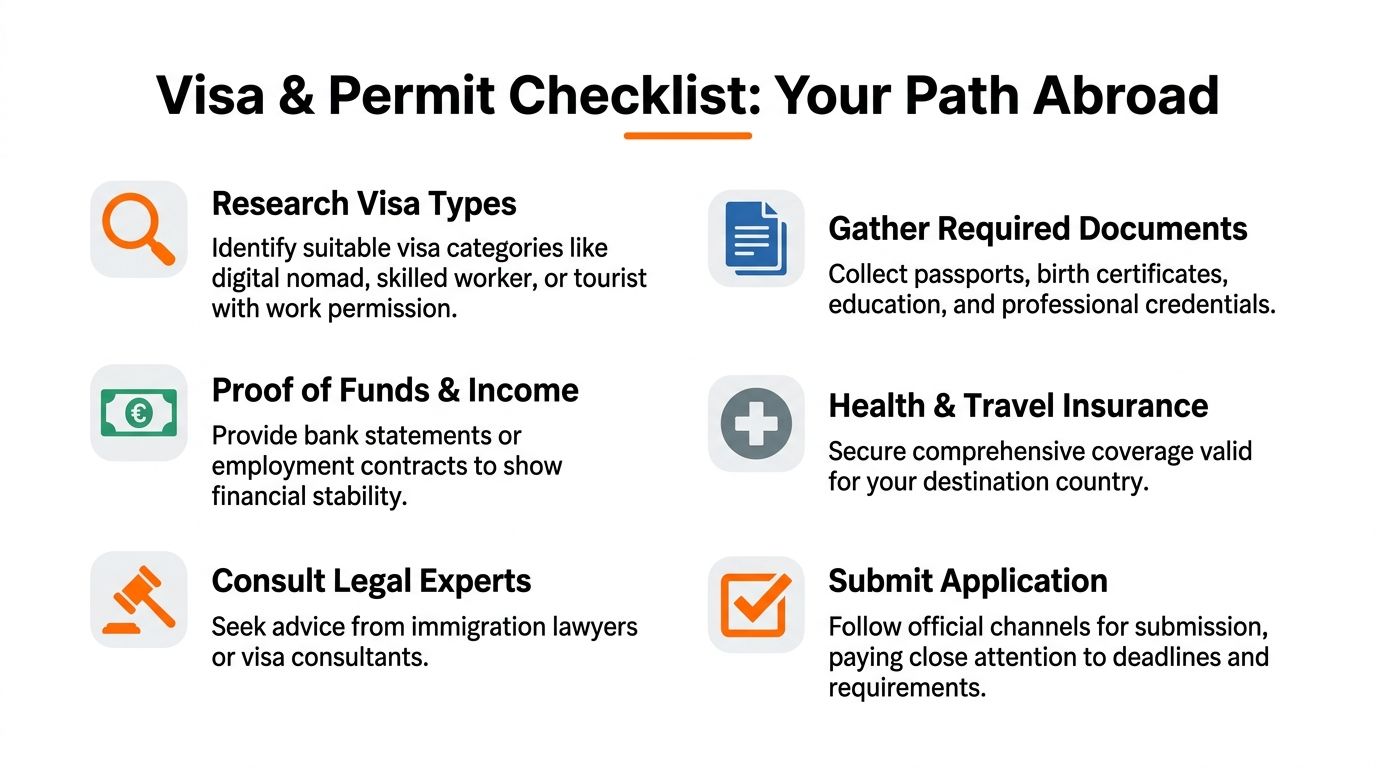
Match the visa to your actual setup
There isn’t one “remote work visa.” There are several buckets that get mixed together:
- Digital nomad visas for remote employees or independent professionals with foreign income
- Long-stay visas that may allow residence but not always remote work
- Residence permits tied to specific categories such as self-employment or other qualifying grounds
- Short stays that may be simple for travel but weak for compliant work
The cleanest option is usually a digital nomad route when available. For digital nomads using eligibility tools, a practical workflow is to match visa rules to your profile, then verify income proof, insurance, and stay duration. Some options, including examples like Portugal D8, often require €3,000+/month income proof, health insurance, and stays in the 4 to 12 month range, and it’s smart to confirm time zone overlap before you apply (cross-border remote work statistics and visa context).
If you want a country-by-country starting point, this guide on digital nomad visa requirements is useful for comparing what different destinations tend to ask for before you get buried in government PDFs.
Build your document pack before you need it
Most applications don’t fail because the applicant is unqualified. They fail because the file is inconsistent.
Prepare these early:
- Passport scans: Check validity, blank pages, and expiration buffer.
- Income evidence: Employment letter, contract, pay slips, bank statements, or client agreements.
- Insurance proof: Make sure the policy wording aligns with the destination’s visa rules.
- Accommodation evidence: Some countries want an address early, others are flexible.
- Background documents: Birth certificates, criminal record checks, or notarized records may be required depending on the route.
What matters is consistency. Your contract, bank records, application form, and insurance dates should tell the same story.
Use a country filter, not a hype list
Portugal, Spain, and Japan often attract the same applicant for very different reasons, but they don’t create the same working conditions.
Portugal may suit someone who wants a known remote-work ecosystem and an established nomad path. Spain often appeals to professionals who want a large-city option with deeper local life. Japan may attract people for personal reasons, but the workability depends heavily on schedule alignment and paperwork fit.
That’s why a decision matrix beats a “top 10” list.
| Decision factor | Better fit |
|---|---|
| Need strong overlap with U.S. teams | Locations closer to North American time zones |
| Want easier social integration with existing nomad circles | Established remote hubs |
| Prefer long, stable stays over frequent moves | Countries with clearer long-stay processes |
| Need a low-friction first attempt | Places with straightforward document requirements |
Don’t apply for a visa you can technically qualify for if the resulting schedule, banking setup, or local registration process will make your working week miserable.
Common application mistakes
The patterns are predictable:
- Applying too late. Processing times can stretch, and document collection always takes longer than expected.
- Using vague employer letters. A generic HR note is weaker than a letter that clearly states your role, salary, remote permission, and ongoing employment.
- Ignoring local follow-up steps. Approval to enter isn’t always the same as completing post-arrival registration.
- Treating forums as legal advice. Community groups are useful for spotting friction points, not for replacing official instructions.
If you want this to feel manageable, think like a project manager. One country. One visa path. One complete document set. No improvisation.
Solving the Tax Payroll and Employer Puzzle
The trip feels approved right up until payroll asks where your wages will be taxed, HR asks whether you can legally work there, and legal asks whether your presence creates employer obligations in another country. That is usually the point where a casual remote-work plan turns into an operations project.

High earners run into this faster than they expect. Larger salaries attract closer review, equity compensation can create extra reporting issues, and employers become less relaxed when a senior employee is signing contracts, managing people, or speaking to clients from abroad.
The three questions your employer is asking
Your company usually cares about three things before it cares about your preferred city:
- Do you have the legal right to work from that country?
- Will your stay create tax, payroll, or employment-law exposure?
- Can the company pay you in a way that matches local rules?
A weak request focuses on productivity and lifestyle. A strong request answers the employer's risk questions in plain language, with dates, country, and a proposed payroll path.
Two concepts drive most decisions.
Tax residency
Tax residency is not just a day count. The 183-day threshold matters in many countries, but tax authorities also look at local rules, treaty treatment, where you live, and whether your center of life has shifted.
I have seen people rely on "under 183 days" as if it were blanket protection. It is not. Some countries can still treat part of your income as taxable locally, and your home country may still expect full reporting.
Permanent establishment
This is the phrase that makes legal teams nervous. If your work abroad suggests the company has an ongoing business presence in that country, the employer may face local corporate tax or registration obligations.
Risk rises when the employee is senior, revenue-facing, or habitually negotiating and signing deals. A software engineer doing temporary internal work from abroad is different from a country manager meeting customers every week from the same location.
Payroll model
In practice, there are three common ways to structure the arrangement:
| Model | Upside | Trade-off |
|---|---|---|
| Stay on home payroll | Lowest disruption if the stay is short and approved | Often fails once the stay gets longer or local rules get stricter |
| Convert to contractor | Can create more location flexibility on paper | Misclassification risk stays high if the working relationship still looks like employment |
| Use an EOR | Gives the employer a local employment wrapper | Adds cost, paperwork, and another party to manage |
The contractor route is where people make expensive mistakes. If the company still controls your hours, equipment, reporting line, and scope of work, changing the label may not change the legal reality.
For a practical breakdown of payroll options, local employment structures, and trade-offs between direct hire and EOR models, this guide on how to pay international employees is worth reviewing.
What to put in a remote work addendum
Get the arrangement in writing before you book anything expensive.
A useful addendum usually covers:
- Approved work location
- Start date and end date
- Expected working hours and time-zone overlap
- Who handles tax review and payroll changes
- Security and device requirements
- Expense policy
- Grounds for ending the arrangement early
- What happens if local registration, tax, or visa assumptions change
That last point matters. I always want a clause that says the company can pause or revise the arrangement if local compliance advice changes, because that is exactly what happens in the world. Rules get interpreted differently. HR changes vendors. Payroll discovers a blocker late.
Your personal side needs the same level of planning. Cash reserves, exchange-rate exposure, retirement contributions, and tax filing costs can all shift once you stop living where you earn. This financial planning for expats piece is a useful companion because it focuses on the money mechanics that sit outside the average HR checklist.
Later in the approval process, it helps to hear the issues discussed plainly:
A script that works better than a vague request
Use a request that reduces ambiguity:
I’m requesting approval to work from one country for a defined period. I’ll maintain the required overlap hours, follow company security rules, and complete HR, payroll, and tax review before departure. If needed, we can start with a limited trial period and document the arrangement in a formal addendum.
That wording works because it gives the company a controlled proposal, not an open-ended exception. It shows you understand that working abroad is not just a travel decision. It is a legal, financial, and operational setup that has to hold together after the flight lands.
Setting Up Your Life Support System Abroad
Once the legal side is in motion, daily life becomes the primary work.
A weak setup doesn’t usually fail in a dramatic way. It fails through friction. Your card gets blocked. Your short-term rental has thin walls and a bad desk. Your insurer covers emergencies but not much else. You spend your first month fixing preventable problems instead of settling into work.
Banking that won’t fight you
You need a payment setup that works across borders, not just a domestic account that happens to function overseas.
A practical stack often includes:
- One primary account where salary or invoices land
- One spending account with low conversion friction
- One backup card stored separately
- A transfer tool for moving money across currencies when needed
The point isn’t sophistication. It’s redundancy. If one provider flags foreign activity, you still need rent money and food money without panic.
Insurance that matches the stay
Travel insurance and long-term international health coverage aren’t the same thing.
Travel insurance can help with trip disruption and emergencies. Long-stay remote workers usually need something broader, especially if the visa requires proof that your coverage is valid in the destination country.
Check the policy language carefully. “Overseas coverage” can mean very different things from one insurer to another.
Housing for a working week, not a holiday week
The photos matter less than the floor plan, noise level, and internet reliability.
I’d rank accommodation like this:
- A one-month furnished place with a proper desk area
- A short initial stay while you inspect medium-term options locally
- A hotel or holiday rental only as a bridge
When screening housing, ask direct questions:
- What’s the workspace?
- Is there street noise at night?
- Is the internet stable during work hours?
- Are there blackout curtains if you’ll work odd hours?
- Is there backup mobile reception in the building?
A beautiful apartment with bad acoustics and weak internet is not a remote-work apartment. It’s a trap with good photos.
Your first month checklist
The first month should focus on stability, not exploration.
- Confirm local connectivity: SIM, eSIM, and backup data.
- Register what must be registered: Follow local arrival and residence rules tied to your visa.
- Map your essentials: Grocery store, pharmacy, clinic, ATM, coworking option.
- Test your workday early: Don’t wait for an important meeting to learn the apartment Wi-Fi drops at noon.
If this system feels slightly overbuilt, that’s good. Working remotely abroad goes much better when ordinary problems stay ordinary.
Building Your Remote Work Command Center
The romance of remote work disappears quickly when your connection fails during a client call or your team can’t tell when you’re available.
A professional setup abroad needs redundancy, security, and predictable communication. Not because you’re trying to look serious, but because distance removes the informal trust you’d otherwise get for free in an office.

Build around failure points
Most remote setups assume everything will work. Good setups assume something will fail.
Start there:
- Internet: Have a primary connection and a backup, usually mobile.
- Power: Know whether your building has outages and where you can relocate fast.
- Hardware: Carry the adapter, charger, headset, and any cable you’d curse yourself for forgetting.
- Security: Use your employer-approved VPN and keep device protections current.
If your company handles sensitive data, this part isn’t optional. The farther you are from IT support, the more your own discipline matters.
Make your hours visible
Time zone confusion causes more damage than people expect.
You don’t need perfect overlap. You need clear overlap. Define when you’re online for meetings, when you’re working asynchronously, and when you’re off.
A simple working-hours note in Slack, Google Calendar, or your team handbook can prevent a lot of resentment. If you need help modeling realistic overlap windows before you commit to a location, a resource like tools for remote work is useful because it points to practical ways teams handle scheduling and async collaboration.
Your command center stack
This doesn’t need to be fancy. It needs to be reliable.
A strong baseline looks like this:
| Layer | What it covers |
|---|---|
| Connectivity | Home Wi-Fi, mobile hotspot, local SIM or eSIM |
| Communication | Slack, email, calendar discipline, meeting norms |
| Execution | Project management tools, docs, task ownership |
| Security | VPN, MFA, device encryption, approved storage |
| Ergonomics | Laptop stand, keyboard, mouse, headset |
Prove reliability through behavior
Remote workers abroad often worry about being seen as less committed. The fix usually isn’t working longer. It’s making work more legible.
Do these instead:
- Send clearer updates than you think you need to.
- Confirm deadlines explicitly.
- Flag blockers early.
- Document decisions after meetings.
- Protect your off-hours so you don’t slide into permanent semi-availability.
A disciplined remote setup sends a message without you saying it: distance isn’t reducing your standards.
Thriving Post-Arrival From Compliance to Community
The first week abroad usually feels efficient. You’ve landed, unpacked, tested the Wi-Fi, maybe found a decent coffee shop. The emotional wobble often comes later.
Usually it shows up after the novelty drops. Your friends are elsewhere, your team is asleep when your evening starts, and the city around you still feels like someone else’s routine. That’s why the post-arrival phase matters just as much as the visa phase.
Handle compliance before it becomes a problem
Some countries expect follow-up steps after entry. That can mean registration, a local appointment, a residence card process, or address confirmation.
Do those early.
Don’t let a “temporary” first apartment become an excuse to delay paperwork you already know is required. The longer you leave it, the more likely it is to collide with work deadlines, travel plans, or missing documents.
Build a safety routine fast
I don’t mean paranoia. I mean reducing avoidable stress.
A good first-week routine includes:
- Walking the area in daylight and after dark
- Saving local emergency contacts
- Learning the common payment and scam patterns
- Keeping digital and physical copies of key documents separate
- Knowing where you’d work if your apartment became unusable for a day
That last one matters more than people think. A backup workspace can save a normal Tuesday.
Community takes more than coworking
A lot of guides stop at “join a coworking space.” Sometimes that helps. Sometimes it just gives you a room full of people doing parallel solitude.
The deeper issue is harder. Research and practitioner reports note that remote workers abroad can experience unexpected waves of isolation and loneliness, and that the long-term strain of outsider status, especially when visa restrictions limit local participation, requires more deliberate strategies than generic networking advice (working remotely abroad and social integration challenges).
So build community on multiple tracks:
- Routine-based contacts: Gym classes, language exchange, recurring cafés, volunteer groups where permitted.
- Interest-based groups: Running clubs, climbing gyms, reading groups, maker spaces, music meetups.
- Professional peers: Industry dinners, founder groups, design critiques, tech meetups.
- Home ties: Keep regular calls with people who know your baseline personality, not just your travel version.
Loneliness abroad often isn’t about being alone. It’s about lacking repeated, low-pressure contact with people who start to recognize you.
Make the place legible
One thing that helps more than people expect is administrative familiarity.
Learn the grocery stores. Learn the pharmacy chain. Learn how deliveries work. Learn what documents people routinely ask for. Learn enough local language to handle basic transactions without stress.
That’s when a destination starts to feel livable rather than temporary. And that shift often matters more for your mental stability than another weekend trip.
Answering Your Toughest Remote Work Questions
You have the flights shortlisted, a lease half-negotiated, and a manager who says, "This should be fine." Then important questions show up. Can you work on a tourist entry without issue? What happens if payroll notices you are abroad? What if a 30-day test turns into 90 and your paperwork does not match reality?
Those are the questions that decide whether this works.
Can you work on a tourist visa?
Sometimes people do. The risk is that the arrangement can fail at exactly the wrong moment.
Tourist status often looks workable until something forces scrutiny. That could be an immigration officer asking about your setup, an employer security review, a landlord requesting local documents, or a simple extension request that exposes the fact pattern. High earners tend to underestimate this because they are used to solving problems with money or speed. Immigration rules do not work that way.
Use the lawful route that matches what you are doing. If no clear route exists, treat that as a risk decision with legal, employment, and travel consequences. Do not treat it as admin trivia.
What if your employer says no?
A vague request gets rejected for vague reasons.
Employers usually worry about four things. Tax exposure, employment law, data security, and precedent. "I want to spend a few months in Spain" sounds like a personal preference. "I want approval for one country, for eight weeks, with fixed overlap hours, employer-approved equipment, and written confirmation from payroll and legal" sounds like something a company can assess.
Bring a proposal your manager can circulate internally:
- Name one country
- Set exact dates
- Define your working hours and response times
- Confirm how you will handle security, devices, and sensitive data
- Ask who needs to approve tax, payroll, and HR implications
- Offer a trial period with a review date
That shifts the conversation from lifestyle to operational control. It also exposes the primary blocker early. In several of my own moves, the issue was not manager trust. It was legal or payroll refusing open-ended arrangements.
What if you accidentally overstay?
Handle it immediately.
Check your entry stamp, e-gate record, visa conditions, and any extension filings. Confirm the exact dates before you book onward travel or speak casually to border staff. If the position is unclear, get advice from the relevant authority or a local immigration lawyer and keep records of every communication.
Small mistakes become expensive because they affect future entries, residence applications, and sometimes even routine banking or registration steps. A simple date log prevents a lot of pain. Keep one file with entry dates, permitted stay, visa validity, extension receipts, and local registration documents.
Is becoming a contractor the easy fix?
Often, no.
Changing the label does not change the working relationship by itself. If the company still controls your hours, equipment, reporting line, and day-to-day work like an employee setup, the contractor structure may create a second problem instead of solving the first. That problem can show up in tax reviews, labor classification disputes, or local invoicing requirements you were not prepared for.
Contractor status can work well when the arrangement fits. It can also increase your admin load fast. You may need your own entity, your own tax filings, your own insurance, and a plan for pension, benefits, and currency risk.
How long should your first attempt be?
Pick a test period that is long enough to expose friction and short enough to unwind cleanly.
For a first run, one country and one housing base usually gives better information than hopping between cities. You learn what your workdays feel like, whether your overlap hours are sustainable, how much admin the location creates, and whether your employer is comfortable once the arrangement becomes real. Constant movement hides bad assumptions because every week feels like an exception.
Start with a defined period. Then review the facts, not the fantasy.
Is this lifestyle sustainable?
Yes, if you run it like a system.
The people who last are rarely the ones chasing the most photogenic setup. They choose places with reliable internet, workable time zones, predictable housing, and clear immigration options. They keep a cash buffer. They know where their documents are. They leave margin for bad weeks, not just good ones.
That is the part many articles skip. Working remotely abroad is not one decision. It is a stack of legal, financial, and logistical decisions that need to keep working at the same time.
If you are ready to turn the idea into an actual plan, YayRemote can help you work the problem from both ends. You can use it to find hand-picked remote roles from distributed companies and, if you’re already employed, use its visa and remote-work resources to compare destinations, requirements, and practical next steps before you move.