Software Development Best Practices: The 2026 Guide
Master modern software development best practices for 2026. This guide covers the entire SDLC for remote and co-located teams, from architecture to CI/CD.
You’re probably dealing with some version of the same mess many organizations encounter. Pull requests sit overnight because the one reviewer who understands that part of the code is asleep in another time zone. Releases feel risky, so they get delayed. New hires need weeks to understand how the system works. Production bugs keep tracing back to “small” changes that nobody thought would matter.
That isn’t a talent problem. It’s usually a systems problem.
The software development best practices that matter in 2026 aren’t abstract ideals. They’re the operating rules that let a distributed team ship without constant hand-holding. In remote-first companies, weak practices show up faster and hurt more. Every unclear interface, every undocumented decision, every flaky test, and every manual deployment turns into asynchronous drag.
Why Best Practices Are Non-Negotiable in 2026
Teams still try to brute-force software delivery with effort alone. More meetings. More status updates. More heroics before a release. That works for a sprint or two, then the cracks widen. Technical debt grows, lead times stretch, and the people doing the work start burning out.
Distributed teams amplify that reality. In an office, someone can swivel a chair and ask what a service is supposed to do. In a remote setup, unclear code and vague process can stall work for a full day. That’s why software development best practices aren’t bureaucracy. They’re latency reduction for humans.
Chaos usually comes from missing discipline
Projects rarely fail because one engineer made a bad call on a Tuesday. They fail because the team runs without stable habits. Requirements shift without a written record. Planning happens once at the start and never again. Stakeholders see progress too late. Review quality depends on who happens to be online.
The long-running Chaos Report is still one of the clearest signals here. Projects using disciplined Agile practices were about three times more likely to succeed than traditional waterfall projects, with a 39% success rate versus 12% according to the summary cited by Senla’s overview of the Chaos Report findings.
That number matters, but the mechanism matters more. Teams do better when they work in smaller loops, involve users earlier, and make progress visible before it’s expensive to change direction.
Best practices aren’t there to make engineers feel controlled. They exist so the team doesn’t have to rediscover the same lessons under deadline pressure.
Remote-first teams need explicit operating rules
A lot of generic engineering advice still assumes proximity. It assumes shared context, hallway conversations, and fast clarification. Remote teams don’t get that for free. They need stronger defaults around architecture, documentation, testing, and delivery.
That’s also why it helps to revisit resources grounded in modern software engineering principles. The useful ones don’t treat quality, collaboration, and delivery as separate tracks. They treat them as one system.
When teams skip that system, they create invisible tax. Every release needs extra coordination. Every handoff needs explanation. Every urgent issue pulls the same senior people back into the loop. Over time, the team stops scaling even if headcount goes up.
What high-performing teams do differently
The strongest remote teams don’t rely on memory or heroics. They build habits that make good outcomes more likely:
- They reduce ambiguity early: requirements, interfaces, and ownership are written down before work spreads across time zones.
- They shorten feedback loops: smaller changes, faster review, and earlier validation beat large releases every time.
- They make quality automatic where possible: style checks, tests, and deployment gates shouldn’t depend on someone remembering.
- They protect focus: they don’t turn every uncertainty into a meeting.
That’s why best practices are essential now. Software got more complex, not simpler. Teams got more distributed, not less. Ad hoc development can still produce code. It just can’t reliably produce outcomes.
Architectural Integrity and Scalable Design
Architecture decides whether a team can move independently or whether every change turns into negotiation. That’s even more obvious in remote companies, where the cost of coordination is higher and slower.
A shaky architecture doesn’t always fail loudly at first. It usually fails as drag. Features take longer than expected because touching one module means touching four others. Reviewers ask for the same clarifications every week. One senior engineer becomes the translation layer between services, teams, and old design decisions.

Architecture is a communication tool
A lot of teams talk about architecture as if it’s only about scalability or performance. Those matter, but for distributed teams the first job of architecture is clarity. It tells people where logic belongs, what depends on what, and how far a change should ripple.
That’s why principles like clear boundaries, explicit contracts, and single-purpose modules matter so much. They reduce the amount of conversation required to safely change the system. If a developer in São Paulo can update a component without needing a live call with someone in Berlin, the architecture is doing useful work.
A practical architecture review should answer questions like these:
| Decision area | Good sign | Warning sign |
|---|---|---|
| Service boundaries | Responsibilities are obvious | One service owns “miscellaneous” logic |
| Interfaces | Inputs and outputs are stable and documented | Behavior is inferred from implementation |
| Ownership | Teams know who maintains what | Critical paths depend on tribal knowledge |
| Change impact | Most changes stay local | Small updates trigger broad regressions |
Connascence is the hidden coupling metric
One of the more useful architectural concepts for remote teams is connascence. It measures how tightly code elements must change together. According to Kluster’s discussion of software development best practices, codebases with low connascence enable independent contribution across time zones and lead to faster code review cycles and fewer merge conflicts.
That’s a practical idea, not an academic one.
If two components need to agree on names, data formats, call order, or hidden assumptions, they’re coupled whether or not they live in separate folders or separate services. Teams feel that coupling when reviews get slow and changes become fragile.
Practical rule: If two engineers need a meeting to safely change two supposedly separate parts of the system, the architecture is more coupled than it looks.
Patterns help, but only when they remove friction
Design patterns still matter. Factory, Observer, and similar patterns can give teams a shared vocabulary and reduce repetitive design debates. But patterns aren’t valuable because they sound advanced. They’re valuable when they lower confusion.
For remote-first teams, that means using patterns to make extension easier and behavior more predictable. A Factory can centralize creation logic. An Observer can make event flow clearer. A strategy-style approach can isolate variable behavior. Each of those choices can reduce the need for synchronous explanation.
What doesn’t work is pattern collecting. A codebase full of abstractions nobody can explain is harder to maintain than a plain one.
Monolith or microservices is the wrong first question
Teams waste time treating this as ideology. The better question is how much operational and coordination complexity the team can absorb.
A modular monolith often beats premature microservices, especially for smaller or earlier-stage teams. It keeps deployment and observability simpler while still allowing strong internal boundaries. Microservices become useful when the domain, scaling needs, or team structure justify the extra overhead.
Use this decision frame instead:
- Choose simpler deployment first: if one deployable unit keeps the team moving, that’s an advantage.
- Split on real boundaries: separate services should reflect domain boundaries, not org chart fashion.
- Avoid shared database shortcuts: they erase service independence and recreate coupling somewhere else.
- Design for change ownership: the right architecture lets one team change one thing without opening a cross-functional coordination thread.
What architectural integrity looks like in practice
A healthy remote codebase has a few visible traits:
- Modules have sharp responsibilities
- Interfaces are documented close to the code
- Dependencies are deliberate
- New contributors can tell where a change belongs
- Most pull requests don’t require a design meeting
That’s the bar. Architecture should reduce coordination cost, not increase it. If the system requires constant explanation to be safe, the design is already telling you what to fix.
Writing Clean Code and Maintaining Standards
Clean code gets framed as taste far too often. It isn’t. In a distributed team, it’s operational infrastructure.
When someone reviews your pull request six hours after you signed off, the code has to explain itself. Not perfectly, and not without comments or docs where needed, but enough that another engineer can understand intent, impact, and likely failure points without booking a call.
Readability beats cleverness
The best remote teams optimize for code that survives absence. That means code another person can pick up when you’re offline, on leave, or gone from the company.
Readable code usually has the same traits:
- Names carry meaning: variables, functions, and modules describe purpose, not just type.
- Functions stay narrow: one function doing three things forces reviewers to reconstruct intent.
- Control flow is boring: predictable code is faster to review and safer to change.
- Comments explain why, not what: the code should show what it does. Comments should explain constraints, trade-offs, and business rules.
A lot of messy code comes from local optimization. Someone shortens a name because they understand the context. Someone combines logic to avoid repetition. Someone leaves a half-generic utility because “we might need it later.” Each choice feels small. Together, they turn review into archaeology.
Standards remove pointless debate
Teams lose a surprising amount of energy on code style arguments that tooling can settle in seconds. Linters, formatters, and pre-commit hooks should handle whitespace, import order, and basic consistency long before a reviewer sees a branch.
That matters even more across time zones. If a reviewer spends limited overlap time on formatting noise, they’re not spending it on architecture, risk, or edge cases.
A sensible baseline includes:
- Automated formatting: tools like Prettier or language-native formatters make style consistent and low drama.
- Linting in CI: ESLint, Ruff, or equivalent tooling should block avoidable issues early.
- Conventional project structure: folders and naming patterns should help people predict where logic lives.
- Review checklists: not giant templates, just enough to remind reviewers to check behavior, tests, and maintainability.
Clean code in a remote team is documented intent made executable.
DRY has limits
“Don’t Repeat Yourself” is good advice until people use it to justify brittle abstractions. The wrong shared utility can spread confusion faster than duplication ever would.
Repeat yourself a little if the abstraction isn’t stable yet. Duplicate a small block of code if it keeps domain meaning visible. Refactor once the repetition teaches you what belongs together.
That trade-off matters in asynchronous work. Over-abstracted code often forces reviewers to jump through multiple files and guess which layer owns the behavior. Slight repetition is sometimes easier to reason about than a “reusable” helper that hides business logic in a generic wrapper.
TDD helps when it sharpens thinking
Teams that use test-first habits well tend to write cleaner interfaces because tests force them to define behavior before implementation sprawls. If you want a grounded walkthrough of that discipline, shipping reliable software faster with TDD is useful because it connects test-first work to delivery, not theory.
The point isn’t to turn every task into ritual. The point is to force clearer boundaries and smaller units of thought.
What to enforce and what to leave alone
Not every standard needs to be formal. Some things should be hard rules, others should be team judgment.
| Area | Enforce strongly | Allow judgment |
|---|---|---|
| Formatting | Yes | No |
| Lint rules | Yes | Sometimes, with exceptions documented |
| Naming clarity | Yes | Case by case |
| File structure | Usually | Some flexibility |
| Abstraction style | No | Yes |
| Comment style | Light guidance | Yes |
The dividing line is simple. Automate what’s mechanical. Discuss what affects design and readability. Don’t ask humans to police what tools can handle.
Clean code lowers cognitive load. In remote teams, that translates directly into faster reviews, fewer misunderstandings, and fewer “quick sync?” messages that never should’ve been necessary.
Robust Testing and Quality Assurance
A remote team can’t run on trust alone. It needs verification that works while people sleep.
That’s what good testing provides. Not a false promise that nothing will break, but a reliable signal that a change behaves as expected, integrates cleanly, and won’t obviously damage production. In distributed teams, that signal replaces a lot of synchronous reassurance.

The testing pyramid still holds up
The classic testing pyramid remains useful because each layer answers a different question.
- Unit tests tell you whether a small piece of logic behaves correctly in isolation.
- Integration tests tell you whether components, data stores, or APIs work together as intended.
- End-to-end tests tell you whether the application works from a user’s point of view.
The mistake isn’t using any of these. The mistake is expecting one layer to do the work of all three.
Teams with weak unit and integration coverage often overinvest in end-to-end tests. That creates a slow, flaky safety net that catches failures late and explains them poorly. On the other hand, a suite made only of unit tests can miss broken contracts between real components. Balance matters.
Coverage matters, but confidence matters more
Coverage is a proxy, not the goal. You can hit a target with shallow tests that don’t protect anything important. Still, broad automated coverage is one of the clearest indicators that a team takes quality seriously.
According to OpsLevel’s summary of software development standards and best practices, organizations that maintain test coverage above 80% typically experience 40-60% fewer production incidents. That same source also notes why this matters so much for remote teams: automated testing enables asynchronous code validation across multiple time zones.
That’s the inherent value. A strong test suite creates shared trust when people aren’t online together.
If a pull request needs a live walkthrough before anyone feels safe merging it, the testing strategy is doing too little.
TDD and BDD solve different problems
Test-Driven Development works well when you want to force clarity at the code and interface level. It helps engineers define expected behavior before implementation gets muddy.
Behavior-Driven Development is more useful when teams need a shared language around workflows, rules, or user outcomes. It can help align product, QA, and engineering, especially on business-critical flows.
Neither approach is magic. Both can become ceremony if teams cargo-cult the format instead of using the discipline. The practical test is whether the method makes changes easier to reason about and failures easier to diagnose.
Build a test strategy for remote reality
A useful testing approach for distributed teams usually includes these habits:
- Run fast checks early: unit tests, linters, and static checks should complete quickly so developers get feedback before context fades.
- Use integration tests for risky boundaries: databases, queues, third-party APIs, and auth flows deserve dedicated attention.
- Keep end-to-end tests focused: cover core user journeys, not every possible branch.
- Treat flaky tests as production issues: they erode trust in the whole system.
- Make failures legible: test output should help the next person understand what broke without a long thread.
Quality gates should reduce, not add, friction
The best test suites make merging easier because they remove uncertainty. The worst ones make everyone afraid of the pipeline because failures are noisy, random, or unrelated to the change.
A healthy quality gate has a few traits:
| Quality gate | What good looks like | What bad looks like |
|---|---|---|
| Unit suite | Fast, deterministic | Slow or brittle |
| Integration suite | Covers real boundaries | Duplicates unit checks |
| End-to-end suite | Focused on critical journeys | Bloated and flaky |
| CI feedback | Clear failure reason | Generic red status |
| Ownership | Teams fix broken tests quickly | Flakiness becomes normal |
Testing is where many software development best practices stop being aspirational and start becoming enforceable. In remote-first environments, that enforcement has to come from automation, not from availability.
Streamlining Delivery with CI/CD and DevOps
Shipping should feel routine. If every deployment feels like an event, the team hasn’t finished building its delivery system.
CI/CD gives software teams a repeatable path from commit to production. For remote teams, that path does more than automate release steps. It removes handoffs, clarifies status, and turns deployment from a meeting-heavy ritual into a normal part of daily work.
Think of delivery as a factory line
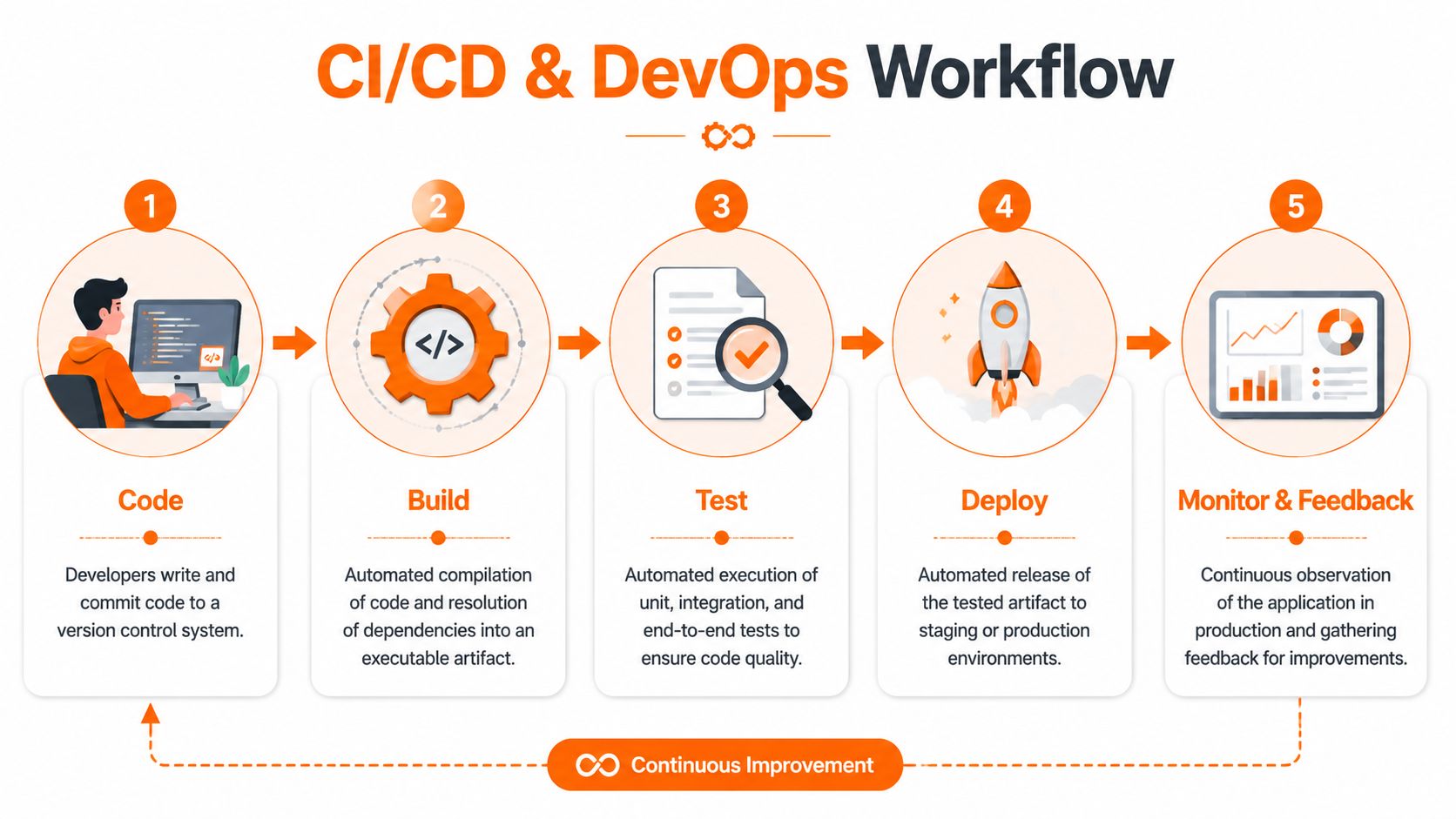
A useful CI/CD pipeline behaves like a factory line with clear stages and automated checks. Code enters the system, gets built, tested, packaged, deployed, and observed. Every stage should answer one question: is this change still safe to move forward?
That factory line usually depends on a few practical habits:
- Frequent integration into the main branch or a short-lived branch model.
- Automated builds that don’t depend on someone’s laptop state.
- Test gates that catch regressions before deployment.
- Repeatable deployments into staging and production.
- Monitoring and rollback paths when behavior changes after release.
Feature flags fit well here because they separate deployment from release. Infrastructure as Code also matters because environments should be reproducible, reviewable, and versioned alongside application change.
DORA gives teams a real operating scoreboard
A lot of teams say they want to move faster, but don’t measure the system that determines speed. The DORA metrics remain one of the best practical scoreboards for software delivery: deployment frequency, lead time for changes, mean time to recovery, and change failure rate.
According to Harness’s summary of DORA metrics, elite-performing teams deploy multiple times per day, have lead time for changes under one day, and recover from incidents in less than one hour. That’s a very different operating model from low performers, who move far more slowly and recover far more slowly.
Those metrics work because they balance speed with reliability. Shipping often means nothing if recovery is slow and failures are common.
A simple way to use them:
| Metric | What it tells you | Team question to ask |
|---|---|---|
| Deployment frequency | How often value reaches users | Are releases too big or too rare? |
| Lead time for changes | How long work sits in the system | Where does work wait the longest? |
| Mean time to recovery | How resilient operations are | Can responders diagnose and fix quickly? |
| Change failure rate | How risky releases are | Are we shipping changes we don’t understand? |
Git habits matter more than most teams admit
Many delivery problems start upstream in version control. Long-lived branches drift. Merge conflicts get worse. Review scope gets too large. By the time code reaches CI, the core problem already happened in workflow.
That’s why trunk-based development and smaller pull requests tend to outperform sprawling branch strategies in distributed teams. If your team needs a practical refresher on conflict reduction and cleaner branch integration, Server Scheduler's Git merging guide covers the mechanics in a way that maps well to day-to-day delivery discipline.
For remote setups, branch hygiene is a collaboration issue, not just a Git issue.
Tooling should make remote delivery boring
A good remote delivery stack gives engineers visibility without requiring constant live coordination. Teams often combine GitHub Actions, GitLab CI, CircleCI, Buildkite, Argo CD, Terraform, LaunchDarkly, Datadog, or similar tooling. The exact stack matters less than consistency and legibility.
If your team is still evaluating stack choices for distributed execution and coordination, this guide to tools for remote teams is a useful companion because software delivery doesn’t happen in a vacuum. It depends on review, communication, and documentation tools working together.
A short visual helps frame the workflow:
What mature CI/CD feels like
Teams know their pipeline is mature when these conditions are true:
- A normal change can move from commit to production without a special meeting
- Deployment status is visible to anyone who needs it
- Rollback or mitigation is already planned
- Incidents produce pipeline improvements, not just apologies
- Engineers trust the delivery path enough to use it often
That’s the standard. CI/CD should reduce drama, not automate chaos faster.
Cultivating Effective Remote Team Workflows
A lot of engineering process still assumes the office is the default and remote work is a thin adaptation layered on top. That assumption causes friction fast.
Remote teams don’t fail because they lack standups or sprint boards. They fail when key knowledge lives in side conversations, when onboarding depends on shadowing, and when progress stalls until two specific people overlap for twenty minutes. Office-native workflows survive that kind of inefficiency longer because people can compensate in person. Distributed teams can’t.

Async-first doesn’t mean meeting-free
The strongest remote teams aren’t anti-meeting. They’re anti-unnecessary synchronization.
That means defaulting to written proposals, documented decisions, and pull requests with enough context to review without a call. Meetings still matter for conflict resolution, design trade-offs, and fast alignment. They just shouldn’t be the primary place where the system learns what it’s doing.
A useful remote-native workflow usually includes:
- Written RFCs or design notes before major implementation starts
- Pull request templates that explain intent, risk, and rollout plan
- Decision records for architectural choices that will otherwise vanish into chat
- Recorded demos or walkthroughs for changes that are easier to show than describe
Code review etiquette matters more across time zones
Remote code review fails when authors treat the diff as self-explanatory and reviewers treat response time as optional. Teams need norms.
Good pull requests are scoped small enough to review in one sitting. They explain what changed, why it changed, and what the reviewer should scrutinize. Good reviewers respond with concrete feedback, not drive-by reactions, and they avoid blocking changes over taste if tooling or standards already settled the issue.
A pull request is not just a patch. In a distributed team, it is a handoff document.
That’s one reason remote-native engineering teams often outperform office-centric teams that moved to Zoom. They design workflows around delayed feedback instead of fighting it.
Developer experience is not a soft concern
Developer experience gets treated as a nice-to-have until a company tries to onboard engineers across time zones. Then every rough edge becomes expensive. Slow local setup, unclear ownership, missing docs, fragmented tooling, and inconsistent environments all compound when help isn’t immediate.
Research summarized by GetDX on SDLC best practices identifies a critical blind spot here: efficient onboarding and reduced daily workflow friction are key competitive advantages for high-performing remote and distributed teams.
That should change how leaders think about process. If it takes a new engineer too long to become productive, the problem isn’t motivation. It’s usually that the system assumes nearby mentorship and oral tradition.
Build workflows for self-service
A remote team scales when engineers can answer common questions without waiting on a specific person.
That means building around self-service artifacts:
| Workflow area | Self-service version | Fragile version |
|---|---|---|
| Onboarding | Setup docs, runbooks, sample tasks | “Ask in Slack if you get stuck” |
| Planning | Written scope and acceptance criteria | Verbal alignment in meetings |
| Reviews | Clear PR context and checklists | Reviewer has to infer everything |
| Incidents | Runbooks and ownership paths | Only veterans know what to do |
Teams that want to understand the broader operating model often benefit from defining what a distributed team really is in practice. It’s not just people in different locations. It’s a team whose systems must work without constant synchronous rescue.
Time-zone-aware planning is a real skill
Sprint planning, incident response, and release timing all need adjustment in distributed companies. Work should be shaped so that dependency chains don’t require same-day back-and-forth wherever possible.
A few habits help:
- Sequence tasks to reduce blocking dependencies
- Assign ownership clearly before the workday ends
- Use overlap time for decisions, not status recaps
- Document next steps where the next person will look
That’s what remote software development best practices look like in practice. Less reliance on proximity. More investment in clarity, autonomy, and low-friction systems.
Building a Culture of Continuous Improvement
Best practices fail when teams treat them like a one-time setup. Add a formatter, buy a CI tool, create a review checklist, and call it done. That approach always stalls.
Strong engineering organizations treat software development best practices as a living system. They review how work moves, where it gets stuck, what breaks too often, and which habits no longer fit the team’s scale. The process improves because the team improves it on purpose.
Retrospectives only work when they are honest
A retro that produces generic action items is just calendar filler. The useful ones focus on specifics. Which handoff broke down. Which deployment step was unclear. Which test failure cost too much time. Which assumption forced unnecessary coordination.
Blameless retrospectives matter because blame makes people hide information. If engineers think every mistake becomes a personal indictment, they’ll optimize for self-protection instead of transparency. Then the team loses the signal it needs to improve.
A strong retro habit usually includes:
- Reviewing one concrete problem at a time
- Separating system causes from individual mistakes
- Assigning small, testable improvements
- Checking later whether those changes helped
The point of a post-incident review is not to decide who was careless. It’s to make the same failure harder to repeat.
Psychological safety has operational value
This gets discussed like a culture slogan, but it has direct engineering consequences. Teams ship better when people can say, “I don’t understand this design,” “this release feels risky,” or “our onboarding docs are broken” without getting punished for slowing things down.
Remote teams need this even more because uncertainty is easier to hide in text than in person. A polite silence in chat can cover real confusion for days.
Improve the system in layers
Trying to overhaul everything at once usually backfires. Better results come from tightening the system a layer at a time.
For example:
- Stabilize code standards so reviews focus on substance.
- Strengthen tests so merges feel safer.
- Improve CI/CD visibility so releases stop feeling opaque.
- Fix onboarding and workflow friction so the team scales without depending on oral tradition.
Those gains compound. A team with cleaner code, more reliable tests, and better written workflows doesn’t just ship better software. It becomes easier to join, easier to trust, and easier to retain.
Great remote teams make improvement visible
Engineers stay where quality work is possible. They leave environments where every task feels heavier than it should. That’s one reason mature engineering culture matters so much in distributed hiring. If a company wants to attract strong people across markets, it has to show that the work system is healthy.
That’s also why companies serious about hiring remote developers should think beyond compensation and job titles. Strong candidates look for signs that the team can collaborate, review, release, and recover without chaos.
The best remote teams don’t chase perfection. They build a habit of noticing friction early, fixing it deliberately, and carrying those lessons into the next cycle.
If you’re building a distributed team or looking for your next remote role, YayRemote is a practical place to start. It brings together hand-picked remote jobs, hiring resources, and tools that help people and companies work better across time zones.