Your Guide to the Digital Nomad Visa Europe in 2026
Unlock Europe with this guide to the digital nomad visa Europe. Compare country requirements, tax rules, and application tips for remote workers in 2026.
A digital nomad visa for Europe is essentially a long-term residency pass that lets you legally live and work remotely from a European country. It's designed for professionals who earn their income from outside the country they want to call home, finally closing the loophole of working illegally on a tourist visa.
What Is a European Digital Nomad Visa?
Think of it as a key that unlocks the ability to live and work remotely across Europe—not just as a temporary visitor, but as a legitimate resident. This is a game-changer for a new wave of professionals who aren't chained to a physical office.
These visas are a completely different beast from other travel documents. Your standard Schengen tourist visa, for instance, lets you stay for 90 days within a 180-day window but makes it very clear that working is off-limits. On the other end of the spectrum, a traditional work permit demands you have a job offer from a local company in that specific country.
The digital nomad visa neatly fills this gap. It was created specifically for remote workers who want to settle down in one place for a year or more while continuing to work for their foreign clients or employers.
Who Are These Visas For?
This new visa category is built for a particular kind of professional. To get the full picture of this travel trend, it helps to understand the wider world of the remote work visa Europe. In short, these visas are a perfect fit for:
- Remote Employees: You work for a company based outside of Europe and have the freedom to do your job from anywhere.
- Freelancers and Consultants: You're self-employed and have a roster of international clients who pay you for your services.
- Entrepreneurs: You own a business that is registered and operates outside of the European country you want to live in.
The main problem these visas solve is the legal gray area. For years, nomads have been country-hopping on tourist visas, a practice that brought constant instability and the risk of being turned away at the border. A digital nomad visa Europe offers a clear, legitimate path to residency.
The Real-World Advantages of a Nomad Visa
Getting a digital nomad visa does more than just make your stay legal. It completely changes your experience, turning a short trip into a chance to build a real life abroad.
The true value of a digital nomad visa isn't just about staying longer; it's about gaining a foothold. You can open a local bank account, sign a long-term lease, and truly integrate into a new community without constantly looking over your shoulder.
This residency pass gives you the power to create a stable life overseas. The core benefits really boil down to this:
- Legal Residency: This is the big one. It lets you live in a country for one to two years, and many programs even offer a path to renewal.
- Access to Local Services: Depending on the country, this can unlock access to the public healthcare system, local banking, and other essentials.
- A Stable Home Base: It gives you a launchpad to explore the rest of Europe without the stress of overstaying a tourist visa.
- Family Unification: Many programs recognize the importance of family and allow you to bring your spouse and dependent children along.
Picking the Right European Nomad Visa in 2026
Alright, you get what a digital nomad visa is. Now comes the fun part: picking one. Think of this as your personal command center for choosing the European country you’ll soon call home. It's crucial to remember that not all visas are built the same—some are designed for high earners, while others offer a quicker route to long-term residency.
Let's dive into the most popular digital nomad visas across Europe. This isn't just a dry list of requirements; it's a strategic breakdown to help you find the perfect match for your career, finances, and lifestyle.
Portugal D8 Visa: The Popular All-Rounder
Portugal has become a superstar in the remote work world, and it's easy to see why. The D8 Remote Work Visa is widely considered one of the most well-rounded and appealing options out there, making it a go-to for aspiring nomads.
Beyond the paperwork, the country just delivers. You get a fantastic quality of life with its vibrant culture, reasonable cost of living, and jaw-dropping coastlines. Plus, the time zone is a huge practical win for remote pros, as it handily overlaps with workdays in both Europe and the Americas.
Since launching in October 2022, Portugal's D8 visa has become a massive hit. It offers a clear path to residency and even citizenship after five years of living there, which is a huge draw. It’s no surprise it snagged a top score of 7.05 in the 2026 Digital Nomad Visa Index. To get in, you need to show a minimum monthly income of €3,680 (about four times the national minimum wage). The visa starts as a one or two-year permit, which you can renew for up to five years, and yes, you can bring your family. The Non-Habitual Resident (NHR) tax program can also offer some sweet perks, but you'll definitely want to chat with a tax advisor about that. You can dig into the full rankings and methodology in the complete 2026 Digital Nomad Visa Index.
Spain Digital Nomad Visa: The Urban Hub
If you’ve been dreaming of working from a laptop in a bustling Barcelona plaza or soaking up the art and energy of Madrid, Spain's Digital Nomad Visa is your ticket. Rolled out in 2023, it was specifically created to pull in international talent, offering a pretty straightforward way for non-EU citizens to live and work in the country.
The real game-changer with Spain's visa is its special tax regime, famously nicknamed "Beckham's Law." It allows nomads to pay a flat 24% tax on their Spanish income for up to six years. That’s a massive saving compared to the usual progressive rates.
Here are the key things you need to know:
- Minimum Monthly Income: You'll need to prove you make at least €2,600 a month. The figure goes up if you're bringing family.
- Application Fee: The main consular fee is only about $80, but expect some additional administrative costs.
- Visa Duration: You start with a one-year visa, but you can renew it for up to five years, which opens the door to permanent residency down the line.
- Application Location: They’re flexible. You can apply from your home country before you go or, conveniently, while you're already in Spain on a tourist visa.
This visa is a fantastic fit for professionals who want to be in the middle of the action, enjoying a lively city life with a very friendly tax bill.
Top European Digital Nomad Visas at a Glance (2026)
Feeling a bit overwhelmed by the options? It's completely normal. To make things a little easier, we've put together a quick comparison of the top contenders. This table breaks down the essentials at a glance, helping you see how they stack up side-by-side.
| Country | Minimum Monthly Income | Application Fee (Approx.) | Visa Duration | Key Feature |
|---|---|---|---|---|
| Portugal | €3,680 | ~$180 | 1-2 years, renewable to 5 | Clear path to residency/citizenship |
| Spain | €2,600 | ~$80 + admin fees | 1 year, renewable to 5 | "Beckham's Law" flat 24% tax rate |
| Croatia | €2,540 | ~$140 | Up to 12 months | 0% income tax on foreign earnings |
| Italy | €28,000 (Annual) | ~$125 | 1 year, renewable | For "highly skilled" professionals |
| Greece | €3,500 | ~$80 | 1-2 years, renewable | 50% tax break for up to 7 years |
Of course, the "best" visa really depends on your personal circumstances—your income, career goals, and whether you're planning a short-term adventure or a long-term move. Use this table as your starting point for a deeper dive.
Croatia Residence Permit: A Mediterranean Escape
What if your remote work fantasy involves island-hopping along the stunning Adriatic coast? If that's you, then Croatia’s digital nomad permit needs to be on your list. It’s technically a temporary residence permit, not a visa, but it lets non-EU nationals stay for up to a year.
The killer feature here is the tax situation. As a digital nomad in Croatia, you are not required to pay local income tax on your foreign earnings. This is a huge deal and can mean thousands in savings.
Croatia's tax exemption for digital nomads makes it one of the most financially attractive options in Europe. It allows you to keep more of your hard-earned income while enjoying a low cost of living and breathtaking scenery.
To get the green light, you'll need to show:
- Minimum Monthly Income: A steady income of around €2,540 per month.
- Application Fee: The fees add up to about $140 for the visa and permit.
- Visa Duration: The permit is good for up to 12 months but isn't immediately renewable. You have to leave the country for 90 days before you can apply again.
- Application Flexibility: The process is pretty convenient—you can apply online or at a local consulate.
While it's not a pathway to permanent residency, it's an absolutely perfect setup for a year-long European adventure without the tax headaches.
Italy Digital Nomad Visa: For Highly Skilled Professionals
After a long wait, Italy finally rolled out its digital nomad visa in April 2024. This one is different, though. It’s specifically aimed at highly skilled professionals, making it a bit more exclusive than others in Europe. Think of it as the 'velvet rope' visa, perfect for established experts who want to pair their careers with la dolce vita.
The Italian government is looking to attract top-tier talent, which means the bar is set higher. You’ll need to prove you’re at the top of your field, often with a university degree and a strong professional history.
Here’s the rundown on the Italian visa:
- Minimum Annual Income: You need to show an annual income of at least €28,000.
- Application Fee: The fee sits at around $125.
- Visa Duration: It’s granted for one year, and you can renew it.
- Healthcare Requirement: This is non-negotiable. You must have comprehensive private health insurance covering your entire stay.
This visa unlocks the door to Italy's incredible history, food, and landscapes, but it's really designed for seasoned professionals. If you're just starting out, you might want to look elsewhere. For a wider view, check out our guide on the best digital nomad visas available globally.
Greece Digital Nomad Visa: Sun, Sea, and Savings
Greece rolls out the blue carpet for remote workers with an incredible offer: stunning islands, ancient history, and a seriously tempting tax break. The Greek digital nomad visa lets you stay for up to two years and comes with a massive financial incentive.
Here’s the deal: nomads on this visa can get a 50% tax break on their income for up to seven years. Let that sink in. This makes Greece one of the most financially rewarding places in Europe for a long-term remote work stint.
Here are the key details you'll need:
- Minimum Monthly Income: The income bar is a bit higher, set at €3,500 per month.
- Application Fee: A very reasonable fee of around $80.
- Visa Duration: You get one year initially, but it's renewable for up to two years.
- Family Inclusion: The program welcomes your spouse and children.
This visa is a dream for higher-earning professionals looking to maximize their savings while living it up in the Mediterranean. The mix of a low cost of living and that huge tax break is a powerful one-two punch for your wallet.
How to Build a Winning Visa Application
Turning your dream of working remotely from Europe into a reality comes down to one thing: a rock-solid application. This is more than just a paper-shuffling exercise. You're building a convincing case for yourself, proving to a consular officer that you’re stable, professional, and a great candidate to welcome into their country.
Think of your application as a professional sales pitch. Every document—from your bank statements to your client contracts—is a piece of evidence. Your job is to make the officer’s decision an easy "yes" by presenting a perfectly organized and persuasive package that answers every question before it's even asked.
Crafting a Compelling Proof of Income
This is the absolute heart of your application. Consular officers need to see, in black and white, that you can support yourself without becoming a financial strain on their country. Here’s the thing: just barely meeting the minimum income isn't enough. You need to show consistency and stability.
- Go Beyond the Bare Minimum: If a visa demands a €2,600 monthly income, showing statements that just squeak by that number can look risky. You want to demonstrate a healthy financial cushion.
- Show Your History: Even if the rules only ask for three months of bank statements, provide the last 6 to 12 months. This paints a clear picture of sustained income, proving you didn't just get a one-time cash infusion.
- Tell Your Income Story: Don’t just throw a stack of papers at them. A short, professional cover letter explaining your income sources—whether it's a single remote job, several freelance clients, or your own business—adds crucial context. Clarity is your best friend.
This chart gives you a quick look at the minimum monthly income you’ll need for some of Europe's most sought-after digital nomad visas.
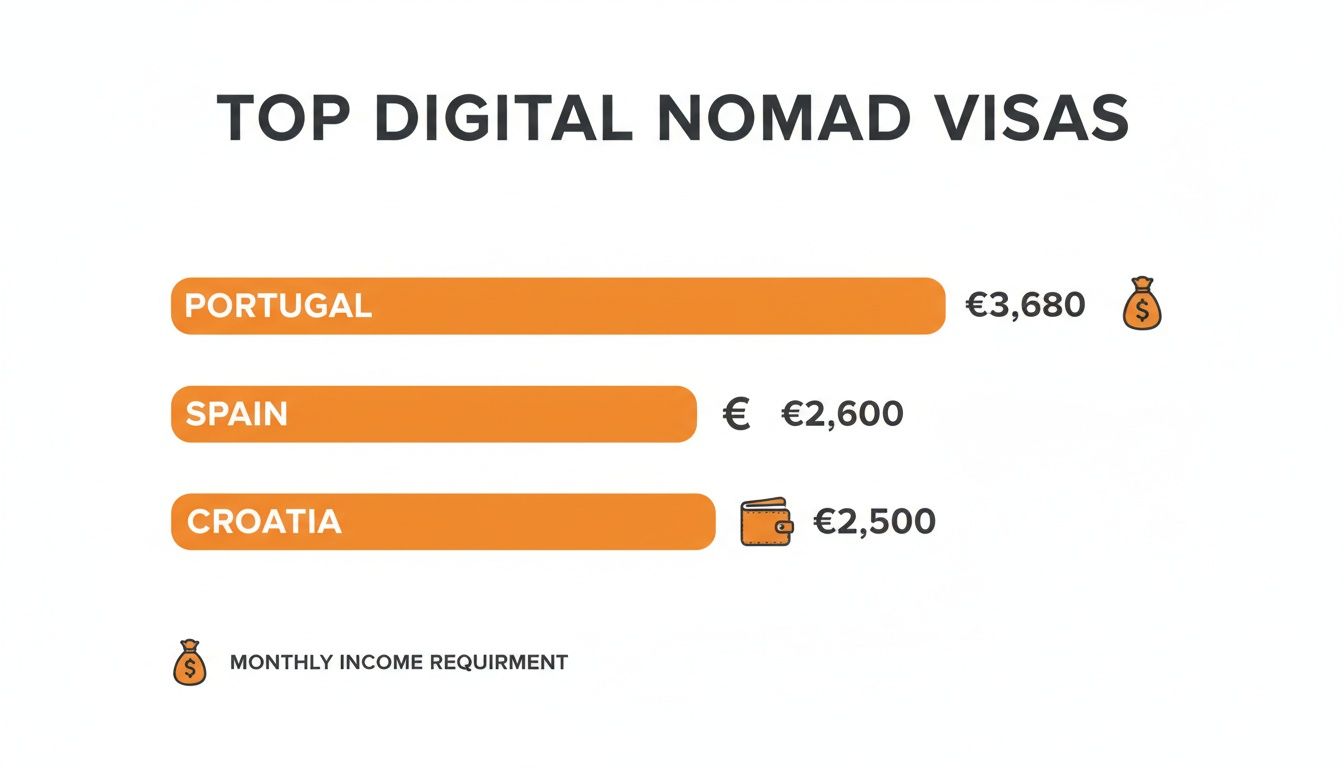
As you can see, the financial requirements can differ quite a bit, with countries like Portugal setting a higher bar than others.
Securing Compliant Health Insurance
Getting the right health insurance is a non-negotiable step for nearly every digital nomad visa in Europe. Your standard travel policy won't do the trick here; you need comprehensive coverage that meets very specific, and often strict, government requirements. It’s worth reading a good guide on health insurance for digital nomads to fully understand your options.
At a minimum, your policy must have:
- Schengen Area Validity: It needs to be valid across the entire Schengen zone, not just the country you’re applying to.
- Minimum Coverage Amount: Most countries require at least €30,000 in coverage for medical emergencies and hospital stays.
- Repatriation Coverage: The policy has to cover the costs of flying you back to your home country for medical reasons or, in the worst-case scenario, in the event of death.
Submitting an application with the wrong type of health insurance is one of the fastest ways to get an immediate rejection. Always, always double-check that your policy documents explicitly state that they meet every single requirement listed by the consulate.
The Pre-Submission Checklist for Success
Before you even think about sending that package off, one final, meticulous review can mean the difference between getting an approval and a denial. Go through every document with a fine-tooth comb.
For a deeper look into the exact documents you'll need for each country, our complete guide to digital nomad visa requirements is your next stop.
Common Pitfalls to Avoid:
- Vague Client Letters: A letter from a client needs to be specific. It should detail what you do for them, how long your contract is, and what your consistent monthly pay is.
- Old Criminal Record Checks: Most consulates will only accept a background check issued within the last 3 to 6 months. Check the date on yours before you submit.
- Missing Certified Translations: If a document isn't in English or the local language of the country you're applying to, you'll almost certainly need a certified translation. Don’t cut corners here.
When you treat your application with this level of care and attention to detail, you’re doing more than just submitting paperwork—you’re making a powerful, positive first impression.
Navigating Taxes as a Digital Nomad in Europe
Let's talk about the one topic that makes most aspiring digital nomads nervous: taxes. The idea of navigating international tax law can sound incredibly complex, but it doesn't have to be a deal-breaker. A little bit of knowledge here goes a long way toward keeping your adventure financially sound and avoiding any nasty surprises down the road.
Think of it like this: when you travel, your phone roams onto a local network. Your tax status can work in a similar way. Spend enough time in a new country, and you might "roam" onto their tax system. The trick is understanding when that happens and making sure you don't get billed for the same income by both your home country and your new European base.
The 183-Day Rule Explained
The first and most critical concept you need to know is the 183-day rule. This is the standard benchmark used across most of Europe to determine if you’ve become a tax resident. Put simply, if you spend more than 183 days (roughly six months) in one country during a calendar year, you will likely be considered a resident for tax purposes.
Once you cross that line, that country generally gains the right to tax your worldwide income—not just the money you earn while you're there. This is why many nomads plan their travels carefully to stay under this limit in any single nation, which often allows them to remain a tax resident of their home country and keep things simple.
Keep in mind, though, that the 183-day rule isn't the only thing that matters. Courts and tax authorities can also look at other factors, like where you have a permanent home, where your family lives, or where your core economic interests are.
Avoiding Double Taxation
The biggest fear for almost every nomad is getting taxed twice on the same income. Nobody wants to pay taxes to their home country and their new host country. Thankfully, there's a system in place to prevent this: Double Taxation Agreements (DTAs).
These treaties are essentially rulebooks signed between two countries that clarify who gets to tax your income and when. They ensure that if you pay taxes in your new country of residence, you can typically claim a credit or exemption back home, so you're not paying for the same thing twice.
Think of DTAs as your financial shield. They are what protect you from being taxed in two places at once, but you have to understand how they work to make sure that shield is up.
For instance, if you're an American who becomes a tax resident in Portugal, the US-Portugal DTA dictates how your income is handled. You'll still need to file returns in both places, but the DTA provides the mechanism (like foreign tax credits) to ensure you only pay the correct total amount.
Special Tax Regimes That Save You Money
Now for the exciting part. To attract skilled remote workers, many European countries with digital nomad visas have created special tax programs that can slash your tax bill. These aren't loopholes; they are official government incentives.
- Spain's "Beckham Law": A well-known option that lets eligible foreigners pay a flat tax of 24% on Spanish income up to €600,000, avoiding the country’s higher progressive rates.
- Italy's "Impatriates" Regime: This incredible program offers new residents a 70% tax exemption on their income. That means you only pay Italian tax on 30% of what you earn for up to 10 years.
- Greece's Tax Incentive: Digital nomads moving to Greece can get a 50% reduction in their income tax for the first seven years.
These special regimes are a huge part of what makes a digital nomad visa for Europe so financially appealing. They are specifically built to make these beautiful countries a magnet for talented professionals.
A final word of advice: hiring a cross-border tax advisor isn't a luxury, it's a vital part of your planning. Find someone who specializes in expatriate and nomad tax situations for your target country. Their fee is an investment that will almost certainly save you a fortune in taxes and give you invaluable peace of mind.
How to Choose Your European Home Base
Getting your digital nomad visa for Europe is a huge win, but it's really just the beginning. Now for the fun part: where on this incredible continent will you actually set up your laptop and call home? Picking a city is so much more than visa paperwork—it’s about finding a place that truly clicks with your lifestyle, budget, and work needs.
Think of it less like picking a spot on a map and more like choosing a long-term roommate. You need to look past the postcard-perfect photos and get real about the day-to-day realities of living somewhere new.
Balancing Cost of Living and Quality of Life
The first thing on most nomads' minds is the cost of living. It’s a simple fact: your money will go a lot further in a city like Budapest or Valencia than it will in Berlin or Amsterdam. But cost alone doesn't tell the whole story. The real goal is to find that sweet spot between what’s affordable and the quality of life you’re looking for.
A city might be cheap, but does it have the things that make you happy? Think about easy access to parks, a buzzing arts scene, good gyms, or an exciting food culture. A low price tag loses its appeal fast if you’re bored or a little miserable.
A successful European home base isn't just about saving money—it's about enriching your life. The ideal city offers an affordable cost of living and a high quality of life, allowing you to thrive both professionally and personally.
Before you get your heart set on a place, do some real homework. Create a mock budget for your top two or three contenders. Jump on local housing sites to check average rent, look up grocery prices, and figure out what a monthly transit pass or gym membership will run you. This is how you move from a vague "I like this place" to a solid financial plan.
Internet Speed and Professional Community
Let’s be honest, for a digital nomad, the internet isn’t a nice-to-have; it's the bedrock of your entire career. A spotty connection can mean blown deadlines and unhappy clients. So, before you fall for that charming rustic village, you have to be absolutely sure its digital infrastructure can keep up with you.
The good news is that Europe generally has fantastic internet, but the quality can definitely vary. Cities like Tallinn and Bucharest are famous for their ridiculously fast and cheap fiber optic networks. Here are a few things to dig into:
- Internet Reliability: Scour expat forums and Facebook groups for honest feedback on local internet providers. What are real people experiencing?
- Coworking Spaces: The number and quality of coworking spaces can tell you a lot about how friendly a city is to remote workers.
- Expat and Professional Networks: A strong community of fellow nomads isn’t just for making friends. It’s an invaluable resource for networking, problem-solving, and finding new opportunities.
Finding Your City Vibe
Beyond all the practical stuff, every city just has a certain feel, a personality. A place that’s a dream for one person could be a total miss for another. The key is to match the city’s energy with your own.
A freelance graphic designer might feel completely at home in the creative, bohemian streets of Lisbon's Alfama district, surrounded by art galleries and Fado bars. Meanwhile, a fintech founder might thrive in Berlin’s more structured, forward-thinking startup ecosystem, where networking events and VCs are just part of the landscape. Our guide to the best countries for remote workers dives even deeper into these kinds of differences.
Ultimately, choosing your European base is a deeply personal decision. By weighing the hard numbers of cost and infrastructure against the softer, intangible feel of a city's culture, you’ll find the perfect place to launch your next chapter.
Answering Your Top Visa Questions
Even after you've mapped out your dream move, a few nagging "what ifs" can creep in. It's completely normal. You're about to make a huge life change, and last-minute questions are just part of the process.
Let's walk through some of the most common questions we hear from aspiring digital nomads. Think of this as the final check-in to clear up any lingering doubts so you can focus on the incredible adventure waiting for you.
Can I Bring My Family with Me?
This is a big one, and for good reason. The good news? The answer is almost always yes. Most European countries that offer a digital nomad visa understand that people have families, and they've built provisions right into the process. Programs in places like Spain, Portugal, and Greece have clear pathways for bringing a spouse or long-term partner and dependent children along.
But it's not quite as simple as just adding their names to your form. You’ll need to be prepared for a few extra steps:
- Prove increased income: You'll have to show you can financially support everyone. The minimum income threshold will be higher, usually by a set percentage for your partner and each child.
- Submit additional documents: Get ready to gather more paperwork, like official marriage certificates and birth certificates for each family member.
- Fill out separate applications: Each person will typically need their own application, which is then linked to yours as the main applicant.
What Happens If My Application Is Denied?
Getting a rejection notice is a gut punch, no doubt about it. But it's rarely the final word. Your first job is to figure out exactly why it was denied. Consulates are required to give you a reason, which could be anything from a missing bank statement to an incomplete background check.
Think of the rejection letter less as a "no" and more as a checklist of what to fix. It's almost never personal; it’s a logistical puzzle, and the letter gives you the missing pieces.
Once you have the reason, you have two choices. You could appeal the decision, but be warned, that can be a long and bureaucratic journey. The more common and often faster route is to simply fix the issues they pointed out and reapply with a much stronger application.
Is Knowing the Local Language Required?
For the visa application itself, the answer is a clear no. Countries offer these visas specifically to attract international remote workers, so they don't expect you to be fluent in Greek or Croatian right out of the gate. The entire application process is almost always handled in English.
That said, once you're on the ground, making an effort to learn the local language is a game-changer. It’s not a legal requirement for keeping your visa, but even learning basic phrases will completely transform your daily life, help you connect with your new community, and show a level of respect that locals truly appreciate.
What Is a Realistic Application Timeline?
Patience is a virtue in the visa world. From the day you start chasing down documents to the moment the visa sticker is in your passport, you should realistically budget between three and six months. This timeline can swing wildly based on the country you choose and how busy your local consulate is.
Here’s a rough breakdown of where that time goes:
- Document Collection: 1-2 months (Things like FBI background checks can take a while!)
- Consulate Appointment & Submission: Varies wildly. Just getting an appointment can sometimes take weeks or even months.
- Processing Time: 4-12 weeks once they have your file.
The key takeaway? Start early. Give yourself way more time than you think you'll need to avoid any last-minute panic.
Feeling ready to find your perfect remote job for your European adventure? YayRemote curates thousands of hand-picked remote roles from top distributed companies. Use our free Skills Analyzer and Visa Eligibility Wizard to find the right fit and start your journey today. Explore remote jobs on YayRemote.