Jobs in Europe for English Speakers: Your 2026 Guide
Find jobs in Europe for English speakers in 2026. Our guide covers visas, CVs, and landing a role in top European countries. Start your career abroad today!
You're probably doing what many do at the start. You type “jobs in Europe for English speakers” into LinkedIn, save a few searches, fire off applications to Berlin, Amsterdam, Dublin, maybe Barcelona, and assume the best role will reveal itself.
That approach wastes time.
The hard truth is that most English-speaking candidates fail in Europe for two boring reasons that almost nobody explains properly. First, they apply to roles that were never realistically open to them because of visa limits. Second, they trust the phrase “English-speaking job” without checking what that means inside the company. I've seen strong candidates miss for months because they chased attractive listings instead of eligible ones.
Europe can absolutely work for English speakers. In fact, English was explicitly required in 22% of all online job vacancies across the 27 EU countries and the UK in 2021, representing over 11 million postings, according to the OECD analysis of language demand in the European labour market. That's real opportunity. But opportunity isn't the same as access.
Treat this like an international move, not a casual job search. Filter hard, localize fast, and stop applying blindly.
Strategically Choosing Your European Destination
Don't pick a country because you liked it on vacation. Pick it because your profile fits its hiring reality.
The strongest candidates I've coached start with three filters: employment strength, industry fit, and daily language reality. If you skip any one of those, you'll spend weeks chasing the wrong market.
A useful starting point is overall job access. As of 2024, the Netherlands had the highest employment rate in the EU at 82.5%, while Malta stood at 78.4% and Italy was at 62.3%, according to Statista's employment rate comparison across Europe. That doesn't mean every English speaker should move to Amsterdam. It means some markets give you a better baseline than others.

Match the country to the work you actually do
If you work in tech, product, data, or digital marketing, your best bets are usually countries and cities where international teams already operate in English. The Netherlands keeps coming up for a reason. So do Germany and Ireland. These markets tend to have more multinational employers, more cross-border teams, and more tolerance for English as the working language.
If you work in finance, compliance, operations, or customer-facing commercial roles, the picture changes. English helps, but local language expectations rise fast once the job touches clients, regulators, vendors, or public-sector counterparts. Many candidates learn this too late.
Use this rough lens:
| Profile | Better fit | Harder fit |
|---|---|---|
| Backend engineer | International hubs with English-heavy teams | Smaller local firms |
| Data analyst | Multinational employers | Roles tied to local stakeholder reporting |
| Performance marketer | Global e-commerce firms | Domestic consumer brands |
| Account manager | Firms serving international accounts | Local-market sales teams |
Ignore hype and look at friction
A city can be exciting and still be the wrong target. Berlin gets attention, but attention attracts competition. Smaller or less glamorous markets can be easier if your skill set aligns and the employer hires across borders.
That's why I tell candidates to build a shortlist of two primary countries and one backup market, not ten. Focus beats enthusiasm.
Practical rule: If you can't explain why your background fits a country's hiring mix in one sentence, you haven't chosen strategically yet.
Also be honest about lifestyle constraints. Housing pressure, bureaucracy, and social integration matter. A country can be professionally attractive and personally draining. Before you commit, compare your target markets using practical relocation criteria, not just salary headlines. This guide on working remotely from Europe is useful for thinking through country trade-offs beyond the job title.
Language still matters, even when English is enough to get hired
Many English speakers make a costly assumption: if the listing is in English, the company runs in English. Sometimes yes. Often only partly.
Internal documentation may be in English while casual team discussions happen in the local language. The company may onboard you in English but expect local-language progress within months. Jobs in Europe for English speakers exist in large numbers, but they cluster in specific functions and company types. The smart move is to target roles where English is structurally necessary, not just tolerated.
Decoding European Visas and Work Permits
You find a role in Berlin or Amsterdam, the job post is in English, the company looks international, and the salary is strong. Then you reach the fine print or ask recruiting one simple question and the answer kills the opportunity: no sponsorship, local work rights required, or contractor-only.
This is the filter too many applicants skip.
For English speakers targeting Europe, visa reality matters before you tailor a CV, write a cover letter, or get attached to a brand name. The biggest mistake I see is treating “English-speaking role” as proof that the company hires non-EU candidates. It does not. Many firms use English internally and still refuse to sponsor visas, or only hire people who already have the right to work in that country.
The European Commission's immigration and labor mobility guidance published through 2024 makes one point clear. Entry routes differ sharply by country, by skill level, and by whether you are being hired as an employee, contractor, or remote worker. Treat legal work authorization as your first screening criterion.
The three visa paths that matter most
Most non-EU English speakers fit into one of three routes. Choose the right one early, because each route changes which jobs are worth your time.
Employer sponsorship
This is the standard route for a salaried job. The employer hires you, supports the permit process where required, and puts you on local payroll. It is the best path for long-term stability.
It is also the hardest to get unless your profile is clearly in demand. Software engineering, data, cybersecurity, some life sciences roles, and senior commercial hiring are far more likely to justify sponsorship than generalist operations or entry-level marketing.
Freelance or self-employment visas
This route fits consultants, creatives, specialists with existing clients, and people who can document independent income. It does not fit applicants trying to convert a normal employee relationship into fake freelance work. Many countries look closely at that distinction, and employers know it.
Digital nomad visas
These visas work for people who already earn remotely from clients or an employer outside the host country. They are residency solutions, not a back door into the local labor market. If that matches your situation, compare options in this guide to digital nomad visas in Europe before you apply anywhere.
What to check before you apply
Use a hard filter. If a role fails it, move on.
- Sponsorship language: Look for explicit wording such as visa sponsorship, relocation support, international applicants welcome, or work authorization support.
- Current work-rights requirements: If the listing says “must already have the right to work in the EU” or names one country, believe it.
- Employment model: Payroll employee, contractor, employer-of-record, and freelance arrangements have different legal consequences.
- Country of employment: “Remote in Europe” often means remote only if you already live in an approved payroll country.
- Restricted sectors: Public sector, defense, security-sensitive, and some regulated jobs may be closed to non-citizens or require local licensing.
Ask early. Good questions save weeks.
A simple message to recruiting is enough: Do you sponsor work authorization for non-EU candidates for this role, and in which country would the employee be hired? If they dodge the question, treat that as your answer.
English-speaking role does not mean low language expectations
This is the other unspoken hurdle.
A company can hire in English and still expect local-language ability for clients, compliance paperwork, cross-functional meetings, or promotion. In practice, the safest targets are roles where English is built into the business model. International sales teams, global customer support, product and engineering in multinational firms, shared service centers, and some startup environments fit that pattern better than locally rooted roles in HR, legal, public affairs, or domestic account management.
You do not need perfect local-language skills for every good opportunity. You do need honesty. If a role touches customers, government agencies, or local vendors, language expectations usually rise fast after hiring.
Don't let job boards do your thinking for you
General job boards are useful for discovery. They are poor at immigration clarity.
Read the full posting. Check the careers page. Search the company's FAQ. Look at where current employees are based. Then decide whether the role is real for you. This is also the stage where you should ensure your resume passes ATS so you do not lose viable opportunities to formatting mistakes after you have done the hard filtering.
My rule is blunt because it works. Apply only if one of these is true: the employer sponsors, or you already have the legal right to work there.
That one filter will cut wasted applications, shorten your search, and push you toward roles that can turn into a move.
Crafting a CV That Crosses Borders
Your current resume probably isn't ready for Europe.
I'm not saying it's bad. I'm saying it's probably built for your home market, your home recruiters, and your home assumptions. European hiring teams often scan for different signals, and they reject clutter fast.
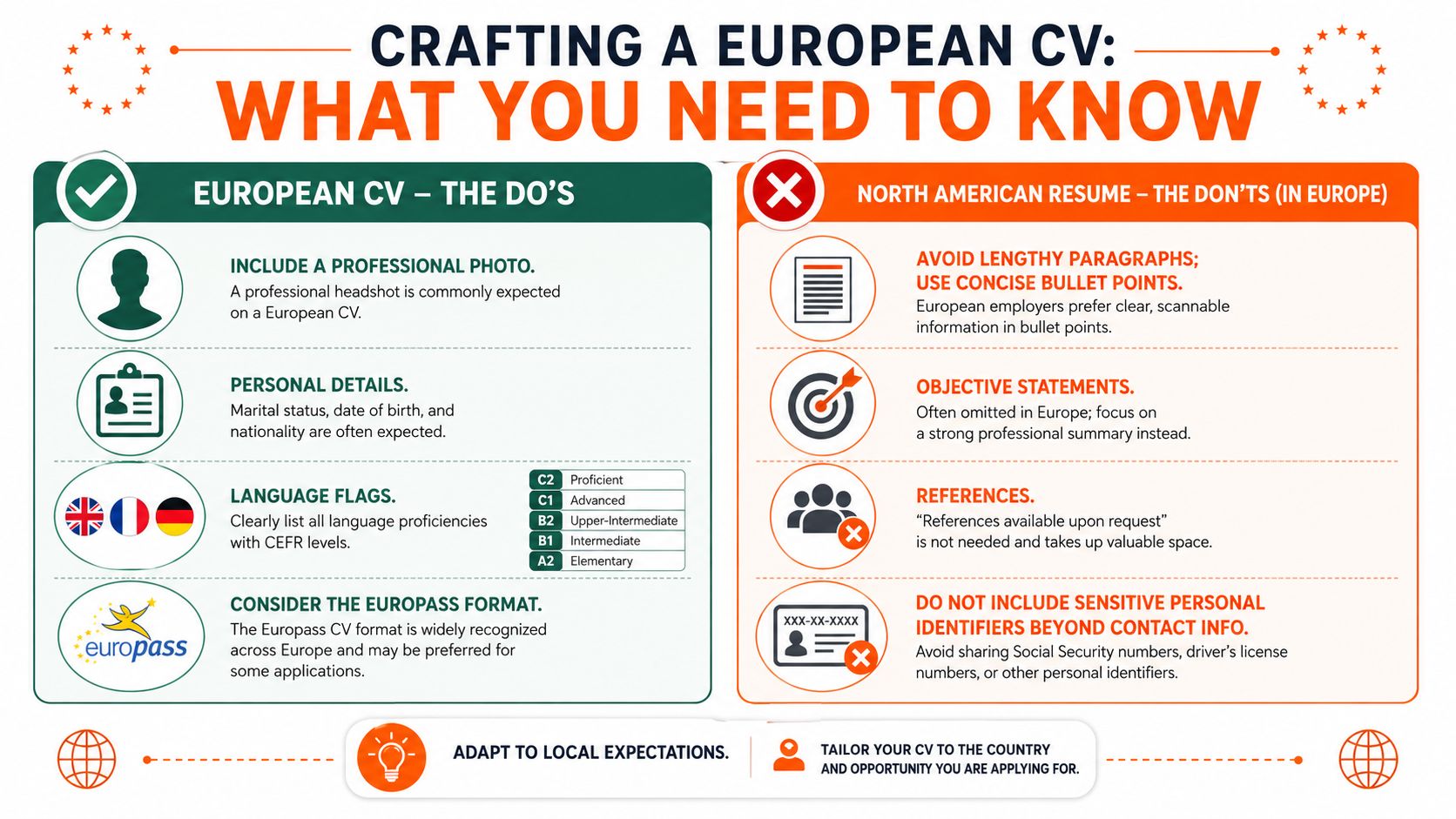
The baseline rule is simple. For European applications, CVs should be 1 to 2 pages, use UK English spelling for the UK and Ireland, and highlight measurable achievements. Visa processing and relocation typically take 2 to 6 months after a job offer, as noted in this expat job search strategy guide.
What to remove immediately
If your CV reads like a biography, fix that first.
Cut these common problems:
- Long responsibility blocks: Recruiters don't want a job description. They want evidence of impact.
- Generic summaries: “Results-driven professional” says nothing.
- US-centric wording: If you're applying in the UK or Ireland, switch to UK English spelling.
- Irrelevant filler: Old internships, outdated software, and vague soft skills dilute your case.
Whether to include a photo or personal details depends on country and employer preference, so don't copy one template blindly across Europe. Local adaptation matters more than universal rules.
What to add instead
Replace duties with outcomes. Not fake outcomes. Real ones.
Bad:
- Managed campaigns
- Supported product launches
- Worked with cross-functional teams
Better:
- Led multi-channel campaign execution across paid and email
- Coordinated launch timelines across product, design, and sales
- Reported retention trends to product stakeholders and proposed fixes
If you have metrics, use them. If you don't, describe scope, ownership, and business relevance clearly. For ATS-heavy hiring flows, you should also ensure your resume passes ATS before you start customizing. Then pressure-test formatting and keyword alignment with a practical guide on how to beat ATS screening.
A European CV should feel sharp, local, and easy to scan. If a recruiter needs effort to understand your value, you've already lost ground.
A simple rewrite method
Use this formula for each bullet:
Action + context + result
Examples:
- Built onboarding documentation for a distributed support team across multiple time zones
- Improved reporting accuracy by redesigning weekly performance dashboards
- Owned customer lifecycle email campaigns for a subscription product
That structure travels well across markets because it's concrete. It also gives interviewers better material to probe later.
One more thing. Your motivation letter matters more in Europe than many candidates expect. Keep it specific. Why this company, why this market, why you. Not a recycled statement about loving international environments.
Finding and Applying to English-Speaking Roles
You find a role in Amsterdam or Berlin. The job post is in English. The company site is in English. You apply, wait, and hear nothing. Then you learn the team wanted Dutch for client calls or only hired candidates who already had work authorization.
That is the filter. Your job search gets better the moment you stop asking, “Where are the English-speaking jobs?” and start asking, “Which of these jobs are open to me?”
Treat your search like a pipeline with hard criteria. If a role fails on visa sponsorship or day-to-day language reality, cut it fast. English-speaking roles exist across Europe, but plenty of them are only English on paper.
Build a search stack that filters before you apply
Relying on one job board is lazy and expensive. It wastes time and floods your tracker with roles that were never realistic.
Use three layers:
- Large job boards: Use LinkedIn, Indeed, and Glassdoor to spot hiring patterns, title variations, and active markets.
- Company career pages: Check these for cleaner details on location, relocation, and work authorization.
- Communities and target lists: Use alumni groups, Slack communities, expat networks, and a shortlist of employers that regularly hire international talent in your function.
The point is not volume. The point is accuracy.
A smart target list beats a hundred random applications. If you work in software engineering, data, product, design, or specialized B2B roles, build a list of employers with international teams and established hiring across borders. If you work in customer support, sales, recruiting, operations, or domestic marketing, be stricter. Those roles often look English-friendly at first glance and then collapse under local-language requirements.
Use a tracker that forces better decisions
A basic spreadsheet is enough, as long as it helps you reject weak leads early.
Use columns like these:
| Company | Country | Role | Visa sponsorship mentioned | Local language needed | Applied | Follow-up |
|---|
This does two things. First, it stops you from applying blindly. Second, it shows you patterns within two weeks.
You will quickly see which countries are realistic, which titles convert, and which employers post in English while still expecting bilingual candidates. That is useful information. It tells you where to focus and where to stop wasting effort.
The strongest applicants are not the ones sending the most applications. They are the ones cutting the wrong roles fast.
Read English-language job posts like a skeptic
Do not trust the headline. Read for the working reality.
A job can be posted in English because the company wants a wider applicant pool, not because the team works fully in English. That gap matters. It is one of the main reasons qualified non-EU candidates keep applying to roles they were never likely to get.
Check the post for clues:
- customer, partner, or vendor contact
- responsibility for a local market
- compliance or regulatory coordination
- office administration or people operations
- phrases like “English required” with no mention of company language
- phrases like “additional European language is a plus,” which often means “preferred in practice”
Then ask three direct questions:
- Will I work with customers or external stakeholders in the local market?
- Will I need buy-in from colleagues who mainly operate in another language?
- Is this company selling mostly inside one country?
A yes to any of those questions should make you more selective.
For monolingual English speakers, the strongest bets are usually engineering, data, product, UX, research, and some central marketing roles in international companies. Client-facing roles are harder. Country-market roles are harder. Internal operations can go either way, depending on the company language and office setup.
Customize by role family, not from scratch every time
You do not need to rewrite your application materials from zero for every job. You do need a version that matches each role family you target.
If you are applying across growth marketing, content marketing, and product marketing, create separate versions. If you are applying to account management and customer success, split those too. Recruiters decide fast. If your CV and motivation letter feel generic, you lose before anyone tests your skills.
Focus your customization on:
- job title alignment
- core tools and domain keywords
- scope that matches the role
- examples that fit the market and team setup
- any proof that you can work across countries, time zones, or international stakeholders
In this context, discipline outweighs enthusiasm. Five sharp applications to realistic roles will outperform twenty vague ones.
Follow up like a professional
If the application process allows it, follow up once after a reasonable gap. Keep it short. Confirm your interest, refer to the role clearly, and mention one reason your background fits. Do not send long messages. Do not chase three times. Do not ask questions already answered in the posting.
Good employers notice candidates who are organized, specific, and easy to deal with. Show that from the first contact.
Mastering the European Interview and Salary Negotiation
A candidate I coached for a Berlin startup had the right background. Strong product operations experience, clean CV, good English, relevant industry knowledge. On paper, she should have moved through the process easily.
Her first mock interview was a mess.
Not because she lacked skill. Because she answered like a smart generalist instead of a prepared hire. She spoke in broad themes, didn't anchor claims in examples, and knew almost nothing about the company beyond the job description. That's exactly how qualified people lose interviews in Europe.
A critical pitfall is that 47% of applicants fail job assessments due to inadequate knowledge about the prospective organization, according to Zoetalent's employment statistics and hiring guidance. That same guidance recommends using the STAR method and quantifying achievements in interview answers.
What good preparation looked like
We rebuilt her prep around three documents.
First, a one-page company brief:
- product
- customers
- business model
- recent announcements
- competitors
- why the role exists
Second, a STAR bank with six stories:
- conflict
- ownership
- failure
- process improvement
- stakeholder management
- delivery under pressure
Third, a compensation worksheet:
- expected base
- minimum acceptable package
- relocation needs
- questions about benefits and probation terms
By the second mock interview, her answers sounded different. Not polished in a fake way. Specific.
How to answer like someone they can hire
When they ask “Tell me about yourself,” don't give your life story. Give a hiring narrative.
Try this structure:
- What you do now
- What kind of problems you solve
- Why this role makes sense next
When they ask about strengths, prove them with examples. If you say you're organized, show how you handled a complex rollout. If you say you're collaborative, describe the stakeholder problem you solved.
Research the company deeply enough that your answers sound tailored, not transferable.
Salary negotiation without confusion
European offers often package value differently from what candidates expect. Benefits, paid leave, pensions, notice periods, and relocation support can materially change the offer. Don't fixate on one number too early.
Ask practical questions:
- Is there a bonus structure?
- How does pension contribution work?
- Is relocation support available?
- What are the leave policies?
- What happens during probation?
Negotiate calmly. State your target, explain your reasoning, and stop apologizing for having standards. Good employers expect an adult conversation.
From Offer to Onboarding Your Final Steps
Getting the offer is not the finish line. It's the handoff from job search to life setup.
Sloppy candidates create avoidable stress. They celebrate the offer, delay the admin, and arrive unprepared. Then the first month becomes a blur of paperwork, housing chaos, weak onboarding, and unnecessary anxiety.
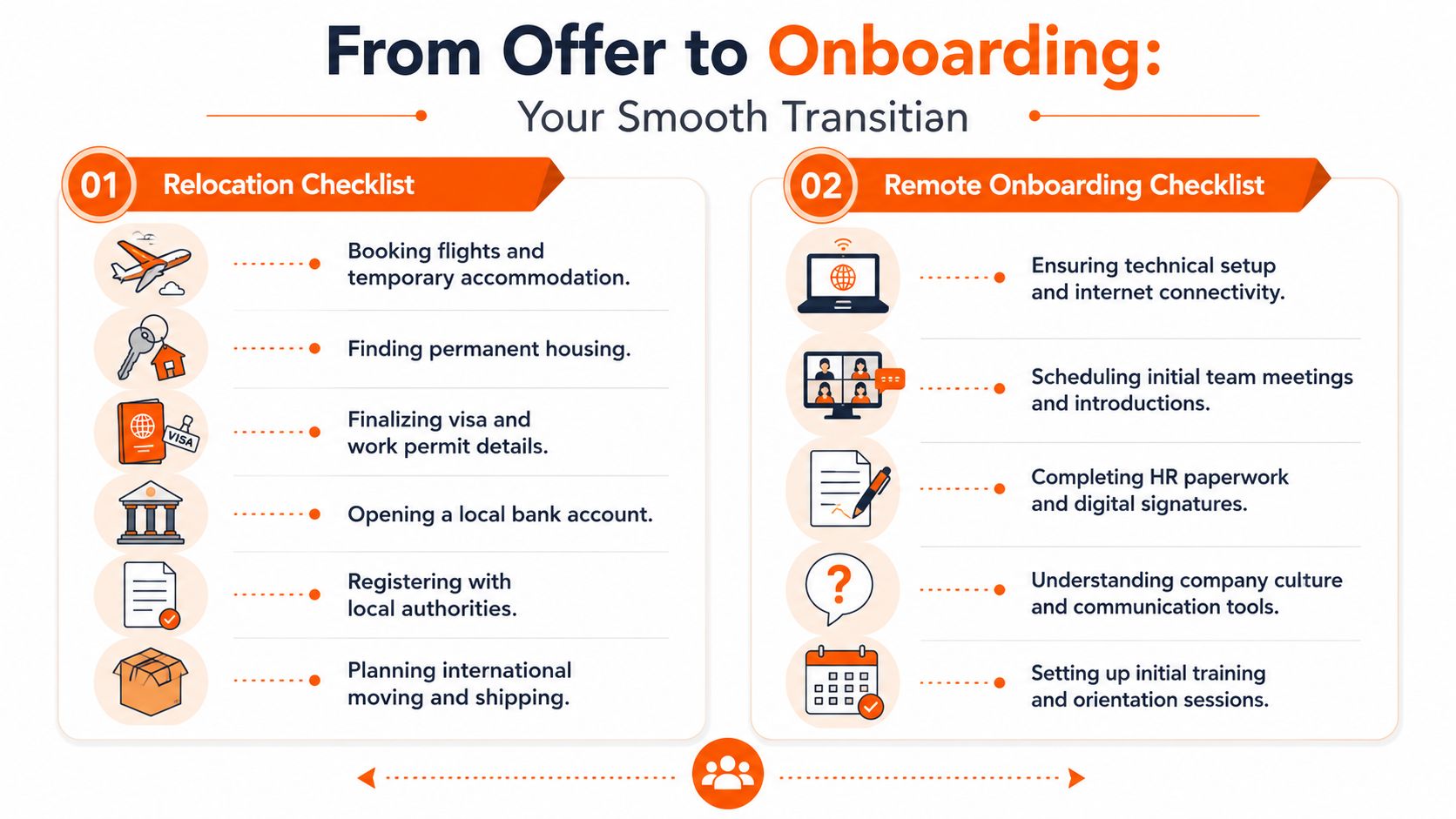
Keep your transition split into two tracks: relocation logistics and professional integration.
If you're relocating
Once the contract is signed, move fast on the basics.
- Secure temporary housing first: Don't overcommit to a long lease before you understand the neighborhood and commute.
- Prepare your documents: Passport, contract, visa paperwork, proof of address, qualifications, and any translated records should be organized before departure.
- Set up banking and registration early: Many countries tie daily admin to local registration and local banking.
- Plan your first month, not your first year: Focus on legality, housing, transport, phone service, and work readiness.
You don't need a perfect apartment and a perfect social life in week one. You need a functional landing.
If you're starting remotely from Europe
Remote onboarding fails when people wait for structure instead of creating it.
Do these early:
- Book introductions proactively: Meet your manager, teammates, and cross-functional partners quickly.
- Clarify communication norms: Learn where decisions happen, which channels matter, and how quickly people expect responses.
- Create visibility: Share progress, blockers, and priorities without being chased.
- Protect your routine: Time zone overlap matters, but so do boundaries.
A remote role can be a powerful entry point into Europe, especially if you want geographic flexibility before committing to one city. But remote work doesn't remove the need for cultural adaptation. It just changes where that adaptation shows up.
Your first month is not about impressing everyone. It's about becoming easy to work with.
The checklist that actually matters
Here's the sequence I recommend:
- Confirm contract terms and start date.
- Lock visa or legal work status.
- Arrange housing and travel.
- Organize local admin and banking.
- Learn team tools, workflows, and decision-makers.
- Build early trust through reliability, not charisma.
That's the actual transition. Not the airport photo, not the offer letter screenshot.
If you handle those steps properly, jobs in Europe for English speakers stop feeling abstract. They become a workable plan.
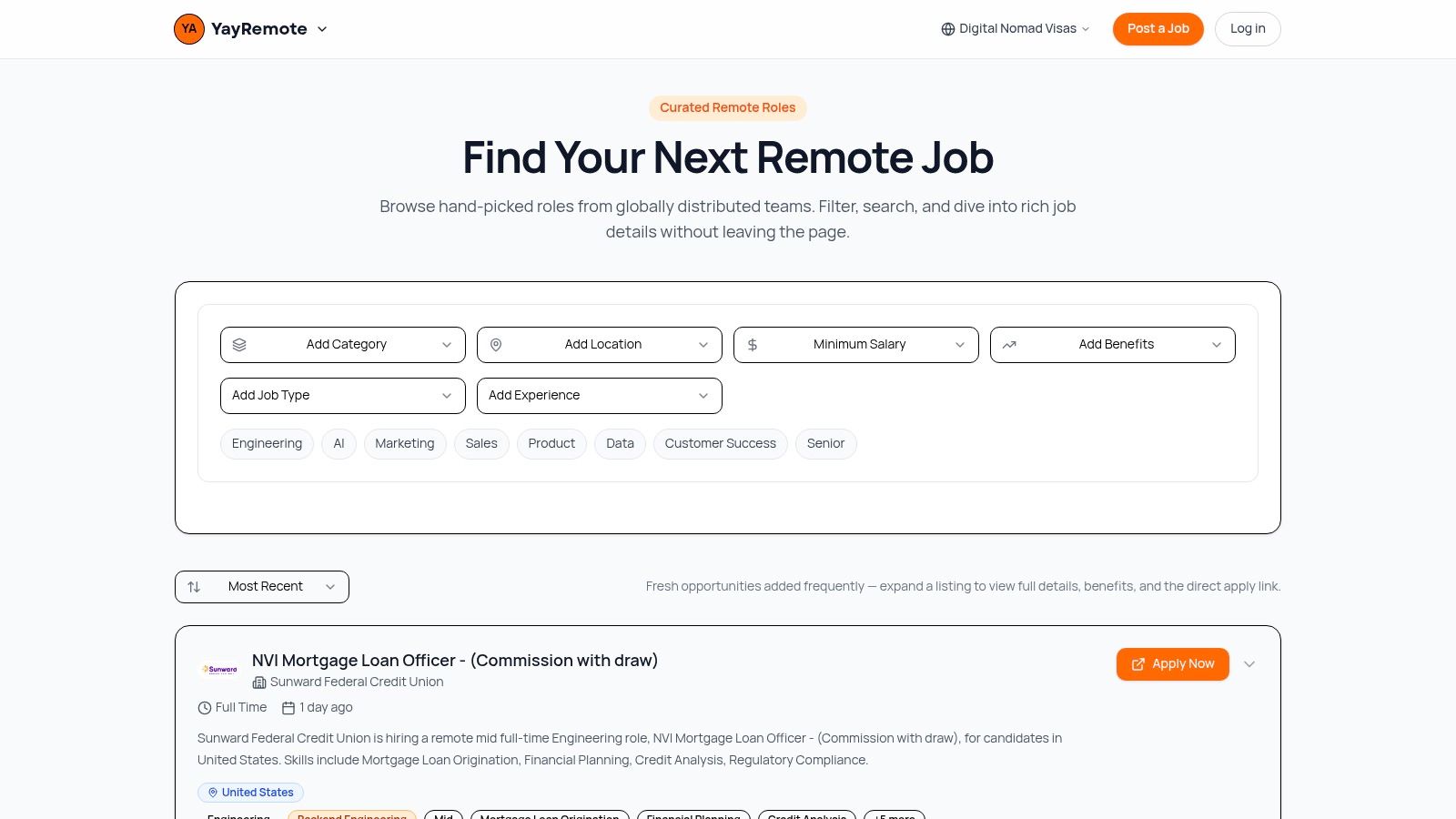
If you want a cleaner way to find remote-friendly international opportunities, browse YayRemote. It's built for people who want location-flexible roles, clearer job discovery, and practical tools that make cross-border applications less chaotic.